ISSN: 1942-9703 / © 2017 IIJ Abstract— The Management of Information Technology (IT) in
PT. XY requires a structured governance planning to execute the IT processes in order to fit the company's business objectives. Effective IT governance is viewed as a great mechanism to use information and processes which in turn leads to greater profits and present future benefits. The purpose of this study is to conduct an audit of IT governance based on the four domains in the COBIT 4.1 framework, such as Plan and Organize (PO), Acquire and Implement (AI), Deliver and Support (DS), and Monitor & Evaluate (MO). COBIT 4.1 is oriented on how to link business goals with IT goals, providing metrics and maturity models to measure achievement, and identifying the associated responsibilities of business and IT process owners. Capability assessment process based on the COBIT maturity models is an important part of the implementation of IT Governance after identifying critical IT and process control. The average value of the maturity level for each domain on the framework are PO domain is 1.08, AI domain is 1.45, DS domain is 1.23, and the ME domain is 1.5, from a scale of 0 to 5. While the maturity level expected by the PT. XY on a scale between 2 to 3 from a scale of 0 to 5. Current maturity level will be used as a reference in formulating recommendations aimed at increasing the value of the expected maturity. This study contributes to the results of the evaluation and recommendations for the improvement that can be applied to PT. XY so that the company can make the IT infrastructure development planning procedures in accordance with COBIT 4.1 domain. In addition, this study also provides a procedure to evaluate the IT governance process in an enterprise based on COBIT 4.1 framework.
Index Terms— IT control, COBIT, IT audit
I. INTRODUCTION
NFORMATIONsystems and technology have an important position in a company to perform a variety of businesses in the development and implementation of information technology [1][2]. IT governance facilitates an efficient organization and opens opportunities for the organization to achieve competitive advantage. Effective IT governance is
Manuscript received October17, 2016. This work was supported in part by the Faculty of Computer Science, Brawijaya University.
Putri, Mayang A., was with Faculty of Computer Science, Brawijaya University, Indonesia.(e-mail: [email protected]).
Lestari,Vivin A., was with Faculty of Computer Science, Brawijaya University, Indonesia.(e-mail: [email protected]).
Aknuranda, Ismiarta., was with Faculty of Computer Science, Brawijaya University, Indonesia.(e-mail: [email protected]).
responsible for distributing the decision making to the individuals that are best qualified to be privy to the needs of the organization. Nowadays, organizations take advantage of technology in the development, management and transaction of intangible assets including knowledge and information. Organizations are showing interest in adopting the best practices for IT governance because these frameworks consider as guidelines and it provides the basic structure that is flexible to apply in a certain environment. This effort was taken to maintain the existence and progress of the company [3][4][5].
One of the companies that have used the information technology to support their business activities is PT. XY. This company is an electric power supply which includes electricity generation, transmission, power distribution, planning and construction of power supply facilities.
However, based on observations that have been made, PT. XY still does not have a clear role in the management of IT and tend to perform activities in a sudden condition and unfocused IT handling. PT. XY has not been done to evaluating all of the information system activities in the enterprise. This will make the IT performance activities in the company not optimal. Therefore, PT. XY requires an evaluation of good governance information technology to improve the IT performance and services that exist within the agencies. IT alignment is not just formulating IT strategy to fit the business strategy. It has to consider the environment uncertainty and the external forces. Application of IT helps the organization to become flexible organization [3]. It can also be used to determine the extent of IT governance that has been done in the agencies that are used to direct and control an organization in achieving business objectives that have been planned [6][7].
In achieving these goals, it requires a control mechanism or an audit of information technology that works to ensure that the application of IT has been carried out efficiently, in order to maintain the integrity and security of data organization [8]. The audit of information technology is a process of collecting and evaluating all of the information system activities in the enterprise [9]. In conducting the governance of information systems, the auditing standards are used and recognized internationally. One of the standards used is COBIT (Control Objectives for Information and related Technology) created by the IT Governance Institute, which is a part of ISACA [10].
Audit of Information Technology Governance
Using COBIT 4.1: Case Study in PT. XY
Mayang Anglingsari Putri, Vivin Ayu Lestari, and Ismiarta Aknuranda
Some previous research, COBIT was explored to determine the level of effectiveness. COBIT was used for assessment of the relevant audit. The result of this study is a conceptual model of COBIT auditor that predicts behavior in fields associated with finding and providing assistance [9]. The implementation of COBIT framework was also used in previous studies. This study discusses the tools used for client-vendor communication that was capable of supporting multiple functions of IT controls. The domains in COBIT framework were used to map the communication and to control the project development [11]. COBIT and ISO 27001 are applied to the evaluation of information technology security at the insurance company. The result of this study is the importance of data security evaluation in the insurance company because of customers' data confidentiality [12].
It is important to implement a policy of standards and guidelines in a company [13]. COBIT framework is used for management control according to best practice guidelines that can be used by companies to manage IT. However, it is still very limited to empirical and theoretical support from academics despite of the extensive use of COBIT framework in the organization, especially for IT, operational and field audit [14]. The author concludes that the COBIT Framework is the most appropriate model used to perform the evaluation of information technology management in organizations that implement information technology in their business processes. The author has not found any research that discusses the evaluation of information technology management in all domains of COBIT 4.1 which is used by the electricity distributor company in Indonesia.
Based on the background, the research was conducted by using COBIT 4.1 framework standards in auditing information technology management in PT XY on domain PO, AI, DS, and ME. This study was conducted to determine the extent of information technology management that has been implemented in the company. The result of this study is an evaluation that can be applied in PT. XY to improve the management of information technology so that it could reach the business goals that have been planned. The result provides recommendations for information technology management that can improve the performance and service. This study also provides a procedure to evaluate the IT management process in an enterprise based on COBIT 4.1 framework.
II.RESEARCH METHOD
A.COBIT 4.1
COBIT (Control Objectives for Information and Related Technology) is an IT governance framework and supporting tool that allows managers to reduce the gap between control requirements, technical issues and business risks, and controls communication with stakeholders [10]. COBIT framework chosen because of its excellence in IT control and also provides IT measurement framework for an analysis of object that needs to be repaired [15].
COBIT defines information technology activities into four domains, they are Plan and Organize (PO), Acquire and Implement (AI), Deliver and Support (DS), and Monitor & Evaluate (MO). Domain PO provides a direction to the implementation (AI) and delivery service (DS). AI provides solutions and can be channeled to services. DS accepts such solution and makes it more useful for end user. While ME monitors all process to assure that the direction given has been followed. The COBIT Framework provides a model process that can be used by companies to view and manage information technology [10].
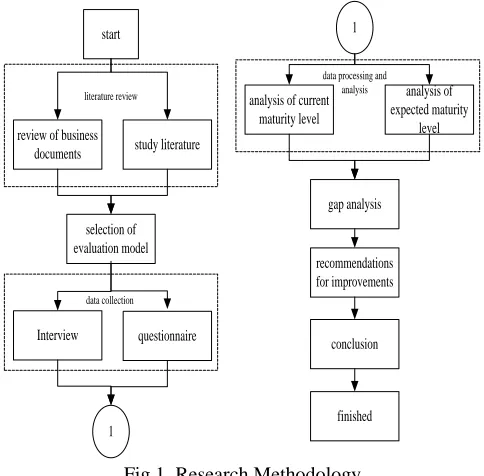
The method used in the study in PT. XY based on COBIT 4.1 framework illustrated in Figure 1.
start
review of business
documents study literature
selection of evaluation model
questionnaire Interview
data collection
1
1
analysis of current maturity level
analysis of expected maturity
level
finished conclusion recommendations for improvements gap analysis
data processing and analysis literature review
Fig.1. Research Methodology
In this study, respondents who participated in completing the questionnaire were five employees of the IT department. Table RACI (Responsible, Accountable, Consulted, Informed) was used to determine the respondents. Thus, in determining the respondents in PT. XY was chosen by qualifying based on the RACI chart. The questionnaire contains 34 questions which were used to question based on the control objective in each domain that contained in the framework COBIT 4.1, namely Plan and Organise (PO), Acquire and Implement (AI), Deliver and Support (DS), and Monitor & Evaluate (ME). The questionnaire in this study aimed to determine the value of the maturity level of information technology governance in the company. The whole domain assessed and taken the average of each domain and grouped based on the level of maturity. A calculation of maturity level that has been done will be mapped according to the maturity status of technological processes information on a scale of 0-5 as shown in Table 1.
TABLEI
SCALE LEVEL MATURITY INDEX Scale Maturity Level 4.51 – 5.00 5 – Optimized
3.51 – 4.50 4 – Managed and Measurable 2.51 – 3.50 3 – Defined Process
ISSN: 1942-9703 / © 2017 IIJ 0.51 – 1.50 1 – Initial / Ad Hoc
0.00 – 0.50 0 – Non-Existent
Then, the recapitulation of calculation of the formula for obtaining Maturity Levels:
Description
= Maturity Level = Total Respondents = Total Weight
= Gap between M as-is and M to-be
III. RESULTS AND ANALYSIS
A.Maturity Level
The calculation of the questionnaire was conducted to determine the maturity level by each process. The total answers obtained in each process will be calculated based on the answers of each parameter.
The results of the current maturity level on the PO domain based on the processes in the COBIT 4.1 framework. Table 2 shows the result of the calculation of the total weight.
TABLEII
MATURITY LEVEL OF DOMAIN PO
P Parameter TR TB M as-is
0 1 2 3 4 5
PO1 1 3 1 0 0 0 5 5 1
PO2 1 2 2 0 0 0 5 6 1.2
PO3 2 1 2 0 0 0 5 5 1
PO4 1 2 2 0 0 0 5 6 1.2
PO5 1 2 2 0 0 0 5 6 1.2
PO6 0 2 2 0 0 0 5 6 1.2
PO7 2 1 2 0 0 0 5 5 1
PO8 2 1 2 0 0 0 5 5 1
PO9 0 4 1 0 0 0 5 6 1.2
PO10 2 2 1 0 0 0 5 4 0.8
P=Process, TR= total Respondents, TB= Total Weight, M as-is = Maturity Level as-is
PO domain had an average value of 1.08 and the lowest score of 0.8. These results indicated that PT. XY still performs activities in the sudden condition without any standard planning procedures. Many processes carried out has been done informally and there has been no documentation of the activity.
Table 5 shows the results of the Maturity Level on AI (Acquire and Implement) domain.
TABLEIII
MATURITY LEVEL OF DOMAIN AI
P Parameter TR TB M
as-is
0 1 2 3 4 5
AI1 0 2 2 1 0 0 5 9 1.8
AI2 2 1 3 0 0 0 5 7 1.4
AI3 0 0 2 3 0 0 5 13 2.6
AI4 1 1 2 1 0 0 5 8 1.6
AI5 1 4 0 0 0 0 5 4 0.8
AI6 1 3 1 0 0 0 5 5 1
AI7 2 1 2 0 0 0 5 5 1
AI domain had an average value of 1.45 and the lowest value of 0.8. The Application of IT architecture in PT. XY has not well organized and there have been no standardized documentation procedures within the agency.
Table 4 shows the results of the Maturity Level on DS domain.
TABLEIV
MATURITY LEVEL OF DOMAIN DS
P Parameter T
R T B
M as-is
0 1 2 3 4 5
DS1 1 3 1 0 0 0 5 5 1
DS2 0 4 1 0 0 0 5 6 1.2
DS3 0 3 3 0 0 0 5 9 1.8
DS4 0 1 4 0 0 0 5 9 1.8
DS5 0 2 3 0 0 0 5 8 1.6
DS6 2 2 1 0 0 0 5 4 0.8
DS7 2 1 2 0 0 0 5 5 1
DS8 1 2 2 0 0 0 5 6 1.2
DS9 1 2 2 0 0 0 5 6 1.2
DS10 0 3 2 0 0 0 5 7 1.4
DS11 2 1 2 0 0 0 5 5 1
DS12 1 3 1 0 0 0 5 5 1
DS13 1 3 1 0 0 0 5 5 1
On the DS domain, the average value was1:23 and the lowest score was 0.8. The provision of services, security management, and management of data in PT. XY has not had the standard documentation. The activity in solving problems that arise has done individually on a sudden condition and without standard procedures.
Table 5 shows the results of the Maturity Level on ME domain.
TABLEV
MATURITY LEVEL OF DOMAIN ME
P Parameter TR TB M
as-is 0 1 2 3 4 5
ME1 2 1 2 0 0 0 5 5 1
ME2 1 1 3 0 0 0 5 7 1.4
ME3 0 2 2 1 0 0 5 9 1.8
ME4 0 2 2 1 0 0 5 9 1.8
In the ME domain, the average value was 1.5 and the lowest value was 1. This indicates that PT. XY, in conducting performance management, monitoring of internal controls, external requirements, and IT governance has not done optimally. The activities were conducted on immediate needs and there have been no standardized documentation procedures.
B.Analysis
Recommendations were given in reference to the study on the same topic and based on the results of the questionnaires and interviews conducted in the IT division in PT. XY
C.Gap Analysis
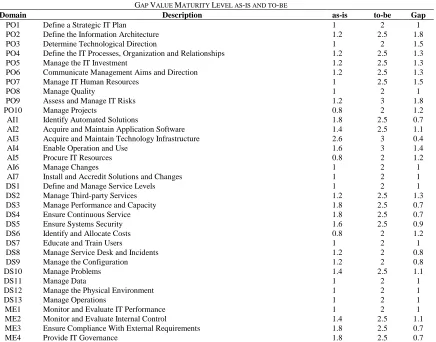
The maturity level of each process on the domain PO, AI, DS and ME will be increased based on the needs of each
company. Table 6 shows the gap between the index of the current maturity level (as-is) and value to be achieved (to-be).
TABLEVI
GAP VALUE MATURITY LEVEL AS-IS AND TO-BE
Domain Description as-is to-be Gap
PO1 Define a Strategic IT Plan 1 2 1
PO2 Define the Information Architecture 1.2 2.5 1.8
PO3 Determine Technological Direction 1 2 1.5
PO4 Define the IT Processes, Organization and Relationships 1.2 2.5 1.3
PO5 Manage the IT Investment 1.2 2.5 1.3
PO6 Communicate Management Aims and Direction 1.2 2.5 1.3
PO7 Manage IT Human Resources 1 2.5 1.5
PO8 Manage Quality 1 2 1
PO9 Assess and Manage IT Risks 1.2 3 1.8
PO10 Manage Projects 0.8 2 1.2
AI1 Identify Automated Solutions 1.8 2.5 0.7
AI2 Acquire and Maintain Application Software 1.4 2.5 1.1
AI3 Acquire and Maintain Technology Infrastructure 2.6 3 0.4
AI4 Enable Operation and Use 1.6 3 1.4
AI5 Procure IT Resources 0.8 2 1.2
AI6 Manage Changes 1 2 1
AI7 Install and Accredit Solutions and Changes 1 2 1
DS1 Define and Manage Service Levels 1 2 1
DS2 Manage Third-party Services 1.2 2.5 1.3
DS3 Manage Performance and Capacity 1.8 2.5 0.7
DS4 Ensure Continuous Service 1.8 2.5 0.7
DS5 Ensure Systems Security 1.6 2.5 0.9
DS6 Identify and Allocate Costs 0.8 2 1.2
DS7 Educate and Train Users 1 2 1
DS8 Manage Service Desk and Incidents 1.2 2 0.8
DS9 Manage the Configuration 1.2 2 0.8
DS10 Manage Problems 1.4 2.5 1.1
DS11 Manage Data 1 2 1
DS12 Manage the Physical Environment 1 2 1
DS13 Manage Operations 1 2 1
ME1 Monitor and Evaluate IT Performance 1 2 1
ME2 Monitor and Evaluate Internal Control 1.4 2.5 1.1
ME3 Ensure Compliance With External Requirements 1.8 2.5 0.7
ME4 Provide IT Governance 1.8 2.5 0.7
Based on data in Table 6, the graph gap of maturity level is illustrated in Figure 2.
Fig. 2. Graph Gap of Maturity level
The results of the audit of information technology governance in PT. XY based on the calculation from COBIT 4.1 framework maturity level shows that overall IT processes
contained in the company is still in the average value of 1.31. The value indicates that PT. XY has not implemented optimal IT governance. The evaluation results based on each domain are as follows:
a.The maturity level in PO domain has an average value of 1:08 with the lowest score of 0.8 and the highest value of 1.2. The PO domain focuses on the strategic planning of IT in managing information technology resources to fit the company's goals. The maturity level value on PO domain shows that the IT division of PT. XY does not have procedures to implement IT strategic planning, agencies still apply information technology in the sudden conditions.
ISSN: 1942-9703 / © 2017 IIJ ready to overcome problems that emerged. There has been
no identification of solutions to early problems in the development of IT projects so that new solutions will be implemented when problems arise and the sudden conditions.
c.The maturity level in DS domain has maturity level value of 1.23, the lowest score of 0.8 and the highest value of 1.8, which indicates that PT. XY in the provision of services, security management, data management, and others does not have a standardized documentation.
d.The maturity level in ME domain has an average value of 1.5, with the lowest score of 1.0 and the highest value of 1.8, which means that the process of ME in PT. XY does not have procedures and documentation with a
standardized format. The process has not been well-organized and performed only on the sudden condition. e.The gap between the current value (as in) and the value that
it calls (to-be) on the domain PO, AI, DS and ME in PT. XY based on the calculations maturity level has a sizable gap.
D.Recommendations for improvements
Based on the audit findings have been made in the research, some recommendations given to increase the maturity level of IT governance in PT. XY. Recommendations which can be given to the improvement of IT governance processes are as follows Table 7.
TABLEVII
RECOMMENDATIONS OF IT GOVERNANCE
Recommendations of IT governance The improvement
PO Recommendations of IT governance of PO domain that has been done by the CEO in PT. XY as the leader in charge of technical planning, policy making in the management of information technology, as well as to the Head of IT Division as a shareholder in the management of IT in institutions.
To increase the value of the index maturity level, the improvement of information technology governance process that can be done are as follows:
a.Make improvements in the IT governance contained in PT. XY.
b.Defining IT investment cost allocation policies clearly and in detail regarding the procurement of network development, bandwidth, servers, maintenance costs, and other IT assets. Allocate the budget in accordance with the needs of the development of IT projects so as to avoid any cost overruns.
c.Make an analysis of possible risks. Then make the solution according to the settlement of problems that arise.
d.Make a schedule for completion of development projects in IT architecture, so that the project goes according to the schedule and budget that has been set. AI IT governance recommendations on
domain AI that have done addressed to the Division of IT in charge of carrying out activities in IT management agency.
a.Documenting all the processes that support the IT performance from identification solutions, IT infrastructure maintenance and a change management into the standardized format documentation.
b.Determine the application that will be used to support the performance of the development of IT architecture in accordance with the business needs and objectives of PT. XY.
c.Creating a maintenance schedule for IT infrastructure’s hardware, software, network, and server-managed in PT. XY periodically to ensure that each component was going well.
d.Make a procedure of manual use of information technology in the management of a website, server and network management, as well as the use of hardware and software used in PT. XY and renew any changes to the existing features.
DS IT governance recommendations on domain DS that have done addressed to the Division of IT in charge of carrying out activities in IT management agency.
a.Draw up a contract with a third party related to the development of the IT architecture to be built explicitly regarding procurement networks, servers, bandwidth, hardware, software, and applications. By scheduling the IT project execution, operational activities, and responsibilities of each party. b.Make IT infrastructure maintenance’s schedule that includes hardware,
software, and server periodically to facilitate the performance monitoring and keeping in accordance with the purpose of planning the development of the IT architecture.
c.Reviewing security environment that will be used to put IT infrastructure on a regular basis and make sure that the surrounding physical environment free from distractions. For example, placing IT infrastructure such as servers and hardware in high place.
ME Recommendations IT governance on ME domain that has been done addressed to the Head of IT Division is in charge of supervising the management of the IT agency.
a.Creating documentation procedures with a standardized format for monitoring IT performed, IT governance, management, and fulfillment of PT. XY used to support the development of the IT architecture.
b.Reviewing and overseeing the development of the IT governance and ensure alignment between IT investment has been in accordance with the needs of IT in PT. XY.
IV. CONCLUSION
The evaluation resulted of an audit of information technology governance in PT. XY using the COBIT 4.1 framework. The average value of the maturity level for each domain on the framework are PO domain is 1.08, AI domain is 1.45, DS domain is 1.23, and the ME domain is 1.5, from a scale of 0 to 5. Based on the maturity level calculation showed that overall IT processes contained in the agency were still in the average value of 1:31. This value indicated that PT. XY has not been implementing optimal IT governance. The recommendations proposed by the authors can be used to increase the level of each domain process COBIT 4.1. In addition, it can be used as recommendations for company improvement. In this study, featuring a procedure for evaluating processes on IT governance in the enterprise based on COBIT 4.1 framework. In future studies, the author will compare IT governance using the COBIT 4.1 and COBIT 5 applied in the company.
REFERENCES
[1] R. A. Islami, I. M. Sukarsa and I. K. A. Purnawan, “Information Technology Governance Archetype in an Indonesian University,”
TELKOMNIKA Indonesia. J. Electr. Eng., vol. 12, no. 7, pp. 5636– 5644, 2014.
[2] D. Yamauchi, Y. Ito and T. Tahara, “A Method of QoE Management in Online Shopping Web Services with TCP Variables,” Internetworking Indonesia Journal, vol. 7(1), pp. 3–7, 2015.
[3] R. Govindaraju and D.R. Chandra, “Analysis of level and barriers of e-commerce adoption by Indonesian small, medium, and micro enterprises (SMMEs),” Internetworking Indonesia Journal, vol. 4(1), pp. 9–14, 2012.
[4] A. A. Sousa-poza, A. Sousa-poza, and C. Searcy, “Implementing a Functional ISO 9001 Quality Management System in Small and Medium-Sized Enterprises System in Small and Medium-Sized Enterprises,” Int. J. Eng., vol. 3, no. July, 2009.
[5] F. C. Tugas, “Assessing The Level Of Information Technology (IT) Processes Performance And Capability Maturity In The Philippine Food, Beverage, And Tobacco (FBT) Industry Using The Cobit Framework,” Acad. Inf. Manag. Sci. J., vol. 13, no. 1, pp. 45–69, 2010. [6] W. R. Flores, T. Sommestad, H. Holm and M. Ekstedt, “Assessing
Future Value of Investments in Security-Related IT Governance Control Objectives – Surveying IT Professionals,” Electron. J. Inf. Syst. Eval., vol. 14, no. 2, pp. 216–227, 2011.
[7] G. Steenkamp and M. Sciences, “Mapping the Information Technology (IT) governance requirements contained in the King III Report to the IT domains and processes of the Control Objectives for Information and Related Technology (COBIT) framework,” Thesis-University of Stellenbosch, no. December, 2009.
[8] M. K. Moorthy, A. S. Z. Mohamed, M. Gopalan, and L. H. San, “The impact of information technology on internal auditing,” African J. Bus.Manag., vol. 5, no. 9, pp. 3523–3539, 2011.
[9] B. Tuttle and S. D. Vandervelde, “An empirical examination of CobiT as an internal control framework for information technology,” Int. J. Account.Inf. Syst., vol. 8, no. 2, pp. 240–263, 2007.
[10] ISACA, COBIT 4.1. IT Governance Institute, 2007.
[11] S. Gantman and J. Fedorowicz, “International Journal of Accounting Information Systems Communication and control in outsourced IS development projects : Mapping to COBIT domains,” Int. J. Account. Inf. Syst., vol. 21, pp. 63–83, 2016.
[12] T. Mataracioglu and S. Ozkan, “Governing Information Security In Conjunction With Cobit And Iso 27001,” Int. J. Netw.Secur.Its Appl., pp. 1–5.
[13] J. A. S. M, H. Guoqing, M. R. Alam, G. Kibria,\ and M. A. Malek, “Improved Information Systems Model for Bangladesh,”
TELKOMNIKA Indones. J. Electr. Eng., vol. 12, no. 7, pp. 4893–4899, 2014.
[14] G. Ridley, J. Young and P. Carroll, “Studies to Evaluate COBIT’s Contribution to Organisations: Opportunities from the Literature, 2003– 06,” Aust. Account. Rev., vol. 18, no. 47, 2008.
[15] E. W. N. Bernroider and M. Ivanov, “IT project management control and the Control Objectives for IT and related Technology (CobiT) framework,” Int. J. Proj. Manag., vol. 29, pp. 325–336, 2011.
Mayang Anglingsari Putri, is a student in the Faculty of Computer Science at the Brawijaya University. She receives a scholarship from Research Intensification for Sustainable Education and Training (RISET) University of Brawijaya. She works in the Information Systems Research Group Filkom UB, under the supervision of Dr.IsmiartaAknuranda, S.T, M.Sc. Mayang research interests are the Artificial Intelligence, Software Engineering, Information Systems (Business Informatics), and Human-Computer Interaction.
VivinAyuLestari, is a student in the Faculty of Computer Science at the Brawijaya University. She receives a scholarship from Research Intensification for Sustainable Education and Training (RISET) University of Brawijaya. She works in the Information Systems Research Group Filkom UB, under the supervision of Dr. Ismiarta Aknuranda, S.T, M.Sc. Vivin research interests are the Software Engineering, Information Systems (Business Informatics), and Human-ComputerInteraction.