
Magharla Dasaratha Dhanaraju
GIET School of Pharmacy, Rajahmundry [A.P.] Email: [email protected]
Address for correspondence
Access this article online www.japer.in
Capillary Electrophoresis-An insight into different modes and it’s
applications
INTRODUCTION
Capillary electrophoresis is the most rapidly extended analytical technique which was employed in the recent years. It has been widely used in the analysis of inorganic ion and in the analysis of drugs, which has been already used for the bio polymer analysis. Tiny fused silica capillaries are available (< 100 µm I.D.) which was protected by a layer of polyimide to make physically resistant. [1-3] Capillary Electrophoresis is a
powerful separation technique that is widely used in Research and Development (R&D), Quality Control (QC) and stability studies of Pharmaceuticals. CE offers several advantages over high performance liquid chromatography which include rapid analysis, automation, ruggedness, different mechanisms for selectivity and low cost. Further, it offers higher efficiency and thus greater resolution over HPLC, even if only a small sample size is available. These advantages are likely to lead to even greater use of CE
in R&D, QC and stability studies of pharmaceuticals. CE has been found particularly useful for separations of peptides, proteins, carbohydrates, inorganic ions, chiral compounds and in numerous other pharmaceutical applications. [4-6]
The use of CE methods for pharmaceutical analysis has become increasingly popular in recent years. The advantages of CE for pharmaceutical analysis include its speed and cost of analysis, reduction in solvent consumption, disposal and the possibility of rapid method development. CE instruments can be coupled to a variety of detector types including mass spectrometers, for special applications and more detailed analysis. [7]
Various Types of Separation Techniques are
1. Capillary Zone Electrophoresis
CZE is the simplest technique of the free solution capillary electrophoresis. The components are separated based on the differential migration generated by the differences in effective mobilities. The capillary is filled with a buffer electrolyte which ensures the controlling of the pH, current flow, viscosity and ionic strength. On injection of the Review
ReviewReview
Review ArticleArticleArticle Article
Electrophoresis is one among the separation science most useful as scientific tool which is used extensively in diagnostic and clinical science. CE is widely used in today’s demanding pharmaceutical industry for its fast and robust separation methods, needed in order to reduce the time to market for new drugs. Compared to chromatography, electrophoresis uses an entirely different mechanism of separations. This technique is extensively used nowadays due to small size requirements, low cost, ideal for samples that are costly and time consuming challenges in chromatography. Even though CE is mainly applicable to R&D laboratories, it is migrating towards product testing laboratories, quality control and quality assurance departments, which indicates the technique does show unique benefits and can expect sustained growth in the near future. For long term sustainability of this technique, further development of capillaries suitable for protein analysis and development of other detection modules such as CE-MS is necessary. The present article is an overview of CE and its applications in various fields. Further developments in CE make this technique demanding in future for pharmaceutical industry.
Keyword: Capillary electrophoresis, Capillary electro chromatography, Micellar electro kinetic chromatography, Micro emulsion electro kinetic chromatography. ABSTRACT
ABSTRACT ABSTRACT ABSTRACT Magharla Dasaratha
Dhanaraju*, A Ramamoorthy Magesh
GIET School of Pharmacy, NH-16 Chaitanya Knowledge City, Rajahmundry-533 296, A.P
sample, they are separated electrophoretically into various individual pure zones on application of an electrical field. In CZE, the ionized compounds only can have a differential migration, whereas the neutral compounds cannot be separated. The neutral are carried to the detection site by the EOF and the neutral components move with the mobility and velocity as that of the EOF. The selectivity is increased by the use of several modifiers like complexing agents and organic solvents. [8, 9, 10]
The most commonly employed additives in CE are organic solvents (acetonitrile, methanol), to increase the solubility of the sample components in the running buffer, anionic (e.g. Sodium dodecyl sulfate, SDS), Cationic (e.g.Cetyl tri-methyl ammonium bromide) or neutral (e.g. Brij) surfactants (below their critical micelle concentration CMC), to increase solubility or to act as ion pairing agents, organic amines (triethylamine, triethanolamine) and linear polymers (PEG, Polyacrylamide, methylcellulose) to increase viscosity, to mask wall charges and to introduce a sieving selectivity into the system. [11]
2. Capillary Gel Electrophoresis
The Capillary is filled with an agarose gel or polyacrylamide in Capillary Gel Electrophoresis which forms a network of polymer acting as a molecular sieving mechanism especially for the separation of species by molecular size, where the analytes move through the pores of the gel. [12] CGE is mostly
employed for the separation of proteins, large bio-molecules, DNA Fragments and polynucleotide’s. CGE has reasonable advantages than the conventional slab-gel electrophoresis due to its automation, small sample requirement, high thorough-put, trace quantitation, efficient molecular mass determination, high sensitivity and is used in the analysis of wide variety of large bio-molecules. [13-16]
3. Capillary Isotachophoresis
The Capillary Isotachophoresis resembles the classical isotachophoresis which is an important separation
mode in CE. In CITP the analytes migrate at the same velocity, hence the name ‘iso’ for same and ‘tach’ for speed. In this mode of separation, the sample is injected between two buffers a leading electrolyte which has the ions of higher mobility than any of the analyte ions and a terminating electrolyte with ions of a lower mobility than the sample ions. The ionic analyte tend to migrate at the same velocity, in discrete zones, after the leading electrolyte and before the terminating electrolyte, according to the individual mobilities. [17] The difference in migration
rate results in the separation of the analyte ions into adjacent bands, where the fast species are located in a band directly adjacent to the leading buffer and the slowest species just ahead of the terminal buffer. After the bands have been formed, the ions then move at the same velocity. [18]
4. Capillary Isoelectric Focusing
compounds are added to the sample such that it helps to identify the electropherogram. CIEF is used to separate biological molecules mainly proteins or peptides based on difference between their isoelectric points. The pH at which known net migration occurs is called isoelectric point (PI) and it is an important physical constant for characterizing the amino acids.
[18]
5. Capillary Electro Chromatography
CEC combines the principles of CE and Chromatography with the major difference that the micelles are replaced by very small, i.e., less than 3µm, solid or semi-solid particles in a packed or open column. The particles form a typical stationary phase and the mobile phase is obtained through the electrically driven flow resulting from the EOF. In CEC, separation of solutes is achieved by differential migration resulting from chromatographic partitioning, electro migration or a combination of both. The separations are performed using packed columns or in open tubular mode. [19] In open tubular
mode, the stationary phase is coated on the inner surface of the capillary column. CEC is almost similar to HPLC, but results in a higher separation efficiency due to the flat profile of the EOF (mobile phase) and probably the stacking effect due to electro dispersion. Additionally, in CEC small particle sized phases can be applied since the EOF does not generate back pressure. The particles can be sol-gel, [19] molecularly
imprinted polymers, [20] continuous monolithic beds [21] and polymer/ layered silicate nanocomposites [22]
with reverse phase (e.g. ODS C18), normal phase,
ion-exchange (SCX) or size exclusion properties. [23]
6. Micellar Electro kinetic Chromatography
In this mode, the separation is based on chromatography like separation mechanism, where a micellar pseudo-stationary phase is introduced in the buffer, where it retains the solutes according to the partitioning between the stationary phase itself and the mobile phase (i.e. the running buffer).In this
technique, a surfactant is employed which includes sodium dodecyl sulphate (SDS) at a concentration level where the micelles are formed. The micelles are formed in the aqueous solutions when the concentration of an ionic species having a long chain hydrocarbon tail which is increased above a certain level called as Critical micelle concentration (CMC). At this junction, the ions starts to form spherical aggregates which are made up to 40 to 100 ions, where the hydrocarbon tails are in the interior of the aggregate and its charged ends are exposed to water on the outside. Micelles constitute a stable second phase which is capable of absorbing non-polar compounds into the hydrocarbon interior of the particles, hence solubilizing the non-polar species. When the capillary electrophoresis is carried out in the presence of micelles, it is termed as micellar electro kinetic capillary chromatography and is termed as MEKC or MECC. [18] In this separation
technique, addition of surfactant is made to the operating buffer in amounts that exceed the critical micelle concentration (Fig.1).
Fig.1: Schematic Representation of Micellar Electro kinetic Chromatography using anionic micelles, teo =
migration time of a neutral ‘‘unretained’’ analyte, ta =
retention time in MEKC, tmc = migration time of a
micelle.
quaternary ammonium salts, to reduce the hydrophobic interactions between analyte and micelles and to increase the migration velocity similar to reverse phase chromatography. [24, 25]
In brief, migration of polar molecules takes place faster than the less polar and hydrophobic compounds and the neutral substances elute within a time window, determined by the mobility of the electro osmotic flow and that of the micelles. Several other common surfactants that are employed in MECC in addition to SDS are bile salts and hydrophobic-chain quaternary ammonium salts, to reduce the hydrophobic interactions between analyte and micelles and to increase the migration velocity similar to reverse phase chromatography. [24, 25]
Table 1: Selected applications of Micellar Electro kinetic Chromatography [26, 27, 28, 29, 30]
Analyte Buffer
Urinary porphyrins 85 mM SDS, 17 mM CAPS, 15% Me OH, pH 11
Cold Prep (14
drugs) 50 mM Sodium deoxycholate ,pH 9 Water-soluble
vitamins 50 mM SDS, 20 mM P04, pH 9 β-lactam antibiotics 150 mM SDS, 20 mM P04 borate, pH 9
Penicillins 20 mM P04,100 mM SDS, pH 8.5
7. Micro emulsion Electro kinetic Chromatography
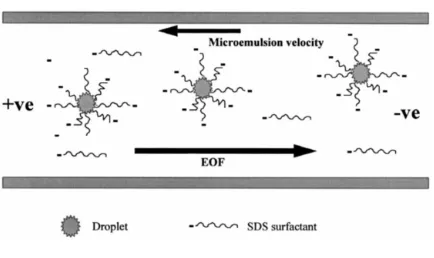
MEEKC is a mode of CE, where the separation is achieved by employing micro emulsion as a carrier electrolyte. In contrary to the other CE techniques, MEEKC is a specific method which can be used for the separation of neutral analytes based on their chromatographic retention factors. Micro emulsions are obtained by dispersion of two immiscible liquid which may be either of oil droplets suspended in water or of water droplets suspended in an oil phase. The separation system in the micro emulsion mode utilizes a high pH buffer, octane, butanol and SDS, where the solute is partitioned between the aqueous phase and the oil droplets, where it tends to move through the solution. [31] The oil in water micro
emulsions are selected for the MEEKC separation and it consists of octane droplets which are dispersed in
an aqueous buffer. Surfactant is added and it coats the octane droplets and the surface tension between the two liquids is lowered and forms a stable micro emulsion. The addition of a short chain alcohol like n-butanol further lowers the surface tension and also stabilizes the emulsion and acts as a co-surfactant. The diameter of the droplets in the micro emulsion is below 10 nm, where the micro emulsion formed is transparent optically and resembles like a single-phase solvent, although it is a two single-phase system. SDS is the most commonly employed surfactant and is used for the micro emulsion stabilization and due to the addition of an anionic surfactant, the oil droplets acquires a negative charge and exhibits a electrophoretic mobility and migrated towards the anode. The aqueous phase normally consists of buffers like phosphate or borate buffer which has alkaline pH
[32] (Fig.2).
Fig.2: Schematic Illustration of the separation process in Micro emulsion electro kinetic chromatography for
a neutral analyte in an alkaline micro emulsion stabilized by negatively charged Sodium dodecyl
sulfate
Table 2: Pharmaceutical applications of Micro emulsion Electro kinetic Chromatography [33, 34, 35, 36]
Application Micro emulsion Composition
Analysis of Betamethasone and
derivatives.
1.44 % w/w SDS,0.81 % w/w octane ,6.6 w/w butan-1-ol, 91.4 % 20 mM sodium phosphate, pH
7.5
Analysis of 4-hydroxy benzoate preservatives in
pharmaceuticals.
3.31 % w/w SDS,0.81 % w/w octane ,6.61 w/w but-an-1-ol 89.27 % w/w 50 mM phosphate
buffer, pH 2.1
Analysis of formulated drug products
3.31 % w/w SDS,0.81 % w/w octane ,6.61 w/w butan-1-ol , 89.27 % w/w 10 mM borate
buffer, pH 9.2
Analysis of ephedrine and pseudo-ephedrine.
8. Non-aqueous Capillary Electrophoresis
Water insoluble basic drugs are troublesome to separate by Capillary Electrophoresis. Non aqueous capillary electrophoresis can be employed for the analysis of such type of samples. The electrolyte is made by the use of organic solvents which is a recent method in CE separation process. [37, 38, 39] A NACE
electrolyte consists of organic solvents such as methanol and acetonitrile instead of water. Generally the electrolytes are prepared in 100 % organic solvents like methanol and acetonitrile, where the implication of non-aqueous solvents has an effect on the solvation of the ions and changes the pKa value of the solute. The selectivity can be altered by differing or changing the organic solvent employed or by using the solvent mixtures. The selectivity is altered by using additives like ion-pair agents, surfactants and cyclodextrins into the non-aqueous electrolyte. [41]
NACE is the most commonly employed method for the analysis of basic drugs, which includes the analysis of opium alkaloids [40], tricyclic antidepressants, [42] a
range of β-blockers [43] and different basic drugs. [44]
NACE can also be used for the separation of polar acidic and basic drugs, calculating pka values of basic analytes in methanol [44] and chiral separation of
pharmaceutical amines. [45]
9. Micro-chip Technology
The CE separations are made in a high speed manner by using micro fabricated devices or chips. There are number of devices which are recently employed for the miniaturized separations. The microchip CE offers great possibilities in the area of fast and inexpensive test equipment for clinical analysis, protein and DNA analysis. Mostly, the CE systems are performed or constructed on glass or plastic chips, which consists of appropriate set of rims where the capillary is replaced and is used to deliver the sample and wash solutions into the system. [46, 47] The lithographic technique has
enabled the formation of network of channels on the micron scale which acts as a separation path for CE and also for the sample manipulation. The main
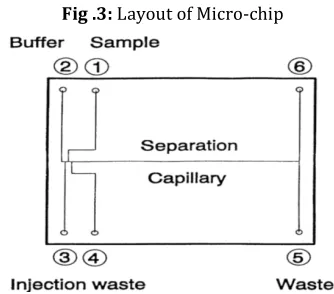
advantage of chip technique is its capability to use electro kinetics for manipulation and to inject samples on the picolitre scale. [48] The sample is placed in the
reservoir 1 and when the voltage is applied between the positions 1 and 3 for a short period of time, the sample tries to fill a small segment of the separation capillary. A very precise sample loading is obtained when the voltage is switched off and applied again between positions 2 and 6 [49, 50] (Fig.3).
Fig .3: Layout of Micro-chip
APPLICATIONS OF CAPILLARY ELECTROPHORESIS
1. Chiral Separation
CE plays an evident role in the separation of chiral compounds [51, 52, 53] and has started penetrating in the
fields of environmental toxicant analysis and forensic drug analysis. [54, 55] CE has attained more attention in
the chiral analysis and has proved to be the most successfully applied method for the separation of enantiomers. The most commonly employed chirally active selectors in CE includes Cu (II)-aspartame, natural and derivatised cyclodextrins, Cu (II)-L-histidine, bile salts, crown ethers, proteins (bovine serum albumin), α1 –acid glycoprotein, ligand
Table 3: Selected Applications of Chiral Separation [57, 58, 59, 60, 61]
Application Buffer
Enantiomeric separation of N-nitroso-nor nicotine found in tobacco smoke.
Citric acid buffer, pH 2.8, 30 mM HP-β-CD
Chiral antimalarial drug erythro-MQ and its
analogues.
100 mM triethanolamine phosphate buffer, pH 3.0, 0.2- 150 mg/ml HP-α-CD,
acetyl-β-CD, HP-β-CD
Analgesic drug. 25 mM borate buffer, pH 9.0, 40 mM, SBE-β-CD Non-steroidal
Anti-inflammatory drug, S-Naproxen.
5 mM SB-β-CD, 20 mM TM-β-CD
Dopa enantiomers used to treat parkinson’s
disease.
10 mM Tris buffer, pH 2.5, 12 mM 18 C6H4
S-β-CD, Sulfate-β-cyclodextrin; HE-β-CD, Hydroxyethyl-β-cyclodextrin; HP-β-CD, Hydroxy propyl-β-cyclodextrin; SB-β-CD, Sulfobutyl-β-cyclodextrin; SU-β-CD, Sulfated-β-cyclodextrin ; TMCD, Trimethyl-β-CD; 18 C6H4 (18-Crown-6)-
2,3,11,12-tetracarboxylic acid; L-ZGP,N-benzocarbonyl Glycyl-L-Proline.
Crown ethers are mostly used for the separation of chiral compounds which have a primary amino group. It is found to be specific for the analysis or separation of amino acids and basic drugs, where it is separated at low pH. A stabilized hydrogen-bond complex is formed by the crown ethers by protonating the primary amines. [62, 63] Most commonly employed
crown ether is 18-Crown-6-tetra carboxylic acid and the combination of the crown ethers and cyclodextrins found to show enhanced chiral resolutions. [64]
2. DNA and Nucleic acid Analysis
CE has proved that it is a simple method to perform a simple and complex genetic test. Number of inherited genetic diseases like mitochondrial heteroplasmy, spinocerebellar ataxia, cystic fibrosis, fragile X and genetic variants of cytochrome P450 which is involved with the drug metabolism also can be detected by employing CE. The determination of the sequence of bases in DNA has become a big challenge and the slab gel electrophoresis has dominated the DNA
sequencing, but recently the dominant technique employed is the CE. [65-70] The sophisticated CE
attached with auto samplers can be used which can quantitatively inject and analyze more number of samples in an unattended sequence. Similar electrophoretic mobilities are shown by the DNA of different lengths as each increase in size is accompanied by increase in the number of negative charges. Hence, the separation cannot be done by mobility difference and the major separations are done by using a sieving mechanism, where the capillary is filled with a matrix of natural or synthetic polymer. [71, 72] The different DNA fragments move or
migrate through the matrix and it becomes entangled or trapped in the matrix. The large DNA fragments migration is retarded and the separation is based on the size where, it is analogous to the gel permeation chromatography. A range of different polymers are employed which acts as a sieving media includes agarose, solutions of cellulose like hydroxyl ethyl cellulose and polyacrylamide. In the earlier stages, the CE had made the use of gels, where the capillary was filled with cross linked polyacrylamide gels, where it had faced problems like shrinkage, drying out and its inability to remove any contaminant. Therefore the use of polymer solutions or liquid gels have been used which offered improved performance and reliability.
[73-75] CE is used to resolve and quantify the DNA
species and the capillary arrays are used in the DNA sequencing of samples, where tens or hundreds of capillaries can be simultaneously analyzed to produce high throughout DNA sequences. [76, 77]
3. Ionic Analysis
Table 4: Application of CE for the separation of small molecules and ions [79, 80, 81, 82, 83, 84, 85]
Application Electrolyte
Anions Indirect Detection TFA
counter-ion of an Opioid peptide analgesic Phthalate, CTAB Drug inorganic counter ion
determination Chromate, TTAB Drug organic acid counter ion
determination
Phthalate, MES,TTAB Anions- Direct detection Determination
of residual Br in excess of chloride for local anaesthetic analysis
60:40 Me CN: Methane sulfonic acid buffer, pH1.3 Drug organic acid counter-ion
determination e.g. Benzoate, Hydroxynapthoate
Borate, pH 9.5
Cations-Indirect Detection Ca in calcium acamprosate drug substance
Imidazole, sulfuric acid Cations- Direct Detection K counter ion
and inorganic cationic impurities of acidic drugs by conductivity
determination
Creatine, acetic acid, 18- crown-6
In CE, the metal ions are generally determined by indirect UV detection method where a small positively charged UV active species like imidazole is added to the indirect detection buffer. The selectivity can be changed by the inclusion of complexing agents like small organic acids or crown ethers. A low pH buffer and uncoated capillaries are generally employed. [86]
The inorganic anions and simple organic acids which are small, have high negative mobility’s, where it opposes the EOF direction of an uncoated capillary, long migration times and a highly diffused peaks results due to this counter-migration. [87]
Hence the capillaries are coated to reverse the EOF direction. When a negative voltage is applied to the coated capillary, the solute migrates towards the detector which results in a fast and efficient separation. Generally, a cationic surfactant such as tetra decyl tri-methyl ammonium bromide (TTAB) or cetyl tri-methyl ammonium bromide (CTAB) is added to the electrolyte. The positively charged TTAB absorbs onto the capillary wall which results in the reversing of the EOF direction due to the capillary becoming positively charged. By the inclusion of UV active anions like chromate, phthalate or pyridine dicarboxylic acid the indirect UV detection is achieved.
[88]
4. Pharmaceutical Substances
The pharmaceutical substances are mostly analyzed by HPLC, where it is applied for the determination of drug-related impurities, chiral separations, trace level determinations, quantification of the metal ions and the inorganic anions. The above specified applications are also possible by CE. Hence, CE is considered as a complementary technique to HPLC for the analysis of pharmaceutical substances. The CE methods have also been validated and it is also included in pharmacopoeias. [89, 90] Most of the pharmaceutical
substances are bases and they are protonated at low pH. Hence, a low pH buffer like phosphate buffer of pH 2.5 can be used for the analysis of a wide range of basic drugs. For example phosphate buffer of low pH is used in the forensic analysis to analyze nearly 550 basic drugs. [91] Acidic drugs can be analyzed by
employing buffers like borate or phosphate buffers at a pH between 7-10.A mixture of charged and neutral compounds can be analyzed by the use of MEKC or MEEKC methods, where CE has been applied for the analysis of major drug classes. [92] The CE method has
also been validated similarly as HPLC which includes the assessment of validation parameters like accuracy, precision, specificity, linearity and sensitivity. [93]
CONCLUSION
CE has proved to be a sensitive, independent, reliable and versatile analytical technique, where the sample and reagent consumption and the running cost is lower than the chromatography. It is a new analytical tool which can be used for the investigation of both seized preparations of illicit drugs and biological samples too. CE has been routinely applied in the numerous fields, which includes the analysis of pharmaceuticals, DNA, chiral compounds, proteins, peptides, clinical and forensic samples, metal ions and inorganic anions.
the sample throughput is increased in the areas like serum protein analysis and DNA profiling. The recent advancements in CE include the non-aqueous CE, CE specific buffer additives such as sulphated cyclodextrins and novel capillary coatings.
CONFLICT OF INTEREST
None
ACKNOWLEDGEMENTS
The author would like to convey their thanks to the management of GIET School of Pharmacy for extending their support in preparing this manuscript successfully.
REFERENCES
1. Jorgenson J.W., Lukacs K.D. Zone electrophoresis in
open-tubular glass capillaries. Anal. Chem.1981;
53: 1298-1301.
2. Jorgenson J.W., Lukacs K.D. High resolution
separations based on electrophoresis and electro
osmosis. J.Chromatogr.1981; 218: 209-216.
3. Jorgenson J.W., Lukacs K.D. Capillary zone
electrophoreses. Science.1983; 222: 266-272.
4. Ahuja, S. Handbook of Bioseparations, Academic
Press, San Diego, 2000.
5. Wehr T., Rodriguez R.D., Zhu M. Capillary
electrophoresis of proteins, Marcel Dekker, In.: New
York, 1998.
6. Khaledi M.G. High performance Capillary
electrophoresis. Wiley, New York, 1998.
7. Altria, K.D. Quantitative analysis of pharmaceuticals
by capillary electrophoresis, Vieweg, Wiesbaden,
1998.
8. Hjerten S. Free zone electrophoresis. Chromatogr.
Rev. 1967; 9:122-219.
9. Wallingford R.A., Ewing A.G. Advances in
chromatography: Biotechnological Applications and
methods. Marcel Dekker, Inc.: New York, 1989.
10. Mikkers F.E.P., Everaerts F.M., Verheggen Th.P.E.
High performance zone electrophoresis. J.
Chromatogr. 1979; 169: 11-20.
11. Tagliaro F., Manetto G., Crivellente F., Smith F.P. A
brief introduction to capillary electroph-oresis.
Forensic. Sci. Int. 1998; 92: 75-88.
12. Chu B., Liang D. Copolymer solutions as separation
media for DNA capillary electrophoresis.
J.Chromatogr.A.2002; 966: 1-13.
13. Heftmann, E. Chromatography: Fundamentals and
applications of chromatography and related
differential migration methods. Elsevier science,
Amsterdam, 1992.
14. 14. Bay S., Starke H., Zhang J.Z., Elliot J.F.,Coulson
L.D., Dovichi N.J. Capillary gel electrophoresis for
DNA sequencing of a template from the malaria
genome. J. Capillary Electrophoresis.1994;
1: 121-126.
15. Kenndler E., Poppe H. Entangled, non-cross-linked
polymer solutions used as physical network in
capillary zone electrophoresis.
J.Capillary.Electrophor.1994; 1: 144-155.
16. 16. Gurley L.R., Buchanan J.S., London J.E., Stavert
D.M., Lehnert B.E. High performance capillary
electrophoresis of proteins from the fluid lining of
the lungs of rats exposed to perfluoroisobutylene. J.
Chromatogr. A.2001; 559: 411-429.
17. Everaerts F.M., Beckers J.L., Verheggen T.P.
Isotachophoresis: Theory, Instrumentation and
Applications, Journal of Chromatography, Elsevier,
Amsterdam, 1976.
18. Skoog D.A., Holler F.J., Niemann T.A. Principles of
Instrumental analysis ,5th ed. Thomson Asia Private
Ltd, Singapore, 2005.
19. Li W., Fries D.P., Malik A. Sol-Gel stationary phases
for capillary electro chromatography.
J. Chromatogr. A. 2004; 1044: 23-52.
20. Nilsson J., Spegel P., Nilsson S. Molecularly imprinted
polymer formats for capillary electro
chromatography. J. Chromatogr. B. 2004; 804: 3-12.
21. Maruska A., Korynsova O. Continuous beds
(monoliths): Stationary phases for liquid
chromatography formed using the hydrophobic
interaction-based phase separation mechanism.
J. Biochem. Biophy. Methods. 2004; 59: 1-48.
22. Jimidar M.I., Vennekens T., VanAel W., Redlich D.,
Smet M.De. Optimisation and validation of an
enantioselective method for a chiral drug with eight
stereo-isomers in capillary electrophoresis.
Electrophoresis. 2004; 25: 2876-2884.
23. Jimidar M., VanAel W., Smet M.De., Cockaerts P.
enantioselective CE method. LC-GC Europe. 2002;
15: 230-242.
24. Terabe S., Otsuka K, Ichikawa K, Tsuchiya A, Ando T,
Electro kinetic separations with micellar solutions
and open-tubular capillaries, Anal. Chem, 56, 1984,
111-113.
25. Terabe S., Chen N., Otsuka K. Micellar electro kinetic
chromatography. Adv. Electrophor.
1994; 7: 87-153.
26. Weinberger R., Snapp E., Moring S. Capillary
electrophoresis of urinary porphyrins with
absorbance and fluorescence detection.
J.Chromatogr.1990; 516: 271-.276.
27. Nishi H., Fukuyama T., Matsuo M., Terabe S.
Separation and determination of the ingredients of a
cold medicine by micellar electro kinetic
chromatography with bile salts. J. Chromatogr. 1990;
498: 313-323.
28. Fujiwara S., Wase S., Honda S. Analysis of water
soluble vitamins by micellar electro kinetic capillary
chromatography. J. Chromatogr. 1988; 447: 133-140.
29. Nishi H., Tsumagiri N., Kakimoto T., Terabe S.
Separation of β-lactam antibiotics by micellar electro
kinetic chromatography. J.Chromatogr.A.1989; 477:
259-270.
30. Nishi H., Fukuyama T., Matsuo M. Separation and
determination of aspoxicillin in human plasma by
micellar electro kinetic chromatography with direct
sample injection. J.Chromatogr.1990; 515: 245-255.
31. Phillipe Schmitt-Kopplin. Capillary Electrophoresis,
Methods and Protocols. Humana Press, Neuherberg
Germany, 2008.
32. Altria K.D. Highly efficient and selective separations
of a wide range of analytes obtained by optimized
micro emulsion electro kinetic chromatography
method. Chromatographia.1999; 49: 457- 464.
33. Lucangioli S.E., Carducci C.N., Scioscia S.L., Carlucci
A., Bregni C., Kenndler E. Comparison of the
retention characteristics of different
pseudostationary phases for micro emulsion and
micellar electro kinetic chromatography of
betamethasone and derivatives. Electrophoresis.
2003; 24: 984-991.
34. Mahuzier P.E., Altria K.D., Clark B.J. Selective and
quantitative analysis of 4-hydroxy benzoate
preservatives by micro emulsion electro kinetic
chromatography. J. Chromatogr. A. 2001; 924:
465-470.
35. Mahuzier P.E., Clark B.J., Crumpton A.J., Altria K.D.
Quantitative micro emulsion electro kinetic capillary
chromatography analysis of formulated drug
products. J. Sep. Sci. 2001; 24:784-788.
36. Zhang J., Xie J., Liu J., Tian J., Chen X., Hu Z. Micro
emulsion electro kinetic Chromatography with laser
induced fluorescence detection for sensitive
determination of ephedrine and pseudoephedrine.
Eletcrophoresis.2004; 25: 74-79.
37. Esaka Y., Okumura N., Uno B., Goto M. Non-aqueous
capillary electrophoresis of p-quinone anion radicals.
Anal. Sci. 2001; 17: 99-102.
38. Leung G.N.W., Tang H.P.O., Tso T.S.C., Wan T.S.M.
Separation of basic drugs with Non-aqueous
capillary electrophoresis. J.Chromatogr.A.1996; 738:
141-154.
39. Hansen S., Tjornelund J., Bjornsdottir I. Selectivity
enhancement in capillary electrophoresis using
non-aqueous media. Trends. Anal. Chem. 1996; 15:
175-180.
40. Bjornsdottir I., Hansen S.H. Determination of opium
alkaloids in crude opium using non-aqueous
capillary electrophoresis. J. Pharm. Biomed. Anal.
1995; 13: 1473-1481.
41. Bjornsdottir I., Tjornelund J., Hansen S.H.
Non-aqueous capillary electrophoresis-its applicability in
the analysis of food, pharmaceuticals and biological
fluids. Electrophoresis. 1998; 19: 2179-2186.
42. Cantu M.D., Hillebrand S., Costa Queiroz M.E., Lancas
F.M., Carrilho E. Validation of non-aqueous capillary
electrophoresis for simultaneous determination of
four tricyclic antidepressants in pharmaceutical
formulations and plasma samples. J. Chromatogr. B.
2004; 799: 127-132.
43. Servais A.C., Fillet M., Chiap P., Abushoffa A.M.,
Hubert P., Crommen J. Optimisation of the separation
of beta-blockers by ion-pair capillary electrophoresis
in non-aqueous media using univariate and
multivariate approaches. J. Sep. Sci. 2002; 25:
1087-1095.
44. Porras S.P., Riekkola M.L. Capillary zone
electrophoresis of basic analytes in methanol as
non-aqueous solvent, Mobility and ionization constant.
45. 45. Hedeland Y., Hedeland M., Bendesson U.,
Pettersson C. Chiral separation of amines with N-
benzoxy carbonyl glycyl-L-Proline as selector in
non-aqueous capillary electrophoresis using methanol
and 1, 2-dichloroethane in the background
electrolyte. J. Chromatogr. A. 2003; 984: 261-271.
46. Waters L.C., Jacobson S.C., Kroutchinina N.,
Khandurina J., Foote R.S., Ramsey J.M. Multiple
sample PCR amplification and electrophoretic
analysis on a microchip. Anal. Chem.1998; 70:
5172-5176.
47. Regnier F.E., Lin B.He.S., Busse J. Chromatography
and electrophoresis on chips: critical elements of
future integrated, micro fluidic analytical systems for
life science. Trends. Biotechnol. 1999; 17: 101-106.
48. Harrison D.J., Fluir K., Seiler K., Fan Z., Effenhauser
C.S., Manz A. Micromachining a miniature capillary
electrophoresis-based chemical analysis system on a
chip. Science.1993; 261: 895-897.
49. Deyl Z., Miksik I., Tagliaro F. Advances in capillary
electrophoresis. Forensic.Sci.Int.1998; 92: 89-124.
50. Kennedy R.T. Bio-analytical applications of fast
capillary electrophoresis. Analytica. Chimica. Acta.
1999; 400: 163-180.
51. Terabe S., Otsuka K., Nishi H. Separation of
enantiomers by capillary electro kinetic Techniques.
J. Chromatogr. A.1994; 666: 295-319.
52. Novotny M., Soini H., Stefansson M. Chiral separation
through capillary electro migration methods.
Anal.Chem.1994; 66: 646A-655A.
53. Fanali S. Identification of chiral drug isomers by
capillary electrophoresis. J. Chromatogr. A.
1996; 735:77-121.
54. Lurie I.S., Klein R.F.X., Dal Cason T.A., Le Belle M.J.,
Brenneisen R., Weinberger R.E. Chiral resolution of
cationic drugs of forensic interest by capillary
electrophoresis with mixtures of neutral and anionic
cyclodextrins. Anal. Chem.1994; 66: 4019-4026.
55. Scarcella D., Tagliaro F., Turrina S., Manetto G.,
Nakahara Y., Smith F.P., Marigo M. Optimisation of a
simple method for the chiral separation of
phenethylamines of forensic interest based on
cyclodextrin complexation capillary electrophoresis
and its preliminary application to the analysis of
human urine and hair. Forensic. Sci. Int. 1997; 89:
33-46.
56. Tagliaro F., Manetto G., Crivellente F., Smith F.P. A
Brief introduction to capillary electrophoresis.
Forensic. Sci. Int. 1998; 92: 75-88.
57. Mc Corquodale M.E., Boutrid H., Colyer C.L.
Enantiomeric separation of N-nitroso nor nicotine by
capillary electrophoresis. Anal. Chim. Acta. 2003;
496: 177-184.
58. Chankvetadze B., Burjanadze N., Blaschke G.
Enantioseparation of erythro-mefloquine and Its
analogues in capillary electrophoresis. J. Pharm.
Biomed. Anal. 2003; 32: 41-49.
59. Ferrara G., Santagati N.A., Alurki Z., Fanali S. Optical
isomer separation of potential analgesic drug
candidates by using capillary electrophoresis.
Electrophoresis.1999; 20:2432-2437.
60. Fillet M., Fotsing L., Bonnard J., Crommen J. Stereo
selective determination of S-naproxen in tablets by
capillary electrophoresis. J. Pharm. Biomed. Anal.
1998; 18, 799-805.
61. Blanco M., Valverde I. Chiral and non-chiral
determination of Dopa by capillary Electrophoresis.
J. Pharm. Biomed. Anal.2003; 31: 431-438.
62. Sutton R.M.C., Sutton K.L., Stalcup A.M. Chiral
capillary electrophoresis with non-cyclic oligo and
polysaccharide chiral selectors. Electrophoresis.
1997; 18: 2297-2304.
63. Verleysen K., Vandijck J., Schelfautand M., Sandra P.
Enantiomeric separations in capillary
electrophoresis using 18-Crown-6-tetra carboxylic
acid as buffer additive. J. High. Resolut. Chromatogr.
1998; 21: 323-331.
64. Armstrong D.W., Chang L.W., Chang S.S.C. Mechanism
of capillary electrophoresis enantioseparations using
a combination of an achiral crown ether plus
cyclodextrins. J. Chromatogr. A. 1998; 793: 115-134.
65. Larsen L.A., Gronskev K., Norgaard-Pedersen B.,
Brondoum-Nielsen K., Hasolt L., Vuust J. High
throughput analysis of fragile X (CGG) n alleles in the
normal and permutation range by PCR amplification
and automated capillary electrophoresis. Hum.
Genet.1997; 100: 546-568.
66. Larsen L.A., Christiansen M., Vuust J., Skytt Andersen
P. High throughput single - strand conformation
polymorphism analysis by automated capillary
electrophoresis: robust multiplex analysis and
pattern-based identification of allelic variants. Hum.
67. Connell C.O., Atha D., Jakupciak J., Amos J., Richie K.
Standardisation of PCR amplification for fragile X
trinucleotide repeat measurements. Clin.Genet.2002;
61: 13-20.
68. Guttman A., Gao H.G., Haas R. Rapid analysis of
mitochondrial DNA heteroplasmy in diabetes by
gel-microchip electrophoresis. Clin. Chem. 2001; 47:
1469-1472.
69. Sung W.C., Lee G.B., Tzeng C.C., Chen S.H. Plastic
microchip electrophoresis for screening: The
analysis of polymerase chain reactions products of
fragile X (CGG) n alleles. Electrophoresis. 2001; 22:
1188-1193.
70. Dorschner M.O., Barden D., Stephens K., Diagnosis of
five spinocerebellar ataxia disorders by multiplex
amplification and capillary electrophoresis.
J.Mol.Diag.2002; 4: 108-113.
71. Righetti P.G., Gelfi C. Recent advances in capillary
zone electrophoresis of DNA. Forensic. Sci. Int. 1998;
92: 239-250.
72. Slater G.W., Kist T.B.L., Ren H., Drouin G. Recent
developments in DNA electrophoretic separation.
Electrophoresis.1998; 19: 1525-1541.
73. Hellar, C. Analysis of Nucleic Acids by Capillary
Electrophoresis, Chromatographia CE Series, Vieweg,
Wiesbaden, 1997.
74. Sunada W.M., Blanch H.W. Polymeric separation
media for capillary electrophoresis of nucleic acids.
Electrophoresis. 1997; 18: 2243-2254.
75. Sassi A.P., Barron A., Alonsoamigo M.G., Hion D.Y., Yu
J.S., Soare D.S., Hooper H.H. Electrophoresis of DNA
in novel thermoreversible matrices.
Electrophoresis.1996; 17: 1460-1469.
76. Kheterpal I., Mathies R.A. Capillary array
electrophoresis DNA sequencing. Anal. Chem. 1993;
71: 31A-37A.
77. Dovichi N.J. DNA sequencing by capillary
electrophoresis. Electrophoresis.1997; 18: 2393.
139. Janos P. Role of chemical equilibria in the
capillary electrophoresis of inorganic substances.
J. Chromatogr. A. 1999; 834: 3-20.
78. Janos P. Role of chemical equilibria in the capillary
electrophoresis of inorganic substances. J.
Chromatogr. A. 1999; 834: 3-20.
79. Hettiarachchi K., Ridge S., Thomas D.W., Olson L., Obi
C.R., Singh D. Characterisation and analysis of
biphalin: an opioid peptide with a palindromic
sequence. J. Peptide. Res2001; 57: 151-161.
80. Altria K.D., Goodall D.M., Rogan M.M. Quantitative
determination of drug counter ion stoichiometry by
capillary electrophoresis. Chromatographia. 1994;
38: 637-642.
81. Altria K.D., Assi K.H., Bryant S.M., Clark B.J.
Determination of organic acid drug counter-ions by
capillary electrophoresis, Chromatographia.1997;
44: 367-371.
82. Stalberg O., Sander K., Singer-Van de Griend C. The
determination of bromide in a local anaesthetic
hydrochloride by capillary electrophoresis using
direct UV detection. J. Chromatogr. A. 2002; 977:
265-275.
83. Assi K., Clark B., Altria K.D. Simultaneous
determination of basic drugs and their acidic
counter-ions by capillary electrophoresis. Pharm. Sci.
1997; 3: 593-596.
84. Fabre H., Blanchin M.D., Julien E., Segonds C.,
Mandrou B., Bosc N. Validation of a capillary
electrophoresis procedure for the determination of
calcium in calcium acamprosate. J. Chromatogr. A.
1997; 772: 265-269.
85. Williams R.C., Boucher R.J. Analysis of potassium
counter-ion and inorganic cation impurities in
pharmaceutical drug substance by capillary
electrophoresis with conductivity detection. J.
Pharm. Biomed. Anal. 2000; 22: 115-122.
86. Timerbaev A.R. Strategies for selectivity control in
capillary electrophoresis of metal Species. J.
Chromatogr. A. 1997; 792:495-518.
87. Kaniansky D., Masar M., Marak J., Bodor R. Capillary
electrophoresis of inorganic anions.
J.Chromatogr.A.1999; 834: 133-178.
88. Pacakova V., Stulik K. Capillary electrophoresis of
inorganic anions and its comparison with ion
chromatography. J. Chromatogr. A.1997; 789:
169-180.
89. Altria, K.D. Quantitative analysis of pharmaceuticals
by capillary electrophoresis: Chromatographia CE
Series, Vieweg, Wiesbaden, 1998.
90. Lunte S.M., Radzick, D.M. Pharmaceutical and
biomedical applications of capillary Electrophoresis,
Progress in pharmaceutical and biomedical analysis,
91. Hudson J.C., Golin M., Malcolm M., Whiting C.F.
Capillary zone electrophoresis in a comprehensive
screen for drugs of forensic interest in whole blood:
An update. Forensic. Sci. J. 1998; 31: 1-29.
92. Altria K.D. Highly efficient and selective separations
of a wide range of analytes obtained by an optimized
micro emulsion electro kinetic chromatography
method. Chromatographia. 1999; 49: 457-464.
93. Yesilada A., Gokhan N., Tozkoparan B., Ertan M.,
Aboulenein H.Y. Method validation in
pharmaceutical analysis: from a general approach to
capillary electrophoresis. J. Liq. Chromatogr. Rel.
Technol. 1998; 21: 2619-2632.
How to cite this article: Magharla Dasaratha Dhanaraju*, A Ramamoorthy Magesh; Capillary Electrophoresis-An insight into different modes and it’s applications; J. Adv. Pharm. Edu. & Res. 2014: 4(1): 1-12.
![Table 3: Selected Applications of Chiral Separation [57, 58, 59, 60, 61]](https://thumb-us.123doks.com/thumbv2/123dok_us/8764673.1753807/6.612.70.297.80.376/table-selected-applications-chiral-separation.webp)
![Table 4: Application of CE for the separation of small molecules and ions [79, 80, 81, 82, 83, 84, 85]](https://thumb-us.123doks.com/thumbv2/123dok_us/8764673.1753807/7.612.72.297.79.279/table-application-ce-separation-small-molecules-ions.webp)
