Dr. Sai Prasad A. J.V.
Research Officer (Ay) - In Charge,
Dr. A. Lakshmipathi Research Centre for Ayurveda, V.H.S. campus, Taramani, Chennai -600 113, Email: [email protected]
Address for correspondence
Access this article online
Analytical Standardization of Ayurvedic Formulation- Aqueous
extracts of
Hedichium spicatum
Ham.Ex Smith,
Sassurea lappa
C.B.Clarke,
Emblica officinalis
Gaertn and
Curcuma longa
Linn
INTRODUCTION
Traditional herbal medicine and their preparations have been widely used for the thousands of years in developing and developed countries owing to its natural origin and lesser side effects or dissatisfaction with the results of synthetic drugs. However, one of the characteristics of oriental herbal medicine preparations is that all the herbal medicines, either presenting as single herbs or as collections of herbs in composite formulae, is extracted with boiling water during the decoction process. This may be the main reason why quality control of oriental herbal drugs is more difficult than that of western drug.[1] The World Health Assembly - in resolutions WHA31.33 (1978), WHA40.33 (1987) and WHA42.43 (1989) - has
emphasized the need to ensure the quality of medicinal plant products by using modern control techniques and applying suitable standards.[2]. Analytical techniques like High Performance Thin Layer Chromatography (HPTLC) finger printing, physical analysis, pH, total ash, acid insoluble ash, bulk density, trapped density, heavy metals, and assay of marker compound by HPLC (High Performance Liquid Chromatography) method has a pivotal role in quality control and standardization. [3, 4]Standardization and quality control of herbal as well as the Ayurvedic products is most essential for the acceptance on the modern parameters. [5,6] Ayurveda emphasizes the importance of standardization of medicinal herbs as well as the finished products on the basis of physical and chemical parameters like the shape, texture, smell of the useful part.
MATERIAL AND METHODS
The present work relates to standardization of parameters covering the processes of preparation, Ayurvedic Formulation is a quadric herbal aqueous extracts combination of
Hedychium spicatum Hamsmithex, Sassurea lappa C.B.Clarke, Emblica officinalis Gaertn and Curcuma longa Linn. in equal proportions has been standardized by physicochemical, organoleptic, estimation of phytochemical compounds and HPTLC finger printing as for the guidelines of Ayurvedic pharmacopeia of India and WHO. The ingredients were authenticity by the standard markers and HPTLC finger prints. Physicochemical parameters shows values of pH 4.53, loss on drying 6.88%, water soluble extractive 87.97%, alcoholic soluble extractive 40.15%, total ash 18.96%, acid. insoluble ash 0.36%, heavy metal estimation of Lead <5ppm,Cadmium <1 ppm, Arsenic <2 ppm Phytochemical compound quantification assessed for curcuminoids by spectrometric, tannis by volumetric and total alkaloids by gravimetric methods shows the values of 0.27%, 15.12% and 0.24% respectively. The designed formulation was in conformity to the properties evaluated for clinical trial on tropical pulmonary eosinophilia in filaria. HPTLC finger printing shows 14 peaks with values of the Total height 902.2, Total area 23988.2 and Rf value of
formulation observed between 0.02-0.65. HPTLC finger printing employed to fix standards which had given accurate, sensitive and specific quality control of raw material as well as formulation containing any of these compounds.
Keywords: Ayurveda, Aqueous extracts Herbal formulation, Analytical standardization.
ABSTRACT Sai Prasad A. J. V* Ratna
Manikyam B1, Trimurtulu. G 2
Reddy K. N3 Naidu M. L.4
*Research Officer(Ay)- In Charge, A. Lakshmipathi Research Centre
for Ayurveda, Chennai-113, Tamilnadu 1Medical Officer, Telaprolu , Krishna dist, Govt of Andhra Pradesh 2 Vice President-Laila Impex,
3Toxanomist-Laila Impex, Vijayawada, 4Dept of Kaya Chikitsa, Dr.N.R.S.Govt Ayurveda College, Vijayawada.
qualitative and quantitative analysis of the major Phytochemical in a novel Ayurvedic formulation, which has to undergo clinical trial in Tropical pulmonary Eosinophilia with special reference to Filariasis. The physico, phyto chemical, organoleptic, HPTLC finger printing and spectrometric studies were conducted at Laila Impex, R &D division, Vijayawada.
Collection of Plant Material
Rhizomes of Heychium spicatum, roots of Sassuea lappa, fruits of Emblica officinalis and rhizomes of Curcuma longa were purchased from the local market and identified by the taxonomist of the R& D Division of the Laila Impex, Vijayawada and Assistant Director (Ay) in-charge, National Research Institute of Basic Ayurvedic Sciences, Pune.
1. Hedychium spicatum Ham.Ex Smith belongs to the family Zingiberaceae is commonly known as
ginger lilies
(Common Name: Hedichium, Kapur Kachri) and is a genus of herbs with thick, fleshy and branched rhizomes that grows to around 1 meter in length. [6-10]
2. Sassurea lappa, C.b.Clarke. belonging to the family Asteraceae is commonly known as the Costus root is a perennial herb. Root is the useful part.[11-14]
3. Emblica officinalis Gaertn. belonging to the family Phyllanthaceae is commonly known as the Indian gooseberry is a deciduous tree of the Euphorbiaceous family, a small or medium sized tree, found in mixed deciduous forests, ascending to 1300 m on hills and cultivated in gardens and home yards. Useful part is Fruit pulp.[ 15-18] 4. Curcuma longa Linn. a perennial herb, is a
member of the Zingiberaceae (ginger) family. The plant grows to a height of three to five feet, and is cultivated extensively in Asia, India, China, and other countries with a tropical climate. [19-22] Authentication: The fresh plant material collected was thoroughly cleaned and air-dried. The voucher specimens of the samples (No.3323/291, No.1
(Sassurea), RC/3321/463 and 3322/211) have been identified. Authenticity matched with the raw material specimen’s in house museum and Sassurea lappa was identified by the microscopic and macroscopic characteristics mentioned in the Pharmacopeia of India and were deposited in the institute. The Water extracts of the Hedychium spicatum (DPB No: L10060516), Sassurea lappa (DP Batch Number: L 10060517), Emblica officinalis (DP B.NO: L 10060518), Curcuma longa (DP Batch Number: L 10060519) and Formulation (Batch No: MIS_16) were homogenized to fine powder and stored in air-tight bottles for further studies.
Preparation of Extracts and Formulation:
The fresh rhizomes of Heychium spicatum, roots of Sassuea lappa, fruits of Emblica officinalis and rhizomes of Curcuma longa were dried and powered. The dried powder of the each ingredient was treated for extraction by hot water for 6 hours separately. The process was repeated twice. The pooled extracted was concentrated and dried under vacuum, until it forms to dry flakes. Dry flakes pulverized by multimill/ micropulviniser and sieved on shifter and packed. Four extracts were mixed thoroughly in equal proportion in mixer/ micropulviniser. All the chemicals used in the present study are of analytical reagent quality.
Physico-chemical studies: Physico-chemical phytochemical, organoleptic, microbial parameters of the formulation studied at laboratories of Laila Impex, Vijayawada. Physicochemical parameter of the formulation was determined as per guidelines of WHO.[3, 4] Total Ash value, loss on drying, water soluble ash, acid insoluble ash, heavy metals, alcohol soluble extractive and water soluble extract values were determined.[ 3,4]
Microbial screening
Spectroscopic screening:
High performance Thin Layer Chromatography for identification of formulation extract dry powder.[ 5]
Methanol refluxed formulation at the ratio of 3:50 for one hour was subjected to high Performance Thin layer Chromatography using LINOMAR IV (CAMA G, Sonnemattstise, 17, Switzerland). Carry out the method of thin layer chromatography using silica gel 60 F 254 precoated aluminum foil plate with layer thickness 0.2mm (Merk, Germany).The mobile phase used was Toluene: Ethyl acetate: Formic Acid (50:15:15). Applied separately to the chromatoplate 5µl of test solution and develop the chromatoplate in above mobile phase about8 cm from point of application. After removal, dry the plate with hot air bower. Evaluate the chromoplate in 254 UV nm.
RESULTS AND DISCUSSION
Sample of raw material was examined for probable adulterants of similar morphological characters which were found to be absent and authenticity by the taxonomist.
Organoleptic Characters:
Color Texture Taste Odor
Dark brown Dry Powder Bitter Aromatic
Physico chemical study:
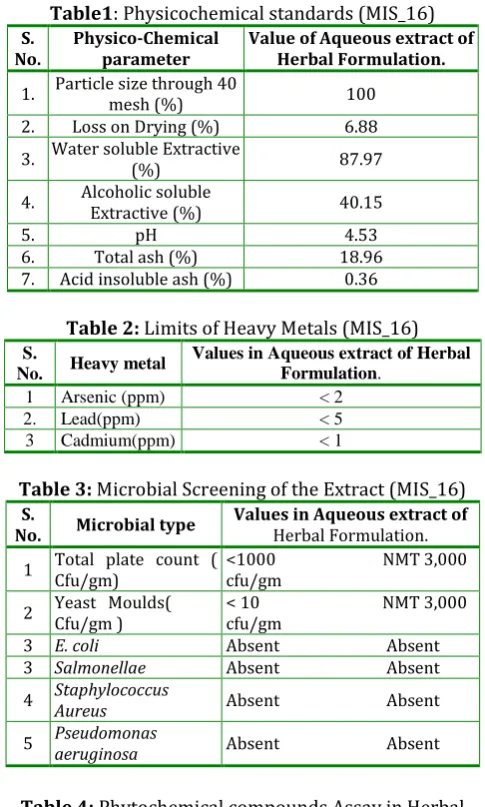
Physico chemical parameters of the formulation viz. total ash, water soluble ash, acid insoluble ash, water soluble extractive, ethanol soluble extractive and moisture content are shown in (Table.1)
Analysis reveals a minor presence of some of heavy metals but the sample does not exceed the limits given according to WHO guidelines. (Table 3)
Microbial count was within the WHO standards and safe for the formulation. [2, 3]
Phytochemicals was assessed compound in herbal formulation. (Table 4)
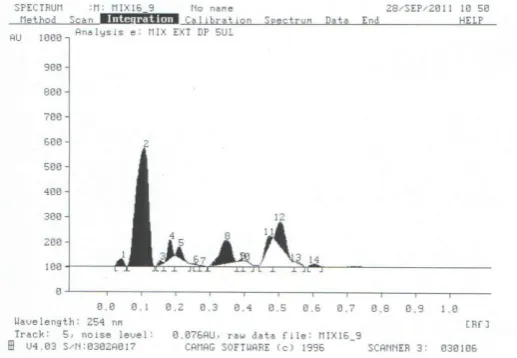
High performance Thin Layer Chromatography High performance Thin Layer Chromatography (HPTLC) of Water extract of herbal formulation (DP
B.NO: Mis16_9) under spectrum M: Mix 16_9 at wave length of 254 of track number 5 produced 14 peaks observed between 0.02-0.65 with peak values of Total height is 902.2 and total area is 23988.2 [Figure 1](Table 4)
Under spectrum M: Mix 16_9A at wave length of 366 nm of track number 5 analysis MIX EXT DP10 UL produce 8 peaks observed between 0.11-0.89 with peak values of total height is 594.9 and total area is 16507.1 [Figure 2].
Under spectrum M: Mix 16_9A at wave length of 366 nm of track number 5 analysis MIX EXT DP5 UL produce 8 peaks observed between 0.81-0.91 with peak values of total height is 424.1 and total area is 10113.4 [Figure 3].
Under spectrum M: Mix 16_9 at wave length of 254 of track number 2 analysis b: GALLIC ACID standard 10 UL produced 1 peak observed between 0.09-0.17 with peak values of total height is 603.6 and total area is 14852.2 [Figure 4].
DISCUSSION
Figure.5 and table 8 ). Rf values of the formulation compare with standard has been mentioned in table no 6. Reverse HPTLC of marker compounds in comparison of Formulation will produce the HPTLC spots in corresponding to active compound of the formulation. Merely identification of marker compound in a formulation is not always possible. Marker compounds of ingredients not necessarily the markers for formulations. Some markers undergo transformations and generate new markers. [23] This formulation needs a further study for marker compound isolation and formation of new marker compounds on variation of manufacturing process has to be standardized.
CONCLUSION
The study reveals that sufficient quality control measures followed for the preparation of novel Ayurvedic preparation. Physicochemical, organoleptic, pharmacognostical aspects of the sample formulation was studied along with Phytochemical and HPTLC finger printing. These standards exhibit a set of diagnostic, identity and authenticity of the formulation. HPTLC profile generated in this study revising a standard tool for the authenticity of Ayurviedc quadric extracts formulation and genuineness of the final product.
Table1: Physicochemical standards (MIS_16) S.
No. Physico-Chemical parameter Value of Aqueous extract of Herbal Formulation. 1. Particle size through 40 mesh (%) 100
2. Loss on Drying (%) 6.88 3. Water soluble Extractive (%) 87.97
4. Alcoholic soluble Extractive (%) 40.15
5. pH 4.53
6. Total ash (%) 18.96 7. Acid insoluble ash (%) 0.36
Table 2: Limits of Heavy Metals (MIS_16)
S.
No. Heavy metal
Values in Aqueous extract of Herbal
Formulation.
1 Arsenic (ppm) < 2
2. Lead(ppm) < 5
3 Cadmium(ppm) < 1
Table 3: Microbial Screening of the Extract (MIS_16) S.
No. Microbial type Values in Aqueous extract of Herbal Formulation. 1 Total plate count ( Cfu/gm) <1000 NMT 3,000 cfu/gm
2 Yeast Moulds( Cfu/gm ) < 10 NMT 3,000 cfu/gm
3 E. coli Absent Absent
3 Salmonellae Absent Absent
4 Staphylococcus Aureus Absent Absent
5 Pseudomonas aeruginosa Absent Absent
Table 4: Phytochemical compounds Assay in Herbal Formulation. (MIS_16)
S.
No. Assay type Method Results Specification
1 Alkaloids (%) Gravimetric 0.24 NLT 0.2% on d/b
2. Tannins (%) Volumetric method 15.12 NLT10.0% on d/b 3. Curcumoids (%) Spectrophotometric 0.27 NLT 0.2% on d/b
Table 5: High Performance Thin Layer Chromatography (MIS_16) at 10 UL and 244 nm
Peak start Max end Area
# Rf H Rf H % Rf H F %
Table 6: High performance Thin Layer Chromatography (MIS_16) at 10 UL and 366nm
Peak start Max end Area
# Rf H Rf H % Rf H F %
1 0.11 0.0 0.13 122.5 20.60 0.16 0.0 2103.6 12.74
2 0.16 0.0 0.18 36.3 6.10 0.20 0.0 680.6 4.12
3 0.20 0.0 0.21 13.4 2.25 0.22 0.0 118.2 0.72
4 0.22 0.0 0.25 117.5 19.75 0.29 0.0 2862.1 17.34
5 0.30 0.0 0.33 102.0 17.14 0.39 0.0 3998.4 24.23
6 0.39 0.0 0.42 144.4 24.27 0.47 0.0 4253.5 25.77
7 0.51 0.0 0.53 10.6 1.78 0.57 2.9 305.2 1.85
8 0.80 0.0 0.85 48.3 8.12 0.89 0.0 2184.8 13.24
Table 7: HPTLC (MIS_16) Standard Gallic acid (Marker compound of Amalaki) 10 UL and 254 nm
Peak start Max end Area
# Rf H Rf H % Rf H F %
1 0.09 0.0 0.13 603.6 100.00 0.17 0.0 14852.2 100.00
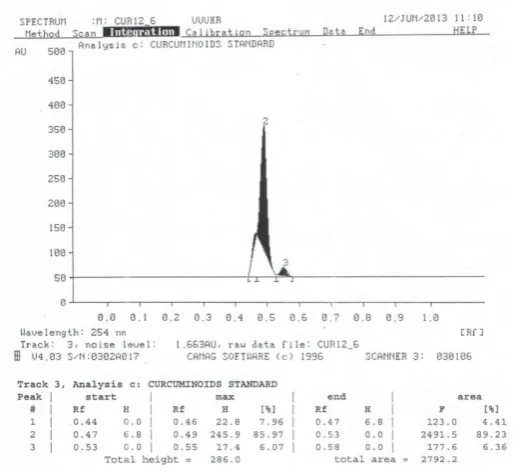
Table 8: HPTLC Standard Curcuminoids (Marker compound of Haridra) 10 UL and 254 nm
Peak start max end area
# Rf H Rf H % Rf H F %
1 0.24 0.0 0.27 205.8 53.96 0.29 0.0 2582.0 51.72 2 0.29 0.0 0.32 175.7 46.04 0.35 0.0 2409.9 48.28
Fig. 1: High Performance Thin Layer Chromatography (MIS_16) at 10 UL and 254 nm
Fig. 3: High performance Thin Layer Chromatography (Mix 16_9) at 5 UL and 366 nm
Fig. 4: HPTLC (MIS_16) Standard Gallic acid (Marker compound of Amalaki) at 10 UL and 254 nm
ACKNOWLEDGEMENT
The authors are grateful to the Director General CCRAS, New Delhi; Dr. Murthy.S.N. Assistant Director In charge, National Research Institute of Basic Ayurvedic Sciences –Pune, Dr.G.K.Swamy, Assistant Director, NARIVBD - Vijayawada, Shri G.Ganga Raju,Chairman, G.Rama Raju Managing Director Laila Impex - Vijayawada for their help and Guidance in the study. The study has been affiliated to Dr. N.T.R. University of Health Sciences as PhD studies.
REFERENCES
1. Anjoo Kamboj (2012). Analytical Evaluation of Herbal Drugs, Drug Discovery Research in Pharmacognosy, Prof. Omboon Vallisuta (Ed.), ISBN: 978-953-51-0213-7,
InTech. http://www.intechopen.com/books/drug di scovery research in pharmacognosy/analytical-evaluation-of-herbaldrugs. (14-05-2013).
2. Anonymous, Quality Control Methods for Medicinal plants materials.( an authorized publication of W.H.O. Geneva). New Delhi: A.I.T.B.S. publishers& Distributors; 2002.pp. 11, 18, 61-63.
3. The international pharmacopoeia, 3rd ed. Geneva, World Health Organization. Vol. 1: General methods of analysis, 1979. Vol. 2: Quality specifications, 1981. Vol. 3: Quality specifications, 1988. Vol. 4: Tests, methods, and general requirements. Quality specifications for pharmaceutical substances, Excipients, and dosage forms, 1994. The use of essential drugs. Eighth report of the WHO Expert Committee. Geneva, World Health Organization, in press (WHO Technical Report Series).
4. Lazarowych N.J., Pekos P. “Use of fingerprinting and marker compounds for identification and standardization of botanical drugs: Strategies for applying pharmaceutical HPLC analysis to herbal products”. Drug Information Journal, Vol.32, 1998: pp.497-512.
5. Sethi P B. High Performance Thin Layer Chromatography (1st Edition). New Delhi: CS Publishers and Distributors Vol. X: 1-56, 1996. 6. Anonymous. The Ayurveda Pharmacopeia of India.
Part.1, Vol. 1. 1st ed. New Delhi: Department of
ISM&H, Ministry of Health and Family welfare; 2001.pp.62.
7. Sharma PC, Yelne MB Dennis TJ. Database on Medicinal plants used in Ayurveda. Vol.4. New Delhi: CCRAS; 2002: pp.505-513.
8. Ratnam Varier PS. Indian Medicinal Plants. Vol.3. 1st ed. Madras: Orient Longman; 1997: pp.274-278. 9. Bhavamisra. Bhavaprakasha. Vol. 1. Sri Kantha
Murthy KR, editor. 2nd ed. Varanasi: Chowkambha Krishnadas Academy; 2001: p.222.
10. Anonymous. Thin layer Chromatographic Atlas of Ayurvedic Pharmacopia. Part 1, Vol. I. 1st ed. New Delhi: Govt. of India. Health and family welfare; 2009: pp.123.
11. Billore KV, Yelne MB, Dennis TJ, Chaudhari BG. Database on Medicinal plants used in Ayurveda. Vol.7. New Delhi: CCRAS; 2005: pp 244-50.
12. Vaidya Ratnam Varier PS Indian Medicinal Plants Vol.5, 1st edition, Anna Salai, Madras: Orient Longman; 1996: pp.80-83.
13. Anonymous: The Ayurveda Pharmacopeia of India part 1,2nd edition, Vol 1.New Delhi: Department of ISM&H, M/O Health welfare; 2001: p76.
14. Anonymous. Thin layer Chromatographic Atlas of Ayurvedic Pharmacopeia. Part 1, Vol. I. 1st ed. New Delhi: Govt. of India. Health and Family Welfare; 2009: p99.
15. Sharma PC, Yelne MB, Dennis TJ. Database on Medicinal plants used in Ayurveda. Vol.3. New Delhi: CCRAS; 2002: pp.11- 56.
16. Vaidya Ratnam Varier PS Indian Medicinal Plants Vol.4. Anna Salai, Madras: Orient Longman; 1996: p.256.
17. Anonymous: The Ayurveda Pharmacopiea of India part 1,2nd editon, Vol 3. New Delhi: Department of ISM&H, M/O Health welfare; 2001: pp.62
18. Anonymous: Ayurveda pharmacopeia of India, Amalaki. Appendex7, Classical References; Vol I ,Slokas,Pdf. New Delhi: IIHM, CCRAS, Department of ISM&H, M/O Health welfare; 2001.
19. Sharma PC, Yelne MB, Dennis TJ. Database on Medicinal plants used in Ayurveda. Vol.1. New Delhi: CCRAS; 2000: 152-55.
21. Bhavamisra, Bhavaprakasha Vol 1. Srikantha Murthy KR editor. 2nd ed. Varanasi: Chowkambha Krishnadas Academy; 2004:246.
22. Anonymous. Ayurveda Pharmacopeia of India part1, Vol. 1.1st Ed. New Delhi: Department of ISM&H, M/O Health welfare, Ayurveda pharmacopeia committee, IIHM, CCRAS ; 2001:45.
23. Mallvardan N, Kasar RP, SubbuRaju T, Suresh B,HPTLC analysis of Withaferine A from an herbal extract formulation J Sep Sci, 2003 26(18): 1707. http://www.niscair.res.in/conclave/downloadables
/Plenary%20Session%201/pdf/Mallavadhani.pdf. (14-05-2013).
How to cite this article: Sai Prasad A. J. V* Ratna Manikyam B,Trimurtulu. G, Reddy K. N,Naidu M. L.; Analytical Standardization of Ayurvedic Formulation- Aqueous extracts of Hedichium spicatum Ham.Ex Smith, Sassurea lappa C.B.Clarke, Emblica officinalis Gaertn and Curcuma longaLinn; J. Adv. Pharm. Edu. & Res. 2014: 4(2): 221-28.