Luz Mary Rincón Texas A&M University-Texarkana [email protected]
Caren Smith Fielder Mount Pleasant Independent School District [email protected]
This article presents the preliminary results of a mentoring program developed by the Mount Pleasant Independent School District (MPISD) in the State of Texas with the goal of improving low-achieving students’ results on the math and reading state mandated tests, Texas Academic Knowledge and Skills (TAKS). The article describes the level of development of the program at the end of the first year of implementation and shows what may be the positive impact of youth participation in mentoring relationships. The apparent impact of the mentoring program is shown through improved scores ofTAKStests of fifth grade and is illustrated in the experience of a mentor teacher and her group of students. Although it does not specifically target ethnic and language minorities, their improved academic performance may have been the result of the mentoring experience.
Key words: Non-academic mentoring program, building interpersonal relationships, language minorities, at-risk students, socio-cultural factors
Palabras Clave: Programa mentor no académico, construcción de relaciones interpersonales, minorías lingüísticas, estudiantes en riesgo, factores socioculturales
Introduction
This article presents the results of the first year of implementation of a mentoring program conducted by the Mount Pleasant Independent School District (MPISD) in the State of Texas (USA) with the goal of improving the academic performance of low-achieving students.
Academic performance is measured through results of the Texas Academic Knowledge and Skills (TAKS), an assessment tool that has to be administered to all students in the state. The mentoring program was first developed during the 2006 – 2007 academic year in view of the persistent lack of district-wide academic achievement. This article presents the level of development of the program during the first year of implementation by means of a comparative analysis ofTAKSscores of fifth grade students and an account of qualitative data obtained from informal observation and interviews to mentor teachers, including the co-writer of this article, who reported on the steps of actual project implementation.
The Context of Study
In 1993, the Texas Legislature enacted statutes that mandated the creation of the Texas public school accountability system to rate school districts and evaluate campuses. The system was effectively developed at the time because the state already had the necessary supportive infrastructure in place: a pre-existing student-level data-collection system; a state-mandated curriculum; and a statewide assessment tied to the curriculum. Beginning in 2003, a new assessment, the Texas Assessment of Knowledge and Skills (TAKS), was implemented to measure student academic performance in grades three through eleven in the areas of reading, English language arts, writing, mathematics, science, and social studies. This criterion-referenced assessment system must be used by Texas school districts and campuses to measure student progress in these areas. In Texas, the academic needs of at-risk students (including low income students) and ethnic and language minority students
(including LEP) can be identified by examining TAKS results. In spite of the
administration’s commitment to the education of their students, district results in the TAKS tests have continuously fallen behind the state average. An analysis of the 2004-2005 and the 2005-2006 Standard Accountability Indicator (TEA, 2008) shows that at the overall level the state’s passing rates are higher than the district’s.MPISD TAKSpassing rates have been mainly affected by the test results of at-risk students and ethnic and language minorities. For instance, of all the students in the state, 58% met the 2004 standard as opposed to 51% of all the students in the district. Data for the same year places the Hispanic passing rate at 40% for the district and 7 points higher for the state at 47%; the scores of the Limited English Proficient students were 2 points lower at the district than at the state level. While for the year 2005 the passing scores of theLEPpopulation both at the district and state level had the same rate at 39%, the state showed an increase of 3% higher than the district in 2006. In view of the inconsistency in the academic achievement of the school population, especially ethnic and linguistic minority groups (includingLEPstudents), theMPISD
administration proposed a mentoring project with the goal of improving TAKS
scores throughout the district.
Objective of the Project
demonstrated by TAKS scores. In view of the inconsistency in the academic achievement throughout the district, especially within the ethnic and language
minority group, a mentoring program that aimed at improving TAKSscores was
designed by the MPISD administration. The focus of the program was not on
academic intervention, but on building relationships between teachers and students to improve student self-assurance and self-esteem and to increase the level of motivation towards academic success, which would ultimately have a positive effect onTAKSscores (MPISDAdministration, personal information, 2008).
Although further data are needed to validate the hypothesis, the study claims that academic intervention alone did not suffice to assist low-achieving students in attaining academic success, but that after mentoring intervention was implemented, scores on the state’s standardized testTAKShad a significant improvement. Data from two years prior to implementation and data at the end of the first year were compared showing that an effective mentoring program based on building connections with the students may have been at the center of academic achievement.
Theoretical Framework
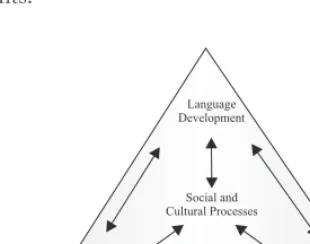
language minority students in the process of acquiring a second language for school must grow linguistically, cognitively, and academically in order for them to become successful and that development in all three of these areas is influenced by social and cultural processes. This model is applicable to any learner, not just LEP children learning a second language, and it becomes highly relevant if the target children are low achieving students.
Along the same lines, research on the education of language minorities has identified the aspects that are crucial in developing children’s human potential, including linguistic, socio-cultural, cognitive, and pedagogical factors (Collier, 1992; Cummins, 1981, 1991, 1992, 1998). Likewise, Freeman and Freeman (1996) argue that factors that are at the heart of the child’s integral development involve intrinsic factors such as anxiety, self-esteem, dignity, self-assurance, and extrinsic factors including societal patterns such as the subordinate status of a minority group or acculturation vs. assimilation, community or regional social patterns such as discrimination and poverty vs. equality, and a dissonant vs. consonant home-school connection. These may negatively or positively influence the child’s overall development. A negative social, community, and school atmosphere, as well as lack of administrative support, lead to the creation of a social and psychological barrier that deters the child’s growth. In his study of minority students, including American working class children, Bernstein (1972) argues that student failure in city schools is the result of the mismatch between teachers’ expectations and students’ backgrounds, thus demonstrating that these theoretical perspectives can be applied to any minority group. The mentoring model analyzed here targeted low-achieving
Academic Development Language
Development
Social and Cultural Processes
Cognitive Development
students, mainly language minority, ethnic minority, and at-risk, including students in households below the poverty line, the most representative groups at the Mount Pleasant Independent School District.
Mentoring studies have traditionally examined the impact of mentoring on adults, mainly principals and teachers in educational settings. However, little work has been done on the impact of non-academic mentoring programs on children’s academic performance in public schools. Mentoring on adults has revealed the importance of developing relationships and their effect on encouragement, self-assurance and identification, professional achievement, and sense of well-being (Bonner & Jennings, 2007; Mendez, Young, Mihalas, Cusumano & Hoffmann, 2006; Oplatka & Eizenberg, 2007; Portner, 2005; Young, Sheets & Knight, 2005). Crasborn, Hennissen, Brouwer, Korthagen, and Bergen (2008) show the important role of mentors of student teachers in stimulating reflection and encouragement. They also show that training has a positive effect on supervisory skills for stimulating reflection in student teachers. Oplatka and Eizenberg (2007) explore career issues and experiences at the induction stage of beginning school teachers and highlight personal and contextual determinants affecting their identification with the new profession. The authors argue that the establishment of mentoring-like relationships and collaboration with the assistant, the supervisor and the group of parents help the new teachers to discover whether their new profession is compatible with their persona and can have a negative or positive influence on the accomplishment of teaching functions, success and well-being. Providing a description of developmental processes and philosophical underpinnings of exemplary programs and focusing on mentoring constructs and best practices, Portner (2005) argues that exemplary mentoring programs reduce teacher attrition rates by half and can dramatically accelerate the professional development of new teachers.
involving listening to students’ ideas, opinions, and concerns, making oneself available, and creating an atmosphere of respect and fairness helped female adolescents in their sample improve their academic performance and their perceptions of themselves and their worth. A supportive mentor is essential in helping children to succeed via the development of relationships in which emotional support, positive feedback, and a steady presence are provided (Jucovy, 2002). The mentoring model developed by MPISDis supported by theory consistent with the assumption that a well-developed mentoring relationship is a positive outcome for a young person, especially at-risk. Indeed, the case for mentoring is that the experience of a quality mentoring relationship in itself is a positive outcome for a young person at-risk (ARTD, 2002; Ferronato, 2001).
Program Implementation
The project was created with the financial support of theMPISD Board in an effort to help low-achieving students meet the required Texas academic standards; thus, participatory mentors would receive a stipend of $250.00 per student who passed the assignedTAKStest. A set of mentoring rules were created and had to be followed to ensure consistency amongst mentors. Rules were very simple and basically asked the mentor to participate by choice and to be persistent. Mentors were to “play” with students encouraging them, building their self-esteem, and showing themselves as trustful partners who cared about students’ success. They had to commit themselves to building meaningful tasks for students outside the school routine, engaging parents, maintaining students at the vanguard of the “mind” of the school. Additionally, academic interventions and tutoring were to continue as usual by staff in charge of this academic component. The mentor had to coordinate student academic performance with the target student, teachers, academic tutors, and parents. However, the focus was on the personal relationship educator-student rather than on the academic component of this relationship.
The project implementation and its apparent impact on improving the student’s attitude and academic performance are illustrated in the experience of a fifth grade teacher and her mentored students, a sample group that represents the success of the project. This section is evidence of the qualitative dimension of the program. It shows how the teacher built rapport with her students in such a way that that led them to attain the academic standards as shown by state test results. It includes a report of the non-academic factors that contributed to the change in students’ academic performance.
also had an extra incentive because the school principal agreed to referee a school wide soccer tournament if the school’s fifth graders were successful onTAKS. As the school year progressed, her targeted children began changing in the hallways and classroom. The same children that seemed indifferent, apathetic, and even annoying started to change. They stopped getting in trouble and started being pleasant to the others. They started doing their homework and wanted to stay in at recess and complete class assignments and study for tests, something they had never considered before.
Mentoring relationships seems to have brought about change in students’ attitudes and behavior as shown in this account of the mentor teacher’s experience. From the standpoint of the teacher, learning more about her students helped her to develop close ties with them. Taking into account her children’s background experiences helped her to develop a smooth transition between home and school experiences. She learned that family was very important to them —most of her children lived with or near their extended families. She learned that their children’s education was very important to Hispanic parents, even if they were not seen often at school. Most of her students’ parents worked and were unable to come to the school for conferences or other events. She learned that her kids had a lot of issues at home which they had to take to school each day. She learned that she provided a safe place for the kids to be themselves. The children learned to trust her. They felt they had someone in addition to their families who understood them and believed in their abilities to succeed. They knew that failure was never a consideration for her and they were resolved to succeed.
The considerations presented here mirror the theoretical framework discussed in the previous section of the article, and, at the same time, that is a reflection of the well-known need for human connection. Kohn’s comment (1999) that “all of us yearn for a sense of relatedness or belonging, a feeling of being connected to others…” (p. 21) may be evidenced by the qualitative description and the results of the quantitative analysis presented in the next section.
Data Source and Methodology
students received at least 10 hours of mentoring during the school year 2006-2007, according to the guidelines described above. Academic gain as a result of the initial implementation of the program is shown in more detail in the description of individual student’s academic improvement in the section that follows. Students described here are those in the sample group whose experiences were described in the previous section. For the purpose of anonymity, students are assigned a code.
MMis a Hispanic girl who had passed the third grade reading and mathTAKS, but who had failed both tests in 4th grade with a scale score of 1953 and 2047, respectively (Note that the passing score is 2100). The year of the mentoring program, she failed the first administration of the fifth grade reading test with a scale score of 1917, but passed the second administration with 2286, a significant gain of 369 points. She also passed the math test with a higher difference of 86 than on her prior test. The second outstanding case is given by EM, a Hispanic boy who had passed the reading test in third grade but failed it in fourth grade. In fifth grade, the student was retained after failing all three administrations of the test with scale scores of 1943, 1890 and 1949 points. During his participation in the program, he passed the first administration of the reading TAKSwith 2151, a significant increase in scale score of 202. After failing the first administration, in fifth grade of 2006,EMpassed the second administration of mathTAKSwith a scale score of 2143. In 2007, the year of the mentoring, he passed the first math administration with a scale score 153 points higher than the previous passing score.ER, a male Hispanic and fifth grade retainee, passed the first administration of the reading test with 2109 after failing all three administrations the previous year and the fourth grade test in 2005. Another exemplary performance isMF’s, a Hispanic female who had failed the fourth grade administration of reading and all three administrations of the test in fifth grade. A retainee in 5th grade of 2007, she passed the first administration with a scale score
gain of 110 points. Data in this section were taken from the AEIS report for
2004-2005, 2005-2006, 2006-2007 (TEA, 2008).
As individual student data shown above, preliminary data of the sample group show important academic gains at the end of this specific time frame. The data presented in this section were provided byMPISD(Deputy Superintendent of the MPISD, personal communication, 2007). Scale scores on the TAKS test were compared from 4thGrade (2006) to 5thGrade (2007) using a Paired Samples t-test.
it was 2122.96, a significant gain of 115.406 in the first year of the project. A Paired Samples t-test revealed that this is a significant difference [t(58) =4.264 , p<.001]; confidence intervals revealed that the true difference between the 2006 and 2007 means was between 89.423 and 141.389. The passing rate of the 2007 readingTAKS of fifth grade students was 83%, showing an equal passing rate at the state level. These scores had an impact at the district level and, while the state showed an increase of 2% from the prior year, the district showed an increase of 13%. Although mathTAKSscores of mentored students did not impact overall scores at the district level, results are very promising and support the value of the project (2007).
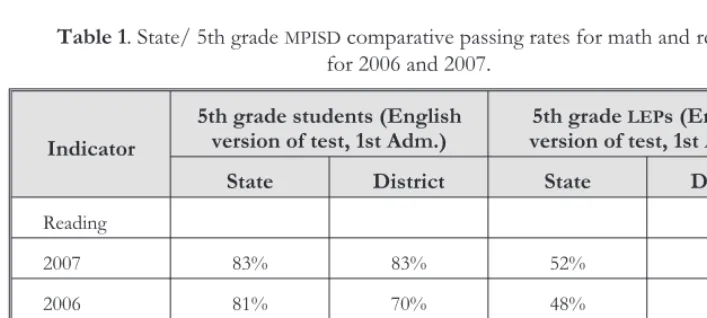
Fifth grade Limited English Proficient students also had an outstanding performance in reading, with a passing rate of 72% the year of the project, up 40% from the prior year. Similar increase rates are displayed in the math results of the fifth grade students andLEPstudents who show a significant improvement from a 56% passing rate in 2006 to 74% in 2007. Table 1 is a comparative data graphic for the years 2006 and 2007 showing the improved performance in reading and math of all fifth grade students, particularlyLEP, as a result of the project (TEA, 2008).
Table 1. State/ 5th gradeMPISDcomparative passing rates for math and reading
for 2006 and 2007.
Indicator
5th grade students (English version of test, 1st Adm.)
5th gradeLEPs (English
version of test, 1st Adm.)
State District State District
Reading
2007 83% 83% 52% 72%
2006 81% 70% 48% 40%
Mathematics
2007 86% 83% 69% 74%
2006 82% 74% 63% 56%
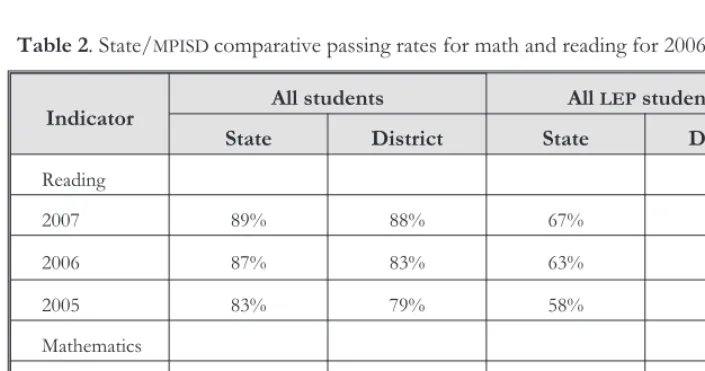
The program seems to have also impacted scale scores on the state’s standardized test (TAKS) at the district level. Significant gains were made in both reading and mathematics. According to an analysis of priorTAKSscores, the district had shown lower rates of performance than the state. In the 2005 administration, 62% of state students met the standard as opposed to 57% of all the students in the district. Although both the state and the district had an increased the following year, the district’s passing rates at 63% were behind the state’s at 67%. With a 70% passing rate at the end of Year 1 of the project implementation,MPISD’s scores were at the same level as the state’s (2007—Sum of all grades tested in 2007, excluding science and TAKS-I). The same pattern is displayed by theLEPstudents. The state passing rate increased from 39% in 2005 to 49% in 2007, while the districtLEPstudents excelled state LEPs from 39% in 2005 to 58% in 2007. Table 2 displays comparative data for the state and the district for the years 2005-2007 (TEA, 2008).
Table 2. State/MPISDcomparative passing rates for math and reading for 2006 and 2007.
Indicator All students AllLEPstudents
State District State District
Reading
2007 89% 88% 67% 75%
2006 87% 83% 63% 61%
2005 83% 79% 58% 58%
Mathematics
2007 77% 79% 62% 72%
2006 75% 72% 58% 60%
2005 71% 67% 53% 56%
teacher in the mentoring process was of utmost importance, especially in supporting students’ affective domain in order to achieve betterTAKSresults. Once they saw that mentoring was changing students’ attitudes and work characteristics, teachers took a personal as well as educational interest in students previously considered “low” and at risk of failing. The teacher became more of an educational partner or student advocate instead of the authority figure that simply judges or evaluates students and points out their weaknesses or failures. Students, on the other hand, did not want to disappoint their mentoring teacher; they acknowledged having the responsibility to demonstrate their knowledge on important evaluations such as TAKS. Teachers from next grade commented favorably on students’ work initiative and behavior; they expressed that students appeared to enjoy the experiences of learning. Compared to previous years, discipline referrals were less in the fifth and sixth grade class. Students came to understand the importance of success in school and that success was attainable even if they had other factors such as home life, poverty, or a language barrier. As reported, with the teacher as a role model, they came to realize that education was attainable. Mentoring resulted in increased teacher-parent contact, which positively impacted the parental attitude towards the teacher and the school. Parents became more active in students’ academic performance. As parents expressed, they started to become aware that students mattered to their teachers and school did not seem as threatening to families.
Conclusion
mentoring relationships alone must be thoroughly demonstrated. Thus, in order to show the effect size of the project, an ongoing qualitative analysis will be needed to determine more precisely which mentor actions had the most influence on student achievement. Likewise, longitudinal data must be used to determine with more precision the extent to which mentoring relationships that are non-academic in nature have an impact on sustained student performance.
Educators of ethnic and language minorities and at-risk students must keep abreast of theoretical research in this area as it offers a promising path for devising non-academic strategies that may be used to complement remediation programs of an academic nature. Mentor teachers as role models encourage positive academic outcomes by communicating their belief in the student’s abilities to succeed, by providing emotional support and a trustworthy and reliable presence in the life of the student.
End Notes
For educational purposes, at-risks are students who are not experiencing success in school, who are low-achievers, and potential dropouts. At-risk students exhibit low self-esteem, behavioral problems, and problems adapting to the mainstream educational system. They generally belong to households below the poverty line and whose parents have limited educational and literacy background as well as who usually have no high educational expectations for their children. Disproportionate numbers of them are males, language and ethnic minorities who exhibit high rates of pregnancy and drug addiction.
References
ARTD. (2002).Mentoring for young offenders: Final report of theNSWpilot program.Retrieved June 20, 2008, from http://pandora.nla.gov.au/pan/34662/20030429-0000/ mentoryoungoffenders.pdf Bernstein, B. (1972). A sociolinguistic approach to socialization: With some reference to
educability. In J. Gumperz & D. Hymes (Eds.),Directions in sociolinguistics: The ethnography of communication(pp. 465-497). New York: Holt, Rinehart and Winston, Inc.
Bonner II, F. A. & Jennings, M. (2007). Never too young to lead: Gifted African American males in elementary school.Gifted Child Today, 30(2), 30-36.
Collier, V. P. (1992). A synthesis of studies examining long-term language minority student data on academic achievement.Bilingual Research Journal, 16(1&2), 187–212.
Crasborn, F., Hennissen, P., Brouwer, N., Korthagen F., & Bergen, T. (2008). Promoting Versatility in Mentor Teacher’s Use of Supervisory Skills.Teaching and Teacher Education, 24(3), 499-514.
Cummins, J. (1981). The role of primary language development in promoting educational success for language minority students. In California State Department of Education (Ed.),Schooling and language minority students: A theoretical framework. Los Angeles, CA: California State University. Evaluation, Dissemination and Assessment Center.
Cummins, J. (1991). Interdependence of first- and second-language proficiency in bilingual children. In E. Bialystok (Ed.),Language processing in bilingual children(pp. 70-89).Cambridge: Cambridge University Press.
Cummins, J. (1992). Empowerment through biliteracy. In J. V. Tinajero & A. F. Ada (Eds.),The power of two languages: Literacy and biliteracy for Spanish-speaking students(pp. 37-48).New York: Macmillan/McGraw-Hill.
Cummins, J. (1998). Beyond adversarial discourse: Searching for common ground in the education of bilingual students. In C. J. Ovando & P. McLaren (Eds.),The politics of multiculturalism and bilingual education: Students and teachers caught in the cross-fire(pp. 126-147). Boston: McGraw-Hill. Ferronato, S. (2001).The building blocks of quality mentoring programs.Retrieved July 24, 2007, from
http://www.mentoringcanada.ca/training/Mentors/Modules/docs/fulltext.pdf
Freeman, Y. & Freeman, D. (1996).Teaching reading and writing in Spanish in the bilingual classroom.
Portsmouth,NH: Heinemann.
Jekielek, S., Moore, K. & Hair, E. (2002).Mentoring programs and youth development: A synthesis.
Washington, DC: Child Trends. (ERICDocument Reproduction Service No.ED465457) Jucovy, L. (2002). Measuring the quality of mentor-youth relationships: A tool for mentoring programs.
Retrieved June 25, 2007, from www.ppv.org/ppv/publications/assets/130_publication.pdf Kohn, A. (1999). Constant frustration and occasional violence.American School Board Journal, 186(9),
20-24.
Mendez, L., Young, E., Mihalas, S., Cusumano D. & Hoffmann, L. (2006). What teachers can do to reduce hidden stressors for girls in middle school.Middle School Journal, 38(2), 13-22. MetLife. (2005).The MetLife survey of the American teacher, 2004-2005: Transitions and the role of supportive
relationships. Retrieved June 1, 2008, from http://www.metlife.com/WPSAssets/ 34996838801118758796V1FATS_2004.pdf
Oplatka, I. & Eizenberg, M. (2007). The perceived significance of the supervisor, the assistant, and parents for career development of beginning kindergarten teachers. Teaching and Teacher Education: An International Journal of Research and Studies, 23(4), 339-354. (ERICDocument Reproduction Service No. EJ 756900)
Portner, H. (2005).Teacher mentoring and induction: The state of the art and beyond.Thousand Oaks, CA: Corwin Press. (ERICDocument Reproduction Service No. ED 495585)
TEA- Texas Education Agency. (2008).Academic Excellence Indicator SystemAEISreports for 2004-2005, 2005-2006, 2006-2007.Retrieved from http://www.tea.state.tx.us/ perfreport/aeis/
The Authors
Luz Mary Rincón is the director of Bilingual/ESL Education at Texas A&M
University-Texarkana, and serves as a consultant for bilingual schools in Northeast Texas. She holds an M.A. inTESOL, an M.A. in Spanish, and a Ph.D. in Applied Linguistics from Ball State University, Indiana, where she was the recipient of the Dissertation of the Year Award in 2004.
Caren Smith Fielder has a B.S. in Interdisciplinary Studies from Texas A&M