This is an open access journal, and articles are distributed under the terms of the Creative Commons Attribution-Non Commercial-ShareAlike 4.0 License, which allows others to remix, tweak, and build upon the work non-commercially, as long as appropriate credit is given and the new creations are licensed under the identical terms.
Evolution of views on the patriotic education of younger
generation
Toleubekova R.K.
1, Nurpeissov N.T.
2, Ibragymkyzy Sh.
3, Joldassova O.K.
4, Tamabaeva M.K.
51 Doctor of Pedagogical Sciences, Professor, 2PhD student, L.N. Gumilyov Eurasian National University, 3PhD. Atyrau State University, 4Candidate of Economic Sciences,
Taraz State Pedagogical University, 5Master of Social Sciences, Central Kazakhstan academy. Kazakhsta
Correspondence: Toleubekova R.KAmina
.
E-mail: galiya008 @ mail.ruABSTRACT
Today the viability of society depends on formation at the younger generation of spiritual immunity which is worked out in union to traditions and the centuries-old culture of own people, in experience of patriotic education. Еxactly a patriotic idea is the basis on which all layers of Kazakhstani society are consolidated at all times. Thus, the purpose of our research are theoretical reasons for an entity and value of patriotic education. Particular importance in this regard is the search and development of fundamentally new approaches to building a system of patriotic upbringing in accordance with the trends in the development of society. Recently more and more the view of a patriotism as extends to the major value, integrating not only social, but also spiritual and moral, ideological, cultural and historical and other components. Therefore the called problem is relevant in the scientific sphere.
Keywords:patriotism, patriotic education, patriotic feelings, patriotic consciousness, patriotic activity
Introduction
Various Problems of development of patriotic education, undoubtedly, deserve the closest attention as it is about tomorrow of any state, including Kazakhstan. The valuable directions of our society, national security of the country are focused in education, creative development, and civil formation of younger generation.
Events of the last time have confirmed that the economic disintegration, devaluation of cultural wealth have exerted negative impact on public consciousness of the youth of many country, have sharply reduced educational influence of culture, art and education as most important factors of formation of patriotism. By A.A Beisenbaeva’s scientific works we understand that the gradual loss of patriotic consciousness by our society has become increasingly noticeable. Objective and subjective processes have significantly aggravated many issues of patriotism. In many ways, the true meaning and understanding of patriotism,
internationalism, tolerance has been lost. In the public mind indifference, selfishness, individualism, pride, aggressiveness, disrespectful attitude to the state and social institutions have become widespread. [1]
Today, in the conditions of a developed modern society, we see the task of patriotic education of the younger generation in strengthening the work on patriotic education on the part of the state. This is evidenced by the adopted regulatory and legal aspects of patriotic upbringing, which will serve as the basis for the development of sectoral and regional programs for the development of patriotic education in the Republic of Kazakhstan.
The regulatory and legal aspects of patriotic education are defined in such state documents as the Constitution of the Republic of Kazakhstan, the "Concepts for the Development of Civil Society of the Republic of Kazakhstan", the Law of the Republic of Kazakhstan "On Education", "The State Program for the Development of Education in the Republic of Kazakhstan for 2011-2020 years". An important stage in strengthening the attention of the leadership of the country and the population to the problems of patriotic education was the development of the "State Program for the patriotic education of the citizens of the Republic of Kazakhstan for 2006-2008 years", which reveals the goals, objectives and principles of educating citizens in the spirit of patriotism.
For example, the State Program for the patriotic education of citizens of the Republic of Kazakhstan is designed to create a high Access this article online
Website: www.japer.in E-ISSN: 2249-3379
patriotic consciousness among citizens, a sense of pride for their country, education of readiness to fulfill civic duty and constitutional duties to protect the interests of the Motherland through systematic development of the patriotic education system.
The objectives of the State Program are: the creation of organizational prerequisites and a system of measures that facilitate the formation of sensible civic solidarity and ownership among the target groups of citizens, interethnic and interpersonal understanding; ensuring the interaction of the state and society as a whole, the state and its citizens in particular when carrying out a set of measures to educate Kazakhstan's patriotism, tolerance, respect for human rights and freedoms; creation of conditions and social preconditions for the formation of civilized civil and interpersonal relations.
In general, the State program is designed to develop the most important qualities of citizens, necessary for creative work in the interests of the Homeland, strengthening the state, protecting its national interests and ensuring sustainable development [2-4].
In the Concept of Education in the System of Continuous Education of the Republic of Kazakhstan (2009), one of the priority directions of educational work is civil-patriotic education, where it is said that civil and patriotic education should form a civic position and patriotic consciousness, developed national self-consciousness, social and religious tolerance based on humanism, love and respect for the language, history and customs of the Kazakh people, preservation and development of its best traditions, study, acceptance and development of cultures other peoples of Kazakhstan [5].
In the last quarter of the XIX - early XX centuries. there was, perhaps, not a single well-known thinker who did not touch upon the theme of patriotism. S.A. Kochevtseva in her own thesis shows philosophers NA Berdyayev, N.Ya. Danilevsky, I.A. Ilyin, V.V.Rozanov, V.Soloviev, teachers V.I.Vodovozov, P.F. Kapterev, V.N. Soroka-Rosinsky, V.Ya.Stoyunin, K.D.Ushinsky, S.T. In their works, Shatsky explored spiritual values in upbringing and education, among which patriotism was singled out as the most important. The psychological aspects of patriotic education were studied in the works of V.M Bekhterev, P.P Blonsky, LS Vygotsky, AN Leontiev, SL Rubinshtein [6]. At the present stage the Kazakhstan scientists D.S. Kusainova, K.K. Menlibaev, A.A Beysenbayeva and others have devoted the dissertation on researching patriotism education. The analysis of researches of a problem of patriotism indicates a variety and ambiguity of interpretation of the term "patriotism" that it explains diversity of his use [7,8].
The term "patriot" began to be applied widely, since an era of the Great French revolution of 1789, but historical roots of patriotism have centuries-old history. The term patriotism (from the Greek Pathis – the Fatherland) means the moral and political principle internally inherent in the citizen. This deeply social feeling which core is the love to the Homeland, devotion to the people, pride of his historical past and the present, care of his future. This aspiration to protect the interests of the state as
within the country, and out of her limit, belong to the category of patriotism: Love for the country, conscience, debt, patriotic feeling, patriotic consciousness, good, justice, etc.
Problems of patriotic education are presented in scientific research of foreign scientists: it demonstrates at works of foreign scientists: Fairbrother, G. P. (2003); Gries, P. H. (2004); Han, Z. (1999, May 12); Hunt, M. (1994). The analysis of modern researchers scientific works of a problem of patriotism indicates a variety and ambiguity of interpretation of the term "patriotism" that it explains diversity of his use. On the basis of the analysis of theoretical sources kinds of patriotism which have various manifestation have been systematized: it is love for the country, to the Fatherland, to native places, to the native language; knowledge of history of the Homeland and respect for traditions, customs of the people; understanding of a general political situation in the world, the tasks facing the native land; intolerance to national, racial hostility, respect for other people, the countries; aspiration to upholding of honor and advantage of the Homeland; active and conscious participation in work for the Homeland benefit; readiness to serve the interests of the Homeland.
The analysis of genesis of maintenance of the concept "patriotism" of public consciousness has allowed to draw a conclusion that this definition in domestic and European scientific tradition, first of all, was treated as devotion to the Homeland and responsibility for her wellbeing [9-11].
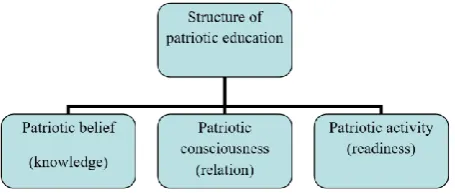
Thus, patriotic education is the purposeful activity designed to form valuable orientations, qualities, standards of behavior of the citizen and patriot of Kazakhstan at children and youth. The purpose of patriotic education consists in orientation of younger generations to values of domestic culture, formation at them the valuable relation to the Homeland, her cultural historically to the past, i.e. development in the identity of high social activity, civil liability, spirituality, formation of the personality having positive values and qualities, capable to show them in creative process for the benefit of the Motherland.
Figure 1: Structure of patriotic education
As one of types of the multidimensional, large-scale and constantly carried out activity patriotic education includes social, target, functional, organizational and other aspects, has the high level of complexity.
knowledge and skills they could with honor fulfill the patriotic and international duty on protection of freedom and independence of the Homeland. The patriotism serves as a standard, an ideal of each individual.
The most important acquisition of the person in the period of the childhood, apprenticeship and students is self-confidence, belief that he knows and is able, self-respect. These qualities need to be formed in the course of patriotic education by means of various means and ways. Heroic fight, feats of the best sons of the Fatherland have to become a basis of patriotic education. Telling about heroic persons, it is necessary to emphasize their moral principles and motives of their actions as it can mention the child's soul.
Меthodology
For achievement of the goal and the solution of the tasks set by a research the complex technique including the coordinated application of theoretical and empirical methods was used; general-theoretical methods of scientific knowledge: theoretical analysis and synthesis of scientific and pedagogical literature and researches, standard and legal documents, state educational standards of higher education, comparison, generalization; theoretical modeling of the organization of patriotic education of students.
The analysis of modern normative documents has allowed us to state the following: fostering patriotism is carried out on the basis of ideas of universal values, tolerance, respect for centuries-old cultural heritage of the people, the close interrelation of civic consciousness and patriotism, formation of national consciousness is observed.
During the research the comparative analysis of experience of formation of patriotism in the different countries has been carried out. This method has been used, for the purpose of identification and comparison of different forms and methods and also a condition of their efficiency.
Main part. Evolution of views of patriotic education of younger generation went together with development of the state, pedagogical views. During the different historical periods the content of the idea of patriotism, but his main kernel - conscious love, fidelity to the Fatherland changed, readiness to protect him from enemies - remained invariable.
By consideration of experience of the Kazakh people to patriotic education of generations historical and pedagogical aspect it won't be correct if we begin with establishment (in the ХІV-ХҮ centuries) of the Kazakh khanate as experience of education originates far back in the past. Because pages of yesterday's last history – the living people in the Great steppe which was a source of East culture communicated in one language, lived in one region, protected these lands from external enemies, trusted in one religion, have made the significant contribution to establishment of world culture – is the ancient beginning of the general culture and history of the present Turkic people. The great Turkic Khaganate has made a big contribution to formation
of a civilization of mankind and was the developed state of that time.
The earliest examples of writing of distant ancestors are called Orkhon-Yenisei or ancient Turkic runic letters. Khagans, beks, and Tarkhans acted as spiritual leaders, prophets, generals, and leaders of destinies. The iron will of the leaders of the Turkic spruce is astonishing, imbued with a deep love for the people, the fatherland. Among such written monuments are the most famous inscriptions on stones in honor of Billegakan and his brother commander Kul-Tegin (VI century). Thus, on one of these stones, sayings about life and way of life, about culture, about the exploits of the ancient nomads against the background of the general history of the Turkic kaganate ("If you, the Turkic people, do not separate from your kagan, from your beks, from your homeland. You yourself will live happily in your home, you will live carefree ").
In the ethical views of Y. Balasaguni, H.A. Yasavi, Al-Farabi, M.Kashgari, their thoughts on the problems of moral and patriotic education of people are the most valuable. At the same time, they pay special attention to the upbringing of the youth, its moral formation. According to thinkers, moral and patriotic perfection is the basis of a way of life.
The formation of the Kazakh Khanate, the state of the early Fedal type, is the result of complex ethnopolitical, socio-economic and ethno-cultural processes that are characteristic for the period of the XIV-XV centuries. The main result of these processes was the completion of the formation of the Kazakh people.
In the XV century. the improvisational poetry arises and develops and a whole gallery of zhyrau - singers, poets, storytellers appears. The great Kazakh zhyrau Asan Kaigi - a connoisseur of genealogy of tribal alliances, people's traditions, calls on his kinsmen to live in peace, in harmony, to be kind, modest, honest and humane, to love their people and their homeland.
The subject of patriotic education is present at poetic manuals of great Abay of Kunanbayev (1845 - 1904). The poet cares for wellbeing of the people, calls youth for unity: "... We have to protect unity, the World - happiness for the native land …" [10].
Kazakh khans, biys, batyrs, heroes are also carriers of patriotic feelings, love for the Motherland, conscience, duty, goodness, justice: the famous commander, batyr of the epoch of Abylai-khan - Bogenbai batyr (1690-1775 gg.); Kazakh batyr, one of the leaders of the struggle against the Dzungarian conquerors and generals of the Kazakh militia in the XVIII century.) - Kabanbai batyr; Kazakh batyr - Raiymbek; with the name of which the new revival of the Kazakh statehood is connected, one of the most prominent political figures and statesman of his time - Abylai Khan; Dzhangir-khan, batyrs Syry Datuly, Isatay Taimanov and Makhambet Utemisov; leaders of the emerging Kazakh intelligentsia, writers, scholars of the XX century: A. Baitrursynov, A. Bukeykhanov, Zh. Akbaev, M. Tynyshbaev, J.
Seidalin, Zh.Dosmukhamedov, H.Dosmukhamedov,
M.Zhumabaev, G.Aymauytov, M.Dulatov and others. All of them were united by one great goal - to achieve independence, freedom and ensure the existence of the Kazakh ethnos. A distinctive feature of the Kazakh people is a special trepidation towards their homeland, to their native places. There are many songs and poems dedicated to this topic, praising the native steppes, mountains, the land where a man was born, where he heard his first lullaby, where he spent his childhood, where his family lives, his parents, how important it is to remember their roots and not to stigmatize their places your family and your homeland. And of course the theme of love and affection for the motherland, the duty of every person to be useful, to bring good to people, loyalty and devotion to the native land was reflected in Kazakh proverbs and sayings. For example, «Оtan – eldin anasy. Еl – erdin anasy»/ «Motherland -is the mother of the people, the people are the mother of the guy»; «Оtan ottanda ystys» / «Love of the Motherland - hotter than fire»; «Еl ishi – altyn besik»/ «Native land is a golden cradle»; «Oragyn otkir bolsa, Karyn talmaidy. Otanin berik bolsa, jauin almaidy/ «"If the sickle is sharp, without bread you will not; If the Motherland is strong, you will be with the enemy "you"»; «Tygan zherdin zhyasy da tatti»/ «And the onion in the Motherland is sweet»; «Tygan zhaerdin auasi da shipa»/ «At home and air - medicine»
[12].
In different periods of the development of pedagogical science, patriotic upbringing was viewed as an indispensable part of the education process. In Kazakhstan pedagogical science on the problem of patriotic education there is a number of scientific research works.
Patriotic upbringing in Kazakhstan, as well as the ethnic roots of the Kazakhs, undoubtedly have an ancient history, the study of which, at various historical stages, is an actual direction for research.
I would like to note that all scientific research concerning patriotic upbringing can be divided into four blocks. Each of the blocks reveals a certain aspect of the problem being studied. The first block is the study and analysis of the methodological approach of patriotic education (Imanbaeva S.T. Scientific and pedagogical bases of patriotic education of pupils of schools in conditions of social development of the Republic of Kazakhstan (2007);
The second block is the works devoted to historical, welfare aspects of patriotism and patriotic education of the younger generation (Nurmukasheva S.N. Development of military patriotic education of seniors at schools of Kazakhstan (1360-1985) (1993); Menlibayev K.N. A role of national traditions in patriotic education (on materials of concrete and sociological researches of youth of the Republic of Kazakhstan)" (1995); Saydakhmetova L.T. Development of patriotic education of pupils at schools of Kazakhstan (1970-2000) (2001); Mukhamedinova N.A. Patriotic education of school students on the basis of national values in heritage of the Kazakh intellectuals of the beginning of the 20th century (2006); Sagyndykov A. Сағындықов Оku-tarbiesi procesinde oralman-tindaushilardin patriottik kasietterin kalyptastiry (2010 y.); The third block – methods and methods of formation of patriotic education (Zhumatayeva E. Patriotic education of school students means of works of writers - veterans of Kazakhstan (1995); Kusainova D.S. "Patriotic education of seniors on Alija's heroism and Manshuk" (1999); Duysenbayev A.B. "Pedagogical conditions of education at pupils of patriotism by means of a heroic image of the Kazakh batyrs" (2006); Rysbekova R.M. "Patriotic education of younger school students means of the Kazakh folk music" (2007); Imanbetov A.N. "Patriotic education on the basis of the Kazakh ethnopedagogics" (2007); Bekmagambetov A.Zh. "Patriotic education of seniors by means of regional local history values" (2008); Kazetova A.H. "Formation of patriotism at children of preschool age in local history activity" (2008); Serikova N.U. "Educating Kazakhstani patriotism through tourist-regional studies" (2009); Erimbetova GH "Patriotic upbringing of senior pupils on the basis of Bauyrzhan Momyshuly's works" (2010); Utegulov GE "Pedagogical management of students' patriotic education in professional information and communication technologies" (2010).
The fourth block is preparation of future teachers for patriotic education (Belgibaeva GK "Preparation of future specialists for patriotic education of children of preschool age by means of oral folk art" (2006), Karpikbaeva AS "Preparation of the future teacher for patriotic education in the process of studying cycle of humanitarian disciplines "(2008)); Mailybaeva LS "Pedagogical conditions of preparing future teachers to patriotic education of pupils" (2010).
The first block is a studying and the analysis of methodological approach of patriotic education (V.V. Dyachenko "The theory and practice of patriotic education in modern Russia", 2001; G.A. Konovalova "Organizational and pedagogical conditions of patriotic education "Pedagogical conditions of the organization of patriotic education of pupils of general education educational institutions in the modern conditions" (2004), V.V. Gladky studying at modern comprehensive school" (2003), V.I. Bayeva "Civil and patriotic education of youth in the polycultural environment of higher education institution: system and activity approach" (2011)) where concepts of expanded educational space are developed, created a control system of process of patriotic education.
The second block is the works devoted to historical, welfare aspects of patriotism and patriotic education of the younger generation: A.V. Lukinova "Patriotic education of the teacher in the theory and practice of domestic pedagogical education of the second half of XX – the beginnings of the XXI century" (2010), A.E. Meshkov "Civil and patriotic education of pupils traditional values of domestic culture" (2010),
The third block – methods and methods of formation of patriotic education (I.V. Kostruleva "Contents and the organization of patriotic education in the conditions of education regionalization" (2004), O.Ya. Yarovikov "Patriotic education of students in the conditions of education internationalization" (2010), T.V. Lavrova "Development of patriotic consciousness of students of college" (2011) where is designed and approved technology of formation of patriotic education.
The fourth block – training of future teachers for patriotic education (N.V. Ippolitova "The theory and practice of training of future teachers for patriotic education of pupils" (2000), N.M. Zarobekova "Training of future teachers for civil patriotically education of pupils" (2010)
Proceeding from the listed scientific research it is possible to draw a conclusion that the problem investigated by us belongs to the world problem of all mankind. The analysis convinces that the pedagogical thought of scientists of the whole world has prepared theoretical base in the field of patriotic education which has been corrected, added and developed by pedagogical science of different historical eras.
Conclusions
of different historical eras. Patriotic education without ethnic values, traditions, mentality of subjects of educational space, turns into "matrix", into the schematized interaction focused on unification of manifestation of patriotic feelings, the patriotic relation to the Homeland.
Patriotic education is an education of the major spiritual moral and the cultural historical values reflecting specifics of formation and development of our society and state, national consciousness, a way of life, outlook and the fate of the Kazakh people. It includes selfless love and devotion to the Homeland, pride of belonging to the people and its fulfillments, honoring of national shrines and symbols, readiness for worthy and dedicated service to society and the state.
Patriotic education is a purposeful systematic activity of public authorities and organizations for formation at citizens of high patriotic consciousness, feeling of fidelity to the Homeland, readiness for performance of a civic duty and the constitutional obligations for protection of interests of the Homeland. Patriotic education is directed to formation and development of the personality having qualities of the citizen and the patriot and capable to successfully carry out civil duties in peace and wartime.
Thus, one of the main tasks of today's sovereign Kazakhstan is the formation of universal and national values, as "patriotic value", "universal patriotism", "Kazakhstan's patriotism", "national patriotism" among the younger generation.
Thus, the theoretical analysis and synthesis of scientific and pedagogical literature and research, methodological literature, analysis and generalization of best practices in patriotic education showed that patriotic upbringing in various manifestations has existed in Kazakhstan since ancient times and has passed in its formation a long way.
Research work on the problems of patriotic education leads to the following conclusions: firstly, a significant scientific interest in the problem of patriotic education in the conditions of a developing multicultural environment was manifested only in the middle of the twentieth century. Secondly, one of the most important areas of pedagogical research in the field of patriotic education is the study of the direction of patriotic education of students: the formation of patriotic consciousness, the development of patriotic feelings, the organization of patriotic activity, patriotic self-education in the conditions of modern society. Thirdly, patriotic upbringing in modern conditions should be viewed as the process of forming a personality devoted to national and state interests, ready to work for the benefit of the Motherland and be responsible for the well-being of the fatherland, a person capable of constructive interaction with representatives of other states and ethnoses on the basis of tolerance.
References
1. Beisenbaeva A.A. Patriotic education of high school students by the means of the Kazakh heroic epic. Thesis for the degree of Candidate of Pedagogical Sciences, Almaty, 1999.Almaty, 2004.
2. Law of the Republic of Kazakhstan of July 27, 2007 No. 319-III "On Education" (with amendments and additions as of July 11, 2017)
4. The state program of patriotic education of citizens of the Republic of Kazakhstan for 2006-2008.
5. The concept of education in the system of continuous education of the Republic of Kazakhstan. Astana, 2009
6. Kochevtseva S.A. Organization of patriotic education of students in an average special educational institution. Thesis for sisk. uch.step. Cand. ped. Sciences, Ryazan, 2005, - 202 p.
7. Kusainova D.S. Patriotic education of high school students on the heroism of Aliya and Manshuk. Thesis for the degree of Candidate of Pedagogical Sciences, Almaty, 1999.Almaty, 1999.
8. Menlibaev K.K. The role of national traditions in patriotic education. Thesis for the degree of Candidate of
Pedagogical Sciences, Almaty, 1999.Karaganda, 1998.
9. Hold high the banner of patriotism. (1993, November 28). The People’s Daily. Translated by Suisheng Zhao.
10. Fairbrother, G. P. (2003). The effects of political education and critical thinking on Hong Kong and Mainland Chinese university students’ national attitudes. British Journal of Sociology of Education, 24(5), 605-620.
11. Gries, P. H. (2004). China’s new nationalism: Pride, politics, and diplomacy. Berkeley, CA: University of California Press.