* Corresponding author. Tel.: +6082-583312; fax: +6082-583410 E-mail address: [email protected]
Manuscript History:
Fixed-bed Column Study for Adsorption of Cadmium on Oil Palm
Shell-derived Activated Carbon
Chai Ping Ling
1, Ivy Ai Wei Tan
2,*, Leonard Lik Pueh Lim
31,2
Department of Chemical Engineering and Energy Sustainability,
Universiti Malaysia Sarawak, 94300 Kota Samarahan, Malaysia.
3
Department of Civil Engineering, Universiti Malaysia Sarawak,
94300 Kota Samarahan, Malaysia.
Abstract
The spread of heavy metal pollution in the environment can lead to the contamination of crops and water for consumption. An approach to control the spread of groundwater pollution is by using a permeable reactive barrier with granular activated carbon. In this study, the adsorption of Cd(II) ions was conducted in a continuous flow fixed-bed column by using oil palm shell-derived activated carbon. The activated carbon column performance was evaluated by manipulating the activated carbon bed height, cadmium solution flow rate and influent concentration. The increase in bed height increased the amount of adsorbent used, thus increasing the total removal of Cd(II) and prolonged the lifespan of the activated carbon column. However, the increase in flow rate and influent concentration resulted in the shortened lifespan of the column. The column system with a bed height of 5.5 cm, flow rate of 2.0 mL/min and 200 mg/L influent concentration showed the best Cd(II) uptake performance in this study. The column performance were best fitted to the Thomas model and Yoon-Nelson model for the longest bed depth of 5.5 cm, all flow rates studied and highest influent concentration of 200 mg/L, with correlation coefficient greater than 0.95.
Keywords: Adsorption, agriculture waste-derived adsorbent, breakthrough curve, continuous flow .
1.
Introduction
is feasible. The cost of activated carbon can be reduced besides minimizing the amount of wastes to be disposed.
Although activated carbon adsorption is effective for removing heavy metals from water, there are limited adsorption studies being conducted in fixed-bed columns to simulate the performance of activated carbon in the form of a barrier. Therefore, this study focus on the continuous fixed-bed adsorption of cadmium, Cd (II) as the batch adsorption study conducted by Chan [4] had provided elementary information concerning the Cd (II) removal process. It has been reported that the activated carbon prepared using H3PO4 treatment with microwave-induced activation is effective for adsorption of Cd (II) ions, with adsorption capacity of 78.73 mg/g. Batch system however provides effective application for a short optimum period at a single time and requires a large amount of adsorbent for a large volume of effluent from the economic point of view. Meanwhile, for the column system, the application is more practical and economical for industrial scale as the operation is conducted continuously and the process is controllable. Besides, the information of the breakthrough curve can be used to determine a rational scale of an adsorption column for industrial scale. The optimum conditions determined from Chan [4] for synthesis of the activated carbon using 1:2 precursor:H3PO4 impregnation ratio, 700 W microwave power and 5 minutes irradiation time was further applied in this continuous fixed-bed adsorption study to identify the feasibility of using the prepared activated carbon under loading with Cd (II) ions continuously.
The aim of this study is to investigate the feasibility of the oil palm shell-derived activated carbon prepared using H3PO4 treatment and microwave-induced activation in removing Cd (II) ions using fixed-bed adsorption column at different activated carbon bed height, Cd (II) solution flow rate and influent concentration. The experimental data were then fitted into different column adsorption models, which were Thomas model, Yoon-Nelson model, Adam-Bohart model and Bed Depth Service Time (BDST) model to evaluate the adsorption capacity and performance of the activated carbon column.
2.
Materials and methods
2.1 Adsorbent preparation
The precursor was first rinsed with water to remove the dirt on the surface. After that, in order to remove oil residue and other impurities, it was soaked in n-hexane. The sample was then dried in an oven at 120°C for 24 hours to remove the moisture content. The dried precursor was subsequently crushed and sieved to obtain 1 mm particle size [4].
The activated carbon was prepared by using
chemical activation combined with microwave-induced heating. Chemical activation which
consisted of phosphoric acid (H3PO4) with 1:2 (w/w) impregnation ratio, 700 W microwave
power and irradiation time of 5 minutes was used to prepare the activated carbon.
2.2 Chemicals and reagents
The chemicals used throughout this study were of analytical reagent grade.
The stock solution of 1000 mg/L Cd (II) was prepared by dissolving Cd (NO3)2.4H2O in 1.0 L of deionized water and further diluted to the desired concentration with deionized water.2.3 Column experiments
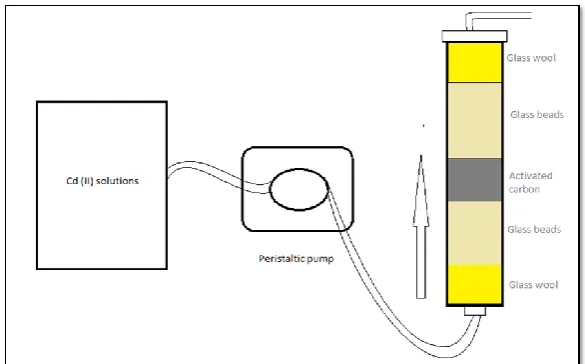
schematic diagram of the continuous packed-bed column system is shown in Figure 1. A known weight of activated carbon was packed into the column according to the desired bed height. The activated carbon packed in the column was wetted with deionized water in upward flow direction before the experiment was started. This was to withdraw the trapped air between the particles inside the column. Then, the Cd (II) working solutions were fed upward into the column by a peristaltic pump continuously [5, 6]. The effluent was collected at regular time intervals, and the samples were filtered and analyzed for the cadmium concentration using an atomic absorption spectrophotometer (AAS).
Figure 1. Schematic diagram of continuous flow packed-bed column system
2.3.1 Effect of bed height
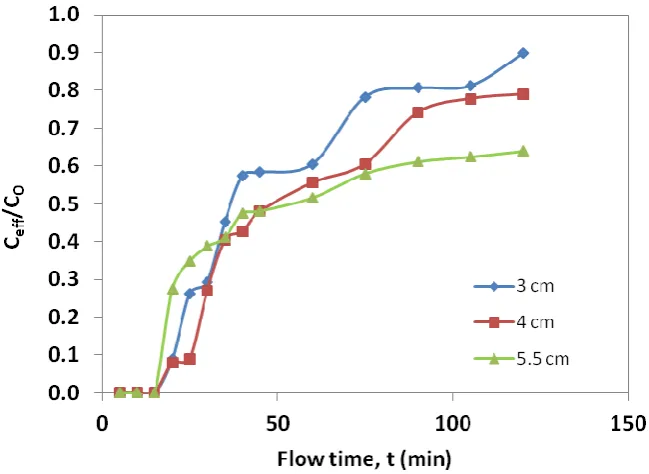
The activated carbon amounts were varied according to the desired bed height and packed in the column for the evaluation of the effect of the bed height [6] on the adsorption performance. The bed height was varied at 3.0 cm, 4.0 cm and 5.5 cm (1.5 g, 2.1 g and 3.0 g of activated carbon, respectively). The influent concentration and the flow rate of Cd (II) solutions were fixed at 200 mg/L and 3.0 mL/min, respectively. The collection of effluent for analysis was at regular time intervals until the breakthrough curve was obtained.
2.3.2 Effect of flow rate
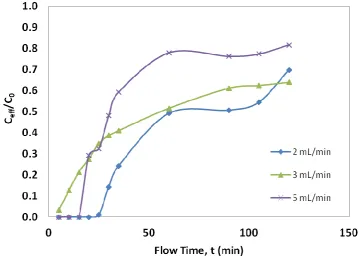
The contact period between the adsorbate and adsorbent affects the removal of metal ions by the adsorbent. In relation to this scenario, the bed height and influent concentration were kept constant at 5.5 cm and 200 mg/L, respectively while manipulating the flow rate at 2.0, 3.0 and 5.0 mL/min. At regular time intervals, the effluent was collected for cadmium analysis.
2.3.3 Effect of influent concentration
2.4 Mathematical description and adsorption modeling of fixed-bed column studies
The breakthrough curve of the continuous fixed-bed system is used to evaluate the column performance. Generally, the breakthrough curve is described by Ceff/Co, in which Ceff and Co represent the effluent and influent concentrations, respectively. The adsorbed metal ion concentrations in the column are observed by a plot of the adsorbed metal concentration, Cad (1) or normalized concentration defined as the ratio of effluent metal concentration to influent concentration (Ceff/Co) as a function of time or volume of effluent (Veff), as shown in (2) [6].
Cad = Inlet concentration (Co) – Outlet concentration (Ceff) (1)
Veff (mL) = Qttotal (2)
where Q = Volumetric flow rate (mL/min) ttotal = Total flow time (min)
The adsorbed metal ion (qtotal) by the column can be obtained by integrating the plot of adsorbed concentration (Cad) versus the flow time (t), represented by the area (A) under the integrated plot. It is substituted in (3) to determine qtotal.
(3)
The total amount of metal ions delivered to the column system (mtotal) is obtained from (4).
(4)
The column performance can be evaluated by the percentage of total metal ions removal, as shown in (5).
(5)
The equilibrium adsorption, which is also known as the column maximum capacity is also determined from the column data to obtain the adsorption capacity of adsorbent, as expressed in (6).
(6)
where X is the unit mass of adsorbent packed in the column.
At the equilibrium, the unadsorbed metal concentration in the continuous flow system is evaluated, as given in (7).
(7)
There are four types of adsorption modeling which are commonly used to study fixed-bed column system, namely Thomas model, Yoon-Nelson model, Adam-Bohart model and Bed Depth Service Time (BDST) model, which are represented by (8), (9), (10), and (11), respectively.
(9)
(10)
(11)
where
CO - Inlet concentration
Ct - Outlet metal concentration at time t kAB - Adam-Bohart kinetic constant kBDST - Adsorption rate constant kTh - Thomas kinetic coefficient kYN - Yoon-Nelson rate constant L - Bed height
m - Mass of adsorbent in column NO - Saturation concentration
NO - Biosorption capacity of the bed (BDST model) qO - Maximum solid phase concentration
T - Time
UO - Linear velocity Z - Bed depth of column
- Time required for 50% of adsorbate breakthrough
- Linear flow velocity of metal solution through the bed
3.
Results and discussion
3.1 Column studies
The ratio of effluent cadmium concentration to the influent cadmium concentration (Ceff/Co) against the flow time (t), which was the breakthrough curve has been plotted in order to study the performance of the activated carbon column at various activated carbon bed height, cadmium solution flow rate and influent concentration.
3.1.1 Effect of bed height
Figure 2.Breakthrough curve for Cd (II) adsorption on prepared AC at different bed heights (flow rate = 3.0 mL/min, influent concentration = 200 mg/L)
Table 1. Mathematical description of column parameters
Bed Height
(cm)
Co (mg/L)
Q (mL/min)
qtotal (mg)
mtotal (mg)
Total Removal
(%)
qeq (mg/g)
Ceq (mg/L)
3.0 200 3 33.24 72 46.16 22.16 107.68
4.0 200 3 36.43 72 50.59 17.35 98.81
5.5 200 3 38.67 72 53.71 12.89 92.59
5.5 200 2 31.24 48 65.08 10.41 69.83
5.5 200 3 37.54 72 52.15 12.52 95.70
5.5 200 5 46.24 120 38.53 15.41 122.94
5.5 100 3 20.73 36 57.59 6.91 42.41
5.5 150 3 36.42 54 57.45 12.14 48.82
5.5 200 3 38.32 72 53.22 12.82 93.58
3.1.2 Effect of flow rate
From Table 1, the slowest flow rate of 2.0 mL/min achieved the highest total Cd (II) removal of 65.08% in the column system. Besides, this flow rate had the lowest unadsorbed cadmium concentration of the continuous flow system at the equilibrium, which was 69.83 mg/L. On the other hand, the adsorption capacity of the activated carbon increased as the flow rate was increased. The performance of the column was remarkably influenced by the flow rate as it affected the contact time between the adsorbate and adsorbent. The Cd (II) ions had longer time to diffuse through the pores and achieved a higher adsorption capacity when the flow rate was decreased [7, 8]. At higher flow rates, the decrease in liquid film surrounding the adsorbent particles led to the reduction of the boundary layer and the mass transfer resistance in adsorption process [7].
Figure 3.Breakthrough curve for Cd (II) adsorption on prepared AC at different flow rates (bed height = 5.5 cm, influent concentration = 200 mg/L)
3.1.3 Effect of influent concentration
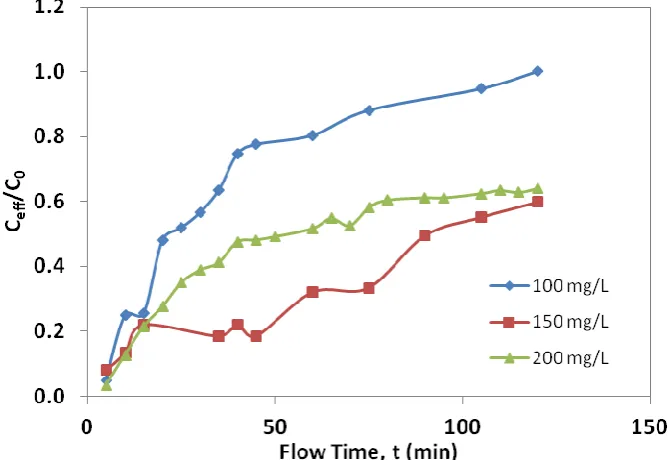
concentration gradient caused a slower transport due to a decrease in diffusion coefficient or mass transfer coefficient [10].
Figure 4.Breakthrough curve for Cd (II) adsorption on prepared AC at different influent concentrations (bed height = 5.5 cm, flow rate = 3.0 mL/min)
3.2 Adsorption modeling for breakthrough curve
3.2.1 Thomas model
The column adsorption data were fitted to the Thomas model in order to evaluate the relationship of the column parameters. The plot was used to determine the Thomas kinetic coefficient (kTh) and the maximum solid-phase concentration of the solute qO (mg/g). From Table 2, the kTh values increased while the qO values decreased with the increase in bed height whereas the kTh values decreased while the qO values increased with the increase in influent concentration. Meanwhile, both the kTh and qO values decreased with the increase in flow rate. The experimental data were better fitted by the Thomas model with longer bed height, slower flow rate and higher influent concentration.
Table 2. Parameters predicted by the Thomas model
Bed Height
(cm)
m (g) CO (mg/L) Q
(mL/min)
kTh
(mL/min.mg) qO (mg/g) R
2
3.0 1.5 200 3.0 0.000126 18173.71 0.7017
4.0 2.1 200 3.0 0.000117 14067.16 0.8607
5.5 3.0 200 3.0 0.000134 14947.57 0.9587
5.5 3.0 200 2.0 0.000127 12092.23 0.9594
5.5 3.0 200 3.0 0.000133 16211.28 0.9613
5.5 3.0 200 5.0 0.000078 7463.675 0.9686
5.5 3.0 100 3.0 0.000251 7677.689 0.8766
5.5 3.0 150 3.0 0.000145 14712.44 0.8699
3.2.2 Yoon-Nelson model
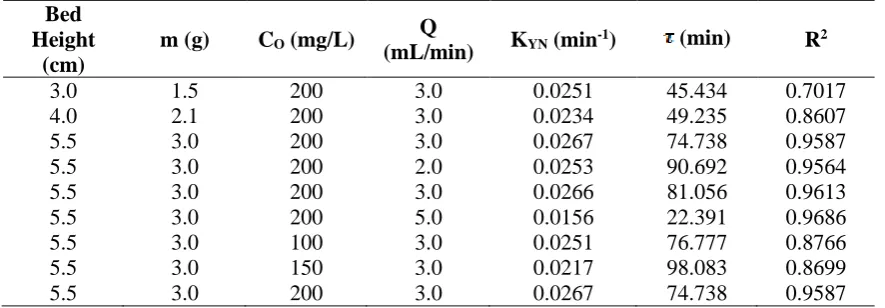
Yoon-Nelson model is a simple theoretical model applied to predict the breakthrough activities. According to Lim and Aris [6], it is suitable for the single component system besides using less column data for the construction of the model values. The rate constant and time required for 50% adsorbate breakthrough can be predicted by the values of kYN and . These values can be obtained from the linearized Nelson equation. Table 3 shows the parameters predicted by the Yoon-Nelson model at different bed heights, flow rates and influent concentrations. The kYN and qO values increased with the increase in bed height whereas the kYN and qO values decreased with the increase in flow rate. Meanwhile, the kYN values increased whereas the qO values decreased with the increase in influent concentration. The results obtained agreed with the results reported by Lim and Aris [6]. The 50% of the breakthrough for Cd (II) was predicted at nearly 75 to 99 minutes with the bed height of 5.5 cm at different flow rates and influent concentrations. The columns however did not achieve 50% breakthrough after one hour of operation. From the R2 values as shown in Table 3, the Yoon-Nelson model had better fitting for the cadmium adsorption in a longer bed column. Lim and Aris [6] also reported similar findings for Yoon-Nelson model applied for adsorption of cadmium using dead calcareous skeletons.
Table 3. Parameters predicted by the Yoon-Nelson model
Bed Height
(cm)
m (g) CO (mg/L) Q
(mL/min) KYN (min
-1) (min) R2
3.0 1.5 200 3.0 0.0251 45.434 0.7017
4.0 2.1 200 3.0 0.0234 49.235 0.8607
5.5 3.0 200 3.0 0.0267 74.738 0.9587
5.5 3.0 200 2.0 0.0253 90.692 0.9564
5.5 3.0 200 3.0 0.0266 81.056 0.9613
5.5 3.0 200 5.0 0.0156 22.391 0.9686
5.5 3.0 100 3.0 0.0251 76.777 0.8766
5.5 3.0 150 3.0 0.0217 98.083 0.8699
5.5 3.0 200 3.0 0.0267 74.738 0.9587
3.2.3 Adam-Bohart model
Table 4. Parameters predicted by the Adam-Bohart model
Bed Height
(cm)
UO
(cm/min) CO (mg/L)
Q (mL/min)
kAB
(L/min.mg) NO (mg/L) R
2
3.0 3.8197 200 3.0 0.0000450 32628.81 0.6828
4.0 3.8197 200 3.0 0.0000435 25414.24 0.9330
5.5 3.8197 200 3.0 0.0000910 16300.74 0.8993
5.5 2.5465 200 2.0 0.0000770 13045.04 0.9543
5.5 3.8197 200 3.0 0.0000915 17296.28 0.9035
5.5 6.3662 200 5.0 0.0000260 35147.56 0.9338
5.5 3.8197 100 3.0 0.0001570 8785.111 0.8426
5.5 3.8197 150 3.0 0.0000993 15116.4 0.9054
5.5 3.8197 200 3.0 0.0000910 16300.74 0.8993
3.2.4 Bed Depth Time Service (BDST) model
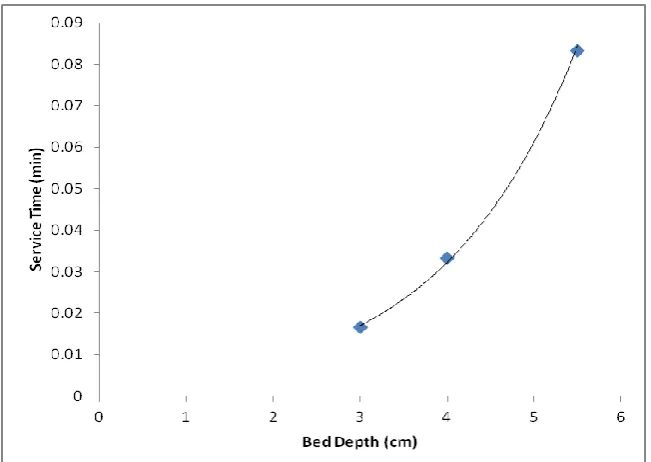
The BDST model shows the relationship between the service time of the column and the fixed-bed column. This model assumes that the adsorption kinetics is controlled by the surface chemical reaction between the Cd (II) ions in the solution and the oil palm shell-based AC that have not been used, neglecting the intraparticular diffusion and external mass resistance [11]. Figure 5 shows the plot of service time against bed depth at flow rate of 3 mL/min and influent concentration of 200 mg/L. The rate constant, kBDST and the adsorption capacity per volume, NO were predicted to be 0.02157 L/mgh and 1.247 mg/L, respectively. The service time increased pseudo exponentially with increasing bed depth, indicating that greater bed height would have longer lifespan, thus requiring longer interval for activated carbon replacement.
Figure 5. Adsorption modeling using BDST model for adsorption of cadmium onto the prepared AC
3.2.5 Comparison between the adsorption modeling
models were best fitted for column data with the longest bed height. The column behaviors could be used for prediction in further design implications and improvement works through the models. The four models used in this study were suitable for single component adsorption. The Thomas model provided information about the mass transfer between the cadmium solutions and the oil palm shell- based AC, indicating the driving force under different parameters. The experimental data for adsorption of Cd (II) on the AC agreed well with the theoretical data obtained from the Thomas and Yoon–Nelson models. The four models applied in this study required different parameters for theoretical calculations.
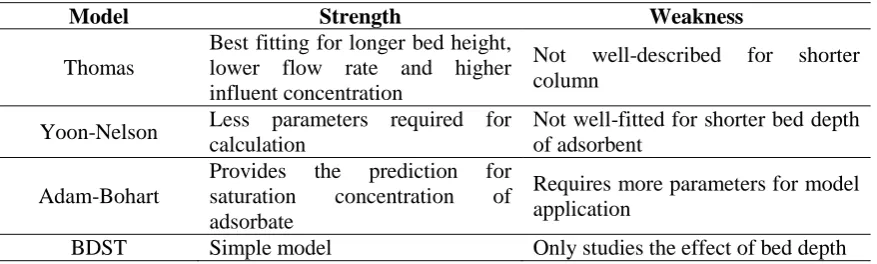
Out of the four models, the Yoon–Nelson model required the least parameters and theoretical data calculation. Yoon–Nelson model provided the mathematical application directly and the information of 50% column breakthrough, which enabled the prediction of exhaustion period of the column without a long duration of experimental time. The Adam–Bohart model could be used to predict the adsorption capacity of the adsorbent. The results obtained from the Adam–Bohart model could be used in application for a large scale effluent treatment system [6]. However, it required more parameters and calculation to obtain the modeling data. As for BDST model, it is a simple and straight-forward model. However, it could only determine the relationship between the bed depth and the service time.
Table 5. Strengths and weaknesses of the column adsorption models
Model Strength Weakness
Thomas
Best fitting for longer bed height, lower flow rate and higher influent concentration
Not well-described for shorter column
Yoon-Nelson Less parameters required for calculation
Not well-fitted for shorter bed depth of adsorbent
Adam-Bohart
Provides the prediction for saturation concentration of adsorbate
Requires more parameters for model application
BDST Simple model Only studies the effect of bed depth
4.
Conclusion
Acknowledgements
The authors acknowledge the research grant provided by Universiti Malaysia Sarawak under Special Grant Scheme F02/SpGS/1406/16/7.
References
[1] Vignola, R., Bagatin, R., D’Auris, A. D. F., Flego, C., Nalli, M., Ghisletti, D., Millini, R.and Sisto, R. (2011). Zeolites in a permeable reactive barrier (PRB): One year of field experience in a refinery groundwater—Part 1: The performances, Chem. Eng. J. 178, 204-209.
[2] Bortone, I., Chianese, S., Di Nardo, A., Di Natale, M., Erto, A. and Musmarra, D. (2013). A Comparison Between Pump & Treat Technique and Permeable Reactive Barriers for the Remediation of Groundwater Contaminated by Chlorinated Organic Compounds, AIDIC Conference Series, 11, 61-70.
[3] Shafie, S. M., Mahlia, T. M. I., Masjuki, H. H. and Yazid, A. A. (2012). A review on electricity generation based on biomass residue in Malaysia, Renew. Sustain. Energ. Rev. 16, 5870-5889.
[4] Chan, J. C. (2014). Adsorption of Cadmium using Phosphoric Acid Treated Microwave-induced Oil Palm Shell Based Activated Carbon, Final Year Project Dissertation, Universiti Malaysia Sarawak, Malaysia.
[5] Baig, S. A., Zhu, J., Tan, L., Xue, X., Sun, C. and Xu, X. (2014). Influence of calcination on magnetic honeycomb briquette cinders composite for the adsorptive removal of As (III) in fixed-bed column, Chem. Eng. J. 257, 1-9.
[6] Lim, A. P. and Aris, A. Z. (2014). Continuous fixed-bed column study and adsorption modeling: Removal of cadmium (II) and lead (II) ions in aqueous solution by dead calcareous skeletons, Biochem. Eng. J. 87, 50-61.
[7] Sotelo, J. L., Ovejero, G., Rodriguez, A., Alvarez, S. and Garcia, J. (2013). Analysis and modelling of fixed bed column operations on flumequine removal onto activated carbon: pH influence and desorption studies, J. Chem. Eng. 228, 102-113.
[8] Hasfalina, C.M., Maryam, R.Z., Luqman, C.A. and Rashid, M. (2012). Adsorption of copper (II) from aqueous medium in fixed-bed column by Kenaf fibres, APCBEE Procedia 3, 255-263.
[9] Salehi, P., Asghari, B. and Mohammadi, F. (2010). Biosorption of Ni (II), Cu (II) and Pb (II) by Punica geranatum from aqueous solutions, J. Water Res. Protect. 2 (8), 701-705.
[10] Tan, I.A.W. (2008). Preparation, characterization and evaluation of mesoporous activated carbons derived from agricultural by-products for adsorption of methylene blue and 2,4,6-trichlorophenol, PhD Dissertation, University Science Malaysia.