w w w . i a j p s . c o m
Page 4315
CODEN [USA]: IAJPBB ISSN: 2349-7750INDO AMERICAN JOURNAL OF
PHARMACEUTICAL SCIENCES
http://doi.org/10.5281/zenodo.1098072
Available online at: http://www.iajps.com Research Article
DESIGN AND
IN-VITRO
CHARACTERIZATION OF DELAYED
RELEASE MULTI UNIT PARTICULATES USING WURSTER
TECHNOLOGY
Dr . M. Sunitha Reddy*, Raju Eddagiri, S. Muhammad Fazal Hl Haq, Dr. V. Venkateswarlu
Centre for Pharmaceutical Sciences, JNTU Kukatpally, Hyderabad-500085, Telangana, India.
Abstract:
The aim of the present research was to design and characterize delayed release Multi Unit Particles (MUPS). These were produced primarily for the purpose of oral modified release dosage forms having gastro resistant and delayed-release properties. During the development of MUPS agglomeration, generations of fines and twins formation are identified as critical issues. The delayed release multiple units were prepared by layering drug suspension using Wurster technology. The prepared multi unit particulates consist of successive layers of drug layer (Esomeprazole), barrier coat and enteric coat (Eudragit L30 D55) on to inert seeds (sugar spheres #50/60). Finally the MUPS are filled into capsules (white to off white hard gelatin). The MUPS were evaluated for drug content, moisture content, particle size distribution, good flow properties and the filled capsules were evaluated for acid resistance (0.1N HCl for 2 hrs) test and In-vitro drug release (pH 6.8 phosphate buffer) and compared with the innovator product. The characterization of pellets was completed and capsules were packed into HDPE bottle (60cc with 33mm closure) and subjected to accelerated stability testing (40°C/75%RH) for six months and results were compared with initial results.
Key words: Delayed release, multi unit particulates (MUPS), Wurster technology, Sugar spheres #50/60, Eudragit L30 D55, Q point at 30minutes NLT 75±5 %, 0.1N HCl, pH 6.8 phosphate buffer.
Corresponding author:
Dr. M. Sunitha Reddy,
Department of Pharmaceutics, Center for Pharmaceutical Sciences,
IST, JNTUH
E-Mail:baddam
[email protected]
,
Phone no: 9849958604
Please cite this article in press as M. Sunitha Reddy et al., Formulation and In-Vitro Characterization of Losartan Potassium and Repaglinide Bilayer Tablets, Indo Am. J. P. Sci, 2017; 4(12).
w w w . i a j p s . c o m
Page 4316
INTRODUCTION:Recent approach that comes into existence is the one that combine the feature of both controlled release tablets and modified release capsules in one dosage form. Such system is known as MUPS technology. The delayed release systems can be used to protect the drug from degradation in the low pH environment of stomach and avoid the irritation by drug. The Esomeprazole is selected as a model drug, the drug was coated onto sugar spheres #50/60. Then further coating was followed by barrier coating was using hydrophobic agents and Enteric coating was done by using Eudragit polymer and plasticizer. In barrier coating HPC acts as binder[1-3]. The development of formulation was done by optimizing percentage (%) build up of Barrier and Enteric coating. Finally, barrier coating percentage was optimized at 55%, and enteric coating at 50%. The formulation was analyzed in 0.1N HCl up to 2hrs, the acid degradation was not exceeded 10%, and then followed by pH 6.8 phosphate buffer medium. Optimized the percentage drug release profile of Esomeprazole to be comparable with the Innovator product and evaluation of the formulation developed was found to be satisfactory [4-7].
MATERIALS AND METHODS Materials:
Esomeprazole Magnesium Trihydrate was procured from Hetero drugs, Povidone (Kollidon 30, BASF, Germany), Polysorbate 80 (Kolliphore PS 80, BASF), Hydroxy propyl cellulose (klucel LF), Sugar Spheres (#50/60) (Colorcon), Hydroxy Propyl methyl Cellulose E5 (Dow Chemical’s), Talc (Luzenac Pharma), Eudragit L30 D55 (Evonic polymers), Glyceryl Mono Stearate (BASF), Poloxamer 188
(BASF), Magnesium Oxide (Granules India), Triethyl citrate (Vertellus), Simethicone (Dow corning), methanol (Rankem chemicals), glacial acetic acid (Rankem chemicals), Acetyl Tributyl Citrate (Vertellus), Di Sodium Hydrogen Phosphate (Rankem chemicals) were used in trials.
Methods
Acid resistance
Acid resistance of Esomeprazole multi unit particulates contained capsule placed in 300 mL of 0.1N HCl medium up to 2hrs. When the test was completed, immediately discarded the medium from the vessel and collected the pellets.
Dissolution
The dissolution test carried out by USP method, the capsule containing pellets was placed in a 0.1N HCl medium followed by pH 6.8 phosphate buffer. Assay
10 mg of omeprazole in 250 ml volumetric flask added 25 ml methanol sonicate for 15 mins, then added 50 ml of diluents and finally make up with water sonicate it up to 5 mins. Taken 5 ml of solution from above stock solution and transferred it 25 ml volumetric flask, then 2 ml of 0.25N NaOH was added and volume was made-up with diluent. Finally, 5-10 ml sample was taken and filtered through 0.45micron filter paper. The sample was Stored in a dark place.
Preformulation Studies
The pre-formulation studies of API and excipients like physical parameters evaluation like moisture content, solubility, bulk density, Drug- Excipient compatibility studies of API and excipients.
Characterization of API
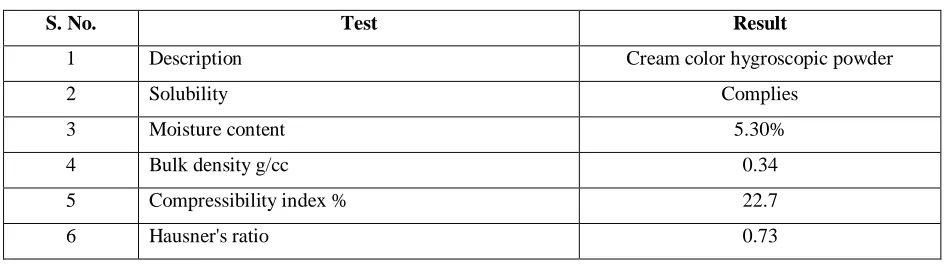
Table 01: characterization of API
S. No. Test Result
1 Description Cream color hygroscopic powder
2 Solubility Complies
3 Moisture content 5.30%
4 Bulk density g/cc 0.34
5 Compressibility index % 22.7
w w w . i a j p s . c o m
Page 4317
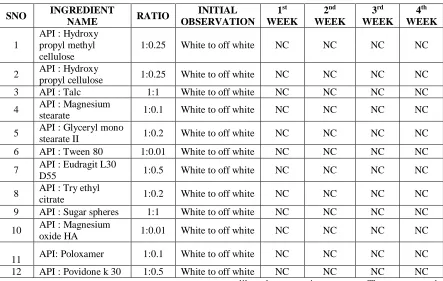
Table 02: Drug-Excipient compatibility studiesSNO INGREDIENT
NAME RATIO
INITIAL OBSERVATION 1st WEEK 2nd WEEK 3rd WEEK 4th WEEK 1
API : Hydroxy propyl methyl cellulose
1:0.25 White to off white NC NC NC NC
2 API : Hydroxy
propyl cellulose 1:0.25 White to off white NC NC NC NC
3 API : Talc 1:1 White to off white NC NC NC NC
4 API : Magnesium
stearate 1:0.1 White to off white NC NC NC NC
5 API : Glyceryl mono
stearate II 1:0.2 White to off white NC NC NC NC
6 API : Tween 80 1:0.01 White to off white NC NC NC NC
7 API : Eudragit L30
D55 1:0.5 White to off white NC NC NC NC
8 API : Try ethyl
citrate 1:0.2 White to off white NC NC NC NC
9 API : Sugar spheres 1:1 White to off white NC NC NC NC
10 API : Magnesium
oxide HA 1:0.01 White to off white NC NC NC NC
11 API: Poloxamer 1:0.1 White to off white NC NC NC NC
12 API : Povidone k 30 1:0.5 White to off white NC NC NC NC
Drug and Excipient compatibility studies
The drug and excipient compatibility studies were performed by physical method. In physical studies the drug and individual excipient, drug and all excipients and placebo was stored in 40oC/75% RH
in glass vials up to 4 weeks. The samples were observed for any colour changes in particular duration of storage.
Drug-Excipient compatibility studies (physical evaluation at 40°C/75%RH).
The following steps involved in formulation of multi unit particulates
1. Drug layering
2. Barrier coating
3. Enteric coating
1. Drug layering: The Drug dispersion was prepared based on the thickness (or) viscosity and coated onto the pellets with the assuming percentage efficiency. The problems like appearance of foam in the coating
solution observed which created fines. It was
rectified by the adding anti foaming agent for avoiding the foam during preparation of drug coating solution.
2. Barrier coating: The Barrier coating dispersion was prepared by adding different hydrophobic agents
like talc, magnesium stearate. The percentage build up of coating was optimized to ensure acid resistance and desired drug release profile.
3. Enteric coating: The Enteric coating solution was prepared by adding anti tacking agent, plasticizer to the 30% Eudragit dispersion. The coating was done by maintaining low temperature. The main advantage of enteric coating is acid protection to the drug in acid media or low pH buffer media.
Process parameters: The below table explains process parameters and their importance in the process optimization and their effects on the formulation.
1. Product Temperature
Product temperature affects the drug-layering pattern, drug loss during layering, spray drying of coating suspension and/or twins formation. All these effects influence assay and content uniformity. The product temperature does not influence the acid resistance or dissolution.
2. Fluidization
w w w . i a j p s . c o m
Page 4318
3. Atomization/Spray rateAtomization pressure decides the size of globules from spray gun and spray rate will influence the volume of suspension per unit time. Globule size should be optimum since smaller size leads to spray drying and bigger globule size causes over wetting of beads and lumps formation. Spray rate should be optimum to achieve better assay and content uniformity. Too low spray rate may lead to spray drying while high spray rate may cause over wetting and lumps formation.
4. Drying/ curing
The drying rate of temperature was high and they easily generated fines and improper coat on to the pellets. Drying rate affects the content uniformity, dissolution and acid resistance. The curing rate
defined as simply the formation of film with high integrity, smoothness and avoiding the pinholes on to the each pellet with the help of minimum film formation temperature (MFT). The literature’s and polymer manufacturer recommended the curing time 90 minutes at 40-45 °C temperature.
Formulation
The below formulation table explains about drug and their excipients, percentage coating and different concentrations used in each formulation. The formulation was divided into three parts like drug layer, barrier coat and enteric coat and each coating was done based on weight gain and percentage was calculated by initial weight of loaded batch and final weight of batch.
Table 03: Formulation
Ingredient F01 F02 F03 F04 F05 F06 F07 F08 F09 F10
Drug layering (quantity in mg/unit)
Sugar spheres 15 15 15 15 15 15 15 15 15 15
Esomeprazole magnesium 22.5 22.5 22.5 22.5 22.5 22.5 22.5 22.5 22.5 22.5
Hydroxy propyl methyl cellulose NA 6 6 6 6 6 6 6 6 6
Povidone 8 NA NA NA NA NA NA NA NA NA
Magnesium oxide 8 NA 6 6 6 6 6 NA NA NA
Poloxamer 3 NA NA NA NA NA 1 2 2 3
Tween 80 NA 0.6 0.6 NA NA NA 0.6 0.6 0.6 0.6
Simethicone NA 0.03 0.03 0.03 0.03 0.03 0.03 0.03 0.03 0.03
Barrier coating (quantity in mg/unit)
Hydroxy propyl methyl cellulose 6.06 NA NA NA 6.46 6.46 NA NA NA NA
Hydroxy propyl cellulose NA 6.06 5.45 4.45 NA NA 4.97 4.7 4.78 4.36
Talc 22.4 22.4 20.1 16.5 23.66 23.66 18.4 17.72 17.72 16.15
Dibutyl sebacate 0.7 NA NA NA NA NA NA NA NA NA
Magnesium stearate 1.1 1.7 1.56 1.27 1.85 1.85 1.42 1.37 1.72 1.51
Enteric coating (quantity in mg/unit)
Eudragit 24.7 22.1 28.4 29.2 36.9 36.9 30.5 19.3 27.6 26.8
Tri ethyl citrate 2.48 2.22 2.84 2.95 3.7 3.7 3.06 NA 2.74 2.69
Acetyl tri butyl citrate NA NA NA NA NA NA NA 1.92 NA NA
w w w . i a j p s . c o m
Page 4319
Table 04: Process parametersSl. No, Parameter Drug layering Barrier coating Enteric coating
1 Inlet Temperature (°C) 30-42 32-41 32-35
2 Product Temperature (°C) 28-30 28-32 22-25
3 Air inlet (CFM) 40-45 40-48 40-45
4 Spray rate (RPM) 8-10 6-8 10-12
5 Spray atomization (Bars) 1.6-1.4 1.4-1.6 1.6-1.8
Evaluation Parameters:
The following methods were done for the Evaluation of multi unit particulates like particle size distribution, bulk density, angle of repose, compressibility index, moisture content, assay, acid resistance, dissolution.
Flow properties of the Pellets
The flow properties of pellets were done by angle of repose, bulk density, tapped density, compressibility index and hausner’s ratio. The below table showed results of pellets and their properties
Table 05: Flow properties of pellets
Evaluation parameter
Angle of repose
Bulk density g/cc
Tapped density g/cc
Compressibility index
Hausner’s ratio
F1 23.9±0.22 0.76±0.022 0.65±0.12 13.84±0.04 0.88±0.016
F2 23.7±0.19 0.74±0.042 0.66±0.13 12.67±0.011 0.87±0.018
F3 22.5±0.10 0.75±0.021 0.66±0.24 13.36±0.041 0.86±0.092
F4 23.1±0.28 0.71±0.022 0.64±0.35 13.13±0.052 0.8±0.020
F5 22.6±0.18 0.72±0.023 0.65±0.16 12.31±0.067 0.87±0.031
F6 21.4±0.13 0.77±0.014 0.66±0.37 13.43±0.038 0.86±0.012
F7 23.1±0.17 0.76±0.035 0.65±0.21 13.83±0.018 0.87±0.053
F8 22.8±0.25 0.73±0.016 0.64±0.23 12.93±0.029 0.86±0.014
F9 23.5±0.21 0.74±0.021 0.65±0.10 12.63±0.082 0.86±0.0055
F10 22.2±0.16 0.75±0.029 0.66±0.31 12.61±0.041 0.86±0.076
Capsule filling and Evaluation
The pellets filled into capsule done by capsule filling machine. Initially, the weights were adjusted by
dossier knob and locked length adjusted by locking pin. The capsules was tested in disintegration apparatus in 0.1N HCl 1000 ml at 37±0.5°C
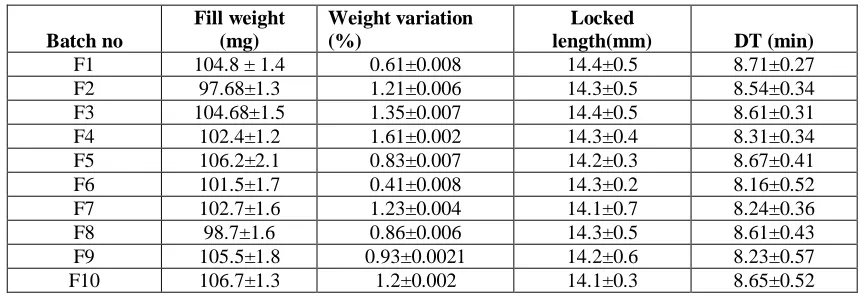
Table 06: Capsule filling and evaluation
Batch no
Fill weight (mg)
Weight variation (%)
Locked
length(mm) DT (min)
F1 104.8 ± 1.4 0.61±0.008 14.4±0.5 8.71±0.27
F2 97.68±1.3 1.21±0.006 14.3±0.5 8.54±0.34
F3 104.68±1.5 1.35±0.007 14.4±0.5 8.61±0.31
F4 102.4±1.2 1.61±0.002 14.3±0.4 8.31±0.34
F5 106.2±2.1 0.83±0.007 14.2±0.3 8.67±0.41
F6 101.5±1.7 0.41±0.008 14.3±0.2 8.16±0.52
F7 102.7±1.6 1.23±0.004 14.1±0.7 8.24±0.36
F8 98.7±1.6 0.86±0.006 14.3±0.5 8.61±0.43
F9 105.5±1.8 0.93±0.0021 14.2±0.6 8.23±0.57
w w w . i a j p s . c o m
Page 4320
RESULTS AND DISCUSSION:Assay and Moisture content
Assay percentage of the Innovator product was 99.8±1.92, Assay percentage of F1 and F2 formulation was 98.2±1.56, 97.6±1.75 and the optimized formulation F10 showed assay percentage
of 98.7±1.79 which is in limit and matches the marketed product. Moisture content of innovator product, F1and F2 formulation was 5.8±2.41, 5.8±2.41, 5.1±1.7 respectively and the moisture content of optimized formulation F10, 5.9±2.16 was comparable with the innovator product.
Table 07: Assay and Moisture content of pellets
TEST Assay ( 98-102% USP) Moisture Content NMT 8% (USP)
RLD (%) 99.8±1.92 5.8±2.41
F1 98.2±1.56 5.1±1.7
F2 97.6±1.75 6.2±1.2
F3 96.5±2.51 7.1±0.97
F4 98.3±1.62 6.7±0.94
F5 97.2±1.89 6.8±1.31
F6 99.1±1.73 7.2±0.67
F7 96.1±2.11 7.6±1.69
F8 96.9±2.31 6.5±1.24
F9 97.2±2.33 6.6±1.32
F10 98.7±1.79 5.9±2.16
Acid resistance of initial batches
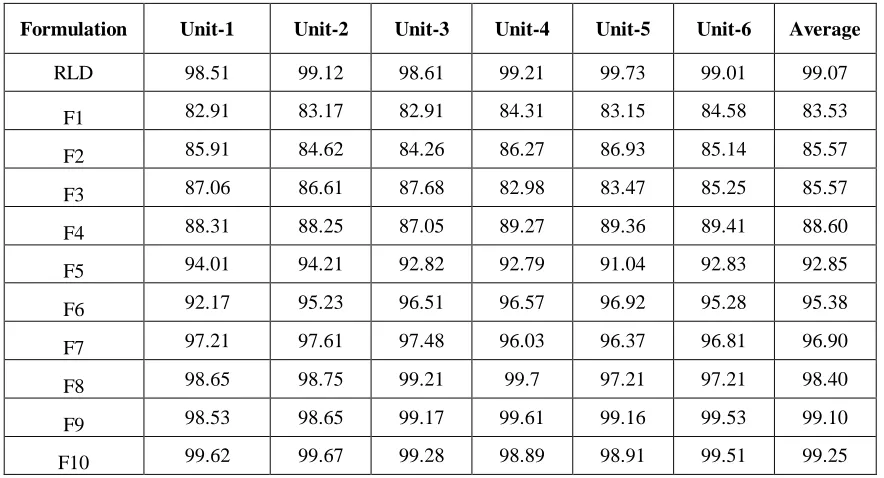
The acid resistance is vital to provide protection to the pellets during gastric emptying time. The pellets were protected by enteric coating for avoiding the degradation of drug in acid media. The improvement
of acid resistance was done by optimized percentage of enteric coating. Average acid resistance values of innovator product, F1, F2 is 99.07, 83.53, 85.57 and the acid resistance value of optimized formulation was 99.25 which are comparable to the innovator product or RLD (Reference Listed Drug).
Table 08: Acid Resistance of pellets
Formulation Unit-1 Unit-2 Unit-3 Unit-4 Unit-5 Unit-6 Average
RLD 98.51 99.12 98.61 99.21 99.73 99.01 99.07
F1 82.91 83.17 82.91 84.31 83.15 84.58 83.53
F2 85.91 84.62 84.26 86.27 86.93 85.14 85.57
F3 87.06 86.61 87.68 82.98 83.47 85.25 85.57
F4 88.31 88.25 87.05 89.27 89.36 89.41 88.60
F5 94.01 94.21 92.82 92.79 91.04 92.83 92.85
F6 92.17 95.23 96.51 96.57 96.92 95.28 95.38
F7 97.21 97.61 97.48 96.03 96.37 96.81 96.90
F8 98.65 98.75 99.21 99.7 97.21 97.21 98.40
F9 98.53 98.65 99.17 99.61 99.16 99.53 99.10
w w w . i a j p s . c o m
Page 4321
DissolutionThe in-vitro percentage drug release of multi units contained each formulation done by dissolution method and maintained sink condition. The percent drug release of formulations F1, F2, F3, F4, F5, F6, F7, F8 F9 is 67.1±2.19, 72.5±0.98, 76.3±1.91, 88.1±2.51, 71.26±1.91, 72.9±1.09, 84.9±1.04, 89.2±1.27 94.2±2.03and the
optimized formulation F10 has a maximum percentage (%) drug release of 100.1±1.91. The Q points of the formulations are not less than 75%. The optimized formulation was compared with innovator product (reference listed drug) and almost the similar drug release profile was observed.
Table 09: Percentage (%) drug release of formulations
Trials Time(min)
0 5 15 30 45
F1 0 6.1±2.31 35.3±2.87 59.2±4.32 67.1±2.19
F2 0 25.4±1.91 68.2±3.47 71.4±1.95 72.5±0.98
F3 0 27.7±1.21 64.2±2.36 68.9±2.17 76.3±1.91
F4 0 30.2±2.17 82.1±1.74 84.7±1.91 88.1±2.51
F5 0 28.7±4.32 68.42±2.34 73.81±5.8 71.26±1.91
F6 0 17.2±2.01 58.8±1.08 84.6±1.21 72.9±1.09
F7 0 18.2±1.2 52.8±1.10 78.4±1.05 84.9±1.04
F8 0 11.8±0.94 47.4±1.61 72.9±1.35 89.2±1.27
F9 0 8.3±1.42 42.8±1.03 74.7±1.81 94.2±2.03
F10 0 3.2±0.92 32.1±2.61 84.7±4.81 100.1±1.91
Fig.1: In-Vitro dissolution profile of all formulations
Table 10: Comparison of Innovator and Optimized formulation (% drug release)
TIME (MIN) RLD F10
0 0 0
5 2.9±1.19 3.2
15 26.9±3.21 32.1
30 84.7±5.71 84.7
w w w . i a j p s . c o m
Page 4322
Fig. 2: In-Vitro dissolution profile of innovator and optimized formulationResults of stability loaded batch (F10)
Assay & Moisture content
Table 11: Assay of stability batch
Trial Condition Duration Assay average (%)
Moisture content Average (%)
F10 (40°C/75%RH)
1M 99.21±2.23 6.8±1.91
2M 98.65±1.71 6.1±1.87
3M 98.71±1.82 6.4±2.01
6M 98.32±1.86 5.9±2.15
Acid resistance
Table 12: Acid Resistance of stability batch
Unit
RLD F10
25°C/60%RH 40°C/75%RH
Initial 1M 2M 3M 6M
Unit -1 98.51 98.23 98.50 97.02 99.07
Unit -2 99.12 97.89 97.27 97.28 99.18
Unit -3 98.61 97.65 97.63 97.06 99.16
Unit -4 99.21 97.72 97.01 98.09 99.26
Unit -5 99.71 98.54 97.08 98.17 99.01
w w w . i a j p s . c o m
Page 4323
In-vitro Dissolution studies
Table 13: Percentage (%) drug release of stability batch
Batch & Month
Stage
Time points (min)
0 5 15 30 45
% Drug Release
RLD initial 0 2.9±1.19 26.9±3.21 84.7±5.71 101.2±2.31
F10
40°C/75%RH
1M 0 8.2±3.21 28.3±4.61 82.14±6.21 98.7±2.97
40°C/75%RH
2M 0 9.1±3.71 27.8±2.13 79.51±3.41 99.52±1.02
40°C/75%RH
3M 0 7.4±4.21 29.63±3.21 81.24±4.57 99.57±1.27
40°C/75%RH
6M 0 4.12±1.93 32.4±3.67 81.7±5.72 99.29±1.06
Fig.3: In-Vitro dissolution profile of innovator and stability loaded batch (F10)
CONCLUSION:
The drug Esomeprazole magnesium trihydrate was found to be suitable for the method of formulating into the multiunit particulates using the pellets as reservoir units. The release of the drug was comparable to the RLD. For the optimization of the formula various excipients and their effects on the formulation was evaluated and the optimized formula was obtained by the multiple (Drug, Barrier, Enteric) layering technique containing sugar spheres as the core were found to be suitable for formulation. All the formulations contained the DR coating in the proportion with a slight variation in their percentage w/w build up. The evaluation tests which include
weight variation test fill weight, locked length, assay, dissolution, % moisture content, particle size distribution, disintegration time. All the formulations were evaluated and the formulation F10 was found to be the optimized formulation and the batch was loaded for the stability at accelerated stability condition (40 ± 2oC / 75 ±5% RH). The initial drug
release was 101.1 ± 1.22 % and it was found to be 99.29 ± 1.06 % at the end of the 6th month.
ACKNOWLEDGEMENT
w w w . i a j p s . c o m
Page 4324
Dr. V Venkateswarlu, Managing Director,NEUHEIT Pharma Technologies Pvt. Ltd. for their supervision, advice and exemplary guidance from the very early stage of this work as well as giving me extraordinary experiences throughout the work. Above all and the most needed, they provided me encouragement and support in various ways. I would also like to express my sincere thanks to them for having provided me with the necessary laboratory facilities and congenial ambience.
REFERENCES:
1.Ansel’s Pharmaceutical Dosage Forms and Drug Delivery Systems – Ninth Edition, Loyd V. Allen,Jr., Nicholas G. Popovich, Howard C. Ansel – Pg:257-268
2.Dr. M. Sunitha reddy, MD. Ameeroddin et al. Formulation and in-vitro characterization of multi
unit particulates as reservoir systems using hydrophobic polymers. 10.20959/wjpr20174-8104 3.Girish S. Sonar et. al. 2015. Formulation and Design of Multiunit Particulate System (MUPS) Tablet of Pantoprazole by QbD: 2015 Oct; 5(10): 91-100.
4.Veena MC. et al.; pelletization technique in drug delivery system- a review; IJPDT, 2013; 3(1): 13-22 5.Zimm KR, et al: Drug release from multiparticulate pellet system. Pharma Dev Technol, 1, 1996, 37-42 6.Wan LSC et al: Factors affecting drug release from drug-coated granules prepared by fluidized-bed coating. Int J Pharm 1991; 72: 163-174