This is an open access journal, and articles are distributed under the terms of the Creative Commons Attribution-Non Commercial-ShareAlike 4.0 License, which allows others to remix, tweak, and build upon the work non -commercially, as long as appropriate credit is given and the new creations are licensed under the identical terms.
© 2019 Journal of Advanced Pharmacy Education & Research | Published by SPER Publication
89
The role of it technologies in the formation of students
leadership
G.K. Tleuzhanova
1, G.B. Sarzhanova
2*, D.K. Joldanova
3, Zh.A. Eskzinova
4, D.N. Assanova
51 Candidate of pedagogical sciences, associate professor. Department of the theory and practice of foreign language training, Karaganda State University named after Ye.A.
Buketov, Karaganda, Kazakhstan. 2PhD. Department of the theory and practice of foreign language training, Karaganda State University named after Ye.A. Buketov,
Karaganda, Kazakhstan. 3PhD doctoral student. Department of the theory and practice of foreign language training, Karaganda State University named after Ye.A. Buketov,
Karaganda, Kazakhstan. 4PhD, senior teacher. Department of the theory and practice of foreign language training, Karaganda State University named after Ye.A. Buketov,
Karaganda, Kazakhstan.5Candidate of pedagogical sciences, associate professor. Department of the theory and practice of foreign language training, Karaganda State
University named after Ye.A. Buketov, Karaganda, Kazakhstan.
Correspondence:G.B.Sarzhanova, PhD, associate professor. Department of the theory and practice of foreign language training, Karaganda State University named after Ye.A. Buketov, Karaganda, Kazakhstan. E mail: [email protected]
ABSTRACT
In this article, the authors made an attempt to consider and reveal the role of information technologies (IT) in the future teachers’ training, as well as in the development of students leadership. The authors had a try at leadership systematizing. It was also revealed that a teacher and his IT competence play an important role in the development of a leader-student. The teaching manners and methods at the university, using IT are presented. Moreover, the authors highlighted the priority areas of education computerization. The authors also considered and revealed the notions of "information technologies", "leader", "leadership" and " teacher’s leadership". The analyzes of scientists' views on the essence of these notions are given. The increased interest of scientists and the authors of this article in this issue is due to the major changes in all spheres of life, in particular education.The authors showed the role of IT in the modern education of students of pedagogical universities and the formation of the leadership of the students – future teachers. In this article, the authors pointed out the link between information technologies, education, and leadership formation.
Keywords: Computerization of education, leader, leadership, information technologies, education, university degree, qualities, methods, forms, IT competence, priority areas, summer camp.
Introduction
Education is considered a main filed of focus which creates and promotes knowledge and skill and improves human resource attitude and performance [1].The strategy of higher education
development presupposes the reliance on the best achievements and experiences, gained over the whole history of society. Dynamic development of the educational system is impossible without intensive use of modern innovative technologies especially pedagogical profile in the training of future specialists.
Enabling students in their learning can help them improve their critical thinking skills and problem-solving activities through non-traditional teaching methods [2]. The Information
technology has been the bane of contention in the present scenario and has been an inevitable part of the life of every citizen in the society [3]. The informatization of modern society
as well as the education computerization, which closely relates to this informatization, are characterized by the improvement and mass dissemination of information technologies. They are widely used to transmit the information and ensure interaction between the teacher and student in the modern education system. It is important to understand that in this regard, the current teachers should not only have knowledge in the field of information technologies but also be expert on utilizing them in their professional activities.
Overall, using the information tools has a really positive impact on the intensification of the university teachers’ function, as well as the effectiveness of students’ learning and the formation of leadership in the future.
Access this article online
Website: www.japer.in E-ISSN: 2249-3379
Journal of Advanced Pharmacy Education & Research | Apr-Jun 2019 | Vol 9 | Issue The university educational environment, acting as a specially
organized pedagogical condition of the development of the individuals, must correlate the existing knowledge, norms and values with the needs of the students’ development [4]. The
relevance of the present research is to highlight the role of information technologies in the educational process of the university, which should be oriented on creating the effective pedagogical conditions for the formation of an active and proactive leader; moreover, as the organizational abilities are fully brought out best in the studentship, the leadership skills, which are necessary for an effective team management, are being formed and developed.
Furthermore, the authors presented the results of a sociological survey of students, which may have an impact on the further study of this problem.
Methods of the research: analysis and
generalization of scientists' views
The authors used a number of methods in their research, one of which is the method of background analysis.
A relatively broad definition of the notion "Computerization" has been given in the publications of academician A.P.Yershov. He wrote that "Computerization is a set of measures oriented on ensuring the full use of reliable, comprehensive and forehanded knowledge in all socially significant human activities", that is the process of mastering a strategic resource, which includes information for further accelerated progress and the technical means of its capture are increasingly computers, communication means, and other information technologies.
In the reference literature, "computerized teaching technology” is defined as a set of theoretical knowledge of computer means, as well as techniques regulating their use in teaching [5].
G.Sarzhanova offers the following definition of this term: "set of methods and technical means of gathering, organization, storage, processing, transmission and presentation of information that expands people's knowledge and develops their ability to manage technical and social processes" [6]. By
information technologies, it becomes possible to have wide access to educational-tutorial and scientific information, organize the prompt consulting assistance, modeling the research activities, and conduct virtual teaching sessions (seminars, lectures) in real time [7].
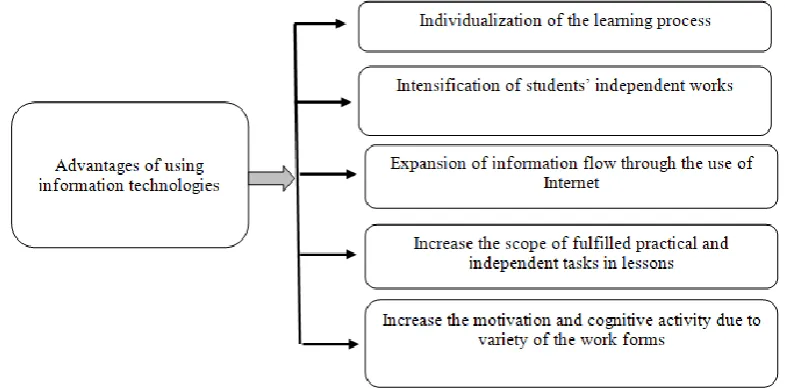
There are new information means and technologies, appearing each year, which are important from the viewpoint of education computerization. It is impossible to list and study all of them. It is important to understand that under certain conditions, most of these technologies can significantly influence the quality increase of teaching and upbringing of students (Fig. 1). Considering this problem, we conducted a number of researches, which included, at first, the analysis and generalization of previous researches in this direction, the study of opinions and definitions of scientists, working on the research topic, also a sociological survey of students was conducted, in which 224 respondents took part.
The results of the research showed that, despite being a large number of researches in this field, the formation of leadership by using information technologies stays behind. The results of the survey are given below.
Figure 1. Advantages of using information technologies
Analysis of educational programs
As shown by the analysis of the programs of academies and institutes, initiative, The analysis of the academies and institutes programs showed that despite initiative, implemented within the framework of educational initiatives, in most of them, there
internet websites, which could show them the possibilities of self-education and co-creation in developing network pedagogical communities, and also programs on developing modern models of e-learning (mobile learning, adaptive learning, etc.).
The content of training programs for the future teachers in the direction of their use in professional IT activities should be designed taking into account the laws of the IT competence formation.
Application of information technologies in the training of future teachers plays a great positive role not only in the rapid finding of information about the topic but also in the development of students’ independence in their search activities and in identifying the leadership capacities of them. Thus, the modern direction of education requires the future teacher to be professionally competent in accordance with the requirements of time and society, to have the skills of a leader-teacher, including the ability to motivate, plan and organize his professional activity.
To
leadership
through
information
technologies
To reveal the theme of our material, let us consider the notion of "leader" and in particular the notion of "leadership capacities of the teacher."
N.V.Kubarkova in her work "Leadership capacities of a teacher: essence and structure" defines a "leader" as a person who plays a key role in the group related to the direction, control, and change of the activities of other group members to achieve group goals. She also defines the notion of "leadership capacities of a teacher" as integral quality systems that ensure in the joint activities of the teacher and learner, the most rapid and successful achievement of the overall educational goals in a specific educational situation [8].
Followers of the situational concept of J.Hunt and W. K.Kassinelly [9] believed that a leader entirely depends on his
followers, as he is largely formed by the world surrounding him and the occurred situation.
L.Petrullo and B.Bass [10] understand leadership as a process that
arises from a specific set of environmental factors - cultural and group.
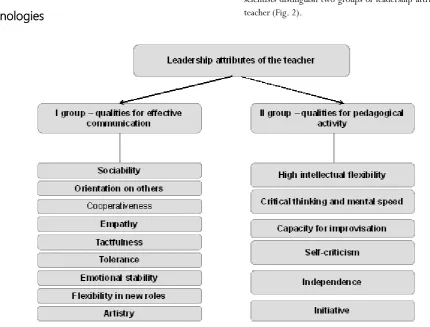
Taking into account the specifics of the pedagogical activity, scientists distinguish two groups of leadership attributes of the teacher (Fig. 2).
Figure 2. Main leadership attributes
After studying the research of scientists, we want to add that the main leadership attributes include the following qualities of personality: 1) independence; 2) discipline; 3) systematicity; 4) internal motivation; 5) reflection.
All of the above items confirm that the function and qualitative professional training of the future teacher during his studies at the university are inextricably linked.
Thus, we can conclude that the student can be a "leader" through his activities. The activity of the university is in the educational process, which should include the development of leadership attributes of students.
Journal of Advanced Pharmacy Education & Research | Apr-Jun 2019 | Vol 9 | Issue and professional IT competence, and the pedagogical conditions
that need to be designed, created, and improved [11].
IT competence of the modern teacher is one of the most important indicators of the success of his activities and at the same time, a necessary prerequisite for further improving his professional competence level, which determines the importance of developing the modern teachers’ systematic training, focused on the use of IT.
The conceptual basis for development of such programs can be considered as “Standards of teachers’ IT competence: modules of competency standards”, proposed by UNESCO, in which the emphasis is made not only on the need for the formation of teachers’ IT competence, but also focuses on the update of implemented IT traditional techniques, as well as teaching methods and technologies. After the development and official launch of multilingual versions of the “UNESCO ICT Competence Framework for Teachers (ICT-CFT)” in 2011-2012, this very document today is the basis for the development of national (regional) standards of IT competence of the teachers. At the same time, UNESCO proposals should be considered as guidelines and adapted taking into account the peculiarities of national, including Kazakhstan education systems, peculiarities of the computerization process, ethnonational cultural traditions, etc [12, 13].
Pedagogical conditions
The content of pedagogical education, enriched by the use of information technologies, which are associated with the acquisition of such key competencies as social, communicative, information, cognitive and special, will become much deeper and more meaningful when the following conditions are met:
creating real conditions for the training of teachers who can take an active part in the realization of national and regional programs of education computerization;
significant increase in the level of professional and general humanitarian interaction between teachers and students due to the possibility of joint projects, including telecommunications;
the appearance of qualitatively new conditions for the realization of the students’ creative potential by expanding the capabilities of traditional libraries and laboratories of the university through access to e-libraries and virtual laboratories, to scientific, educational and other culturally and socially significant resources of the internet websites;
improving the efficiency of students' independent work with traditional and electronic resources through developed systems for self-monitoring and support of feedback from the teacher;
realization of continuous open education, where students will be able to take an active part in the learning process, by choosing courses available at any time due to telecommunications.
The fulfillment of the above-listed conditions will contribute to achieving the main goal to improve the quality of education, increase the availability of education, ensure the needs of the harmonious development of the individual and the information society as a whole.
Set of measures in the educational process, which act as a result of targeted selection, design and application the content elements, methods and organizational forms of education and upbringing to achieve the goals, determine the pedagogical conditions.
Results
Based on all of the above, we present the results of our sociological survey, that the students of pedagogical specialties of universities took part.
The questionnaire consisted of 20 questions. Here are some. To the question: "In your opinion, what is the main role of the use of information technologies in the educational process of the University?" the respondents' response is arranged in the following order (table 1):
Тable 1: Respondents response
Answers Quantity of
respondents
Easy access to information 56
Development of learners’ creativity and leadership 98
Good presentation of the information for its best
acquisition 70
Table 1 shows that 31.3% of students had got developed visual memory, who remember information presented in the form of presentation, better. 25% of respondents preferred the ease of information mining, that shows the superficiality of knowledge. 43.8% of students preferred to deepen knowledge and the development of creative and leadership skills.
To the question: "Does the use of information technologies influence the development of activity in learning and deepening knowledge, also in the development of students’ leadership?" the answers are as follows (table 2):
Таble 2 Answers for question
Answers Quantity of respondents
No 33
Yes 115
Maybe, do not know 76
From the above-mentioned results of the sociological survey, it is clear that students were interested in the use of information technologies in the educational process of the university, and believed that they play an important role in the development of personal, creative and leadership skills of students [14].
Thus, we can state that the process of leadership formation in education and upbringing at the university is effective if only it is based on the internal activity of students, on the desire for self-improvement, education, independent acquisition of knowledge, interest in obtaining them using information technologies, its application in practice, caused by the whole course of the educational process.
Discussion
The application of information technologies allows the teacher and students to specify the material, clearly formulate the main idea, prepare an abstract, presentation, etc.
The most important characteristics of the pedagogical potential of information technologies include the expansion of extracurricular independent works of students, contributing to the conscious assimilation of learning.
A.V.Zoriina in her research considered the option of out-of-class work for the development of students’ leadership. For instance, to the question "Do you like to take part in various extracurricular activities, to be an active participant in studentship?" out of the 132 (52 %) students, gave a positive response, 85 people (33.5%) replied that "only to learn – is boring"; 42 students (16.5 %) explained that "it makes a variety into studentship"; 124 respondents (48,8 %) answered that they "like to make conversation after the lecture" [15].
We are in solidarity with the opinion of A.V.Zorina and also we considered the option of extracurricular use of information technologies in the educational aspect.
The object of the work was a pedagogical camp for schoolchildren. For teach children, video materials, presentations, video games, and psychological diagnostic tests were prepared. Various competitions were held. With all the abundance of methods, preference is given to the methods which are mostly simple and understandable for students, giving the most accurate result options. The set of techniques is determined with the purpose of the research and the conditions of conduction.
Application of information technologies in solving set objectives helps to form students' special skills: the use of laboratory instruments, observation of animals and plants, the formulation of the experiment and analysis of the gained results, and the definition of living objects. In addition, further development of intellectual skills, including the establishment of cause-and-effect relationships, generalization, comparison, the formation of conclusions. Participation in planning experiments, using directories helps to sustain skills in managing academic work. An important place in each of the works is given to intra-subject and inter-subject relations.
Thus, the use of information technologies in educational and extracurricular time is positive for the development and deepening of not only students’ knowledge and skills of but also the development of creative abilities, leadership attributes of future specialists.
Conclusion
Therefore, the successful completion of the workshop in an educational camp and the acquisition of relevant knowledge and skills has a positive impact on the creation of creative research projects of children, the development of the creative activity of each child.
Summing up the results of our research, we can conclude that the development of leadership qualities of the individual will be successful in the use of information technologies in educational activities if the educational process is organized through a system of theoretical and practical teaching.
Thus, the use of information technologies in the process of education and upbringing allows students, on the one hand – a creative approach to their learning activities, on the other – to find a new approach in solving a particular educational problem, on the third – to improve themselves, develop and become a leader.
References
1. Dahmarde, H. Khodabakhshi, M. & Mahmoodi Rad, Gh. (2018). Birjand teaching hospitals nurses’ attitude towards personal development plan. Pharmacophore, 9(3), 25-29.
2. Sarabi, N. (2019). Nursing Students' Experiences from Two Methods of Teaching: Film Preparation and Demonstration of Physical Examinations. International Journal of Pharmaceutical and Phytopharmacological Research, 9(2), pp.14-20.
3. Ibrahim, S. Azhar, A.S. Ather, A.S. Ahsan, A.S. Muneer, A.S. & Kaleem, A.S. (2019). Backache: Association with Stature, Posture and Work-Station Ergonomics in Information Technology Professionals-An Professionals-Analytical Study. International Journal of Pharmaceutical Research & Allied Sciences, 8(2):10-14. 4. Rakisheva, G. Abdirkenova,A. Abibulayeva, A. Seiitkazy, P. & Tazhetov, A. (2018). Tools of adaptation in the context of globalization of future teachers: transcultural competence, Entomol Appl Sci Lett, 5 (4): 49-55.
5. Yershov A., Computerization: from computer literacy of students to information culture of society // Kommunist. 1988. No. 2., 83 p.
Journal of Advanced Pharmacy Education & Research | Apr-Jun 2019 | Vol 9 | Issue 7. Venturelli S., Cultural Rights and World Trade
Agreements in the Information Society // Gazette. - 1998. - Vol. 1. - P. 59.
8. Kubarkova N.V. Leadership of a teacher: the essence and structure //Electronic scientific edition (scientific-pedagogical online magazine). January, 2012 (http://www.emissia.org/offline/2012/1772.htm) / date of application: 25.12.2015 15: 19 Crosscurrents in leadership. Leadership Symposia series. V. 5 [Text] / Ed. By J.G.Hunt Carbondale, 1979. - 635 p.
9. Kassinelly, C.W. Free activities and interpersonal relations [Text] /W. Kassinelly. - Hague, 1966. - pp. 66-67.
10. Pettrullo, L. Leadership and International Behavior [Text] / L. Pettrullo, B. Bass, - N. Y., 1964. - pp. 5-67.
11. Sarzhanova, G.B. and others. Information competence as a means of developing leadership qualities in student-teachers. International Journal of Environmental and Science Education, 2016.
12. World open educational resources congress: 2012 Paris OER declaration (2012). Paris, 20-22 june 2012. Paris: UNESCO.
13. Buckingham Shum S. Learning analytics: Policy Brief, November 2012. Moscow: UNESCO Institute for Information Technologies in Education, 2012. URL: http://iite.unesco.org/pics/publications/en/fi les/3214711.pdf.
14. Kadisha K.S., Alimbekova A.A. Competency Building Approach in Development of Leadership Skills of a To-Be Pedagogue. /World Applied Sciences Journal 30 (Management, Economics, Technology & Tourism): 149-152, 2014