The Journal of Threatened Taxa (JoTT) is dedicated to building evidence for conservation globally by publishing peer-reviewed articles online every month at a reasonably rapid rate at www.threatenedtaxa.org. All articles published in JoTT are registered under Creative Commons Attribution 4.0 International License unless otherwise mentioned. JoTT allows allows unrestricted use, reproduction, and distribution of articles in any medium by providing adequate credit to the author(s) and the source of publication.
www.threatenedtaxa.org
ISSN 0974-7907 (Online) | ISSN 0974-7893 (Print) Building evidence for conservation globally
Journal of Threatened Taxa
For Focus, Scope, Aims, Policies, and Guidelines visit https://threatenedtaxa.org/index.php/JoTT/about/editorialPolicies#custom-0 For Article Submission Guidelines, visit https://threatenedtaxa.org/index.php/JoTT/about/submissions#onlineSubmissions For Policies against Scientific Misconduct, visit https://threatenedtaxa.org/index.php/JoTT/about/editorialPolicies#custom-2 For reprints, contact <[email protected]>
Communication
The distribution of blue-green algae (Cyanobacteria) from
the paddy fields of Patan and Karad tehsils of Satara District,
Maharashtra, India
Sharada Jagannath Ghadage & Vaneeta Chandrashekhar Karande
26 November 2019 | Vol. 11 | No. 14 | Pages: 14862–14869 DOI: 10.11609/jott.4891.11.14.14862-14869
Partner
Member
Threatened Taxa
Publisher & Host
PLATINUMOPEN ACCESS
Communica
tion
DOI:https://doi.org/10.11609/jott.4891.11.14.14862-14869
Editor: Asheesh Shivam, Nehru Gram Bharati (Deemed to be University), Prayagraj, India. Date of publication: 26 November 2019 (online & print)
Manuscript details: #4891 | Received 14 February 2019 | Final received 10 October 2019 | Finally accepted 12 November 2019
Citation: Ghadage, S.J. & V.C. Karande.(2019). The distribution of blue-green algae (Cyanobacteria) from the paddy fields of Patan and Karad tehsils of Satara District, Maharashtra, India. Journal of Threatened Taxa 11(14): 14862–14869. https://doi.org/10.11609/jott.4891.11.14.14862-14869
Copyright: © Ghadage & Karande 2019. Creative Commons Attribution 4.0 International License. JoTT allows unrestricted use, reproduction, and distribution of this article in any medium by adequate credit to the author(s) and the source of publication.
Funding: None.
Competing interests:The authors declare no competing interests.
Author details: Sharada J. Ghadage graduated from the University of Kolhapur and is currently a research scholar with center for Yashwantrao Chavan Institute of Science, Satara. She is working as a senior assistant professor in S.G.M. college, Karad. She is currently working on one minor project - Effect of Azolla biofertilizer on soil quality and developmental stages of various crops, fnded by RUSA. Dr. Mrs. V. C. Karande has 36 years experience as a professor for PG and UG department in Botany subject Yashwantrao Chavan Institute of Science, Satara. She is working as a Head of Botany department as well as Vice Principal in Y.C. Institute of Science, Satara and is a BOS member in Shivaji University, Kolhapur. Also she worked as a science faculty Dean in Shivaji University, Kolhapur. She had completed two minor projects on biodiversity of blue green algae.
Author contribution: SJG - Conconceptualized study, collected and analyzed data, wrote final version of manuscript translated in the field, VCK - supervised study, helped in the revision of the manuscript.
Acknowledgements: We are thankful to Dr. K.G. Kanade, principal, Y.C. Institute. of Science, Satara for the encouragement during the work. Thanks are also due to the head Department of Botany Y.C. Institute of Science, Satara for the facilities. We are thankful to staff members and colleagues and friends for the keen interest and suggestions during this work.
The distribution of blue-green algae (Cyanobacteria) from
the paddy fields of Patan and Karad tehsils of Satara District,
Maharashtra, India
Sharada Jagannath Ghadage 1 & Vaneeta Chandrashekhar Karande 2
1,2 Department of Botany, Yashwantrao Chavan Institute of Science, Tal Karad, Satara District,
Maharashtra 415001, India.
1 [email protected] (corresponding author), 2 [email protected] Journal of Threatened Taxa | www.threatenedtaxa.org | 26 November 2019 | 11(14): 14862–14869
Abstract: The distribution pattern of blue-green algae was studied from paddy fields of Patan and Karad tehsils in relation to physico-chemical properties of soil, viz., pH, electrical conductivity, organic carbon %, available N, P, and K. Paddy field soil samples of 38 localities from Patan and 28 localities from Karad were analysed. One-hundred-and-thirty-seven species belonging to 35 genera of 10 families from three orders were encountered from paddy field soils of both the tehsils. Out of 66 soil samples 93.65% samples showed occurrence of unicellular, heterocystous and non heterocystous forms while 6.34% soil samples showed only non heterocystous forms. Anabaena and Oscillatoria were found to be of common occurrence. Significant variation was not observed in distribution pattern of blue-green algal forms in relation to physico-chemical properties during successive surveys.
Keywords: Cyanobacteria, heterocystous, physico-chemical parameters, soil samples. ISSN 0974-7907 (Online)
ISSN 0974-7893 (Print)
Distribution of blue-green algae in paddy fields Ghadage & Karande
Journal of Threatened Taxa | www.threatenedtaxa.org | 26 November 2019 | 11(14): 14862–14869 14863
INTRODUCTION
Blue-green algae are the first photosynthetic prokaryotes which emit oxygen in the atmosphere. Cyanobacteria are the connecting link between bacteria, eukaryotic algae, and higher plants. They resemble bacteria in the lack of membrane bound organelles like true nucleus, chloroplast, and mitochondria (Feldgarden & Cohn 2003); and they contain a photosynthetic system like that of eukaryotic algae and green plants (Castenholz & Waterbury 1989).
They contain bluish-green colored pigment phycocyanin where ‘cyan’ means dark blue, hence the name ‘Cyanobacteria’ and this pigment in conjunction with green chlorophyll, hence the common name is ‘Blue-green algae’. Besides chlorophyll, other pigments also present and giving different coloration to them are carotenoids, phycobilins (phycocyanin, phycoerythrin). They also appear bluish, purple, brown, black and green in color (Kondo & Yasuda 2003).
Blue-green algae are important components of soil microflora in the paddy field. They play an important role in maintaining and improving soil fertility as they have the ability to fix nitrogen. Rice fields provide ideal environment for luxuriant growth of blue-green algae. They are found in paddy field soil throughout the year at various growth stages of the rice crop. The occurrence, distribution and proliferation of those blue-green algae is controlled by the physical and chemical nature of the paddy field soil. These parameters of soil show profound effect on the distribution of blue-green algae (Nayak et al. 2004).
Extensive work on the blue-green algae of paddy fields has been carried out in various regions of India, viz., West Bengal, Kerala, Chattisgarh, Manipur, Mizoram, Uttar Pradesh, Madhya Pradesh, Odisha, Tamil Nadu, and Maharashtra, and in Bangladesh (Banarjee 1935; Goyal et al. 1984; Anand & Revati 1987; Anand et al. 1987, 1995; Sahu et al. 1997; Ahmed 2001; Nayak et al. 2001). There have been some reports on the growth and nitrogen fixation potentials of blue-green algae (Gupta 1964; Prasad & Mehrotra 1980; Santra 1991). Marked variations among the species of blue-green algae from rice field soils of different regions of India have been recorded by Tiwari (1972), Sinha & Mukherjee (1975a,b; 1984), and Anand (1990). The effect of soil pH on the blue-green algal diversity in rice field soils was studied by Singh (1978), Sardeshpande & Goyal (1981b), and Nayak & Prasanna (2007).
Studies on blue-green algal flora from the paddy fields of Maharashtra were undertaken by Gonzalves & Gangla
(1949), Sardeshpande & Goyal (1981a); Kolte & Goyal (1985), Patil & Satav (1986), Madane & Shinde (1993), and Patil & Chougule (2009). Biodiversity of blue-green algae from the paddy fields of Satara District was studied by Karande (2009); and Kamble (2010, 2017). Blue-green algal diversity other than paddy was studied by Kamat (1962, 1963, 1964, 1974); Jawale & Kumawat (2004); Auti & Pingle (2006), and Nikam et al. (2013). There is, however, no report on the blue-green algal distribution pattern in relation to physicochemical properties of paddy soil from Patan and Karad tehsils of Satara District, hence the present work.
MATERIALS AND METHODS
Study Area
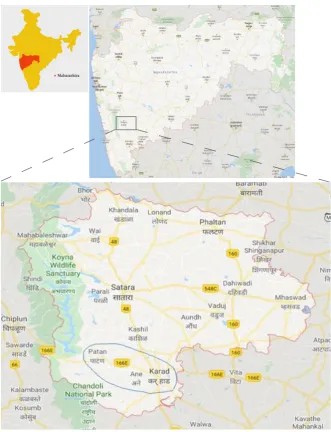
For the present work paddy fields were selected from Patan and Karad tehsils of Satara, Maharashtra. Patan is 65km away to the south-west of Satara. It is located at 17.3700N and 73.9000E. Most of Patan Tehsil is hilly with
deep valleys while some part is plains. It receives heavy rainfall. Common soil is red lateritic soil, in plains it is black cottony soil while at elevations it is of basaltic and lateritic type. This tehsil is famous for cultivation of local varieties of paddy, viz.: Dombya, Dodkya, Kolambya, Bhados, Panwel, Indrayani, Champakali, Ghansal, Jiresal, Teliansh 6444, Kaveri 888, Krishnakusal, Basmati, and Ambemohar.
Karad is 52km away to the south-east of Satara. It is located at 17.2890N and 74.1810E. Karad city situated
at southern part of Satara District near Agashiva, at the confluence of Koyna and Krishna rivers which is called ‘Preeti sangam’. The tehsil receives moderate rainfall and the common soil type is black cottony soil. It is famous for cultivation of local varieties of rice, viz.: Indrayani, Rethare Basmati, Pusa Basmati, Hansa, Khadkil Kolhapuri, Kolhapuri R-24, and Kaveri.
(Tables 3 and 4).
From above sieved soil about 1g of soil transferred aseptically to BG 11 + and BG 11- medium (Rippka et al. 1979), Fogg’s medium and chu 10 medium. We found good results in BG 11 ± medium, so for further culturing and sub culturing we prefer BG 11 ± medium. These cultures were incubated at 22±2˚c with 16/8 light dark cycle under 5 Klux intensity of light, after incubation algal growth appeared in enriched cultures in laboratory. Cyanobacterial growth from enriched cultures were examined microscopically and identified with the help of standard literature (Dasikachary 1959; Santra 1993; Anand 1990; Anagnostidis & Komarek 1985). Photographs were taken by using photomicrography unit of Olympus CH20i (Photoplates II, III).
The composition of BG 11 culture media
BG-11 Medium (Allen 1968; Allen & Stainer 1968; Rippka et al. 1979)
Component g L -1
K2HPo4 0.04
MgSO4.5H2O 0.075
Cacl2.2H2O 0.036
Citric acid 0.006
Ferric Ammonium Citrate 0.006
EDTA 0.001
Na2CO3 0.002
Trace Metal Mix (A5) 1ml
The trace metal mixture A5 solution contained the following constituents in
Distribution of blue-green algae in paddy fields Ghadage & Karande
Journal of Threatened Taxa | www.threatenedtaxa.org | 26 November 2019 | 11(14): 14862–14869 14865
Salts g L-1.
H3BO3 2.86
MnCl2.4H2O 1.81
ZnSO4.7H2O 0.222
Na2MoO4.2H2O 0.390
CuSO4.5H2O 0.079
CO(NO3)2.6H2O 0.049
pH was maintained in 7–7.5
RESULT AND DISCUSSION
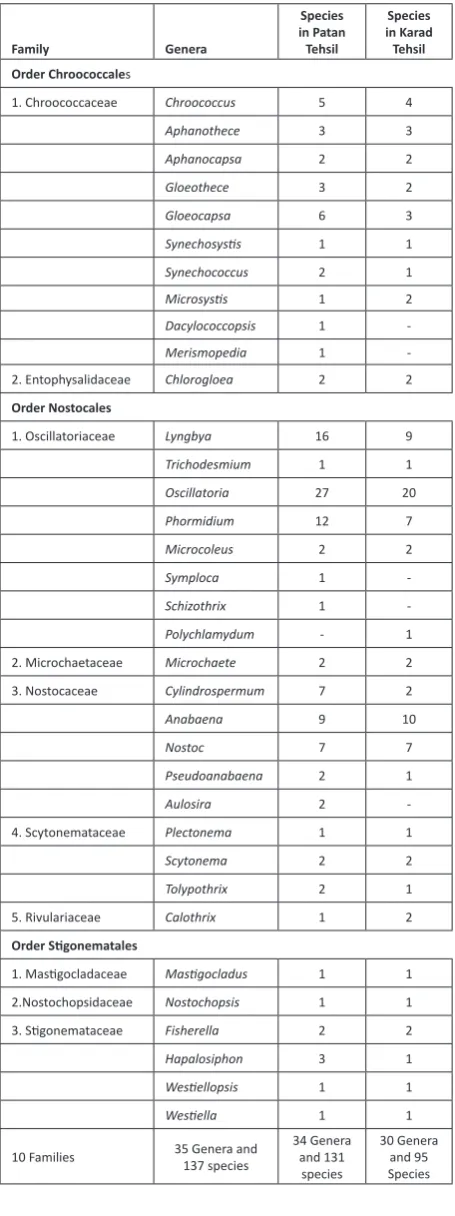
Thorough screening of 66 paddy field soil samples collected and cultured from study area have shown occurrence of 137 species belonging to 35 genera of 10 families from three orders, viz., Chroococcales, Nostocales, and Stigonematales (Table 1). Of the 35 genera isolated from soil samples 11 are unicellular and 24 are filamentous. Among filamentous taxa; 10 were filamentous non-heterocystous and 14 are filamentous heterocystous. Filamentous heterocystous forms are found to be dominant over filamentous non-heterocystous forms. Among the heterocystous form order Nostocales found to be dominant. The abundance and distribution of heterocystous forms may be indicating the lower nitrogen status in study region. Species richness was found in the genus Oscillatoria. The most widespread genus from the paddy field soils of study region is Anabaena followed by
Oscillatoria and Lyngbya. The observations of the present study do not differ much from those by Anand et al. (1995), where it was reported that the genera Oscillatoria and
Phormodium were predominant in rice fields of Kerala. Thirty-four genera and 131 species from Patan and 30 genera and 95 species from Karad were recorded (Table 1); 63.50% taxa showed common occurrence, 32.11% taxa restricted to paddy soils of Patan while 4.37% taxa found in paddy field soils of Karad. Nine forms strictly restricted to paddy field soils of Patan, viz., Synechosystis,
Westiellosis, Aulosira, Symploca, Schizothrix,
Merismopedia, Trichodesmium, Cylindrospermum, and
Dacyloccocopsis while Polychlamydum is a rare form
restricted to paddy field soils of Karad. Order Nostocales found to be largest order in the family Oscillatoriaceae. Genera Oscillatoria, Lyngbya, and Phormidium belonging to family Oscillatoriaceae and genera Anabaena and
Nostoc belonging to the family Nostocaceae were found to be dominant from paddy soils of both the tehsils.
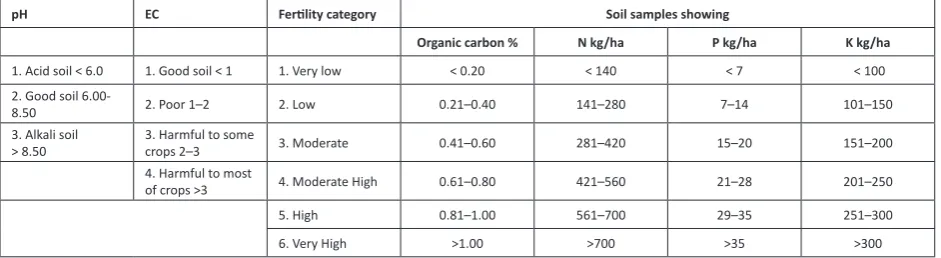
Analysis of paddy field soils (38 localities from Patan and 28 localities from Karad) by applyingstandards of soil parameters required for agriculture were conducted (Table 2). Soil analysis showed that pH and EC of majority
Table 1. Total number of species from Patan and Karad tehsils.
Family Genera Species in Patan Tehsil Species in Karad Tehsil Order Chroococcales
1. Chroococcaceae Chroococcus 5 4
Aphanothece 3 3
Aphanocapsa 2 2
Gloeothece 3 2
Gloeocapsa 6 3
Synechosystis 1 1
Synechococcus 2 1
Microsystis 1 2
Dacylococcopsis 1
-Merismopedia 1
-2. Entophysalidaceae Chlorogloea 2 2
Order Nostocales
1. Oscillatoriaceae Lyngbya 16 9
Trichodesmium 1 1
Oscillatoria 27 20
Phormidium 12 7
Microcoleus 2 2
Symploca 1
-Schizothrix 1
-Polychlamydum - 1
2. Microchaetaceae Microchaete 2 2
3. Nostocaceae Cylindrospermum 7 2
Anabaena 9 10
Nostoc 7 7
Pseudoanabaena 2 1
Aulosira 2
-4. Scytonemataceae Plectonema 1 1
Scytonema 2 2
Tolypothrix 2 1
5. Rivulariaceae Calothrix 1 2
Order Stigonematales
1. Mastigocladaceae Mastigocladus 1 1
2.Nostochopsidaceae Nostochopsis 1 1
3. Stigonemataceae Fisherella 2 2
Hapalosiphon 3 1
Westiellopsis 1 1
Westiella 1 1
10 Families 35 Genera and 137 species 34 Genera and 131 species
of the paddy soils from both the tehsils are in good range (Tables 3 and 4). Organic carbon % form paddy field soils of Patan ranged from 0.31–0.106 %; while that of Karad ranged from 0.73–0.87 % by applying standards of soil parameters; the organic carbon % from paddy field soils of Patan was higher than paddy field soils of Karad (Table 3 and 4). Blue-green algal abundance was recorded to be more in paddy soils of Patan than Karad. The total nitrogen from Patan ranged 150.5–410 kg/ha and that of Karad 61.1–323.4 kg/ha found to be favorable for the distribution of blue-green algal forms. The range of available N from both the tehsils when compared with standards (Table 2) indicated that the low to moderate nitrogen content (Tables 3 & 4)did not affect the blue-green algal abundance. Roger & Kulasooriya (1980) reported that under deficiency of nitrogen in soil condition, nitrogen fixing blue-green algae show their dominance. Our observations are in concordance with those proposed by them.
Available P in Patan ranged 62.7–168 kg/ha and Karad ranged 20.1–56 kg/ha showed blue-green algal abundance. Majority of the localities showed fertility category lowto moderate (Tables 3 & 4) when compared with standards from both the tehsils and even though it did not affect blue-green algal dominance. According to Fuller & Rogers (1952), Cyanobacteria are responsible for increased soil phosphorous. Majority of the localities showed average concentrations of phosphorous. Our observations about available phosphorous of paddy soils of Karad support them, but only up to some extent. Available K from Patan paddy field soils ranged 304.6–647.3 Kg/ha and from Karad ranged 145.6–676.4 kg/ha, respectively. Majority localities showed moderate and high range of available K and blue-green algal abundance observed at this range. There is no significant correlationfound in concentration of P and blue-green algal distribution from both the tehsils paddy field soils.
Among the soil properties pH is most important factor
which determines growth, establishment and diversity of Cyanobacteria. Blue-green algae generally prefer neutral to slightly alkaline pH for optimum growth (Singh 1961). Our observations support this view as majority of the soil samples from the study area showed neutral to alkaline pH ranging 7–8.40 with occurrence of abundant blue-green algae. pH values of various localities showed significant positive correlation. In culture media the optimal pH for the growth of Cyanobacteria ranges 7.5–10. Abundance of blue-green algae is observed at the pH 6.5–7.5 in our experiments. Low available Nitrogen and Potassium does not affect blue-green algal dominance. Paddy field soil of Patan was rich in organic carbon % while that of Karad showed less organic carbon %. This may be the reason for blue-green algal dominance from paddy soils of Patan area. There was no remarkable role of available phosphorous noted on the blue-green algal dominance from study area.
Different unicellular, heterocystous filamentous and non-heterocystous filamentous forms were isolated, identified and maintained in unialgal culture. Blue-green algal forms were more or less evenly distributed in the rice fields of both the tehsils. Out of 66 soil samples 93.65% samples contained unicellular, heterocystous and non heterocystous forms; 6.34% contained only non heterocystous forms.
Patan is famous for paddy cultivation, traditional cropping system, use of local varieties for cultivation and favorable climatic conditions favours luxuriant growth of paddy in Patan area. Hence we recorded blue-green algal dominance from paddy field soils of Patan . Observations suggested that soil from both the tehsils is nutritionally rich. Understanding of blue-green algal flora and its correlation with soil parameters will help in applying fertilzers, it will also help in enhancing the nitrogen fixing blue-green algae and reducing non nitrogen fixers which usually compete with the all available nutrients with the nitrogen fixers.
Table 2. Standard of soil parameters required for agriculture (Somawanshi et al. 1999).
pH EC Fertility category Soil samples showing
Organic carbon % N kg/ha P kg/ha K kg/ha
1. Acid soil < 6.0 1. Good soil < 1 1. Very low < 0.20 < 140 < 7 < 100 2. Good soil
6.00-8.50 2. Poor 1–2 2. Low 0.21–0.40 141–280 7–14 101–150
3. Alkali soil
> 8.50 3. Harmful to some crops 2–3 3. Moderate 0.41–0.60 281–420 15–20 151–200
4. Harmful to most
of crops >3 4. Moderate High 0.61–0.80 421–560 21–28 201–250
5. High 0.81–1.00 561–700 29–35 251–300
Distribution of blue-green algae in paddy fields Ghadage & Karande
Journal of Threatened Taxa | www.threatenedtaxa.org | 26 November 2019 | 11(14): 14862–14869 14867 Table 3. Numerical analysis for fertility category of soil samples from Patan Tehsil, Satara District.
pH EC Fertility status No. of soil samples showing
Organic carbon
% Available N kg/ha Available P kg/ha Available K kg/ha
1
37 soil samples with Good soil pH; except soil sample of Rasati with acidid i. e. 5.68 p H
37 soil samples have good Ec. Except Soil sample of Konjawde having 1.48 Ec; Which is not good for seed germination
Very low 02 08 - 01
2 Low 13 15 05 01
3 Moderate 04 09 03 02
4 Moderate high 04 03 06 10
5 High 06 02 04 04
6 Very high 09 01 20 20
Total 38 38 38 38 38 38
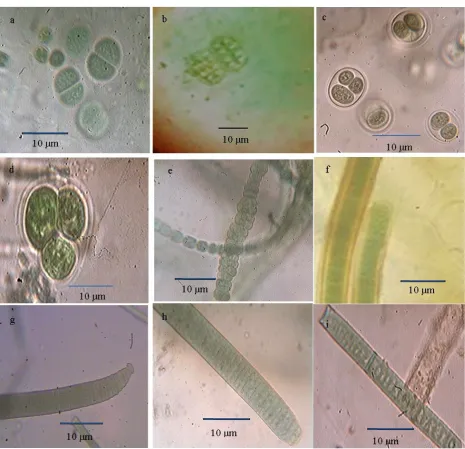
Image 1. a—Aphanothece pallida | b—Merismopedia tenuissima | c—Gloeocapsa livida | d—Chroococcus turgidus | e—Chlorogloea fritschii
Journal of Threatened Taxa | www.threatenedtaxa.org | 26 November 2019 | 11(14): 14862–14869
14868
Table 4. Numerical analysis for fertility category of soil samples from Karad Tehsil, Satara District.
pH EC Fertility status No. of soil samples showing
Organic carbon % Ava. N kg/ha Ava. P kg/ha Ava. K kg/ha
1
All 28 soil samples with Good soil pH
27 soil samples have good Ec.Soil sample of Talbid having 1.16 Ec; Which is not good for seed germination
Very low 07 08 01
-2 Low 10 17 05 02
3 Moderate 04 01 05 03
4 Moderate high 06 02 02 02
5 High - 03 03
6 Very high 01 12 18
Total 28 28 28 28 28 28
Image 2. a—Anabaena fertilissima | b—Nostoc rivulare | c—Calothrix bharadwajae | d—Calothrix fusca | e—Nostochopsis lobatus | f—
Distribution of blue-green algae in paddy fields Ghadage & Karande
Journal of Threatened Taxa | www.threatenedtaxa.org | 26 November 2019 | 11(14): 14862–14869 14869
REFERENCES
Allen, M. (1968). Simple conditions for growth of unicellular blue green algae on plates. Journal of Phycology 4: 1–4.
Allen, M. & R. stanier (1968). Selective isolation of blue green algae from water and soil. Journal of General Microbiology 51: 203–209. Anand, N. (1990). A hand book of Blue green algae. Bishen singh,
Mahendra pal singh, Dehra Dun. pp.1–79.
Anand, N., R.S. Hooper & S. Kumar (1995 ). Distribution of blue – green algae in rice fields of Kerla state, India. Phykos 35: 55–64.
Anand, N., S. Kumar & R.S. Hooper ( 1987 ). Blue- green algae from rice fields in Kerala state, India. Hydrobiologia 144: 223–232.
Anand, N. & G. Revathi ( 1987 ). Blue green algae from rice fields of Tamil Nadu. Phykos 26: 17–21.
Ahmed, S.U. (2001). Distribution pattern of blue green algae in rice field soils of Hojai sub-division of Assam. Phykos 40 (1 and 2) : 33–38. Anagnostidis, K. & J. Komarek (1985). Modern approach to the
classification system of cyanophytes 1 - Introduction. Arch Hydrobiology supplement 71. Algologicalstudies 38/39: 291–302. Auti, B.K. & S.D. Pingle (2006). Nostocales from Northern circle of
Ahmednagar district ( M. S. ) Indian Hydrobiology 9(2) : 147–150. Banarjee, J.C. (1935). On algal found on soil samples from alluvial paddy
field of Faridpur, Bengal, Science Culture. Journal : 298.
Castenholz, R.W. & J.B. Waterbury(1989). In: Staley, J.T., M. P. Bryant, N.P. fenningand & J.G. Holt (eds.). Bergey’s Mannual of Systematic Bacteriology - Vol. 3. Williams and Wilkins, Baltimore, 1710–1727. Desikachary, T.V. (1959). Cyanophyta. Indian council of Agricultural
Research, New Delhi, 685pp.
Feldgarden, M.N. Byrd M. S. & F.M. Cohan (2003). Gradual evolution in bacteria: evidence from Bacillus systematics. Microbiology 149: 3565–3573.
Fuller, W.H. & R.N. Roger (1952). Utilization of the Phosphorous of the algal cells as measured by the Neubauer technique. Soil Science 74: 417
Goyal, S.K., B.M. Shrama & R.S. Gupta (1984). Algal flora of rice field soils of Jammu and Kashmir states. Phykos 23: 59–64.
Gonzalves, E.A. & K.S. Gangla (1949). Observations on the algae of paddy field soils. Journalof University Bombay 18 : 51–59.
Gupta, A.B. (1964). Algal flora and its importance in the economy of rice fields. Hydrobiologia 38: 213–222.
Jawale, A.K. & D.A. Kumawat (2004). Some blue green algae from Maharashtra in National Symposium on Biology and Biodiversity of fresh water algae. Chennai, 37pp.
Kamat, N.D. (1962). The Cyanophyceae and Chlorophyceae of Panhala. Journal of University Bombay 30: 22–31.
Kamat, N.D. (1963). The Algae of Kolhapur, India. Hydrobiologia 22 (3 & 4): 209–305.
Kamat, N.D. (1964). The Algae of Mahabaleshwar. Journal of University Bombay 31: 28–41.
Kamat, N.D. (1974). Algae of Marathwada, Maharashtra. Phykos 13(1 & 2) : 22–32.
Karande, C.T. (2009). Cyanobacterial biodiversity in paddy fields from Satara district - A project submitted to UGC.
Kamble, P.B. (2010). Isolation purification and biochemical characterization of blue green algae from paddy field soils of Satara district - MPhil Dessertation submitted to Shivaji university, Kolhapur, 125pp.
Kamble, P.B. (2017). Studies on Filamentous blue green algae from Satara district Maharastra. PhD Thesis submitted to Shivaji University, Kolhapur, 278pp.
Kolte, S.O. & S.K. Goyal (1985). Distribution pattern of blue green algae in rice field soils of Vidarbha region of Maharashtra state. Phykos 24: 156–162.
Kondo, M. & M. Yasuda(2003). Seasonal changes in N2 fixation activity
and environment in paddy soils of Japan. Japan Agricultural Research Quarterly 37: 105–111.
Madane, N.P. & P.A. Shinde (1993). Blue-green algae in salt affected soils of Kolhapur district (M. S.) Journal of Maharashtra Agricultural Universities 18: 289–290.
Nayak, S. & R. Prasanna (2007). Soil pH and its role in cyanobacterial abundance and diversity in rice field soils. Applied ecology and environmental Research 5(2): 103–113.
Nayak, S., R. Prassana, T.K. Dominic & P.K. Singh (2001). Floristic abundance and relative distribution of different cyanobacterial genera in rice field soil at different crop growth stages. Phykos 40: 14–21. Nayak, S., R. Prasanna, T.K. Dominic & P.K. Singh (2004). Effect of BGA –
Azolla biofertilizers on nitrogen fixation and chlorophyll accumulation at different depths in soil cores. Biology and Fertility of Soils 40: 67–72. Nikam, T.D., J.N. Nehul, Y.R. Gahile, B.K. Auti, M.L. Ahire, K.M. Nitnaware, B.N. Joshi & N. Jawali (2013). Cyanobacterial diversity in Western Ghats region of Maharashtra, India. Bioremediation, Biodiversity and Bioavailability 7(1): 70–80.
Patil, S.R. & B.B. Chaugule (2009). Diversity of blue green algae in paddy fields of Western Maharashtra IndianHydrobiology 12: 89–94. Patil, P.L. & S.D. Satav (1986). A study of nitrogen fixing blue green algae
from rice fields of Western Maharashtra Phykos 25(1 & 2): 113–116. Prasad, B.N. & R.K. Mehrotra (1980). Blue green algae of paddy fields of
U.P. Phykos 19: 121–128.
Rippka, R., J. Deruelles, J.H. Waterbury, M. Berdman & R.Y. Stanier (1979). Generic assignments and strain histories and properties of pure cultures of Cyanobacteria. Journal of General Microbiology III: 1–61
Roger, P.A. & S.A. Kulasooriya (1980). Book of blue green algae and Rice. The International Rice Research Institute, Los Banos, Laguna, Philippines, 117pp.
Santra, S.C. (1991). Rice field blue green algae (Cyanobacteria) and its utilization prospects as biofertilizer in West Bengal, India, Proceeding of National Symposium On Cyanobacterial Nitrogen fixation New Delhi, 385–389pp.
Santra, S.C. (1993). Biology of Rice Fields Blue Green Algae. Daya Publishing House, New Delhi, 184pp.
Sardeshpande, J.S. & S.K. Goyal (1981a). Distributional pattern of blue green algae in rice field soils of Konkan region of Maharashtra State. Phykos 20: 102–106
Sardeshpande, J.S. & S.K. Goyal (1981b). Distribution pattern of blue green algae in rice field soils of Konkan region of Maharashtrra State. Phykos 20: 102–106.
Sinha, J.P. & D. Mukherjee (1975a). On Blue green algae from the paddy fields of Bankura district of West Bengal - I. Phykos 14(1 & 2): 117–118. Sinha, J.P. & D. Mukherjee (1975b). On Blue green algae from the paddy fields of Bankura district of West Bengal - II. Phykos 14 (1 & 2): 119– 120.
Sinha, J.P. & D. Mukherjee (1984). Blue green algae from the paddy fields of Bankura District of West Bengal - III. Phykos 23(1 & 2): 142–143. Sahu, J. K., H. Naik & S.P. Adhikary (1997). Blue green Algae of rice field
soils of Orissa state - I Distributional pattern in different agroclimatic zones. Phykos 35: 93–110.
Singh, R.N. (1961).Role of blue green algae in the nitrogen economy of Indian agriculture. Indian council of Agricultural Research, New Delhi, 175pp.
Singh, P.K. (1978). Nitrogen economy of rice soils in relation to nitrogen fixation by blue green algae and Azolla, pp. 12–23. In: Proceeding of National, Symposium On increasing rice yield in Kharif (CFRI, India). Somawanshi, R.B., A.D. Kadlag, A.N. Deshpande, B.D. Tamboli, P.P.
Kadu & B.D. Bhakare (1999). A Book of Laboratory methods for analysis of soils, irrigation water and plants. 230pp.
Tiwari, G.L. (1972). Study of blue green algae from paddy field soils of India. Hydrobiologia 29: 335–350.
ISSN 0974-7907 (Online) | ISSN 0974-7893 (Print)
November 2019 | Vol. 11 | No. 14 | Pages: 14787–14926 Date of Publication: 26 November 2019 (Online & Print)
DOI: 10.11609/jott.2019.11.14.14787-14926
www.threatenedtaxa.org
The Journal of Threatened Taxa (JoTT) is dedicated to building evidence for conservation globally by publishing peer-reviewed articles online every month at a reasonably rapid rate at www.threatenedtaxa.org. All articles published in JoTT are registered under Creative Commons Attribution 4.0 International License
unless otherwise mentioned. JoTT allows allows unrestricted use, reproduction, and distribution of articles in any medium by providing adequate credit to the author(s) and the source of publication.
Announcement
The Sally Walker Conservation Fund -- an appeal for support – P. 14787
Communications
Complementary bat (Mammalia: Chiroptera) survey techniques uncover two new country records for Nigeria
– Iroro Tanshi, Anthony Ekata Ogbeibu & Paul Jeremy James Bates, Pp. 14788–14801
Bone fractures in roadkill Northern Tamandua Tamandua mexicana
(Mammalia: Pilosa: Myrmecophagidae) in Costa Rica
– Randall Arguedas, Elisa C. López & Lizbeth Ovares, Pp. 14802–14807
Barilius torsai (Teleostei: Cypriniformes: Cyprinidae), a new freshwater fish from the Brahmaputra drainage, India
– Kavita Kumari, Manas Hoshalli Munivenkatappa, Archana Sinha, Simanku Borah & Basanta Kumar Das, Pp. 14808–14815
Butterfly diversity throughout Midnapore urban area in West Bengal, India – Surjyo Jyoti Biswas, Debarun Patra, Soumyajit Roy, Santosh Kumar Giri, Suman Paul & Asif Hossain, Pp. 14816–14826
Plant and fungi diversity of Devi Pindiyan Valley in Trikuta Hills of northwestern Himalaya, India
– Sajan Thakur, Harish Chander Dutt, Bikarma Singh, Yash Pal Sharma, Nawang Tashi, Rajender Singh Charak, Geeta Sharma, Om Prakash Vidyarthi, Tasir Iqbal, Bishander Singh & Kewal Kumar, Pp. 14827–14844
A checklist of rust fungi from Himachal Pradesh, India – Ajay Kumar Gautam & Shubhi Avasthi, Pp. 14845–14861
The distribution of blue-green algae (Cyanobacteria) from the paddy fields of Patan and Karad tehsils of Satara District, Maharashtra, India
– Sharada Jagannath Ghadage & Vaneeta Chandrashekhar Karande, Pp. 14862–14869
Short Communications
Cordia diffusaK.C. Jacob, the Kovai Manjack (Boraginaceae):a highly threatened steno-endemic species from Coimbatore City, Tamil Nadu, India – S. Arumugam, K. Sampath Kumar, B. Karthik & V. Ravichandran, Pp. 14870– 14875
New distribution records in the orchid flora of Tripura, India – Arjun Adit, Monika Koul & Rajesh Tandon, Pp. 14876–14885
Notes on the extended distribution of Humboldtia bourdillonii (Fabales: Fabaceae), an Endangered tree legume in the Western Ghats, India – Anoop P. Balan, A.J. Robi & S.V. Predeep, Pp. 14886–14890
Notes
Vertebrate prey handling in the Indian Grey Hornbill Ocyceros birostris
(Aves: Bucerotiformes: Bucerotidae) – James A. Fitzsimons, Pp. 14891–14894
Impact of cyclone Fani on the breeding success of sandbar-nesting birds along the Mahanadi River in Odisha, India
– Subrat Debata, Pp. 14895–14898
First record of the micromoth Ethmia lineatonotella (Moore, 1867) (Lepidoptera: Depressariidae: Ethmiinae) from Bhutan
– Jatishwor Singh Irungbam & Meenakshi Jatishwor Irungbam, Pp. 14899–14901
Additional distribution records of the rare Nepal Comma
Polygonia c-album agnicula (Moore, 1872) (Insecta: Lepidoptera: Nymphalidae) from Rara National Park, Nepal
– Sanej Prasad Suwal, Biraj Shrestha, Binita Pandey, Bibek Shrestha, Prithivi Lal Nepali, Kaashi Chandra Rokaya& Bimal Raj Shrestha, Pp. 14902–14905 A new distribution record of the gall midge Octodiplosis bispina Sharma (Diptera: Cecidomyiidae) from the Western Ghats of Tamil Nadu, India – Duraikannu Vasanthakumar, Radheshyam Murlidhar Sharma & Palanisamy Senthilkumar, Pp. 14906–14907
New recruitment of staghorn corals in the Gulf of Mannar - the emergence of a resilient coral reef
– Koushik Sadhukhan, Ramesh Chatragadda, T. Shanmugaraj & M.V. Ramana Murthy, Pp. 14908–14911
New records of coral diseases in the Persian Gulf
– Parviz Tavakoli-Kolour & Sanaz Hazraty-Kari, Pp. 14912–134913
Crepidium aphyllum (Orchidaceae), a new record from Bhutan – Kinley Rabgay & Pankaj Kumar, Pp. 14914–14916
Rediscovery, after over a century, of the endemic climbing vine
Argyreia lawii (Convolvulaceae) from the Western Ghats of India – Pramod R. Lawand, Rajaram V. Gurav & Vinod B. Shimpale, Pp. 14917–14920
Linostoma decandrum (Roxb. ) Wall. ex Endl. (Thymelaeaceae): an addition to the flora of Andaman Islands, India
– L. Rasingam & K. Karthigeyan, Pp. 14921–14922
On the floral biology and pollination of a rare Twining Liana
Sarcolobus carinatus Wall. (Asclepiadoideae: Apocynaceae) in Coringa Mangrove Forest, Andhra Pradesh, India
– A.J. Solomon Raju, Pp. 14923–14926
Partner
Member
Publisher & Host
PLATINUM