Very Sparse Random Projections
Ping Li
Department of Statistics Stanford University Stanford CA 94305, USA[email protected]
Trevor J. Hastie
Department of Statistics Stanford University Stanford CA 94305, USA[email protected]
Kenneth W. Church
Microsoft Research Microsoft Corporation Redmond WA 98052, USA[email protected]
ABSTRACT
There has been considerable interest in random projections, an approximate algorithm for estimating distances between pairs of points in a high-dimensional vector space. Let
A∈Rn×D be our npoints inD dimensions. The method multipliesAby a random matrixR∈RD×k, reducing the D dimensions down to just k for speeding up the compu-tation. Rtypically consists of entries of standard normal N(0,1). It is well known that random projections preserve pairwise distances (in the expectation). Achlioptas proposed sparse random projections by replacing the N(0,1) entries inRwith entries in {−1,0,1}with probabilities {1
6, 2 3,
1 6},
achieving a threefold speedup in processing time.
We recommend usingRof entries in{−1,0,1}with prob-abilities{2√1 D,1− 1 √ D, 1
2√D}for achieving a significant
√
D-fold speedup, with little loss in accuracy.
Categories and Subject Descriptors
H.2.8 [Database Applications]: Data MiningGeneral Terms
Algorithms, Performance, Theory
Keywords
Random projections, Sampling, Rates of convergence
1.
INTRODUCTION
Random projections [1, 43] have been used in Machine Learning [2, 4, 5, 13, 14, 22], VLSI layout [42], analysis of La-tent Semantic Indexing (LSI) [35], set intersections [7, 36], finding motifs in bio-sequences [6, 27], face recognition [16], privacy preserving distributed data mining [31], to name a few. The AMS sketching algorithm [3] is also one form of random projections.
We define a data matrixAof sizen×Dto be a collection ofn data points{ui}ni=1 ∈RD. All pairwise distances can
Permission to make digital or hard copies of all or part of this work for personal or classroom use is granted without fee provided that copies are not made or distributed for profit or commercial advantage and that copies bear this notice and the full citation on the first page. To copy otherwise, to republish, to post on servers or to redistribute to lists, requires prior specific permission and/or a fee.
KDD’06, August 20–23, 2006, Philadelphia, Pennsylvania, USA. Copyright 2006 ACM 1-59593-339-5/06/0008 ...$5.00.
be computed asAAT, at the cost of timeO(n2D), which is
often prohibitive for largenandD, in modern data mining and information retrieval applications.
To speed up the computations, one can generate a ran-dom projection matrixR∈RD×kand multiply it with the original matrixA∈Rn×Dto obtain a projected data matrix
B=√1
kAR∈R
n×k
, kmin(n, D). (1)
The (much smaller) matrixB preserves all pairwise dis-tances of A in expectations, provided that R consists of i.i.d. entries with zero mean and constant variance. Thus, we can achieve a substantial cost reduction for computing
AAT, fromO(n2D) toO(nDk+n2k).
In information retrieval, we often do not have to materi-alizeAAT. Instead, databases and search engines are
inter-ested in storing the projected data B in main memory for efficiently responding to input queries. While the original data matrixAis often too large, the projected data matrix
Bcan be small enough to reside in the main memory. The entries ofR(denoted by{rji}Dj=1ki=1) should be i.i.d.
with zero mean. In fact, this is the only necessary condi-tion for preserving pairwise distances [4]. However, differ-ent choices of rji can change the variances (average errors)
and error tail bounds. It is often convenient to letrjifollow
a symmetric distribution about zero with unit variance. A “simple” distribution is the standard normal1, i.e.,
rji∼N(0,1), E (rji) = 0, E`rji2 ´ = 1, E` rji4 ´ = 3.
It is “simple” in terms of theoretical analysis, but not in terms of random number generation. For example, a uni-form distribution is easier to generate than normals, but the analysis is more difficult.
In this paper, whenRconsists of normal entries, we call this special case as the conventional random projections, about which many theoretical results are known. See the monograph by Vempala [43] for further references.
We derive some theoretical results whenRis not restricted to normals. In particular, our results lead to significant im-provements over the so-calledsparse random projections.
1.1
Sparse Random Projections
In his novel work, Achlioptas [1] proposed using the
pro-1The normal distribution is 2-stable. It is one of the few
jection matrixRwith i.i.d entries in rji=√s 8 < : 1 with prob. 1 2s 0 with prob. 1−1 s −1 with prob. 1 2s , (2)
where Achlioptas useds= 1 or s= 3. Withs= 3, one can achieve a threefold speedup because only1
3 of the data need
to be processed (hence the namesparse random projections). Since the multiplications with√scan be delayed, no floating point arithmetic is needed and all computation amounts to highly optimized database aggregation operations.
This method ofsparse random projectionshas gained its popularity. It was first experimentally tested on image and text data by [5] in SIGKDD 2001. Later, many more publi-cations also adopted this method, e.g., [14, 29, 38, 41].
1.2
Very Sparse Random Projections
We show that one can uses 3 (e.g.,s=√D, or even s=logDD) to significantly speed up the computation.
Examining (2), we can see that sparse random projec-tionsare random sampling at a rate of 1
s, i.e., whens= 3,
one-third of the data are sampled. Statistical results tell us that one does not have to sample one-third (D/3) of the data to obtain good estimates. In fact, when the data are approximately normal, logD of the data probably suf-fice (i.e., s = logDD), because of the exponential error tail bounds, common in normal-like distributions, such as bino-mial, gamma, etc. For better robustness, we recommend choosingsless aggressively (e.g.,s=√D).
To better understand sparse and very sparse random pro-jections, we first give a summary of relevant results on con-ventional random projections, in the next section.
2.
CONVENTIONAL RANDOM
PROJECTIONS:
R∼N(0,1)Conventional random projectionsmultiply the original data matrixA∈Rn×D with a random matrixR∈RD×k, con-sisting of i.i.d.N(0,1) entries. Denote by{ui}ni=1∈RDthe
rows inAand by {vi}ni=1 ∈ Rk the rows of the projected
data, i.e.,vi= √1kRTui. We focus on the leading two rows:
u1,u2 andv1,v2. For convenience, we denote
m1=ku1k2= D X j=1 u21,j, m2=ku2k2= D X j=1 u22,j, a=uT1u2= D X j=1 u1,ju2,j, d=ku1−u2k2=m1+m2−2a.
2.1
Moments
It is easy to show that (e.g., Lemma 1.3 of [43])
E` kv1k2´=ku1k2=m1, Var`kv1k2´N= 2 km 2 1, (3) E` kv1−v2k2 ´ =d, Var` kv1−v2k2 ´ N= 2 kd 2, (4)
where the subscript “N” indicates that a “normal” projec-tion matrix is used.
From our later results in Lemma 3 (or [28, Lemma 1]) we can derive E“v1Tv2 ” =a, Var“v1Tv2 ” N = 1 k ` m1m2+a2´. (5)
Therefore, one can compute both pairwise 2-norm dis-tances and inner products ink (instead ofD) dimensions, achieving a huge cost reduction whenkmin(n, D).
2.2
Distributions
It is easy to show that (e.g. Lemma 1.3 of [43]) v1,i p m1/k ∼N(0,1), kv1k 2 m1/k ∼ χ2k, (6) v1,i−v2,i p d/k ∼N(0,1), kv1−v2k2 d/k ∼χ 2 k, (7) » v1,i v2,i – ∼N „» 0 0 – ,Σ = 1 k » m1 a a m2 –« . (8) whereχ2
kdenotes a chi-squared random variable withk
de-grees of freedom. v1,i i.i.d. is any entry inv1∈Rk.
Knowing the distributions of the projected data enables us to derive (sharp) error tail bounds. For example, various Johnson and Lindenstrauss (JL) embedding theorems [1,4,9, 15,20,21] have been proved for precisely determiningkgiven some specified level of accuracy, for estimating the 2-norm distances. According to the best known result [1]:
Ifk≥k0=2/4+22−γ3/3logn, then with probability at least
1−n−γ, for any two rowsu
i,uj, we have
(1−)kui−ujk2≤ kvi−vjk2≤(1 +)kui−ujk2. (9)
Remark: (a) The JL lemma is conservative in many ap-plications because it was derived based on Bonferroni cor-rection for multiple comparisons. (b) It is only for the l2
distance, while many applications care more about the in-ner product. As shown in (5), the variance of the inin-ner product estimator, Var`
vT
1v2´N, is dominated by the
mar-gins (i.e.,m1m2) even when the data are uncorrelated. This
is probably the weakness of random projections.
2.3
Sign Random Projections
A popular variant of conventional random projectionsis to store only the signs of the projected data, from which one can estimate the vector cosine angles,θ= cos−1“√ a
m1m2 ”
, by the following result [7, 17]:
Pr(sign(v1,i) = sign(v2,i)) = 1− θ
π, (10) One can also estimateaby assuming thatm1,m2are known,
froma= cos(θ)√m1m2, at the cost of some bias.
The advantage of sign random projections is the saving in storing the projected data because only one bit is needed for the sign. With sign random projections, we can com-pare vectors using hamming distances for which efficient al-gorithms are available [7,20,36]. See [28] for more comments on sign random projections.
3.
OUR CONTRIBUTIONS
We propose very sparse random projectionsto speed up the (processing) computations by a factor of√D or more.
• We derive exact variance formulas forkv1k2,kv1−v2k2,
andvT
1v2as functions ofs.2 Under reasonable
regular-ity conditions, they converge to the corresponding vari-ances whenrji∼N(0,1) is used, as long ass=o(D)
2[1] proved the upper bounds for the variances of
kv1k2and kv1−v2k2 fors= 1 ands= 3.
(e.g.,s=√D, or evens= D logD). Whens= √ D, the rate of convergence is O“ 1 D1/4 ”
, which is fast since D has to be large otherwise there would be no need of seeking approximate answers. This means we can achieve a√D-fold speedup with little loss in accuracy.
• We show thatv1,i, v1,i−v2,i and (v1,i, v2,i) converge
to normals at the rateO“ 1
D1/4 ”
whens=√D. This allows us to apply, with a high level of accuracy, re-sults ofconventional random projections, e.g., the JL-embedding theorem in (9) and the sign random pro-jections in (10). In particular, we suggest using a max-imum likelihood estimator of the asymptotic (normal) distribution to estimate the inner product a=uT
1u2,
taking advantage of the marginal normsm1,m2. • Our results essentially hold for any other distributions
of rji. When rji is chosen to have negative kurtosis,
we can achieve strictly smaller variances (errors) than conventional random projections.
4.
MAIN RESULTS
Main results of our work are presented in this section with detailed proofs in Appendix A. For convenience, we always let s = o(D) (e.g., s = √D) and assume all fourth mo-ments are bounded, e.g., E(u41,j) < ∞, E(u42,j) < ∞ and
E(u2
1,ju22,j)<∞. In fact, analyzing the rate of convergence
of asymptotic normality only requires bounded third mo-ments and an even much weaker assumption is needed for ensuring asymptotic normality. Later we will discuss the possibility of relaxing this assumption of bounded moments.
4.1
Moments
The first three lemmas concern the moments (means and variances) ofv1,v1−v2 andvT1v2, respectively.
Lemma 1. E` kv1k2´=ku1k2=m1, (11) Var` kv1k2´= 1 k 2m 2 1+ (s−3) D X j=1 u41,j ! . (12) AsD→ ∞, (s−3)PD j=1(u1,j)4 m2 1 → s−D3 E(u1,j) 4 E2(u 1,j)2 →0, (13) i.e., Var` kv1k2´∼D 1 k ` 2m21 ´ . (14) D
∼denotes “asymptotically equivalent” for largeD. Note thatm21= “ PD j=1u 2 1,j ”2 =PD j=1u 4 1,j+Pj6=j0u 2 1,ju21,j0,
withD diagonal terms and D(D2−1) cross-terms. When all dimensions ofu1 are roughly equally important, the
cross-terms dominate. SinceD is very large, the diagonal terms are negligible. However, if a few entries are extremely large compared to the majority of the entries, the cross-terms may be of the same order as the diagonal terms. Assum-ing bounded fourth moment prevents this from happenAssum-ing. The next Lemma is strictly analogous to Lemma 1. We present them separately because Lemma 1 is more conve-nient to present and analyze, while Lemma 2 contains the results on the 2-norm distances, which we will use.
Lemma 2. E` kv1−v2k2´=ku1−u2k2=d, (15) Var` kv1−v2k2 ´ =1 k 2d 2+ (s −3) D X j=1 (u1,j−u2,j)4 ! (16) D ∼1 k ` 2d2´. (17)
The third lemma concerns the inner product.
Lemma 3. E“vT 1v2 ” =uT 1u2=a, (18) Var“vT 1v2 ” =1 k m1m2+a 2+ (s −3) D X j=1 u21,ju22,j ! . (19) D ∼k1` m1m2+a2 ´ . (20)
Therefore,very sparse random projections preserve pair-wise distances in expectations with variances as functions of s. Compared with Var(kv1k2)N, Var(kv1−v2k2)N, and
Var(vT
1v2)Nin (3), (4), and (5), respectively, the extra terms
all involve (s−3) and are asymptotically negligible. The rate of convergence is O“qs−3
D
”
, in terms of the standard er-ror (square root of variance). When s = √D, the rate of convergence isO“ 1
D1/4 ”
.
Whens < 3, “sparse” random projections can actually achieve slightly smaller variances.
4.2
Asymptotic Distributions
The asymptotic analysis provides a feasible method to study distributions of the projected data.
The task of analyzing the distributions is easy when a nor-mal random matrixRis used. The analysis for other types of random projection distributions is much more difficult (in fact, intractable). To see this, each entryv1,i= √1kRTiu1=
1
√
k
PD
j=1rjiu1,j. Other than the case rji ∼ N(0,1),
ana-lyzingv1,i and v1 exactly is basically impossible, although
in some simple cases [1] we can study the bounds of the moments and moment generating functions.
Lemma 4 and Lemma 5 present the asymptotic distribu-tions of v1 and v1−v2, respectively. Again, Lemma 5 is
strictly analogous to Lemma 4.
Lemma 4. AsD→ ∞, v1,i p m1/k L =⇒N(0,1), kv1k 2 m1/k L =⇒χ2k, (21)
with the rate of convergence
|Fv1,i(y)−Φ(y)| ≤0.8 √ s PD j=1|u1,j|3 m31/2 →0.8 r s D E|u1,j|3 ` E` u2 1,j ´´3/2 →0, (22)
where=L⇒denotes “convergence in distribution;”Fv1,i(y)is
the empirical cumulative density function (CDF) ofv1,i and
Lemma 5. AsD→ ∞, v1,i−v2,i p d/k L =⇒N(0,1), kv1−v2k 2 d/k L =⇒χ2k, (23)
with the rate of convergence
|Fv1,i−v2,i(y)−Φ(y)| ≤0.8 √ s PD j=1|u1,j−u2,j| 3 d3/2 →0. (24)
The above two lemmas show that both v1,i and v1,i −
v2,iare approximately normal, with the rate of convergence
determined byp
s/D, which isO“ 1
D1/4 ”
whens=√D. The next lemma concerns the joint distribution of (v1,i, v2,i).
Lemma 6. AsD→ ∞, Σ−12 » v1,i v2,i – L =⇒N „» 0 0 – , » 1 0 0 1 –« , (25) and Pr(sign(v1,i) =sign(v2,i))→1− θ π. (26) where Σ =1 k » m1 a a m2 – , θ= cos−1 „ a √m 1m2 « .
The asymptotic normality shows that we can use other random projections matrixRto achieve asymptotically the same performance asconventional random projections, which are the easiest to analyze. Since the convergence rate is so fast, we can simply apply results onconventional random projectionssuch as the JL lemma and sign random projec-tions when a non-normal projection matrix is used.3
4.3
A Margin-free Estimator
Recall that, because E(vT1v2) =uT1u2, one can estimate
a=uT
1u2 without bias as ˆaM F =vT1v2, with the variance
Var (ˆaM F) = 1 k m1m2+a 2+ (s −3) D X j=1 u21,ju22,j ! , (27) Var (ˆaM F)∞= 1 k ` m1m2+a2´, (28)
where the subscript “MF” indicates “Margin-free,” i.e., an estimator ofawithout using margins. Var (ˆaM F) is the
vari-ance ofv1Tv2 in (19). Ignoring the asymptotically negligible
part involvings−3 leads to Var (ˆaM F)∞.
We will compare ˆaM F with an asymptotic maximum
like-lihood estimator based on the asymptotic normality.
4.4
An Asymptotic MLE Using Margins
The tractable asymptotic distributions of the projected data allow us to derive more accurate estimators using max-imum likelihood.
In many situations, we can assume that the marginal norms m1 = PDj=1u21,j and m2 = PDj=1u22,j are known,
3In the proof of the asymptotic normality, we used E( |rji|3)
and E(|rji|2+δ). They should be replaced by the
correspond-ing moments when other projection distributions are used.
as m1 andm2 can often be easily either exactly calculated
or accurately estimated.4
The authors’ very recent work [28] onconventional ran-dom projectionsshows that if we know the marginsm1 and
m2, we can estimatea=uT1u2 often more accurately using
a maximum likelihood estimator (MLE).
The following lemma estimatesa=uT1u2, taking
advan-tage of knowing the margins.
Lemma 7. When the margins,m1andm2are known, we
can use a maximum likelihood estimator (MLE) to estimate aby maximizing the joint density function of(v1, v2). Since
(v1,i, v2,i) converges to a bivariate normal, an asymptotic
MLE is the solution to a cubic equation a3−a2“vT 1v2 ” +a` −m1m2+m1kv2k2+m2kv1k2´ −m1m2vT1v2= 0. (29)
The asymptotic variance of this estimator, denoted byˆaM LE,
is Var(ˆaM LE)∞= 1 k ` m1m2−a2´2 m1m2+a2 ≤ Var(ˆaM F)∞. (30)
The ratio Var(ˆaM LE)∞ Var(ˆaM F)∞ = (m1m2−a2) 2 (m1m2+a2) 2 = (1−cos2(θ))2 (1+cos2(θ))2 ranges
from 0 to 1, indicating possibly substantial improvements. For example, when cos(θ) ≈ 1 (i.e., a2 ≈m
1m2), the
im-provement will be huge. When cos(θ)≈0 (i.e.,a≈0), we do not benefit from ˆaM LE. Note that some studies (e.g.,
du-plicate detection) are mainly interested in data points that are quite similar (i.e., cos(θ) close to 1).
4.5
The Kurtosis of
rji:
(s−3)We have seen that the parameter s plays an important role in the performance of very sparse random projections. It is interesting thats−3 is exactly the kurtosis ofrji:
γ2(rji) =
E((rji−E(rji))4)
E2((rji−E(rji))2)−
3 =s−3, (31)
asrji has zero mean and unit variance.5
The kurtosis forrji∼N(0,1) is zero. If one is only
inter-ested in smaller estimation variances (ignoring the benefit of sparsity), one may choose the distribution ofrjiwith
nega-tive kurtosis. A couple of examples are
• A continuous uniform distribution in [−l, l] for anyl > 0. It’s kurtosis =−6
5.
• A discrete uniform distribution symmetric about zero, withN points. Its kurtosis =−6
5
N2+1
N2−1, ranging
be-tween -2 (whenN= 2) and−6
5 (whenN→ ∞). The
case withN = 2 is the same as (2) withs= 1.
• Discrete and continuous U-shaped distributions.
4Computing all marginal norms of A costs O(nD), which
is often negligible. As important summary statistics, the marginal norms may be already computed during various stage of processing, e.g., normalization and term weighting.
5Note that the kurtosis can not be smaller than−2 because
of the Cauchy-Schwarz inequality: E2(r2ji) ≤ E(rji4). One
may consulthttp://en.wikipedia.org/wiki/Kurtosisfor refer-ences to kurtosis of various distributions.
5.
HEAVY-TAIL AND TERM WEIGHTING
The very sparse random projections are useful even for heavy-tailed data, mainly because ofterm weighting.We have seen that boundedforthand thirdmoments are needed for analyzing the convergence of moments (variance) and the convergence to normality, respectively. The proof of asymptotic normality in Appendix A suggests that we only need stronger than boundedsecondmoments to ensure asymptotic normality. In heavy-tailed data, however, even the second moment may not exist.
Heavy-tailed data are ubiquitous in large-scale data min-ing applications (especially Internet data) [25,34]. The pair-wise distances computed from heavy-tailed data are usually dominated by “outliers,” i.e., exceptionally large entries.
Pairwise vector distances are meaningful only when all dimensions of the data are more or less equally important. For heavy-tailed data, such as the (unweighted) term-by-document matrix, pairwise distances may be misleading. Therefore, in practice, various term weighting schemes are proposed e.g., [33, Chapter 15.2] [10, 30, 39, 45], to weight the entries instead of using the original data.
It is well-known that choosing an appropriate term weight-ing method is vital. For example, as shown in [23, 26], in text categorization using support vector machine (SVM), choosing an appropriate term weighting scheme is far more important than tuning kernel functions of SVM. See similar comments in [37] for the work on Naive Bayes text classifier. We list two popular and simple weighting schemes. One variant of thelogarithmic weightingkeeps zero entries and replaces any non-zero count with 1+log(original count). An-other scheme is thesquare root weighting. In the same spirit of the Box-Cox transformation [44, Chapter 6.8], these vari-ous weighting schemes significantly reduce the kurtosis (and skewness) of the data and make the data resemble normal.
Therefore, it is fair to say that assuming finite moments (third or fourth) is reasonable whenever the computed dis-tances are meaningful.
However, there are also applications in which pairwise dis-tances do not have to bear any clear meaning. For example, using random projections to estimate the joint sizes (set intersections). If we expect the original data are severely heavy-tailed and no term weighting will be applied, we rec-ommend usings=O(1).
Finally, we shall point out thatvery sparse random pro-jectionscan be fairly robust against heavy-tailed data when s=√D. For example, instead of assuming finite fourth mo-ments, as long asD
PD j=1u41,j
(PD j=1u21,j)
2 grows slower thanO( √
D), we can still achieve the convergence of variances ifs=√D, in Lemma 1. Similarly, analyzing the rate of converge to normality only requires that√D
PD j=1|u1,j|3 (PD j=1u 2 1,j) 3/2 grows slower
thanO(D1/4). An even weaker condition is needed to only
ensure asymptotic normality. We provide some additional analysis on heavy-tailed data in Appendix B.
6.
EXPERIMENTAL RESULTS
Some experimental results are presented as a sanity check, using one pair of words, “THIS” and “HAVE,” from two rows of a term-by-document matrix provided by MSN.D= 216 = 65536. That is, u
1,j (u2,j) is the number of
occur-rences of word “THIS” (word “HAVE”) in thejth document
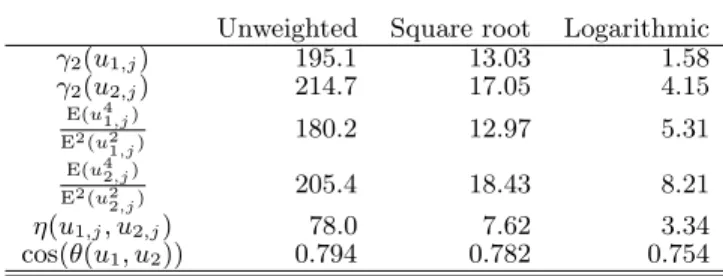
(Web page),j= 1 toD. Some summary statistics are listed in Table 1.
The data are certainly heavy-tailed as the kurtoses for u1,j andu2,j are 195 and 215, respectively, far above zero.
Therefore we do not expect thatvery sparse random projec-tions withs = D
logD ≈6000 work well, though the results
are actually not disastrous as shown in Figure 1(d).
Table 1: Some summary statistics of the word pair, “THIS” (u1) and “HAVE” (u2). γ2 denotes the kurtosis. η(u1,j, u2,j) =
E(u2 1,ju22,j)
E(u2
1,j)E(u22,j)+E2(u1,ju2,j),
af-fects the convergence of Var`
vT
1v2´(see the proof of Lemma 3). These expectations are computed empir-ically from the data. Two popular term weighting schemes are applied. The “square root weighting” replacesu1,j with√u1,j and the “logarithmic
weight-ing” replaces any non-zero u1,j with1 + logu1,j.
Unweighted Square root Logarithmic γ2(u1,j) 195.1 13.03 1.58 γ2(u2,j) 214.7 17.05 4.15 E(u4 1,j) E2(u2 1,j) 180.2 12.97 5.31 E(u42,j) E2(u2 2,j) 205.4 18.43 8.21 η(u1,j, u2,j) 78.0 7.62 3.34 cos(θ(u1, u2)) 0.794 0.782 0.754
We first test random projections on the original (unweighted, heavy-tailed) data, fors= 1,3,256 =√Dand 6000≈ D
logD,
presented in Figure 1. We then apply square root weighting and logarithmic weighting before random projections. The results are presented in Figure 2, fors= 256 ands= 6000. These results are consistent with what we would expect:
• Whensis small, i.e.,O(1), sparse random projections perform very similarly to conventional random projec-tions as shown in panels (a) and (b) of Figure 1 .
• With increasings, the variances of sparse random pro-jections increase. Withs= D
logD, the errors are large
(but not disastrous), because the data are heavy-tailed. Withs=√D, sparse random projections are robust.
• Since cos(θ(u1, u2))≈0.7∼0.8 in this case, marginal
information can improve the estimation accuracy quite substantially. The asymptotic variances of ˆaM LEmatch
the empirical variances of the asymptotic MLE estima-tor quite well, even fors=√D.
• After applying term weighting on the original data, sparse random projections are almost as accurate as conventional random projections, even fors ≈ D
logD,
as shown in Figure 2.
7.
CONCLUSION
We provide some new theoretical results on random pro-jections, a randomized approximate algorithm widely used in machine learning and data mining. In particular, our theoretical results suggest that we can achieve a significant
√
D-fold speedup in processing time with little loss in accu-racy, whereDis the original data dimension. When the data
10 100 0 0.1 0.2 0.3 0.4 0.5 0.6 0.7 k Standard errors MF MLE Theor. MF Theor. ∞ (a)s= 1 10 100 0 0.1 0.2 0.3 0.4 0.5 0.6 0.7 k Standard errors MF MLE Theor. MF Theor. ∞ (b)s= 3 10 100 0 0.1 0.2 0.3 0.4 0.5 0.6 0.7 k Standard errors MF MLE Theor. MF Theor. ∞ (c)s= 256 10 100 0 0.5 1 1.5 k Standard errors MF MLE Theor. MF Theor. ∞ (d)s= 6000
Figure 1: Two words “THIS” (u1) and “HAVE” (u2) from the MSN Web crawl data are tested. D= 216. Sparse random projections are applied to estimated
a = uT
1u2, with four values of s: 1, 3, 256 = √
D
and 6000 ≈ D
logD, in panels (a), (b), (c) and (d),
respectively, presented in terms of the normalized standard error,
√
Var(ˆa)
a . 10
4 simulations are con-ducted for each k, ranging from 10 to 100. There are five curves in each panel. The two labeled as “MF” and “Theor.” overlap. “MF” stands for the empirical variance of the “Margin-free” estimator
ˆ
aM F; while “Theor. MF” for the theoretical
vari-ance of ˆaM F, i.e., (27). The solid curve, labeled as
“MLE,” presents the empirical variance ofˆaM LE, the
estimator using margins as formulated in Lemma 7. There are two curves both labeled as “Theor. ∞,” for the asymptotic theoretical variances ofˆaM F (the
higher curve, (28)) andˆaM LE(the lower curve, (30)).
are free of “outliers” (e.g., after careful term weighting), a cost reduction by a factor of D
logD is also possible.
Our proof of the asymptotic normality justifies the use of an asymptotic maximum likelihood estimator for improving the estimates when the marginal information is available.
8.
ACKNOWLEDGMENT
We thank Dimitris Achlioptas for very insightful com-ments. We thank Xavier Gabaix and David Mason for point-ers to useful references. Ping Li thanks the enjoyable and helpful conversations with Tze Leung Lai, Joseph P. Ro-mano, and Yiyuan She. Finally, we thank the four anony-mous reviewers for constructive suggestions.
9.
REFERENCES
[1] Dimitris Achlioptas. Database-friendly random projections: Johnson-Lindenstrauss with binary coins.Journal of Computer and System Sciences, 66(4):671–687, 2003.
10 100 0 0.1 0.2 0.3 0.4 0.5 0.6 0.7 k Standard errors MF MLE Theor. MF Theor. ∞
(a) Square root (s= 256)
10 100 0 0.1 0.2 0.3 0.4 0.5 0.6 0.7 k Standard errors MF MLE Theor. MF Theor. ∞ (b) Logarithmic (s= 256) 10 100 0 0.1 0.2 0.3 0.4 0.5 0.6 0.7 k Standard errors MF MLE Theor. MF Theor. ∞ (c) Square root (s= 6000) 10 100 0 0.1 0.2 0.3 0.4 0.5 0.6 0.7 k Standard errors MF MLE Theor. MF Theor. ∞ (d) Logarithmic (s= 6000)
Figure 2: After applying term weighting on the orig-inal data, sparse random projections are almost as accurate as conventional random projections, even for s = 6000≈ D
logD. Note that the legends are the
same as in Figure 1.
[2] Dimitris Achlioptas, Frank McSherry, and Bernhard Sch¨olkopf. Sampling techniques for kernel methods. InProc. of NIPS, pages 335–342, Vancouver, BC, Canada, 2001. [3] Noga Alon, Yossi Matias, and Mario Szegedy. The space
complexity of approximating the frequency moments. In Proc. of STOC, pages 20–29, Philadelphia,PA, 1996. [4] Rosa Arriaga and Santosh Vempala. An algorithmic theory
of learning: Robust concepts and random projection. In Proc. of FOCS (Also to appear in Machine Learning), pages 616–623, New York, 1999.
[5] Ella Bingham and Heikki Mannila. Random projection in dimensionality reduction: Applications to image and text data. InProc. of KDD, pages 245–250, San Francisco, CA, 2001.
[6] Jeremy Buhler and Martin Tompa. Finding motifs using random projections.Journal of Computational Biology, 9(2):225–242, 2002.
[7] Moses S. Charikar. Similarity estimation techniques from rounding algorithms. InProc. of STOC, pages 380–388, Montreal, Quebec, Canada, 2002.
[8] G. P. Chistyakov and F. G¨otze. Limit distributions of studentized means.The Annals of Probability, 32(1A):28–77, 2004.
[9] Sanjoy Dasgupta and Anupam Gupta. An elementary proof of a theorem of Johnson and Lindenstrauss.Random Structures and Algorithms, 22(1):60 – 65, 2003.
[10] Susan T. Dumais. Improving the retrieval of information from external sources.Behavior Research Methods, Instruments and Computers, 23(2):229–236, 1991. [11] Richard Durrett.Probability: Theory and Examples.
Duxbury Press, Belmont, CA, second edition, 1995. [12] William Feller.An Introduction to Probability Theory and
Its Applications (Volume II). John Wiley & Sons, New York, NY, second edition, 1971.
projection for high dimensional data clustering: A cluster ensemble approach. InProc. of ICML, pages 186–193, Washington, DC, 2003.
[14] Dmitriy Fradkin and David Madigan. Experiments with random projections for machine learning. InProc. of KDD, pages 517–522, Washington, DC, 2003.
[15] P. Frankl and H. Maehara. The Johnson-Lindenstrauss lemma and the sphericity of some graphs.Journal of Combinatorial Theory A, 44(3):355–362, 1987. [16] Navin Goel, George Bebis, and Ara Nefian. Face
recognition experiments with random projection. InProc. of SPIE, pages 426–437, Bellingham, WA, 2005.
[17] Michel X. Goemans and David P. Williamson. Improved approximation algorithms for maximum cut and satisfiability problems using semidefinite programming. Journal of ACM, 42(6):1115–1145, 1995.
[18] F. G¨otze. On the rate of convergence in the multivariate CLT.The Annals of Probability, 19(2):724–739, 1991. [19] Piotr Indyk. Stable distributions, pseudorandom
generators, embeddings and data stream computation. In FOCS, pages 189–197, Redondo Beach,CA, 2000. [20] Piotr Indyk and Rajeev Motwani. Approximate nearest
neighbors: Towards removing the curse of dimensionality. InProc. of STOC, pages 604–613, Dallas, TX, 1998. [21] W. B. Johnson and J. Lindenstrauss. Extensions of
Lipschitz mapping into Hilbert space.Contemporary Mathematics, 26:189–206, 1984.
[22] Samuel Kaski. Dimensionality reduction by random mapping: Fast similarity computation for clustering. In Proc. of IJCNN, pages 413–418, Piscataway, NJ, 1998. [23] Man Lan, Chew Lim Tan, Hwee-Boon Low, and Sam Yuan
Sung. A comprehensive comparative study on term weighting schemes for text categorization with support vector machines. InProc. of WWW, pages 1032–1033, Chiba, Japan, 2005.
[24] Erich L. Lehmann and George Casella.Theory of Point Estimation. Springer, New York, NY, second edition, 1998. [25] Will E. Leland, Murad S. Taqqu, Walter Willinger, and
Daniel V. Wilson. On the self-similar nature of Ethernet traffic.IEEE/ACM Trans. Networking, 2(1):1–15, 1994. [26] Edda Leopold and Jorg Kindermann. Text categorization
with support vector machines. how to represent texts in input space? Machine Learning, 46(1-3):423–444, 2002. [27] Henry C.M. Leung, Francis Y.L. Chin, S.M. Yiu, Roni
Rosenfeld, and W.W. Tsang. Finding motifs with insufficient number of strong binding sites.Journal of Computational Biology, 12(6):686–701, 2005. [28] Ping Li, Trevor J. Hastie, and Kenneth W. Church.
Improving random projections using marginal information. InProc. of COLT, Pittsburgh, PA, 2006.
[29] Jessica Lin and Dimitrios Gunopulos. Dimensionality reduction by random projection and latent semantic indexing. InProc. of SDM, San Francisco, CA, 2003. [30] Bing Liu, Yiming Ma, and Philip S. Yu. Discovering
unexpected information from your competitors’ web sites. InProc. of KDD, pages 144–153, San Francisco, CA, 2001. [31] Kun Liu, Hillol Kargupta, and Jessica Ryan. Random
projection-based multiplicative data perturbation for privacy preserving distributed data mining.IEEE Transactions on Knowledge and Data Engineering, 18(1):92–106, 2006.
[32] B. F. Logan, C. L. Mallows, S. O. Rice, and L. A. Shepp. Limit distributions of self-normalized sums.The Annals of Probability, 1(5):788–809, 1973.
[33] Chris D. Manning and Hinrich Schutze.Foundations of Statistical Natural Language Processing. The MIT Press, Cambridge, MA, 1999.
[34] M. E. J. Newman. Power laws, pareto distributions and zipf’s law.Contemporary Physics, 46(5):232–351, 2005. [35] Christos H. Papadimitriou, Prabhakar Raghavan, Hisao
Tamaki, and Santosh Vempala. Latent semantic indexing:
A probabilistic analysis. InProc. of PODS, pages 159–168, Seattle,WA, 1998.
[36] Deepak Ravichandran, Patrick Pantel, and Eduard Hovy. Randomized algorithms and NLP: Using locality sensitive hash function for high speed noun clustering. InProc. of ACL, pages 622–629, Ann Arbor, MI, 2005.
[37] Jason D. Rennie, Lawrence Shih, Jaime Teevan, and David R. Karger. Tackling the poor assumptions of naive Bayes text classifiers. InProc. of ICML, pages 616–623, Washington, DC, 2003.
[38] Ozgur D. Sahin, Aziz Gulbeden, Fatih Emek¸ci, Divyakant Agrawal, and Amr El Abbadi. Prism: indexing
multi-dimensional data in p2p networks using reference vectors. InProc. of ACM Multimedia, pages 946–955, Singapore, 2005.
[39] Gerard Salton and Chris Buckley. Term-weighting approaches in automatic text retrieval.Inf. Process. Manage., 24(5):513–523, 1988.
[40] I. S. Shiganov. Refinement of the upper bound of the constant in the central limit theorem.Journal of Mathematical Sciences, 35(3):2545–2550, 1986.
[41] Chunqiang Tang, Sandhya Dwarkadas, and Zhichen Xu. On scaling latent semantic indexing for large peer-to-peer systems. InProc. of SIGIR, pages 112–121, Sheffield, UK, 2004.
[42] Santosh Vempala. Random projection: A new approach to VLSI layout. InProc. of FOCS, pages 389–395, Palo Alto, CA, 1998.
[43] Santosh Vempala.The Random Projection Method. American Mathematical Society, Providence, RI, 2004. [44] William N. Venables and Brian D. Ripley.Modern Applied
Statistics with S. Springer-Verlag, New York, NY, fourth edition, 2002.
[45] Clement T. Yu, K. Lam, and Gerard Salton. Term weighting in information retrieval using the term precision model.Journal of ACM, 29(1):152–170, 1982.
APPENDIX
A.
PROOFS
Let{ui}ni=1denote the rows of the data matrixA∈Rn×D.
A projection matrixR∈RD×k consists of i.i.d. entriesrji:
Pr(rji=√s) =Pr(rji=−√s) =
1
2s, Pr(rji= 0) = 1− 1 s, E(rji) = 0, E(r2ji) = 1, E(rji4) =s, E(|rji3|) =
√ s, E (rjirj0i0) = 0, E ` r2jirj0i0 ´ = 0 when i6=i0, or j6=j0. We denote the projected data vectors byvi = √1kRTui.
For convenience, we denote
m1=ku1k2= D X j=1 u21,j, m2=ku2k2 = D X j=1 u22,j, a=uT1u2= D X j=1 u1,ju2,j, d=ku1−u2k2=m1+m2−2a.
We will always assume
s=o(D), E(u41,j)<∞, E(u42,j)<∞, (⇒E(u21,ju22,j)<∞).
By the strong law of large numbers
PD j=1u I 1,j D →E “ uI1,j ” , PD j=1(u1,j−u2,j)I D →E (u1,j−u2,j) I, PD j=1(u1,ju2,j) J D →E (u1,ju2,j) J, a.s. I= 2,4, J= 1,2.
A.1
Moments
The following expansions are useful for proving the next three lemmas. m1m2= D X j=1 u21,j D X j=1 u22,j= D X j=1 u21,ju22,j+ D X j6=j0 u21,ju22,j0, m21= D X j=1 u21,j !2 = D X j=1 u41,j+ 2 X j<j0 u21,ju21,j0, a2= D X j=1 u1,ju2,j !2 = D X j=1 u21,ju22,j+ 2 X j<j0 u1,ju2,ju1,j0u2,j0. Lemma 1. E` kv1k2´=ku1k2 =m1, Var` kv1k2´=1 k 2m 2 1+ (s−3) D X j=1 u41,j ! . AsD→ ∞, (s−3)PD j=1(u1,j) 4 m2 1 → s−D3 E(u1,j) 4 E2(u 1,j)2 → 0. Proof of Lemma 1 . v1 = √1 kR Tu 1, LetRi be theith
column ofR,1≤i≤k. We can write theith element ofv1 to bev1,i= √1kRTiu1=√1kPDj=1(rji)u1,j. Therefore, v21,i= 1 k 0 @ D X j=1 ` rji2 ´ u21,j+ 2 X j<j0 (rji)u1,j(rj0i)u1,j0 1 A,
from which it follows that E` v12,i ´ = 1 k D X j=1 u21,j, E ` kv1k2´= D X j=1 u21,j=m1. v14,i = 1 k2 0 @ D X j=1 ` r2ji ´ u21,j+ 2 X j<j0 (rji)u1,j(rj0i)u1,j0 1 A 2 =1 k2 0 B B @ PD j=1 ` rji4 ´ u41,j+ 2 P j<j0 ` r2ji ´ u21,j ` r2j0i ´ u21,j0 +4“P j<j0(rji)u1,j(rj0i)u1,j0 ”2 +4“PD j=1 ` r2 ji ´ u2 1,j ” “ P j<j0(rji)u1,j(rj0i)u1,j0 ” 1 C C A ,
from which it follows that E` v14,i ´ = 1 k2 0 @s D X j=1 u41,j+ 6 X j<j0 u21,ju21,j0 1 A, Var` v12,i ´ = 1 k2 0 @s D X j=1 u41,j+ 6 X j<j0 u21,ju21,j0− D X j=1 u21,j !21 A = 1 k2 0 @(s−1) D X j=1 u41,j+ 4 X j<j0 u21,ju21,j0 1 A = 1 k2 2m 2 1+ (s−3) D X j=1 u41,j ! , Var` kv1k2 ´ =1 k 2m 2 1+ (s−3) D X j=1 u41,j ! . AsD→ ∞, (s−3)PD j=1(u1,j) 4 m2 1 = s−3 D PD j=1(u1,j) 4/D m2 1/D2 → o(D)D E(u1,j) 4 E2(u 1,j)2 →0. Lemma 2. E` kv1−v2k2´=ku1−u2k2=d, Var` kv1−v2k2´= 1 k 2d 2+ (s −3) D X j=1 (u1,j−u2,j)4 ! . AsD→ ∞, (s−3)PD j=1(u1,j−u2,j) 4 d2 → s−3 D E(u1,j−u2,j)4 E2(u 1,j−u2,j)2 →0
Proof of Lemma 2. The proof is analogous to the proof
of Lemma 1. Lemma 3. E“vT 1v2 ” =uT 1u2 =a, Var“vT 1v2 ” =1 k m1m2+a 2+ (s −3) D X j=1 u21,ju22,j ! . AsD→ ∞, (s−3)PD j=1u 2 1,ju22,j m1m2+a2 →s−D3 E ` u21,ju22,j ´ E` u2 1,j ´ E` u2 2,j ´ +E2(u 1,ju2,j) → 0. Proof of Lemma 3. v1,iv2,i= 1 k 0 @ D X j=1 ` rji2 ´ u1,ju2,j+ X j6=j0 (rji)u1,j(rj0i)u2,j0 1 A, =⇒E(v1,iv2,i) = 1 k D X j=1 u1,ju2,j, E “ vT 1v2 ” =a. v21,iv22,i =1 k2 0 @ D X j=1 ` r2ji ´ u1,ju2,j+ X j6=j0 (rji)u1,j(rj0i)u2,j0 1 A 2 =1 k2 0 B B B B @ PD j=1 ` r4 ji ´ u2 1,ju22,j+ 2P j<j0 ` r2 ji ´ u1,ju2,j`r2j0i ´ u1,j0u2,j0+ “ P j6=j0(rji)u1,j(rj0i)u2,j0 ”2 + “ PD j=1 ` r2ji ´ u1,ju2,j ” “ P j6=j0(rji)u1,j(rj0i)u2,j0 ” 1 C C C C A ,
=⇒ E` v12,iv22,i ´ =1 k2 0 @s D X j=1 u21,ju22,j+ 4 X j<j0 u1,ju2,ju1,j0u2,j0+ X j6=j0 u21,ju22,j0 1 A =1 k2 0 @(s−2) D X j=1 u21,ju22,j+ X j6=j0 u21,ju22,j0+ 2a2 1 A =1 k2 m1m2+ (s−3) D X j=1 u21,ju22,j+ 2a2 ! , Var(v1,iv2,i) = 1 k2 m1m2+a 2+ (s −3) D X j=1 u21,ju22,j ! , Var“v1Tv2 ” = 1 k m1m2+a 2+ (s −3) D X j=1 u21,ju22,j ! .
A.2
Asymptotic Distributions
Lemma 4. AsD→ ∞, v1,i p m1/k L =⇒N(0,1), kv1k 2 m1/k L =⇒χ2k,
with the rate of convergence
|Fv1,i(y)−Φ(y)| ≤0.8 √ s PD j=1|u1,j| 3 m31/2 →0.8 r s D E|u1,j|3 ` E` u2 1,j ´´3/2 →0,
where=L⇒denotes “convergence in distribution,”Fv1,i(y)is
the empirical cumulative density function (CDF) ofv1,iand
Φ(y) is the standard normalN(0,1)CDF.
Proof of Lemma 4. The Lindeberg central limit
theo-rem (CLT) and the Berry-Esseen theotheo-rem are needed for the proof [12, Theorems VIII.4.3 and XVI.5.2].6
Write v1,i = √1kRTiu1 = PDj=1√1k(rji)u1,j = PD j=1zj, withzj =√1k(rji)u1,j. Then E(zj) = 0, Var(zj) = u2 1,j k , E(|zj| 2+δ) =sδ 2|u1,j| 2+δ k(2+δ)/2,∀δ >0. Let s2 D = PDj=1Var(zj) = PD j=1u 2 1,j k = m1 k . Assume the Lindeberg condition 1 s2 D D X j=1 E` zj2;|zj| ≥sD´→0, for any >0. Then PD j=1zj sD = pv1,i m1/k L =⇒N(0,1),
6The best Berry-Esseen constant 0.7915 (≈0.8) is from [40].
which immediately leads to v2 1,i m1/k L =⇒χ21, k v1k2 m1/k = k X i=1 „ v2 1,i m1/k « L =⇒χ2k.
We need to go back and check the Lindeberg condition. 1 s2 D D X j=1 E` z2j;|zj| ≥sD ´ ≤ s12 D D X j=1 E „ |zj|2+δ (sD)δ « =“s D ”δ2 1 δ PD j=1|u1,j| 2+δ/D “ PD j=1u21,j/D ”(2+δ)/2 → „ o(D) D «δ2 1 δ E|u1,j|2+δ ` E(u2 1,j) ´(2+δ)/2 →0,
provided E|u1,j|2+δ < ∞, for some δ > 0, which is much
weaker than our assumption that E(u41,j)<∞.
It remains to show the rate of convergence using the Berry-Esseen theorem. LetρD=PDj=1E|zj|3 =s
1/2 k3/2 PD j=1|u1,j| 3 |Fv1,i(y)−Φ(y)| ≤0.8 ρD s3 D = 0.8√s PD j=1|u1,j|3 m31/2 →0.8 r s D E|u1,j|3 ` E` u2 1,j ´´3/2 →0. Lemma 5. AsD→ ∞, v1,i−v2,i p d/k L =⇒N(0,1), kv1−v2k 2 d/k L =⇒χ2k,
with the rate of convergence
|Fv1,i−v2,i(y)−Φ(y)| ≤0.8 √ s PD j=1|u1,j−u2,j| 3 d3/2 →0.8 r s D E|u1,j−u2,j|3 E32(u1,j−u2,j)2 →0.
Proof of Lemma 5. The proof is analogous to the proof
of Lemma 4.
The next lemma concerns the joint distribution of (v1,i, v2,i).
Lemma 6. AsD→ ∞, Σ−12 » v1,i v2,i – L =⇒N „» 0 0 – , » 1 0 0 1 –« , Σ = 1 k » m1 a a m2 – and Pr(sign(v1,i) =sign(v2,i))→1−θ π, θ= cos −1„ a √m 1m2 « .
Proof of Lemma 6. We have seen that Var(v1,i) =m1
k , Var(v2,i) = mk2, E(v1,iv2,i) = ak, i.e., cov „» v1,i v2,i –« = 1 k » m1 a a m2 – = Σ.
The Lindeberg multivariate central limit theorem [18] says Σ−12 » v1,i v2,j – L =⇒N „» 0 0 – , » 1 0 0 1 –« .
The multivariate Lindeberg condition is automatically satis-fied by assuming bounded third moments ofu1,j andu2,j. A
trivial consequence of the asymptotic normality yields
Pr(sign(v1,i) =sign(v2,i))→1−θ
π.
Strictly speaking, we should writeθ= cos−1 „ E(u1,ju2,j) q E(u2 1,j)E(u22,j) « .
A.3
An Asymptotic MLE Using Margins
Lemma 7. Assuming that the margins, m1 and m2 are
known and using the asymptotic normality of(v1,i, v2,i), we
can derive an asymptotic maximum likelihood estimator (MLE), which is the solution to a cubic equation
a3−a2“v1Tv2 ”
+a`
−m1m2+m1kv2k2+m2kv1k2´ −m1m2v1Tv2= 0,
Denoted byaˆM LE, the asymptotic variance of this
estima-tor is Var(ˆaM LE)∞= 1 k ` m1m2−a2´2 m1m2+a2 .
Proof of Lemma 7. For notational convenience, we treat
(v1,i, v2,i)as exactly normally distributed so that we do not
need to keep track of the “convergence” notation. The likelihood function of{v1,i, v2,i}ki=1is then lik“{v1,i, v2,i}ki=1 ” = (2π)−k2|Σ|− k 2× exp −12 k X i=1 ˆ v1,i v2,i ˜Σ−1 » v1,i v2,i –! . where Σ = 1 k » m1 a a m2 – .
We can then express the loglikelihood function, l(a), as loglik“{v1,i, v2,i}ki=1 ” ∝l(a) =−k2log` m1m2−a2´− k 2 1 m1m2−a2 k X i=1 ` v21,im2−2v1,iv2,ia+v22,im1 ´ ,
The MLE equation is the solution tol0(a) = 0, which is a3−a2“v1Tv2 ” +a` −m1m2+m1kv2k2+m2kv1k2 ´ −m1m2v1Tv2= 0
The large sample theory [24, Theorem 6.3.10] says that ˆ
aM LE is asymptotically unbiased and converges in
distribu-tion to a normal random variable N“a, 1 I(a)
”
, where I(a), the expected Fisher Information, is
I(a) =−E` l00(a)´ =k m1m2+a 2 (m1m2−a2)2 ,
after some algebra.
Therefore, the asymptotic variance ofaˆM LE would be
Var(ˆaM LE)∞= 1 k ` m1m2−a2´2 m1m2+a2 . (32)
B.
HEAVY-TAILED DATA
We illustrate thatvery sparse random projectionsare fairly robust against heavy-tailed data, by a Pareto distribution.
The assumption of finite moments has simplified the anal-ysis of convergence a great deal. For example, assuming (δ+ 2)th moment, 0< δ≤2 ands=o(D), we have
(s)δ/2 PD j=1|u1,j| 2+δ “ PD j=1(u21,j) ”1+δ/2 = “s D ”δ/2 PD j=1|u1,j| 2+δ/D “ PD j=1(u21,j)/D ”1+δ/2 →“Ds”δ/2 E ` u2+δ 1,j ´ ` E` u2 1,j ´´1+δ/2 →0. (33)
Note thatδ = 2 corresponds to the rate of convergence for the variance in Lemma 1, andδ= 1 corresponds to the rate of convergence for asymptotic normality in Lemma 4. From the proof of Lemma 4 in Appendix A, we can see that the convergence of (33) (to zero) with anyδ >0 suffices for achieving asymptotic normality.
For heavy-tailed data, the fourth moment (or even the second moment) may not exist. The most common model for heavy-tailed data is the Pareto distribution with the density function7f(x;α) = α
xα+1, whosemth moment =
α α−m, only
defined ifα > m. The measurements ofαfor many types of data are available in [34]. For example,α= 1.2 for the word frequency,α= 2.04 for the citations to papers,α= 2.51 for the copies of books sold in the US, etc.
For simplicity, we assume that 2< α≤2 +δ ≤4. Un-der this assumption, the asymptotic normality is guaranteed and it remains to show the rate of convergence of moments and distributions. In this case, the second moment E`
u21,j
´
exists. The sum PD
j=1|u1,j|
2+δ grows as O“D(2+δ)/α” as
shown in [11, Example 2.7.4].8 Thus, we can write
sδ/2 PD j=1|u1,j|2+δ “ PD j=1(u21,j) ”1+δ/2 =O „ sδ/2 D1+δ/2−2+αδ « = 8 < : O“ s D2−4/α ” δ= 2 O“ s D3−6/α ”1/2 δ= 1 , (34)
from which we can choosesusing prior knowledge ofα. For example, supposeα= 3 ands=√D. (34) indicates that the rate of convergence for variances would beO(D1/12)
in terms of the standard error. (34) also verifies that the rate of convergence to normality isO(D1/4), as expected.
Of course, we could always choosesmore conservatively, e.g.,s=D1/4, if we know the data are severely heavy-tailed. SinceD is large, a factor ofD1/4 is still considerable.
What if α < 2? The second moment no longer exists. The analysis will involve the so-calledself-normalizing sums [8, 32]; but we will not delve into this topic. In fact, it is not really meaningful to compute thel2 distances when the
data do not even have bounded second moment.
7Note that in general, a Pareto distribution has an addition
parameterxmin, andf(x;α, xmin) = αxminxα+1 withx≥xmin.
Since we are only interested in the relative ratio of moments, we can without loss of generality assume xmin = 1. Also
note that in [34], their “α” is equal to ourα+ 1.