Exploring Electronic Payment System Acceptibility
Determinants: A Consumer Outlook
The aim of this research paper is to explore the electronic payment system (EPS) acceptability determinants, from the consumer perspective. Exploratory factor analysis has been used to explore the factors based on different statements. The study has been conducted in North-West region of Delhi. Data has been collected from male-female of different age groups by using the questionnaire tool of data collection. For extraction of factors Principal component analyses and Varimax with Kaiser Normalization rotation method was used. The rotated component matrix shows best fitting of items to form a factor. As per the convergence of items, 4 factors were extracted and named. These factors are security concern, Knowledge, awareness and acceptability & convenience which are contributing for acceptability of electronic payment system among the consumers.
Akanksha Upadhyaya*, Bhajneet Kaur
Rukmini Devi Institute of Advanced Studies, Delhi, India.
*Email: [email protected]
1. Introduction
Electronic payment system (EPS) is a way to transact online for the goods and services availed. EPS has gained popularity in recent years due to widespread of various applications dealing online for goods and services. Ranging from B2B, B2C, C2C e- commerce models, digital wallets, EPS has its own benefits in terms of facilitating electronic payments for any kind of payments and transactions. Business to Business (B2B) model basically involves wholesaler and producer as an entity to deal with goods and services and also for the electronic transactions. In Business to
Journal on Today’s Ideas - Tomorrow’s
Technologies
Journal homepage: https://jotitt.chitkara.edu.in/
Keywords: Electronic payment system, e-commerce, online transactions, exploratory factor analysis, B2B, B2C, C2C, e-business
ARTICLE INFORMATION ABSTRACT
The Author(s) 2018. This article is published with open access at www.chitkara.edu.in/publications. https://doi org//10.15415/
done easily and quickly. Therefore, in order to outline the past study conducted in this direction and thereby finding the objective of study, the introduction section is divided into two parts: Background of study and purpose of study. First section includes various studies that have been conducted for identification of contributing factors for widespread acceptability of EPS among consumers and next section deals with the objective of study that has been defined after conducting the review of literature.
2. Background of study
In recent time electronic payment (EPS) has been given attention due to the importance and relevancy of E-commerce. There are various determinants or factors which are influencing the acceptability of EPS i.e. usefulness, trust, ease of use, security, cost, benefit, awareness, IT skills, flexibility and convenience [1]. EPS has been classified into 5 categories i.e. Electronic cash is the payment method which needs specific id number with the amount of money, the cash transfers through the digital payment system with various communication channels [2],
Pre-paid cards can be used in stores or through online transactions , generates from specific value by specific trader/ merchant, given as gift cards, Credit cards and debit cards are plastic payment cards. Credit cards has high complex payment structure and provide secure interface to its customers and debit cards are also secure medium to purchase the goods or services both online and offline. The payment is automatically deducted from the customer’s account and it is one of the frequent using methods of e-payment [2]. Electronic cheque is the least frequent method of e-payment as compared to other payment methods. Security is one of the
factor found as an important factor affects accessibility of e-payment system by the customer point of view, with the security determinant mainly four factors have been found as per the past study i.e. transaction procedure, security statements, technical protection & individual past experience [2]. F. Arne et al. [3] identified the factor ease of use or convenience which is confirmed factor in the multitude studies using Technology Acceptance Model (TAM) model. The TAM model is basically based on Information theory and defines that how the users come forward to accept the use of technology. Ease of use has significance relationship with the online payment system. Two very important factors which have been influenced to the accessibility of user for the use of e-payment system are recognition in benefits and usability of the system.
3. Purpose of study
The main aim to conduct this study is to identify the factors causing Electronic payment system acceptability among the consumers. The study is exploratory in nature and considered the reasons shown in past study for development of factors. The main objective of the study is “to identify the factors which are causing acceptability of Electronic payment system by consumers for transacting electronically”.
4. Research methodology
4.1 Sample & data collection
were correctly received, after rigorous checking of response collected. The response rate was 44.6%, which is considered to be good for conducting the study, as mentioned by Roscoe (1975). One of the studies also mentioned that to avoid sample biasness the response rate must be greater than 30%, Sekaran (2003). Therefore 134 responses are sufficient to conduct the exploratory factor analysis.
4.2 Instrument
The survey conducted was offline in nature and questionnaire was built on 5-point likert scale using MS-Word 2010. The first part of the questionnaire consists of demographics such as Age, Gender and weekly frequency of transacting online. The questionnaire was pre-tested by showing it to the some of the respondents who uses Electronic payment systems very frequently as well as infrequently. The content validity was validated by showing the questionnaire to the experts such as bank employees and some of the website developers. The main objective to show the questionnaire is to ensure the sufficiency of coverage of items under study. Thereafter the statements were
redefined as per their suggestions and tested for reliability. Cronbach alpha is popularly used for reliability of the statements and it is found to be greater than 0.7 (Nunnally, 1978). Therefore, it reveals the internal consistency of the items. The value of Cronbach alpha was analyzed over 22 items and 134 respondents.
5. Data analysis and
interpretation
5.1 Demographics
Table 1 shows demographics of respondents. Approximately 58% respondents were male and 48% were female. Furthermore, the majority of respondents lays in the age group of 26-40(38%) and the age group less than 25 (26%). The demographics related to frequency of transacting electronically also revealed that most of the respondents i.e. 42% perform 2-5 number of electronic transactions in a week followed by 33% of respondents using 5-10 electronic transaction weekly and it is least for more than 10 transactions weekly.
Table 1: Demographics of respondents
S. No. Respondent’s Characteristics Percentage (%)
I Sex
Male 58
Female 42
II Age Group
Less than 25 26
26-40 38
41-55 17
More than 55 19
Table 3: Total variance explained and Eigen value greater than 1
Component Initial Eigen value
Rotation Sums of Squared Loadings Total % of Variance Cumulative %
1 3.930 3.867 21.484 21.484
2 2.734 2.589 14.386 35.870
3 2.553 2.566 14.258 50.128
4 2.166 2.360 13.109 63.237
Less than 1 16
2-5 42
5-10 33
More than 10 9
6. Exploratory factor analysis
Exploratory Factor Analysis using Principal Component Analyses and Varimax rotation was used to explore and identify the factors that cause acceptability of Electronic payment system among the consumers. The Exploratory factor analyses were implemented using IBM SPSS statistics 21 tool.
7. Measuring sample adequacy
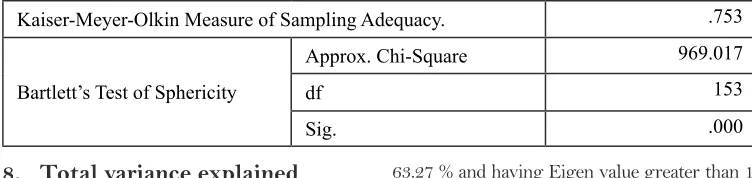
KMO and Bartlett’s test was used to measure the sample adequacy. It is suggested that KMO value must be
Table 2: KMO and Bartlett’s test
Kaiser-Meyer-Olkin Measure of Sampling Adequacy. .753
Bartlett’s Test of Sphericity
Approx. Chi-Square 969.017
df 153
Sig. .000
greater than .50 and p-value must be less than .05 for Bartlett’s test. To check the appropriateness of factor analysis the KMO and Bartlett’s test was used. KMO-Bartlett test is used for sample adequacy because KMO shows the variance proportion of the variables which yields the distinct factors and reliable factors while Bartlett’s test defines the presence of correlation among the variables therefore; it is measured for the p-value less than .005. Hence Table 2 shows that items are reliable to continue for factor extraction.
8. Total variance explained
Table 3 shows that total 4 factors can be extracted during exploratory study because 22 items together explains the total variance of
9. Principal component analyses
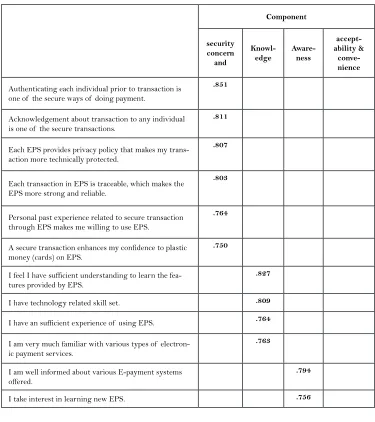
For extraction of factors Principal component analyses and Varimax with Kaiser Normalization rotation method was used. The rotated component matrix shows best fitting of items to form a factor. All the statements showing the value greater
than 5 hence these items are contributing and converging to make a factor. As per the convergence of items into a factor 4 factors were extracted and named. These factors are security concern, Knowledge, awareness and acceptability & convenience. Table 4 shows the observed results.
Table 4: Rotated component matrix for factor extraction
Component
security concern and
Knowl-edge Aware-ness
accept-ability &
conve-nience
Authenticating each individual prior to transaction is one of the secure ways of doing payment.
.851
Acknowledgement about transaction to any individual is one of the secure transactions.
.811
Each EPS provides privacy policy that makes my trans-action more technically protected.
.807
Each transaction in EPS is traceable, which makes the EPS more strong and reliable.
.803
Personal past experience related to secure transaction through EPS makes me willing to use EPS.
.764
A secure transaction enhances my confidence to plastic money (cards) on EPS.
.750
I feel I have sufficient understanding to learn the fea-tures provided by EPS.
.827
I have technology related skill set. .809
I have an sufficient experience of using EPS. .764
I am very much familiar with various types of electron-ic payment servelectron-ices.
.763
I am well informed about various E-payment systems offered.
.794
Various advertisements update me about new EPS. .691
I feel EPS are easy to understand and use. .667
I used to watch carefully advertisement and any promo-tional dimensions.
.640
Various e-services provided in terms of POS, NEFT, RTGS etc. help me in transactions.
.877
Eps provides variety of payment modes for ease of use. .866
EPS provides services anytime and anywhere. .865
10. Conclusion
The study explored the factors which are causing acceptability of Electronic payment system among the consumers based on 22 statements. These statements were analyzed using exploratory factor analysis using Principal component analysis and Varimax rotation. The statements prior to exploratory factor analyses were tested for validity and reliability. The implementation of exploratory factor analyses on 22 items revealed that there are 4 major factors i.e. security concern, Knowledge, awareness and acceptability & convenience, which are contributing for acceptability of electronic payment system among the consumers.
11. Limitation of study
The study has revealed the major factors and gone through all the necessary process for identification of factors, but still it has some limitations that can be recovered by refining the analysis. i. For exploratory study the sample size
was adequate but the number can be in-creased for further refinement of anal-ysis.
ii. The statement under each factor shows good reliability but these factors can be confirmed in the extended study. iii. The results cannot be generalized for
other geographical areas.
iv. During literature review various other reasons were also found for acceptabil-ity of electronic payment system but during the analysis those reasons did not converged to form a factor, hence not considered.
v. As per the common terrain of TAM standard only the EPS acceptability dimension of customer management as a Horizontal business function was considered. Full-fledged customer management is not taken into consid-eration.
12. Future scope
The limitation of study gives the directions to the researchers for identification of other factors as well as establishment of explored factors through this study. Furthermore, the study can be refined and generalized for other geographic areas.
References
electronic payment adoption”, Journal of Engineering and Applied Sciences, vol. 12, pp. 6560-6568, 2017.
[2] E. Oney, G. G. Oksuzoglu and H. W. Rizvi, “The determinants of electronic payment systems usage from consumers’ perspective”, Economic Research - Ekonomska Istraživanja, vol. 30, no. 1, pp. 394-415, 2017.