ISSN(Online): 2319-8753 ISSN (Print): 2347-6710
I
nternational
J
ournal of
I
nnovative
R
esearch in
S
cience,
E
ngineering and
T
echnology
(A High Impact Factor, Monthly, Peer Reviewed Journal)
Visit: www.ijirset.com
Vol. 7, Special Issue 2, March 2018
IOT Enabled Smart Mirror for Physically
Challenged
Vivek.V 1, Homan Rajan.G 2, Vijay.R 3, Surendar.S 4 , R. Geetha 5
U.G. Student, Computer Science and Engineering, S.A. Engineering College, Chennai,
Tamil Nadu, India123
Professor, Computer Science and Engineering, S.A. Engineering College, Chennai,
Tamil Nadu, India4
ABSTRACT: Technology has been improved to live people’s life most easily. Developing an application in such a way that the technologies reach the human to live a sophisticated life. Smart Mirror is one of the best ways to bridge a gap between the human and technologies. Since each person use the Mirror in his daily life, the mirror provides a natural means of interaction through which the residents can control the household smart appliances and access personalized services. So building time management technique in mirror will be useful and an efficient one. Making the smart mirror helps the physically challenged people much by making them up to date with latest technologies and provide security to them. Existing smart mirror are meant to be an entertaining people and for business purpose. So we proposed to build a smart mirror in order to help the physically challenged people to secure them and the busy people to effectively manage their time in their daily routines.
I. INTRODUCTION
Effective time management is one of the most import ant factors for every person’s life, especially if the person is physically challenged. By increasing the integration of technology in our lives helps us to maintain an efficient schedule. Keeping the event and the social media notification up to date is made easier through technology such as PC’s, smart phones etc. But using these gadgets doesn’t make us to use in busy life and also provide distractions that can interrupt anyone’s routine. So concept of integrating those high-tech features in mirror helps user to effectively manage their time in their daily routine.
This high-tech feature helps the physically challenged people. They cannot move from one place to another often for their every need. So voice recognition will be very helpful by the way of controlling the Home appliances. Security option will make them to be safe in home where physically challenged need no other security appliances. In an emergency case, if they need to contact any one for help, just by voice commanding. Emergency alerting system using GSM benefits the users for up-to-date notification from mirrors.
The various technologies used in smart mirror are Artificial Intelligence, Deep learning, Cloud. Artificial intelligence has extended its intelligent conclusion retrieval is being achieved using Machine learning. It derives the conclusion based upon the collected data. Machine learning is latest technology of making the machine to learn the data and to bring the conclusion by making itself a decision. Deep learning is the growing technique of determining the conclusion with high accuracy. Deep learning is a kind of machine learning in which ML learns without being explicitly programming. Once the program is implemented it should react based on real time data in variable environment. But Deep learning uses convolutional learning and clustering learning to get deeper results what machine learning does. Deep learning uses layering concepts in which it contains input layer , output layer and the intermediate hidden layers.
ISSN(Online): 2319-8753 ISSN (Print): 2347-6710
I
nternational
J
ournal of
I
nnovative
R
esearch in
S
cience,
E
ngineering and
T
echnology
(A High Impact Factor, Monthly, Peer Reviewed Journal)
Visit: www.ijirset.com
Vol. 7, Special Issue 2, March 2018
Learning is done in both supervised and unsupervised manners, learning the multiple levels of representations that correspond to different levels of abstraction. Layers that have been used in deep learning include hidden layers of artificial neural networks. Types of Deep learning models are: Unsupervised Pertained Networks (UPNs), Convolutional Neural Networks (CNNs), Recurrent Neural Networks, Recursive Neural Networks. Convolution neural network, as a kind of depth learning model, can automatically learn and extract features from data. Its generalization ability is superior to traditional methods, and has been successfully applied to pattern classification, object detection and object recognition [1].
Here Conventional Neural network is used and Convolutional Neural Networks (CNN) has made great success on image and audio, which is the important component of deep learning [1]. Using the development of computer vision, pedestrian detection in the intelligent auxiliary driving, intelligent monitoring, pedestrian analysis and intelligent robot, and other fields have been widely used. Hinton and their students in the 2012 ILSVRC using convolution neural network got first place, and the classification task Top - 5 error rates is 15.3%, which is much better than the others [1].CNN will learn to recognize patterns across space. So, as you say, a CNN will learn to recognize components of an image (e.g., lines, curves, etc.) and then learn to combine these components to recognize larger structures (e.g., faces, objects, etc.).
Recurrent Neural Network will similarly learn to recognize patterns across time. So a RNN that is trained to translate text might learn that "dog" should be translated differently if preceded by the word "hot". Cluster learning is a concept of collective learning network which predict and detect object based on collective data from various layers Test set accuracy comparison for a convolutional neural network (CNN) and a clustering learning (CL) network with 1 and 2 layers on the SVHN dataset [2].
And also the results in the CIFAR10 dataset in figure 2. As in the SVHN case, we compared results of accuracy in the test set for 4 cases: clustering learning with 1 layer (CL 1 layer), clustering learning with 2 layers (CL 2 layers), a 1-layer and a 2-1-layers convolutional neural network (convnet 1l, 2l) [2].
Table 1 : Deep learning Comparison
Layer Best Worst References
1 layer
Convolutional
Neural Network 57% 50% [1]
Clustering learning 52% 38% [2]
2 layers
Convolutional
Neural Network 70% 45% [1]
Clustering learning 40% 36% [2]
From the table 1, we can conclude that convolution neural network is an efficient one. In Existing system, the smart mirror is developed based on three objectives: [3] 1. To design a prototype Smart Mirror using Raspberry PI
2. To develop a voice recognition system to facilitate the implementation of Smart Mirror. 3. To carry out the testing process on Raspberry PI for usability evaluation to users.
ISSN(Online): 2319-8753 ISSN (Print): 2347-6710
I
nternational
J
ournal of
I
nnovative
R
esearch in
S
cience,
E
ngineering and
T
echnology
(A High Impact Factor, Monthly, Peer Reviewed Journal)
Visit: www.ijirset.com
Vol. 7, Special Issue 2, March 2018
Touch less data acquisition is achieved [4] using Vision camera and Multispectral camera for emotional analysis. The Wize Mirror features an advanced sensing framework for unobtrusive acquisition of videos, images, and 3D scans of individuals standing in front of the mirror.
Multispectral cameras are used for analysis the skin tissues and microcirculation. In [4] the main objective is to promote a healthy lifestyle using smart mirror.
In the paper [5], the author proposed a Wize mirror that uses multisensory cardio-metabolic risk monitoring system. In this paper, mirror is built as a result of the FP7 funded SEMEOTICONS (Semeiotic Oriented Technology for Individuals Cardio metabolic risk self-assessment and Self-monitoring). In this, user can self-monitor their well-being status over time and to improve their lifestyle using latest technology.
In the paper [6] , the author proposed a smart mirror to monitor the elder at the home, it collect the data like pulse , emotion, Blood pressure of them and collect those data in EC system, This system then process the data with the threshold limit set in the EC system , When a threshold limit exceed , and alert messages with the critical value of forwarded to the elder care taker via SMS
In the paper [7] , the author developed a smart mirror that is an reflective interface, which displays the news feed, calendar, reminder features to the user . Author also proposed it with an face recognition system that identifies the user, Here no other features are being proposed.
In the paper [8], the author proposed an interactive mirror with Home aware, It consist of many interactive features like Load cell, RFID, webcam. The load cell is used to weigh the user and get his BMI, RFID is used to detect the garments worn by the user, and webcam is to perform the face recognition. Here no home automation and security features are being proposed.
In the paper [9], the author developed a smart mirror which consist of the Automated home control system , It uses the Relay module to control the appliances. No other security features and social media interaction is being proposed In the paper [10], the author designed and developed a mirror that has an user identification module, Interactive games for the user and Activities tracking. It enhanced with the emotion detection. Here it is not implemented for any security features.
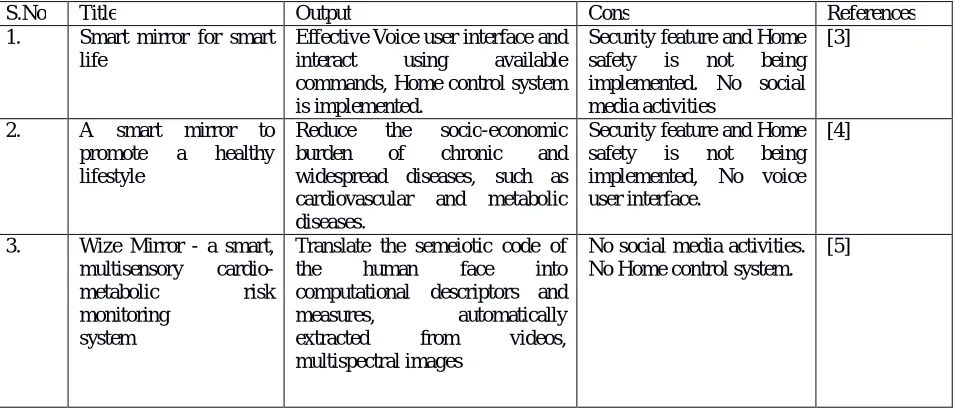
Table 2: Comparison for existing project with our proposal
S.No Title Output Cons References
1. Smart mirror for smart
life
Effective Voice user interface and
interact using available
commands, Home control system is implemented.
Security feature and Home
safety is not being
implemented. No social media activities
[3]
2. A smart mirror to
promote a healthy
lifestyle
Reduce the socio-economic
burden of chronic and
widespread diseases, such as cardiovascular and metabolic diseases.
Security feature and Home
safety is not being
implemented, No voice user interface.
[4]
3. Wize Mirror - a smart,
multisensory
cardio-metabolic risk
monitoring system
Translate the semeiotic code of
the human face into
computational descriptors and
measures, automatically
extracted from videos,
multispectral images
No social media activities. No Home control system.
ISSN(Online): 2319-8753 ISSN (Print): 2347-6710
I
nternational
J
ournal of
I
nnovative
R
esearch in
S
cience,
E
ngineering and
T
echnology
(A High Impact Factor, Monthly, Peer Reviewed Journal)
Visit: www.ijirset.com
Vol. 7, Special Issue 2, March 2018
4. Smart Mirror Health
Management Services based on
IoT Platform
Monitor the parent health ( Pulse, Blood pressure, etc) , uses Elder care system which collects the data and notify their care taker via SMS to their Android phone.
No security provided to elder who are alone in the home, No entertainment features, Emergency call facilities not available
[6]
5. Smart Mirror: A
Reflective Interface to Maximize
Productivity
Smart mirror for displaying the news feeds, Calendar, weather and it has face recognition using webcam
No security features and No Home control system.
[7]
6 Design and
Development of Interactive Mirror for Aware Home
Smart mirror with face
recognition, load sensors for measuring user’s weight,
Radio-frequency identification
(RFID) reader and RFID tags for identifying the garment worn by the user
No security features and No Home control system.
[8]
7 Home Automated
Smart Mirror as an Internet of
Things (IoT) Implementation
Smart mirror has the Home automated system with home application control
No security features and no social media
[9]
8 FitMirror: A Smart
Mirror For Positive Affect in
Everyday User Morning Routines
Smart mirror has user
identification, Interactive games,
activities tracking, Emotion
detection
No security and
emergency features
[10]
From the table 2 , we conclude that the security features is not being implemented in smart mirror.
II. CONCLUSION
ISSN(Online): 2319-8753 ISSN (Print): 2347-6710
I
nternational
J
ournal of
I
nnovative
R
esearch in
S
cience,
E
ngineering and
T
echnology
(A High Impact Factor, Monthly, Peer Reviewed Journal)
Visit: www.ijirset.com
Vol. 7, Special Issue 2, March 2018
REFERENCES
[1] Hailong Li Zhendong Wu ,. Jianwu Zhang ,School of Communication Engineering, Hangzhou Dianzi University ,Hangzhou, China. “Pedestrian Detection Based on Deep Learning Model”. CISP-BMEI 2016.
[2] N. Dalal, B. Triggs, Histograms of oriented gradients for human detection. In: Computer Vision and Pattern Recognition, 2005.CVPR 2005. IEEE
Computer Society Conference on. Vol. 1. June 005:pp.886–893 vol. 1.
[3] Husni Ruslai3, Kamaruzzaman Jahidin4, Mohammad Syafwan Arshad4, Smart Mirror for Smart Life ,2017 IEEE
[4] Muhammad Mu’izzudeen Yusri1, Shahreen Kasim1, Rohayanti Hassan2, Zubaile Abdullah1 Husni Ruslai3, Kamaruzzaman Jahidin4, Mohammad Syafwan Arshad4 1Soft Computing and Data Mining Centre, Fakulti Sains Komputer dan Teknologi Maklumat, Universiti Tun Hussein Onn Malaysia, Johor, Malaysia 2Faculty of Computing, Universiti Teknologi Malaysia, Johor, Malaysia.” Smart Mirror for Smart Life”.2017 IEEE.
[5] Yasmina Andreu a , Franco Chiarugi c , Sara Colantonio b , ∗, Giorgos Giannakakis c , Daniela Giorgi b , Pedro Henriquez a , Eleni Kazantzaki c ,
Dimitris Manousos c , Kostas Marias c , Bogdan J. Matuszewski a , Maria Antonietta Pascali b , Matthew Pediaditis c , Giovanni Raccichini b , Manolis Tsiknakis.” Wize Mirror - a smart, multisensory cardio-metabolic risk monitoring system”.2016 SCIENCE DIRECT.
[6] Young Bag Moon, Se Won Oh, Hyun Joong Kang, Ho Sung Lee, Sun Jin Kim, Hyo Chan Bang IoT Convergence Research Department Electronics and Telecommunications Research Institute Daejeon, Korea.” Smart Mirror Health Management Services based on IoT Platform”.2015 IEEE.
[7] Piyush Maheshwari Professor and Head of Engineering Amity University, Dubai. Maninder Jeet Kaur Assistant Professor Department of Engineering Amity University, Dubai.” Smart Mirror: A Reflective Interface to Maximize Productivity”. May 2017 International Journal of Computer Applications.
[8] Chidambaram Sethukkarasi, Vijayadharan SuseelaKumari HariKrishnan, Raja Pitchiah National Ubiquitous Computing Research Centre ,Centre for Development of Advanced Computing Chennai, India. “Design and Development of Interactive Mirror for Aware Home”. SMART 2012 . [9] Jane Jose1, Raghav Chakravarthy2, Jait Jacob3, Mir Masood Ali4, Sonia Maria D’souza5 Student, Dept. of CSE, Cambridge Institute of Technology, Bangalore. “Home Automated Smart Mirror as an Internet of Things (IoT) Implementation - Survey Paper.”2017 IJARCCE.