Volume -3, Issue-2, March – April 2017, Page No. 39 - 49
Corresponding Author: B.Sai Kumar, Page No. 39 - 49
Pag
e39
Using a DVR Improving the Power Quality Problems
B.Sai Kumar, M.Vigneshwar, M.Anusha, B.Nandhakishore
1
B.Tech scholars, Dept of EEE, SVS Institute of Technology, Hanamkonda, Warangal, T.S, India
Mr.D.Kumaraswamy (Phd)
2
Associate Professor, Dept of EEE, SVS Institute of Technology, Hanamkonda, Warangal, T.S, India
Abstract
Power quality is one of major concerns in the present era. It has become important, especially, with the introduction of
sophisticated devices, whose performance is very sensitive to the quality of power supply. Power quality problem is an
occurrence manifested as a nonstandard voltage, current or frequency that results in a failure of end use equipments. One
of the major problems dealt here is the voltage sag. To solve this problem, custom power devices are used. One of those
devices is the Dynamic Voltage Restorer (DVR), which is the most efficient and effective modern custom power device
used in power distribution networks. Its appeal includes lower cost, smaller size, and its fast dynamic response to the
disturbance. This paper introduces power quality problems and overview of Dynamic Voltage Restorer so that young
electrical engineers come to know about such a modern custom power device for power quality improvement in future
era. Key words: power quality, voltage sags, Dynamic Voltage Restorer (DVR)
Keywords: DVR, Voltage, Devices, Power.
1. Introduction
Power quality issues are of vital concern in most industries today, because of the increase in the number of loads sensitive
to power disturbances. The power quality is an index to qualify of current and voltage available to industrial, commercial
and household consumers of electricity. The problem regards both the utilities and customers. For the utilities, to provide
adequate power quality is a moving objective because of changes in user equipment and requirements. For consumers,
problems stemming from the sensitivity of electrical equipment to voltage quality have often very heavy consequences.
Power quality is a topic embracing a large field. On one side, several different events are involved in power quality: spikes
or surges, sags, swells, outages, under and Overvoltage, harmonics, flicker, frequency deviations, electrical noise.
Accordingly, different measurements and analysis tools are required to investigate such phenomena, and different
remedial actions can be adopted to compensate them or to reduce their effects. On the other side, many electronic devices
(such as computers, process controls, adjustable speed drives, solid-state-relays, optical devices, to name a few) are
sensitive to a different extend to power quality. Since a certain event may be not serious problem for a given customer
class, but it may represent a big problem for another class, it has doubtful practical sense to rank the above events in terms
of importance without referring to a more specific context. As far as industrial and commercial customers are concerned,
several recent studies agree on the statement that voltage sags must be regarded as one of the most important concerns in
power quality. This statement is particularly true for industrial facilities, where even short duration voltage sags are often
© IJERGS, All Rights Reserved.
Pag
e40
Pag
e40
Pag
e40
Pag
e40
Pag
e40
Pag
e40
Pag
e40
Pag
e40
Pag
e40
Pag
e40
Pag
e40
Pag
e40
Pag
e40
Pag
e40
Pag
e40
Pag
e40
Pag
e40
Pag
e40
Pag
e40
Pag
e40
Pag
e40
various power quality problems and basic concept of DVR (Dynamic Voltage Restorer) This study deals with overview of
a Dynamic Voltage Restore (DVR) for mitigation of voltage sags.
2. Voltage SAG.
IEEE Standard 1100-1992 (IEEE Emerald Book) defines sag as “an rms reduction in the AC voltage, at the power
frequency, for durations from a half-cycle to a few seconds”. Note: The IEC terminology for sag is dip. They may be
accompanied with phase jumps. If the voltage is reduced to zero, the disturbance is said to be a momentary outage or
micro interruption. The most obvious way to characterize voltage sag is in terms of the reduced voltage rms, duration and
probably accompanied phase jump. Voltage dips (sags) are generally caused by faults occurring in the customers’
installations on in the public distribution system. They are unpredictable, largely random events. The annular frequency
varies greatly depending on the type of the supply systems and on the point of observation. Moreover, the distribution
over the year can be very irregular. Voltage sags are often generated by starting of large loads, such as motors, transformer
energizing, equipment faults, transmission and distribution system faults. Faults on the distribution and transmission
systems can be caused by numerous sources such as lightning strikes, conductors blowing together in a storm, contact
with objects (e.g. tree branches, animals, etc.) or vandalism. Most of these faults (70-80%) are temporary in nature; they
are self-clearing within a few milliseconds. The fault that does not clear will cause a protective device/s (e.g. fuse, circuit
breaker, or recloser) to operate to interrupt current to that part of the system in the affected area. There are several
solutions currently available that will provide ride-through capability to critical loads under voltage sag condition. 1)
Uninterruptible Power Supplies (UPS’s) 2) Ferro resonant, Constant Voltage Transformers (CVT’s) 3) Magnetic
Synthesizers 4) Superconducting Storage Devices 5) Dynamic Voltage Restorer (DVR)
3. DVR Basics
Developed in the early 1990’s, a Dynamic Voltage Restorer, with its excellent dynamic capabilities, when installed
between the supply and a critical load feeder, can compensate for voltage sags, restoring line voltage to its nominal value
within a few milliseconds and hence avoiding any power disruption to that load. A power electronic converter based series
compensator that can protect critical loads from all supply side disturbances other than outages is called a dynamic voltage
restorer. The restorer is capable of generating or absorbing independently controllable real and reactive power at its AC
output terminal. This device employs solid-state power electronic switches in a pulse-width modulated (PWM) inverter
structure. It injects a set of three-phase AC output voltages in series and synchronism with the distribution feeder voltages.
The amplitude and phase angle of the injected voltages are variable thereby allowing control of the real and reactive
power exchange between the device and the
Distribution system. The DC input terminal of the restorer is connected to an energy source or an energy storage device of
appropriate capacity. The reactive power exchanged between the restorer and the distribution system is internally
generated by the restorer without AC passive reactive components. The real power exchanged at the restorer output AC
terminals is provided by the restorer input DC terminal from an external energy source or energy storage system. The
© IJERGS, All Rights Reserved.
Pag
e41
Pag
e41
Pag
e41
Pag
e41
Pag
e41
Pag
e41
Pag
e41
Pag
e41
Pag
e41
Pag
e41
Pag
e41
Pag
e41
Pag
e41
Pag
e41
Pag
e41
Pag
e41
Pag
e41
Pag
e41
Pag
e41
Pag
e41
Pag
e41
during a dip, compensating the difference between faulty and nominal voltages. All three phases of the injected voltages
are of controllable amplitude and phase. Voltage source inverter fed from the DC link supply the required active and
reactive power. In August 1996, Westinghouse Electric Corporation installed world’s first DVR in Duke Power
Company’s 2.7kV substation in Anderson, South Carolina. This was installed to provide protection to an automated rug
manufacturing plant. For a total load of 3.5MVA at a power factor of 0.8, a 2MVA DVR, with 660kJ of energy storage
was installed and put into service on September 4, 1996. The next commissioning of a restorer was done by Westinghouse
in February 1997 in Power 22kV distribution system at Stanhope, Victoria, Australia to protect a diary milk processing
plant. The total load was approximately 5.25MVA and a 2MVA DVR was installed. The saving that results from the
installation of this Installation is estimated at over $100,000 per year. In the next phase of development, Westinghouse
(now taken over by Siemens) installed world’s first platform mounted DVR to protect Northern Lights Community
College and several other smaller loads in Dawson Creek, British Colombia, Canada. ABB installed and commissioned
the world’s biggest dynamic voltage restorer in August 2000, in Israel. The two systems (each 22.5MVA) protect the
production facility of a microprocessor manufacturer located in a desert environment. 3.1 Propitious Choice of DVR There
are numerous reasons why DVR is preferred over other devices:
1) Although, SVC predominates the DVR but the latter is still preferred because the SVC has no ability to control active
power flow.
2) DVR is less expensive compared to the UPS.
3) UPS also needs high level of maintenance because it has problem of battery leak and have to be replace as often as five
years.
4) DVR has a relatively higher energy capacity and costs less compared to SMES device.
5) DVR is smaller in size and costs less compared to DSTATCOM
6) DVR is power efficient device compared to the UPS.
4. Basic Configuration of DVR
Power circuit and the control circuit are the 2 main parts of the DVR. There are various critical parameters of control
signals such as magnitude, phase shift, frequency etc. which are injected by DVR. Fig.1 Basic Configuration of DVR
these parameters are derived by the control circuit. This injected voltage is generated by the switches in the power circuit
based on the control signals. Furthermore the basic structure of DVR is described by the power circuit and is discussed in
this section. The 5 main important parts of power circuit, their The injected voltages are introduced into the distribution
system through an injection transformer connected in series with the distribution feeder. The primary side of the injection
transformer is connected in series to the distribution line, while the secondary side is connected to the DVR power circuit.
Now 3 single phase transformers or 1 three phase transformer can be used for 3 phase DVR whereas 1 single phase
transformer can be used for 1 phase DVR. The type of connection used for 3 phase DVR if 3 single phase transformers are
used is called “Delta-Delta” type connection. If a winding is missing on primary and secondary side then such a
connection is called “Open-Delta” connection which is as widely used in DVR systems. In order to carefully select a
© IJERGS, All Rights Reserved.
Pag
e42
Pag
e42
Pag
e42
Pag
e42
Pag
e42
Pag
e42
Pag
e42
Pag
e42
Pag
e42
Pag
e42
Pag
e42
Pag
e42
Pag
e42
Pag
e42
Pag
e42
Pag
e42
Pag
e42
Pag
e42
Pag
e42
Pag
e42
Pag
e42
winding voltage and current ratings 3) The turn-ratio which, in turn, determines the secondary 4) Winding voltage and
current rating 5) The short-circuit impedance
5. Harmonic Filters
To convert the PWM inverted pulse waveform into a sinusoidal waveform, low pass passive filters are used. In order to
achieve this it is necessary to eliminate the higher order harmonic components during DC to AC conversion in Voltage
Source Inverter which will also distort the compensated output voltage. These filters which play a vital role can be placed
either on high voltage side i.e. load side or on low voltage side i.e. inverter side of the injection transformers. We can
avoid higher order harmonics from passing through the voltage transformer by placing the filters in the inverter side. Thus
it also reduces the stress on the injection transformer. One of the problems which arise when placing the filter in the
inverter side is that there might be a phase shift and voltage drop in the inverted output. So this could be resolved by
placing the filter in the load side. But this would allow higher order harmonic currents to penetrate to the secondary side
of the transformer, so transformer with higher rating is essential.
6. Energy Storage Unit
Various devices such as Flywheels, Lead acid batteries, Superconducting Magnetic energy storage (SMES) and
Super-Capacitors can be used as energy storage devices. The main function of these energy storage units is to provide the desired
real power during voltage sag. The amount of active power generated by the energy storage device is a key factor, as it
decides the compensation ability of DVR. Among all others, lead batteries are popular because of their high response
during charging and discharging. But the discharge rate is dependent on the chemical reaction rate of the battery so that
the available energy inside the battery is determined by its discharge rate.
7. Protection and Short Circuit Operation of DVR
The protection and short circuit operation of DVR is implemented by properly switching the semiconductors of the VSIs.
By this way additional thyristors needed during short circuit operation are eliminated. Since DVR is rated to compensate
for 50% voltage sags, the current rating of the semiconductor switches must be enough to handle full load current which
makes them suitable for continuous operation during non-sag condition.
8. Location of DVR
The intention is only to protect one consumer or a group of consumers with value added power. Applying a DVR in the
medium or low voltage distribution system would often be possible and a radial grid structure is the only type of system
Considered here. In Europe three wire systems are common in the medium voltage systems and four wires in low voltage
systems. In both systems the main purpose is to inject synchronous voltages during symmetrical faults and in some cases
inject an inverse voltage component during non-symmetrical faults.
A main difference between a Low Voltage (LV) connection and a Medium Voltage (MV) connection is the flow of zero
sequence currents and the generation of zero sequence voltages. In the four-wire system, the DVR must secure low
impedance for zero sequence currents and the zero sequence must either flow in the power converter or in a delta winding
of the injection transformer.
© IJERGS, All Rights Reserved.
Pag
e43
Pag
e43
Pag
e43
Pag
e43
Pag
e43
Pag
e43
Pag
e43
Pag
e43
Pag
e43
Pag
e43
Pag
e43
Pag
e43
Pag
e43
Pag
e43
Pag
e43
Pag
e43
Pag
e43
Pag
e43
Pag
e43
Pag
e43
Pag
e43
The DVR functions by injecting three single phase AC voltages in series with the three phase incoming network voltages
during sag, compensating for the difference between faulty and nominal voltages. All three phases of the injected voltages
are of controllable amplitude and phase. Three pulse-width modulated (PWM) voltage source inverters (VSI) fed from a
DC link supply the active and reactive power. During undisturbed power supply condition, the DVR operates in a low loss
standby mode. In the normal operation mode (no sag) the low voltage side of the booster transformer is shorted either by
solid state bypass switch or by switching one of the inverter legs and it functions as a short-circuited current transformer.
Since no VSI switching takes place, the DVR produces conduction losses only. These losses should be kept as low as
possible so as not to cause steady state power loss. Harmonics produced by the operation of VSI must be reduced to an
acceptable limit defined by proper filtering scheme. Modulation scheme used on the VSI switches has also impact on the
harmonics produced. The required energy during sags has to be supplied by an energy source. The necessary amount of
energy that must be delivered by the energy source depends on load MVA requirement, control strategy applied, deepest
sag to be protected. Under normal conditions, the short circuit impedance of the injection transformer determines the
voltage drop across the DVR. This impedance must be low and has an impact on the fault current through the VSI on
secondary side caused by a short-circuit at load side. The filter design is also affected by the impedance of the injection
transformer. In case of fault or over current exceeding the rating of DVR on the load side, solid state bypass switches or
electromechanical bypass switches must be added as a measure to protect DVR from getting damaged. As an overview the
following main design criteria influence the rating and the performance of the DVR: 1) Maximum MVA-load and power
factor, 2) Maximum 1 phase and 3 phase voltage sags to be compensated, 3) Maximum duration of 3 phase voltage sag, 4)
Maximum allowed voltage drop across DVR under steady-state conditions, 5) Short circuit impedance of the injection
transformers, 6) Short circuit impedance and connection of step down transformers at the input and output sides of the
DVR as well as the short circuit power
10. Control of DVR
The control of a DVR is not straight forward because of the requirements of fast response, large variation in the type of
sags to be compensated and variation in the type of connected load. The DVR must also be able to distinguish between
background power problems and the voltage sags to be compensated. Sags are often nonsymmetrical and accompanied by
a phase jump. The possibility of compensation of voltage sags can be limited by a number of factors including finite DVR
power rating, different load conditions, background power quality problems and different type of sags. If the DVR should
be a successful device, the control may be able to handle most sags and the performance must be maximized according to
the equipment inserted. Otherwise, the DVR may not be able to avoid load tripping and even cause additional disturbance
to load.
A control strategy for voltage sags with phase jump should be included, to be able to compensate this particular type of
sag. The control strategy can depend on the type of the load connected. Some loads are very sensitive to phase jump and
the load should be protected from them. Other types of loads are more tolerant to phase jump and the main task is to
© IJERGS, All Rights Reserved.
Pag
e44
Pag
e44
Pag
e44
Pag
e44
Pag
e44
Pag
e44
Pag
e44
Pag
e44
Pag
e44
Pag
e44
Pag
e44
Pag
e44
Pag
e44
Pag
e44
Pag
e44
Pag
e44
Pag
e44
Pag
e44
Pag
e44
Pag
e44
Pag
e44
Method 1: Pre-sag compensation; the supply voltage is continuously monitored and the load voltage is compensated to the
pre-sag condition. The method gives nearly undisturbed load voltage, but can often exhaust the rating of the DVR
Method 2: In-phase compensation; the generated DVR voltage is always in phase with the measured supply voltage
regardless of the load current and presage voltage.
Method 3: Energy optimal compensation; to fully utilize the energy storage, information about the load current is used to
minimize the depletion of the energy storage.
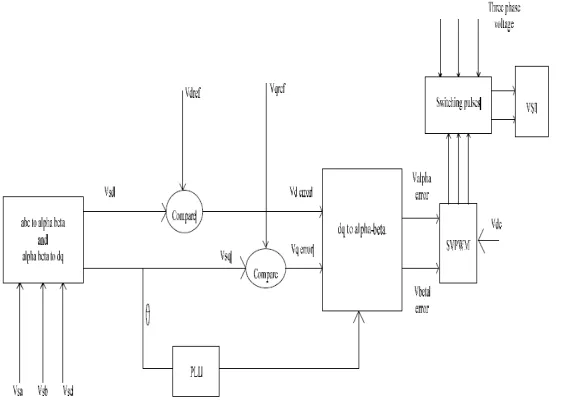
DVR control scheme
The main objective is to maintain voltage profile on the load bus where sensitive load is connected. Here only active
power is measured. The switching pulse generated for VSI is based on SVPWM. It is a simple method and better than
other PWM techniques. Normally, three phase inverters use SPWM technique. However, problem like large noise peak at
carrier frequency are present in such technique. Hence, SVPWM has an advantage over such technique such as better dc
utilization and easy implementation with digital signal processor. In this way, SVPWM is used as a control method for
DVR.The proposed control technique for DVR The Phase Locked Loop (PLL)circuit used here is used to generate a unit
sinusoidal wave which is in phase with main supply voltage
Figure 1 : Control scheme for DVR
11. Simulation Results and Discussion
Voltage dip occurs due to sudden disconnection of load or faults in the system whereas voltage swell occurs due to
connection of capacitive load. Voltage unbalance occurs for certain duration in the system due to faults in the network.
During this period voltage disturbance occurs at PCC (Point Of Coupling) and DVR operates to restore/maintain the
voltage profile. Here all voltages are taken in per unit values, whenever disturbance occurs it can be observed that the
magnitude voltage profile increases/decreases from its rated value. DVR operates and inject the desired voltage to
compensate this voltage rise/dip. After compensation, there is slight disturbance at the start and end point of sag/swell
© IJERGS, All Rights Reserved.
Pag
e45
Pag
e45
Pag
e45
Pag
e45
Pag
e45
Pag
e45
Pag
e45
Pag
e45
Pag
e45
Pag
e45
Pag
e45
Pag
e45
Pag
e45
Pag
e45
Pag
e45
Pag
e45
Pag
e45
Pag
e45
Pag
e45
Pag
e45
Pag
e45
12. Voltage Sag Compensation:
Compensation of balanced voltage sag
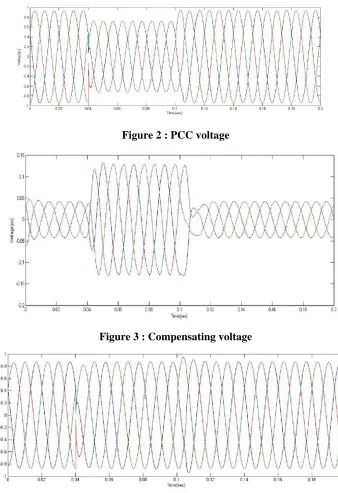
A three phase fault is generated in the system to create balanced voltage sag for time duration of 0.04s to 0.1s. The PCC
voltages after the sag occurs for the duration of 0.06s The DVR respond to this disturbance and inject the compensating
voltage. The compensated voltage is. After sag compensation, the load voltage regains its previous profile. The load
voltage after compensation.
Figure 2 : PCC voltage
Figure 3 : Compensating voltage
© IJERGS, All Rights Reserved.
Pag
e46
Pag
e46
Pag
e46
Pag
e46
Pag
e46
Pag
e46
Pag
e46
Pag
e46
Pag
e46
Pag
e46
Pag
e46
Pag
e46
Pag
e46
Pag
e46
Pag
e46
Pag
e46
Pag
e46
Pag
e46
Pag
e46
Pag
e46
Pag
e46
13. Compensation of unbalanced voltage sag:
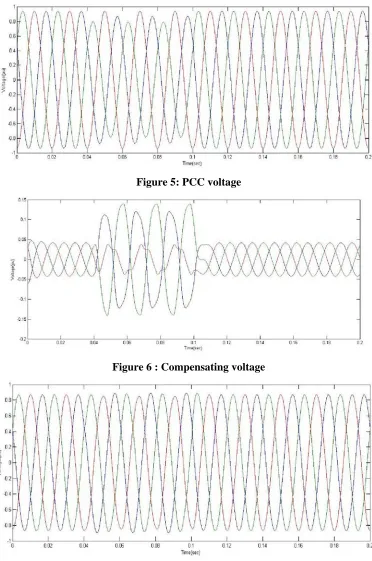
Unbalanced voltage sag occurs due to SLG fault in the network for time duration of0.04s to 0.1s. The PCC voltage after
the sag occurs for duration of 0.06s DVR injects the desired voltage for this duration. The compensating voltage injected
by DVR After the successful operation of DVR and sag compensation, the compensated load voltage
Figure 5: PCC voltage
Figure 6 : Compensating voltage
© IJERGS, All Rights Reserved.
Pag
e47
Pag
e47
Pag
e47
Pag
e47
Pag
e47
Pag
e47
Pag
e47
Pag
e47
Pag
e47
Pag
e47
Pag
e47
Pag
e47
Pag
e47
Pag
e47
Pag
e47
Pag
e47
Pag
e47
Pag
e47
Pag
e47
Pag
e47
Pag
e47
14. Voltage Swell compensation
Compensation of balanced voltage swell
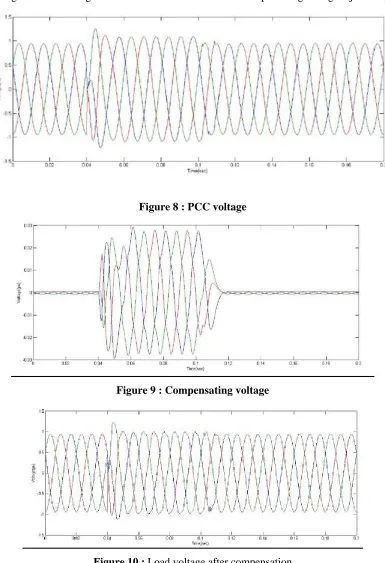
A three phase balanced voltage swell occurs by connecting a capacitive load in the network for time duration of 0.04s to
0.1s. The PCC voltage after the voltage unbalance for this duration. The compensating voltage injected by DVR
Figure 8 : PCC voltage
Figure 9 : Compensating voltage
© IJERGS, All Rights Reserved.
Pag
e48
Pag
e48
Pag
e48
Pag
e48
Pag
e48
Pag
e48
Pag
e48
Pag
e48
Pag
e48
Pag
e48
Pag
e48
Pag
e48
Pag
e48
Pag
e48
Pag
e48
Pag
e48
Pag
e48
Pag
e48
Pag
e48
Pag
e48
Pag
e48
Compensation of unbalanced voltage swell
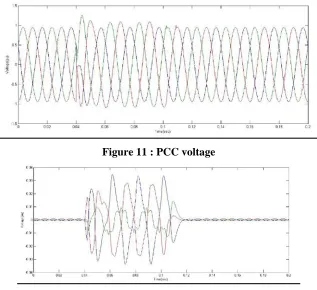
An unbalanced voltage swell occurs by generating a two phase swell in the network for duration of 0.04s to 0.6s. The PCC
voltage for this duration. The compensating voltage injected by DVR
Figure 11 : PCC voltage
Figure 12 : Compensating voltage
Figure 13 : Load voltage after compensation
15. Conclusion
The demand for quality power has become a challenging issue for industrial area and consumers. Among them voltage
unbalance is considered as the major affecting problem leads to degradation in performance of electrical equipments.
FACTS devices used for compensation are the best method to overcome such problem. Among them DVR considered the
most efficient and cost effective. Voltage unbalances such as voltage sag/swell are considered here. Voltage unbalance
© IJERGS, All Rights Reserved.
Pag
e49
Pag
e49
Pag
e49
Pag
e49
Pag
e49
Pag
e49
Pag
e49
Pag
e49
Pag
e49
Pag
e49
Pag
e49
Pag
e49
Pag
e49
Pag
e49
Pag
e49
Pag
e49
Pag
e49
Pag
e49
Pag
e49
Pag
e49
Pag
e49
compensating technique used by DVR for compensating such unbalance are also presented. The simulation result shows
that DVR compensate sag/swell effectively and provide good voltage regulation. The performance of DVR is satisfactory
16. References
[1] M H J Bollen, Understanding Power Quality Problems-Voltage sags & Interruptions, IEEE press , New York, 2000.
[2] Math H.J.Bollen,”Understanding power quality problems (voltage sags and interruptions), first edition, IEEE press, 2001.
[3] H. Hingorani “Introducing custom power” IEEE spectrum, vol.32
[4] Yash Pal Swarup, Bhim Singh, “A review of Compensating Type Custom Power Devices for Power Quality Improvement”, IEEE conf.proc. 2008.
[5] Ray Arnold “Solutions to Power Quality Problems” power engineering journal 2001 pages: 65-73.
[6] Omar, N.A.Rahim & M. Sulaiman, “Modelling & Simulation for Voltage sag/swells mitigation using Dynamic Voltage Restorer”, Journel.Theor. Applied information technology, pp 464-470, 2009
[7] M.H.Haque “Compensation of distribution system voltage sag by DVR and DSTATCOM” Power Tech Proceedings, 2001 IEEE Porto, Volume: 1 , 10-13 Sept. 2001 Pages:5 pp. vol.1.
[8] Arindam Ghosh, Gerard Ledwich, “Structures and Control of a Dynamic Voltage Regulator”,\Power Engineering Society Winter Meeting, pp. 10271032, 2001.
[9] Russel Buxton, “Protection from Voltage Dips with the Dynamic Voltage Restorer”, Dynamic Power Ltd. Review, pp. 3/1-3/6, 1998.