Dorota Jakubiec
1,B–D, F, Katarzyna Jagielska
2, A–C, Mikołaj Karmowski
3, B, E,
Katarzyna Kubicka
1, C, D, Andrzej Karmowski
3, A, F, Krzysztof A. Sobiech
1, A, E, FEffect of Attending Childbirth Education Classes
on Psychological Distress in Pregnant Women Measured
by Means of the General Health Questionnaire
1 Department of Human Biology, University School of Physical Education, Wrocław, Poland 2 Department of Physiotherapy, Wroclaw Medical University, Poland
3 1st Department of Gynecology and Obstetrics, Wroclaw Medical University, Poland
A – research concept and design; B – collection and/or assembly of data; C – data analysis and interpretation;
D – writing the article; E – critical revision of the article; F – final approval of article; G – other
Abstract
Background. Pregnancy brings about many changes in a woman’s life in somatic, psychological and social spheres. Therefore, many women decide to participate in childbirth education classes. The aim of study was to determine the differences in emotional distress between women who participated in childbirth education classes and these who did not.
Material and Methods. Seventy first-time mothers after labor were examined. Based on a survey carried out, the women were divided into two equal groups. Group I consisted of women who had participated in childbirth education classes and Group II of women who had not. The data was gathered by means of the General Health Questionnaire (GHQ-12) adapted to Polish conditions.
Results. There were no differences either in age or in BMI rates among the examined women. The level of educa-tion and knowledge about labor was significantly higher among the participants of childbirth classes. The results of the GHQ-12 revealed that women from Group I had a better mental status than women from Group II. Significant differences were observed in terms of sleep deprivation, overcoming difficulties and in the ability to enjoy daily activities.
Conclusions. Participation in childbirth classes has a significant influence on psychological well-being in pregnant women as measured by the GHQ-12 (Adv Clin Exp Med 2014, 23, 6, 953–957).
Key words: psychological distress, pregnant women, childbirth classes, GHQ-12.
Adv Clin Exp Med 2014, 23, 6, 953–957 ISSN 1899–5276
ORIGINAL PAPERS
© Copyright by Wroclaw Medical University
Psychological distress in pregnant women has been the subject of numerous studies in vari-ous institutions and health care centers all over the world [1–6]. Pregnancy brings about a great many changes in somatic, psychological and social aspects of life. First-time mothers have the added stressors of adapting to their new role as mothers and the in-securities associated with their ability to nurture an infant for the first time, therefore many women – if they have such the possibility – decide to participate in childbirth education classes. The originator of the idea, Grantly Dick-Read, a British obstetrician,
was the first one to observe a correlation between the mental state of the woman in labor and the pain which accompanies childbirth. He defined that cor-relation as the fear-tension-pain syndrome, which was the cause of pain during labor [7, 8]. The first childbirth education classes in Poland were held in the 50’s by Professor Włodzimierz Fijałkowski, who followed the idea of Dick-Read and aimed at cor-recting misconceptions and eliminating the nega-tive emotions related to childbirth [7]. At present, the most important goal of childbirth education classes is physiotherapeutic preparation for natural
birth. Additionally, childbirth education classes help pregnant women overcome their fear and mentally prepare for childbirth [7, 8]. Therefore, the objec-tive of this study was to evaluate the effects of the ex-panding knowledge, psychological preparation and suitably chosen physical activity offered by child-birth education classes on the emotions accompa-nying pregnancy and labor and thus the emotional distress status of the examined women.
Material and Methods
The examined group consisted of 70 postpar-tum women. Classification criterion was the first childbirth and delivery after the 37th week of
preg-nancy. All women gave their informed consent prior to their inclusion in this study. The neces-sary data was gathered by means of a two-part, anonymous questionnaire. The first part – socio-logical – consisted of general questions concern-ing age, received education and knowledge about childbirth. The second part included the General Health Questionnaire (GHQ-12) adapted to Pol-ish conditions. The GHQ-12 consists of 12 items, each assessing a certain problem in the Likert scor-ing system (0 – 1 – 2 – 3) [9]. The obtained results were subjected to statistical analysis by means of CSS STATISTICA 6.0 and presented in the form of arithmetical mean (x) and standard deviation (± SD). A quantitative comparison employed the non-parametric Mann-Whitney U test, assuming the level of statistical significance at p ≤ 0.05.
All procedures were approved by the Eth-ics Committee/KB-165/210 of Wroclaw Medical University.
Results
Based on the questionnaire, the examined women were divided into 2 groups, 35 women in each. Group I consisted of those women who had
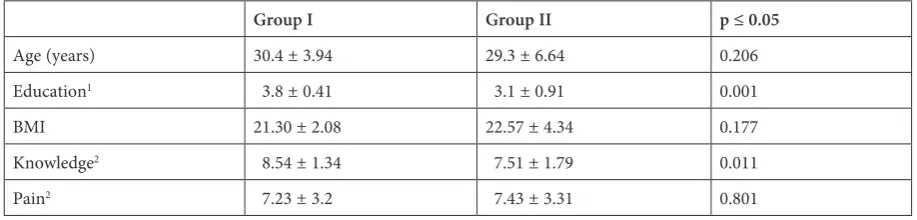
participated in childbirth education classes and Group II of the women who had not. The differ-ences regarding age and BMI values between the groups were statistically insignificant. Howev-er, the level of received education and knowledge about childbirth were significantly higher in child-birth classes’ participants (Table 1). Twenty eight (80%) women in Group I had university education and none had vocational or elementary education. In Group II only 15 (43%) women had received university education. The subjective evaluation of pain was at the same level in both groups.
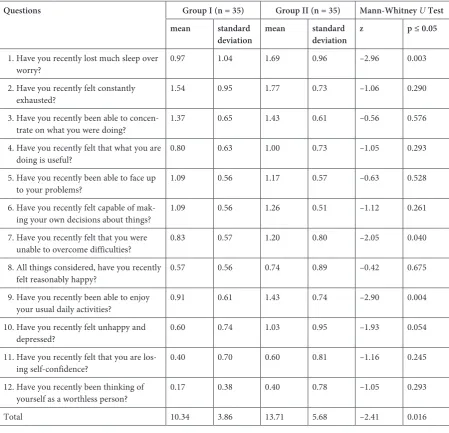
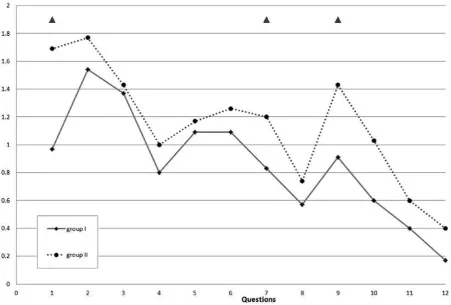
Assessment of psychological distress by means of the GHQ-12, where lower point values mean bet-ter emotional status, revealed that the mental health status between the women in Group I and Group II differed significantly. Group I obtained lower point values (better mental health status) than Group II. The significant differences regarded questions 1, 7 and 9, which were related to sleeping problems, overcoming difficulties and enjoying everyday ac-tivities (Table 2). As far as the rest of the questions are concerned, the average number of points ob-tained was comparable in both groups – similarly low or high, yet always higher in Group II (Fig. 1).
Discussion
Within the last decades, due to changes in our culture and lifestyle, women are deciding to be-come mothers much later in life, and the age of late, yet still healthy, motherhood has increased from 35 to 40 [10, 11]. The majority of pregnant women are over 25. The average age in Group I was 30.4 and in Group II 29.3.
The examined women who participated in childbirth education classes had higher education than the ones who did not. A similar tendency was observed by Kołomyjec et al. [12], who found that 54.6% of women who attended childbirth education classes had received university education, whereas that percentage dropped to 24.4% in women who
Table 1. Age, education and knowledge of childbirth in the examined postpartum women of both groups (p ≤ 0.05)
Group I Group II p ≤ 0.05
Age (years) 30.4 ± 3.94 29.3 ± 6.64 0.206
Education1 3.8 ± 0.41 3.1 ± 0.91 0.001
BMI 21.30 ± 2.08 22.57 ± 4.34 0.177
Knowledge2 8.54 ± 1.34 7.51 ± 1.79 0.011
Pain2 7.23 ± 3.2 7.43 ± 3.31 0.801
1 – education: 1 – elementary, 2 – vocational, 3 – secondary, 4 – university.
had not participated in the classes [13]. That may prove that well-educated women are more aware of the fact that the course of labor to a great extent depends on the woman herself and therefore are more willing to participate in childbirth education classes [14]. Kolanko and Kolanko [7] did not ob-serve any correlations between education and the motivation to attend childbirth education class-es; however, the results were much better among those women who were well-educated.
Psychological distress in pregnant women has been the subject of numerous publications all over the world [1–6]. The studies carried out were also focused on women burdened with various illnesses or/and different questionnaires were used [3, 15]. The GHQ is a widely used instrument designed to screen for psychological disturbance, and also to screen women during pregnancy and in the post-natal period. The Chinese version of the GHQ-12 is widely used in Hong Kong [5]. The GHQ-12 was
employed by van Bussel et al. [4], who examined mentally healthy women before, during and after pregnancy. They observed frequent mental health disorders in the early stages of pregnancy and af-ter childbirth. However, according to those au-thors, pregnant women are not more predisposed to mental disorders than those women who are not pregnant or have not given birth recently. Setse et al. [15] observed that alterations in depressive symptomatology have a substantial effect on func-tioning during pregnancy and after delivery.
Pregnancy brings about a great many changes in a women’s life, most of all those resulting from the changes that are happening to her body. Physi-cal abilities decrease, the body’s shape alters and hor-monal balance is disturbed. Lower physical activi-ty during pregnancy contributes to increasing body weight, which in turn results in overloading of the osteoarticular system [16]. As the amount of blood and lymph increases and blood vessels expand,
Table 2. Evaluation of the quality of life by means of the 12-item General Health Questionnaire (GHQ-12)
Questions Group I (n = 35) Group II (n = 35) Mann-Whitney U Test mean standard
deviation mean standard deviation z p ≤ 0.05
1. Have you recently lost much sleep over
worry? 0.97 1.04 1.69 0.96 –2.96 0.003
2. Have you recently felt constantly
exhausted? 1.54 0.95 1.77 0.73 –1.06 0.290
3. Have you recently been able to
concen-trate on what you were doing? 1.37 0.65 1.43 0.61 –0.56 0.576 4. Have you recently felt that what you are
doing is useful? 0.80 0.63 1.00 0.73 –1.05 0.293
5. Have you recently been able to face up
to your problems? 1.09 0.56 1.17 0.57 –0.63 0.528 6. Have you recently felt capable of
mak-ing your own decisions about thmak-ings? 1.09 0.56 1.26 0.51 –1.12 0.261 7. Have you recently felt that you were
unable to overcome difficulties? 0.83 0.57 1.20 0.80 –2.05 0.040 8. All things considered, have you recently
felt reasonably happy? 0.57 0.56 0.74 0.89 –0.42 0.675 9. Have you recently been able to enjoy
your usual daily activities? 0.91 0.61 1.43 0.74 –2.90 0.004 10. Have you recently felt unhappy and
depressed? 0.60 0.74 1.03 0.95 –1.93 0.054
11. Have you recently felt that you are
los-ing self-confidence? 0.40 0.70 0.60 0.81 –1.16 0.245 12. Have you recently been thinking of
yourself as a worthless person? 0.17 0.38 0.40 0.78 –1.05 0.293
there is a possibility of varices [17]. The center of gravity shifts forwards which may result in pain in the lumbar section of the spine and balance disor-ders [18, 19]. During pregnancy the oxygen require-ment increases while lung capacity decreases due to upshifting of the diaphragm caused by the expand-ing uterus [20]. The aforementioned changes as well as many others which accompany pregnancy may obviously affect the psycho-emotional condition of the woman and thus her quality of life.
Both psychological well-being and physical condition are important factors to quality of life. The quality of life in pregnancy is not a constant value and, depending on the situation and various factors, it may decrease or increase accordingly [14, 21, 22]. Health-related quality of life progres-sively decreases when the probability of being a psy-chiatric case increases [23]. The physical exercise provided at childbirth education classes, similarly
to Yoga classes for pregnant women, bring posi-tive results by improving efficiency and well-being [24, 25]. It was observed in both cases that the level of psychological distress decreased and the quali-ty of life in physical, psychological and sociological aspects increased and even the quality of sleep im-proved among the women participating in child-birth education classes in comparison with control groups. Therefore, childbirth education classes in an unconventional way improve the quality of life of pregnant women as well as their physical effi-ciency, provide necessary knowledge and become, in a way, support group sessions which improve the mental state of the women.
The authors concluded that participating in childbirth education classes significantly improves mental health status by decreasing emotional dis-tress in pregnant women, measured by means of the GHQ-12.
Fig. 1. Comparison of mean number of points scored for particular questions in the 12-item General Health Questionnaire (GHQ-12) in both groups
References
[1] Kitamura T, Toda MA, Shima S, Sugawara M: Validity of the repeated GHO among pregnant women: a study in a Japanese general hospital. Int J Psychiatry Med 1994, 24, 149–156.
[2] Rondo PHC, Ferreira RF, Nogueira F, Ribeiro MCN, Lobert H, Arles R: Maternal psychological stress and dis-tress as predictors of low birth weight, prematurity and intrauterine growth retardation. Eur J Clin Nutr 2003, 57, 266–272.
[4] van Bussel JCH, Spitz B, Demyttenaere K: Women’s mental health before, during, and after pregnancy: a popu-lation-based controlled cohort study. Birth 2004, 33, 297–302.
[5] Yim Ip W, Martin CR: Psychometric properties of the 12-item General Health Questionnaire (GHQ-12) in Chinese women during pregnancy and in the postnatal period. Psychol Health Med 2006, 11, 60–69.
[6] Chaaya M, Osman H, Naassan G, Mahfoud Z: Validation of the Arabic version of the Cohen perceived stress scale (PSS-10) among pregnant and postpartum women. BMC Psychiatry 2010, 10, 111–116.
[7] Kolanko A, Kolanko J: Przygotowanie do porodu naturalnego w szkole rodzenia. Fizjoterapia 1999, 7, 53–55.
[8] Stangret A, Cedrowska A, Szukiewicz D: Kurs szkoły rodzenia jako sposób na obniżenie poziomu lęku przed porodem. Fam Med Prim Care Rev 2009, 11, 53–59.
[9] Makowska Z, Merecz D: Polska adaptacja Kwestionariuszy Ogólnego Stanu Zdrowia Davida Goldberga. [Polish adaptation of David Goldberg’s General Health Questionnaires] In: Dudek B (ed) Ocena zdrowia psychicznego na podstawie badań kwestionariuszem Dawida Goldberga. Podręcznik dla użytkowników kwestionariuszy GHQ-12 i GHQ-28. Oficyna Wydawnicza Instytutu Medycyny Pracy im. Prof. J. Nofera, Łódź, 2010, 191–264.
[10] Studziński Z: Ciąża i poród u kobiet po 40 roku życia. Wiad Lek 2004, 57, 140–144.
[11] Witek A, Bojdys-Szyndlar M: Ciąża po 40 roku życia – nowa norma w położnictwie. Przegl Menop 2006, 5, 306–310.
[12] Kołomyjec P, Suchocki S, Kędra-Rakoczy M: Wykształcenie i zachowania prozdrowotne ciężarnych biorących udział w zajęciach szkoły rodzenia oraz ich wpływ na przebieg porodu i stan noworodka. Klin Perin Gin 2007, 43, 57–60.
[13] Piziak W: Wpływ przygotowania psychofizycznego w szkole rodzenia na przebieg ciąży i porodu. Prz Med Uniw Rzesz Inst Leków 2009, 3, 282–292.
[14] Naseem K, Khurshid S, Khan SF, Moeen A, Farooq MU, Sheikh S: Health related quality of life in preg-nant women: a comparison between urban and rural populations. J Pak Med Assoc 2011, 6, 308–312.
[15] Setse R, Grogan R, Pham L, Cooper LA, Strobino D, Powe NR: Longitudinal study of depressive symptoms and health-related quality if life during pregnancy and after delivery: The health status in pregnancy (HIP) study. Matern Child Health J 2009, 13, 577–587.
[16] Jakubek A, Susik P: Znaczenie aktywności fizycznej w utrzymaniu należnej masy ciała i wysokiej jakości życia. Lider 2006, 10, 3–6.
[17] Karmowski A, Sobiech KA, Kotarska E, Majda J, Karmowski M, Łątkowski K: Wpływ ćwiczeń ruchowych w szkole rodzenia na izoenzymatyczny wskaźnik dehydrogenazy mleczanowej w surowicy krwi rodzących. Adv Clin Exp Med 2005, 14, 947–952.
[18] Fijałkowski W: Poród naturalny po przygotowaniu w szkole rodzenia. Warszawa PZWL 1981.
[19] Araujo D: Ćwiczenia fizyczne a ciąża. Med Dypl 1998, 7, 168–172.
[20] Poręba R, Pędzikiewicz J, Stokłosa H: Wpływ ćwiczeń według programu Szkoły Rodzenia na wybrane parametry układu oddechowego i biochemiczne we krwi kobiet ciężarnych. Rocz Nauk AWF Katowice 1994, 22, 113–121.
[21] Moyer ChA, Yang H, Kwawukume Y, Gupta A, Zhu Y, Koranteng I: Optimism/pessimism and health-related quality of life during pregnancy cross three continents: a matched cohort study in China, Ghana and the United States. BMC Pregnancy Childbirth 2009, 9, 39–48.
[22] Amador-Licona N, Guízar-Mendoza JM: Daytime sleepiness and quality of life: are they associated in obese preg-nant women? Arch Gynecol Obstet 2012, 285, 105–109.
[23] Serrano-Aguilar P, Ramallo-Fariña Y, Trujillo-Martín Mdel M, Muñoz-Navarro SR, Perestelo-Perez L, de las Cuevas-Castresana C: The relationship among mental health status (GHQ-12) health related quality of life (EQ-5D) and health-state utilities in a general population. Epidemiol Psichiatr Soc 2009, 18, 229–239.
[24] Rakhshani A, Maharana S, Raghuram N, Nagendra HR, Venkatram P: Effects of integrated yoga on quality of life and interpersonal relationship of pregnant women. Qual Life Res 2010, 19, 1447–1455.
[25] Tendais I, Figueiredo B, Mota J, Conde A: Physical activity, health-related quality of life and depression during pregnancy. Cad Saude Publica 2011, 27, 219–228.
Address for correspondence:
Dorota Jakubiec
1st Department of Human Biology
University School of Physical Education I.J. Paderewskiego 35
51-612 Wrocław Poland
E-mail: [email protected] Tel.: + 48 600 906 040
Conflict of interest: None declared Received: 10.10.2013