ISSN: 2333-6048 (Print), 2333-6056 (Online) Copyright © The Author(s). 2014. All Rights Reserved. Published by American Research Institute for Policy Development DOI: 10.15640/jmpp.v2n3a4 URL: http://dx.doi.org/10.15640/jmpp.v2n3a4
Are Leadership and Management Different? A Review
Dr. Ali Algahtani1
Abstract
Management and leadership have been used differently by different people. While some use them as synonymous terms, other view them as two completely different words. However, the majority appreciates some similarities and differences between them. The aim of this review is to determine whether management and leadership are different? The findings of this review showed that management and leadership are two very distinct functions. Although, management and leadership do share many similar duties which consist of working with people and influencing others to achieve goals. Management skills are used to plan, build, and direct organizational systems to accomplish missions and goals, while leadership skills are used to focus on a potential change by establishing direction, aligning people, and motivating and inspiring.
Keywords:Management, Leadership, Skills, Differences
1. Introduction
One may assume that all managers are leaders, but that is not correct since some of the managers do not exercise leadership, and some people lead without having any management positions. Therefore, there is a continuing controversy about the difference between leaders and managers. Some scholars argue that although management and leadership overlap, the two activities are not synonymous (Bass, 2010). Furthermore, the degree of overlap is a point of disagreement (Yukl, 1989). In fact, some individual see them as extreme opposites, and they believe that good leader cannot be a good manager and the opposite is true (Ricketts, 2009).
1ME, MBA, MLD, Bachelor degree in mechanical engineering (ME), Master of business administration
Leadership and management entail a unique set of activities or functions. While leaders and managers share some similarities because they both influence others by using specific powers to achieve certain goals, there are also some prominent differences (Northouse, 2007). While, managers maintain a smoothly functioning workplace, leaders test the current position and encourage new functions, so they are looking for long-term goals (Yukl, 1989). In today’s vigorous workplace, organizations need both effective management, and effective leadership for optimal success (Kotterman, 2006).
This review article will address and compare fundamental definitions of leadership and management, the specific types of skills for the manager and the leader, and discuss the similarities and differences between management and leadership.
2. The Paper Aim
To examine both leadership and management and know whether they are the same or differ.
3. Paper Question
What is the difference between leadership and management?
4. Methodology of Analysis
An extensive literature search was conducted using the following electronic databases: EBSCO, EMBASE and Google Scholar. The search aimed to identify and locate all previous articles which discussed the differences between the management and leadership. There was no time limitation; however the research was limited to only articles written in English. The title should have “management” and “leadership” terms within it. The keywords and phrases used in the research include (leadership) and (management), or (differences), or (similarities). Original and peer reviewed articles were considered for this review.
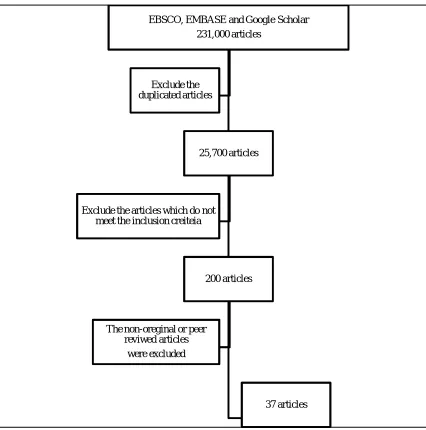
The titles and the abstracts of the identified articles are checked for eligibility and relevance. Among these 25,700 articles, only 200 articles were included because they meet the search criteria by having both “management” and “leadership” terms within the title. Finally, 37 articles were considered for this review because they were original and peer reviewed articles (Figure 1).
Figure 1: Research Flowchart
EBSCO, EMBASE and Google Scholar 231,000 articles
25,700 articles
200 articles
37 articles The non-oreginal or peer
reviwed articles were excluded Exclude the articles which do not
5. Results/Finding
In reviewing a series of articles, the majority of authors tried to identify the differences by comparing the management and the leadership in form of definition, and skills. In this document, the definition of the management and leadership will be discussed first, then the manager and the leader needed skills, and finally the differences between the management and the leadership.
6. Management
Katz defined the management as exercising direction of a group or organization through executive, administrative, and supervisory positions (Katz, 1955). Katz thought that management responsibilities are usually tasked-oriented, and it involves developing staff, mentoring persons with high potential, and resolving conflicts while maintaining ethics and discipline (Katz, 1955). Kappa states that the aim from a good management is to provide services to the community in an efficient and sustainable manner (Kappa, 1991). Moreover, Kotter defined the management as a job which takes care of planning, organizing, budgeting, coordinating and monitoring activities for group or organization (Kotter, 2001). Northouse defined the management as a process by which definite set objectives are achieved through the efficient use of resources (Northouse, 2007). Thus, Management in general is a process that is used to achieve organizational goals.
7. Leadership
Leadership is a complex, multidimensional phenomena (DePree, 1989). It has been defined as: a behavior; a style; a skill; a process; a responsibility; an experience; a function of management; a position of authority; an influencing relationship; a characteristic; and an ability (Northouse, 2007). John Maxwell defined leadership by influence (Maxwell, 1998). Kotter (1990) stated that “Leadership is the capacity for collective action to vitalize”. Robert Greenleaf defined effective leadership as people who serve others, while they follow them (Bennis and Nanus, 1997). Moreover, Peter Drucker defined a leader is someone who has followers (Drucker, 1999). However, some theorists believe that leadership is a form of the social influence processes (House and Aditya, 1997). Although there are a variety of leadership definitions, the majority of definitions focused on two components which are: the process of influencing a group of individuals to obtain a common goal; and to develop a vision.
Leaders focus on motivation, and inspiration (Kotter, 1990). Leaders aim to create passion to follow their vision, to reach long term goals, take risks to accomplish common goals, and challenge the current status quo (Bennis and Nanus, 1997). The leader keeps an open eye on his followers’ benefits, so people follow the leader voluntarily, and the leader directs the follower by using a transformational style (Bass, 1990). Leaders should have some critical qualities such as integrity; vision; toughness; decisive; trust; commitment; selflessness, creativity; risk taking; toughness; communication ability, and visibility (Capowski, 1994). Moreover, leaders should have charisma; a sense of mission; ability to influence people in a positive environment; and ability to solve problems (House, 1977).
In addition, research shows that being an effective leader depends upon common behaviors and characteristics like: confidence; service mentality; good coaching skills; reliability; expertise; responsibility; good listening skills; being visionary; realistic; good sense of priorities; honesty; willingness to share; strong self-esteem; technical or contextual, and recognition (Bennis and Nanus, 1997).
8. Management vs. Leadership
Both leadership and management involve influence, working with people, and working to achieve common goals(The Guardian, 2013).However, the fields of leadership and management considered very different(Kotterman, 2006). Katz asserts that leadership is a multi-directional influence relation, while management is a unidirectional authority relationship (Katz, 1955).
In 1977, Abraham Zaleznik wrote the first scholarly andlandmark article about the difference between leaders and managers (Zaleznik, 1977). Zaleznik mentioned that the organizationneeds both effective managers and effective leaders in order to reach its goals, but he argues that managers and leaders have different contributions (Zaleznik, 1977). Whereas leaders promoter change, new approaches, and work to understand people’s beliefs to gain their commitment, managers promoter stability, exercise authority, and work to get things accomplished. Therefore, management and leadership need different types of people(Zaleznik, 1977).
In 1983, Watson stated that managers take care of structure and system, but leaders focus on the communication, motivation, and shared goals. In addition, Watson mentioned that 7S strategy which include;strategy, structure, systems, shared values, skills, and style; is more effective for leaders comparing to managers.In 1985, Bryman added that leadership is about strategic motivation. Bennis and Nannus (1985) briefly describe the differencesbetween the leaders and managersin one sentence: "Leaders do the right things; managers do things right." (p. 33).Moreover, In 1989 Bennis stated that “To survive in the twenty-first century, we are going to need a new generation of leaders
- leaders, not managers. The distinction is an important one. Leaders conquer the context
- the volatile, turbulent, ambiguous surroundings that sometimes seem to conspire against us and will surely suffocate us if we let them—while managers surrender to it.”(p. 7).
Kotter stated that “Leadership is different from management, but not for the reason most people think. Leadership isn‟t mystical and mysterious. It has nothing to do with having charisma or other exotic personality traits. It‟s not the province of a chosen few. Nor is leadership necessarily better than management or a replacement for it: rather, leadership and management are two distinctive and complementary activities. Both are necessary for success in an increasingly complex and volatile business environment (Kotter, 1990).” In contrast, the management is a process that aims to control organization’sformal functions (Kotter, 2001).
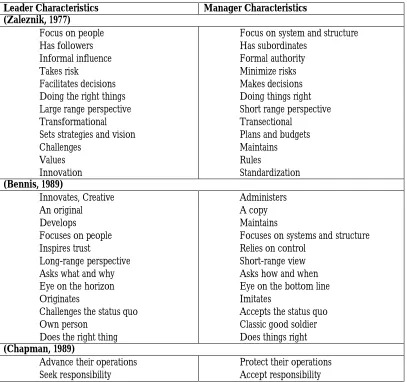
Bernard Bass (1990) in his book "Bass and Stogdill’s Handbook of Leadership" states that "Leaders manage and managers lead, but the two activities are not synonymous. Management functions can potentially provide leadership; leadership activities can contribute to managing. Nevertheless, some managers do not lead, and some leaders do not manage". (p. 383). Other researchers mention that the leaderis inspiring, innovative, flexible, courageous and independent, and has a soul, the passion and the creativity. Whilethe manager is deliberate, authoritative, consulting, analytical, and stabilizing, and has the rational, the mind, and the persistence (Capowski, 1994).In 1997, Robert House states that management consists ofcontrolling daily problems, and implementing leader's vision (House, 1977).Furthermore, Warren Bennis a business professor at the University of Southern California, (1997) sharps the difference by using 12 paired contrasts listed in his book "Learning to Lead: A Workbook on Becoming a Leader", (p. 9).
In summary, while management and leadership share similar roles, it is important to make a distinction between those two functions. The primary mission of both leaders and managers is to control and influence other people. The most important difference between managers and leaders is their approach to achieve the goals. Managers exercise their control through formal power, but leaders use their vision, and by inspiration, motivation to align their followers (The Guardian, 2013). Balancing the role of both management and leadership are critical to the organization’ssuccess. Moreover, sometimes it is essential for managers to be successful to work as leaders (Mullins, 2010). Summary of the most historically well known comparison between leaders and managers is listed in table 1.
Table 1: Historical Comparison between Manger and Leader Characteristics
Leader Characteristics Manager Characteristics
(Zaleznik, 1977) Focus on people
Has followers
Informal influence
Takes risk
Facilitates decisions
Doing the right things
Large range perspective
Transformational
Sets strategies and vision
Challenges
Values
Innovation
Focus on system and structure
Has subordinates
Formal authority
Minimize risks
Makes decisions
Doing things right
Short range perspective
Transectional
Plans and budgets
Maintains
Rules
Standardization
(Bennis, 1989)
Innovates, Creative
An original
Develops
Focuses on people
Inspires trust
Long-range perspective
Asks what and why
Eye on the horizon
Originates
Challenges the status quo
Own person
Does the right thing
Administers
A copy
Maintains
Focuses on systems and structure
Relies on control
Short-range view
Asks how and when
Eye on the bottom line
Imitates
Accepts the status quo
Classic good soldier
Does things right
(Chapman, 1989)
Advance their operations
Seek responsibility
Protect their operations
Take calculated risks
Generate speaking opportunities
Set “unreasonable” goals
Challenge problem employees
Strive for an exciting working environment
Use power forcefully
Delegate enthusiastically
View workers as potential followers
Minimize risks
Accept speaking opportunities
Set reasonable goals
Pacify problem employees
Strive for a comfortable working environment
Use power cautiously
Delegate cautiously
View workers as employees
(Certo, 1997) Soul Visionary Passionate Creative Flexible Inspiring Innovative Courageous Imaginative Experimental Independent Mind Rational Consulting Persistent Problem-solving Tough-minded Analytical Structured Deliberate Authoritative Stabilizing
(Bennis and Goldsmith, 1997) Innovates
An original
Develops
Investigatesreality
Focuses on people
Inspires trust
Has a long-range perspective
Asks what and why
Has his or her eye on the horizon
Originates
Challengesthe status quo
His or her own person
Counseling, empowerment
Manager, Work with a mechanistic approaches
Administers
A copy
Maintains
Accepts reality
Focuses on systems
Relies on control
Has a short-range view
Asks how and when
Has his or her eye always on the bottom line
Imitates
Accepts the status quo
The classic good soldier
Counseling, empowerment
Manager, Work with a mechanistic approaches
(Buchanan and Huczynski, 2004; based on Kotter, 1990)
Establishing direction: Vision of the future, develop strategies for
Aligning people: Communicate vision and strategy, influence creation of teams which accept the validity of goals
Motivating and inspiring: Energize people to overcome obstacles, satisfy human need.
Produces positive and sometimes dramatic change.
Plans and budgets: Decide action plans and timetables, allocate resources.
Organizing and staffing: Decide structure and allocate staff, develop policies, procedures and monitoring.
Controlling, problem solving: Monitor results against plan
Produces order, consistency and predictability.
(Northouse 2007, p.10) Establishing directions
Creating a vision
Clarifying the big picture
Planning and budgeting
Establishing agendas
Setting strategies Allocating resources
Aligning people
Communicating goals
Seeking commitment
Building teams and coalitions
Organizing and staffing
Provide structure
Making job placements
Establishing rules and procedures
Motivating and inspiring
Inspiring and energize
Empowering subordinates
Satisfying unmet needs
Controlling and problems solving
Developing incentives
Generating creative solutions
Taking corrective action
(Lunenburg, 2011) Focuses on people
Looks outward
Articulates a vision
Creates the future
Sees the forest
Empowers
Colleagues
Trusts & develops
Does the right things
Creates change
Serves subordinates
Uses influence
Uses conflict
Acts decisively
Focuses on things
Looks inward
Executes plans
Improves the present
Sees the trees
Controls
Subordinates
Directs & coordinates
Does things right
Manages change
Serves superordinates
Uses authority
Avoids conflict
Acts responsibly
9. Author Reflection
From my point view, Ithink that there are some individuals who have the capacity to fulfil the roles of both a leader and a manager. In my experience, leaders used to create the new changes, and managers used to apply them. However, new changes implantationis not easy, thus managers sometime resist to apply the new changes. In addition, I totally agree with those who ask for the balance between the manager’s roles and the leader’s roles, because it is vital to ensure the best outcomes. Moreover, I believe that leadership becomes a must in every organization, especially inthe business world; to cope with the rapid changes and different need for this century.
10. Conclusion
The optimal effectiveness of an organization can only reach if the organization has strong leadership and strong management. In today’s dynamic workplace, organizations need leaders to cope with new challenges, and transform organizations in order to achieve a competitive advantage in the marketplace. In addition, organizations need managers to maintain a smoothly functioning workplace, and to utilize resources effectively. Finally, a well balanced organization should have a mix of leaders and managers to succeed (Kotterman, 2006).
11. References
Bass, B. (1985). Leadership and performance beyond expectations. New York, Free Press, 1985.
Bass, B. (1990). Bass and Stogdill's Handbook of Leadership: Theory, Research & Managerial Applications, 3rd Ed., The Free Press, New York, NY.
Bass, B. (2010). The Bass handbook of leadership: Theory, research, and managerial applications. New York, NY: Simon & Schuster.
Bennis, W. G. and Nanus, B. (1985), Leaders: The Strategies for Taking Charge, Harper and Row, New York.
Bennis, W. G. (1989). Managing the dream: leadership in the 21st century. Journal of Organizational Change Management, 2(1), 6-10.
Bennis, W., and Goldsmith, J. (1997). Learning to Lead: A Workbook on Becoming a Leader, updated Ed., Addison-Wesley, Reading, MA.
Bennis, W. G. and Nanus, B. (1997), Leaders: The Strategies for Taking Charge, HarperCollins, New York.
Bennis, W. G., and Nanus, B. (2007). Leaders: The strategies for taking charge. NewYork, NY: HarperCollins.
Bryman, A. (1986). Leadership and Organizations. UK: Routledge & Kegan Paul.
Capowski, G., (1994), “Anatomy of a leader: where is the leader of tomorrow?”, Management Review, Vol. 83 Issue 3, p. 10-18.
Certo, S. C. (1997). Modern Management. USA: Prentice Hall.
Chapman, E. N. (1989). Leadership. USA: Prentice Hall Englewood Cliffs.
Covey, S. R. (2003). Principle Centered Leadership. New York: Franklin Covey Company. DePree, M. (1989). Leadership is an art. New York: Dell Publishing.
Drucker, P F (1999) Knowledge-worker productivity: The biggest challenge. California Management Review, 41 (2), 79.
Gosling, J. & Murphy, A. (2004). Leading Continuity. Working Paper: Centre for Leadership Studies, University of Exeter.
Hughes, H., Ginnett, M & Curphy, R. (1999). Leadership.Singapore: Mc Graw-Hill.
Hull, T., & Ozeroff, P. (2004). The transitioning from Manager to leader. New York: Harper and Row.
Katz, R. L. (1955). Skills of an effective administrator. Harvard Business Review, 33(1), 33-42. Kotterman, J., (2006), “Leadership vs Management: What’s the difference?”, Journal for
Quality & Participation, Vol. 29 Issue 2, p.13-17
Kotter, J. P. (1987), The Leadership Factor, The Free Press, New York, NY. Kotter, J. P. (1990a). What leaders really do. Harvard Business Review, 68, 103-111.
Kotter, J. P. (1990b). A force for change: How leadership differs from management. New York, NY: Free Press.
Kotter, J. P., (2001), “What leaders really do?“, Harvard Business Review, Vol. 79 Issue 11, p.85-96
Lunenburg, F. C. (2011). Leadership versus Management: A Key Distinction—At Least in Theory. International Journal of Management, Business, and Administration, 14 (1), 1-4.
Maxwell, J C (1998) 21 Irrefutable Laws of Leadership. Nashville, Tennesse: Thomas Nelson, Inc.
Mullins, L. J. (2010). Management and Organizational Behavior. UK: Pearson Education. Northouse, P. (2007). Leadership theory and practice. Thousand Oaks, CA: Sage Publications. Phi Theta Kappa. (1991). Creating then communicating your vision. In Phi Theta Kappa,
Leadership Development Program. Jackson, MS: Phi Theta Kappa, p.2.2.
Rehnquist, W. H. (1995). Time: It’s yours to use or abuse. In Phi Theta Kappa, Leadership Development Program. Jackson, MS: Phi Theta Kappa, p. 5.5-5.8.
The Guardian. (2013). What's the difference between leadership and management?. Available at http://careers.theguardian.com/difference-between-leadership-management Watson, C. M. (1983). Leadership, Management and the Seven Keys. Business Horizons,
March–April.
Ylitalo, J. (2004). Leadership and Management. Department of Industrial Engineering and Management, Helsinki University of Philosophy USA available at www.hcl.hut.fi Yukl, G., 1989. Managerial Leadership: a review of theory and research. Journal of
Management, Vol. 15 Issue 2, p. 251-290