Iranian Journal of Electrical & Electronic Engineering, Vol. 14, No. 2, June 2018 124
Row/Column-First: A Path-based Multicast Algorithm for 2D
Mesh-based Network on Chips
S. Kashi* and A. Patooghy*(C.A.)
Abstract: In this paper, we propose a new path-based multicast algorithm that is called Row/Column-First algorithm. The proposed algorithm constructs a set of multicast paths to deliver a multicast message to all multicast destination nodes. The set of multicast paths are all of row-first or column-first subcategories to maximize the multicast performance. The selection of row-first or column-first approaches is done based on the location of multicast source node i.e., how the multicast source is far from right/left and top/bottom margins of the mesh network. In this way, the proposed algorithm improves two performance criteria i.e., traffic and communication latency as compared with the well-known Column-Path multicast algorithm. In order to evaluate the proposed algorithm, an analytical model is developed to estimate the mentioned performance criteria. The modeling and simulation results show improvement of 10 and 20 percent on traffic and communication latency respectively for Row/Column-First algorithm as compared to the Column-Path algorithm.
Keywords: Network-on-Chip, Multicast Communication, Column-Path, Row/Column-First, Traffic, Communication Latency.
1 Introduction1
S the number of cores integrated into multi-processor chips increase rapidly, scalability and fabrication problems of traditional communication architectures e.g. bus-based architectures, point-to-point architectures, and ad-hoc architectures are becoming challenging. Network-on-Chip (NoC) has been proposed as a promising solution to tackle these problems [1]. In this solution, packetized data are transmitted through an on-chip network to be delivered to on-chip cores. Due to wide spread usage of multi-thread parallel programs, data transmission from one source core to multiple destination cores is frequently seen in NoCs.
This type of packet transmission which is known as multicasting extremely affects the efficiency of the whole chip. Many researchers has been considered
Iranian Journal of Electrical & Electronic Engineering, 2018. Paper first received 06 December 2016 and accepted 12 December 2017.
* The authors are with the Department of Computer Engineering, Iran University of Science and Technology,Tehran, Iran.
E-mails: [email protected] and [email protected]. Corresponding Author: A. Patooghy.
design and evaluation of multicast algorithms for NoCs [2-6]. Based on these work, multicast algorithms may be divided into three categories: unicast-based multicast algorithms [4,7], tree-based multicast algorithms [2,4,8], and path-based multicast algorithms [12-24].
Path-based algorithms are deadlock/livelock-free; have a much lower blocking probability than tree-based algorithms making them a good candidate for wormhole switched NoCs [12,13]. Several researches have been conducted to shortage the multicast path in path-based multicast algorithms [12-24]. To do this, destination nodes can be divided into some distinct subsets at the source node; then copies of the multicast message are routed through disjoint multicast paths to deliver the message into each destination subset [12].
The contribution of this paper is two folds. First, we propose a new path-based multicast algorithm which is called Row/Column-First algorithm. This algorithm reduces two performance criteria: traffic and communication latency with respect to the well-known Column-Path (CP) multicast algorithm [13]. The traffic parameter is calculated as the average number of messages the algorithm sends throughout the network and the communication latency is calculated as the average of hop count steps across the network. Second, an analytical performance model is proposed in this
A
Iranian Journal of Electrical & Electronic Engineering, Vol. 14, No. 2, June 2018 125 paper which estimates both traffic and communication
latency parameters for the proposed and the CP multicast algorithm.
The rest of this paper is organized as follows. Section 2 describes the related work. Section 3 introduces path-based multicast routing algorithms. The modeling of the CP multicast algorithm is presented in Section 4. Section 5 proposes and models the new proposed algorithm. Section 6 offers simulation results to verify modeling, Section 7 concludes the paper.
2 Related Work
In parallel computing multicast communication is being increasingly demanded in which the same message is delivered from a source node to an arbitrary number of destination nodes. Most existing parallel computers support only unicast communication in hardware environment. Therefore, multicast must be implemented by sending multiple unicast messages in software environment. In unicast-based multicast algorithms, the source node sends the multicast message to the set of destination nodes using some one-to-one data transmission. In fact, the multicast message is replicated and each replication is sent to a particular destination node [7]. Obviously, unicast-based algorithms imposes time complexity of O(N) to accomplish the multicast operation where N is the number of multicast destination nodes. This time complexity increases the network communication latency and degrades the network performance [2,4]. Tree-based multicast algorithms construct a spanning tree to deliver the multicast message to all multicast destination nodes [8-11]. The multicast source node is considered as the tree root while destination nodes are either intermediate nodes or leaves of the tree [8,9], [10,11]. These algorithms may create branches at some intermediate nodes leading to messages being duplicated in cross-path points. Since for a successful multicast routing, all the paths should be available at the same time, it is highly probable to have messages blocking in tree-based multicast algorithms under wormhole switching [4,12].
In path-based algorithms [12-24], there are no branches but some paths should be constructed to deliver multicast message to all destination nodes. A sorted list of destination addresses is embedded in the header of multicast message. The multicast message is routed along the path until it reaches the first destination of the list; the message is delivered both to the local core and to the corresponding output channel to continue its path toward the next destination of the list. In this way, the message is delivered to all specified destination nodes of the list i.e., a path is formed between the source node and the last destination node of the list. Two heuristic multicast wormhole routing algorithms is established as the Hamiltonian path algorithms in [12]. The Dual-Path (DP) routing method
allows up to two paths, while the Multi-Path (MP) routing method allows up to d paths, where d is the maximum number of outgoing channels in the source node. In [13,14], the CP algorithm is proposed which partitions the set of destinations of a multicast message into at most 2n subsets (n is the number of columns in the mesh), such that there are at most 2 messages directed to each column. Only one message is sent to a column if all destinations in that column are either below or above the source node; otherwise, two messages are sent to that column. The CP algorithm is compatible with the popular E-Cube unicast algorithm. A multicast path-based algorithm which is referred as the Qualified Groups (QG) is presented in [15]. Through the QG algorithm, the destinations nodes are divided in a way that the traffic load on network channels will be balanced during the propagation of the multicast message. The authors of [17] have proposed a distributed optimal routing algorithm that balances the traffic load along multiple paths for multiple unicast and multicast scenarios. Multicast routing algorithms based on a Hamiltonian cycle model have been proposed in [18,19]. The Hamiltonian cycle model compromises between cost and efficiency for multicasting in symmetric networks (e.g. torus networks and star graph networks). In Hamiltonian cycle model, a symmetric network is partitioned into subnetworks with virtual channels to avoid deadlock.
In [20,21], a low distance path-based multicast scheme is proposed which takes advantage of the network partitioning. The proposed algorithm utilizes of an efficient sorting algorithm for ordering the destination nodes to algorithm to achieve better power performance compared to the traditional path-based multicast algorithm. Recursive Partitioning Multicast (RPM) routing algorithm was proposed in [22]. The RPM algorithm performs the routing decision based on the current network partitioning i.e. allows the routers to select intermediate replication nodes based on the global distribution of destination nodes. This provides more path diversities, thus achieves more bandwidth-efficiency and finally improves the performance of the whole network. When a router receives one copy of the original multicast packet even though it is not one of the destinations, it divides the whole network into at most eight parts according to its position. Destination nodes in a multicast packet belong to one of these parts. In [24], the authors have proposed a customized labeling and partitioning method to efficiently split the 3-D NoC into well-balanced subnetworks and enhance the multicast routing function. They have presented a Hamiltonian path-based multicast routing algorithm which exhibits a high degree of parallelism and reduces the startup latency by generating only two messages for created subnetworks.
In this paper, we propose the Row/Column-First algorithm to reduce traffic and communication latency with respect to the well-known Column-Path (CP)
Iranian Journal of Electrical & Electronic Engineering, Vol. 14, No. 2, June 2018 126 multicast algorithm [13]. To estimate the traffic and
communication latency parameters for the proposed and the CP multicast algorithm, an analytical performance model is proposed in this paper.
3 Path-based Multicast Algorithms
Path-based multicast algorithms construct Hamiltonian paths to deliver multicast messages to all destination nodes. A Hamiltonian path visits every node in a network exactly once. In an m × n mesh network, a label L(x, y) is assigned for each node where x and y are the node coordinates, as Eq. (1):
,
: even1 : odd
x n y x
L x y
x n n y x
(1)
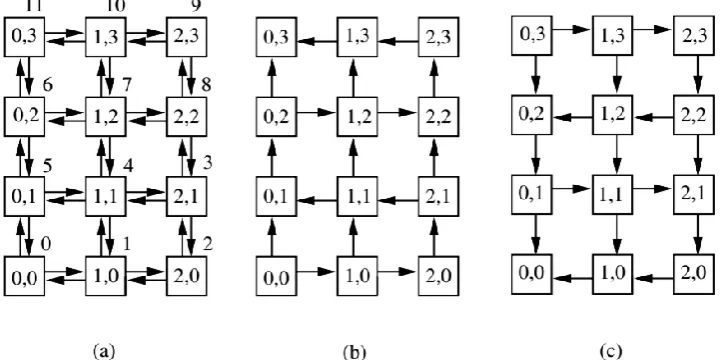
As shown in Fig. 1(a), two directed Hamiltonian paths (or two subnetworks) are constructed by the mentioned labeling [2]. If the label of the destination node is greater than that of the source node, the routing takes place in the high-channel subnetwork, Hu, that starts at (0, 0) (Fig. 1(b)); otherwise it takes place in the low-channel subnetwork, Hl, that ends at (0, 0) (Fig. 1(c)). Many path-based multicast routing algorithms utilize different partitioning methods e.g. DP algorithm [12], MP algorithm [12] and CP algorithm [13,14] to reduce multicast path length. A partitioning method divides the set of network nodes, P, into disjoint logical partitions,
0, 1, 2, , l
p p p p where l mn,
0 l
i i
p P
and
0 l
i i
p
. The set of multicast destination nodes, D, is then distributed among partitions p0 to pl such that
:! ,1
i j i j
d D p j l d p
.
In the DP algorithm, the destination set is partitioned into two subsets, Dhand Dl, where each node in Dhhas a label greater than that of the source node and each node
in Dlhas a label smaller than that of the source node. Dh and Dl are sorted in ascending and descending orders respectively and are stored in the header of the multicast message at the source node. Thus, multicast messages disseminated from the source node are sent to destination nodes in Dhusing the Husubnetwork and to destination nodes in Dlusing the Hl subnetwork.
In order to reduce the average length of multicast paths, a MP multicast routing algorithm has been proposed [12], where removes the constraint of having at most two paths. In a two dimensional (2D) mesh where most nodes have four output channels, up to four disjoint paths can be used to deliver a multicast message. In this algorithm, destination sets of the DP algorithm i.e. Dh and Dlare once again partitioned into two disjoint subsets. The set Dhis partitioned into two subsets, where one subset consists of nodes which x
coordinates are greater than or equal to that of the source node and the other subset contain the remaining nodes of Dh. The set Dlis partitioned in a similar way. Hence; all destination nodes of a multicast message are grouped into at most four disjoint subsets and long latencies are reduced by using up to four copies of the original multicast message. The DP algorithm and the MP algorithm are not compatible with the well-known E-Cube routing algorithm i.e., if E-cube routing algorithm is used for unicast messages, then using DP or MP algorithms to route multicast messages leads to deadlock on communication channels. Generally, a unicast routing algorithm and a multicast routing algorithm are said to be compatible if and only if incorporation of these algorithms in a network does not lead into a deadlock situation [13].
The CP multicast algorithm is compatible with the popular E-Cube unicast algorithm [13]. This algorithm partitions the set of destination nodes of a multicast message into at most 2n subsets n is the number of columns in the mesh). In a way that there are at most two messages directed to each column. If a
Fig. 1 The labeling of a 4 × 3 mesh: a) physical network, b) high-channel network, and c) low-channel network.
Iranian Journal of Electrical & Electronic Engineering, Vol. 14, No. 2, June 2018 127 column of the mesh has one or more destination nodes
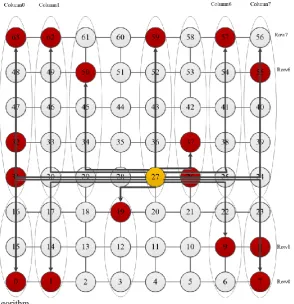
in the same row or in rows above that of the source, then one copy of the message is sent to service all those destination nodes. Similarly, if a column has one or more destination nodes in the rows below that of the source, then one copy of the message is sent to service all those destination nodes. So if all destination nodes in one column are in rows either below or above that of the source node, two copies of the message are sent to that column; otherwise, one copy of the message is sent to that column. The CP algorithm which is a dimension-order routing algorithm uses row-first routing for each partition of multicast destination nodes, i.e. the multicast message is routed along horizontal line in the row of the source node to achieve specific column and then is routed along vertical line to achieve multicast destination nodes. As an example, sending of a multicast message to destination nodes (0, 0), (0, 1), (0, 7), (1, 7), (1, 6), (2, 3), (3, 5), (3, 0), (4,0), (4,5), (6,2), (6,7), (7,6), (7,4), (7,1) and (7, 0) from source node (3, 4) using the CP multicast algorithm is shown in Fig. 2. Twelve copies of the message are used to achieve the desired multicast operation. Although destination nodes as: (0, 0), (0,3), (0, 4) and (0, 7) are in the same column, since three of these destination nodes are in rows above that of the source node and the remainder one is in row below that of the source node, two copies of the message are routed to these destination nodes. At the first step, two copies of the multicast message are routed
along horizontal line to achieve column 0 and at the second step one of two messages is routed along vertical line in column 0 to achieve row 3, row 4 and row 7 and another one is routed along vertical line in column 0 to achieve row 0.
As seen in above example, the CP multicast routing algorithm is a dimension-order algorithm which every multicast message is routed along to partitions of multicast destination nodes with row-first routing. So, if this algorithm is used to route multicast messages concurrent with E-cube routing algorithm to route unicast messages, there is no deadlock on communication channels. In the next Section, an analytical model is presented for evaluating the performance of the CP algorithm.
4 Analytical Performance Modeling of the CP Algorithm
The CP algorithm as a dimension-order routing algorithm uses row-first routing for each partition of multicast destination. This algorithm is compatible with E-cube unicast routing algorithm so can be used in many multi-computers and multi-processors [13]. In this section, an analytical model is presented to estimate the average number of messages (ANM) and the average of hop count (AHC) in an n × n mesh network when CP is used as the multicast routing algorithm. The proposed model assumes:
Fig. 2 The CP Multicast algorithm.
Iranian Journal of Electrical & Electronic Engineering, Vol. 14, No. 2, June 2018 128
The network is homogeneous [15].
Destination nodes in the network are distributed fairly and evenly [13,14,21,23,24].
There is an equal chance for all nodes of the network to be the source node [13,14,21,23,24].
4.1 Calculation of ANM Parameter in the CP Algorithm
In the CP algorithm, if all destination nodes in a column are placed higher/lower than rows of the source node, this algorithm sends only one multicast message to all destination nodes in that column. Otherwise, the CP algorithms sends two individual multicast messages to complete multicasting. Suppose that the probability of sending only one message is P1 and the probability of
sending two messages is P2, P1 +P2 = 1. The ANM for a specified column is equal to 2P2 + P1. Since P2 = 1 −
P1, so the ANM in a specified column is equal to 2 − P1.
In an n × n mesh, the number of columns is n, so ANM
in the total network as written in Eq. (2):
1
2
Mean n P (2)
In the CP algorithm, the number of messages generated by a source node to complete a multicast operation depends on its location. Suppose a source node on a mesh is placed in row i (such a S(i, j) in Fig. 3) and ND destination nodes are placed in each
column of network. Meani, the average number of messages generated by this source node can be calculated by Eq. (3), where P1(i) is probability of sending only one message to each column of mesh for
S(i, j).
1
2
i
Mean n P i (3)
The probability of locating in row i or lower is
/
D D
i n
N N
and the probability of locating in higher than row i is /
D D
n i n
N N
. So, P1(i) is the sum of these two terms:
1D D
D D
i n i
N N
P i
n n
N N
(4)
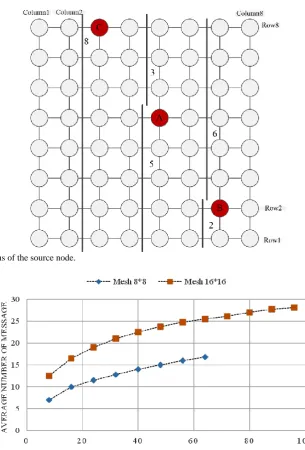
For example, suppose that there are three multicasting source nodes A, B and C on an 8 × 8 mesh network such as Fig. 4. If three destination nodes are located on a column of this network, according to Eq. (4), probability of sending only one message to three destination nodes on one column from these three source nodes (A, B and C) is equal to
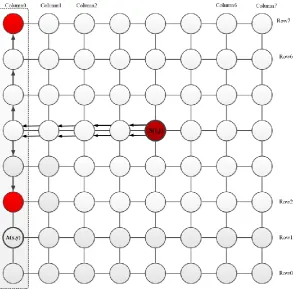
Fig. 3ANM parameter in the CP algorithm.
Iranian Journal of Electrical & Electronic Engineering, Vol. 14, No. 2, June 2018 129
1
5 3
3 3 11
,
8 56
3 A
P
1
2 6
3 3 20
,
8 56
3 B
P
1
8 0
3 3
1 8
3 C
P
Number of rows in an n × n mesh is n, so the average number of messages can be calculated by Eq. (5).
1 n
i
Mean ANM
n
(5)Fig. 5 shows the average number of messages in terms of number of destination nodes in an 8 × 8 and a 16 × 16 mesh network. As Fig. 5 shows, the number of messages reaches approximately to 2n with increasing the number of destination nodes.
Lemma 1) As the number of destination nodes increases, lim 2
DANM n.
Proof Lemma 1) With using Eqs. (3)–(5) and assuming
ND= D/n, gives us:
Fig. 4 Different positions of the source node.
Fig. 5 Average Number of Message.
Iranian Journal of Electrical & Electronic Engineering, Vol. 14, No. 2, June 2018 130
1
1
lim lim 2
2 lim n D D i n D i
i n i
D D n n A NM n D n
i n i
D D n n n D n
Based on limit law:
lim 0, x n ax thus lim 0, D
i n i
D D n n n D n therefore
lim 2 .
DANM n
4.2 Calculation of AHC Parameter in the CP Algorithm
In the CP algorithm, the AHC parameter depends on the location of the source node. In this algorithm, each path may consist of two parts; vertical part and horizontal part. Suppose that node S(i, j) is the source node and the set D = {d1, d2, ...,
D
N
d } is the set of multicast destination nodes in one column. The length of the vertical part of a multicast path depends on the row of the source node, i, and the length of the horizontal part depends on the column of the source node, j. To calculate average length of the vertical part, set D is partitioned into two subsets Dland Dh, which is resulting in the row of all destination nodes in Dl become lower than i and the row of all destination nodes in Dh become higher than i. In both subsets, the maximum vertical distance is the difference between row of the farthest destination node and i. Suppose dlis said to be the maximum vertical distance in subset Dl and dhin subset Dh. Maximum size of dlis equal to i and maximum size of dhis equal to n − i − 1. If the number of all destination nodes in one column is ND, the
probability that the number of destination nodes in set
Dlis equal to
D
N
d is as Eq. (6).
1
l l
Dl
D D D
N
D
i n i
N N N
P n N (6)
The probability that a node such as Ax,y in set Dl is destination node is as Eq. (7).
l D A N P i
(7)
If node A(x, y) is the farthest destination node from row
i, then other destination nodes must be placed between row i and row x. The probability of this is:
1 1 l l D r D i x N P i N (8)
The probability that dl is equal to i − x and the number of destination nodes in set Dlis
l
D
N is equal to
Dl
N
P ×
PA × Pr. Firstly, all
l
D
N destination nodes must be in set
Dl, secondly node A(x, y) must be a destination node and thirdly other destination nodes must be placed between row i and row x. Expectance that maximum distance between destination nodes in set Dland row i is equal to
dl, El, is as follows,
Dl
l l N A r
E d P P P (9) Expectance that maximum distance between destination nodes in set Dhand row i is equal to dh, Eh, is achieved in similar way. Length of disseminated vertical path from the row i, Veri, is equal to El + Eh. Length of horizontal path depends on distance between the column of destination nodes, y, and that of the source node, j. This distance, Horj, is equal to |j − y|.
The probability that only one message is sent to a
column is equal to
1 / /
i
D D D D
i n n i n
p
N N N N
, and the
probability of sending two messages is 2 1 1
i i
P P . If one message is sent to a column, this message is sent to either subset Dlor subset Dh. In this case, average length of vertical path is equal to Veri/2 and average length of horizontal path is equal to Horj. But if two messages are sent to a column, average length of vertical path is Veri and average length of horizontal path is 2Horj. Suppose node Si,j as the source node, hop count can be written as Eq. (10)
Iranian Journal of Electrical & Electronic Engineering, Vol. 14, No. 2, June 2018 131
, 1
2 2
2 .
i i
i j j
i
i j
V er
A HC P Hor
P V er Hor
(10)
In an n × n mesh network, AHCi,j is calculated for whole network which i = 0, 1, 2, ..., n − 1 and
j = 0, 1, 2, ...n − 1. Total AHC parameter is as follows:
,
1 1
2 .
n n
i j i j A HC
A HC
n
(11)Fig. 3 shows an example of AHC parameter for reaching to destination nodes in column 0 from source node (4, 4) that two messages are sent to column 0. The horizontal hop count is equal to 8 and vertical hop count is equal to 3 + 3 = 6. Fig. 6 demonstrates how the hop count rapidly grows as the number of destination nodes increases in 8 × 8 and 16 × 16 mesh networks. As can be seen in this figure, by increasing the number of destination nodes, the hop count growth rate is reduced and it approximately reaches to 3/2n(n − 1). This is because in an n × n mesh, maximum length of a horizontal path is n(n−1)/2 and maximum length of a vertical path is n(n − 1).
It can be seen that the AMN and AHC parameters are depend on position of the source node. In Fig. 3 if a source node is located on the uppermost row or on the lowermost row, only one message will be transferred to destination nodes in a column. So AMN parameter is halved and one horizontal path is considered in AHC
parameter. Also, if source node is located on the leftmost column or on the rightmost column, with Column-First routing one can mitigate the performance degradation of CP algorithm (Row-First routing).
5 Row/Column-First: Proposed Algorithm
The CP multicast algorithm uses row-first routing for each column partition of multicast destination, i.e. if the source node is located on the uppermost row or in the lowermost row, only one multicast message is sent to each partition. Otherwise, two individual multicast messages must be sent to each partition to complete
multicasting. Unlike the CP algorithm, Row-Path (RP) multicast algorithm which is a dimension-order algorithm uses column-first routing for each row partition of multicast destination nodes, i.e. the multicast message is routed along vertical line in the column of the source node to achieve specific row and then is routed along horizontal line to reach multicast destination nodes. If the source node is located on the leftmost or in the rightmost column, only one multicast message is sent to each partition. Otherwise, two individual multicast messages must be sent to each partition to complete multicasting.
In order to improve two previously discussed parameters, ANM and AHC, we propose a novel algorithm that is called Row/Column-First algorithm. Row/Column-First algorithm uses combination of both Row-First and Column-First routings for each partition of multicast destination nodes, depending on the location of the source node.
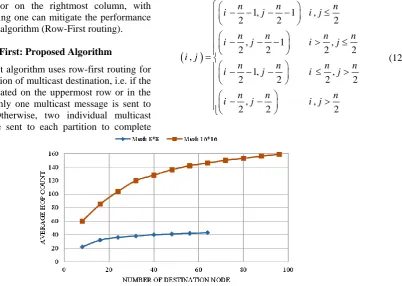
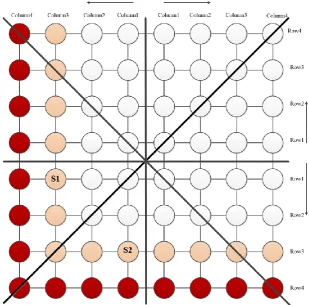
In the Row/Column-First algorithm, if the source node is located near to the uppermost/lowermost row then the CP algorithm is preferred. Otherwise, if the source node is located near to the lefmost/rightmost column then the RP algorithm is preferred. In order to choose suitable multicast algorithm, it is necessary 1) to move the origin of coordinates to the center of mesh according to Eq. (12), and 2) assuming S(i, j) as the multicast source node, choose RP algorithm if |j| ≥ |i| or choose the CP algorithm if |j| < |i|, i.e. in Fig. 7, the CP multicast algorithm is used for S2 as a source node and the RP
multicast algorithm is used for S1 as a source node.
1, 1 ,
2 2 2
, 1 ,
2 2 2 2
,
1, ,
2 2 2 2
, ,
2 2 2
n n n
i j i j
n n n n
i j i j
i j
n n n n
i j i j
n n n
i j i j
(12)
Fig. 6 The curve of AHC parameter in the CP algorithm.
Iranian Journal of Electrical & Electronic Engineering, Vol. 14, No. 2, June 2018 132
Fig. 7 Dark red nodes have same ANM parameter and light red nodes have same ANM parameter too.
5.1 Calculation of ANM Parameter in the
Row/Column-First Algorithm
As mentioned before, the proposed algorithm choose among RP and CP methods based on where the multicast source node is located. The ANM parameter in the CP algorithm depends on which row the source node is located; in the RP algorithm in contrast the ANM
parameter depends on the column number where the source node is located. As an example, Fig. 7 shows two source nodes in a mesh NoC. The source node S1 uses
the RP algorithm and the source node S2 uses the CP
algorithm to complete multicasting. Since the column number of source node S1 is equal to the row number of
source node S2, the ANM parameter of both source
nodes is identical. In other words, if two source nodes are symmetric with respect to main diameters of mesh, then the ANM parameter by these source nodes will be identical in the Row/Column-First algorithm. Moreover, the ANM parameter will be identical for all source nodes on one row in the CP algorithm as well as for all source nodes on one column in the RP algorithm. So, the ANM
parameter for all source nodes which are located on either row i or column j are equal when i = j (symmetric nodes). As shown in Fig. 7, all symmetric source nodes with dark red color are located on either row 1 or column 1 have the same ANM parameter and all symmetric source nodes with light red color are located on either row 2 or column 2 have the same ANM
parameter too. In an 8 × 8 mesh, e.g. Fig. 7, total
number of symmetric source nodes on row 1 and column 1 is 15 and total number of symmetric source nodes on row 2 and column 2 is 13. It can be proven that total number of symmetric source nodes on row i
and column i is equal to 2n − (2i − 1) in an n × n mesh. In the Row/Column-First algorithm the ANM parameter is calculated as Eq. (13):
1
2
. 2 2 1 ,
n
i
i Mean n i
ANM
n
(13)where Meaniis average number of messages generated by a source node on row or column i, n2 is total number
of nodes, 2n − (2i − 1) is total number of symmetric nodes on row i and column i, n is number of rows and columns in an n × n mesh.
Fig. 8 compares the ANM parameter in both CP and Row/Column-First algorithms in an 8 × 8 and a 16×16 mesh networks. According to their charts, it is proved that the ANM parameter in the Row/Column-First algorithm is approximately 10% less than that of the CP algorithm.
5.2 Calculation of AHC Parameter in the
Row/Column-First Algorithm
As mentioned in Section 5.1, in the Row/Column-First algorithm, source nodes which are symmetric with respect to main diagonals of mesh have the same behaviors, i.e. the same ANM parameter and the same
Iranian Journal of Electrical & Electronic Engineering, Vol. 14, No. 2, June 2018 133
AHC parameter. In Fig. 7, the source node S1 uses the
RP algorithm and the source node S2 uses the CP
algorithm to complete multicasting and these source nodes are symmetric. The HCi,jparameter for the source node S2(i, j) is equal to AHCi,j in the CP algorithm which is calculated as Eq. (14). But, the HCi,j parameter for the source node S1(i, j) is equal to the AHC
parameter of a symmetric source node (e.g. S2(j, i)) with
exchanged i and j coordination. So the HCi,jparameter is calculated as Eq. (14) and the total AHC parameter for whole network is as Eq. (15), which n2 is total
number of nodes in an n × n mesh network.
, j,
,
i
i j
j i
AHC i j CP
HC
AHC i j RP
(14)
,
1 1
2
n n
i j
i j HC
AHC
n
(15)As shown in Fig. 9, the AHC parameter in the Row/Column-First algorithm is approximately 20% less than that in the CP algorithm.
6 Simulation Results
In this paper, for simulation of both CP and
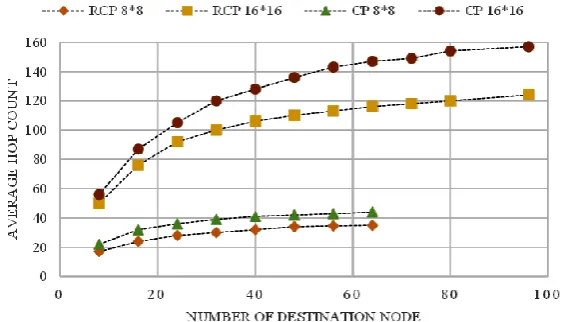
Row/Column-First algorithms, we used a VHDL-based NoC simulator. This simulator uses bit-string techniques which forgive each node of an n×n mesh corresponding addresses. In this simulator the wormhole switching and traffic pattern are considered to be steady. The network size, the multicast source address, and the number of multicast destination nodes are fed into simulator. Number of messages generated by a source node and number of hops that each multicast message crosses through the network are outputs of simulator. In order to evaluate both CP and Row/Column-First algorithms, we simulated a mesh of size 16 × 16 and with different number of destination nodes. We then obtained both
ANM and AHC parameters as output. Fig. 10 and Fig. 11 show diagrams of modeling and simulation results of both CP and Row/Column-First algorithms for the ANM parameter and the AHC parameter respectively. These diagrams represent a 12% reduction in the ANM parameter and 17% reduction in the AHC
parameter in the Row/Column-First algorithm as compared to the CP algorithm. Moreover, the results obtained from simulation validate the presented models for ANM and AHC parameters as well.
Fig. 8ANM parameter in CP algorithm and Row/Column-First algorithms.
Fig. 9AHC parameter in CP algorithm and Row/Column-First algorithms.
Iranian Journal of Electrical & Electronic Engineering, Vol. 14, No. 2, June 2018 134
Fig. 10 Simulation results and modeling of ANM parameter on a 16 × 16 mesh.
Fig. 11 Simulation results and modeling of AHC parameter on a 16 × 16 mesh.
7 Conclusions
In this work, we proposed Row/Column-First an efficient path-based multicast algorithm for mesh based NoCs. In this algorithm, Row-First routing or Column-First routing was selected depending on the location of the multicast source node. An analytical model was developed to estimate two performance criteria i.e.
ANM and AHC parameters of the network. The modeling and simulation results indicted an average of 11% less ANM parameter and 18% less AHC parameter for the Row/Column-First algorithm as compared to the CP algorithm. This performance improvement is achieved due to the conditional selection among RP and CP strategies.
References
[1] T. A. Midford and R. L. Bernick, “Millimeter wave CW IMPATT diodes and oscillators,” IEEE Transactions on Microwave Theory Technology, Vol. 27, No. 5, pp. 483-492, 1979.
[2] S. Kumar, A. Jantsch, J. P. Soininen, M. Forsell, M. Millberg, J. Oberg, K. Tiensyrja and A. Hemani, “A network on chip architecture and design methodology,” IEEE Computer Society Annual Symposium on VLSI (ISVLSI), pp. 117-124, 2002. [3] J. Duato, C. Yalamanchili and L. Ni,
“Interconnection networks: an engineering approach,” Elsevier Science, 2003.
Iranian Journal of Electrical & Electronic Engineering, Vol. 14, No. 2, June 2018 135 [4] Z. Lu, B. Yin and A. Jantsch, “Connection-oriented
multicasting in wormhole-switched networks on chip”, IEEE Computer Society Annual Symposium on VLSI (ISVLSI), 2006.
[5] A. Y. Al-Dubai, M. Ould-Khaoua and L. M. Mackenzie, “Trade-offs between latency, complexity, and load balancing with multicast algorithms,” IEEE Transactions on Computers, Vol. 59, No. 2, pp. 159-173, 2010.
[6] K. Duraisamy, Y. Xue, P. Bogdan and P. Pratim Pande, “Multicast-aware high-performance wireless network-on-chip architectures,” IEEE Transactions on Very Large Scale Integration (VLSI) Systems, Vol. 25, No. 3, pp.1126-1139, 2017.
[7] D. Xiang, K. Chakrabarty and H. Fujiwara, “Multicast-based testing and thermal-aware test scheduling for 3D ICs with a stacked network-on-chip,” IEEE Transactions on Computers, Vol. 65, No. 9. pp. 2767-2779, 2016.
[8] P. K. McKinley, H. Xu, A.-H. Esfahanian and L. M. Ni, “Unicast-based multicast communication in wormhole-routed networks,” IEEE Transactions on Parallel and Distributed Systems, Vol. 5, No. 12, pp. 1252-1265, 1994.
[9] K. Viswanath, K. Obraczka and G. Tsudik, “Exploring mesh and tree-based multicast. Routing protocols for MANETs,” IEEE Transactions on Mobile Computing, Vol. 5, No. 1, pp. 28-42, 2006. [10]Y. H. Kang, J. Sondeen and J. Draper,
“Implementing tree-based multicast routing for write invalidation messages in networks-on-chip,” in 52nd
International Midwest Symposium on Circuits and Systems (MWSCAS), pp. 1118-1121, 2009.
[11]F. A. Samman, T. Hollstein and M. Glesner, “Adaptive and deadlock-free tree-based multicast Routing for networks-on-chip,” IEEE Transactions on Very Large Scale Integration (VLSI) System, Vol. 18, No. 7, pp. 1067-1080, 2010.
[12]W. Hu, Z. Lu, A. Jantsch and H. Liu, “Power-efficient tree-based multicast support for networks-on-chip,” in Proceedings of the 16th Asia and South
Pacific Design Automation Conference, pp. 363-368, 2011.
[13]X. Lin and L. M. Ni, “Deadlock-free multicast wormhole routing multicomputer networks,” IEEE Transactions on Parallel and Distributed Systems, Vol. 5, No. 8, 1994.
[14]R. V. Boppana, S. Chalasani and C. S. Raghavendra, “On multicast wormhole routing in multicomputer,” Symposium on Parallel and Distributed Processing, pp. 722-729, 1994.
[15]R. V. Boppana, S. Chalasani and C. S. Raghavendra, “Resource deadlock and performance of wormhole multicast routing algorithms,” IEEE Transaction on Parallel and Distributed Systems, Vol. 9, No. 6, pp. 535-549, 1998.
[16]Y. Al-Dubai, M. Ould-Khaoua and L. M. Mackenzie, “An efficient path-based multicast algorithm for mesh networks,” Parallel and Distributed Processing Symposium, 2003.
[17]A. Y. Al-Dubai and I. Romdhani, “A performance study of path-based multicast communication algorithms,” International Symposium on Parallel Computing in Electrical Engineering, pp. 245-250, 2006.
[18]T. Guven, R. J. La, M. A. Shayman and B. Bhattacharjee, “A unified framework for multipath routing for unicast and multicast traffic,”
IEEE/ACM Transactions on Networking, Vol. 16, No. 5, pp.1038-1051, 2008.
[19]N. C. Wang, C. P. Yen and C. P. Chu, “Multicast communication in wormhole-routed symmetric networks with hamiltonian cycle model,” Journal of Systems Architecture, Vol. 51, No. 3, pp. 165-183, 2005.
[20]N. C. Wang and Y. P. Hung, “Hamiltonian-cycle-based multicasting on wormhole-routed torus networks,” Asia-Pacific Computer Systems Architecture Conference (ACSAC), pp. 1-8, 2008. [21]M. Ebrahimi, M. Daneshtalab, M. H. Neishaburi,
S. Mohammadi, A. Afzali-Kusha, J. Plosila and H. Tenhunen, “An efficent dynamic multicast routing protocol for distributing traffic in NOCs,”
Design Automation and Test in Europe Conference and Exhibition (DATE), pp. 1064-1069, 2009. [22]M. Daneshtalab, M. Ebrahimi, S. Mohammadi and
A. Afzali-Kusha, “Low-distance path-based multicast routing algorithm for network on-chips,”
IET Computers and Digital Techniques, Vol. 3, No. 5, pp. 430-442, 2009.
[23]L. Wang, Y. Jin, H. Kim and E. J. Kim, “Recursive partitioning multicast: A bandwidth-efficient routing for networks-on-chip,” in Proceedings of the 3th International Symposium on Networks-on-Chip, pp. 64-73, 2009.
[24]L. Wang, P. Kumar, R. Boyapati, K. Hwan, Y. Eun and J. Kim, “Efficient look ahead routing and header compression for multicasting in networks-on-chip,”
ACM/IEEE Symposium on Architectures for Networking and Communications Systems (ANCS), 2010.
Iranian Journal of Electrical & Electronic Engineering, Vol. 14, No. 2, June 2018 136 [25]S. Rahimi Moosavi, A. M Rahmani, P. Liljeberg,
J. Plosila and Hannu Tenhunen, “An efficient implementation of Hamiltonian path-based multicast routing for 3D interconnection networks,” Iranian Conference on Electrical Engineering (ICEE), pp. 1-6, 2013.
S. Kashi received her B.Sc. degree in Computer Engineering from Isfahan University of Technology, Isfahan, Iran, in 2009, and her M.Sc. degree in Computer Engineering from Amirkabir University of Technology, Tehran, Iran, in 2012. She is currently working towards Ph.D. degree in School of Computer Engineering, Iran University of Science and Technology, Tehran, Iran. Her research interests are architectural design of multi- and many-core chips, reconfigurable systems, electronic design automation,
dependability and security evaluation of VLSI circuits, and bioinformatics.
A. Patooghy received his M.Sc. and Ph.D. in Computer Engineering from Sharif University of Technology, Tehran, Iran, in 2005 and 2011, respectively. He is currently an assistance processor at Department Of Computer Engineering, Iran University of Science and Technology, Tehran, Iran. His research interests include hardware design and test, architectural design of multi- and many-core chips, dependability and security evaluation of VLSI circuits, fault injection, and analytical modeling. Dr. Patooghy initiated the Dependable Systems and Architectures Laboratory at Iran University of Science and Technology in 2012 and has chaired the Laboratory since then.