An Analysis of Teachers’ Professional Development
Training at Elementary Level
Ehsan ul Haq* Shamim Haider Tirmazi**
Asia Zulfqar***
Abstract
This study explored the effectiveness of professional development training of the public and private sector at elementary level. A survey was conducted by involving elementary teachers from the public and private sector, who attended the training. A questionnaire was developed focusing the four key factors of the training: suitability of the resources; quality of the content and management; competency of the trainers; and usefulness of the training. A simple random sampling technique was applied to collect data from the trainee elementary teachers of the public and the private sector. From the public sector 750 trainee teachers and 600 elementary teachers from the private sector were selected from the five districts of the Punjab province. Data were analyzed on the basis of above mentioned four factors. Descriptive statistics and t-test were calculated to analyze the data. The findings based on sector-wise analysis discovered a significant differences in the opinion of trainees in both public and private sector in view of the “usefulness of the training” (p-value=0.041).The rest of the three factors were insignificant which means trainees from the both public and private sector having the same opinion about the training. While on the other hand, gender-wise analysis discovered significant differences in the opinions of trainees in both sectors in view of the quality of content and management and competency of trainers. The rest of the two factors were insignificant. The possible reasons and implications of these insignificant findings were discussed.
Keywords: professional development, teachers’ training, public sector, private sector.
*
PhD scholar at Department of Education, BZU. Multan, Senior Subject Specialist at GHSS Iqbal Nagar, Distt. Sahiwal, Punjab. Email: [email protected]
**
Associate Professor at Department of Education, BZU. Multan. ***
Introduction
Literature emphasized that the quality of education is linked with teachers’ professional development. Literature also identified the key stages in teachers’ professional development programs e.g., job-embedded, on-going, in-depth, and content-focused (Darling-Hammond, 2000; Guskey & Huberman, 1995). The core features of an effective professional development includes: content focused; active participation of the learner; and feedback/follow-up.The major characteristics of the effective professional development programs are the enhancement of teachers’ content and pedagogical knowledge; use of adequate time and resources; mutual knowledge exchange among participants; activity-based learning; high-quality instructions; and proper evaluation (Guskey, 2003).
Professional development is regarded as “a comprehensive, sustained and intensive approach to improve teachers’ effectiveness to improve students’ academic achievements” (Johnson & Denise, 2001). Generally, teachers’ professional development is marked by four types of growth i.e. (a) improvement in knowledge (b) improvement in skills (c) improvement in judgment (all of which are related to classroom), and (d) improvement in contribution teachers make to a professional community (Borko, 2004). Guskey and Yoon (2009) “argued that professional development is the key to improve the school”. He further stated that professional development has a broader scope starting from developing teachers to overall school development (Elmore, 2002).
Newmann, King, and Youngs (2000) discussed that effective professional development should encompass the following salient features: it should be school specific and should concentrate on instructions and student outcomes; it should provide the opportunity for knowledge sharing with colleagues, helping them in their problems and providing them feedback; it should have the provision to connect teachers to some external efficiency as well as respecting teachers’ creative thinking; and it should be an ongoing part of the school activities rather than of short period and divided into episodes.
that professional development is likely to be higher quality if it is not only consist of a substantial number of hours but also is sustained over time. The powerful component of effective professional learning is gaining knowledge from other professionals (Mourshed, Chijioki, & Barber, 2010).
In addition to teachers’ professional development, an organizational arrangement by the school supports the teachers to apply the learned knowledge and skills. The productive working relationship in schools results in greater consistency in teaching and learning, sharing practices and solving classroom problems (Darling- Hammond, Wei, Andree, Richardson, & Orphanos, 2009). Organizational arrangements support the teachers to apply knowledge and skills. Next, follow-up is crucial for such development programs. But, the necessary follow-up activities for teachers have not always been the priority for teachers’ professional development programs (Darling-Hammond, 1996).
The evaluation process is an essential part of the professional development programs that are aimed to improve teacher and student’s learning and performance. The most widely cited result of a significant number of studies in the field of professional development concluded that there is the need to focus on enhancing the content and pedagogical knowledge of the teachers (Guskey, 2003).But, most of the studies in this field have shown that these programs have been moderately effective and often fail to achieve the objectives (Wade, 1985; Kealey, Peterson, Gaul &Dinh, 2000; Guskey, 2003).
Some studies have shown that one of the most crucial problems of professional development programs is the absence of adequate follow-up after the training programs. One or two seminars or workshops as follow-up are insufficient to improve the pedagogical knowledge and skills of teachers (Barnett, 2002; Desimone et al., 2002). Similarly, studies in the field of professional development concluded that effective professional programs had some common salient features such as sufficient duration, the inclusion of theory, demonstration, practice, feedback mechanism, and classroom application of the learned experiences (Linn et al., 2010).
the nation. But, despite the continuous efforts and spending a reasonable budget, the educational standard and ration could not be increased.
Besides the other certain reasons, the quality of the teachers may be one of the reasons. Both the public and private sector have been trying to provide professional development training to their teachers. In the light of available literature on professional development, the present study aimed to investigate the opinions of trainee teachers from the both public and private sector about the effectiveness of professional development program. This study will help to identify the effectiveness of the teachers’ professional development program as well.
Objectives of the Study
The following objective guided the study:
i. To investigate the effectiveness of the professional development training at elementary level.
ii. To analyze the effectiveness of the professional development training in the public and private sector schools at elementary level.
Research Question
How do the elementary teachers of the public and the private sector rate the effectiveness of the professional development training resources, management, trainers, and its usefulness for trainees?
Methodology
Procedure
formalities to get approval before the data collection. Participants were asked to fill up the survey questionnaire. The researcher was available to the participants if they need any clarity in filling up the questionnaire.
Sample
All the male and female elementary teachers from the public and private sector, who attended the professional development training were the population of this study. Since the private sector is adopting various types of curriculum, we only involve those private schools that are offering the same syllabus as their counterparts. The sample was collected from the five districts of Punjab province: Sahiwal, Khanewal, Khushab, Mianwali, and Rajanpur.
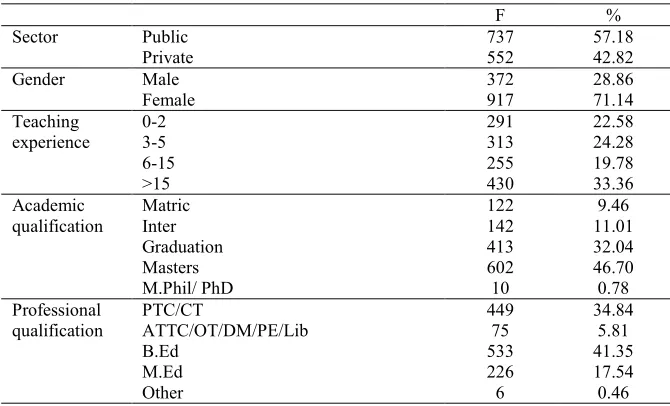
A simple random sampling technique was applied to select the sample. Random sampling is the best single way to obtain a representative sample (Gay, 2003; Plano Clark, & Cresswell, 2010). From the public sector out of 4731 trainee teachers 750 (15.85 %) teachers, and from the private sector out of 2845 trainee teachers 600 (21.08 %) teachers were selected as the sample of the study. Gay (2003) claims that the larger the population size, the smaller the percentage of population is required to get a representative sample. As to demographic variables, overall 57.18% teachers participated from the public schools and 42.82% teachers from the private schools participated in this research. Next, 28.86% male teachers and 71.14% female teachers took part in this study. Their teaching experience was ranging between 1 to 15 years. The minimum qualification was Matriculation and maximum qualification was Ph.D. Moreover, we also asked about professional qualification, the minimum level was PTC and maximum M. Ed in the both public and private sector.
Data Collection
the duration of the training was maximum two weeks. The items of the questionnaire were based on four key factors: suitability of resources (i.e., separate training centers for male and female teachers, suitable furniture for adult learners, cooperation of the administration, computer labs, science labs, libraries, spacious classrooms etc.) quality of content and management (i.e., trainees’ selection policy, availability of the training manual, accordance of training content with trainees’ needs, achievement of training objectives, strict implementation of the training schedule, sufficient incentive to the trainees, use of modern pedagogical skills, use of effective communication skills, transparent evaluation of training, appropriate duration of training, easy access to the training centers etc.), competency of trainers (committed and devoted to their work, use of appropriate teaching aids, concept clarity, motivation for questioning, variety of teaching techniques for different topics, situation handling techniques, activity based training, friendly attitude with the trainees.), usefulness for trainees ( enrichment of knowledge about lesson planning, expertise in the preparation of low cost/ no cost A.V. aids, enabled to handle the discipline problems in the classroom and schools, enrichment of knowledge about the use of new assessment techniques, maintenance of school record, problem solving techniques, better classroom management techniques etc.). Following steps were taken to develop the questionnaire.
First, the available literature on the professional development training was reviewed including the training manual/ training schedule of both sectors. Secondly, pilot interviews were conducted with twelve elementary teachers (6+6) from the both public and private sector to determine the themes and items pool for the instrument.
On the basis of the previous studies and interviews with the trainee teachers, items of the questionnaire were categorized and specific headings were assigned to different categories of the questionnaire. The research instrument was developed under the guidance of the experts in the field of Education, Bahauddin Zakariya University, Multan. Expert opinion was obtained to determine the face and content validity of the questionnaire. The research instrument was pilot tested on a small sample to examine its reliability and validity. Initially, 42 items were developed, but on the basis of expert opinion and pilot testing out of 42 items six items were dropped and 36 items were retained.
private sector 552 questionnaires were received. The response rate of the questionnaire was 95.48%.
Validity of the Research Instrument
The instrument was validated through expert opinion and pilot testing. Furthermore, a Factor Matrix was drawn to assess the correlation among all the factors of the instrument. A positive correlation was identified among the factors of the instrument. The minimum value of ‘r’ was 0.35 while the maximum value was 0.64. These positive moderate values showed that all factors of the research instrument were positively correlated with one another. It could be concluded that factors of scale were internally related with one another.
Reliability of the Research Instrument
To assess the reliability of the instrument Chronbach Alpha was calculated. The Cronbach Alpha value of the research instrument was .87, which is considered excellent by following the benchmark of Law (2004).
Table 1
Demographic Characteristics of the Respondents
F %
Sector Public 737 57.18
Private 552 42.82
Gender Male 372 28.86
Female 917 71.14
Teaching experience
0-2 291 22.58
3-5 313 24.28
6-15 255 19.78
>15 430 33.36
Academic qualification
Matric 122 9.46
Inter 142 11.01
Graduation 413 32.04
Masters 602 46.70
M.Phil/ PhD 10 0.78
Professional qualification
PTC/CT 449 34.84
ATTC/OT/DM/PE/Lib 75 5.81
B.Ed 533 41.35
M.Ed 226 17.54
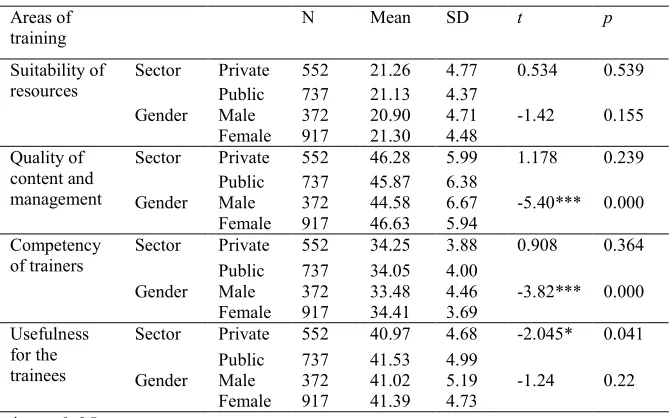
Table 2
Sector Wise and Gender Wise Comparison of the Opinions of Teachers
Areas of training
N Mean SD t p
Suitability of resources
Sector Private 552 21.26 4.77 0.534 0.539
Public 737 21.13 4.37
Gender Male 372 20.90 4.71 -1.42 0.155
Female 917 21.30 4.48
Quality of content and management
Sector Private 552 46.28 5.99 1.178 0.239
Public 737 45.87 6.38
Gender Male 372 44.58 6.67 -5.40*** 0.000
Female 917 46.63 5.94
Competency of trainers
Sector Private 552 34.25 3.88 0.908 0.364
Public 737 34.05 4.00
Gender Male 372 33.48 4.46 -3.82*** 0.000
Female 917 34.41 3.69
Usefulness for the trainees
Sector Private 552 40.97 4.68 -2.045* 0.041
Public 737 41.53 4.99
Gender Male 372 41.02 5.19 -1.24 0.22
Female 917 41.39 4.73
*p < 0.05
Table depicts that no significant difference was found in the opinion of trainees both in the public and private sector regarding the suitability of resources (p-value= 0.593). Similarly, no difference of opinion was identified between male and female trainees (p-value 0.155). It can be concluded that trainee teachers of both sectors were equally satisfied with the factor “suitability of resources.”
Next, no significant difference was identified in the opinions of trainees both in the public and the private sector in relation to the quality of content and management (p-value = 0.239). It can be concluded that trainee teachers of both sectors were equally satisfied with the factor “quality of content and management.” However, a significant difference was found in the opinions of male and female trainee teachers on the factor “quality of content and management” (p-value 0.000). Mean score of female teachers (46.63) shows that female teachers were more satisfied than male teachers (Mean= 44.58).
“competency of the trainers.” In contrary to sector wise comparison of the opinions of the teachers, gender-wise comparison found a significant difference (p-value= 0.000). Mean value of female teachers (34.41) was greater than male teachers (33.48). It can be concluded that female teachers showed their greater satisfaction than male teachers.
However, a significant difference was found in the opinion of trainees in both the public and the private sector in view of the “usefulness for trainees” (p-value= 0.041). Furthermore, the Mean value of the public sector is (41.53) which was greater than the private sector (40.97). It can be concluded that the professional development training for the teachers of the public sector was more useful than the private sector training. However, gender-wise comparison of the results shows that no significant difference was found in the opinions of male and female teachers on the factor “usefulness for trainees” (p-value= 0.22). It can be concluded that training was equally useful for male and female teachers.
Discussion
This study aimed to evaluate the effectiveness/appropriateness of the teachers’ professional development training at the elementary level. The results of this study show that the trainees of both the public and private sector were satisfied with the resources of the professional development training. These resources included separate training centers for female and male teachers, proper furniture facility for adult learners, appropriateness of training rooms (e.g., lighting, capacity of the rooms, and temperature), availability of equipment at computer labs, library facility, availability of equipment at science labs, and some other necessities like pencils, notebooks etc.
be asserted that professional development training venues have been furnished and well equipped.
As the data were collected from the district level training venues and these training venues have been made the centers of excellence. However, at tehsil level training centers, the situation may be different. Similarly, the private sector might have arranged the better resources at their training venues. Furthermore, the result showed that the trainees of both the public and private sector were almost equally satisfied with the items included in the factor of “quality of content and management.” The items included in this factor were: on time information, the availability of training manual well before time, training material’s accordance with the participants’ needs, achievement of the objectives of the training, fair assessment of training, appropriate duration of time, appropriate cooperation of the administration, and appropriateness of the training material. This finding is also contrary to the earlier research studies (Chand, 2015; Dahar, 2011; Hussain, Hameed, & Malik, 2015).
As Fullan (2007), Guskey (2003), Harris (2011), and Spillane (2006) identified that training was unorganized, failed to achieve the objectives, participants’ needs were not met and lack of interest of the administration. It can be concluded that the quality of content and management of professional development training might have been improved by both sectors. Sufficient and necessary arrangements might have been assured regarding the execution of the training. The objectives might have been achieved, training might have met the needs of the participants, and fair assessment might have been assured. Similarly, on the factor of the “competency of trainers”, the results of the present study showed that there is a consensus of the trainees on the trainers’ competency.
Gamoran, Secada, and Marret (1998) claimed that if the instructors focus on facilitating the learners rather than lecturing then the learners becomes more focused on learning and the process of learning and instruction becomes successful. It can be concluded that the trainers of both sectors might have focused on facilitating the participants. The trainers might have been expert in their subjects, their pedagogical and communication skills might have been good, they might have kept the participants busy in active learning, trainees’ questions might have been encouraged and answers might have been given accordingly, and collaborative participation might have been ensured.
private sector trainees. It can be concluded that the training of public sector might have been well organized and proved more useful for the public sector. But, the training of the private sector might not have met the needs of the participants, might not have increased the attention of the participants to their subjects, the participants might not have felt motivated for training, and the content of the training might not have been comprehensive for the trainee teachers. In view of this factor our findings were in line with the available research but with the international research. In this regard Fullan (2007), Guskey (2003), Harris (2011), Spillane (2006) concluded that unorganized trainings bring no significant change in the knowledge and skills of the participants. Moreover, our study findings are also in accordance with the results of Gokmenoglu and Clark (2015) who conducted the evaluation of such programs in Turkish context. They identified that such trainings have not been helpful for participants. Similarly, female teachers were more satisfied with training as compared to male teachers. Khan (2004) found that female teachers had lesser opportunities to participate in in-service trainings. So, the result of this research study has shown their satisfaction with the training. The findings regarding gender were not in line with the study conducted by Gökmenoğlu and Clark (2015).They found that gender, has no effect on the professional development of teachers.
Conclusion
This study aimed to explore the effectiveness of the training conducted for teachers’ professional development in the public and private sector atelementary level. It can be concluded that the findings of this study indicated that the teachers from the both public and private sector were satisfied with the suitability of the resources, quality of the content management, competency of the trainers but as to the usefulness of the training program, teachers in both sectors were not satisfied with the training.
Implications
References
Akram, M., & Khan, F. J. (2007). Public provision of education and
government spending in Pakistan (working paper 2007: 40).
Islamabad: Pakistan Institute of Development Economics.
AKU-IED & SAHE. (2004). Effectiveness of in-service teacher education programmes offered by the University of Education,
Lahore. A report of an evaluation study by Aga Khan University
Institute for the Educational Development, Karachi and the Society for the Advancement of Education, Lahore.
Barnett, M. (2002). Issues and trends concerning electronic networking technologies for teacher professional development: A critical review
of the literature. The American Educational Research Association,
New Orleans, LA.
Borko, H. (2004). Professional development and teacher learning: Mapping the terrain. Educational Researcher, 33(8), 3-15.
Chand, D. (2015). Major problems and issues of teacher education:
International Journal of Applied Research, 1(4), 350-353.
Dahar, M. A. (2011). Relationship between school resource inputs and academic achievement of students at thesecondary level in Pakistan (Unpublished doctoral dissertation). Department of Education, International Islamic University, Islamabad.
Darling-Hammond, L. (2000). Teacher quality and student achievement: A review of state policy evidence. Education Policy Analysis
Archives, 8(1), 33-99.
Darling-Hammond, L. (2006). Constructing 21st Century Teacher Education. Journal of Teacher Education, 57(3), 90-99.
Darling-Hammond, L., Wei, R., Andree, A., Richardson, N., &Orphanos, S. (2009). Professional learning in the learning profession: Astatus report on teacher development in the US and abroad. Dallas,: TX, National Staff Development Council.
Delvaux, E., Vanhoof, J., Tuytens, M., Vekeman, E., Devos, G. & Van Petegem, P. (2013). How may teacher evaluation have an impact on professional development? A multilevel analysis. Teaching and
Desimone, L. (2009). Improving impact studies of teachers' professional development: Toward better conceptualizations and measures.
Educational Researcher, 38(3), 181-199.
Desimone, L. M., Porter, A. C., Garet, M. S., Yoon, K. S., & Birman, B. F. (2002). Effects of professional development on teachers’ instruction: Results from a three-year longitudinal study.
Educational Evaluation and Policy Analysis, 24(2), 81-112.
Elmore, R. (2002). Bridging the gap between standards and
achievement. Washington, DC: Albert Shanker Institute.
Eylon, B., & Bagno, E. (1997). Professional development of physics teachers through long-term in-service program: The Israeli experience. In E. F. Redish & J. S. Rigden (Eds.), The changing role of physics departments in modern universities: Proceedings of
ICUPE, The American Institute of Physics, (pp. 299-326).
Fullan, M. (2007). The new meaning of educational change (4th Ed.). New York: Teachers College Press.
Fullan, M. G. (1991). The new meaning of educational change. London, England: Cassell.
Gamoran, A., Secada, W. G., & Marrett, C. A. (1998). The organizational context of teaching and learning: changing theoretical perspectives.
In M.T. (Eds), Hallinan, Handbook of Sociology of Education. Sage
Publications.
Garet, M., Porter, A., Desimone, L., Birman, B., & Yoon, K. (2001). What makes professional development effective? Results from a national sample of teachers. American Educational Research
Journal, 38, 915-945.
Gay, L. R. (2003). Educational research: Competencies for analysis and
application (6th ed). USA: New Jersey. Hearson Education Inc.
Gökmenoğlu, T. & Clark, C. M. (2015). Teachers’ evaluation of professional development in support of national reforms. Issues in
Educational Research, 25(4), 442-459.
Government of Pakistan. (1998-2010). National Education Policy 1998-2010, Islamabad: Ministry of Education.
Guskey, T. R. & Huberman, A. M. (1995). Professional development in education: New paradigms and practices in professional
Guskey, T. R., & Yoon, K. (2009). What works in professional development? Phi Delta Kappan, 4(1), 224-231.
Guskey, T. R. (2003). What makes professional development effective?
Phi Delta Kappan, 84(10), 748-750. doi:10.1177/003172170308401007
Guskey, T. R. (2005). Taking a second look. Journal of Education for
Sustainable Development,26(1),10-18.
Harris, A. (2011). Distributed leadership: current evidence and future directions, Journal of Management Development, 30(10), 20–32.
Harris, A., & Muijs, D. (2005). Improving schools through teacher
leadership. Maidenhead, UK: Open University Press.
Hussain, S. N., & Hameed, A. (2014). Identifying the causes of parents’ dissatisfaction over public sector schools. Journal of Educational
Sciences and Research, 1(1), 2-10.
Imran, M. (2008). A comparative study of quality of education in public
and private secondary schools of Punjab (Unpublished doctoral
dissertation). University Institute of Education and Research, PirMehr Ali Shah Arid Agriculture University, Rawalpindi.
Johnson, S. & Denise, B. (2001). The perceived effectiveness of professional development and training practices to achieve computer competence by instructional personnel in school divisions across the commonwealth of Virginia. Dissertation Abstracts International,
61(7), 264-266.
Joyce, B. & Showers, B. (1980). Improving in-service training: The messages of research. Educational Leadership, 37(5), 379-385.
Kakkar, S. B. (1996). Changing Perspectives in Education. New Delhi: India. Vikas Publishing House Pvt. Ltd.
Kealey, K. A., Peterson, A. V., Gaul, M. A. & Dinh, K. T. (2000). Teacher training as a behavior change process: Principles and results from a longitudinal study. Health Education and Behavior, 27(1), 64-81. http://dx.doi.org/10.1177/109019810002700107
Khan, T. (2004). Teacher Job Satisfaction and Incentives: A Case Study
of Pakistan, USAID, UNESCO/Pakistan. Retrieved from http//:
www.gov.edu.pk
Law, M. (2004). Outcome measures rating form guidelines. Canadian
Linn, G. B., Gill, P., Sherman, R., Vaughn, V., &Mixon, J. (2010). Evaluating the long-term impact of professional development.
Professional Development in Education, 36(4), 679-682.
doi:10.1080/19415250903109288
Mourshed, M., Chijioki, C., & Barber, M. (2010). How the World’s Most
Improved School Systems Keep Getting Better. London: McKinsey & Co.
Newmann, F., King, M., &Young, P. (2000). Professional development that addresses school capacity: Lessons from urban elementary schools. American Journal of Education, 108(4),259-299.
Clark, P., V. L. & Cresswell, J. W. (2010). Understanding Research, A
consumer’s guide. London: Pearson.
Saeed, M., & Wain, K. R. (2011). Status of missing physical facilities in government schools of Punjab. Journal of Research and Reflections
in Education, 5(2), 105-127.
Schleicher, A. (2011). Building a high-quality teaching profession:
Lessons from around the world Paris, Organization for Economic
Co-operation and Development.
Spillane, J. (2006). Teacher professional development: A critical review
of the literature. San Francisco LA: Jossey-Bass
Wade, R. K. (1985). What makes a difference in in-service teacher education? A meta-analysis of research. Educational Leadership, 42(4), 48-54.
Yoon, K., Duncan, T., Lee, S., Scarloss, B., & Shapley, K. (2007). Reviewing the evidence on how teacher professional development
affects student achievement. Retrieved from http://ies.ed.gov/ncee/
edlabs/regions/southwest/pdf/REL_2007033.pdfwww.ijsr.net
Citation of this Article:
Ehsan ul Haq., Tirmazi, S.H., & Zulfqar, A. (2018). An analysis of teachers’ professional development training at elementary level. Pakistan
Journal of Education, 35(2), 1-16, DOI: 10.30971/pje.v35i2.269.g137.
To link this article: http://dx.doi.org/10.30971/pje.v35i2.269.
Received on: November 05, 2017
Revised on: July 10, 2018