ISSN 2291-8639
Volume 5, Number 1 (2014), 27-32 http://www.etamaths.com
A NEW CHAOTIC ATTRACTOR WITH QUADRATIC EXPONENTIAL NONLINEAR TERM FROM CHEN’S
ATTRACTOR
IFTIKHAR AHMED∗, CHUNLAI MU, AND FUCHEN ZHANG
Abstract. In this paper a new three-dimensional chaotic system is proposed, which relies on a nonlinear exponential term and a nonlinear quadratic cross term necessary for folding trajectories. Basic dynamical characteristics of the new system are analyzed. Compared with the Chen system, the equilibrium points of the new system does not contain the origin, and has a greater positive Lyapunov index, can produce more complex shaped chaotic attractor.
1. Introduction
Since Lorenz found the first chaotic attractor in a three first order autonomous ordinary differential equations (ODEs) when he studied the atmospheric convection in 1963 [1], many new three dimension (3D) chaotic attractors have been proposed in the last three decades, such as the Rossler system [2], the Chen system [3], the L¨u system [4], the Liu system [5], and the generalized Lorenz system family [6]. New chaotic system can also be achieved by adding or changing the linear/nonlinear ter-m of existing chaotic systeter-m. The nonlinear terter-m of systeter-m is norter-mally the product of variables at different state. when the system contains nonlinear terms of the ex-ponential function Whether there will be chaos phenomenon, yet need research.
Wei and Yang [7] revealed a 3D autonomous chaotic attractor with a nonlin-ear term in the form of exponential function at the right-hand side in ODEs as
˙
x=ay−ax, ˙y=−by+mxz, ˙z=n−exy, where the existence of singularly
degen-erate heteroclinic cycles for a suitable choice of the parameters was investigated. Recently, Liang and Zhonglin [8] discussed the basic dynamic characteristics of the new chaotic system containing a nonlinear term of exponential function instead of the nonlinear term in L¨u system.
In this paper, a new chaotic system containing a nonlinear term of exponential function instead of the nonlinear term in Chen’s system is proposed. The dynamic characteristics and simulation show clearly that proposed system is chaotic same as Lorenz chaotic attractor and others, but its topological structure is different from all existing chaotic attractors.
2000Mathematics Subject Classification. 34C28.
Key words and phrases. New chaotic attractor, Chen’s attractor; Quadratic exponential non-linear term.
c
2014 Authors retain the copyrights of their papers, and all open access articles are distributed under the terms of the Creative Commons Attribution License.
This paper is organized as follows. Section 2 presents the design of a new chaotic system. Section 3 outlines the basic properties of the new system. Finally, conclu-sions are given in section 4.
2. Design of a new chaotic system
Chen’s chaotic system is given by
˙
x=a(y−x) ˙
y= (c−a)x+cy−xz
˙
z=xy−bz
(1)
Whena= 35, b= 3, c = 28 ,the Lyapunov exponents of system (1) are found to be LE1=1.997, LE2=0.0002 , LE3=-11.9943. The fractal dimension of system (1) is D1=2.1665 . The chaotic attractor is shown in figure 1. System (I) is still in a state of chaos. In system (I), we useexy instead of xyin the third equation, and
get a new system (2) :
˙
x=a(y−x),
˙
y= (c−a)x+cy−xz,
˙
z=exy−bz,
(2)
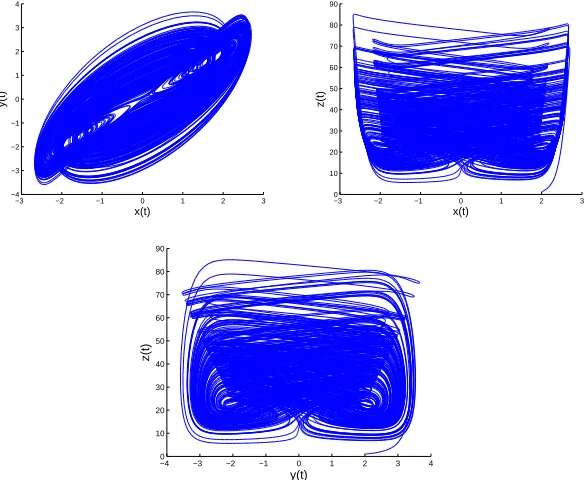
Whena= 35,b= 3,c= 28 the Lyapunov exponents of system (2) are found to be LEI =3.8065, LE2=0.010904 , LE3=-13.817. There is a positive Lyapunov expo-nent, which is much larger than that of the system (1). The Lyapunov dimension of system (2) is:
DL=j+
1 |LEj+1|
j
X
i=1
LEi= 2 +
LE1+LE2
|LE3|
= 2 + 3.806 + 0.0109
|−13.817| = 2.2762
0 50 100 150 200 250 300 −20
−15 −10 −5 0 5 10
Dynamics of Lyapunov Exponents
L
1 =3.8065
L
2 =0.010904
L
3 =−13.817
Time
Lyapunov Exponents
Figure 1. Dynamics of Lyapunov exponents of system (2)
−25 −20 −15 −10 −5 0 5 10 15 20 25 −30
−20 −10 0 10 20 30
x(t)
y(t)
−255 −20 −15 −10 −5 0 5 10 15 20 25 10
15 20 25 30 35 40 45 50
x(t)
z(t)
−305 −20 −10 0 10 20 30
10 15 20 25 30 35 40 45 50
y(t)
z(t)
Figure 2. Phase portraits of chaotic attractors of system (I)
−3 −2 −1 0 1 2 3 −4
−3 −2 −1 0 1 2 3 4
x(t)
y(t)
−3 −2 −1 0 1 2 3 0
10 20 30 40 50 60 70 80 90
x(t)
z(t)
−4 −3 −2 −1 0 1 2 3 4
0 10 20 30 40 50 60 70 80 90
y(t)
z(t)
3. Basic properties of the new system
A. Equilibria
For equilibrium points we take
a(y−x) = 0,
(c−a)x+cy−xz= 0, exy−bz= 0,
(3)
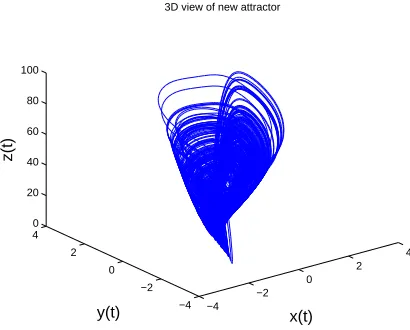
Whena= 35,b= 3,c= 28, system (2) has three equilibrium points: E1(0,0,0.333), E2(2.035,2.035,21), E3(−2.035,−2.035,21). The equilibrium point of system (2)
does not contain the origin. The Jacobian matrix of system (2) is given by
J =
−a a 0
c−a−z c −x
yexy xexy −b
(4)
For the equilibrium pointE1 = (0,0,0.333) , system (2) has three eigenvalues: λ1=−3, λ2= 23.835,λ3=−30.835. Eigenvalues is not all for the positive or
neg-ative, according to the Routh-Hurwitz ,E1= (0,0,0.333) is unstable saddle node.
For the equilibrium points E2 = (2.035,2.035,21) and E3 = (−2.035,−2.035,21)
, system (2) has same eigenvalues: λ1 =−26.053, λ2,3 = 8.026±25.203i. λ1 is
a negative real root andλ2,3 are a pair of conjugate roots with positive real part.
SoE2= (2.035,2.035,21) andE3= (−2.035,−2.035,21),are unstable saddle-focus
points.
B. Symmetry and invariance
It is easy to see the invariance of system under the coordinate transformation (x, y, z)→(−x,−y, z) i.e., the system has rotation symmetry around the z -axis.
−4 −2
0 2
4
−4 −2 0 2 4 0 20 40 60 80 100
x(t) 3D view of new attractor
y(t)
z(t)
C. Dissipativity
The three Lyapunov exponents and the divergence of the vector field is:
3
X
i=1
LEi= ∆V =
∂x˙
∂x+
∂y˙
∂y +
∂z˙
∂z =−a+c−b=f,
(5)
where
3
P
i=1
LEi denote the three Lyapunov exponents of the system. Note thatf =
−a+c−b=−10 is a negative value, so the system is a dissipative system and an exponential rate is:
dV
dt =e
f =e−10
(6)
From(6), it can be seen that a volume element V0 is contracted by the flow into
a volume element V0e−10t in time t . This means that each volume containing
the system trajectory shrinks to zero as t → ∞ at an exponential rate of −10 . Therefore, all system orbits are ultimately confined to a specific subset having zero volume and the asymptotic motion settles onto an attractor .
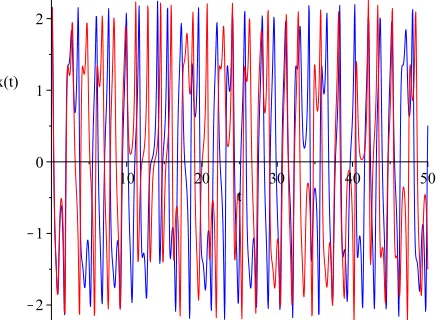
D. Sensitivity to initial conditionsFigure 4 shows that the evolution of the chaos trajectories is very sensitive to initial conditions. The initial values of the system are set to [2,2,1]T for the solid line and [2.01,2,1]T for the dashed line.
Figure 5. Sensitivity of system(2) to initial conditions
4. Conclusions
References
[1] E. N. Lorenz, Deterministic non-periodic flow? J.Atmos. Sci., Vol. 20, No. 1, pp. 130-141, 1963.
[2] O. E . Rossler, An equation for continuous chaos?Phys. Lett. A, Vol. 57, No. 5, pp. 397-399, 1976.
[3] G. Chen, T. Ueta, Yet another chaotic attractor? Internat. J. Bifur. Chaos, Vol. 9, No. 7, pp. 1465-1457, 1999.
[4] J. L? G. Chen, A new chaotic attractor conined? Internat. J. Bifur. Chaos, Vol. 12, No. 3, pp. 659-662, 2002.
[5] C. Liu, T. Liu, L. Liu, K. Liu, A new chaotic attractor? Chaos, Solitons Fractals, Vol. 22, No. 5, pp. 1031-1038, 2004.
[6] S. Celikovsky, G. Chen, On the generalized Lorenz canonical form? Chaos, Solitons Fractals, Vol. 26, No. 5, pp. 1271-1276, 2005.
[7] Z. Wei, Q. Yang, Dynamical analysis of a new autonomous 3-D chaotic system only with stable equilibria? Nonlinear Anal.: RWA, Vol. 12, No. 1, pp. 106-118, 2011. [8] Z.Liang, W. Zhonglin, ”Design and realization of a new chaotic system”, Sensor
Netw. Sec. Technol. and Prc. Commun. Syst., 2013 International Conference on, 10.1109/SNS-PCS.2013.6553844, pp.101-104, 2013.
[9] Li, X.F., Chlouverakis, K.E., Xu, D.L.: Nonlinear dynamics and circuit realization of a new chaotic flow: A variant of Lorenz, Chen and Lu. Nonlinear Anal. 10, 2357-2368 (2009) .
[10] Hahn, W., The Stability of Motion. Springer, New York (1967).
College of Mathematics and Statistics,Chongqing University, Chongqing 401331, PR China
∗