CU
s
s
CLINICAL SUPERVISIONClinical Supervision and
Professional Development of
the Substance Abuse Counselor
A Treatment
Improvement
Protocol
TIP
52
U.S. DEPARTMENT OF HEALTH AND HUMAN SERVICES
Substance Abuse and Mental Health Services Administration
Center for Substance Abuse Treatment
Clinical Supervision and
Professional Development
of the Substance Abuse
Counselor
Treatment Improvement Protocol (TIP) Series
52
U.S. DEPARTMENT OF HEALTH AND HUMAN SERVICES
Substance Abuse and Mental Health Services Administration Center for Substance Abuse Treatment
Acknowledgments
This publication was produced under the Knowledge Application Program, contract number 270-04-7049, a Joint Venture of The CDM Group, Inc. and JBS International, Inc., for the Center for Substance Abuse Treatment CSAT), Substance Abuse and Mental Health Services Administration SAMHSA), U.S. Department of Health and Human Services (HHS). Christina Currier served as the CSAT Government Project Officer.
Disclaimer
The views, opinions, and content expressed herein are those of the expert panel and do not necessarily reflect the views, opinions, or policies of CSAT, SAMHSA, or HHS. No official support of or endorsement by CSAT, SAMHSA, or HHS for these opinions or for particular instruments, software, or resources is intended or should be inferred.
Public Domain Notice
All materials appearing in this volume except those taken directly from copyrighted sources are in the public domain and may be reproduced or copied without permission from SAMHSA/CSAT or the authors. Citation of the source is appreciated. However, this publication may not be reproduced or distributed for a fee without the specific, written authorization of the Office of Communications, SAMHSA, HHS.
Electronic Access and Copies of Publication
This publication may be downloaded or ordered at http://www.samhsa.gov/shin. Or, please call SAMHSA’s Health Information Network at 1-877-SAMHSA-7 (1-877-726-4727) (English and Español).
Recommended Citation
Center for Substance Abuse Treatment. Clinical Supervision and Professional Development of the Substance Abuse Counselor. Treatment Improvement Protocol (TIP) Series 52. DHHS Publication No. (SMA) 09-4435. Rockville, MD: Substance Abuse and Mental Health Services Administration, 2009.
Originating Office
Quality Improvement and Workforce Development Branch, Division of Services Improvement, Center for Substance Abuse Treatment, Substance Abuse and Mental Health Services Administration, 1 Choke Cherry Road, Rockville, MD 20857.
Contents
Consensus Panel . . . . . . . . .
. . .
. . .
. . .
. . . . . . . . . . . . . . . . . . . . . . . . . . . . . . . . . Supervision . . . . . . . . . . . . . . . . . . . . . . . . . . . . . . . . . . . . . . . . . .
. . . . . . . . . . . . . . .
v
What Is a TIP? vii
Foreword ix
How This TIP Is Organized xi
Part 1
1Overview of Part 1 1
Chapter 1 3
Introduction 3
Central Principles of Clinical Supervision 5
Guidelines for new Supervisors 6
Models of Clinical Supervision 8
Developmental Stages of Counselors 9
Developmental Stages of Supervisors 10
Cultural and Contextual Factors 11
Ethical and Legal Issues 13
Monitoring Performance 17
Methods of Observation 20
Practical Issues in Clinical 24
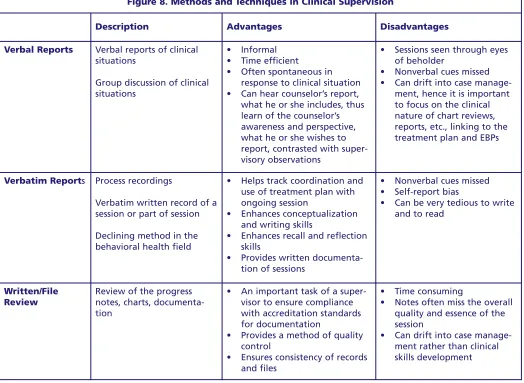
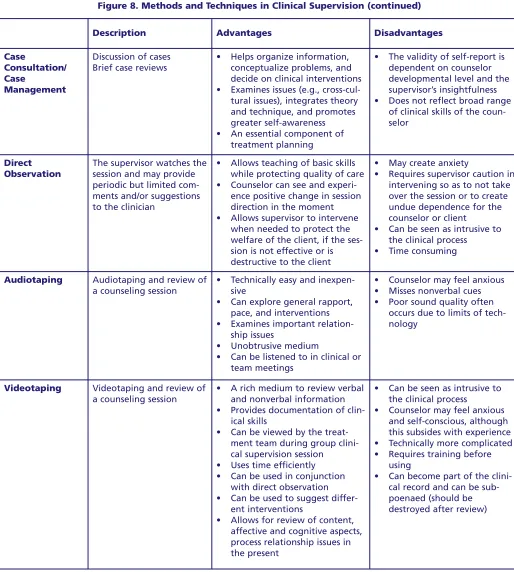
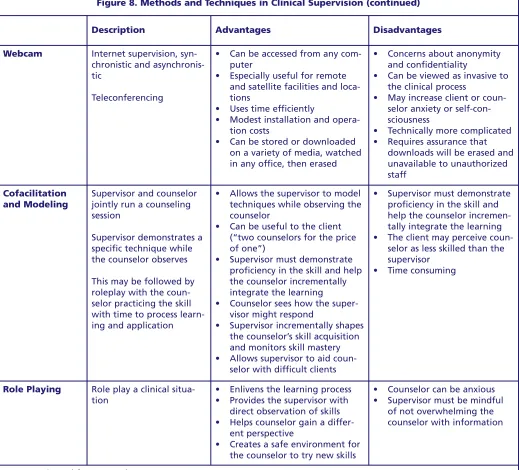
Methods and Techniques of Clinical Supervision 30
Administrative Supervision 33
Resources 34
Chapter 2 35
Introduction 35
Vignette 1—Establishing a New Approach for Clinical Supervision 35
Vignette 2—Defining and Building the Supervisory Alliance 44
Vignette 3—Addressing Ethical Standards 51
Vignette 4—Implementing an Evidence-Based Practice 58
Vignette 5—Maintaining Focus on Job Performance 64
Vignette 6—Promoting a Counselor From Within 69
Vignette 7—Mentoring a Successor 73
Vignette 8—Making the Case for Clinical Supervision to Administrators 78
Part 2
85Chapter 1 87
Benefits and Rationale 87
Key Issues for Administrators in Clinical Supervision 88
Administrative and Clinical Supervision 89
Legal and Ethical Issues for Administrators . . . . . . . . .
. . .
. . . . . .
. . . . . . . . . . . . . . . . . . . . . . . . . . . . . . . . .
. . .
. . . .
. . .
. . .
. . .
. . .
. . .
. . . 90
Diversity and Cultural Competence 91
Developing a Model for Clinical Supervision 92
Implementing a Clinical Supervision Program 92
Professional Development of Supervisors 99
Chapter 2 101
Introduction 101
Assessing Organizational Readiness 101
Legal and Ethical Issues of Supervision 106
Supervision Guidelines 109
The Supervision Contract 111
The Initial Supervision Sessions 113
Evaluation of Counselors and Supervisors 118
Individual Development Plan 122
Outline for Case Presentations 123
Audio- and Videotaping 124
Appendix A—Bibliography 127
Appendix B—New York State Office of Alcoholism and Substance Abuse
Services Clinical Supervision Vision Statement 135
Appendix C—Advisory Meeting Panel 139
Appendix D—SAMHSA Stakeholders Meeting Attendees 141
Appendix E—Field Reviewers 143
Appendix F—Acknowledgments 145
Consensus Panel
Chair, Part 1 and Part 2 Consensus Panels
David J. Powell, Ph.D. (Chair) President
International Center for Health Concerns, Inc. East Granby, Connecticut
Part 1 Consensus Panel Members
Bruce Carruth, Ph.D. KAP Expert Content Director The CDM Group, Inc.
Bethesda, Maryland Bettye Harrison
Opioid Treatment Program Accreditation Director CARF International
Tucson, Arizona
Sharon Hartman, M.B.A., LSW
Director of Professional Training and Education Caron Treatment Centers
Wernersville, Pennsylvania
Pamela Mattel, M.S.W., LCSW-R, ACSW, CASAC Executive Deputy Director
BASICS, Inc.
New York, New York John Porter, M.S.
Northwest Frontier Addiction Technology Transfer Center Wilsonville, Oregon
Part 2 Consensus Panel Members
Bruce Carruth, Ph.D. KAP Expert Content Director The CDM Group, Inc.
Bethesda, Maryland
Charles F. Gressard, Ph.D., LPC, NCC Associate Professor, School of Education College of William & Mary
Williamsburg,Virginia
Pamela Mattel, M.S.W., LCSW-R, ACSW, CASAC Executive Deputy Director
BASICS, Inc.
New York, New York
What Is a TIP?
Treatment Improvement Protocols (TIPs), developed by the Center for Substance Abuse Treatment (CSAT), part of the Substance Abuse and Mental Health Services Administration (SAMHSA) within the U.S.
Department of Health and Human Services (HHS), are best-practices guidelines for the treatment of substance use disorders. CSAT draws on the experience and knowledge of clinical, research, and administrative experts to produce the TIPs, which are distributed to facilities and individuals across the country. As alcohol and drug use disorders are increasingly recognized as a major problem, the audience for the TIPs is expanding beyond public and private treatment facilities to include practitioners in mental health, criminal justice, primary care, and other healthcare and social service settings.
The recommendations contained in each TIP are grounded in scientific research findings and the opinion of the TIP consensus panel of experts that a particular practice will produce a specific clinical outcome (measurable change in client status). In making recommendations, consensus panelists engage in a process of “evidence based thinking” in which they consider scientific research, clinical practice theory, practice principles, and prac tice guidelines, as well as their own individual clinical experiences. Based on this thinking, they arrive at rec ommendations for optimal clinical approaches for given clinical situations. Relevant citations (to research out come reports, theoretic formulations, and practice principles and guidelines) are provided.
TIP Format
This TIP is organized into three parts:
• Part 1 for substance abuse clinical supervisors focuses on providing appropriate supervision methods and frameworks.
• Part 2 for program administrators focuses on providing administrative support to implement adoption of the counseling recommendations made in Part 1.
• Part 3 for clinical supervisors, program administrators, and interested counselors is an online literature review that provides an in-depth look at relevant published resources. Part 3 will be updated every 6 months for 5 years following publication of the TIP.
Ideally this TIP might be used in a series of six or so meetings in which the materials in the TIP would be reviewed, discussed, and in other ways used as an educational and training vehicle for the improvement of clin ical supervision skills (with the particulars of how this training would be done determined by the trainer, based upon her or his unique situation, needs, and preferences). Thus, after a relatively short period of time and with few or no additional resources, this TIP could meet the challenge of fostering improvement in the delivery of substance abuse treatment services.
Development Process
TIPs Online
TIPs can be accessed via the Internet at http://www.kap.samhsa.gov. The online Clinical Supervision and Professional Development of the Substance Abuse Counselor: Part 3, A Review of the Literature, which will be updated every 6 months for 5 years, is also available at http://www.kap.samhsa.gov.
Terminology
Throughout the TIP, the term “substance abuse” has been used to refer to both substance abuse and substance dependence (as defined by the Diagnostic and Statistical Manual of Mental Disorders, 4th edition, Text Revision [DSM-IV-TR] [American Psychiatric Association 2000]). This term was chosen partly because substance abuse treatment professionals commonly use the term “substance abuse” to describe any excessive use of addictive substances. In this TIP, the term refers to the use of alcohol as well as other substances of abuse. Readers should attend to the context in which the term occurs in order to determine what possible range of meanings it covers; in most cases, however, the term will refer to all varieties of substance use disorders described by DSM-IV.
Foreword
The Treatment Improvement Protocol (TIP) series supports SAMHSA’s mission of building resilience and facili tating recovery for people with or at risk for mental or substance use disorders by providing best practices guid ance to clinicians, program administrators, and payors to improve the quality and effectiveness of service deliv ery and, thereby, promote recovery. TIPs are the result of careful consideration of all relevant clinical and health services research findings, demonstration experience, and implementation requirements. Clinical researchers, clinicians, and program administrators meet to debate and discuss their particular areas of expert ise until they reach a consensus on best practices. This panel’s work is then reviewed and critiqued by field reviewers.
The talent, dedication, and hard work that TIP panelists and reviewers bring to this highly participatory process have helped bridge the gap between the promise of research and the needs of practicing clinicians and administrators to serve, in the most scientifically sound and effective ways, people who abuse substances. We are grateful to all who have joined with us to contribute to advances in the substance abuse treatment field.
Eric Broderick, D.D.S., M.P.H. Acting Administrator Substance Abuse and Mental Health Services Administration H. Westley Clark, M.D., J.D., M.P.H., CAS, FASAM Director Center for Substance Abuse Treatment Substance Abuse and Mental Health Services Administration
How This TIP Is Organized
This TIP is divided into three parts:
• Clinical Supervision and Professional Development of the Substance Abuse Counselor, Part 1.
• Clinical Supervision and Professional Development of the Substance Abuse Counselor: An Implementation Guide for Administrators, Part 2.
• Clinical Supervision and Professional Development of the Substance Abuse Counselor: A Review of the Literature, Part 3.
Parts 1 and 2 are presented in this publication; Part 3 is available only online at http://www.kap.samhsa.gov.
Part 1 of the TIP is for clinical supervisors and consists of two chapters. Chapter 1 presents basic information about clinical supervision in the substance abuse treatment field. It covers:
• Central principles of clinical supervision and guidelines for new supervisors, including the functions of a clinical supervisor.
• The developmental levels of counselors and clinical supervisors.
• Information on cultural competence, ethical and legal issues such as direct and vicarious liability, dual rela tionships and boundary issues, informed consent, confidentiality, and supervisor ethics.
• Information about monitoring clinical performance of counselors, the various methods commonly used for observing counselors, the methods and techniques of supervision and administrative supervision, and practi cal issues such as balancing one’s clinical and administrative duties, finding the time to do clinical supervi sion, documentation, and structuring clinical supervision sessions.
Chapter 2 presents the “how to” of clinical supervision. Chapter 2 contains: • Representative vignettes of clinical supervision scenarios.
• Master supervisor notes and comments that help you understand the thinking behind the supervisor’s approach in each vignette.
• “How-to” descriptions of specific techniques.
It is strongly recommended that you read chapter 1 before reading chapter 2.
Part 2 is an implementation guide for program administrators and consists of two chapters. Chapter 1 lays out the rationale for the approach taken in chapter 2 and will help administrators understand the benefits and rationale behind providing clinical supervision for their program’s substance abuse counselors. Chapter 2 pro vides tools for making the tasks associated with implementing a clinical supervision system easier.
The following topics are addressed in Part 2:
• How to develop a model for clinical supervision and implement a clinical supervision program.
• Key issues for administrators to consider, including assessing organizational structure and readiness. • Legal and ethical issues to consider.
• Cultural competence issues.
• Providing professional development for clinical supervisors.
Clinical Supervision and
Professional Development of
the Substance Abuse
Counselor
Part 1
Overview of Part 1
Chapter 1: Information You Need To Know
This chapter presents the basic information about clinical supervision in the substance abuse treatment field and is organized as follows:
• Introduction (pp. 3–4)
• Central Principles of Clinical Supervision (pp. 5–6) • Guidelines for New Supervisors (pp. 6–8)
• Models of Clinical Supervision (pp. 8–9)
• Developmental Stages of Counselors (pp. 9–10) • Developmental Stages of Supervisors (pp. 10–11) • Cultural and Contextual Factors (pp. 11–13) • Ethical and Legal Issues (pp. 13–17)
• Monitoring Performance (pp. 17–20) • Methods of Observation (pp. 20–24)
• Practical Issues in Clinical Supervision (pp. 24–29)
• Methods and Techniques of Clinical Supervision (pp. 30–32) • Administrative Supervision (pp. 33–34)
• Resources (p. 34)
Chapter 2: Clinical Scenarios Showing How To Apply the Information
This chapter presents several realistic clinical supervision scenarios that could take place in a substance abuse treatment agency to demonstrate the material presented in chapter 1. Master Supervisor Notes are provided to explain the thinking behind these actions. How-to Notes instruct supervisors on using a specific technique. The scenarios should be useful to both counselors and supervisors.
Chapter 1
Introduction
Clinical supervision is emerging as the crucible in which counselors acquire knowledge and skills for the substance abuse treatment profession, providing a bridge between the classroom and the clinic. Supervision is necessary in the substance abuse treatment field to improve client care, develop the professionalism of clinical personnel, and impart and maintain ethical standards in the field. In recent years, especially in the substance abuse field, clinical supervision has become the cornerstone of quality improvement and assurance.
Your role and skill set as a clinical supervisor are dis tinct from those of counselor and administrator. Quality clinical supervision is founded on a positive supervisor–supervisee relationship that promotes client welfare and the professional development of the supervisee. You are a teacher, coach, consultant, mentor, evaluator, and administrator; you provide support, encouragement, and education to staff while addressing an array of psychological, interpersonal, physical, and spiritual issues of clients. Ultimately, effective clinical supervision ensures that clients are competently served. Supervision ensures that coun selors continue to increase their skills, which in turn increases treatment effectiveness, client retention, and staff satisfaction. The clinical supervisor also serves as liaison between administrative and clinical staff.
This TIP focuses primarily on the teaching, coaching, consulting, and mentoring functions of clinical super visors. Supervision, like substance abuse counseling, is a profession in its own right, with its own theories, practices, and standards. The profession requires knowledgeable, competent, and skillful individuals who are appropriately credentialed both as counselors and supervisors.
Definitions
This document builds on and makes frequent refer ence to CSAT’s Technical Assistance Publication (TAP), Competencies for Substance Abuse Treatment
Clinical Supervisors (TAP 21-A; CSAT, 2007). The clinical supervision competencies identify those responsibilities and activities that define the work of the clinical supervisor. This TIP provides guidelines and tools for the effective delivery of clinical supervi sion in substance abuse treatment settings. TAP 21-A is a companion volume to TAP 21, Addiction
Counseling Competencies (CSAT, 2006), which is another useful tool in supervision.
The perspective of this TIP is informed by the follow ing definitions of supervision:
• “Supervision is a disciplined, tutorial process wherein principles are transformed into practical skills, with four overlapping foci: administrative, evaluative, clinical, and supportive” (Powell & Brodsky, 2004, p. 11). “Supervision is an interven tion provided by a senior member of a profession to a more junior member or members. . . . This relationship is evaluative, extends over time, and has the simultaneous purposes of enhancing the professional functioning of the more junior per-son(s); monitoring the quality of professional serv ices offered to the clients that she, he, or they see; and serving as a gatekeeper of those who are to enter the particular profession” (Bernard & Goodyear, 2004, p. 8).
• Supervision is “a social influence process that occurs over time, in which the supervisor partici pates with supervisees to ensure quality of clinical care. Effective supervisors observe, mentor, coach, evaluate, inspire, and create an atmosphere that promotes self-motivation, learning, and profession al development. They build teams, create cohesion, resolve conflict, and shape agency culture, while attending to ethical and diversity issues in all aspects of the process. Such supervision is key to both quality improvement and the successful implementation of consensus- and evidence-based practices” (CSAT, 2007, p. 3).
Rationale
For hundreds of years, many professions have relied on more senior colleagues to guide less experienced professionals in their crafts. This is a new develop
ment in the substance abuse field, as clinical supervi sion was only recently acknowledged as a discrete process with its own concepts and approaches. As a supervisor to the client, counselor, and organiza tion, the significance of your position is apparent in the following statements:
• Organizations have an obligation to ensure quality care and quality improvement of all personnel. The first aim of clinical supervision is to ensure quality services and to protect the welfare of clients.
• Supervision is the right of all employees and has a direct impact on workforce development and staff and client retention.
• You oversee the clinical functions of staff and have a legal and ethical responsibility to ensure quality care to clients, the professional development of counselors, and maintenance of program policies and procedures.
• Clinical supervision is how counselors in the field learn. In concert with classroom education, clinical skills are acquired through practice, observation, feedback, and implementation of the recommenda tions derived from clinical supervision.
Functions of a Clinical Supervisor
You, the clinical supervisor, wear several important “hats.” You facilitate the integration of counselor self-awareness, theoretical grounding, and development of clinical knowledge and skills; and you improve func tional skills and professional practices. These roles often overlap and are fluid within the context of the supervisory relationship. Hence, the supervisor is in a unique position as an advocate for the agency, the counselor, and the client. You are the primary link between administration and front line staff, inter preting and monitoring compliance with agency goals, policies, and procedures and communicating staff and client needs to administrators. Central to the supervi sor’s function is the alliance between the supervisor and supervisee (Rigazio-DiGilio, 1997).
As shown in Figure 1, your roles as a clinical supervi sor in the context of the supervisory relationship include:
• Teacher: Assist in the development of counseling knowledge and skills by identifying learning needs, determining counselor strengths, promot
ing self-awareness, and transmitting knowledge for practical use and professional growth. Supervisors are teachers, trainers, and profes sional role models.
• Consultant: Bernard and Goodyear (2004) incor porate the supervisory consulting role of case con sultation and review, monitoring performance, counseling the counselor regarding job perform ance, and assessing counselors. In this role, super visors also provide alternative case conceptualiza tions, oversight of counselor work to achieve mutu ally agreed upon goals, and professional gatekeep ing for the organization and discipline (e.g., recog nizing and addressing counselor impairment). • Coach: In this supportive role, supervisors pro
vide morale building, assess strengths and needs, suggest varying clinical approaches, model, cheer-lead, and prevent burnout. For entry-level coun selors, the supportive function is critical.
• Mentor/Role Model: The experienced supervisor mentors and teaches the supervisee through role modeling, facilitates the counselor’s overall profes sional development and sense of professional iden tity, and trains the next generation of supervisors.
Figure 1. Roles of the Clinical Supervisor
Part 1, Chapter 1
Central Principles of
Clinical Supervision
The Consensus Panel for this TIP has identified cen tral principles of clinical supervision. Although the Panel recognizes that clinical supervision can initial ly be a costly undertaking for many financially strapped programs, the Panel believes that ultimate ly clinical supervision is a cost-saving process. Clinical supervision enhances the quality of client care; improves efficiency of counselors in direct and indirect services; increases workforce satisfaction, professionalization, and retention (see vignette 8 in chapter 2); and ensures that services provided to the public uphold legal mandates and ethical standards of the profession.
The central principles identified by the Consensus Panel are:
1. Clinical supervision is an essential part of all clinical programs. Clinical supervision is a central organizing activity that integrates the program mission, goals, and treatment philosophy with clinical theory and evidence-based practices (EBPs). The primary reasons for clinical supervi sion are to ensure (1) quality client care, and (2) clinical staff continue professional development in a systematic and planned manner. In substance abuse treatment, clinical supervision is the pri mary means of determining the quality of care provided.
2. Clinical supervision enhances staff reten tion and morale. Staff turnover and workforce development are major concerns in the substance abuse treatment field. Clinical supervision is a primary means of improving workforce retention and job satisfaction (see, for example, Roche, Todd, & O’Connor, 2007).
3. Every clinician, regardless of level of skill and experience, needs and has a right to clinical supervision. In addition, supervisors need and have a right to supervision of their supervision. Supervision needs to be tailored to the knowledge base, skills, experience, and assignment of each counselor. All staff need supervision, but the frequency and intensity of the oversight and training will depend on the role, skill level, and competence of the individual.
The benefits that come with years of experience are enhanced by quality clinical supervision. 4. Clinical supervision needs the full support
of agency administrators. Just as treatment programs want clients to be in an atmosphere of growth and openness to new ideas, counselors should be in an environment where learning and professional development and opportunities are valued and provided for all staff.
5. The supervisory relationship is the crucible in which ethical practice is developed and reinforced. The supervisor needs to model sound ethical and legal practice in the supervisory rela tionship. This is where issues of ethical practice arise and can be addressed. This is where ethical practice is translated from a concept to a set of behaviors. Through supervision, clinicians can develop a process of ethical decisionmaking and use this process as they encounter new situations. 6. Clinical supervision is a skill in and of itself
that has to be developed. Good counselors tend to be promoted into supervisory positions with the assumption that they have the requisite skills to provide professional clinical supervision.
However, clinical supervisors need a different role orientation toward both program and client goals and a knowledge base to complement a new set of skills. Programs need to increase their capacity to develop good supervisors.
7. Clinical supervision in substance abuse treatment most often requires balancing administrative and clinical supervision tasks. Sometimes these roles are complementary and sometimes they conflict. Often the supervisor feels caught between the two roles.
Administrators need to support the integration and differentiation of the roles to promote the efficacy of the clinical supervisor. (See Part 2.) 8. Culture and other contextual variables
influence the supervision process; supervi sors need to continually strive for cultural competence. Supervisors require cultural com petence at several levels. Cultural competence involves the counselor’s response to clients, the supervisor’s response to counselors, and the pro gram’s response to the cultural needs of the diverse community it serves. Since supervisors are in a position to serve as catalysts for change, they need to develop proficiency in addressing the needs of diverse clients and personnel.
9. Successful implementation of EBPs requires ongoing supervision. Supervisors have a role in determining which specific EBPs are relevant for an organization’s clients (Lindbloom, Ten Eyck, & Gallon, 2005). Supervisors ensure that EBPs are successfully integrated into ongoing programmat ic activities by training, encouraging, and moni toring counselors. Excellence in clinical supervi sion should provide greater adherence to the EBP model. Because State funding agencies now often require substance abuse treatment organizations to provide EBPs, supervision becomes even more important.
10. Supervisors have the responsibility to be gatekeepers for the profession. Supervisors are responsible for maintaining professional stan dards, recognizing and addressing impairment, and safeguarding the welfare of clients. More than anyone else in an agency, supervisors can observe counselor behavior and respond promptly to potential problems, including counseling some individuals out of the field because they are ill-suited to the profession. This “gatekeeping” func tion is especially important for supervisors who act as field evaluators for practicum students prior to their entering the profession. Finally, supervisors also fulfill a gatekeeper role in per formance evaluation and in providing formal rec ommendations to training institutions and cre dentialing bodies.
11. Clinical supervision should involve direct observation methods. Direct observation should be the standard in the field because it is one of the most effective ways of building skills, monitoring counselor performance, and ensuring quality care. Supervisors require training in methods of direct observation, and administrators need to provide resources for implementing direct observation. Although small substance abuse agencies might not have the resources for one-way mirrors or videotaping equipment, other direct observation methods can be employed (see the section on methods of observation, pp. 20–24).
Guidelines for New
Supervisors
Congratulations on your appointment as a supervisor! By now you might be asking yourself a few questions: What have I done? Was this a good career decision?
There are many changes ahead. If you have been pro moted from within, you’ll encounter even more hur dles and issues. First, it is important to face that your life has changed. You might experience the loss of friendship of peers. You might feel that you knew what to do as a counselor, but feel totally lost with your new responsibilities (see vignette 6 in chapter 2). You might feel less effective in your new role. Supervision can be an emotionally draining experi ence, as you now have to work with more staff-related interpersonal and human resources issues.
Before your promotion to clinical supervisor, you might have felt confidence in your clinical skills. Now you might feel unprepared and wonder if you need a training course for your new role. If you feel this way, you’re right. Although you are a good counselor, you do not necessarily possess all the skills needed to be a good supervisor. Your new role requires a new body of knowledge and different skills, along with the ability to use your clinical skills in a different way. Be confi dent that you will acquire these skills over time (see the Resources section, p. 34) and that you made the right decision to accept your new position.
Suggestions for new supervisors:
• Quickly learn the organization’s policies and pro cedures and human resources procedures (e.g., hir ing and firing, affirmative action requirements, format for conducting meetings, giving feedback, and making evaluations). Seek out this informa tion as soon as possible through the human resources department or other resources within the organization.
• Ask for a period of 3 months to allow you to learn about your new role. During this period, do not make any changes in policies and procedures but use this time to find your managerial voice and decisionmaking style.
• Take time to learn about your supervisees, their career goals, interests, developmental objectives, and perceived strengths.
• Work to establish a contractual relationship with supervisees, with clear goals and methods of supervision.
• Learn methods to help staff reduce stress, address competing priorities, resolve staff conflict, and other interpersonal issues in the workplace. • Obtain training in supervisory procedures and
methods.
Part 1, Chapter 1
• Find a mentor, either internal or external to the organization.
• Shadow a supervisor you respect who can help you learn the ropes of your new job.
• Ask often and as many people as possible, “How am I doing?” and “How can I improve my perform ance as a clinical supervisor?”
• Ask for regular, weekly meetings with your administrator for training and instruction. • Seek supervision of your supervision.
Problems and Resources
As a supervisor, you may encounter a broad array of issues and concerns, ranging from working within a system that does not fully support clinical supervision to working with resistant staff. A comment often heard in supervision training sessions is “My boss should be here to learn what is expected in supervi sion,” or “This will never work in my agency’s bureau cracy. They only support billable activities.” The work setting is where you apply the principles and prac tices of supervision and where organizations are driv en by demands, such as financial solvency, profit, census, accreditation, and concerns over litigation. Therefore, you will need to be practical when begin ning your new role as a supervisor: determine how you can make this work within your unique work environment.
Working With Staff Who Are
Resistant to Supervision
Some of your supervisees may have been in the field longer than you have and see no need for supervision. Other counselors, having completed their graduate training, do not believe they need further supervision, especially not from a supervisor who might have less formal academic education than they have. Other resistance might come from ageism, sexism, racism, or classism. Particular to the field of substance abuse treatment may be the tension between those who believe that recovery from substance abuse is neces sary for this counseling work and those who do not believe this to be true.
In addressing resistance, you must be clear regarding what your supervision program entails and must con sistently communicate your goals and expectations to
staff. To resolve defensiveness and engage your supervisees, you must also honor the resistance and acknowledge their concerns. Abandon trying to push the supervisee too far, too fast. Resistance is an expression of ambivalence about change and not a personality defect of the counselor. Instead of arguing with or exhorting staff, sympathize with their con cerns, saying, “I understand this is difficult. How are we going to resolve these issues?”
When counselors respond defensively or reject direc tions from you, try to understand the origins of their defensiveness and to address their resistance. Self-disclosure by the supervisor about experiences as a supervisee, when appropriately used, may be helpful in dealing with defensive, anxious, fearful, or resist ant staff. Work to establish a healthy, positive super visory alliance with staff. Because many substance abuse counselors have not been exposed to clinical supervision, you may need to train and orient the staff to the concept and why it is important for your agency.
Things a New Supervisor
Should Know
Eight truths a beginning supervisor should commit to memory are listed below:
1. The reason for supervision is to ensure quality client care. As stated throughout this TIP, the primary goal of clinical supervision is to protect the welfare of the client and ensure the integrity of clinical services.
2. Supervision is all about the relationship. As in counseling, developing the alliance between the counselor and the supervisor is the key to good supervision.
3. Culture and ethics influence all supervisory interactions. Contextual factors, culture, race, and ethnicity all affect the nature of the supervi sory relationship. Some models of supervision (e.g., Holloway, 1995) have been built primarily around the role of context and culture in shaping supervision.
4. Be human and have a sense of humor. As role models, you need to show that everyone makes mistakes and can admit to and learn from these mistakes.
5. Rely first on direct observation of your counselors and give specific feedback. The best way to deter mine a counselor’s skills is to observe him or her and to receive input from the clients about their perceptions of the counseling relationship. 6. Have and practice a model of counseling and of
supervision; have a sense of purpose. Before you can teach a supervisee knowledge and skills, you must first know the philosophical and theoretical foundations on which you, as a supervisor, stand. Counselors need to know what they are going to learn from you, based on your model of counseling and supervision.
7. Make time to take care of yourself spiritually, emotionally, mentally, and physically. Again, as role models, counselors are watching your behav ior. Do you “walk the talk” of self-care?
8. You have a unique position as an advocate for the agency, the counselor, and the client. As a super visor, you have a wonderful opportunity to assist in the skill and professional development of your staff, advocating for the best interests of the supervisee, the client, and your organization.
Models of Clinical
Supervision
You may never have thought about your model of supervision. However, it is a fundamental premise of this TIP that you need to work from a defined model of supervision and have a sense of purpose in your oversight role. Four supervisory orientations seem particularly relevant. They include:
• Competency-based models. • Treatment-based models. • Developmental approaches. • Integrated models.
Competency-based models (e.g., microtraining, the Discrimination Model [Bernard & Goodyear, 2004], and the Task-Oriented Model [Mead, 1990], focus primarily on the skills and learning needs of the supervisee and on setting goals that are specific, measurable, attainable, realistic, and timely
(SMART). They construct and implement strategies to accomplish these goals. The key strategies of com petency-based models include applying social learn ing principles (e.g., modeling role reversal, role play ing, and practice), using demonstrations, and using
various supervisory functions (teaching, consulting, and counseling).
Treatment-based supervision models train to a particular theoretical approach to counseling, incorpo rating EBPs into supervision and seeking fidelity and adaptation to the theoretical model. Motivational interviewing, cognitive–behavioral therapy, and psy chodynamic psychotherapy are three examples. These models emphasize the counselor’s strengths, seek the supervisee’s understanding of the theory and model taught, and incorporate the approaches and tech niques of the model. The majority of these models begin with articulating their treatment approach and describing their supervision model, based upon that approach.
Developmental models, such as Stoltenberg and Delworth (1987), understand that each counselor goes through different stages of development and recog nize that movement through these stages is not always linear and can be affected by changes in assignment, setting, and population served. (The developmental stages of counselors and supervisors are described in detail below).
Integrated models, including the Blended Model, begin with the style of leadership and articulate a model of treatment, incorporate descriptive dimen sions of supervision (see below), and address contex tual and developmental dimensions into supervision. They address both skill and competency development and affective issues, based on the unique needs of the supervisee and supervisor. Finally, integrated models seek to incorporate EBPs into counseling and supervision.
In all models of supervision, it is helpful to identify culturally or contextually centered models or approaches and find ways of tailoring the models to specific cultural and diversity factors. Issues to con sider are:
• Explicitly addressing diversity of supervisees (e.g., race, ethnicity, gender, age, sexual orientation) and the specific factors associated with these types of diversity;
• Explicitly involving supervisees’ concerns related to particular client diversity (e.g., those whose cul ture, gender, sexual orientation, and other attrib utes differ from those of the supervisee) and addressing specific factors associated with these types of diversity; and
Part 1, Chapter 1
• Explicitly addressing supervisees’ issues related to effectively navigating services in intercultural communities and effectively networking with agencies and institutions.
It is important to identify your model of counseling and your beliefs about change, and to articulate a workable approach to supervision that fits the model of counseling you use. Theories are conceptual frame works that enable you to make sense of and organize your counseling and supervision and to focus on the most salient aspects of a counselor’s practice. You may find some of the questions below to be relevant to both supervision and counseling. The answers to these questions influence both how you supervise and how the counselors you supervise work:
• What are your beliefs about how people change in both treatment and clinical supervision?
• What factors are important in treatment and clini cal supervision?
• What universal principles apply in supervision and counseling and which are unique to clinical supervision?
• What conceptual frameworks of counseling do you use (for instance, cognitive–behavioral therapy, 12-Step facilitation, psychodynamic, behavioral)? • What are the key variables that affect outcomes?
(Campbell, 2000)
According to Bernard and Goodyear (2004) and Powell and Brodsky (2004),the qualities of a good model of clinical supervision are:
• Rooted in the individual, beginning with the supervisor’s self, style, and approach to leadership. • Precise, clear, and consistent.
• Comprehensive, using current scientific and evi dence-based practices.
• Operational and practical, providing specific con cepts and practices in clear, useful, and measura ble terms.
• Outcome-oriented to improve counselor compe tence; make work manageable; create a sense of mastery and growth for the counselor; and address the needs of the organization, the supervisor, the supervisee, and the client.
Finally, it is imperative to recognize that, whatever model you adopt, it needs to be rooted in the learning and developmental needs of the supervisee, the spe
cific needs of the clients they serve, the goals of the agency in which you work, and in the ethical and legal boundaries of practice. These four variables define the context in which effective supervision can take place.
Developmental Stages of
Counselors
Counselors are at different stages of professional development. Thus, regardless of the model of super vision you choose, you must take into account the supervisee’s level of training, experience, and profi ciency. Different supervisory approaches are appro priate for counselors at different stages of develop ment. An understanding of the supervisee’s (and supervisor’s) developmental needs is an essential ingredient for any model of supervision.
Various paradigms or classifications of developmental stages of clinicians have been developed (Ivey, 1997; Rigazio-DiGilio, 1997; Skolvolt & Ronnestrand, 1992; Todd and Storn, 1997). This TIP has adopted the Integrated Developmental Model (IDM) of
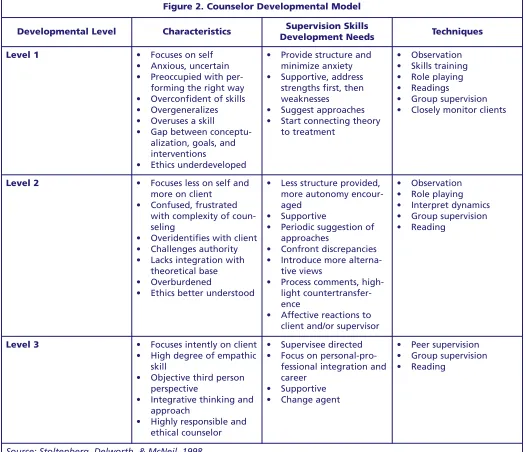
Stoltenberg, McNeill, and Delworth (1998) (see figure 2, p. 10). This schema uses a three-stage approach. The three stages of development have different char acteristics and appropriate supervisory methods. Further application of the IDM to the substance abuse field is needed. (For additional information, see Anderson, 2001.)
It is important to keep in mind several general cau tions and principles about counselor development, including:
• There is a beginning but not an end point for learning clinical skills; be careful of counselors who think they “know it all.”
• Take into account the individual learning styles and personalities of your supervisees and fit the supervisory approach to the developmental stage of each counselor.
• There is a logical sequence to development,
although it is not always predictable or rigid; some counselors may have been in the field for years but remain at an early stage of professional develop ment, whereas others may progress quickly through the stages.
• Counselors at an advanced developmental level have different learning needs and require different supervisory approaches from those at Level 1; and • The developmental level can be applied for differ
ent aspects of a counselor’s overall competence (e.g., Level 2 mastery for individual counseling and Level 1 for couples counseling).
Figure 2. Counselor Developmental Model
Developmental Level Characteristics Supervision Skills
Development Needs Techniques
Level 1 • Focuses on self • Anxious, uncertain • Preoccupied with per
forming the right way • Overconfident of skills • Overgeneralizes • Overuses a skill
• Gap between conceptu alization, goals, and interventions
• Ethics underdeveloped
• Provide structure and minimize anxiety • Supportive, address
strengths first, then weaknesses
• Suggest approaches • Start connecting theory
to treatment
• Observation • Skills training • Role playing • Readings
• Group supervision • Closely monitor clients
Level 2 • Focuses less on self and more on client
• Confused, frustrated with complexity of coun seling
• Overidentifies with client • Challenges authority • Lacks integration with
theoretical base • Overburdened
• Ethics better understood
• Less structure provided, more autonomy encour aged
• Supportive
• Periodic suggestion of approaches
• Confront discrepancies • Introduce more alterna
tive views
• Process comments, high light countertransfer ence
• Affective reactions to client and/or supervisor
• Observation • Role playing • Interpret dynamics • Group supervision • Reading
Level 3 • Focuses intently on client • High degree of empathic
skill
• Objective third person perspective
• Integrative thinking and approach
• Highly responsible and ethical counselor
• Supervisee directed • Focus on personal-pro
fessional integration and career
• Supportive • Change agent
• Peer supervision • Group supervision • Reading
Source: Stoltenberg, Delworth, & McNeil, 1998
Developmental Stages of
Supervisors
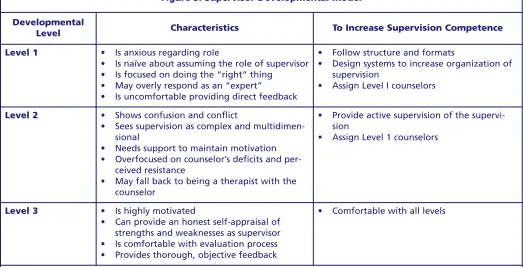
Just as counselors go through stages of development, so do supervisors. The developmental model present ed in figure 3 provides a framework to explain why supervisors act as they do, depending on their devel opmental stage. It would be expected that someone new to supervision would be at a Level 1 as a super visor. However, supervisors should be at least at the second or third stage of counselor development. If a newly appointed supervisor is still at Level 1 as a
Part 1, Chapter 1
counselor, he or she will have little to offer to more seasoned supervisees.
Figure 3. Supervisor Developmental Model
Developmental
Level Characteristics To Increase Supervision Competence
Level 1 • Is anxious regarding role
• Is naïve about assuming the role of supervisor • Is focused on doing the “right” thing
• May overly respond as an “expert”
• Is uncomfortable providing direct feedback
• Follow structure and formats
• Design systems to increase organization of supervision
• Assign Level I counselors
Level 2 • Shows confusion and conflict
• Sees supervision as complex and multidimen sional
• Needs support to maintain motivation • Overfocused on counselor’s deficits and per
ceived resistance
• May fall back to being a therapist with the counselor
• Provide active supervision of the supervi sion
• Assign Level 1 counselors
Level 3 • Is highly motivated
• Can provide an honest self-appraisal of strengths and weaknesses as supervisor • Is comfortable with evaluation process • Provides thorough, objective feedback
• Comfortable with all levels
Source: Stoltenberg, Delworth, & McNeil, 1998
Cultural and Contextual
Factors
Culture is one of the major contextual factors that influence supervisory interactions. Other contextual variables include race, ethnicity, age, gender, disci pline, academic background, religious and spiritual practices, sexual orientation, disability, and recovery versus non-recovery status. The relevant variables in the supervisory relationship occur in the context of the supervisor, supervisee, client, and the setting in which supervision occurs. More care should be taken to:
• Identify the competencies necessary for substance abuse counselors to work with diverse individuals and navigate intercultural communities.
• Identify methods for supervisors to assist coun selors in developing these competencies. • Provide evaluation criteria for supervisors to
determine whether their supervisees have met
minimal competency standards for effective and relevant practice.
Models of supervision have been strongly influenced by contextual variables and their influence on the supervisory relationship and process, such as Holloway’s Systems Model (1995) and Constantine’s Multicultural Model (2003).
The competencies listed in TAP 21-A reflect the importance of culture in supervision (CSAT, 2007). The Counselor Development domain encourages self-examination of attitudes toward culture and other contextual variables. The Supervisory Alliance domain promotes attention to these variables in the supervisory relationship. (See also the planned TIP, Improving Cultural Competence in Substance Abuse Counseling [CSAT, in development b].)
Cultural competence “refers to the ability to honor and respect the beliefs, language, interpersonal styles, and behaviors of individuals and families receiving services, as well as staff who are providing such services. Cultural competence is a dynamic, ongoing, developmental process that requires a com mitment and is achieved over time” (U.S. Department
of Health and Human Services, 2003, p. 12). Culture shapes belief systems, particularly concerning issues related to mental health and substance abuse, as well as the manifestation of symptoms, relational styles, and coping patterns.
There are three levels of cultural consideration for the supervisory process: the issue of the culture of the client being served and the culture of the coun selor in supervision. Holloway (1995) emphasizes the cultural issues of the agency, the geographic environ ment of the organization, and many other contextual factors. Specifically, there are three important areas in which cultural and contextual factors play a key role in supervision: in building the supervisory rela tionship or working alliance, in addressing the spe cific needs of the client, and in building supervisee competence and ability. It is your responsibility to address your supervisees’ beliefs, attitudes, and bias es about cultural and contextual variables to advance their professional development and promote quality client care.
Becoming culturally competent and able to integrate other contextual variables into supervision is a com plex, long-term process. Cross (1989) has identified several stages on a continuum of becoming culturally competent (see figure 4).
Figure 4. Continuum of Cultural Competence
Cultural Destructiveness
Superiority of dominant culture and inferiority of other cultures; active discrimination
Cultural Incapacity
Separate but equal treatment; passive discrimination
Cultural Blindness
Sees all cultures and people as alike and equal; discrimination by ignoring culture
Cultural Openness (Sensitivity)
Basic understanding and appreciation of importance of sociocultural factors in work with minority populations
Cultural Competence
Capacity to work with more complex issues and cultural nuances
Cultural Proficiency
Highest capacity for work with minority populations; a commitment to excellence and proactive effort
Source: Cross, 1989.
Although you may never have had specialized train ing in multicultural counseling, some of your super
visees may have (see Constantine, 2003). Regardless, it is your responsibility to help supervisees build on the cultural competence skills they possess as well as to focus on their cultural competence deficits. It is important to initiate discussion of issues of culture, race, gender, sexual orientation, and the like in supervision to model the kinds of discussion you would like counselors to have with their clients. If these issues are not addressed in supervision, coun selors may come to believe that it is inappropriate to discuss them with clients and have no idea how such dialog might proceed. These discussions prevent mis understandings with supervisees based on cultural or other factors. Another benefit from these discussions is that counselors will eventually achieve some level of comfort in talking about culture, race, ethnicity, and diversity issues.
If you haven’t done it as a counselor, early in your tenure as a supervisor you will want to examine your culturally influenced values, attitudes, experiences, and practices and to consider what effects they have on your dealings with supervisees and clients. Counselors should undergo a similar review as preparation for when they have clients of a culture different from their own. Some questions to keep in mind are:
• What did you think when you saw the supervisee’s last name?
Part 1, Chapter 1
• What did you think when the supervisee said his or her culture is X, when yours is Y?
• How did you feel about this difference?
• What did you do in response to this difference?
Constantine (2003) suggests that supervisors can use the following questions with supervisees:
• What demographic variables do you use to identify yourself?
• What worldviews (e.g., values, assumptions, and biases) do you bring to supervision based on your cultural identities?
• What struggles and challenges have you faced working with clients who were from different cul tures than your own?
Beyond self-examination, supervisors will want con tinuing education classes, workshops, and conferences that address cultural competence and other contextu al factors. Community resources, such as community leaders, elders, and healers can contribute to your understanding of the culture your organization serves. Finally, supervisors (and counselors) should participate in multicultural activities, such as com munity events, discussion groups, religious festivals, and other ceremonies.
The supervisory relationship includes an inherent power differential, and it is important to pay atten tion to this disparity, particularly when the super visee and the supervisor are from different cultural groups. A potential for the misuse of that power exists at all times but especially when working with supervisees and clients within multicultural contexts. When the supervisee is from a minority population and the supervisor is from a majority population, the differential can be exaggerated. You will want to pre vent institutional discrimination from affecting the quality of supervision. The same is true when the supervisee is gay and the supervisor is heterosexual, or the counselor is non-degreed and the supervisor has an advanced degree, or a female supervisee with a male supervisor, and so on. In the reverse situa tions, where the supervisor is from the minority group and the supervisee from the majority group, the difference should be discussed as well.
Ethical and Legal Issues
You are the organization’s gatekeeper for ethical and legal issues. First, you are responsible for upholding the highest standards of ethical, legal, and moral practices and for serving as a model of practice to staff. Further, you should be aware of and respond to ethical concerns. Part of your job is to help integrate solutions to everyday legal and ethical issues into clinical practice.Some of the underlying assumptions of incorporating ethical issues into clinical supervision include: • Ethical decisionmaking is a continuous, active
process.
• Ethical standards are not a cookbook. They tell you what to do, not always how.
• Each situation is unique. Therefore, it is impera tive that all personnel learn how to “think ethi cally” and how to make sound legal and ethical decisions.
• The most complex ethical issues arise in the con text of two ethical behaviors that conflict; for instance, when a counselor wants to respect the privacy and confidentiality of a client, but it is in the client’s best interest for the counselor to con tact someone else about his or her care.
• Therapy is conducted by fallible beings; people make mistakes—hopefully, minor ones.
• Sometimes the answers to ethical and legal ques tions are elusive. Ask a dozen people, and you’ll likely get twelve different points of view.
Helpful resources on legal and ethical issues for supervisors include Beauchamp and Childress (2001); Falvey (2002b); Gutheil and Brodsky (2008); Pope, Sonne, and Greene (2006); and Reamer (2006). Legal and ethical issues that are critical to clinical supervisors include (1) vicarious liability (or respon deat superior), (2) dual relationships and boundary concerns, (4) informed consent, (5) confidentiality, and (6) supervisor ethics.
Direct Versus Vicarious Liability
An important distinction needs to be made between direct and vicarious liability. Direct liability of the supervisor might include dereliction of supervisory responsibility, such as “not making a reasonable effort to supervise” (defined below).
In vicarious liability, a supervisor can be held liable for damages incurred as a result of negligence in the supervision process. Examples of negligence include providing inappropriate advice to a counselor about a client (for instance, discouraging a counselor from conducting a suicide screen on a depressed client), failure to listen carefully to a supervisee’s comments about a client, and the assignment of clinical tasks to inadequately trained counselors. The key legal ques tion is: “Did the supervisor conduct him- or herself in a way that would be reasonable for someone in his position?” or “Did the supervisor make a reasonable effort to supervise?” A generally accepted time stan dard for a “reasonable effort to supervise” in the behavioral health field is 1 hour of supervision for every 20–40 hours of clinical services. Of course, other variables (such as the quality and content of clinical supervision sessions) also play a role in a rea sonable effort to supervise.
Supervisory vulnerability increases when the coun selor has been assigned too many clients, when there is no direct observation of a counselor’s clinical work, when staff are inexperienced or poorly trained for assigned tasks, and when a supervisor is not involved or not available to aid the clinical staff. In legal texts, vicarious liability is referred to as “respondeat superior.”
Dual Relationships and Boundary
Issues
Dual relationships can occur at two levels: between supervisors and supervisees and between counselors and clients. You have a mandate to help your super visees recognize and manage boundary issues. A dual relationship occurs in supervision when a supervisor has a primary professional role with a supervisee and, at an earlier time, simultaneously or later, engages in another relationship with the supervisee that transcends the professional relationship.
Examples of dual relationships in supervision include providing therapy for a current or former supervisee, developing an emotional relationship with a super visee or former supervisee, and becoming an Alcoholics Anonymous sponsor for a former super visee. Obviously, there are varying degrees of harm or potential harm that might occur as a result of dual relationships, and some negative effects of dual rela tionships might not be apparent until later.
Therefore, firm, always-or-never rules aren’t applica ble. You have the responsibility of weighing with the counselor the anticipated and unanticipated effects of dual relationships, helping the supervisee’s self-reflective awareness when boundaries become
blurred, when he or she is getting close to a dual rela tionship, or when he or she is crossing the line in the clinical relationship.
Exploring dual relationship issues with counselors in clinical supervision can raise its own professional dilemmas. For instance, clinical supervision involves unequal status, power, and expertise between a supervisor and supervisee. Being the evaluator of a counselor’s performance and gatekeeper for training programs or credentialing bodies also might involve a dual relationship. Further, supervision can have ther apy-like qualities as you explore countertransferen tial issues with supervisees, and there is an expecta tion of professional growth and self-exploration. What makes a dual relationship unethical in supervision is the abusive use of power by either party, the likeli hood that the relationship will impair or injure the supervisor’s or supervisee’s judgment, and the risk of exploitation (see vignette 3 in chapter 2).
The most common basis for legal action against coun selors (20 percent of claims) and the most frequently heard complaint by certification boards against coun selors (35 percent) is some form of boundary violation or sexual impropriety (Falvey, 2002b). (See the dis cussion of transference and countertransference on pp. 25–26.)
Codes of ethics for most professions clearly advise that dual relationships between counselors and clients should be avoided. Dual relationships between counselors and supervisors are also a concern and are addressed in the substance abuse counselor codes and those of other professions as well. Problematic dual relationships between supervisees and supervisors might include intimate relationships (sexual and non sexual) and therapeutic relationships, wherein the supervisor becomes the counselor’s therapist. Sexual involvement between the supervisor and supervisee can include sexual attraction, harassment, consensual (but hidden) sexual relationships, or intimate roman tic relationships. Other common boundary issues include asking the supervisee to do favors, providing preferential treatment, socializing outside the work setting, and using emotional abuse to enforce power.
Part 1, Chapter 1
It is imperative that all parties understand what con stitutes a dual relationship between supervisor and supervisee and avoid these dual relationships. Sexual relationships between supervisors and supervisees and counselors and clients occur far more frequently than one might realize (Falvey, 2002b). In many States, they constitute a legal transgression as well as an ethical violation.
The decision tree presented in figure 5 (p. 16) indi cates how a supervisor might manage a situation where he or she is concerned about a possible ethical or legal violation by a counselor.
Informed Consent
Informed consent is key to protecting the counselor and/or supervisor from legal concerns, requiring the recipient of any service or intervention to be suffi ciently aware of what is to happen, and of the poten tial risks and alternative approaches, so that the per son can make an informed and intelligent decision about participating in that service. The supervisor must inform the supervisee about the process of supervision, the feedback and evaluation criteria, and other expectations of supervision. The supervision contract should clearly spell out these issues. Supervisors must ensure that the supervisee has informed the client about the parameters of counsel ing and supervision (such as the use of live observa tion, video- or audiotaping). A sample template for informed consent is provided in Part 2, chapter 2 (p. 106).
Confidentiality
In supervision, regardless of whether there is a writ ten or verbal contract between the supervisor and supervisee, there is an implied contract and duty of care because of the supervisor’s vicarious liability. Informed consent and concerns for confidentiality should occur at three levels: client consent to treat ment, client consent to supervision of the case, and supervisee consent to supervision (Bernard &
Goodyear, 2004). In addition, there is an implied con sent and commitment to confidentiality by supervi sors to assume their supervisory responsibilities and institutional consent to comply with legal and ethical parameters of supervision. (See also the Code of Ethics of the Association for Counselor Education and
Supervision [ACES], available online at
http://www.acesonline.net/ethical_guidelines.asp). With informed consent and confidentiality comes a duty not to disclose certain relational communication. Limits of confidentiality of supervision session con tent should be stated in all organizational contracts with training institutions and credentialing bodies. Criteria for waiving client and supervisee privilege should be stated in institutional policies and disci pline-specific codes of ethics and clarified by advice of legal counsel and the courts. Because standards of confidentiality are determined by State legal and leg islative systems, it is prudent for supervisors to con sult with an attorney to determine the State codes of confidentiality and clinical privileging.
In the substance abuse treatment field, confidentiali ty for clients is clearly defined by Federal law: 42 CFR, Part 2 and the Health Insurance Portability and Accountability Act (HIPAA). Key information is available at http://www.hipaa.samhsa.gov. Super visors need to train counselors in confidentiality regu lations and to adequately document their supervision, including discussions and directives, especially relat ing to duty-to-warn situations. Supervisors need to ensure that counselors provide clients with appropri ate duty-to-warn information early in the counseling process and inform clients of the limits of confiden tiality as part of the agency’s informed consent proce dures.
Under duty-to-warn requirements (e.g., child abuse, suicidal or homicidal ideation), supervisors need to be aware of and take action as soon as possible in situa tions in which confidentiality may need to be waived. Organizations should have a policy stating how clini cal crises will be handled (Falvey, 2002b). What mechanisms are in place for responding to crises? In what timeframe will a supervisor be notified of a cri sis situation? Supervisors must document all discus sions with counselors concerning duty-to-warn and crises. At the onset of supervision, supervisors should ask counselors if there are any duty-to-warn issues of which the supervisor should be informed.
New technology brings new confidentiality concerns. Websites now dispense information about substance abuse treatment and provide counseling services. With the growth in online counseling and supervi sion, the following concerns emerge: (a) how to main
Part 1, Chapter 1