Dissent: Accountable Anonymous Group Messaging
Henry Corrigan-Gibbs and Bryan Ford
Department of Computer Science Yale University
New Haven, CT, USA
[email protected], [email protected]
ABSTRACT
Users often wish to participate in online groups anonymously, but misbehaving users may abuse this anonymity to disrupt the group’s communication. Existing messaging protocols such as DC-nets leave groups vulnerable to denial-of-service and Sybil attacks, Mix-nets are difficult to protect against traffic analysis, and accountable voting protocols are unsuited to general anonymous messaging.
We present the first general messaging protocol that offers prov-able anonymity with accountability for moderate-size groups, and efficiently handles unbalanced loads where few members wish to transmit in a given round. TheN group members first coopera-tively shuffle anN×Nmatrix of pseudorandom seeds, then use these seeds inN“pre-planned” nets protocol runs. Each DC-nets run transmits the variable-length bulk data comprising one member’s message, using the minimum number of bits required for anonymity under our attack model. The protocol preserves message integrity and one-to-one correspondence between mem-bers and messages, makes denial-of-service attacks by memmem-bers traceable to the culprit, and efficiently handles large, unbalanced message loads. A working prototype demonstrates the protocol’s practicality for anonymous messaging in groups of40+members.
Categories and Subject Descriptors
C.2.0 [Computer-Communication Networks]: General—Secu-rity and Protection; C.2.2 [Computer-Communication Networks]: Network Protocols—Applications
General Terms
Algorithms, Security
Keywords
Anonymity, Accountability, Denial of Service, Group Communica-tion, Peer-to-Peer Networks, Verifiable Anonymous Shuffle
1.
INTRODUCTION
Anonymous participation is often considered a basic right in free societies [43]. The limited form of anonymity the Internet provides is a widely cherished feature [37, 41], enabling people and groups
Permission to make digital or hard copies of all or part of this work for personal or classroom use is granted without fee provided that copies are not made or distributed for profit or commercial advantage and that copies bear this notice and the full citation on the first page. To copy otherwise, to republish, to post on servers or to redistribute to lists, requires prior specific permission and/or a fee.
CCS’10,October 4–8, 2010, Chicago, Illinois, USA. Copyright 2010 ACM 978-1-4503-0244-9/10/10 ...$10.00.
with controversial or unpopular views to communicate and orga-nize without fear of personal reprisal [34]. Yet anonymity makes it difficult to trace or exclude misbehaving participants [13]. Online protocols providing stronger anonymity, such as mix-networks [9, 21] and DC-nets [10, 22, 32, 40], further weaken accountability and yield forums in which no content may be considered trustworthy and no defense is available against anonymous misbehavior.
This paper focuses on providing anonymous messaging within small, private online groups. We assume a group’s membership is closed and known to its members; creating groups with secret membership is a related but orthogonal goal [38]. Members may wish to send messages to each other, to the whole group, or to a non-member, such that the receiver knows thatsomemember sent the message but no one knowswhichmember. Members may also wish to cast secret ballots in votes held by the group, or to create pseudonyms under which to collaborate with other members.
We also wish to hold membersaccountable, however, not by compromising their anonymity and allowing some authority or ma-jority quorum to unmask a member whose messages prove unpop-ular, but rather by ensuring that no malicious member can abuse his (strong) anonymity to disrupt the group’s operation. For example, a malicious member should be unable to corrupt or block other mem-bers’ messages, overrun the group with spam, stuff ballots, or cre-ate unlimited anonymous Sybil identities [17] or sock puppets [36] with which to bias or subvert the group’s deliberations.
As a motivating example, suppose an international group of jour-nalists wishes to form a “whistleblowing” publication analogous to WikiLeaks [42]. To protect journalists and their sources, member journalists wish to submit leaked documents and related informa-tion to the group anonymously. Member journalists need assurance that powerful organizations or governments cannot trace the leak to an individual journalist or her source. The journalists wish to prove to their readers that leaked documents come via a trustwor-thy channel, namely one of the group’s known and reputable mem-bers, and not from an outsider. The group must be able to analyze and vet each document thoroughly before collectively approving it for publication. The group must protect its internal operation and its members’ anonymity even from adversaries who have planted colluding spies within the group. And this security must come at acceptable time and resource costs.
We present an accountable anonymous messaging protocol called Dissent (Dining-cryptographers Shuffled-Send Network), the first we know of with the properties needed in scenarios like the one out-lined above. Dissent offers integrity, anonymity, and accountability in the face of strong traffic analysis and compromised members. An experimental prototype shows Dissent to be efficient enough for latency-tolerant messaging in small distributed groups.
In contrast with mix-networks [9,21] and DC-nets [10,22,32,40], Dissent implements ashuffled sendprimitive, whereby each group member sendsexactlyone message per round, making it usable for
voting or assigning pseudonyms with a 1-to-1 correspondence to real group members. Unlike verifiable cryptographic shuffles [20, 26], Dissent uses only readily-available cryptographic primitives, and handles arbitrarily large messages and unbalanced loads effi-ciently, such as when one journalist has a multi-gigabyte document to leak while the others have nothing to send. While group and ring signatures [4,11,30] can anonymously authenticate messages trans-mitted via some anonymous transmission channel, signatures offer no protection against anonymous denial-of-service (DoS) or Sybil attacks against the transmission channel itself, as Dissent does.
Dissent operates in two stages,shuffleand bulk transfer. The shuffle protocol builds on a data mining protocol by Brickell and Shmatikov [7] to permute a set of fixed-length messages, one from each group member, and broadcast the set of messages to all mem-bers with cryptographically strong anonymity. Like many anony-mous messaging protocols, the original data mining protocol was vulnerable to untraceable DoS attacks by malicious group mem-bers. Our refinements remove this vulnerability by adding go/no-goandblamephases, which can trace and hold accountable any group member maliciously disrupting the protocol.
Dissent’s bulk protocol builds on DC-nets [10,22,32,40] to trans-mit variable-length messages anonymously. In place of the DoS-prone slot reservation systems in prior DC-nets schemes, however, Dissent leverages its shuffle protocol to prearrange the DC-nets transmission schedule, guaranteeing each member exactly one mes-sage slot per round. In each round, all group members broadcast bit streams based on pseudorandom seeds distributed via the shuffle protocol, so that XORing all members’ bit streams together yields a permuted concatenation of all members’ variable-length messages. Cryptographic hashes distributed in the shuffle phase enable mem-bers to verify the correctness of each others’ bulk transmissions, ensuring message integrity and DoS protection throughout.
Dissent has limitations, of course. It is not intended for large-scale, “open-access” anonymous messaging or file sharing [12,21], although it might serve as a building block in designs like Herbi-vore [32]. Dissent’s accountability properties assume closed groups, and are ineffective if a malicious member can leave and rejoin the group under a new (public) identity after expulsion. Dissent is also not a general-purpose voting system: for example, it provides only a limited form of coercion resistance. Finally, the serialized shuf-fle protocol imposes a per-round startup delay that makes Dissent impractical for latency-sensitive applications.
We built a working prototype of Dissent and tested it under Emu-lab [18] on groups of up to 44 nodes connected via simulated wide-area links. Anonymously distributing messages up to 16MB in size among 16 nodes with 100ms inter-node delays, Dissent’s shuffle protocol and other startup costs incur a 1.4-minute latency. Dis-sent handles large message loads, both balanced and unbalanced, in about3.5×the time required for non-anonymized group messag-ing via TCP. Varymessag-ing group size, Dissent can send a 1MB message anonymously in less than 1 minute in a 4-node group, 4 minutes in a 20-node group, and 14 minutes in a 40-node group. While not suitable for interactive workloads, Dissent should be usable for “WikiLeaks”-type scenarios requiring strong security guarantees in small but decentralized groups.
This paper makes four main technical contributions. First, we enhance Brickell/Shmatikov’s shuffle protocol [7] to make DoS at-tackers traceable without compromising anonymity. Second, we use this shuffle protocol to create a DoS-resistant DC-nets vari-ant for bulk transfer, which guarvari-antees each member exactly one transmission slot per round. Third, we introduce the first shuffle protocol that supports arbitrary-size and unbalanced message loads efficiently, e.g., when only one member has data to send. Fourth,
we demonstrate through a working prototype the practicality of the protocol, at least for delay-tolerant applications.
Section 2 outlines Dissent’s communication model, security goals, and operation. Section 3 describes the shuffle protocol, and Sec-tion 4 details the bulk transfer protocol. SecSec-tion 5 informally covers practical implementation and usage considerations such as protocol initiation, coercion resistance, and liveness. Section 6 describes our prototype implementation and experimental results. Section 7 sum-marizes related work, and Section 8 concludes.
2.
PROTOCOL OVERVIEW
This section first introduces the group communication model our protocol implements, outlines a few applications of this model, and defines the protocol’s precise security goals, leaving protocol de-tails to subsequent sections.
Dissent consists of two sub-protocols: ashuffleprotocol and a bulkprotocol. The shuffle protocol has two practical limitations: all messages must be of equal length L, incurringO(N L)extra communication if only one member wishes to send; and its decrypt-and-shuffle phase is inherently serial, incurring a long delay ifN orLis large. We currently have no solution if the number of partic-ipating nodes is large, but ourbulkprotocol addresses the problem of sending large, variable-length messages efficiently. Our shuffle protocol ensures integrity and anonymity exactly as in its precur-sor [7], but our newgo/no-goandblamephases enable all group members to trace the culprit of any protocol malfunction.
2.1
The Shuffled Send Primitive
Dissent’s purpose is to provide ashuffled sendcommunication primitive, providing sender anonymity among a well-defined group of nodes. We assume that the set of members comprising the group and each member’s public key (or certificate) is agreed upon and known to all group members. The group may initiate a run of the shuffled send protocol in any way that preserves anonymity. For ex-ample, a designated leader, oreverygroup member, might initiate runs periodically on a fixed or random schedule. Alternatively, a “client” nodenotrequiring anonymity, within or outside the group, might initiate a run to request a service provided by the group col-lectively. For protection against traffic analysis, however, a mem-ber’s desire to send anonymously must not be the initiation event.
Each Dissent protocol run is independent and permits each group member to send exactly one variable-length message to some tar-get designated for that run. Ongoing interaction requires multiple protocol runs. A run’s designated target may be a particular group member, all members (for anonymous group multicast), or another node such as a non-member “client” that initiated the run. Group members might agree upon the target of a run using a higher-level “wrapper” protocol, for example, as described in Section 5.
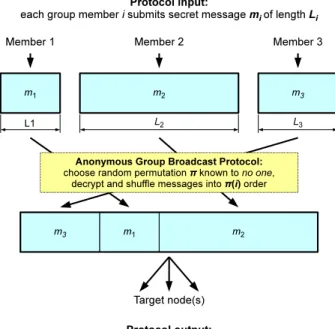
Each protocol run operates as shown in Figure 1. Every group memberisecretly creates a messagemiand submits it to the
pro-tocol. The protocol collects allN secret messages, shuffles their order according to some random permutationπthatno oneknows, concatenates the messages in this shuffled order so thatmiappears
at positionπi, and sends the concatenated sequence of messages to
the target. Each input messagemican have a different lengthLi,
and the protocol’s output has lengthPiLi.
2.2
Applications of Shuffled Send
The shuffled send model combines and generalizes the function-ality of several classes of anonymity protocols. Although every participant must submit a message in a given protocol run, mem-bers with nothing to send can submit a message of length zero, providing efficient single-sender as well as multiple-sender service.
Figure 1: Shuffled send communication model
The protocol still requires each member to send a similar number of bits on the underlying network for traffic analysis protection, but none of these bits are wasted for purposes of padding mes-sages of unbalanced lengths. Members wishing receiver anonymity can first anonymously send a public encryption key to establish a pseudonym, then look for messages encrypted with that key in sub-sequent shuffled sends targeted at the whole group.
Since each member submitsexactly one message per shuffled send, one run’s messages can serve as ballots in an anonymous vote. Unlike anonymous voting protocols designed for specific types of ballots and tallying methods, Dissent supports ballots of arbitrary type, format, and size. Group members can count and indepen-dently verify the ballots in any agreed-upon fashion. Ballots need not be one-shot messages either. A group can use one protocol run to establish a set of pseudonymous signing keys, one per mem-ber, then use these pseudonyms in subsequent protocol runs for pseudonymous deliberation, without permitting members to create unlimited pseudonyms for Sybil attacks [17] or sock puppetry [36]. Applications to which shuffled send may be suited include whistle-blowing [42], surveys [7], file sharing [32], accountable Wiki-style editing [36], and “cocaine auctions” [33]. The current version of Dissent has some notable limitations: e.g., it may not scale to large groups, it provides only a limited form of coercion resistance (de-scribed in Section 5.3), and the latency incurred by its shuffle pro-tocol may make it unsuitable for interactive or real-time messaging. Future work may be able to address these limitations.
2.3
Security Goals
We now define Dissent’s attack model and security goals. We assume the attacker is polynomial-time limited, but can monitor all network traffic and compromise any subset of group members. A member ishonestif she follows the protocol exactly and is not un-der the attacker’s control, and isfaultyotherwise. Faulty nodes are byzantine: they may collude and send arbitrary messages. For sim-plicity, our core protocol descriptions in Sections 3 and 4 assume
that nodes never just go silent; we address liveness using principles from PeerReview [23] as outlined in Section 5.
The formal security properties we wish the protocol to satisfy are integrity,anonymity, andaccountability, as we define below.
• Integrity: The protocol maintainsintegrityif, at the end of a protocol run involvingNgroup members, every honest member either: (a) obtains exactlyNmessages, including each message submitted by an honest group member, or (b) knows that the protocol did not complete successfully.
• Anonymity:Following Brickell and Shmatikov [7], the protocol maintainsanonymityif a group ofk≤N−2colluding members cannot match an honest participant’s message to its author with a probability significantly better than random guessing. (If all but one member colludes, no anonymity is possible.)
• Accountability:As in PeerReview [23], a memberiexposesa memberjifiholds third-party verifiable proof ofj’s misbehav-ior. The protocol maintainsaccountabilityif no member ever ex-poses an honest member, and after a run, either: (a) each honest member successfully obtains every honest member’s message, or (b) all honest members expose at least one faulty member.
2.4
Simplifying Assumptions
Our core protocol descriptions in Sections 3 and 4 make several simplifying assumptions, which we will relax and address more re-alistically later in Section 5. We assume for now that: (a) all mem-bers know when to initiate a protocol run and how to distinguish one run from another; (b) all members of a group participate in ev-ery protocol run; (c) all members have public encryption keys and nonrepudiable signing keys known to all other members; and (d) all members remain connected throughout a protocol run and never stop sending correctly-signed messages until the protocol run has completed from the perspective of all group members. Assumption (d) implies that we address only safety properties for now, defer-ring liveness issues to Section 5—including the important corner case of a node withholding the last message it is supposed to send, while collecting all other members’ final messages, thereby learn-ing a protocol run’s results while denylearn-ing others those results.
3.
SHUFFLE PROTOCOL
This section details the shuffle protocol, first covering its cryp-tographic building blocks, then formally describing the protocol, proving its correctness, and analyzing its complexity.
3.1
Cryptographic Primitives
Dissent relies on a conventional, possibly randomizedsignature scheme, which consists of: (a) a key generation algorithm produc-ing a private/public key pair(u, v); (b) a signing algorithm taking private keyuand messagemto produce signatureσ=SIGu{m}; and (c) a deterministic verification algorithm taking public keyv, messagem, and candidate signatureσ, and returning true iffσis a correct signature ofmusingv’s associated private keyu. The notation{m}SIGuindicates the concatenation of messagemwith the signatureSIGu{m}.
We also require apublic-key cryptosystem, which must be IND-CCA2 secure [2]. The cryptosystem must also provide access to the random bits it uses in key generation and encryption; Dissent’s accountability mechanisms use this capability for commitment and verification of behavior, as described below. A software implemen-tation of RSA-OAEP [19] using a pseudorandom number generator meets these requirements, for example. The cryptosystem specif-ically consists of: (a) a key generation algorithm producing a pri-vate/public key pair(x, y); (b) an encryption algorithm taking
pub-Figure 2: Illustration of bulk protocol operation for 3-member group, shuffled using permutationπ= [2,3,1].
lic keyy, plaintextm, and some random bitsR, and producing a ci-phertextC={m}R
y; (c) a deterministic decryption algorithm
tak-ing private keyxand ciphertextC, and returning the plaintextm. A node can save the random bitsRit uses during encryption, and can encrypt deterministically using a givenR, such that given inputsy, m, andRalways yield the same ciphertext. We assume that hon-est nodes can check an arbitrary(x, y)purported to be a key pair, to verify that this(x, y)is indeed a key pair generated according to the specified key generation algorithm. The appendix describes how any public-key cryptosystem can be adapted, if necessary, to satisfy this assumption. The notationC = {m}R1:RN
y1:yN indicates
iterated encryption via multiple keys: C = {. . .{m}R1 y1 . . .}
RN yN.
We omitRwhen an encryption’s random inputs need not be saved. We use a standard definition [35] of a collision-resistantunkeyed hash functionand will denote the hash of messagemasHASH{m}. We use a standard definition [35] of apseudorandom number generator(PRNG). We will denote the firstLbits generated from a PRNG seeded withsasPRNG{L, s}.
3.2
Protocol Description
Each group memberi(fori= 1, . . . , N) initially has a primary encryption key pair(xi, yi), a signing key pair(ui, vi), and a secret
messagemiof fixed lengthLto send anonymously.
Before a protocol run, all members agree on a session nonce nR uniquely identifying this protocol run, the participants’
pri-mary public encryption and signing keys, and a common ordering of all members1, . . . , N. Such agreement might be achieved via Paxos [25] or BFT [8], as discussed further in Section 5.
The shuffle protocol operates inphases. Each honest member isends at most one unique messageµiφper phaseφ. A member
imay send the sameµiφto all members, in which case we sayi
broadcastsµiφ. An implementation of Dissent may use an
under-lying broadcast transmission primitive for this purpose, if available, or may simply send the same messageNtimes, once to each group member. A faulty node mightequivocateduring a broadcast by sending different messages to different members.
Each group member maintains atamper-evident logof all mes-sages it sends and receives in a protocol run [23]. Memberisigns eachµiφit sends with its private keyui, and includes in each
mes-sage the session noncenRand a hashhiφofi’s current log head in
phaseφ. Eachhiφdepends on all messagesireceived up to phase
φ, before sendingµiφ. Members ignore any messages they receive
containing a bad signature or session nonce.
• Phase 1: Secondary Key Pair Generation. Each memberichooses an encryption key pair(wi, zi), and broadcasts:
µi1={zi, nR, hi1}SIGui
• Phase 2: Data submission. Each memberiencrypts her datum miwith all members’ secondary public keys:
C′
i={mi}zN:z1
MemberistoresC′
ifor later use, then further encryptsCi′with
all members’ primary public keys, this time internally saving the random bits used in each encryption:
Ci={Ci′} RiN:Ri1
yN:y1
If encryption fails at any point, the group moves directly to phase 5b below (“blame”). Memberinow sends to member 1:
µi2={Ci, nR, hi2}SIGui
• Phase 3: Anonymization. Member 1 collects all ciphertexts into a vectorC~0 = C1, . . . , CN, randomly permutes its elements,
then strips one layer of encryption from each ciphertext using private keyx1to formC~1. Member 1 sends to member 2:
µ13={C~1, nR, h13}SIGu1
Each member1 < i < Nin turn accepts C~i−1, permutes it randomly, strips one encryption layer to formC~i, then sendsC~i
to memberi+ 1. MemberN finally permutes and decrypts ~
CN−1to formC~N, and broadcasts to all members:
µN3={C~N, nR, hN3}SIGuN
If any memberidetects a duplicate or invalid ciphertext during this phase, memberireports it and the group moves directly to phase 5b below (“blame”).
• Phase 4: Verification. All members now holdC~N, which should
be a permutation ofC′
her ownC′
iis included in theC~Nshe received, and sets a flag GOitoTRUEif so andFALSEotherwise.
Each membericreates a vectorB~ of all broadcast messages it sent or received in prior phases: all members’ public key mes-sages from phase 1, and memberN’s phase 3 message contain-ingC~N. Thus,B~ =µ11, . . . , µN1, µN3. Memberibroadcasts:
µi4 ={GOi,HASH{B~}, nR, hi4}SIGui
Each memberithen waits to receive such a “go/no-go” message fromeveryother member. Ifeverymemberj reportsGOj =
TRUEfor the expectedHASH{B~}, then memberienters phase 5a below; otherwiseienters phase 5b (“blame”).
• Phase 5a: Decryption. Each memberidestroys her copy ofC′ i
and the random bits she saved in phase 2, then broadcasts her secondary private keywito all members:
µi5 ={wi, nR, hi5}SIGui
Upon receiving all keysw1, . . . , wN, memberichecks that each
wjis the private key corresponding to public keyzj, and if not,
exposesj using the signed messages fromj containing these invalid keys. Otherwise,iremoves the remaining N levels of encryption fromC~N, resulting in a permutation of the submitted
datam1, . . . , mN, and the protocol completes successfully. • Phase 5b: Blame. Each member destroys her secondary
pri-vate keywi, then reveals to all members the random bitsRij
she saved from the primary public key encryptions in phase 2, and all signed messages she received and sent in phases 1–4. Each memberiuses this information to check the behavior of each memberjin phases 1–4, replayingj’s primary key encryp-tions in phase 2, and verifying thatj’s anonymized outputC~j
in phase 3 was a decrypted permutation ofC~j−1. Memberi ex-posesmemberjas faulty ifjsigned an invalidzjin phase 1, an
incorrectly encryptedCjin phase 2, an improperly decrypted or
permutedC~jin phase 3, aGOj=FALSEor a wrongHASH{B~}
in phase 4 after phases 1–3 succeeded, or ifjequivocated by signing more than one message or log headhjφin any phaseφ.
3.3
Protocol Correctness
The shuffle protocol’s integrity and anonymity derive almost di-rectly from Brickell/Shmatikov [7], so we only sketch proofs of these properties, focusing instead on the accountability property introduced by our enhancements.
3.3.1
Integrity
To preserve integrity, after a protocol run every honest mem-ber must either: (a) hold the datummiof every honest member
i, or (b) know that the protocol did not complete successfully. Sup-pose that a protocol run appears to complete successfully via phase 5a (decryption), but that some honest memberidoes not hold the plaintextmj of some other honest memberj. Sincejis honest,
j’s intermediate ciphertextC′
jmust be a correct encryption ofmj,
andC′
jmust have appeared inC~N. Otherwise,jwould have sent
GOj = FALSEin phase 4. Since honest memberiwould not
en-ter phase 5a without receivingGOj= TRUEfor the sameB~ from allmembers, andB~includes messageµN3containingC~N,imust
holdC′
j. If all members released correct secondary private keys
w1, . . . , wNduring phase 5a,Cj′must then decrypt tomj. If some
memberkreleased a secondary private keywksuch that(wk, zk)
is an invalid key pair, all honest members expose memberk.
3.3.2
Anonymity
The protocol preserves anonymity if no group ofk ≤ N−2 colluding members can win ananonymity game, determining with non-negligible probability which of two honest members submitted which of two plaintexts, as detailed in prior work [7]. The attacker might gain advantage either by manipulating protocol messages, or by using only the information revealed by a correct protocol run. In the first case, the attacker can identify the intermediate ciphertext C′
i of some honest memberiby duplicating or eliminating other
honest members’ ciphertexts in phase 3, but any honest member will detect duplication in stage 3 and elimination in stage 4, abort-ing the protocol before the attacker can decrypt C′
i. In the
sec-ond case, an attacker who can win the anonymity game with non-negligible probability, using only information revealed by correct protocol runs, can use this ability to win thedistinguishing game that defines an IND-CCA2 secure cryptosystem [2, 7].
3.3.3
Accountability
A memberiexposesanother memberjifiobtains proof ofj’s misbehavior verifiable by a third party. To maintain accountability, no member may expose an honest member, and at the end of a protocol run, either: (a) the protocol completes successfully, or (b) all honest members expose at least one faulty member.
We first show that no memberican expose an honest member j. A proof of misbehavior byjconsists of some “incriminating” messageµjφsigned byjin phaseφ, together with all of the
mes-sages inj’s log up through phaseφ, and the random bits each node saved during phase 2 and released in phase 5b. Membericould “truthfully” exposejonly ifjsigns an incorrect message in phases 1–5a, or signs more than one message per phase, contradicting the assumption thatjis honest. Membericould also falsely accusej by exhibiting one ofj’s messagesµjφ, together with a false “prior”
messagem′
kφ′ (forφ′ < φ) signed by some colluding nodek,
dif-ferent from the messageµkφ′ thatjactually used to compute her
messageµjφ. In this case, the “proof” will contain bothµkφ′(from
j’s log) and the falsem′
kφ′, exposing the equivocating memberk
instead of honest memberj.
Suppose a protocol run fails, but some honest memberidoes not expose any faulty member. Memberiobserves a run to fail if it reaches phase 5a (decryption) but detects a bad secondary private key, or if it reaches phase 5b (blame). A failure in phase 5a exposes the sender of the bad secondary key. Memberienters phase 5b only if it: (a) detects a faulty encryption key in phase 1, (b) detects a duplicate or faulty ciphertext in phase 3, (c) sees aGOj=FALSE
in phase 4, or (d) sees an incorrectHASH{B~}in phase 4. Case (a) immediately exposes the relevant message’s sender as faulty.
In case (b), memberican encounter a duplicate ciphertext in phase 3 only if some member1≤j < iinjected it earlier in the anonymization phase, or if two membersj1andj2colluded to in-ject it in phase 2. (Two independently encrypted ciphertexts are cryptographically unique due to the random bits used in encryp-tion.) If some member1 ≤ j < iduplicated a ciphertext, then using the message logs of members1throughiand the random bits from phase 2, memberican replay the decryptions and permu-tations of each member beforeiin phase 3 to exposejas faulty. If no member duplicated a ciphertext in phase 3, then in replaying phase 3,iidentifies the ciphertextsCj1andCj2(which decrypt to
identical ciphertexts inC~i−1), and exposes their sendersj1andj2. Ificannot decrypt a ciphertext in phase 3, it similarly traces the bad ciphertext to the member responsible.
In case (c), the senderjof theGOj = FALSEeither truthfully
although its ciphertextC′
jappeared inC~N. In the former case,i
replays phase 3 to expose the member who replacedj’s ciphertext. In the latter case, the occurrence ofC′
jinC~Nexposesjitself.
In case (d), memberi’sB~does not match theHASH{B~′}in
an-other memberj’s go/no-go (B~ 6=B~′). Membersiandjcompare
their respective message logs. Ifi’s log of prior broadcast messages does not match its computedB~, this fact exposesi, and similarly forjwith itsB~′. Otherwise, for some memberkand phaseφ, there
must be corresponding signed messages that differ betweenBand B′, i.e., someµ
kφ∈Bandµ′kφ∈B′such thatµkφ6=µ′kφ. These
messages exposekas having equivocated during a broadcast.
3.4
Asymptotic Complexity
Since iterated public-key encryptions as performed in phase 2 typically involve plaintext expansion, letL˜ =L+O(N)be the size of anL-bit input message after these2Nencryptions.
If the underlying network provides efficient broadcast, then each node transmitsO(NL˜)bits during a run, for a total messaging cost ofO(N2L˜). Without efficient broadcast, the “normal-case” phases 1 through 5a still require each node to transmit onlyO(NL˜)bits, forO(N2L˜)overall cost, because all broadcasts in these phases are either single messages of lengthO(NL˜) or N messages of lengthO( ˜L). The blame phase in an unsuccessful run may require O(N3L˜)total communication for all honest members to expose some faulty member, but an attacker can trigger at mostO(N)such runs before the group exposes and removes all faulty members.
Latency is dominated by theNserial communication rounds in phase 3, in which each node must sendO(NL˜) bits, for a total latency ofO(N2L˜)transmission bit-times. Other phases require a constant number of unicast messages or parallelizable broadcasts.
Excluding the blame phase, each member’s computational cost is dominated by the2N public-key encryptions and decryptions it performs. Each of these operations is on a plaintext of lengthO( ˜L), for a processing cost ofO(NL˜)per node orO(N2L˜)total. The blame phase introduces an additionalO(N)factor if all members must replay all other members’ encryptions.
4.
BULK PROTOCOL
We now describe Dissent’s bulk protocol in detail, then analyze its correctness, security properties, and complexity.
4.1
Protocol Description
Members1, . . . , N initially hold messagesm1, . . . , mN, now
of varying lengthsL1, . . . , LN. We reuse the cryptographic
prim-itives described in Section 3.1. As before, each memberihas a signing key pair(ui, vi)and a primary encryption key pair(xi, yi).
All members know each others’ public keys, and have agreed upon session noncenRand an ordering of members.
• Phase 1: Message Descriptor Generation. Each memberichooses a random seedsijfor each memberj, then for eachj6=i,
gen-eratesLipseudorandom bits fromsijto obtain ciphertextCij:
Cij=PRNG{Li, sij} (j6=i)
Memberinow XORs her messagemiwith eachCijforj6=i
to obtain ciphertextCii:
Cii=Ci1⊕. . .⊕Ci(i−1)⊕mi⊕Ci(i+1)⊕. . .⊕CiN
Membericomputes hashesHij =HASH{Cij}, encrypts each
seedsijwithj’s public key to formSij ={sij} Rij
yj , and
col-lects theHijandSijfor eachjinto vectorsH~iandS~i:
~
Hi=Hi1, . . . , HiN
~
Si=Si1, . . . , SiN
Finally, memberiforms amessage descriptor,di:
di={Li,HASH{mi}, ~Hi, ~Si}
• Phase 2: Message Descriptor Shuffle. The group runs the shuffle protocol in Section 3, each memberisubmitting its fixed-length descriptordias the secret message to be shuffled. The shuffle
protocol broadcasts all descriptors in some random permutation πto all members, sodiappears at positionπ(i)in the shuffle. • Phase 3: Data transmission. Each memberjnow recognizes its
own descriptordjin the shuffle, and setsC′jj=Cjj. From all
otherdescriptorsdi(i6=j),jdecryptsSijwith private keyxj
to reveal seedsij, computes ciphertextCij =PRNG{Li, sij},
and checksHASH{Cij}againstHij. If decryption succeeds and
the hashes match, memberjsetsC′
ij =Cij. If decryption of
Sijfails or HASH{Cij} 6= Hij, thenjsetsCij′ to an empty
ciphertext,C′ ij={}.
Memberjnow signs and sends eachC′
ijto the designated target
for the protocol run, inπ-shuffled order:
{C′
π−1(1)j, . . . , Cπ′−1(N)j, nR, hj3}SIGuj.
• Phase 4: Message Recovery. The designated target (or each member if the target is the group) checks eachC′
ijit receives
from memberjagainst the correspondingHij from descriptor
di. IfCij′ is empty orHASH{Cij′ } 6= Hij, then message slot
π(i)was corrupted and the target ignores it. For each uncor-rupted slotπ(i), the target recoversi’s message by computing:
mi=Ci′1⊕...⊕CiN′
• Phase 5: Blame. If any messages were corrupted in phase 4, all members run the shuffle protocol again, during which each memberiwhose message was corrupted anonymously broad-casts anaccusationnaming the culprit memberj:
Ai={j, Sij, sij, Rij}
Each accusation contains the seedsijthatiassignedjand the
random bitsiused to encrypt the seed. Each memberkverifies the revealed seed by replaying its encryptionSij = {sij}
Rij yj ,
and checks thatHij =HASH{PRNG{Li, sij}}. If the
accusa-tion is valid, thenk exposesjas faulty. If the shuffle reveals no valid accusation for a corrupted message slotπ(i), thenk does nothing: either the anonymous senderihas corrupted its own message or has chosen not to accuse the member who did, which is equivalent toisending a valid but useless message.
4.2
Protocol Correctness
We now sketch proofs of the bulk protocol’s correctness.
4.2.1
Integrity
The shuffle protocol ensures that the message descriptordi of
each honest memberiis correctly included in the shuffled output. The target can use either the individual ciphertext hashesHij or
the cleartext hashHASH{mi}fromdito verify the integrity ofi’s
message in the bulk output. The cleartext hashHASH{mi}is tech-nically redundant, but enables all members to verify the output if only one node collects and combines the ciphertexts for efficiency.
4.2.2
Anonymity
Suppose an attacker controls all but two honest membersiand j, and wishes to win the anonymity game [7] by determining with
non-negligible advantage over random guessing which honest mem-ber sent one of their plaintexts, for example, mi. The attacker
knows which two message slotsπ(i)andπ(j)belong to the honest members, and must find the exact permutationπ. Since the shuf-fle protocol preserves anonymity (Section 3.3.2) and the shufshuf-fled message descriptors depend only on random bits and the messages themselves, the attacker learns nothing aboutπfrom the message descriptors. The only other information the attacker obtains about miare the ciphertextsCik′ produced by all membersk. But since
each bit ofC′
iiandCij′ is encrypted with a pseudorandom one-time
pad generated from a seedsijthat onlyiandjknow, the attacker
learns nothing from these ciphertext bits.
4.2.3
Accountability
We first show that no dishonest memberican expose an hon-est memberj. Since the shuffle protocol maintains accountability, we need only show that the bulk protocol never exposes an hon-est member in its blame phase. To exposej,imust anonymously submit a valid accusation namingjas faulty. This accusation must include a seeds′
ijsuch thatPRNG{Li, s′ij} 6=PRNG{Li, sij}and
Hij=HASH{PRNG{Li, s′ij}}, thus violating our assumption that
the hash function is collision resistant.
Now suppose the bulk protocol violates accountability, such that at the end of a protocol run, some honest memberjdoes not hold the plaintext of another honest memberiand does not expose any dishonest member. Since the shuffle protocol maintains account-ability, memberjmust have receivedi’s message descriptordi, or
have exposed some group memberk. Sinceiis honest,dicontains
correctly computed hashesHikand correctly encrypted seedsSik
for ciphertextsC′
ikthat, XORed together, would reveali’s message
mitoj. Some memberkmust therefore have sent an incorrect
ci-phertext in the bulk phase. But sinceiis honest,iwould have sent a correct accusation ofkin the blame phase, exposingkas faulty.
4.3
Asymptotic Complexity
With efficient broadcast, in the normal case each member trans-mitsO(N2)bits to shuffleNmessage descriptors of lengthO(N), then sendsLtot +O(1) bits of bulk ciphertext, whereLtot =
P
iLi. Normal-case communication complexity is thusO(N2) +
Ltotbits per node. An unsuccessful run may transmitO(N3) +
Ltotbits per node due to the shuffle protocol’s blame phase.
IfN is small so thatLtotdominates, only one member wishes
to transmit (Li=LtotandLj= 0forj6=i), and the transmitted
data is incompressible, then Dissent’s communication efficiency is asymptotically optimal for our attack model: trivial traffic analy-sis reveals that any member sending fewer thanLtotbits cannot be
the sender. An interesting question for future work is whether bet-ter communication efficiency is feasible, while preserving strong traffic analysis resistance, when several members transmit at once. The shuffle protocol incurs an O(N3) startup latency, as the N nodes serially shuffleN descriptors of lengthO(N), but the data transmission phase is fully parallelizable, for a total latency of O(N3+L
tot)transmission bit-times overall.
Each memberiperformsN cryptographic operations onO(N) bits each during the shuffle,N operations onLibits to compute
Cii, and one operation onLjbits to computeCijfor eachj 6=i.
Computational complexity is thusO(N2+N L
tot)per node.
5.
USAGE CONSIDERATIONS
In describing Dissent’s shuffle and bulk protocols, we made a number of simplifying assumptions, which we now address by plac-ing these core protocols in the context of a more realistic, high-level “wrapper” protocol. We merely sketch this wrapper protocol
with-out formal definition or analysis, since it is intended only to illus-trate one way to deploy Dissent in a realistic environment, and not to define the “right” way to do so. The wrapper protocol addresses five practical issues: protocol initiation, member selection, deni-able keying, liveness assurance, and end-to-end reliability.
5.1
Protocol Initiation
Our shuffle and bulk protocols assume that all group members “just know” when to commence a protocol run, but in practice some node must initiate each run. Members mustnotinitiate a protocol run out of a desire to send anonymously, however, since doing so would make the sender’s identity obvious to traffic analysis.
In our wrapper protocol, therefore, each protocol run is unilat-erally initiated by some node, whom we call theleader. To en-able members to send “spontaneously” without compromising their anonymity, everygroup member periodically initiates a protocol run independently of its own desire to send, on either a fixed or ran-domized time schedule. Anonymity would be equally well served if the leader was the same for all protocol runs, but requiring ev-ery member to act as leader occasionally makes it easier to address the liveness issues discussed below. If group policy permits, a non-anonymous outsider may also lead a protocol run, effectively in-voking the collective services of the group as in anonymous data-mining applications [7].
5.2
Selecting Available Participants
The core protocols above assume that every group member par-ticipates in a given protocol run, but in practice at least a few mem-bers of a long-lived group are likely to be unavailable at any given time, making it pragmatically important for the group to be able to make progress in the absence of some members. The wrapper protocol therefore distinguishes a group’slong-term membership M from the set of membersMR participating in a particular run
R, whereMR ⊆ M. In the wrapper protocol, the leader of run
Ris responsible for detecting which members are presently avail-able, and for bringing those members available to a consensus on the precise set of participantsMRfor protocol runR.
A key issue in choosingMR is preventing a malicious leader
from packingMRwith colluding members to the exclusion of most
honest members, limiting the anonymity of the few honest mem-bers remaining. Group policy should therefore define some mini-mumquorumQ, and honest nodes must refuse to participate in a proposed run where|MR|< Q. If there are at mostf ≤Q−2 faulty nodes, honest nodes will be guaranteed at least(Q−f )-anonymity within a run, regardless of howMRis chosen.
If members establish and reuse long-lived pseudonyms across multiple runs, however, then a quorum requirement may be insuffi-cient to protect these pseudonyms from intersection attacks [3] by a malicious leader who selectively exludes different nodes in each run. As a further defense, honest members might protect each other against malicious exclusion as follows. If honest memberireceives a proposal from would-be leaderlRto initiate runRwhile
exclud-ing some other memberj, butibelievesjto be reachable, theni demands thatlRaddjtoMR—forwarding messages betweenlR
andjif necessary—as a precondition toiparticipating in roundR.
5.3
Coercion Resistance via Deniable Keying
Dissent’s shuffle protocol assumes each group memberihas a signing key pair(ui, vi)with which it signs all messages, creating
the nonrepudiable “accountability trail” that the blame phase (5b) requires to trace a misbehaving member. Unfortunately, this non-repudiable record also enables members to prove to a third party which message they sent (or didn’t send) in a given protocol run.
In anonymous communication scenarios, we often desire not just anonymity but also repudiability [6]: after a protocol run, no one should be able to prove to a third party which message any member sent, or ideally, whether a member participated at all. In anony-mous voting applications, we often desire the closely related prop-erty of resistance to coercion or “vote-buying.”
Our wrapper protocol can provide some repudiability or coercion resistance as follows. We assume each group memberi’s well-known identity is definedonlyby its primary encryption key pair (xi, yi), and members now choose a fresh, temporary signing key
pair(ui, vi)for each protocol run. To initiate a run, the would-be
leaderluses a deniable authenticated key exchange algorithm such as SKEME [28] to form a secure channel with each potential par-ticipanti, usingl’s andi’s primary encryption keys for this authen-tication. Each memberiuses this pairwise-authenticated channel to send the leaderi’s fresh public signing keyvifor the run.
Oncelforms a tentative list ofN=|MR|participants,l
broad-casts to all participants around descriptorDRcontaining a round
nonce, all participants’ primary public keysy1, . . . , yN, and all
participants’ temporary signing keysv1, . . . , vNfor the run. Each
memberinow forms achallengecijfor each nodej, containing
a random seedSij and a hash ofDR keyed onSij. Member i
encryptscijwithj’s public keyyjto yieldCij. Memberisends
its encrypted challenges to the leader, who forwards eachCij to
memberj. MemberjdecryptsCij, verifies the keyed hash it
con-tains against theDR thatjreceived from the leader, and returns
cijto the leader, who forwards it toi. On a decryption failure or
challenge mismatch, the leader must decide whether to excludeior jfrom a retry attempt;ican prove its innocence by revealing the random bits it used to encrypt its original challenge toj.
Once all members confirmDRwith all other members, the
shuf-fle proceeds using the temporary signing keys inDR. These
sign-ing keys are nonrepudiable onlywithin the protocol run, so the leader can trace misbehaving members and exclude them from sub-sequent runs. No node is left with proof that any memberiactually used signing keyuiduring a given run, however, since anyone can
unilaterally forge all the authenticated key exchanges, challenges, and subsequent messages in the shuffle and bulk protocols.
Of course, this form of repudiability is useful only against an at-tacker who actually requires third-party verifiable “proof of respon-sibility” in order to coerce group members. If the attacker can see all network traffic, as our attack model assumes,andthe attacker’s traffic logs alone constitute “proof” of which network packets a given member sent, then we know of no way to achieve deniability or coercion resistance. Similarly, a member might be coerced be-forea protocol run into sending some sufficiently unique, attacker-supplied message or ballot. If the mere appearance of that mes-sage/ballot in the run’s output satisfies the attacker that the member “stayed bought,” then no anonymity mechanism based purely on a random shuffle will address this form of coercion.
5.4
Ensuring Liveness
As we have seen, tracing active disruptors of the shuffle or bulk protocols presents particular technical challenges due to the need to protect the anonymity of honest senders. A member might pas-sivelydisrupt either protocol, however, by simply going offline at any time, either intentionally or due to node or network failure. For-tunately, given the core protocols’ resistance to both active disrup-tion and traffic analysis, we can ensure liveness and handle passive disruption via more generic techniques.
Each phase of the shuffle and bulk protocols demand that partic-ular members send properly signed messages to other members. Again borrowing terminology and ideas from PeerReview [23],
when the protocol demands that memberisend memberja mes-sage, and memberjhas not received such a (properly signed) mes-sage for some time, we say thatjsuspectsi. Oncejsuspectsi,j informs another nodek(the leader, for example) ofj’s suspicion; kin turn contactsidemanding a (signed) copy ofi’s message toj. Ififails to offer this message tok, then after some timeksuspects jas well and notifies other members in turn, eventually causing all honest, connected members to suspecti. Memberican dispel any honest member’s suspicion at any time by offering a copy of the demanded message. Ifihonestly cannot send tojdue to asymmet-ric connectivity, for example, theniresponds tok’s demand with the required message, whichkforwards back toj, dispelling both j’s andk’s suspicion and enabling the protocol to proceed.
Since our wrapper protocol makes the leader responsible for ini-tiating protocol runs, we also make it the leader’s responsibility to decide when a protocol run has failed due to a suspected node go-ing offline—or deliberately withholdgo-ing a required message—for too long. At this point, the leader starts a new protocol run, exclud-ing any exposed or persistently suspected nodes from the previous run, and the remaining members attempt to resend their messages. If the leader fails, members can retry their sends in a future run initiated by a different leader.
5.5
End-to-End Reliability
A corner-case liveness challenge for most protocols isclosure: determining when participants may consider the protocol “success-fully concluded.” In a byzantine model, a malicious member might intentionally withhold the last message it was supposed to send— e.g., its own secondary private key in phase 5a of the shuffle proto-col, or its own ciphertext in the bulk protocol—while collecting the last messages of other members, thereby learning the results of the protocol run while denying those results to other members.
We approach this class of problems in general by treating our shuffle and bulk protocols as a “best-effort” anonymous delivery substrate, atop which some higher-level protocol must provide end-to-end reliable delivery and graceful closure if desired. If a faulty member denies other members a protocol run’s results, the honest members will soon suspect the faulty member. The same or a differ-ent leader will evdiffer-entually start a new protocol run without the faulty member, in which the members may retransmit their messages. If a memberiwishes to ensure that a message it sends anonymously is reliably seen by a particular memberj, for example, thenimust re-send the message in successive protocol runs untiljacknowledges the message. Memberjmight sign acknowledgments via public or pseudonymous keys, or group or ring signatures [4, 11, 30].
If the messages sent in a protocol run are interrelated, such as the ballots comprising an anonymous vote, the group may wish to ensure that some quorum of members sees the result. The group can follow such a voting run with an acknowledgment run, dis-carding and repeating unsuccessful voting runs (with successively smaller membership sets as members are exposed or go offline) un-til the required number of members acknowledges the results. If the group wishes to provide reliable broadcast semantics or main-tain some consistent group state across successive protocol runs, the group can implement byzantine consensus [8] atop the shuf-fled send primitive, ensuring both liveness and strong consistency as long as over two thirds of the group members remain live.
6.
PROTOTYPE IMPLEMENTATION
To evaluate Dissent’s practicality, we built and tested a simple proof-of-concept prototype implementing the protocol. The pro-totype is written in Python, using OpenSSL’s implementations of 1024-bit RSA-OAEP with AES-256 for public-key encryption and
Figure 3: Time required for anonymous broadcast of balanced and unbalanced message loads among 16 nodes, via shuffle alone or full Dissent protocol.
signing, AES-256 in counter mode as the bulk protocol’s pseudo-random number generator, and SHA-1 as the hash algorithm.
We used the Emulab [18] network testbed to test the prototype under controlled network conditions. We ran the prototype on re-cent x86 PCs machines running Ubuntu 7.04 and Python 2.5, on a simulated star topology in which every node is connected to a cen-tral switch via a 5Mbps connection with a latency of 50ms (100ms node-to-node latency). We make no claim that this topology is “representative” of likely deployment scenarios for Dissent, since we know of no available data on the network properties “typical” of online groups that might wish to run Dissent. Our simulated topol-ogy is merely intended to reflectplausiblecommunication band-widths and delays for wide-area Internet communication.
We rely on the analysis in previous sections to evaluate Dissent’s security properties, and assume that the accountability measures in a full implementation of Dissent will deter or eventually exclude misbehaving members. For experimentation purposes, therefore, we implement and test only the “normal-case” aspects of the pro-tocol in the current prototype. The prototype does not use a se-cure public key infrastructure, and does not implement the “blame” phases or the full wrapper protocol. Nodes sign and verify all messages, however, ensuring that performance measurements ac-curately reflect Dissent’s normal-case costs.
The prototype uses TCP for communication, maintaining TCP connections throughout a given protocol run to minimize startup overhead, but closing all connections at the end of each run. Where Dissent requires broadcast, nodes implement these broadcasts atop TCP by sending their messages to a leader, who bundles all broad-casts for that phase and sends each node a copy of the bundle.
6.1
Performance Evaluation
Figure 3 shows the total time the prototype requires to broadcast messages of varying sizes anonymously among16 nodes, using either the shuffle protocol alone or the full Dissent protocol. In each case, we test two message loads: aBalancedload in which each node sends1/16th of the total message data, and aOneSenderload in which one node sends all the data and other nodes send nothing. For a single node to send a16MB message, Dissent ran in about 31 minutes on the experimental topology, or3.6×longer than one node required to broadcast the same data to the other 15 nodes with no encryption or anonymization. While significant, a3–4× slow-down may be a reasonable price to pay for strong anonymity.
As expected, the full protocol incurs a higher startup delay than the shuffle protocol alone, but handles unbalanced loads more grace-fully, maintaining similar performance for a given total message
Figure 4: Time required to send varying message sizes, broken into shuffle and bulk transfer protocol portions.
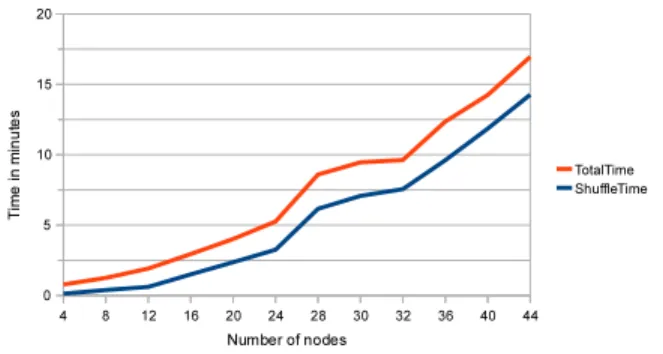
Figure 5: Time required to send 1MB of data (balanced) using shuffle and bulk protocols together, with varying group size.
length regardless of balance. We are not aware of any other verifi-able shuffles [20, 26] for which working implementations and per-formance data are available, but given their typical assumption of small, equal-length messages, we expect their performance on un-balanced loads to be at best on par with our shuffle protocol alone. Figure 4 breaks the runtime of the full Dissent protocol into its shuffle and bulk protocol components, illustrating that the shuffle’s cost remains constant with message size and becomes negligible as total message length grows.
The full Dissent protocol still showed some slowdown under highly unbalanced load: although balance does not affect Dissent’s communication cost, itdoesaffect computation costs. When only one node is sending, that node must compute and XOR together N −1pseudorandom streams of message lengthL, while other nodes each compute only oneL-byte stream. This timing differ-ence could lead to a side-channel attack if not handled carefully in implementation, e.g., by pre-computing all required bit strings be-fore commencing a send. We have made no attempt to analyze the protocol in detail for side-channel attacks, however.
Figure 5 measures the prototype’s runtime with varying group sizes. In a successful run, each node sendsO(N2)bits in the shuf-fle andLtot+O(1)bits in the bulk protocol. As expected, the
shuffle’s runtime increases much more quickly with N than the bulk protocol, although the superlinearN2 curve manifests only slightly for the small groups we tested.
7.
RELATED WORK
Dissent’s shuffle protocol builds directly on an anonymous data collection protocol by Brickell and Shmatikov [7], adding DoS re-sistance via our new go/no-go and blame phases. Dissent’s bulk protocol is similarly inspired by DC-nets [10], which are
compu-tationally efficient and provide unconditional anonymity. DC-nets traditionally require nondeterministic “reservation” schemes to al-locate the anonymous channel’s communication bandwidth, how-ever, and are difficult to protect against anonymous DoS attacks by malicious group members. Strategies exist to strengthen DC-nets against DoS attacks [22, 40], or to form new groups when an attack is detected [32]. Dissent’s use of a shuffle protocol to set up adeterministicDC-nets instance, however, cleanly avoids these DoS vulnerabilities while providing the additional guarantee that each member sendsexactlyone message per protocol run, a useful property for holding votes or assigning 1-to-1 pseudonyms.
Mix-networks [9] offer scalable, practical anonymous unicast communication, and can be adapted to group broadcast [27]. Un-fortunately, mix-networks are difficult to protect against traffic anal-ysis [31] and DoS attacks [16, 24], and in fact, lose security under DoS attack [5]. Crowds [29] are more computationally efficient than mix-networks, but are vulnerable to statistical traffic analy-sis when an attacker can monitor many points across the network. k-anonymous transmission protocols [39] provide anonymity only when most members of a group are honest. Dissent, in contrast, is provably secure against traffic analysis, preserving anonymity even when up toN−2members maliciously collude.
Anonymous voting protocols solve a problem closely related to group broadcast. Each user casts a ballot whose contents should be publicly known but whose author should be unknown to both the election officials and other voters. Many voting protocols allow transmission of only fixed-length messages, e.g., “Yes” or “No” [1]. Cryptographically verifiable shuffles [20, 26] might replace our shuffle protocol, making the shuffle verifiable offline. These al-gorithms require more exotic and complex cryptography, however, and generally verify only a shuffle’scorrectness(i.e., that it is a per-mutation), and not itsrandomness(i.e., that it ensures anonymity). All existing techniques of which we are aware to assure a shuf-fle’s randomness and anonymity, in the presence of compromised members, require passing a batch of messages through a series of independent shuffles, as in Dissent or mix-networks [15].
Group signatures [4, 11] and ring signatures [30] provide anony-mousauthenticationrather than anonymous transmission. Com-bining group/ring signatures with classic DC-nets transmission can meet the first two of Dissent’s three key security goals, integrity and anonymity (see Section 2.3). Such a combination fails to provide accountability, however: malicious group members can still anony-mously disrupt the DC-nets transmission channel, preventing com-munication from occurring at all. Layering group/ring signatures atop DC-nets also does not provide the 1-to-1 mapping needed for anonymous voting or assigning Sybil attack-resistant pseudonyms. Tor [14] and Herbivore [32] are two well-known practical sys-tems for providing anonymous communication over the Internet. These systems scale to far larger groups than Dissent does, and also permit interactive communication. These systems do not provide Dissent’s strong guarantees of anonymity or accountability, how-ever. As a system based on mix-networks, Tor is vulnerable to traf-fic analysis attacks. Herbivore provides unconditional anonymity, but only within a small subgroup of the total group of participants. Dissent may be more suitable for non-interactive communication between participants willing to sacrifice protocol execution speed for strong assurances of anonymity and accountability.
8.
CONCLUSION
Dissent is a novel protocol for anonymous and accountable group communication. Dissent allows a well-defined group of partici-pants to exchange variable-length messages anonymously without the risks of traffic analysis or anonymous DoS attacks associated
with mix-networks and DC-nets. Dissent improves upon previous shuffled-send primitives by adding accountability—the ability to trace misbehaving nodes—and by eliminating the message padding requirements of earlier schemes. We have reviewed practical con-cerns associated with a real-world deployment of Dissent, and have proposed potential solutions for each. Our implementation demon-strates Dissent to be practical, at least for non-interactive anony-mous communication within moderate-size groups.
Acknowledgments
We would like to thank Vitaly Shmatikov, Michael Fischer, Bimal Viswanath, Animesh Nandi, Justin Brickell, Jacob Strauss, Chris Lesniewski-Laas, Pedro Fonseca, Philip Levis, and the anonymous CCS reviewers for valuable feedback and discussion. This work was supported in part by the National Science Foundation under grant CNS-0916413.
9.
REFERENCES
[1] Ben Adida.Advances in cryptographic voting systems. PhD thesis, Cambridge, MA, USA, 2006.
[2] Mihir Bellare, Anand Desai, David Pointcheval, and Phillip Rogaway. Relations among notions of security for public-key encryption schemes.Advances in Cryptology —CRYPTO ’98, pages 549–570, 1998.
[3] Oliver Berthold, Andreas Pfitzmann, and Ronny Standtke. The disadvantages of free MIX routes and how to overcome them. InWorkshop on Design Issues in Anonymity and Unobservability, July 2000.
[4] Dan Boneh, Xavier Boyen, and Hovav Shacham. Short group signatures. InCRYPTO, August 2004.
[5] Nikita Borisov, George Danezis, Prateek Mittal, and Parisa Tabriz. Denial of service or denial of security? How attacks on reliability can compromise anonymity. In14th ACM CCS, October 2007.
[6] Nikita Borisov, Ian Goldberg, and Eric Brewer.
Off-the-record communication, or, why not to use PGP. In WPES, pages 77–84, October 2004.
[7] Justin Brickell and Vitaly Shmatikov. Efficient
anonymity-preserving data collection. In Tina Eliassi-Rad, Lyle H. Ungar, Mark Craven, and Dimitrios Gunopulos, editors,KDD, pages 76–85. ACM, 2006.
[8] Miguel Castro and Barbara Liskov. Practical byzantine fault tolerance. In3rd OSDI, pages 173–186, February 1999. [9] David Chaum. Untraceable electronic mail, return addresses,
and digital pseudonyms.Communications of the ACM, 24(2), February 1981.
[10] David Chaum. The dining cryptographers problem:
Unconditional sender and recipient untraceability.Journal of Cryptology, 1(1):65–75, January 1988.
[11] David Chaum and Eugène Van Heyst. Group signatures. In Eurocrypt, April 1991.
[12] Ian Clarke, Oskar Sandberg, Brandon Wiley, and Theodore W. Hong. Freenet: A distributed anonymous information storage and retrieval system. InWorkshop on Design Issues in Anonymity and Unobservability, July 2000. [13] David Davenport. Anonymity on the Internet: why the price
may be too high.Communications of the ACM, 45(4):33–35, April 2002.
[14] Roger Dingledine, Nick Mathewson, and Paul Syverson. Tor: the second-generation onion router. InSSYM’04:
Symposium, pages 21–21, Berkeley, CA, USA, 2004. USENIX Association.
[15] Roger Dingledine, Vitaly Shmatikov, and Paul Syverson. Synchronous batching: From cascades to free routes. In WPET, May 2004.
[16] Roger Dingledine and Paul Syverson. Reliable MIX cascade networks through reputation. InFinancial Cryptography, March 2002.
[17] John R. Douceur. The Sybil attack. In1st International Workshop on Peer-to-Peer Systems, March 2002. [18] Emulab network emulation testbed.
http://emulab.net/.
[19] Eiichiro Fujisaki, Tatsuaki Okamoto, David Pointcheval, and Jacques Stern. RSA-OAEP is secure under the RSA assumption.Journal of Cryptology, 17(2):81–104, 03 2004. [20] Jun Furukawa and Kazue Sako. An efficient scheme for
proving a shuffle. InCRYPTO, August 2001.
[21] David Goldschlag, Michael Reed, and Paul Syverson. Onion routing for anonymous and private internet connections. Communications of the ACM, 42(2):39–41, February 1999. [22] Philippe Golle and Ari Juels. Dining cryptographers
revisited.Eurocrypt, May 2004.
[23] Andreas Haeberlen, Petr Kouznetsov, and Peter Druschel. PeerReview: Practical accountability for distributed systems. In21st SOSP, October 2007.
[24] Jan Iwanik, Marek Klonowski, and Miroslaw Kutylowski. DUO-Onions and Hydra-Onions — failure and adversary resistant onion protocols. InIFIP CMS, September 2004. [25] Leslie Lamport. The part-time parliament.TOCS,
16(2):133–169, 1998.
[26] C. Andrew Neff. A verifiable secret shuffle and its application to e-voting. In8th CCS, pages 116–125, November 2001.
[27] G. Perng, M.K. Reiter, and Chenxi Wang. M2: Multicasting mixes for efficient and anonymous communication. In26th ICDCS, pages 59–59, 2006.
[28] Mario Di Raimondo, Rosario Gennaro, and Hugo Krawczyk. Secure off-the-record messaging. In WPES, November 2005. [29] Michael K. Reiter and Aviel D. Rubin. Anonymous web
transactions with crowds.Communications of the ACM, 42(2):32–48, 1999.
[30] Ronald Rivest, Adi Shamir, and Yael Tauman. How to leak a secret. InASIACRYPT, December 2001.
[31] Andrei Serjantov, Roger Dingledine, and Paul Syverson. From a trickle to a flood: Active attacks on several mix types.Information Hiding, pages 36–52, 2003.
[32] Emin Gün Sirer et al. Eluding carnivores: File sharing with strong anonymity. In11th SIGOPS European Workshop, September 2004.
[33] Frank Stajano and Ross Anderson. The cocaine auction protocol: On the power of anonymous broadcast. In3rd Information Hiding Workshop, September 1999.
[34] Edward Stein. Queers anonymous: Lesbians, gay men, free speech, and cyberspace.Harvard Civil Rights-Civil Liberties Law Review, 38(1), 2003.
[35] Douglas R. Stinson.Cryptography: Theory and Practice, Third Edition (Discrete Mathematics and Its Applications). Chapman & Hall/CRC, November 2005.
[36] Brad Stone and Matt Richtel. The hand that controls the sock puppet could get slapped.New York Times, July 2007.
[37] Al Teich, Mark S. Frankel, Rob Kling, and Ya-ching Lee. Anonymous communication policies for the Internet: Results and recommendations of the AAAS conference.Information Society, May 1999.
[38] Eugene Vasserman, Rob Jansen, James Tyra, Nicholas Hopper, and Yongdae Kim. Membership-concealing overlay networks. In16th ACM CCS, November 2009.
[39] Luis von Ahn, Andrew Bortz, and Nicholas J. Hopper. k-anonymous message transmission. In10th CCS, pages 122–130, New York, NY, USA, 2003. ACM.
[40] Michael Waidner and Birgit Pfitzmann. The dining cryptographers in the disco: Unconditional sender and recipient untraceability with computationally secure serviceability. InEurocrypt, page 690, April 1989. [41] Jonathan D. Wallace. Nameless in cyberspace: Anonymity
on the internet, December 1999. Cato Briefing Paper No. 54. [42] Wikileaks.http://wikileaks.org/.
[43] The constitutional right to anonymity: Free speech, disclosure and the devil.Yale Law Journal, 70(7):1084–1128, June 1961.
APPENDIX: KEY PAIR VERIFICATION
In the decryption phase of Dissent’s shuffle protocol, honest group members receive secondary private keys from other, potentially malicious group members, and must verify both that this private keywiis valid for the cryptosystem in use, and that it corresponds
to the public keyzidistributed during phase 1. Such a check is not a
standard function of public-key cryptosystems, but any public-key cryptosystem can be augmented to support such a check. The key point is that disclosure of the private key in phase 5a eliminates all secrecy requirements associated with that key pair, so the member who generated a key pair can “prove” the key’s validity simply by including enough information with the private key for the receiving member to replay the key generation process exactly.
Given a public-key cryptosystem [19] with aprobabilistickey generation algorithmK(ρ)taking security parameterρas input and producing key pair(x, y)as output, we define adeterministic con-structionK(ρ, r)of the same algorithm, wherercontains the ran-dom bits supplied to the key generation algorithm. We define the augmented key pairof the original private/public key pair(x, y)to be the pair((x, r),(y, ρ)). Using this augmented algorithm, mem-bers participating in the shuffle protocol broadcast(y, ρ) during phase 1, and reveal(x, r)during phase 5a.
An honest member who receives an augmented key pair need not rely on the correctness of the received private keyxand its claimed correspondence to the public key y. Instead, the receiver runs the deterministic key generation algorithm to compute(x′, y′) = K(ρ, r), and verifyx = x′ andy = y′. Sinceρhas a
well-defined validity range andris an unstructured bit string for which any sufficiently long value is by definition valid, a correct key gen-eration algorithm must produce a working key pair for any valid input combination. Replay thus enables the receiver to verify that the purported key pair is a correct output of the key generation al-gorithm, before using the released private key for decryption.
A faulty member might choose the “random” bitsrnon-randomly during initial key generation. A non-randomrmight compromise the secrecy of ciphertexts encrypted using the public key gener-ated fromr, but such behavior harms the security only of the faulty member itself, as if the faulty member incorrectly revealed its pri-vate key before phase 5a. Independently of how the random input rwas chosen or who knows it, a correct public-key cryptosystem must encrypt and decrypt reliably using the resulting key pair.
![Figure 2: Illustration of bulk protocol operation for 3-member group, shuffled using permutation π = [2, 3, 1].](https://thumb-us.123doks.com/thumbv2/123dok_us/9533670.2829478/4.918.179.743.85.392/figure-illustration-protocol-operation-member-group-shuffled-permutation.webp)