2008-5435/14/63-184-191
INTERNATIONAL JOURNAL OF OCCUPATIONAL HYGIENE Copyright © 2014 by Irnian Occupational Health Association (IOHA) IJOH 6: 184-191, 2014
The Effect of Thermal Stress on Asphalt Workers’ Function and
Their Physiological Parameters
RAMAZAN MIRZAEI
1, ROOHALAH HAJIZADEH
2, KEYKAOUS AZRAH
3,
MOHAMMAD HOSEIN BEHESHTI
3*
1Department of Occupational Health Engineering, Health Promotion Research Center, Zahedan University of
Medical Sciences, Zahedan, Iran; 2Department of Occupational Health Engineering, School of Medical
Sciences, Tarbiat Modares University, Tehran, Iran; 3Department of Occupational Health Engineering, Faculty
of Health, Gonabad University of Medical Sciences, Gonabad, Iran
Received July 04, 2014; Revised August 21, 2014; Accepted September 09, 2014
This paper is available on-line at http://ijoh.tums.ac.ir
ABSTRACT
Heat stress effects on physical and mental health of workers and decreases human function. Asphalt workers are both exposed to the heat of their working process and to the sun heat. This study aimed at evaluating thermal stress and its following function fall and the effect of asphalt work on the degree of heat stress and asphalt workers’ physiological parameters. The present study was done at the work location of 29 asphalt workers in Qum City, central Iran. The degree of thermal stress was by WBGT index. The workers’ physiological parameters such as their blood pressure and pulse rate were studied as well. In order to determine the function fall caused by thermal stress, the related graph was utilized, and the calculated data were analyzed by SPSS software. The longest heat (WBGT) exposure period of asphalt paver drivers, troweling workers, shoveling workers, and burner service workers were 31.59, 32.68, and 33.53 centigrade degrees, respectively causing the laborers’ function fall by 70, 85, and 82%. Increase in WBGT is followed by increase in the average diastolic and systolic blood pressure and pulse rate. There was found a significant relationship between WBGT in the asphalt working locations and out of asphalt working locations (P<0.05). In addition to diseases and effects caused by thermal stress, it is a major reason for man’s function fall and efficiency decline, which eventually causes poor production. Thus, accurate planning and controlling thermal stress are required to prevent occupational diseases and improve human function.
KEYWORDS:Thermal stress, Asphalt work, WBGT, Function fall, Blood pressure, Pulse rate
INTRODUCTION
Thermal stress is one of the harmful physical agents of workplace well known as a health destructive factor for workers in the working environment especially in developing countries causing health and function disorders for the exposed persons [1]. While working start the side effects of exposure to heat is thermal strain and then is followed by increasing heart beats and body temperature
* Corresponding Author: Mohammad Hossein
Beheshti, Email: [email protected]
occurrence of natural disasters, and so on and so forth. When people do physical activities in hot places, they are exposed to the risk of deep body temperature, low physical work capacity, low mental work capacity, occupational incidents, heat exhaustion, and heatstroke [6]. Heat is also known as a risk factor for cardiovascular diseases [7-9]. Currently, mortalities from heat stress of occupational places in the US and in Canada is 22 cases per year; health organization of Toronto has predicted that such kind of death will increase from 20 cases in 2001 to 300 cases in 2020 in this state [10]. In a study with the aim of determining the effects of heat of the working places on the workers, who were alternately working, it was discovered that when ambient temperature increased 1 ºC, 1 beat was added to the number of heart beats per minute [11]. In the countries with very hot seasons, the laborers are working at places a way warmer than the temperature that the physiological mechanism of human body can tolerate [6].
High degree of heat causes high mental pressure, low work capacity, thinner workforce, and low efficiency [12, 13]. Temperature augmentation causes human function fall in different situations apart from health effects [4]. NIOSH has also affirmed that high level of WBGT do not let the laborer do the assigned task, correctly [14, 15]. One of the natural reactions of human body confronting heat stress is a decline in a person’s physical activity causing a decrease in producing internal body heat. This preventive reaction reduces work capacity of the person facing thermal stress. Hence, the effect of prolonged heat exposure on the people’s work capacity is the result of a preventive natural reaction for reducing the probability of heatstroke by decreasing the working pace [6]. The leading cause of such effects is an increase in the deep body
temperature. But dehydration due to
perspiration and using insufficient amount of water could be counted as two effective and important factors. Over-dehydration might lead to marked exhaustion and clinical diseases especially kidney diseases [6]. Heat stress might associate with different kinds of mental and physical effects such as irritability, rage, behavioral change, depression, heart activity, perspiration, unbalanced water and electrolyte, and a change in the surface blood flow (physical effects).
A combination of mental and physical responses is shown as a decline in the work efficiency and vocational skill, an increase in the speed of enforcement of exhaustion, a fall in concentration power, and so a rise in the number of mistakes. Ambient heat can possibly augment the indoor and outdoor heat load of working locations and impact on the productivity of millions of workers [4]. Construction workers, farmer assistants, and fishermen may suffer from the effects of climate heat on their efficiency [14]. In order to compensate the resulted production fall, more hours of work or more laborers may be required [4]. In average or low income countries due to thin support in providing a proper working place at open or close areas, there is a possibility of a drop in efficiency [4]. At the time being, there are a limited number of studies dealing with the effects of thermal stress on the function and efficiency of human beings, and the available data as respect to the real exposure of laborers to hot environments and the resulted low efficiency of them are ambiguous [14]. If the required control measures are not applied, an increase in the degree of ambient heat might have major effects on the efficiency, vocational productivity, and the expenses. Most of the laborers, who work in open air areas, are exposed to both climate and working process heat. Investigating about the portion of working process on thermal stress may have an important role in applying control measures. The reason is controlling the process heat is a way simpler than controlling the climate heat. Laborers of open air areas especially during the hot seasons of arid regions are exposed to sun heat and in some of the vocations are exposed to the heat of the working place, either. Asphalt laborers are the ones experiencing such a condition and are faced with heat risks. Since asphalt work is a heat producer process, and asphalt laborers are mainly active during the hot season in an open-air place, they are exposed to both sunrays and working process heat.
The Effect of Thermal Stress … ijoh.tums.ac.ir | 186
MATERIAL AND METHODS
The present study was done in the summer of 2012 at working locations of asphalt workers in Qum City, central Iran. The investigated participants were 22 asphalt workers including the workers of burner service, asphalt paver drivers, troweling workers, and shoveling men, who were active in different asphalt work steps and were exposed to the climate heat and the heat of the working process. The degree of thermal stress was also evaluated in the working scope of 7 people, who were not directly exposed to the asphalt process including the headman, rock breaker, and Loader drivers; WBGT was assessed in 3 periods of time from 3 different heights based on climate parameters for determining the effect of asphalt work on thermal stress in the working stations of the studies people. In order to evaluate the environmental parameters including dry, natural wet, and radiating temperature, WBGT-meter (made by Casella Co. Model: MK 427JY) was utilized. Along with environmental parameters, the considered physiological parameters – blood pressure and pulse rate of the studied laborers – were simultaneously measured by DW-701 waist manometer. All the measurements were based
on the guidelines of ISO 7243 from 3 different heights of head, chest, and stomach throughout 3 different periods of time (7:30-10, 10-12, 12-14:30); the average time of them was calculated in the working shift. Afterwards, WBGT was measured for the laborers in the working place with the use of the equation 1.
(1) ( )
Since the laborers were wearing simple usual working outfits including a sleeved shirt and pants, the correction factor was 0.6 in all WBGT measurements. The results of the studies by Kjellstrom et al. on the relationship between man’s work capacity and increasing WBGT were used in order for evaluating production fall (function fall) due to global warming. They designed a graph based on ISO and NIOSH to show the decline in the work efficiency parallel to the increase in WBGT amount [6]. Indeed, they drew a graph, in which work capacity is considered as the function of WBGT for acclimatized people/ workers. The graph demonstrates variant work capacity levels at 4 different work intensities (Fig. 1).
Fig1. Relationship between work capacity and WBGT for 4 work intensities based on the suggested international standard by NIOSH, USA[14, 6]
Based on ACGIH categorization, occupations are divided into light, average, heavy and very heavy occupations [16]. The work burden of troweling and shoveling
dispersion indices of independent variables (dry temperature, wet temperature, bulb globe temperature) and the dependent variable (WBGT) were evaluated with t-test and Pearson correlational coefficient, considering the normality of the data. In addition to SPSS 16 (Chicago, IL, USA), Excel 2010 was utilized for analyzing the evaluated data.
RESULTS
The results of the evaluation of WBGT caused by climate/ atmospheric conditions and the resulted function fall, measured in 3 periods of time showed that the mean degree of thermal stress in asphalt paver drivers was 22.7, 29.32 and 31.2ºC in the considered time periods without considering the heat of the working process; the function fall of the laborers were 0, 40, and 60%, respectively. However, WBGT degree of the working process and climate condition for asphalt paver drivers in the measured periods was 26.44, 31.06, and 31.59ºC, and the rate of man’s function fall was 0, 65, and 70%. This study showed that the working process from 7:30 to 10 a.m. increased the degree of WBGT of asphalt paver drivers by 3.74ºC; this portion of WBGT increase does not effect on the man’s function. Besides, asphalt work from 10 a.m. to 12 p.m. augments the degree of drivers’ WBGT by 1.74ºC causing 40 to 60% of
function fall for the laborers. Climate condition’s WBGT degree and its resulted function fall for troweling and shoveling workers, whose work has been categorized as heavy work, was 22.82ºC (without any fall in man function), 29.44ºC (with the function fall of 60%), and 31.83ºC (with the function fall of 79%) in the measured time periods; however, this study indicate that with increase in WBGT degree, man’s function fall increased in all the investigation time.
Climate WBGT degrees and the resulted function fall for Burner service equaled 27.46ºC (without any fall in man function), 29.19ºC (with the function fall of 35%), and 33.07ºC (with the function fall of 80%); though based on table 2, WBGT degree and the function fall amount caused by ambient and working process heat were 29.01 ºC (with the function fall of 27%), 30.07ºC (with the function fall of 60%), and 33.53ºC (with the function fall of 82%) in the evaluated durations. In all the conditions, the amount of WBGT in asphalt work locations is more than the amount of atmospheric WBGT. Mean WBGT degrees in the working location (WBGT of asphalt workstations) and out of the working locations (WBGT caused by the region’s climate) in the evaluated periods are shown in Fig. 2.
Fig2. Mean WBGT in different times in and out of work scope of asphalt workers (A. Asphalt paver driver, B. Troweling and Shoveling workers, C. The service burner)
As it is shown in Table 1 and Fig 2; the degree of WBGT was the lowest in early hours of morning and was the highest at
The Effect of Thermal Stress … ijoh.tums.ac.ir | 188
that in all the studied stations, the degree of WBGT of asphalt work area was more than the degree of WBGT out of work areas.
The assessed findings related to the thermal stress (by WBGT) and the resulted function fall in the work stations of the people who were not directly exposed to asphalt process showed that, the mean heat stress of climate condition for the headman and rock breaker was 24.62, 29.26, and 31.95 ºC causing man function fall by 0, 30, and 72% in the evaluated durations.
The assessed degree of WBGT of the rock breaker’s work scope was exactly the same as the WBGT degrees of climate condition. The climate WBGT, and the resulted function fall of it for Loader drivers in
the measured time periods was respectively 27.46ºC (with the function fall of 0%), 29.19ºC (with the function fall of 35%), and 33.07ºC (with the function fall of 80%). This is when there was no function fall out of environmental/ ambient heat and the working process heat in the measured periods, which
were 23.21ºC, 24.24ºC, and 33.53ºC.
Therefore, in this dominant condition, working process does not effect on the thermal stress and man’s function fall.
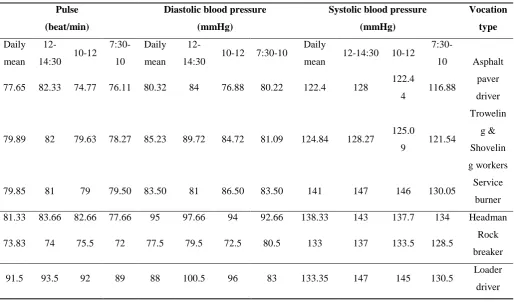
The data related to systolic and diastolic blood pressure, and pulse rate of the subjects in 3 time periods for various vocations are demonstrated in Table 1 and Fig 2.
Table 1. Mean amount of physiological parameters of asphalt workers in the evaluated time periods
Vocation
type Systolic blood pressure
(mmHg) Diastolic blood pressure
Fig 2. Changes of the asphalt workers’ physiological factors throughout 3 different periods of time
As the Table 1 illustrates, with approaching to the midday and increasing WBGT amounts, the average amounts of systolic and diastolic blood pressure and pulse rate are increased. Still, the increased amount of systolic blood pressure is more than other factors. The results of t-test showed that, there is a significant and meaningful relationship between WBGT degrees of asphalt workers’ working place and WBGT degrees out of their working place. This statistical test showed that there is also a meaningful relationship among the WBGT degrees of foot, stomach and heat height of the laborers who are both exposed to
sun heat and working process’s heat (P<0.05). Even the relationship between the mean WBGT degrees of foot and stomach height of the troweling and shoveling laborers was found meaningful (P<0.05). Furthermore, there is not any significant relationship among the foot, stomach and head heights of mean degrees of WBGT for asphalt paver drivers (P<0.05). The correlational relationship
between WBGT degrees of asphalt
workstations and pulse rate, systolic and diastolic blood pressures are indicated in Table 2.
Table 2. Correlations between WBGT and pulse rate, systolic and diastolic pressure
Diastolic blood
pressure Systolic blood
pressure Pulse
Statistical variables
-0.044 -0.194
-0.077 Correlational coefficient
WBGT
0.822 0.314
0.691
P-value
DISCUSSION
Based on the findings of the present research, all the asphalt laborers are exposed to thermal stress, a portion of which goes to the thermal stress out of sun heat and another portion of it goes to the thermal stress out of asphalt work. Averagely, asphalt work increases the probability of exposure to thermal stress by 1-3 ºC. This amount of increase in low degrees of WBGT (less than
The Effect of Thermal Stress … ijoh.tums.ac.ir | 190
class of averagely difficult vocations, there was not any function fall in both of the conditions, and the laborers were working with their full work capacity. Hence, 3.74 ºC increase in WBGT degrees, the laborers’ function did not change. Asphalt work augmented the WBGT of the drivers by 1.74 ºC from 10-12 p.m., but increased man’s function fall from 40% to 65%. Therefore, asphalt work at midday and high temperature noticeably effects on human function.
In a study done with pilot method in southern Africa, in the regions with temperature over 40ºC, laborers tremendously suffer from the side effects of radiated heat such as sunburn, insomnia, irritability, and exhaustion generating problems in keeping work efficiency and causing a severe drop in productivity [17]. Pilot study proved that the production rate and the function of the laborers working in open air areas decrease due to direct exposure to sun rays [17].
Langkulsen et al. in a study on the effects of climate conditions on the health and production amount in Thailand expressed that,
climate changes and global warming
phenomenon reduce health and production amount, simultaneously. In a way that, productivity fall for the construction laborers was more than 60%, and in fact, productivity reduced from 10% to 66.7% [18]. The production rate in most of the Southeast Asia, Central America and The Caribbean would have been decreased from 10% to 27% by 2080, without special acclimatization [4]. Internal physical activities also produce heat in the body increasing the internal body temperature and effecting on the health and function efficiency of man [13].
Due to the nature of asphalt workers’ vocation, along with the environmental and working process heat, the heat of the internal metabolism of body increases thermal stress as well. A study in Taiwan dealing with the effects of heat on the health and efficiency of laborers, who work in open air, like construction laborers, farmer assistants and fishermen that are in direct exposure of sun
rays showed that average maximum
temperature in 4 to 6 months of year is over 30 ºC, and is one of the important reasons of thermal stress in the laborers, too [14]. In this study, average exposure to thermal stress is the highest in troweling and shoveling laborers due to their proximity to the asphalt work.
The laborers on the melt platform are exposed to thermal stress the longest due to their proximity to the source [19]. Thus, it is possible to prevent thermal stress by controlling heat producers. The laborers of different stages of asphalt work do not experience the same amount of heat exposure and received heat in different parts of their head, stomach and foot, and the laborers who are directly exposed to the hot asphalt experience the highest degrees of WBGT in their feet. Based on the results of this study, there was not found a high srong correlation between the amounts of WBGT and pulse rate, diastolic and systolic blood pressures. Again on the basis of the results of the study, WBGT degrees and medium blood pressure at midday are the highest.
Although the increase in the blood pressure and pulse rate of the investigated laborers is not statistically important, but in the study by Christian et al. [20] with the participants of 18770 persons, a negative correlation was reported between WBGT and blood pressure. Based on their study’s findings, each 10 ºC temperature decline is followed by 1.5 mmHg increase in the blood pressure of men and 2.4 mmHg in the blood pressure of women. In the present study in contrast to the last mentioned study, an increase in pulse rate and systolic and diastolic blood pressures – though not statistically meaningful – was considered as the probable result of different stresses. As this study is a field research and is not controlled, absolute judgments cannot be given about this amount of increase.
CONCLUSION
the asphalt workers. Moreover, conducting more researches in this field for measuring the function fall amount of acclimatized workers to heat is recommended.
ACKNOWLEDGEMENT
We gratefully acknowledge friendly support and help from Health Center and Municipality Security Office of Qum City, Iran. The authors declare that there is no conflict of interests.
REFERENCES
1. Kovats RS, Hajat S. Heat stress and public health: a critical review. Annu Rev Public Health 2008;29:41-55.
2. Golbabaei F, Omidvari M. Man and thermal environment. 2nd edition. Tehran: University of Tehran Publication; 2008 (in Persian).
3. Morabito M, Cecchi L, Crisci A, Modesti PA, Ndiorlani S. Relationship between work-related accidents and hot weather conditions in Tuscany (central Italy). Ind Health Rev 2006;44(3):458-64.
4. Kjellstrom T, Kovats RS, Lloyd SJ, Holt T, Tol RSJ. The direct impact of climate change on regional labor productivity. Arch Environ Occup H 2009;64(4):217-27.
5. Misaqi F, Inderberg J, Blumenstein P, Naiman T. Heat stress in hot US mines and criteria for standards for mining in hot environments: US Department of the Interior, MESA. 1976.
6. Kjellstrom T, Holmer I, Lemke B. Workplace heat stress, health and productivity–an increasing challenge for low and middle-income countries during climate change. Global Health Action 2009;2: 46-51.
7. Brake R, Bates G. A valid method for comparing rational and empirical heat
stress indices. Ann Occup Hyg
2002;46(2):165-74.
8. Semenza JC, McCullough JE, Flanders WD, Mcgeehin MA, Lumpkin JR. Excess hospital admissions during the July 1995 heat wave in Chicago. Am J Prev Med 1999;16(4):269-77.
9. Semenza JC, Rubin CH, Falter KH, Selanikio JD, Flanders WD, Howe HL, et al. Heat-related deaths during the July 1995 heat wave in Chicago. N Engl J
Med 1996;335(2):84-90.s
10. Jay O, Kenny GP. Heat exposure in the Canadian workplace. Am J Ind Med 2010;53(8):842-853.
11. 11.Kamon E. Relationship of
physiological strain to change in heart rate during work in the heat .Am Ind Hyg Assoc J 1972;33(11):701-708.
12. Hosseini HM. Evaluation of Thermal Stress workers In a Tile Factory. 7th Occupational Health Congress, 16-18 February 2010; Qazvin, Iran. (in Persian).
13. Kerslake DM. The stress of hot
environments: CUP Archive; 1972. 14. Lin R, Chan C. Effects of heat on
workers' health and productivity in
Taiwan. Glob Health Action
2009;2:2024-2030.
15. Hannani M, Motallebi M, Kashani, Mousavi S, Bahrami A. Evaluation of workplaces heat stress for bakers in kashan city. Feyz 2004:8(3) (in persian).
16. ACGIH. TLVs and BEIs: Threshold
Limit Values for Chemical Substances and Physical Agents and Biological Exposure Indices. ACGIH Worldwide, New York, USA ; 2001.
17. Mathee A, Oba J, Rose A. Climate change impacts on working people (the HOTHAPS initiative): findings of the South African pilot study . Glob Hea Act 2010; (3):64-73.
18. Langkulsen U, Vichit-Vadakan N,
Taptagaporn S. Health Impact of Climate Change on Occupational Health and Productivity in Thailand. Glob Hea Act 2010: 22(1):45-52.
19. Haji Azimi KA, aghajani M, soleymanian A. Heat stress measurement according to WBGT index in smelters. J Mil Med 2011; 13(2):59-64 (In Persian).