Which Performs Better on In-Vocabulary Word Segmentation:
Based on Word or Character?
Zhenxing Wang
1,2, Changning Huang
2and Jingbo Zhu
11 Institute of Computer Software and Theory, Northeastern University,
Shenyang, China, 110004
2 Microsoft Research Asia, 49, Zhichun Road,
Haidian District, Beijing, China, 100080
[email protected]
[email protected]
[email protected]
Abstract
*Since the first Chinese Word Segmenta-tion (CWS) Bakeoff on 2003, CWS has experienced a prominent flourish be-cause Bakeoff provides a platform for the participants, which helps them rec-ognize the merits and drawbacks of their segmenters. However, the evaluation metric of bakeoff is not sufficient enough to measure the performance tho-roughly, sometimes even misleading. One typical example caused by this in-sufficiency is that there is a popular be-lief existing in the research field that segmentation based on word can yield a better result than character-based tag-ging (CT) on in-vocabulary (IV) word segmentation even within closed tests of Bakeoff. Many efforts were paid to bal-ance the performbal-ance on IV and out-of-vocabulary (OOV) words by combining these two methods according to this be-lief. In this paper, we provide a more de-tailed evaluation metric of IV and OOV words than Bakeoff to analyze CT me-thod and combination meme-thod, which is a typical way to seek such balance. Our evaluation metric shows that CT outper-forms dictionary-based (or so called word-based in general) segmentation on both IV and OOV words within Bakeoff
*
The work is done when the first author is working in MSRA as an intern.
closed tests. Furthermore, our analysis shows that using confidence measure to combine the two segmentation results should be under certain limitation.
1
Introduction
segmentation (we call it “DS” for short hereaf-ter), CT method can achieve a higher accuracy on OOV word recognition and a better perfor-mance of segmentation in whole. Thus, CT has drawn more and more attention and became the dominant method in the Bakeoff 2005 and 2006.
Although CT has shown its merits in word segmentation task, some researchers still hold the belief that on IV words DS can perform bet-ter than CT even in the restriction of Bakeoff closed test. Consequently, many strategies are proposed to balance the IV and OOV perfor-mance (Goh et al., 2005), (Zhang et al., 2006a). Among these strategies, the confidence measure used to combine the results of CT and DS is a straight-forward one, which is introduced in (Zhang et al., 2006a). The basic assumption of such combination is that DS method performs better on IV words and Zhang derives this belief from the fact that DS achieves higher IV recall rate as Table 1 shows. In which AS, CityU, MSRA and PKU are four corpora used in Ba-keoff 2005 (also see Table 2 for detail). We pro-vide a more detailed evaluation metric to ana-lyze these two methods, including precision and F measure of IV and OOV respectively and our experiments show that CT outperforms DS on both IV and OOV words within Bakeoff closed test. The precision and F measure are existing metrics and the definitions of them are clear. Here we just employ them to evaluate segmenta-tion results. Furthermore, our error analysis on the results of combination reveals that confi-dence measure in (Zhang et al., 2006a) has a representation flaw and we propose an EIV tag method to revise it. Finally, we give an empiri-cal comparison between existing pure CT me-thod and combination, which shows that pure CT method can produce state-of-the-art results on both IV word and overall segmentation.
Corpus RIV ROOV DS CT DS CT AS 0.982 0.967 0.038 0.647 CityU 0.989 0.967 0.164 0.736 MSRA 0.993 0.972 0.048 0.716 PKU 0.981 0.955 0.408 0.754
Table 1 IV and OOV recall in (Zhang et al., 2006a)
The rest of this paper is organized as fol-lows. In Section 2, we give a brief introduction
to Zhang‟s DS method and subword-based tag-ging, which is a special CT method. And by comparing the results of this special CT method and DS according our detailed metric, we show that CT performs better on both IV and OOV. We review in Section 3 how confidence measure works and indicate its representation flaw. Fur-thermore, an “EIV” tag method is proposed to revise the confidence measure. In Section 4, the experimental results of existing pure CT method are demonstrated to compare with combination result, based on which we discuss the related work. In Section 5, we conclude the contribu-tions of this paper and discuss the future work.
2
Comparison between DS and CT
Based on Detailed Metric
We proposed a detailed evaluation metric for IV and OOV word identification in this section and experiments based on the new metric show that CT outperforms DS not only on OOV words but also on IV words with F-measure of IV. All the experiments in this paper conform to the constraints of closed test in Bakeoff 2005 (Emerson, 2005). It means that any resource beyond the training corpus is excluded. We first review how DS and CT work and then present our evaluation metric and experiment results. There is one thing should be emphasized, by comparing DS and CT result we just want to verify that our new metric can show the performance on IV words more objectively. Since either DS or CT implementation has specific setting here we should not extend the comparison result to a general sense between those generative models and discriminative models.
2.1 Dictionary-based segmentation
For the dictionary-based word segmentation, we collect a dictionary from training corpus first. Instead of Maximum Match, trigram language model2 trained on training corpus is employed for disambiguation. During the disambiguation procedure, a beam search decoder is used to seek the most possible segmentation. Since the setting in our paper is consistent with the closed test of
2
Bakeoff, we can only use the information we learn from training corpus though other open resources may be helpful to improve the perfor-mance further. For detail, the decoder reads cha-racters from the input sentence one at a time, and generates candidate segmentations incre-mentally. At each stage, the next incoming cha-racter is combined with an existing candidate in two different ways to generate new candidates: it is either appended to the last word in the candi-date, or taken as the start of a new word. This method guarantees exhaustive generation of possible segmentations for any input sentence. However, the exponential time and space of the length of the input sentence are needed for such a search and it is always intractable in practice. Thus, we use the trigram language model to se-lect top B (B is a constant predefined before search and in our experiment 3 is used) best candidates with highest probability at each stage so that the search algorithm can work in practice. Finally, when the whole sentence has been read, the best candidate with the highest probability will be selected as the segmentation result. Here, the term “dictionary-based” is exactly the method implemented in (Zhang et al., 2006a), it does not mean the generative language model in general.
2.2 Character-based tagging
Under CT scheme, each character in one sen-tence is labeled as „B‟ if it is the beginning of a word, „O‟ tag means the current character is a single-character word, other character is labeled as „I‟. For example, “全中国 (whole China)” is labeled as “全 (whole)/O 中 (central)/B 国
(country)/I”.
In (Zhang et al., 2006a), the above CT me-thod is developed as subword-based tagging. First, the most frequent multi-character words and all single characters in training corpus are collected as subwords. During the subword-based tagging, a subword is viewed as an unit instead of several separate characters and given only one tag. For example, in subword-based tagging, “全中国 (whole China)” is labeled as “ 全 (whole)/O 中国 (China)/O”, if the word “中 国 (China)” is collected as a subword. As the preprocessing, both training and test corpora are segmented by maximum match with subword set
as dictionary. After this preprocessing, every sentence in both training and test corpora be-comes subword sequence. Finally, the tagger is trained by CRFs approach3 on the training data. Although word information is integrated into this method, it still works in the scheme of “IOB” tagging. Thus, we still call subword-based tagging as a special CT method and in the reminder of this paper “CT” means subword-keoff 2005 are listed in Table 2 (Emerson, 2005).
Corpus Encoding #Training
Table 2 Corpora statistics of Bakeoff 2005
Evaluation standard is also provided by Ba-keoff, including overall precision, recall, F measure, IV recall and OOV recall (Sproat and each experiment, a more detailed evaluation with precision and F measure of both IV and kens in the gold data, and IV (or OOV) precision is the proportion of the correctly segmented IV
3
(or OOV) word tokens to all IV (or OOV) word tokens in the segmenter‟s output. One thing have to be emphasized is that the single character in test corpus will be defined as OOV if it does not appear in training corpus. We will see later in this section, by this evaluation, some facts cov-ered by the bakeoff evaluation can be illustrated by our new evaluation metric.
Here, we repeat two experiments described in (Zhang et al., 2006a), namely dictionary-based approach and subword-based tagging. For CT method, top 2000 most frequent multi-character words and all single characters in training corpus are selected as subwords and the feature tem-plates used for CRF model is listed in Table 3. We present all the segmentation results in Table 6 to see the strength and weakness of each me-thod conveniently.
Based on IV and OOV recall as we show in Table 1, Zhang argues that the DS performs
bet-ter on IV word identification while CT performs better on OOV words. But we can see from the results in Table 6 (the lines about DS and CT), the IV precision of DS approach is much lower than that of CT on all the four corpora, which also causes a lower F measure of IV. The reason for low IV precision of DS is that many OOV words are segmented into two IV words by DS. For example, OOV word “歌唱班(choral)” is segmented into“歌唱(sing) 班(class)” by DS. These wrongly identified IV words increase the number of all IV words in the segmenter‟s out-put and cause the low IV precision of the DS result. Since the F measure of IV is a more rea-sonable metric of performance of IV than IV recall only, Table 6 shows that CT method out-performs the DS on IV word segmentation over all four corpora. The comparison also shows that CT outperforms the DS on OOV and overall segmentation as well.
Type Feature Function
Unigram C-2, C-1, C0, C1, C2 Previous two, current and next two subword Bigram C-2 C-1, C-1 C0, C0 C1, C1 C2 Two adjacent subwords
Jump C-1 C1 Previous character and next subwords Table 3 Feature templates used for CRF in our experiments
3
Balance between IV and OOV
Per-formance
There are other strategies such as (Goh et al., 2005) trying to seek balance between IV and OOV performance. In (Goh et al, 2005), infor-mation in a dictionary is used in a statistical model. In this way, the dictionary-based ap-proach and the statistical model are combined. We choose the confidence measure to study be-cause it is straight-forward. We show in this sec-tion that there is a representasec-tion flaw in the formula of confidence measure in (Zhang et al., 2006a). And we propose an “EIV” tag method to solve this problem. Our experiments show that confidence measure with EIV tag outperforms CT and DS alone.
3.1 Confidence measure
Confidence Measure (CM) means to seek an optimal tradeoff between performance on IV and OOV words. The basic idea of CM comes from the belief that CT performs better on OOV words while DS performs better on IV words.
When both results of CT and DS are available, the CM can be calculated according to the fol-lowing formula in (Zhang et al., 2006a):
ng iob w iob
iob
iob w CM t w t t
t | ) ( | ) (1 ) ( , )
(
CM
Here,
w
is a subword,t
iob is “IOB” tag givenby CT and tw is “IOB” tag generated by DS. In the first term of the right hand side of the formu-la, CMiob(tiob|w) is the marginal probability of
iob
t
(we call this marginal probability “MP” for short). And in the second term, (tw,tiob)ng is aKronecker delta function, returning 1 if and only if
t
w andt
iob are identical, else returning 0. But if(tw,tiob)ng 1 , there is no requirement ofre-placement at all. While if (tw,tiob)ng 0 , when
iob
w t
t , CM depends on the first term of its
the final tag, otherwise
t
iobwill be remained as the final tag. However, two parameters in the CM, namely
andt
, are unnecessary, because when MP is greater than or equal to t/
,t
iob will be kept, otherwise it will be replaced withw
t
. Thus, the CM ultimately is the marginal probability of the “IOB” tag (MP). In the expe-riment of this paper, MP is used as CM because it is equivalent to Zhang‟s CM but more conve-nient to express.3.2 Experiments and error analysis about combination
We repeat the experiments about CM in Zhang‟s paper (Zhang et al., 2006a) and show that there is a representation flaw in the CM formula. Fur-thermore, we propose an EIV tag method to make CM yield a better result.
In this paper,
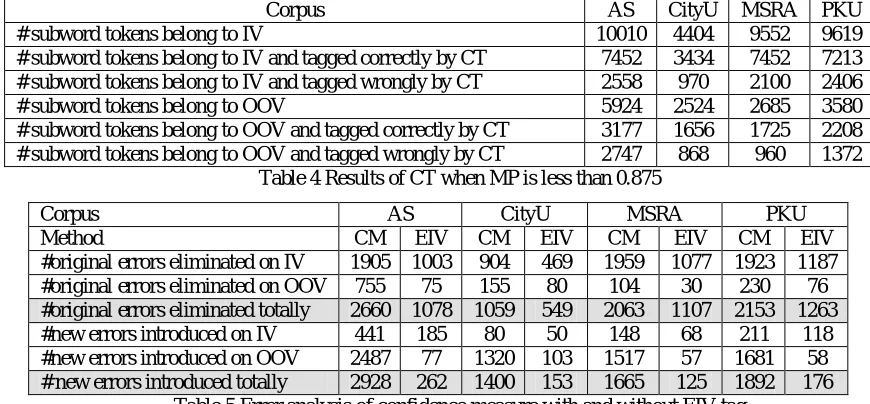
= 0.8 and t = 0.7 (Parameters in two papers, Zhang et al. 2006a and Zhang et al. 2006b, are different. And our parameters are consistent with Zhang et al. 2006b which is con-firmed by Dr Zhang through email) are used in CM, namely MP= 0.875 is the threshold. Here, in Table 4, we provide some statistics on the results of CT when MP is less than 0.875. From Table 4 we can see that even with MP less than 0.875, most of the subwords are still tagged cor-rectly by CT and should not be revised by DS result. Besides, lots of the subwords with low MP contained by OOV words in test data, espe-cially for the corpus whose OOV rate is high (i.e. on CityU corpus more than one third sub-words with low MP belong to OOV word) and performance on OOV recognition is the advan-tage of CT rather than that of DS approach. Thus when combining the results of the two methods, it is thet
iobshould be maintained if the subword is contained by an OOV word. Therefore, the CM formula seems somewhat unreasonable. The error analysis about how many original errors are eliminated and how many new errors are introduced by CM is provided in Table 5 (the columns about CM). Table 5 illustrates that, af-ter combining the two results, most original er-rors on IV words are corrected because DS can achieve higher IV recall as described in Zhang‟s paper. But on OOV part, more new errors areintroduced by CM and these new errors decrease the precision of the IV words. For example, the OOV words “警卫队员 (guard member)” and “ 设计费 (design fee)” is recognized correctly by CT but with low CM. In the combining proce-dure, these words are wrongly split as IV errors: “警卫 (guard) 队员 (member)” and “设计 (de-sign) 费 (fee)”. Thus, for two corpora (i.e. CityU and AS), F measure of IV and overall F measure decreases since there are more new er-rors introduced than original ones eliminated and only on the other two corpora (MSRA and PKU), overall F measure of combination method is higher than CT alone, which is shown in Ta-ble 6 by the lines about combination.
3.3 EIV tag method
Since combining the two results by CM may produce an even worse performance in some case, it is worthy to study how to use this CM to get an enhanced result. Intuitively, if we can change only the CT tags of the subwords which contained in IV word while keep the CT tags of those contained in OOV words unchanged, we will improve the final result according to our error analysis in Table 5. Unfortunately, only from the test data, we can get the information whether a subword contained in an IV word, just as what we do to get Table 4. However, we can get an approximate estimation from DS result. When using subwords to re-segment DS result4, all the fractions re-segmented out of character words, including both multiple-character words and single multiple-characters, will be given an “EIV” tag, which means that the cur-rent multiple-character word or single character is contained in an IV word with high probability. For example, “人力资源 (human resource)” in DS result is a whole word. However, only “资源 (resource)” belongs to the subword set, so dur-ing the re-segmentation “人力资源 (human re-source)” will be re-segmented as “人 (people) 力 (force) 资源 (resource)”. All these three frac-tions will be labeled with an “EIV” tag respec-tively. It is reasonable because all the multiple-character words in the DS result can match an IV word. After this procedure, when combining
4
Corpus AS CityU MSRA PKU # subword tokens belong to IV 10010 4404 9552 9619 # subword tokens belong to IV and tagged correctly by CT 7452 3434 7452 7213 # subword tokens belong to IV and tagged wrongly by CT 2558 970 2100 2406 # subword tokens belong to OOV 5924 2524 2685 3580 # subword tokens belong to OOV and tagged correctly by CT 3177 1656 1725 2208 # subword tokens belong to OOV and tagged wrongly by CT 2747 868 960 1372
Table 4 Results of CT when MP is less than 0.875
Corpus AS CityU MSRA PKU
Method CM EIV CM EIV CM EIV CM EIV #original errors eliminated on IV 1905 1003 904 469 1959 1077 1923 1187 #original errors eliminated on OOV 755 75 155 80 104 30 230 76 #original errors eliminated totally 2660 1078 1059 549 2063 1107 2153 1263 #new errors introduced on IV 441 185 80 50 148 68 211 118 #new errors introduced on OOV 2487 77 1320 103 1517 57 1681 58 # new errors introduced totally 2928 262 1400 153 1665 125 1892 176
Table 5 Error analysis of confidence measure with and without EIV tag
the two results, only the CT tag with EIV tags and low MP will be replaced by DS tag, other-wise the original CT tag will be maintained. Un-der this condition the errors introduced by OOV will not happen and enhanced results are listed in Table 6 lines about EIV. We can see that on all four corpora the overall F measure of EIV result is higher than that of CT alone, which show that our EIV method works well. Now, let‟s check what changes happened in the num-ber of error tags after EIV condition added into the CM. We can see from the Table 5 columns about EIV, there are more errors eliminated than the new errors introduced after EIV condition added into CM and most CT tags of subwords contained in OOV words maintained unchanged as we supposed. And then, our results (in Table 6 lines about EIV) are comparable with that in Zhang‟s paper. Thus, there may be some similar strategies in Zhang‟s CM too but not presented in Zhang‟s paper.
4
Discussion and Related Works
Although the method such as confidence meas-ure can be helpful at some circumstance, our experiment shows that pure character-based tag-ging (pure CT) can work well with reasonable features and tag set. In (Zhao et al., 2006), an enhanced CRF tag set is proposed to distinguish different positions in the multi-character words when the word length is less than 6. In this me-thod, feature templates are almost the same as shown in Table 3 with a 3-character window and
a 6-tag set {B, B2, B3, M, E, O} is used. Here, tag B and E stand for the first and the last posi-tion in a multi-character word, respectively. S stands up a single-character word. B2 and B3 stand for the second and the third position in a multi-character word, whose length is larger than two-character or three-character. M stands for the fourth or more rear position in a multi-character word, whose length is larger than four-character.
In Table 6, the lines about “pure CT” provide the results generated by pure CT with 6-tag set. We can see from the Table 6 this pure CT ap-proach achieves the state-of-the-art results on all the corpora. On three of the four corpora (AS, MSRA and PKU) this pure CT method gets the best result. Even on IV word, this pure CT ap-proach outperforms Zhang‟s CT method and produces comparable results with combination with EIV tags, which shows that pure CT me-thod can perform well on IV words too. Moreo-ver, this character-based tagging approach is more clear and simple than the confidence measure method.
Corpus Method R P F RIV PIV FIV ROOV POOV FOOV
AS DS 0.943 0.881 0.911 0.984 0.892 0.935 0.044 0.217 0.076 CT 0.954 0.938 0.946 0.967 0.960 0.964 0.666 0.606 0.635 Combination 0.958 0.929 0.943 0.980 0.945 0.962 0.487 0.593 0.535 EIV tag 0.960 0.942 0.951 0.973 0.962 0.968 0.667 0.624 0.645 Pure CT 0.958 0.947 0.953 0.971 0.963 0.967 0.682 0.618 0.648 CityU DS 0.928 0.848 0.886 0.989 0.865 0.923 0.162 0.353 0.223 CT 0.947 0.940 0.944 0.963 0.964 0.964 0.739 0.717 0.728 Combination 0.954 0.922 0.938 0.984 0.938 0.961 0.581 0.693 0.632 EIV tag 0.953 0.949 0.951 0.970 0.968 0.969 0.744 0.750 0.747 Pure CT 0.947 0.948 0.948 0.967 0.973 0.970 0.692 0.660 0.676 MSRA DS 0.969 0.927 0.947 0.994 0.930 0.961 0.036 0.358 0.066 CT 0.963 0.964 0.963 0.970 0.979 0.975 0.698 0.662 0.680 Combination 0.977 0.961 0.969 0.990 0.970 0.980 0.511 0.653 0.574 EIV tag 0.972 0.970 0.971 0.980 0.982 0.981 0.696 0.679 0.688 Pure CT 0.972 0.975 0.973 0.978 0.986 0.982 0.750 0.632 0.686 PKU DS 0.948 0.911 0.929 0.981 0.920 0.950 0.403 0.711 0.515 CT 0.944 0.945 0.945 0.955 0.966 0.961 0.763 0.727 0.745 Combination 0.955 0.942 0.949 0.973 0.953 0.963 0.664 0.782 0.718 EIV tag 0.950 0.952 0.951 0.961 0.970 0.966 0.768 0.753 0.760 Pure CT 0.946 0.957 0.951 0.956 0.973 0.964 0.672 0.580 0.623 Table 6 Results of different approach used in our experiments (White background lines are the results we repeat Zhang‟s methods and they have some trivial difference with Table 1.)
Therefore, the most important thing worth to pay attention in future study is how to integrate lin-guistic information into the statistical model effec-tively, no matter character or word information.
5
Conclusions and Future Work
In this paper, we first provided a detailed evalua-tion metric, which provides the necessary infor-mation to judge the performance of each method on IV and OOV word identification. Second, by this evaluation metric, we show that character-based tagging outperforms dictionary-character-based seg-mentation not only on OOV words but also on IV words within Bakeoff closed tests. Furthermore, our experiments show that confidence measure in Zhang‟s paper has a representation flaw and we propose an EIV tag method to revise the combina-tion. Finally, our experiments show that pure cha-racter-based approach also can achieve good IV word and overall performance. Perhaps, there are two reasons that existing combination results don‟t outperform the pure CT. One is that most information contained in statistic language model is already captured by the CT feature templates in CRF framework. The other is that confidence
measure may not be the effective way to combine the DS and CT results.
In the future work, our research will focus on how to integrate word information into CRF fea-tures rather than using it to modify the results of CRF tagging. In this way, we can capture the word information meanwhile avoid destroying the optimal output of CRF tagging.
Acknowledgement
The authors appreciate Dr. Hai Zhao in City Uni-versity of Hong Kong and Dr. Ruiqiang Zhang in Spoken Language Communications Lab, ATR, Japan providing a lot of help for this paper. Thank those reviewers who gave the valuable comment to improve this paper.
References
Thomas Emerson. 2005. The Second International Chi-nese Word Segmentation Bakeoff. In Proceedings of the Fourth SIGHAN Workshop on Chinese Language Processing, pages 123-133, Jeju Island, Korea:
Chinese Language Processing, Vol. 10(3): pages 381-396.
Gina-Anne Levow. 2006. The Third International Chi-nese Language Processing Bakeoff: Word Segmen-tation and Named Entity Recognition. In Proceed-ings of the Fifth SIGHAN Workshop on Chinese Language Processing , pages 108-117, Sydney: Ju-ly.
Jin Kiat Low, Hwee Tou Ng, and Wenyuan Guo. 2005. A Maximum Entropy Approach to Chinese Word Segmentation. In Proceedings of the Fourth SIGHAN Workshop on Chinese Language Processing, pages 161-164, Jeju Island, Korea.
Fuchun Peng, Fangfang Feng, and Andrew McCallum. 2004. Chinese segmentation and new word detection using conditional random fields. In COLING 2004, pages 562–568. Geneva, Switzerland.
Richard Sproat and Thomas Emerson. 2003. The First International Chinese Word Segmentation Bakeoff. In
Proceedings of the Second SIGHAN Workshop on Chi-nese Language Processing, pages 133-143, Sapporo, Ja-pan: July 11-12,
Huihsin Tseng, Pichuan Chang et al. 2005. A Conditional Random Field Word Segmenter for SIGHAN Bakeoff 2005. In Proceedings of the Fourth SIGHAN Workshop on Chinese Language Processing, pages 168-171, Jeju Island, Korea.
Neinwen Xue and Susan P. Converse. 2002. Combin-ing Classifiers for Chinese Word Segmentation. In
Proceedings of the First SIGHAN Workshop on Chinese Language Processing, pages 63-70, Taipei, Taiwan.
Ruiqiang Zhang, Genichiro Kikui and Eiichiro Sumita. 2006a. Subword-based Tagging by Conditional Random Fields for Chinese Word Segmentation. In
Proceedings of the Human Language Technology Conference of the NAACL, Companionvolume, pag-es 193-196. New York, USA.
Ruiqiang Zhang, Genichiro Kikui and Eiichiro Sumita. 2006b. Subword-based Tagging for Confidence-dependent Chinese Word Segmentaion. In Proceed-ings of the COLING/ACL, Main Conference Poster Sessions, pages 961-968. Sydney, Australia.
Yue Zhang and Stephen Clark. 2007. Chinese Segmenta-tion with a Word-Based Perceptron Algorithm. In
Proceedings of the 45th Annual Meeting of the As-sociation for Computational Linguistics, pages 840-847. Prague, Czech Republic.
Hai Zhao, Changning Huang et al. 2006. Effective Tag Set Selection in Chinese Word Segmentation via Conditional Random Field Modeling. In