26
INTERNATIONAL JOURNAL OF ADVANCES IN ENGINEERING RESEARCH
ABSTRACT
3D printers are now being used everywhere from simple prototyping to complex product creation. However, there still are a lot of hurdles to overcome for a much wider adaptation of such printers. One of the biggest problems is the difficulty in 3D model creation. It takes a lot of experience to create such models also, most of the 3D model creating software available today comes at a high price tag. To help with this, 3D scanners are available, but these scanners are sold separately and come at a high price. To solve these problems, a 3D printer with an integrated 3D scanning is proposed here.
Index Terms— 3D printing, Interpolation, Kinect, Scanning.
INTRODUCTION
3D printing or additive manufacturing is a process of making three dimensional solid objects from a digital file. The creation of a 3D printed object is achieved using additive processes. In an additive process an object is created by laying down successive layers of material until the entire object is created. Each of these layers can be seen as a thinly sliced horizontal cross-section of the eventual object. It has a vast future potential and is an emerging technology, still at its infancy. 3D printers create things, the possible things that can be made with 3D printers are infinite. However one of the biggest challenges for adopting 3D printer to households is the difficulty in making 3D models and the cost of 3D modelling software. Here we try to avoid this problem to an extend by integrating a 3D scanner to the printer so that models can be easily created.
In this work, we integrate a 3D scanner along with the printer to produce a standalone device that can scan and print objects without much hassle. In this approach, we use a Kinect sensor as the 3D camera, due to it’s high availability and comparatively lower price. The approaches taken to extract the depth information from 3D scanner and to produce a viable 3D model from the noisy and the aliased depth information provided by Kinect is mentioned in the paper.
STANDALONE 3D PRINTER WITH INTEGRATED 3D
SCANNING
27
INTERNATIONAL JOURNAL OF ADVANCES IN ENGINEERING RESEARCH
Okarma, in his work has introduced some algorithms applied for the calibration of the 3D scanning system and image analysis in the experimental system for positioning the work pieces on the CNC machines. [1]
Jin Zhou, Ligang, Zhigeng Pan and Hao Yan, in their work, discusses about depth camera such as Microsoft Kinect, which is much cheaper than conventional 3D scanning devices, and thus it can be acquired for everyday users easily. However, the depth data captured by Kinect over a certain distance is of extreme low quality. In this work, a novel scanning system for capturing 3D full human body models by using multiple Kinects is proposed. [2]
In Chaoching Ho’s work [3], the study presents a low-cost scanning system for acquiring 3D geometry and texture information of large objects and for performing multi-scanning patch registration to obtain a whole realistic 3D model. The proposed system is composed of a line-stripe laser and a colour CCD camera. In Xiaoqing Yu, Qingtong Xu and Jing Wang’s work, for 3D point cloud data scanned by a laser scanner, noise has become an obstacle for point cloud reconstruction. [4] The paper proposes some methods for point noise processing based on 3D scanning data. In the authors use the way to process the point cloud generated by the scanning machine. And also use the point cloud with clustering and sampling steps to finally achieve a satisfying de-noising result.
PROPOSED METHODOLOGY
A. Block Diagram
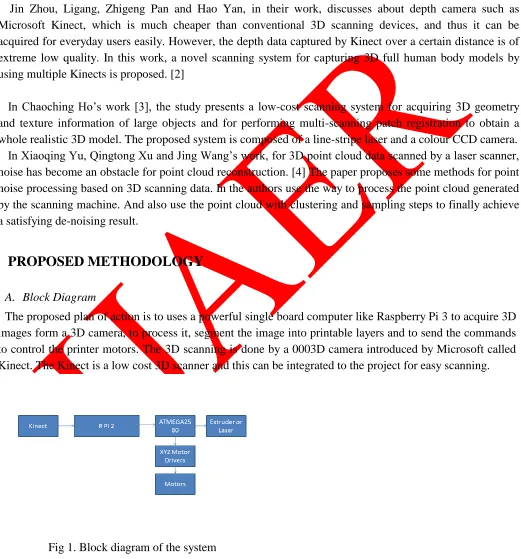
The proposed plan of action is to uses a powerful single board computer like Raspberry Pi 3 to acquire 3D images form a 3D camera, to process it, segment the image into printable layers and to send the commands to control the printer motors. The 3D scanning is done by a 0003D camera introduced by Microsoft called Kinect. The Kinect is a low cost 3D scanner and this can be integrated to the project for easy scanning.
28
INTERNATIONAL JOURNAL OF ADVANCES IN ENGINEERING RESEARCH B. Circuit Diagram
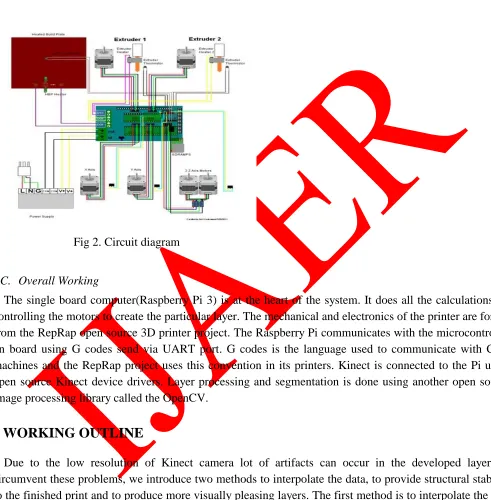
Fig 2. Circuit diagram
C. Overall Working
The single board computer(Raspberry Pi 3) is at the heart of the system. It does all the calculations for controlling the motors to create the particular layer. The mechanical and electronics of the printer are forked from the RepRap open source 3D printer project. The Raspberry Pi communicates with the microcontroller on board using G codes send via UART port. G codes is the language used to communicate with CNC machines and the RepRap project uses this convention in its printers. Kinect is connected to the Pi using open source Kinect device drivers. Layer processing and segmentation is done using another open source image processing library called the OpenCV.
WORKING OUTLINE
Due to the low resolution of Kinect camera lot of artifacts can occur in the developed layers to circumvent these problems, we introduce two methods to interpolate the data, to provide structural stability to the finished print and to produce more visually pleasing layers. The first method is to interpolate the data in each layer known as inter-layer interpolation. The second method will be to interpolate between layers so as to make smooth transitions between layers this is called as intra-layer interpolation.
29
INTERNATIONAL JOURNAL OF ADVANCES IN ENGINEERING RESEARCH
HARDWARE
D. Electronic Components
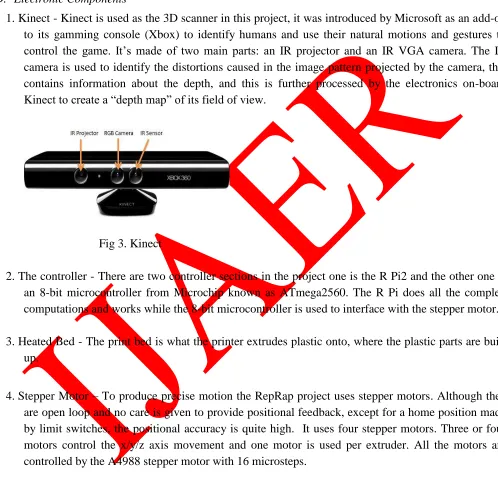
1.Kinect - Kinect is used as the 3D scanner in this project, it was introduced by Microsoft as an add-on to its gamming console (Xbox) to identify humans and use their natural motions and gestures to control the game. It’s made of two main parts: an IR projector and an IR VGA camera. The IR camera is used to identify the distortions caused in the image pattern projected by the camera, this contains information about the depth, and this is further processed by the electronics on-board Kinect to create a “depth map” of its field of view.
Fig 3. Kinect
2.The controller - There are two controller sections in the project one is the R Pi2 and the other one is an 8-bit microcontroller from Microchip known as ATmega2560. The R Pi does all the complex computations and works while the 8-bit microcontroller is used to interface with the stepper motor.
3.Heated Bed - The print bed is what the printer extrudes plastic onto, where the plastic parts are built up.
30
INTERNATIONAL JOURNAL OF ADVANCES IN ENGINEERING RESEARCH
ALGORITHMS
As of now, due to the computational limitations of our embedded platform a simple algorithm is devised for 3D scanning. It can only create the 3D model of an object as seen from a single view point, the back and the sides are just extrapolated to fit the front view. This could be enough for most regular shaped objects, but to get the complete 3D reconstruction depth image of the object has to be taken from multiple angles and this image has to be fused together through image fusion techniques. This is a resource intensive task and our embedded platform does not have such huge resources to spare.
In this project, we will be focusing on a single view point 3D reconstruction. For this, at first the depth map of the object is acquired from Kinect and then each layer is made by isolating all the points in the image that are of same distance from Kinect and find a contour of all these points. All these points after some processing forms a layer. These points are then converted into G codes (layer description codes of a 3D printer) and the motors of the motors are controlled as required.
As mentioned before, the scanning uses interpolation techniques achieve printable results. Inter layer interpolation is used to thicken the width of each layer border and to remove discontinues in a layer, this will also help to proved stability and support to the final print. The inter layer interpolation methods involves mainly image morphological operators, namely erosion and dilation. The process of dilation slides a kernel along the image and replacing the kernel anchor point with the maximum value found in the kernel in that particular slide, this helps to thicken the small borders formed by the single layer values of Kinect and also helps to remove discontinuities in each layer caused by the in sufficient resolution of the 3D camera.
Morphological erosion does the opposite process in which the ancor point is replaced by the value of the lowest pixel in the kernel as the particular kernel slide, this helps to reduce small speckles in the Kinect image caused due to its intrinsic errors. Both these operators greatly improve the visibility and structural integrity of the model.
Intra-layer interpolation is used to provide smooth transition between layers and to provide much more pleasing outer surface for the z-axis. We use linear interpolation techniques to approximate the lost layers in between. Image occlusion has to be avoided by the user in order to make meaningful 3D models.
RESULTS
31
INTERNATIONAL JOURNAL OF ADVANCES IN ENGINEERING RESEARCH
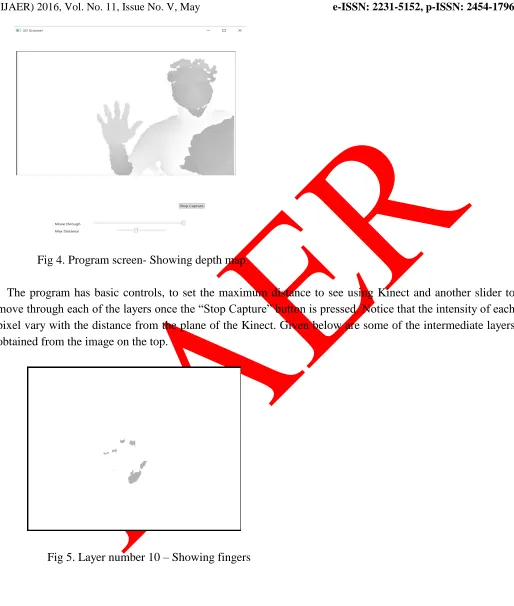
Fig 4. Program screen- Showing depth map
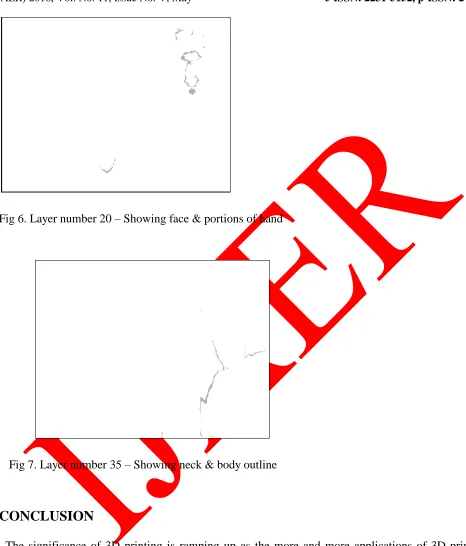
The program has basic controls, to set the maximum distance to see using Kinect and another slider to move through each of the layers once the “Stop Capture” button is pressed. Notice that the intensity of each pixel vary with the distance from the plane of the Kinect. Given below are some of the intermediate layers obtained from the image on the top.
32
INTERNATIONAL JOURNAL OF ADVANCES IN ENGINEERING RESEARCH
Fig 6. Layer number 20 – Showing face & portions of hand
Fig 7. Layer number 35 – Showing neck & body outline
CONCLUSION
33
INTERNATIONAL JOURNAL OF ADVANCES IN ENGINEERING RESEARCH
REFERENCES
[1] Okarma K, “The 3D scanning system for the machine vision based positioning of work pieces on the CNC machine tools”, Methods and Models in Automation and Robotics (MMAR), May 2012.
[2] Jin Zhou, Ligang Liu, Zhigeng Pan, Hao Yan, "Scanning 3D Full Human Bodies Using Kinects", IEEE Transctions Visualization and Computer Graphics, April 2013.
[3] Chaoching Ho, "Machine vision based 3D scanning system", Electronic Measurement & Instruments ICEMI, April 2011.
[4] Xiaoqing Yu, Qingtong Xu, Jing Wang, "Research on 3D scanning point cloud de-nosing", International Conference on Audio, Language and Image Processing (ICALIP), July 2014, Oklahoma, USA.
[5] A. Savini, G.G. Savini, “ A Short history of 3D printing- a technology revolution just started”, History of high technologies and their Socio-Cultural Contexts Conference (HISTELCON), 2015 ICOHTEC/IEEE International.
[6] Jung Su Kim, Dong Soo Kim, Min Cheol Lee, “ 3D printing method of multi piezo head using a photopolymer resin”, Control Automation and Systems (ICCAS '07) International Conference, October 2007.
[7] Yanlin He, Shuxiang Guo, Liwei Shi, Shaowu Pan, Zhe Wang, “3D printing technology - based an amphibious spherical robot”, 2014 IEEE International Conference on Mechatronics and Automation, August 2014.