P
age
12
Defining Indian SMEs: A Critical Analysis
CA Manish Kumar Jain*& Professor Sunil Kumar Gandhi**
*Associate Vice President-Srei Infrastructure Finance Ltd, and Research Scholar, University of Kalyani **Professor, Department of Commerce,University of Kalyani
ABSTRACT:
The Government of India is focusing on Startup and Make in India. But Make in India and Startup India is not possible without contribution from SMEs of India. SMEs could play an important role in Startup and Make in India. An entity is considered as Startup if its turnover for any of the financial years has not exceeded Rs 25 crore. Micro Small and Medium Enterprise Development (MSMED) Act 2006 has defined Micro Small and Medium Enterprise (MSME) based on investment in plant ,machinery and equipment popularly known as 3 tier classification of Indian SMEs. But a need for change in definition of MSMEs in MSMED Act 2006 has been raised by the various stakeholders from time to time. The MSME related Parliamentary Standing Committee on Industry had taken up this issue in its 245th Report and recommended that considering the inflation and dynamic market situation, the definition of MSME as provided in the MSMED Act 2006 may be revised every five years.
In this backdrop the present paper is a narrative account of change in Definition of SMEs in India over a period of time since Independence. Different regulator/law in India has defined SMEs in different ways. This has often created confusion in identification of SMEs in India.In our analysis we have attempted to study the evolution of definition of SMEs after independence and criteria for identification of SMEs in different regulation/law in India.We have attempted to highlight the issues and different approach in defining the SMEs in India .We have concluded that there is need for revision in definition of SMEs in MSMED Act 2006 and alignment of definition of SMEs as per MSMED Act 2006 and different regulation/law in India.
Key Word: MSMED Act 2006, SMEs, Definition, Law, Regulation, Startup and Make in India.
JEL Classification: K20, K22, M48
1. INTRODUCTION:
P
age
13
in India has defined SMEs in different ways. We have attempted to study the evolution of Definition of SMEs in India after independence. The study attempted to highlight the issues and different approach in defining the SMEs in India by different regulator and law. This has often created confusion in identification of SMEs in India.
EVOLUTION OF DEFINITION OF SSI IN INDIA:
In India there was no official definition of SMEs till 1950. In 1950 the Fiscal Commission, Government of India, New Delhi, for the first time defined a small-scale industry (SSI) as, one which is operated mainly with hired labor usually 10 to 50 hands. During that time word used to defined small business was Small Scale Industry (SSI) as the concept of small business was mainly confined to manufacturing sector.
The Industries (Development and Regulation) Act, (IDRA), came into force on 8th May 1952 under a notification of the Central Government published in the Gazette of India. Section 11-B of the Industries (Development and Regulation) Act 1951 has given power to Central Government to specify the definition of SSI in consideration of factors relating to investment of unit in fixed assets, nature of ownership, the number of workers employed ,Nature, cost and quality of products, etc. The Central Government started defining the SSI based on investment in plant and machinery and other criteria. Fixed capital investment in a unit has also been adopted as main criteria to make a distinction between small-scale and large-scale industries. This limit is being continuously raised upwards by the government time to time.
In order to promote small-scale industries in the country, the Government of India set up the Central Small-Scale Industries Organisation and the Small- Scale Industries Board (SSIB) in 1954-55. In 1955 the Small Scale Industries Board defined SSI as as a unit employing less than 50 employees if using power and less than 100 employees if not using power and with a capital asset not exceeding Rs 5 lakhs. The definition of SSI was mainly based on number of employees employed linked with use of power and value of capital assets used by an entity. This limit was revised from time to time to offset the impact of inflation and to meet the technological needs.The definition of SSI and Ancillary units undergo changes with the development of the economy. The table below depicts the evolution in definition of SSI over period of time
Table 1 : Change in Eligibility Criteria of SSI Over a Period of Time
Year SSI Ancillaries Tiny
1950 Gross Investment in Fixed Assets uptoRs 5 Lacs and employing less than 50 workers per day with the use of power/ less than 100 workers per day without the use of power
Not Defined Not Defined
1958 Gross Investment in Fixed Assets uptoRs 5 Lacs and employing less than 50
P age
14
workers per shift with the use of power/ less than 100 workers per shift without the use of power
1959 The clarity was given on investment. It was clarified that the price paid for machinery was original price paid irrespective of machine is old or new
Not Defined Not Defined
1960 Gross Value of Fixed Assets uptoRs 5 Lacs and Employment criteria was dropped.
Gross Value of Fixed Assets uptoRs 10.
Not Defined
1966 Gross Value* of Fixed Assets uptoRs 7.5 Lacs
Same as above. Not Defined
1975 Gross Value of Fixed Assets uptoRs 10
Gross Value of Fixed Assets uptoRs 15
Not defined.
1977 Gross Value of Fixed Assets uptoRs 10
Gross Value of Fixed Assets uptoRs 15
UptoRs 1 Lacs
1980 Gross Value of Fixed Assets uptoRs 20
Gross Value of Fixed Assets uptoRs 25
Upto 2 Lacs (for units located in rural area/towns with maximum population of 50000( as per 1971 census)
1985 Gross Value of Fixed Assets uptoRs 35
Gross Value of Fixed Assets uptoRs 45
Upto 2 Lacs(for units located in rural area/towns with maximum population of 5 Lacs as per 1981 census)
1991 Gross Value of Fixed Assets uptoRs 60
Gross Value of Fixed Assets uptoRs 75
UptoRs 5 Lacs
1997 Gross Value of Fixed Assets uptoRs 3 crs
Gross Value of Fixed Assets uptoRs 3 crs
UptoRs 25 Lacs
1999 Gross Value of Fixed Assets uptoRs 1 crs
Gross Value of Fixed Assets uptoRs 1crs
UptoRs 25 Lacs
Source: Own compilation
*Gross Value=Original Value of Plant and Machinery from year 1966 onwards.
P
age
15
based on investment in Plant and Machinery. In 1960 the concept of Ancillaries Industry was first time introduced in India. The concept of tiny enterprises was recognized by Government in 1977.
The Industry related business-oriented service enterprises were classified for the first time as Small-scale Service Establishments (SSSEs) in 1985 (investment in Fixed Assets excluding land and building is uptoRs 2 Lacs) and later in 1991 redefined as Small-scale Service and Business (industry related) Enterprises (SSSBEs) as having investment in Gross Value of Fixed Assets not more than Rs 5 lacs. However, enterprises like education, transportation, Hotels, Legal Service, Social Services etc were not considered as SSSBEs during that time.
MICRO, SMALL & MEDIUM ENTERPRISES DEVELOPMENT (MSMED) ACT, 2006:
This Act has introduced service sector in the definition of Micro, Small & Medium enterprises and extended the scope to medium enterprises. In accordance with the provision of Micro, Small & Medium Enterprises Development (MSMED) Act, 2006 the Micro, Small and Medium Enterprises (MSMED) are classified into two Classes i.e manufacturing Enterprises and Service Enterprises. The Manufacturing Enterprises is engaged in the manufacture or production of goods pertaining to any industry specified in the first schedule of the industries (Development and regulation) Act, 1951) or employing plant and machinery in the process of value addition to the final product having a distinct name or character or use. It is defined in terms of investment in Plant & Machinery. The Service Enterprises is engaged in providing or rendering of services and are defined in terms of investment in equipment.
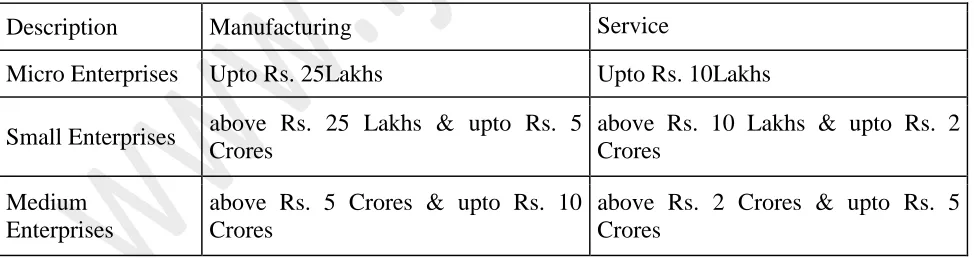
The MSMED Act 2006 has classified manufacturing and service MSMEs into micro, small and medium enterprise based on investment in plant, machinery and equipment popularly known as 3 tier classification of Indian MSMEs, which is summarized in the below table:-
Table 2 : 3 Tier Classifications of Indian MSMEs
Source: http://www.dcmsme.gov.in/ssiindia/defination_msme.htm viewed on 19-05-2016
The above 3 tier classifications were based on investment in Plant and Machinery or equipment irrespective of volume of turnover of the enterprise and number of employee employed by the business entity.
Description Manufacturing Service
Micro Enterprises Upto Rs. 25Lakhs Upto Rs. 10Lakhs
Small Enterprises above Rs. 25 Lakhs & upto Rs. 5 Crores
above Rs. 10 Lakhs & upto Rs. 2 Crores
Medium Enterprises
above Rs. 5 Crores & upto Rs. 10 Crores
P
age
16
AMENDMENTS PROPOSED MSMED ACT 2006 IN 2015:
A need for change in definition of MSME in MSMED Act 20016 has been raised by the various stakeholders from time to time. The MSME related Parliamentary Standing Committee on Industry had taken up this issue in its 245th Report .They had recommended that considering the inflation and dynamic market situation, the definition of MSME as provided in the MSMED Act 2006 need to be revised every five years. Further, in its 258th Report, it had recommended that the Act should be amended to make definition flexible. Ministry of MSME has accordingly decided in November 2014 for amendment to the MSMED Act, 2006 to double the investment limits of micro and small enterprises and triple the investment limits of medium scale enterprises. The existing limits of investment were fixed in 2006 under the MSMED Act. Since then, there has been a significant increase in the price index and cost of inputs. The indices have roughly doubled since 2006. The Union Budget 2014-15 has also announced review of definition of MSME to provide for higher capital ceiling ( Government of India, (2014), http://msme.gov.in/WriteReadData/Whatsnew/Letter-Secretaries-States-UT.PDF ).
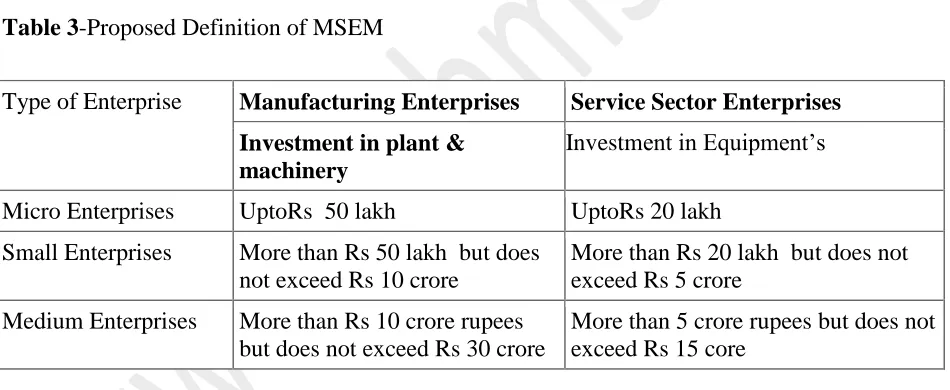
The MSME (Amendment) bill 2015 was introduced in Lok Sabha on 20th April 2015. The below table depict the proposed definition of MSME in the MSME (Amendment) bill 2015:-
Table 3-Proposed Definition of MSEM
Type of Enterprise Manufacturing Enterprises Service Sector Enterprises Investment in plant &
machinery
Investment in Equipment’s
Micro Enterprises UptoRs 50 lakh UptoRs 20 lakh
Small Enterprises More than Rs 50 lakh but does not exceed Rs 10 crore
More than Rs 20 lakh but does not exceed Rs 5 crore
Medium Enterprises More than Rs 10 crore rupees but does not exceed Rs 30 crore
More than 5 crore rupees but does not exceed Rs 15 core
Source: Background Note on Micro Small & Medium Enterprises Development (Amendment) Bill, 2014 - Special dispensation for revival and exit of MSMEs available at http://msme.gov.in/WriteReadData/Whatsnew/Letter-Secretaries-States-UT.PDF viewed on 30-03-2016 at 12.45 PM
P
age
17
SOCIAL LEGISLATURE AND SSI:
Social legislation such as labour laws, Provident Fund and medical insurance apply for entity employing workers between 10 to 20.The Factories Act, 1948 is applicable to the industries employing more than 10 workers with power and employing 20 workers without power on any day of the preceding twelve months and are engaged in manufacturing process. There is no concept of SSI in Social Legislature.
The Employees Provident Fund and Miscellaneous Provisions Act 1952 is applicable to business entity employing more than 20 or more people (in case of Cinema Theatres employing 5 or more persons) and there is no concept/protection of SMEs in Employees Provident Fund and Miscellaneous Provisions Act.
Employee's State Insurance Scheme has been extended to shops, hotels, and restaurants, cinemas including preview theatres, road-motor transport undertakings and newspaper establishments employing 20 or more person’s .However 14 State Govts. / UTs have reduced the threshold limit for coverage of shops and other establishments from 20 to 10 or more persons (http://www.esic.nic.in/coverage.php viewed on 19-05-2016).
The Social Legislature in India does not define SSI or MSME neither there is any provision for any relief for SSI in social legislature.
THE NATIONAL SAMPLE SURVEY ORGANIZATION:
The industrial sector is one of the important sectors of the Indian economy and hence compilation of industrial statistics assumes a crucial importance, both for research and policy-making. The National Sample Survey Organization under the Central Statistical Organization (CSO) Government of India is entrusted with this task .It defines the entire industrial sector in terms of organized and unorganized segments and also in terms of industrial enterprises run by the households and no households. There is no concept of SME/MSMEs in the National Sample Survey Organization and it collected data on the basis of organized sector and unorganized sector.
STARTUP ENTITY:
P
age
18
they are not eligible for Startup Entity as Startup Entity must be Private Limited Company or Registered Partnership Firm or Limited Liability Partnership.
PLANNING COMMISSION:
The Planning Commission, Government of India considered the entire village and small industrial sector (VSI) as SSI Sector. Small Scale Industry is part of large village and small industries sector which consists of traditional industries and small scale industries. The VSI sector is divided into nine sub-sectors, namely, Khadi, Village Industries, Handlooms, Sericulture, Handicrafts, Coir, Artisans, Small Scale Industries and Power looms. The small scale Industries and Power looms are the modern small industries and the other seven sub-sectors mentioned above constitute traditional industries as per planning commission. The Small Scale Industry is further divided into four sub category viz: Export Oriented, Ancillaries, Tiny Enterprises and Small Scale Service and Business Enterprises.
NitiAyoog:-The Government has replaced Planning Commission with a new institution named
NITI Aayog (National Institution for Transforming India). The institution will serve as ‘Think Tank’ of the Government-a directional and policy dynamo. The aim of the NITI Aayog is to give policy support to 5 crore Small enterprises to generate more employment for weaker sections but Small enterprises is not defined by NITI Aayogdirectly.NITIAayog has also not defined MSMEs.
It is clear that Planning Commission/NitiAayog has not defined clearly and directly SMEs.
CENTRAL EXCISE ACT 1944:
The term SSI is not defined in the Excise Act 1944. However notification no 8/2003 dated 1-3-2003 gives concession/exemption to SSI from excise duty subject to certain conditions. The manufacturer is eligible for exemption from excise duty upto turnover of Rs 1.50 crores during the current year if turnover during the previous year does not exceed Rs 4.00 crores. As SSI is not defined in the Act it is presumed that all industries irrespective of their investment or number of employee are eligible for concession. However if the item is not covered in the above notification SSI exemption will not be available. Thus SSI definition in central excise Act is different from MSME Act 2006. It is based on turnover of the entity during the previous year but MSME Act 2006 definition of MSME is based on investment in Plant and Machinery or Equipment.
COMPANIES ACT 2013:
P
age
19
ACCOUNTING STANDARD:
SMEs are defined in Accounting Standard issued by Institute of Chartered Accountant of India as level II or level III entities within the meaning of Accounting Standard issued by the Institute of Chartered Accountant of India (ICAI).
Enterprises which fall in any one or more of the following categories, at any time during the accounting period, are classified as Level I enterprises:
a. Enterprises whose equity or debt securities are listed whether in India or outside India.
b. Enterprises which are in the process of listing their equity or debt securities as evidenced by the board of directors' resolution in this regard.
c. Banks including co-operative banks. d. Financial institutions.
e. Enterprises carrying on insurance business.
f. All commercial, industrial and business reporting enterprises, whose turnover for the immediately preceding accounting period on the basis of audited financial statements exceeds Rs. 50 crore. Turnover does not include 'other income'.
g. All commercial, industrial and business reporting enterprises having borrowings, including public deposits, in excess of Rs. 10 crore at any time during the accounting period.
h. Holding and subsidiary enterprises of any one of the above at any time during the accounting period.
Enterprises which are not Level I enterprises but fall in any one or more of the following categories are classified as Level II enterprises
i. All commercial, industrial and business reporting enterprises, whose turnover for the immediately preceding accounting period on the basis of audited financial statements exceeds Rs. 40 lakhs but does not exceed Rs. 50 crore. Turnover does not include 'other income'.
ii. All commercial, industrial and business reporting enterprises having borrowings, including public deposits, in excess of Rs. 1 crore but not in excess of Rs. 10 crore at any time during the accounting period.
iii. Holding and subsidiary enterprises of any one of the above at any time during the accounting period
Enterprises which is not Level I and Level II enterprise are Level III enterprise. The Level II and Level III enterprise are different from MSMEs as per MSMED Act 2006.
COMPANIES (ACCOUNTING STANDARDS) RULES, 2006/2016:
P
age
20
which does not have borrowings (including public deposits) in excess of rupees ten crore at any time during the immediately preceding accounting year; and (v) which is not a holding or subsidiary company of a company which is not a small and medium-sized company. The Companies (Accounting Standards) Rules, 2006 rule is applicable for company and not to other form of business entity like partnership or proprietorship. The Companies (Accounting Standards) Rules does not recognize micro entity and there is no concept of micro entity in Companies Act. On 30th March 2016 government has notified that (Accounting Standards) Rules 2006 rules may be called the Companies (Accounting Standards) Amendment Rules, 2016. The definition of SMC has not changed in the Companies (Accounting Standards) Amendment Rules, 2016.
BANK/RBI SMES:
RBI has adopted the same definition of MSME as per MSMED Act 2006 for purposes of bank credit vide RBI circular ref. RPCD.PLNFS. BC.No.63/ 06.02.31/ 2006-07 dated April 4, 2007. Hence RBI definition of MSME and MSMED Act 2006 definition of MSME is same. However RBI does not recognize micro, small and medium enterprise for the purpose of priority sector lending. The priority sector lending of Banker depends upto sector of funding and not on type of business entity. However few banks have opened branches specially designated for micro, small and medium enterprises.
STOCK EXCHANGE & SSI:
The stock exchange does not define directly the term SSI. The Prime Ministers task force (2010) has recommended setting up dedicated stock exchange/Platform for SMEs. There is SME platform in BSE & NSE.BSE is the first stock exchange in the country to receive final approval from SEBI to launch SME platform. In BSE an issuer with post issue face value capital between Rs 1 crores to 10 crores will be invariably covered under SME platform. However issuer with post issue face value capital between Rs 10 crores to Rs 25 crores may get listed either on SME platform or mainboard. The net tangible assets and Net worth of the company to be at least one crores as per latest audited financial result for listing at SME platform. Similarly the SME platform of the NSE shall be open for SMEs whose post issue paid up capital shall be less than or equal to Rs.25 crores. The SMEs platform listing criteria of BSE & NSE is in compliance of guideline issue by SEBI.
P
age
21
SECURITIES AND EXCHANGE BOARD OF INDIA (SEBI):
It does not directly define SMEs. But SEBI, through its circular dated May 18, 2010, laid down framework for setting up a stock exchange/ trading platform dedicated to SMEs. Chapter XB of the Securities and Exchange Board of India (Issue Of Capital And Disclosure Requirements) Regulations defines SME Exchange as a trading platform of a recognized stock exchange or a dedicated exchange permitted by SEBI to list the securities issued in accordance with Chapter XA of SEBI (ICDR) Regulations and this excludes the Main Board .To be listed on the SME Exchange, the post-issue paid up capital of the company should not exceed INR 25 Crore. Thus the meaning of SME in in the Micro, Small and Medium Enterprises Development Act, 2006 is different from that the SME Exchange criteria for listing of SMEs.
SERVICE TAX :
In Service Tax MSMEs/SMEs are not defined. However notification no 33/2012 dated 20th June 2012 gives exemption to a small service provider from service tax upto aggregate value of taxable service not exceeding Rs 10 Lacs in the subsequent financial year. An entity is treated as small service provider if turnover of the preceding financial year is uptoRs 10 lacs. In Service tax the concept of small service provider is based on the turnover and not aligned with MSMED Act 2006 definition of MSMEs which is based on Investment.
VALUE ADDED TAX (VAT):
VAT is state law and different state has prescribed different threshold limit based on turnover for giving exemption to small business. But none of the Sate VAT law has defined SMEs clearly and directly. The definition of small business in different State VAT is based on turnover. The white paper on VAT in order to provide relief to small business states that registration for VAT will not be compulsory for dealer below threshold turnover of Rs 5 Lacs and it is optional for small business to register. The empowerment committee subsequently raised the limit of registration under VAT from Rs 5 Lacs to 10 Lacs. In VAT there is composite scheme of taxation based on small percentage of turnover for dealer having the prescribed turnover. The composite scheme is designed to give benefits to small dealer having prescribed turnover. Small dealer having turnover exceeding Rs 5 lacs but less than 50 lacs have option of composite scheme. In West Bengal the threshold turnover for composite scheme is Rs 50 lacs. In composite scheme dealer are required to pay prescribed percentage of tax on the turnover of the dealer. The VAT law in different state is not aligned with MSMED Act 2006 definition of SMEs and it based on turnover.
INCOME TAX ACT 1961:
P
age
22
business for the year. The scheme is not available to company. Also Start-ups will not be required to pay income tax on their profits for the first three years, and will also be exempt from capital gains tax. In Income Tax Act there is no concept of MSMEs in India.
GOODS AND SERVICE TAX( GST) :
The term SMEs is not defined in the proposed draft GST bill in India. In the first discussion paper on GST it is mentioned that the threshold prescribed in different State VAT Acts below which VAT is not applicable varies from State to State. A uniform State GST threshold across States is desirable and, therefore, it is considered that a threshold of gross annual turnover of Rs.10 lakh both for goods and services for all the States and Union Territories may be adopted with adequate compensation for the States (particularly, the States in North-Eastern Region and Special Category States) where lower threshold had prevailed in the VAT regime to exempt small business from GST. Keeping in view the interest of small traders and small scale industries and to avoid dual control, the States also considered that the threshold for Central GST for goods may be kept at Rs.1.5 crore and the threshold for Central GST for services may also be appropriately high. It may be mentioned that even now there is a separate threshold of services (Rs. 10 lakh) and goods (Rs. 1.5 crore) in the Service Tax and CENVAT (The Empowered Committee of State Finance Ministers, 2009, page xxii). The draft GST bill is also not aligned with MSMES Act 2006 definition of SMEs.
OECD :
As per OECD Glossary of Statically term Small and medium-sized enterprises (SMEs) are non-subsidiary, independent firms which employ fewer than a given number of employees. This number varies across countries. The most frequent upper limit designating an SME is 250 employees, as in the European Union. However, some countries set the limit at 200 employees, while the United States considers SMEs to include firms with fewer than 500 employees. Small firms are generally those with fewer than 50 employees, while micro-enterprises have at most 10, or in some cases 5, workers.
WORLD BANK AND SMES :
The World Bank recognized an entity as MSME when it meets two of the three criteria – employee strength, size of assets, or annual sales mentioned in the below table :
Table 4: World Bank Criteria for MSMEs.
Type of entity Employee Assets Annual Sales
Micro <10 ≤USD 10,000 ≤USD 10,000
Small <50 ≤USD 3 Million ≤USD 3 Million
Medium <300 ≤ USD 15 Million ≤USD 15 Million
P
age
23
GLOBAL FINANCIAL MARKETS:
The global financial system facilitates international flows of financial capital for purposes of investment and trade financing .It is the worldwide framework of legal agreements and institutions. It categorizes its clients’ sub-borrowers according to the following definitions: (1) Microenterprise if loan < US$10,000 at origination (2) Small Business if loan < US$100,000 at origination (3) Medium Business if loan is <USD $1 million at origination (<USD $ 2 million for more advanced countries)(IFC, 2012, page 1).
ANALYSIS CRITERIA OF DEFINITION OF MSMES :
On the basis of above discussion we have plotted in the below table criteria for SMEs as per different regulation/law in force in India:-
Table 5: Criteria for MSMEs as per Different Regulation/Law in India Name of
Law/Regulation/Regulator
Micro Enterprise Defined/Recognized Separately
Basis of Defining SMEs
Employee Turnover Bank Loan
Investment
MSMED Act 2006 Yes - - - Yes
Social Legislature No Yes
National Sample Survey Organization
NO - - - -
Planning Commission - - - - -
Start Up Entity No Yes
Central Excise Act 1944 No Yes
Companies Act 2013 No Yes Yes-Paid
up capital
Accounting Standard No Yes Yes
Companies (Accounting Standard )Rules
2006/2013
No Yes Yes
RBI Yes Yes
Stock Exchange No Yes-Paid
up Capital
SEBI -Do
Income Tax Act 1961 No - - - -
Proposed GST No Yes
Service Tax Act No Yes
VAT No Yes
OECD No Yes
World Bank Yes Yes Yes
Global Financial Market Yes Yes -
P
age
24
On the basis of above analysis it is very clear that MSMED Act 2006 definition of MSME is not aligned with definition of MSMEs as per other regulator /law in India. Most of the regulation in India defines SME on the basis of turnover. The concept of micro enterprise is not recognized in other regulation/law in India other than MSMED Act 2006.The definition of SMEs on the basis of turnover is having limitation when value of one unit of product is very high especially in case of heavy machinery and other equipment. If we define the MSME on the basis of turnover it is necessary to link the different threshold of turnover for different Industry to overcome the aforesaid limitation. The MSMEs definition based on number of employees is not very correct way as in some places labor is cheap and hence more employment of labour for the purpose of business. Also number of labour employed in Business will not always reflect growth of business. There are some business which is labour intensive business and even at small scale level large number of labour are required. In service sector employment of manpower are high even at small scale level. Although investments in plant and machinery are tangible and measurable but it is not the correct way to define the MSMEs as there are some business which is highly capital intensive and even at small scale level it needs huge capital investment.
CONCLUSION:
The term used for small business was Small Scale Industry during 1950s as it was mainly confined to manufacturing sector. In MSMED Act 2006, the concept of micro enterprise and small service sector was introduced first time in India. The government startup India and made in India has not align with definition of MSMEs in MSMED Act 2006. It has over 11 years since MSMED Act 2006 came into force but there is no revision in the definition of Small business in MSMED Act. MSMED Act 2006 definition may be revised from investment to turnover basis as most of the law and regulation in India defines Small business on the basis of turnover, employees and size of the Bank loan. The criteria of defining a business as small or big on the basis of turnover will support the business to grow at the initial stage when turnover will be low even investment is high. However, it has one limitation in Industry where value of one unit of product is very high especially in case of heavy machinery and other equipment even small and micro entity will have high turnover. It is necessary to bring industry wise threshold of turnover to overcome the aforesaid limitation. There is need to redefining the SMEs on the basis of industry wise threshold of turnover.We conclude that there is need for revision of definition of SMEs in MSMED Act 2006 and alignment of SMEs definition of MSMED Act 2006 and other regulation/law in India to overcome the identification problem of SMEs.
REFERENCES :
i. MEDC Economic Digest, (2001), Small & Medium Enterprises in India-Local Strength to Global Reach, pp-49
ii. The Empowered Committee of State Finance Ministers, 2009, First Discussion Paper on Goods and Service Tax, New Delhi, page xxi.
P
age
25
http://www.ifc.org/wps/wcm/connect/de7d92804a29ffe9ae04af8969adcc27/Interpretation Note_SME_2012.pdf?MOD=AJPERES on 16-05-2016 at 7.55
iv. Ministry of Micro Small and Medium Enterprise, GoI (2013-14).Annual Report, New Delhi, 255-258
v. Government of India, (2014), Ministry of Micro, Small and Medium Enterprises letter dated 20th November 2014 electronic copy available at http://msme.gov.in/WriteReadData/Whatsnew/Letter-Secretaries-States-UT.PDF viewed on 18-01-2016 at 17.46
vi. Government of India, Ministry of Micro Small & Medium Enterprise,2014, Background Note on Micro Small & Medium Enterprises Development (Amendment) Bill, 2014 - Special dispensation for revival and exit of MSMEs available at http://msme.gov.in/WriteReadData/Whatsnew/Letter-Secretaries-States-UT.PDF viewed on 30-03-2016 at 12.45 PM
Websites
i. http://www.dcmsme.gov.in/ssiindia/defination_msme.htm viewed on 19-05-2016 at 17.24
ii. http://dcmsme.gov.in/publications/reserveditems/resvex.htm viewed on 13-01-2016 at 2.00 PM
iii. http://dcmsme.gov.in/publications/reserveditems/itemrese.htm viewed on 21-01-2016 at 6.15 AM
iv. www.dcmsme.gov.in/publications/circulars/Notification79items.pdfviwed on 25-04-2016 at 2.23.