CUT CHECKOUT WAITING TIME IN SUPERMARKET
USING QR CODE TECHNOLOGY [RAPP KART]
Rajat Lutade, Ankoor Tathe, Pankaj Kulkarni,
Prabhakar Guttargi,Prof. V.V.Dakhode.
Department of Computer Engineering
Smt. Kashibai Navale COE, Vadgaon, Pune, India
Abstract: RAPP stands for Rajat, Ankoor, Prabhakar and Pankaj are the group/team members for BE Project performing entrepreneurship Project. After negotiating busy supermarket aisles, you often have to pick the queue you think will move fastest to stand a chance of getting your shopping home before the ice cream melts. Now days purchasing and shopping at big malls is becoming a daily activity in metro cities. We can see huge rush at malls on holidays and weekends. The rush is even more when there are special offers and discount. People purchase different items and put them in trolley. After total purchase one needs to go to billing counter for payments. At the billing counter the cashier prepare the bill using bar code reader which is a time consuming process and results in long queues at billing counters. But this tedious ritual may become a thing of the past thanks to sensors embedded into the wheel of trolleys. Our aim is to develop a system that can be used in shopping malls to solve the above mentioned challenge. The system will be placed in all the trolleys. It will consist of a QR Code reader. All the products in the mall will be equipped with QR-Codes. When a person puts any products in the trolley, its code will be detected and the price of those products will be stored. Thus the billing will be done in the trolley itself. Item name and its cost will be displayed on local display.
Index Terms: QR code, QR code readers, QR code tags, Sensors, Local display, Trolleys, Embedded System.
1. INTRODUCTION
In the modern world, every supermarket employ shopping baskets and shopping trolleys in
order to aid customers to select and store the products which they intend to purchase. The main motivation behind this project idea is to JUMP the long payment queue in shopping malls. To increase productivity time as well as resource utilization. The customers have to drop every product which they wish to purchase into the shopping cart and then proceed to
checkout at the billing counter. The billing process is quite highly time consuming.
Today’s
Journal homepage: www.mjret.in
most common issues in Shopping mall is of payment queues. Even though, malls provide 10-12 outage, but still in rush hours it is very heavily loaded, and users need to wait for 30
minutes to 60 minutes in queue. This problems are most common in “Big-Bazar”,”D-Mart”
like supermarkets.
The system will be placed in all the trolleys. It will consist of a QR code reader. All the products in the mall will be equipped with QR-Codes. When a person puts any products in the trolley, its code will be detected and the price of those products will be stored. Thus the billing will be done in the trolley itself. Item name and its cost will be displayed on local display.
2. LITERATURE SURVEY
We had visited few of the shopping malls for collecting the present working methodologies and technologies used.
2.1 1D and 2D Barcode to capture product info
A barcode is an optical machine-readable representation of data relating to the object to which it is attached (Refer Fig.1). Still (1D) barcode system are used in super-market for reading the product information. Generally, in supermarket the cashier scan the product using (1 or 2) D scanner device and displayed on the screen. [2]
Figure 1: 2D bar code
Barcodes became commercially successful when they were used to automate supermarket checkout systems, a task for which they have become almost universal. Their use has spread too many other tasks that are generically referred to as Automatic identification and data capture (AIDC). The very first scanning of the now Ubiquitous Universal Product Code (UPC) barcode was on a pack of Wrigley Company Chewing gum in June 1974.
At Store: This process is much time consuming for cashier. Some of the scanner read the barcode in correct alignment only. Multiple grid barcode is alternative for 1D or 2D barcode scanner where the alignment of product during scanning doesn’t makes any difference.
2.2 Using NFC (Near Field Communication) technology
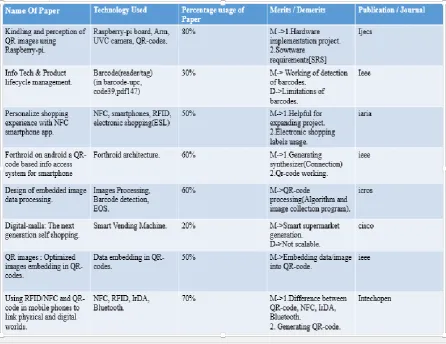
2.3 GAP Analysis:- For refference paper. (Refer Fig.2)
Figure 2: GAP Analysis
3. SYSTEM ARCHITECTURE
3.1 Representational State Transfer (REST)
REST is the software architectural style of the RAPP Kart (Refer Fig.1). REST gives a coordinated set of constraints to the design of components i.e. n trolleys in a distributed hypermedia system that can lead to a higher performing and more maintainable architecture i.e. Server of the Shopping Mall. To the extent that systems conform to the constraints of REST they can be called RESTful. RESTful systems typically, but not always, communicate over the Hypertext Transfer Protocol with the same HTTP verbs (GET, POST, PUT, DELETE, etc.) which web browsers use to retrieve web pages and to send data to remote servers. REST interfaces usually involve collections of resources with identifiers.
Performance- component interactions can be the dominant factor in user perceived
performance and network efficiency of Project.
Scalability-to support large numbers of components and interactions among components.
Simplicity- of interfaces. Modifiability- of interfaces. Portability-of components i.e. trolleys by moving program code with the data.
4. SET THEORY ANALYSIS
A) Let S be the RAPP Kart S= (...).
Set S is divided into 6 modules S= S1, S2, S3, S4, S5, S6 S1= Client HW (CHW) S2= Order Logic (OL)
S3= Communication Manager (CM) S4= Camera Module (CM)
S5= Database Manager (DM) S6= QrCode Reader/Writer (QRW) B) Identify the inputs I
Inputs = X1, X2, X3, ....Xn X1= Product Order
X2= Product Details via QR-Code C) Identify the output as O
Outputs = Y1, Y2, Y3, ....Yn Y1= Payment Transaction Y2= Payment Receipt
5. CONCLUSION
6. FUTURE SCOPE
We can provide application to user such that they can scan the product using their
phone.
The system can be upgraded to include interfacing with GSM which will help to get
information about transaction on mobile.
Also the transaction and billing system can be linked with bank account of individual
user to make direct payment provided that security issues are being taken care of.
Also the trolley can be further designed to search products in shelves and guide the
user accordingly to the position of the exact product by locating the products required by user.
REFERENCES
[1]. Raju Kumar, K. Gopalakrishna, K. Ramesha on “Intelligent Shopping Cart” in International Journal of Engineering Science and Innovative Technology (IJESIT) Volume 2, Issue 4, July 2013
[2]. Kindiling And Perception Of Qr-Images Using Raspberry-PI 1P.V.Vinod Kumar, 2K.Dhanunjaya-International Journal Of Engineering And Computer Science ISSN:2319-7242 Volume 4 Issue 7 July 2015, Page No. 13082-13085
[3]. International Journal of Computer Applications (0975 – 8887) International Conference on Communication, Computing and Information Technology (ICCCMIT-2014)