Modeling of Efficient Multi-Agent based Mobile
Health Care System
Sandeep Kumar Polu PG Student
Department of Information Technology Acharya Nagarjuna University, India
Abstract
In this paper, I present a multi-agent based versatile healthcare system which is the blend of a remote restorative sensor module with data mining strategies. Versatile Health Care is the use of mobile computing techniques for enhancing interaction among patients, caretakers, doctors, and other healthcare providers. Here we separate association rule investigation into two information groups. The first one data collected from the patient's body using smart sensors and the second one the patient's health history gathered in the past. This framework gathers the diagnosis patterns, orders them into typical and crisis terms and announces an emergency by contrasting the two information groups as referred to before. Therefore, recommends techniques to examine and demonstrate examples of a patient's health condition.
Keywords: Multi-Agent System, Data Mining, Body Sensors, Smart Health, Health Care System
_______________________________________________________________________________________________________
I. INTRODUCTION
Health care is portrayed by a high level of distributed, labor-intensive works, portability, and data access to an expansive set of dynamic and unstructured data, distributed over a large number of information systems. The approach of the Internet and the advancement of information technologies advance the improvement of Internet-based applications that endeavor to make successful the remote association between medicinal service providers and their patients and among health- care providers and to automatize the securing, exchange and analyzing of data disseminated in heterogeneous information systems.
Multi-agent frameworks provide the most encouraging data innovation for adapting to a class of issues (i.e., remote and heterogeneous programming applications integration, distributed task execution, system coordination, and remote observing and assistance) which are commonplace issues of the vast piece of Internet-based health services applications.
The smart gadgets like mobiles, laptops, smart wearables, and so forth have made ubiquitous computing conceivable i.e. they are accessible anyplace at any time. Pervasive computing is utilized in health centers, crisis, and critical circumstances, industry, or healthcare training centers. Here we proposed a Multi-Agent based mobile healthcare System which is the mix of a restorative sensor module and remote monitoring technology as coordination of mobile computing to pervasive health services. By looking at patient's historical information and ongoing tangible information it furnishes the patients with more quick-witted and more customized means through which they can get health feedback which will spare their significant time and lower the expense of long-haul medical care.
II. RELATED WORK
Multi-Agent System
A multi-agent framework is a loosely coupled system of problem-solving elements (agents) that cooperate to discover answers to issues that are beyond the individual capacities or knowledge of every element (agent).
The way that the agents inside a multi-agent framework together infers that a sort of collaboration among individual agents is to be included. In any case, the idea of collaboration in MAS is at best unclear and at worst highly inconsistent, with the goal that the terminology, conceivable classifications, and so forth. Are much trickier than in the case of agents what makes any endeavor to display multi-agent system a difficult issue.
Fundamental focal points of the multi-agent system are robustness and versatility. Robustness alludes to the capacity that if responsibilities and control are adequately shared among agents inside a multi-agent system, the framework can endure failures of one or more agents. The versatility of the multi-agent system starts from its measured quality. It ought to be simpler to add new agents to a multi-agent system than to add new abilities to a monolithic framework.
The LEAP (Lightweight Extensive Agent Platform) is a multi-agent framework that runs consistently on both portable and fixed devices over both remote and wired systems. In our proposed design we take a favorable position of both remote and multi-agent design for the utilization of portable medicinal services.
Fig. 1: Multi-Agent System for Decision Support
Sensor Technologies in Healthcare
Sensor innovations have started to enter the telehealth services and are basically centered on consistent observing and exact diagnostics to illuminate administration of different wellbeing conditions and diseases. Advancements in portable and electronic medicinal services are changing the inclusion of both health specialists and patients in the cutting-edge healthcare system by broadening the capacities of physiological monitoring gadgets. Extension of health data innovation and consumer smart health devices and services, for example, tele monitoring service and smart mobile health applications, have made new open doors for people to take an interest effectively in their healthcare and gives the chance to the remote observing of clinically pertinent factors in non-clinical settings. These gadgets can be coordinated into routine consideration of intense and chronic diseases and give fundamental data to management to both the health service providers and patients.
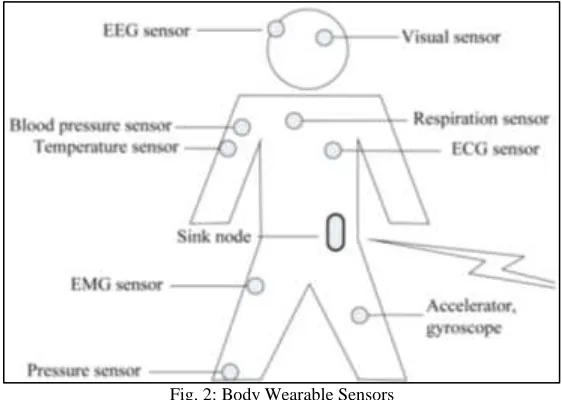
Wearable smart gadgets can screen and record continuous data about one's physiological condition and movement activities. Wearable sensor-based health checking systems may involve distinctive sorts of adaptable sensors that can be incorporated into the textile fiber, garments, and wristbands or specifically connected to the human body. The sensors are fit for estimating physiological signs, for example, electrocardiogram, body temperature, pulse, blood vessel oxygen immersion, circulatory strain, and breath rate.
Fig. 2: Body Wearable Sensors
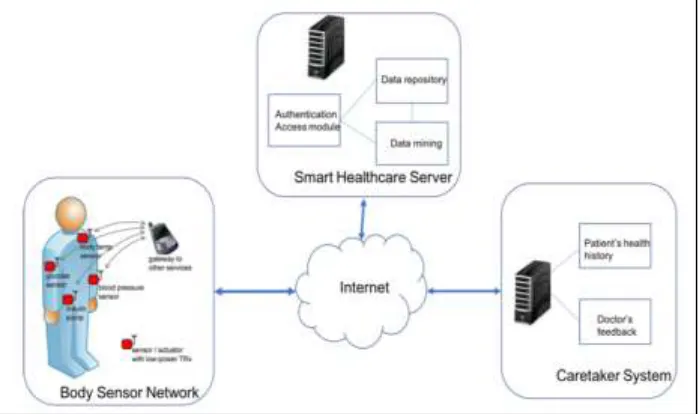
Fig. 3: System Architecture
Body Sensor Network
In Body Sensor Network (BSN) sensors are connected to body territory with the end goal to catch bio-signals, including body temperature, heartbeat, breathing and blood pressure. It is, for the most part, partitioned into two sections i.e., Remote Body Area Network and PMD.
Remote Body Area Network
The wearable Body Sensor Network is shaped of wearable or implantable bio-sensors in patient's body. The sensors gather fundamental readings from the patient's body and send to the central hub in a type of low recurrence electromagnetic waves.
Health Monitoring Devices (HMD)
The patient's Health Monitoring Devices can be smart wearables or smart sensors or smartphone. It gets data from Remote Body Area Network by methods of Bluetooth or ZigBee. It contains rationales to decide if to send this data to Smart Healthcare Server (SHS) or not. The patient’s Health Monitoring Devices will act as a requester and The Smart Healthcare Server will act as a service provider.
Smart Healthcare Server (SHS)
Smart Healthcare Server gets data from the Body Sensor Network. It fills in as a center between the patient and caretaker's facility. It is the main part of the whole framework and is equipped for taking in patient's particular thresholds. A specialist decides if a patient is in a critical condition dependent on restorative information exchanged from the Body Sensor Network. In case it is resolved that there is a health emergency, the health data is sent to the Caretaker System for approving emergency measures, after being saved in the SHS framework. On the off chance If it is not an emergency, the health information is just put away in the Smart Healthcare Server. For information put away in the SHS, vital information is frequently saved to the central database of the doctor's facility. This continuous information will be erased after a specific timeframe except if there is a requirement. Information put away in the Smart Healthcare Server is accessible to the healthcare specialists and care staff in the clinic.
Caretaker System
The third sub-system is a Caretaker System. In the event that vital, patient's data is enrolled, recovered, changed, refreshed and erased by specialists, patients, and caretakers. Contingent upon the Smart Healthcare Server's analysis reports the doctor will take the preventive or restorative activities for the patient.
IV. MULTI-AGENT SYSTEM DESIGN
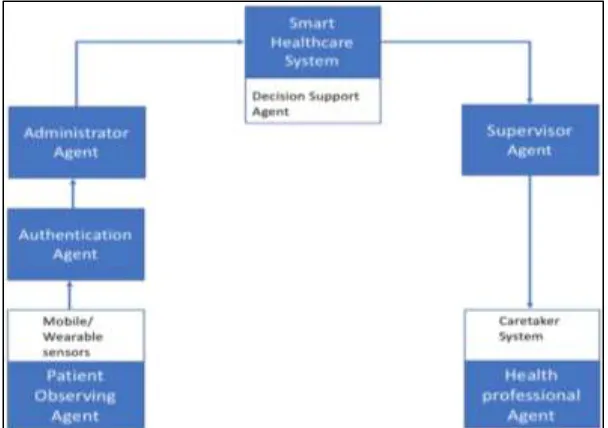
Fig. 4: Block Diagram of Proposed Multi-Agent System
Patient Observing Agent
The Patient Observing Agent works on a smart mobile or internet enabled smart system with the accompanying capacities: Firstly, it utilizes sensors to collect medicinal information from a patient, and fringe information, including temperature and humidity. Besides, it exchanges the identified information alongside insights about the sender and gadget data to an SHS through the administrative agent. Thirdly, it conveys a health specialist's diagnosis and findings to his patient through the visual interface.
Authentication Agent
The Authentication Agent checks a patient's confirmation of his demand for services. Patients have diverse access rights to the system, as per different benefits given by their jobs.
Administrator Agent
The Administrator Agent works between the smartphone or smart computer and the doctor's facility framework, controlling the whole SHS. Firstly, it gets continuous therapeutic information from a patient including the body temperature, breathing, heartbeat and blood pressure. It spares the information into an archive, and after that uses a particular pattern recognition module to investigate the information and contrast it with ordinary conditions. In the event that the estimation of information surpasses ordinary range (edge), the operator sends an emergency alert message to a specialist or some other individual with an expert in the doctor's facility by means of the supervisor agent, to take the suitable crisis measures. On the off chance that the esteem falls inside the typical range (edge), services will be ceased when information is spared in a database.
Supervisor Agent
The Supervisor Agent works on a health care sub- system. On the off chance that the Supervisor Agent sends emergency measures, it searches for the health specialist in charge and caretaker staff. This agent communicates something specific including the patient's chronicled information and which asks for a finding of a patient by the health specialist in charge. This agent stores the opinion and diagnosis in the prescription repository, including a timestamp and prescription id. Apart from this medical history, database stores data about a patient from the Administrator Agent. It likewise oversees essential information for information recovery, enlistment and refresh, and cancellation.
Caretaker Agent
The caretaker's analysis of a patient is aided by messages from the Supervisor Agent. And in addition to this finding, the Supervisor Agent sends a diagnosis report to the patient. This report and the medical information is saved in the Medical Prescription repository. The saved medical report and prescription are overseen and kept up as verifiable records, which are utilized when required by patients.
Information is mined in such a way, to the point that even its events do not visit but rather the conditions represented by it are irregular. Such information assumes essential job while taking choices amid instance of an emergency.
V. CONCLUSION
Nevertheless, to give a valuable contribution to healthcare, current healthcare solutions need to confront essential difficulties. Among the open issues, some are identifiable in any application space, for example, user expectations and acknowledgment, and the absence of centralized control. Others are common in the healthcare domain, for example, ethical and legal issues like privacy and authentication in the exchange of patient data between operators. This paper proposed a pervasive medicinal services framework by displaying ongoing conclusion and remedy administrations given by a healthcare facility system, in view of gathered restorative and fringe information. The proposed framework gives an interconnection of patients and a clinic in a pervasive processing condition. In our multi-agent framework, health specialists are engaged with capacities, for example, utilizing sensors to gather medicinal and fringe information progressively, storing the gathered information in the Smart Healthcare Server, deciding if a patient is in a normal condition, exchanging information to the Caretaker System about the patient that has been resolved to be conveying the specialist's conclusions and remedies to the patient. Be that as it may, assurance of the patient's condition in medical terms dependent on the gathered information requires advance examination. When the innovation is refined, healthcare expenses for remedying unending restorative conditions will be decreased. Our objectives will be satisfied if the smart healthcare System can help a solitary individual by observing the patient's health and alerts him to take vital activities against any forthcoming emergency health issues.
REFERENCES
[1] S. K. S. Gupta, S. Lalwani, Y. Prakash, E. Elsharawy, and L. Schwiebert. Towards a propagation model for wireless biomedical applications. IEEE International Conference on Communications (ICC), 3:1993-1997, May 2003.
[2] Chen, H., Finin, T., Joshi, A., Perich, F., Chakraborty, D., & Kagal, L. (2004). Intelligent Agents Meet the Semantic Web in Smart Spaces. IEEE Internet Computing, 6(8), 69- 79
[3] Deloitte Center for Health Solutions (2006). Promoting Physician Adoption of Advanced Clinical Information Systems: A Deloitte Point of View. Retrieved May 15, 2011, from http://www.deloitte.com/dtt/cda/doc/content/us_chs_cis_ad option_21406.pdf
[4] Fuhrer, J.P., & Guinard, D. (2006) Building a Smart Hospital Using RFID Technologies. In Proc. of the 1st European Conference on eHealth (ECEH06), (pp. 131- 142), Fribourg, Switzerland.
[5] Camarinha-Matos, L.M., Castolo, O., Rosas, J. (2003). A multi-agent based platform for virtual communities in elderly care. In Emerging Technologies and Factory Automation, 2003. Proceedings. ETFA '03. IEEE Conference, vol.2, no., pp. 421- 428 vol.2, 16-19 Sept. 2003.
[6] Greenwood, D., & Calisti, M. (2004). Engineering Web Service-Agent Integration. In Proc. of the IEEE International Conference on Systems, Man and Cybernetics, (pp.1918-1925). Hague, The Netherlands.
[7] Sandeep Kumar Polu. "Efficient Healthcare Data Processing Mechanism on Cloud" International Journal for Innovative Research in Science & Technology Volume 5 Issue 7 2018 Page 1-4
[8] Jadad, A.R., Goel, V ., Rizo, C., Hohenadel, J., & Cortinois, A. (2000). The Global e-Health Innovation Network - Building a Vehicle for the Transformation of the Health System in the Information Age. Business Briefing: Next Generation Healthcare, (pp. 48-54).
[9] Centre for Pervasive Healthcare. http://www.pervasivehealthcare.dk/.
[10] D. M. Fraser. Biosensors: Making sense of them. Medical Device Technology, 5(8):38-41, Feb 1994
[11] Sandeep Kumar Polu. "Security Enhancement for Data Objects in Cloud Computing" International Journal for Innovative Research in Science & Technology Volume 5 Issue 6 2018 Page 18-21
[12] Aware Home Homepage-Aware Home Research Institute at Georgia Tech. http://awarehome.imtc.gatech.edu/. [13] Data Mining Concepts and Techniques by Jiawei Han and Micheline Kamber
[14] Java Cryptography Extension. http://java.sun.com/j2se/1.4.2/docs/guide/security/jce/JCE RefGuide.html.
[15] A. Milenkovic, C. Otto, and E. Jovanov. Wireless sensor networks for personal health monitoring: Issues and an implementation Computer Communications (Special issue: Wireless Sensor Networks: Performance, Reliability, Security, and Beyond), Elsevier, 29(13-14):2521-2533, Oct 2006.
[16] Li, H., Lee, S., Shan, M.: Online Mining (Recently) Maximal Frequent Itemsets over Data Streams. In: Proc. ORIDE-SDMA 2005, pp. 11–18 (April 2005) [17] Sandeep Kumar Polu. "Human Activity Recognition on Smartphones using Machine Learning Algorithms" International Journal for Innovative Research in
Science & Technology Volume 5 Issue 6 2018 Page 31-37
[18] Dokovsky, N., van Halteren, A., Widya, I.: BANip: enabling remote healthcare monitoring with Body Networks. In: International Workshop on Engineering of Distributed Java applications, pp. 27–28 Area scientific(2003)
[19] O. Banos, C. Villalonga, M. Damas, P. Gloesekoetter, H. Pomares and I. Rojas, “PhysioDroid: Combining Wearable Health Sensors and Mobile Devices for a Ubiquitous, Continuous, and Personal Monitoring”, The Scientific World Journal, vol. 2014, (2014).
[20] H. Zhou, “The Internet of Things in the Cloud, a middleware Perspective”, CRC Press, Taylor and Francis Group, ISBN: 978-1-4398-9299-2, (2013). [21] Sandeep Kumar Polu. "OAuth based Secured authentication mechanism for IoT Applications", International Journal of Engineering Development and
Research (IJEDR), ISSN:2321-9939, Vol.6, Issue 4, pp.409-413, December 2018, URL :http://www.ijedr.org/papers/IJEDR1804075.pdf
[22] Y. Gelogo and S. Lee, “Database Management System as a Cloud Service”, International Journal of Future Generation Communication and Networking, vol. 5, no. 2, (2012) June.
[23] O. Vermesan and P. Friess, “Internet of Things Strategic Research and Innovation Agenda”, Internet of Things – From Research and Innovation to Market Deployment”, River Publishers Series in Communication, pp. 62-65
[24] Sandeep Kumar Polu. "NFC based Smart Healthcare Services System" International Journal for Innovative Research in Science & Technology Volume 5 Issue 7 2018 Page 45-48