ISSN: 2008-8191. pp. 83-114
The or That: Definite and Demonstrative Descriptions in
Second Language Acquisition
Mohammad Javad Rezai ∗∗∗∗ Assistant Professor, TEFL
Yazd University [email protected]
Razieh Alishvandi MA, TEFL Yazd University [email protected]
Abstract
Since Heubner's (1985) pioneering study, there have been many studies on (mis) use/ non-use of articles by L2 learners from article-less and article languages. The present study investigated how Persian L2 learners of English produce and interpret English definite descriptions and demonstrative descriptions. It was assumed that definite and demonstrative descriptions share the same central semantics of 'uniqueness', although they differ in the domain relative to which uniqueness is computed. While the book denotes the unique book in the discourse, that book denotes the unique book in the immediately salient situation. Persian has demonstratives and is partially marked for specificity, while English encodes definiteness. Persian L2 learners, due to lack of an equivalent for English definite marker 'the' in their language, use demonstratives as one of the compensating mechanisms to encode definiteness in definite descriptive contexts. A forced-choice elicitation production task and a picture-based comprehension task were used to examine Persian L2 learners' ability to distinguish definite and demonstrative contexts. The L2 learners were able to acquire both definite and demonstrative descriptions, but were more target-like regarding demonstratives than definite descriptions. The variability in choosing articles and demonstrative adjectives in one specific context (e.g. applying both the and that in contexts specific to the only or that only) shows that Persian EFL learners equate the demonstrative ān with both the and that. This also indicates that L1 transfer may determine the L2 learners' choices.
Keywords: articles, definiteness, demonstratives, descriptions, determiners, semantics, L1 transfer
Received: 06/22/2014 Accepted: 12/31/2015
∗ ∗ ∗
1. Introduction
The Syntax-Semantics interface is where L2-learners face many challenges and difficulties which in turn shed light on the processes of L2 acquisition. Article-acquisition in L2-English is a good example. Articles are notorious for being quite difficult for L2-English learners to master (Ionin, Zubizarreta, & Philippov, 2009). The acquisition of English articles by adult L2-learners has been extensively investigated (see, among many others, Goad &White, 2004; Huebner, 1983; Ionin, Ko, & Wexler, 2004; Ionin, Zubizarreta, & Maldonado, 2008; Leung, 2001; Murphy, 1997; Parish, 1987; Robertson, 2000; Trenkic, 2000, 2007, 2008; Young, 1996). EFL teachers are well aware that their students often fail to achieve native-like use of English articles. Even learners at higher levels of proficiency continue to make errors (Kharma, 1981; Master, 1997). Also research on EFL writing has found inaccurate article use to be one of the most frequent errors committed (Bardovi-Harlig & Bofman, 1989; Bitchener, Young, & Cameron, 2005). Master (1987) argues that learning to use articles appropriately is especially challenging for native speakers of article-less languages.
To explain the use of articles cross-linguistically, Ionin (2003a) proposed Article Choice Parameter (ACP) along with its two values of specificity and definiteness. She also proposed the Fluctuation Hypothesis according to which L2 learners of English from article-less L1s (e.g. Japanese, Korean, and Russian) fluctuate between setting specificity and definiteness. This fluctuation has mostly been observed in specific and partitive indefinite contexts (see Ionin, 2006; Ko, Ionin, & Wexler, 2005, among many others).
Persian, as Rezai and Jabbari (2010) argued, has been set (although partially) for specificity rather than definiteness. Unlike English in which definiteness is realized as the, there is no definite marker in Persian (Here we are concerned with formal Persian. In colloquial Persian, however, there is enclitic 'e' which is suffixed onto the noun and makes it definite.). Persian, however, has demonstrative adjectives which can denote definiteness, and Rezai and Jabbari enumerated them as one of the compensating mechanisms which Persian L2 learners of English resort to due to lack of the definite article in their first language. This is good evidence in support of what Wolter (2006) and Hawkins (1991) called the shared semantic of definites and demonstratives, i.e. uniqueness.
According to Ionin, Baek, Ko, Kim, and Wexler (2012), demonstrative descriptions are measured according to more restrictive parameters than definite descriptions. This is but a subtle difference for which there is not enough positive evidence either in the instruction the Persian EFL learners receive in their English classes or in their textbooks. As mentioned above, Persian just maps definiteness concept onto the demonstrative adjectives, but not onto a definite marker. According to White (2003), these two conditions suffice to test whether UG is yet available to the L2 learners in L2 acquisition of the morpho-syntactic the. Also, it would clarify the situation regarding L1 transfer, i.e. transfer from the shared semantic of demonstratives which are instantiated in the L1 into the acquisition of L2 definite article, the. Spotting the problems that Persian L2-learners have when facing definite and demonstrative descriptions in comprehension or production will open up new horizons to help curriculum designers, textbook writers, teachers, and all practitioners, to make the long list short, in their attempts at helping L2-learners on the way of mastery of a foreign language.
Since the theme of the present study is the perception and production of definite and demonstrative descriptions in their both unique and shared contexts, the theoretical framework of this study revolves around 'definiteness', the underlying semantic feature shared by definite and demonstrative descriptions. In order to adopt an appropriate theoretical framework for the study, various definitions of 'definiteness' in the literature were studied and reviewed from which Hawkins' (1991) synthetic definition was selected. Hawkins merged two important approaches to definiteness, namely, Russellian uniqueness approach (Russell, 1905, as cited in Ionin et al., 2012) and familiarity approach (Kamp, 1981; Heim, 1982). Russellian
uniqueness is totally semantic and familiarity approach is purely pragmatic.
Hawkins' attempt at a synthesis was indeed an attempt to propose a semantico-pragmatic definition to the theory of definiteness which made it, as Ionin et al. (2012) maintain, the most comprehensive approach in the literature. In what follows, the theoretical aspects of definiteness and demonstratives will be explicated in more detail.
2. Literature Review
2.1 Semantics of definite and demonstrative descriptions
In the semantics literature, there are two main approaches to definiteness: they are uniqueness and familiarity approaches; on the uniqueness approach, which goes back to Russell (1905) (see also Hawkins, 1978, 1991; Heim, 1991; Ionin et al., 2012), the dog denotes a unique dog. On the familiarity approach (e.g. Heim, 1982), however, the dog denotes a dog that is familiar to both speaker and hearer. Hawkins (1984, 1991) and Roberts (2003) tried to synthesize uniqueness and familiarity approaches. Following Ionin et al. (2012), the view of uniqueness proposed by Hawkins (1991) is adopted in the current study. To define uniqueness, Hawkins (p.14) states “the conventionally implicates that there is some subset of entities, {P}, in the universe of discourse which is mutually manifest to S[peaker] and H[earer]
on-line and within which definite referents exist and are unique”. To have a better understanding of the concept of 'definiteness',
common ground of speaker and hearer (first sentence). Contrastively, in (1b) the discourse comprises three dogs, so the uniqueness requirement is violated rendering the dog infelicitous. Nevertheless, using a dog is felicitous because indefinites do not have a uniqueness requirement. The existence requirement on the is violated in (1c): the existence of a particular dog is known only to the speaker, but not to the hearer; therefore, again using the is infelicitous.
(1) a. The pet shop had one dog and one cat. I bought the dog.
b. The pet shop had three dogs and three cats. I bought a/*the dog.
c. Guess what I did yesterday? I bought a/*the dog. (Ionin et al., 2012, p.72)
Maximality (Heim, 1991) and inclusiveness are two terms used to talk
about uniqueness in the case of plural definites such as the books, which denotes all the books in the discourse. Therefore, the books in (2a) refers to all the six books which were previously mentioned, not some of the members of the first-established set. To compare plural definite with plural indefinite, we can consider the indefinite some books in (2b)as referring to some of the previously-established set, two, three, four, or five books, but not all the six books.
(2) a. The instructor had six books and three articles on the topic. I borrowed the books.
[= all 6 books]
b. The instructor had six books and three articles on the topic. I borrowed some books.
[= 2, 3, 4, or 5 books]
2.1.1 Definite and demonstrative descriptions in English
speaker. Bruge (2002) enumerated referring feature as the most obvious characteristic of demonstratives. Definite and demonstrative descriptions are interchangeable in some specific contexts. At the same time, they serve clearly different functions. There are contexts in which using definite descriptions is not felicitous.
(3) a. In an art gallery [speaker points at a painting]: That/this/*the painting is beautiful.
b. A woman entered from stage left. Another woman entered from stage right.
That/this/*the woman was carrying a basket of flowers. (Ionin et al., 2012, p. 73)
In (3a) above, the 'uniqueness' requirement on the is violated since the discourse contains more than one painting, leading to the infelicity of the use of the. For the same reason, using a definite article in (3b) is also infelicitous because there are two women in the first-established set and the woman cannot 'pick out a unique referent', to use Wolter's term. Using a demonstrative description in both contexts is completely felicitous because
of a pointing gesture in (3a) and being the most recently mentioned in (3b).
Regarding the semantics of demonstrative descriptions in the literature, there are various accounts. Hawkins (1991), King (2001), Roberts (2002), and Wolter (2006) have the consensus that definite and demonstrative descriptions share the central semantics of uniqueness. Compare the examples in (4) with those mentioned in (1) and (2).
(4) a. There was a chair in the room. I sat on that chair. b. There were three chairs in the room. *I sat on that chair.
c. There were six chairs in the room. We sat on those chairs. [= all 6 chairs] Hawkins (1991) suggests that uniqueness, shared by both definite and demonstrative descriptions, is computed according to more restrictive
parameters for demonstrative descriptions than for definite descriptions. For
demonstrative descriptions, being immediately perceptible or textually
introduced are the requirements for the uniqueness concept to be established
(See the examples in 3).
demonstrative descriptions, namely, demonstration. He further argues that definite descriptions, unlike demonstrative descriptions, are unmarked. According to Roberts, using definite descriptions is felicitous in any context where the two requirements of existence and uniqueness are satisfied (See example 2a). Contrastively, the more marked option, i.e., demonstrative descriptions, needs demonstration. A pointing gesture and immediate prior
mention are the two ways to satisfy this requirement (See examples in 3). In
contexts where using both definite and demonstrative descriptions is possible, there should be a rationale behind choosing either definite or demonstrative descriptions. Therefore, definite descriptions, the less marked member, can be substituted for the more marked member, demonstrative descriptions, only where the demonstration requirement has been satisfied through a pointing gesture or an immediate prior mention.
2.1.2 Demonstrative descriptions in Persian
Persian has two demonstrative determiners, namely īn 'this' (a proximal form) and ān 'that' (a distal form). These forms (i.e. the proximal īn and the distal ān) precede both singular and plural nouns. Both of these forms can also be used in deictic as well as anaphoric contexts (Mahootian, 1999).
In Persian, according to Darzi and Rezai (2010), Khanlari (1998), Khayampour (2007), and Mahootian (1999), 'īn' and 'ān' are demonstrative adjectives when they precede NPs whereas they act as demonstrative pronouns if they are used alone (without NPs). That is why, demonstrative pronouns, unlike their adjective counterparts, have plural forms of 'īnha' and 'ānha'. Meshkatoddini (2000) defines demonstrative pronouns as the pronouns which are free regarding their linguistic referents.
Lazard (1992) introduced another criterion for distinguishing demonstrative adjectives from demonstrative pronouns. That is, demonstrative pronouns can be followed by enclitic '-i' (See example 5). (5 )ānha-i ke tæsævvor mikonand ma be nætije nemiresim dær eshtebahænd. Those who imagine do we to result no-reach in mistake are
Haghshenas, Samei, Samai, and Tabatabai (2008) have a different view in this regard. They enumerate 'īn', 'ān' and their plural forms as pronouns only when their referents are present in the previous discourse. In fact, they believe in an only anaphoric use for demonstrative pronouns. To them, when these forms have no specific referent in the discourse and their referents are determined on the basis of the clues outside the discourse, they are called demonstrative pronouns. In other words, when the referent of 'īn', 'ān' and their plural forms are specified with a sense reference or when their referent is a complete sentence which precedes these forms (example 6), they are called demonstrative pronouns.
(6) Hærsokhæne rasti-ra nemitævan goft. Īn ra hæme midanænd.
Every word-e true-obj-marker cannot told. This all know-3rd-Pl
Not every true word should be told. Everyone knows this. (Haghshenas et al., 2008, p.134)
The criteria for distinguishing demonstrative adjectives and demonstrative pronouns , as pointed out by Mahootian (1997), are as follows: demonstrative pronouns (a) have plural forms, while demonstrative adjectives do not, (b) can be substituted with 'īnyeki' (this one)or 'ānyeki' (that one), (c) have free referents, and (d) can be followed by enclitic '-i'.
2.2 Studies on the acquisition of articles and demonstratives
A large number of theoretical and empirical studies have been conducted on the acquisition of articles. In this section, four studies which are more pertinent to the current research are reviewed. Ko, Provic, Ionin, and Wexler (2008) suggest that three semantic features play an important role in article choice: specificity, partitivity, and definiteness. The term partitivity refers to a nominal expression denoting a part-whole relationship (e.g. seven of the
ten students).The study was conducted to check if partitivity effects hold
factors. That is, EFL learners associate the with [+specificity] or [+prtitivity].
Interpretability hypothesis (Tsimpli & Dimitrakopoulou, 2007) posits that semantically interpretable features such as English plural marker do not create problems in L2 acquisition while semantically uninterpretable features such as third person singular marker in simple present tense pose learnability problems. To test the Interpretability Hypothesis, Rezai and Jabbari (2010) investigated the comprehension and production of the
definiteness feature which is interpretable in English both in logical form
(LF) and phonetic form (PF), while it is merely LF interpretable in Persian implying that there is no overt definite article in Persian to encode definiteness. To test the perception as well as production of definite article in L2 English, Rezai and Jabbari provided 50 intermediate and advanced Persian learners with forced-choice elicitation and translation tasks. The results of the study indicated that L2 learners acquired the realization of the definiteness feature in L2 English. This supports the Interpretability Hypothesis in which the LF-interpretable, PF-uninterpretable features do not impose persistent problems on the L2 learners. In cases where L2 learners face difficulty in producing L2 English article, learners resort to some compensating mechanisms such as using demonstrative and possessive adjectives for encoding definiteness. The other significant finding which is in line with the results of many studies in the literature was the variability (fluctuation) observed in the L2 learners' performance when making indefinite references in singular contexts.
Studies on demonstratives before Robertson’s (2000) study had been on the frequency and types of demonstrative adjectives and pronouns and, to the best of the researchers' knowledge, no empirical studies had been conducted on the acquisition of plural demonstratives and their interaction with the acquisition of articles.
was twofold: first, to provide a high degree of control over the input and second, to get rich data, full of referential noun phrases. Then, he chose Bickerton's (1981) taxonomy that is based on two basic distinctions: specific reference (SR) and hearer knowledge (HK) which together form four different combinations. He first tried to account for the non-suppliances through using the three principles in the literature, namely; (a) a syntactic principle of 'determiner drop', (b) a 'recoverability' principle, and (c) a 'lexical transfer principle'. But there again remained a residue of 206 noun phrases with no articles along with identical contexts for which the learners supplied articles. Robertson ascribed the optionality in using definite articles to the difficulty which L2-learners experience in mapping the
surface features of definiteness and referentiality from the abstract features
of the determiner phrases (DPs).
Referring to the fact that definite article the, from a historical analysis of English, is claimed to be derived from demonstratives 'this' or 'that', Robertson (2000) could account for the kind of compensating strategy that L2-learners use to substitute these demonstratives in definite descriptive contexts. That is, he argued that Chinese, like what has happened long before in English, is in the process of grammaticalization, using demonstratives to encode the semantico-pragmatic functions of definite articles. This is exactly what has happened in English. From a diachronic point of view, demonstratives this and that once lost their final consonants and their vowels, and got shortened so as to get into a new functional morpheme (the) which could take over a new function, that is, to be a definite article. This occurred when the matching constraint that is required of demonstratives was alleviated for the to have a much wider discoursal scope to refer to.
native speakers' intuition regarding the semantic features of definite and demonstrative descriptions with what exists in the literature. The native speakers' performance attested the behaviors attributed to definite and demonstrative descriptions in the literature. The instruments were a picture-based comprehension task and a forced-choice written production task. A translation of sample items from these tasks was given to Korean informants to check their intuition regarding demonstrative and definite descriptions in Korean. The results of the study verified the trace of L1 transfer. Although Korean EFL learners performed in a native-like fashion in both definite and demonstrative contexts in both production and comprehension tasks, they relied more on the behavior of demonstrative adjectives in their native language for the perception and production of definite descriptions.
3. Purpose of the Study
Based on the situations regarding definite and demonstrative descriptions in English and Persian, and the fact that Persian lacks an equivalent for the definite article 'the', this study investigated whether Persian L2 learners of English can comprehend and/or produce definite and demonstrative descriptions felicitously. The purpose of this study was to explore whether the shared semantic features of definite and demonstrative descriptions and also lack of a definite article in the Persian language render the comprehension and production of definite and demonstrative descriptions and also the identification of the specific contexts for each of these descriptions challenging for Persian L2-learners of English or not. The study also aimed at checking if the proficiency level of the L2 learners plays any determining and predictive role in the acquisition of definite and demonstrative descriptions in English. To this end, this study tried to address the following questions:
1.Can Persian L2-learners of English acquire the differences between definite and demonstrative descriptions?
3. Method 3.1 Participants
The participants in this study were 11 Persian informants and 75 L1-Persian L2-English learners. Their age range was from 18 to 35. The native Persian informants were students of different majors at Yazd University. The L2 learners were selected from Zahedan and Yazd Universities. They were majoring in English literature, Translation, and English Teaching fields of study. None of the participants had resided in any English speaking country. To determine their proficiency level, all the participants completed Oxford Quick placement test. Based on the obtained results, they were placed into elementary (N=18), intermediate (N= 27) and advanced (N=30) proficiency groups.
3.2 Instruments and procedures
3.2.1 Forced-choice written elicited production task
The forced-choice written elicited production task (adopted from Ionin et al., 2012) consisted of 32 items, each of which had a mini-story consisting of four or five sentences. One of the sentences towards the end of the story (but not the very last one) contained a blank. The participants were instructed to supply the missing words in the mini-stories. A sample item is provided in (7).
(7) Vicky was getting ready for a long train trip, and she wanted something to read on her trip. So she went to the library, and got out a book and a new magazine, and packed them in her bag. The next day, Vicky got on the train. She found her seat and sat down. Then, she read___ book. It was really interesting. (Ionin et al., 2012, p. 79)
For each form below, please indicate whether it is appropriate in the blank above:
Determiners Yes No
The O O
That O O
A O O
Which of the four forms is the best choice for the blank? the O that O a O one O
This task consisted of three test item categories: (a) a unique and salient category, (b) a unique and non-salient category, and (c) a non-unique category (See the examples in 8). Half of the items in this task (n=16) targeted definite/demonstrative descriptions while the other half targeted indefinite descriptions. The items were randomized in the order of presentation.
All test items targeted only singular NPs because the main focus of the study was on the demonstrative adjective that and its Persian equivalent ān. The focus was on the three test categories, exemplified in (8), where the target NP was used anaphorically. The target NP following the blank is highlighted, while underlining shows first mention of this NP. There was no highlighting, or underlining in the actual test.
(8) a. 'Unique and salient' category: both 'the' and 'that' possible, but 'the' preferred
Betsy was staying at a hotel, and didn't have anything to read. It was too early to go to bed. So she went to a bookstore, and bought a
magazine. Then she came back to her hotel and read____ magazine.
She enjoyed it a lot. (Ionin et al., 2012, pp. 79- 80)
b. 'Unique and non-salient' category: 'the' preferred over 'that'
Vicky was getting ready for a long train trip, and she wanted something to read on her trip. So she went to the library, and got out a book and a new magazine, and packed them in her bag. The next day, Vicky got on the train. She found her seat and sat down. Then, she read____ book. It was really interesting. (Ionin et al., 2012, p. 80)
c. 'Non-unique' category: 'that' preferred over 'the'
As to the data analysis of the forced-choice written production task,
‘the’ responses were coded as 1, and 'that' responses were coded as 2. The
dependent variable was the accuracy score of all choices of the plus all choices of that.
In order to determine whether ān would be allowed in the Persian
equivalents of the test sentences we provided 11 native Persian informants with translations of six of the test items, two from each of the test categories. The Persian translations were verified by two experts from the Persian Literature department of Yazd University. The informants were asked whether they would prefer ānNP or a bare NP in each case. The results
revealed that in both the 'Unique and salient' category and the 'Non-unique' category, the informants overwhelmingly opted for ān over a bare NP. In the 'Unique and non-salient' category, the informants' responses were evenly divided between ān and a bare NP (four informants preferred ān, four preferred the bare NP and three indicated a preference for ān in one item and for a bare NP in the other).
To sum up, the Persian informants' performance on the equivalent task in Persian suggests that the demonstrative ān has taken over some of the functions normally associated with the definite determiner, while still retaining the features of a demonstrative determiner. In both anaphoric and non-anaphoric contexts, ān behaves more like that than like the.
that the should be preferred in contexts where uniqueness is satisfied in the discourse, while that should be preferred in contexts where uniqueness is not satisfied in the discourse, but a referent is made salient through prior mention or a physical demonstration.
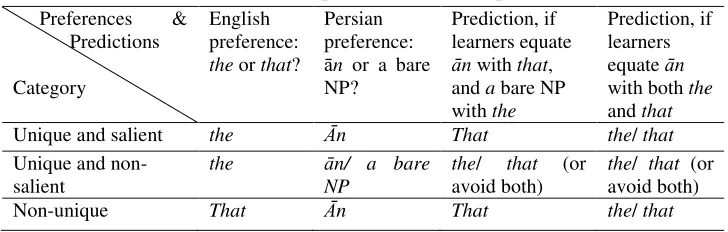
The predictions of the possibilities based on preferences are indicated in Table 1. As shown in this table, if learners map ān to that, and a bare NP to the, they should be target-like in the 'Non-unique' category and non-target-like in the two 'Unique' categories. If, contrastively, they map ān to both that and the, they should allow the two forms in all three categories, which results in overusing that in the two 'Unique' categories and overusing the in the 'Non-unique' category. Finally, if the learners have begun to differentiate the conditions on the from those on that, they should treat the three categories differently, preferring the in the two 'Unique' categories, and that in the 'Non-unique' category.
Table 1. Preferences and predictions for the production task Ppref Preferences &
Predictions
Category
English preference: the or that?
Persian preference: ān or a bare NP?
Prediction, if learners equate ān with that, and a bare NP with the
Prediction, if learners equate ān with both the and that
Unique and salient the Ān That the/ that
Unique and non-salient
the ān/ a bare NP
the/ that (or avoid both)
the/ that (or avoid both)
Non-unique That Ān That the/ that
3.2.2 Picture-based comprehension task
The production task examined the learners' use of the vs. that when faced with a choice between the two determiners. In contrast, the comprehension task (adopted from Ionin et al., 2012) examined how the learners interpreted definite and demonstrative descriptions when they were not forced to make a choice.
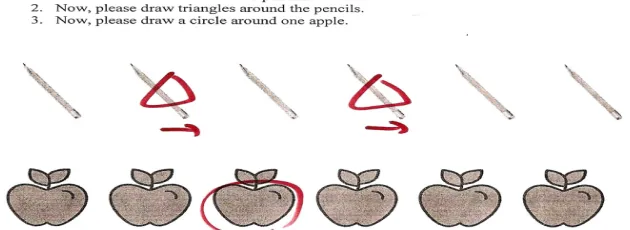
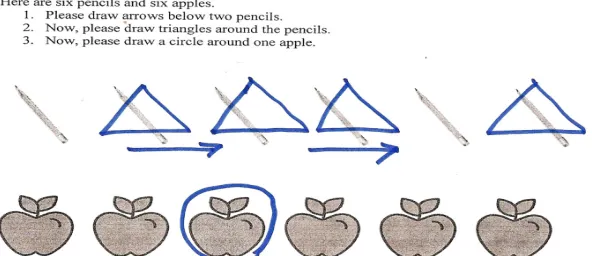
naming the objects and three command lines (line 1, line 2, and line 3) asking the participants to draw geometric shapes. Sample items (text only) are given in (9). The actual test items, with pictures and sample responses, are given in Figures 1 through 3.
This test consisted of 40 items, arranged into a 20-page booklet with two items per page (plus a front page with instructions and example items). In 24 of the items, the target command was in line 2 (the other 16 items were distracters, in which the target command was in line 3). The objects and the geometric shapes were randomized and the 40 items were randomized for the order of presentation.
The test comprised three conditions. The focus of this study was on the three plural conditions to limit the scope of the investigation in the comprehension task to plurals only: (a) a definite plural condition, (b) a demonstrative plural condition, and (c) an indefinite plural condition. There were four items per condition, 12 items in total, which are exemplified in Figures 1, 2, and 3.
These items all had the following format: line 1 asked the participants to act upon 'two Xs', where X stands for a lexical NP. Line 2 then asked the participants to act upon 'the Xs', 'those Xs', or 'some Xs', using the same lexical NP as in line 1. Line 3 was a distracter, asking the participants to act upon one or more of the other objects in the picture.
Figure 2. Sample 'All' response in the definite plural condition (Ionin et al., 2012, p. 88)
Figure 3. Sample 'different' response in the definite plural condition (Ionin et al., 2012, p. 88)
(9) a. Demonstrative plural condition Here are six pens and six balloons. 1.Please draw arrows above two balloons.
2.Now, please draw triangles around those balloons. 3.Now, please draw stars on two pens.
b. Definite plural condition Here are six cars and six books.
c. Indefinite plural condition Here are six knives and six cars. 1.Please draw arrows below two cars. 2.Now, please draw stars on some cars.
3. Now, please draw a square around one knife. (Ionin et al., 2012, p. 86)
The focus was on the possible responses to line 2. For native English speakers, according to Ionin et al. (2012), both definite and demonstrative plural NPs must refer maximally, picking out the maximal referent of the relevant type in the situation. For definites, maximality is computed relative to the discourse, but there is some flexibility as to what speakers may take to be the relevant discourse. If the entire discourse in 9(b) is taken to be relevant, then the maximal referent of the books is all six books in the picture. But if the relevant discourse is taken to begin with line 1, then the maximal referent is the two books acted upon in response to line 1, i.e. the two books with arrows above them. Therefore, learners can provide two different types of responses to line 2 in 9(b): they might act upon all six books, or upon the same two books as in response to line 1. In contrast, for plural demonstratives, only the latter option (acting upon the same two objects) is a possibility: the salient entity in (9a) is the two balloons that have arrows above them, after the action in line 1. The demonstrative description those balloons implies a contrast between the balloons that should have triangles drawn around them and the salient ones which have just drawn arrows above them.
In order to investigate native Persian informants' computation of maximality and saliency in the comprehension of the above-mentioned conditions in Persian, the translation of six of the items from the three conditions (two items per condition) was given to the 11 native Persian informants. The predictions were similar to the ones proposed in the production task (See Table 1). The results showed a less categorical response in the definite plural conditions compared to the other two contexts.
right type of object: e.g. on balloons in response to lines 1 and 2, and pens in response to line 3 in (4a). The data were also checked to see whether the participants paid attention to the number and acted upon two or more objects in response to line 2, as well as upon the indicated number of objects in response to lines 1 and 3. For all responses which did not contain object or number errors, we scored each response to line 2 as 'all', 'same', or 'different’, depending on which objects were acted upon in response to line 2. An 'all' response was the one in which the participants acted upon all six objects of the right type in response to line 2. A 'same' response (See Figure 3) was the one in which the participants acted upon exactly the same objects in response to line 2 as in response to line 1. A 'different' response was any other kind of response to line 2, such as acting upon two to five objects of the right type in response to line 2, where these objects are non-identical to those acted upon in response to line 1 (but overlap between the objects acted upon in response to line 1 vs. line 2 is possible). For the definite and demonstrative conditions, such 'different' responses are incorrect.After doing the required monitoring, the 'all' responses were coded as 1, the 'same' responses were coded as 2, and the 'different' responses were coded as 3 and the data were fed into the SPSS software for further analyses .
4. Data Analysis
After codifying the participants’ responses, both descriptive and inferential analyses were made. Two types of inferential analyses were employed. First, two mixed between-within ANOVAs were conducted to compare the effect of different contexts and also the impact of the proficiency levels. Then, paired-samples t-tests were run to compare the participants’ performance on the comprehension and the production tasks. The results are presented in the following section.
5. Results
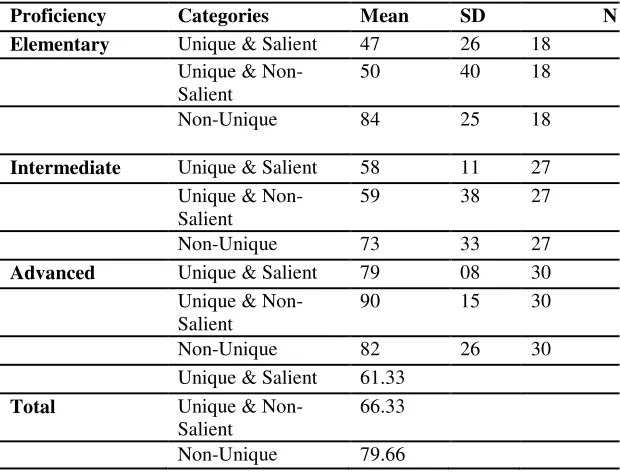
Table 2. Accuracy scores of the groups across different contexts in the production task
Proficiency Categories Mean SD N
Elementary Unique & Salient 47 26 18 Unique &
Non-Salient
50 40 18
Non-Unique 84 25 18
Intermediate Unique & Salient 58 11 27 Unique &
Non-Salient
59 38 27
Non-Unique 73 33 27
Advanced Unique & Salient 79 08 30 Unique &
Non-Salient
90 15 30
Non-Unique 82 26 30
Unique & Salient 61.33
Total Unique & Non-Salient
66.33
Non-Unique 79.66
As depicted above, the mean scores of the elementary and intermediate groups are much closer on the three categories than the score of the advanced group on these categories. An interesting fact about these data is that the elementary group had the best performance on the Non-Unique category in comparison with either the intermediate or advanced group. In the other two categories, (i.e. Unique & Salient and Unique & Non-Salient) the advanced group outperformed the elementary and intermediate groups.
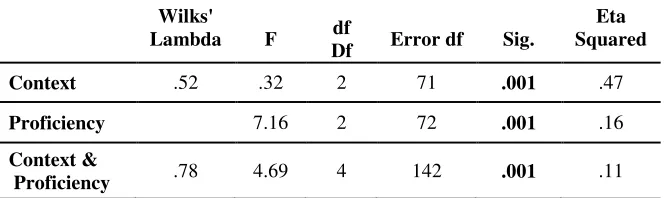
To see whether the differences depicted in Table 2 were statistically significant, a mixed between-within subjects ANOVA was conducted. The results are indicated in Table 3.
Preliminary analyses were performed to ensure that the assumption of homogeneity of variances was not violated. The sig. value in the Box’s Test of Equality of Covariance Matrices was more than .001 (p= .03) which shows no violation of this assumption. The results showed that there was a significant main effect for context (i.e. the three categories discussed above) [Wilks’ Lambda= .52, F (2, 71) = .32, p=0.001, partial Eta squared= .47].
p=0.001, partial eta squared=0.16]. This shows that there was a significant difference among the three proficiency groups. Additionally, the interaction effect between context and proficiency turned out to be significant [Wilks’ Lambda= .78, F (4, 142) = 4.69, p=0.001, partial Eta squared= .11].
Table 3. Results of the mixed ANOVA for the production task scores
Wilks'
Lambda F df
Df Error df Sig.
Eta Squared
Context .52 .32 2 71 .001 .47
Proficiency 7.16 2 72 .001 .16
Context &
Proficiency .78 4.69 4 142 .001 .11
Post-hoc comparisons using Scheffe adjustment were also conducted to see where exactly the differences lay. The participants exhibited significant asymmetries across all the three contexts. Their performance on the non-unique context (M=79.66) was significantly higher than the non-unique and salient (M=61.33) as well as unique and non-salient (M= 66.33) contexts.
Further post-hoc analysis of the proficiency factor revealed that the impact of proficiency was merely significant on the 'Unique and non-salient' category. The performance of the intermediate and advanced groups was significantly different from each other (Mean difference=-30, p=.001). The difference between the elementary and advanced groups was also statistically significant (Mean difference=-40, p=.001). Nonetheless, the difference was not statistically significant between the elementary and intermediate groups (Mean difference =-09, p=.63).
Table 4. Accuracy scores of the groups in the comprehension task
Condition Elementary Intermediate Advanced Total (context)
Definite plural 97 (08) 91 (15) 97 (10) 95
Demonstrative
plural 83 (29) 88 (18) 93 (15) 88
Indefinite plural 100 (00) 99 (04) 98 (07) 99
Total
(proficiency) 93.66 92.66 96
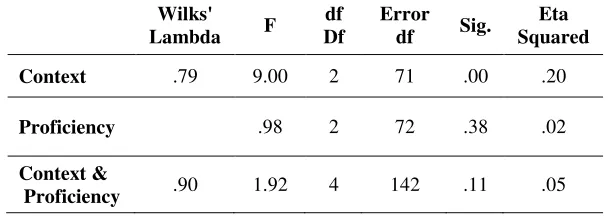
A mixed between-within subjects ANOVA was conducted to check whether any of the contexts or the proficiency levels made any significant difference in the variance of the participants' scores in the comprehension task. The results, as depicted in Table 5, revealed a significant main effect for the context (demonstrative plural, definite plural, and indefinite plural) [Wilks' Lambda=.79, F (2, 71) = 9, p=0.00, Eta squared=.20]. However, the interaction effect between context and proficiency was not significant [Wilks' Lambda=.90, F (4, 142)=1.92, p=0.11, partial Eta squared=.05]. Additionally, there was no significant main effect for proficiency [F (2, 72) =.98, p=0.38]. This shows that there was no significant difference among the three proficiency groups in their perception of definite, demonstrative and indefinite conditions in the comprehension task.
Table 5. Results of the mixed ANOVA for the comprehension task scores
Wilks'
Lambda F
df Df
Error df Sig.
Eta Squared
Context
.79 9.00 2 71 .00 .20
Proficiency .98 2 72 .38 .02
Context &
Proficiency .90 1.92 4 142 .11 .05
conditions (p=0.03). The difference between the demonstrative plural and indefinite plural conditions was also statistically significant (p=0.00). Nonetheless, the L2 learners’ performance in the definite plural and indefinite plural conditions did not prove to be significant (p=.06).
As the last step in data analysis, the production and comprehension tasks were compared to find out any possible asymmetry across the two tasks. The results obtained through paired samples t-test revealed that the differences between the definite and demonstrative contexts in the two tasks were not statistically significant (p>0.05).
In what follows, the above results are discussed in light of the research questions of the study.
6. Discussion
6.1 Acquisition of definite and demonstrative descriptions
Regarding the focus of the first research question, the difference between definite and indefinite contexts and the difference between demonstrative and indefinite contexts are of no relevance here. The only pertinent pair in addressing the first research question is definite and demonstrative contexts. The participants' comprehension of the definite descriptions, as tabulated in Table 4, was slightly better than that of the demonstrative descriptions (Mean difference = .07). This difference can be attributed to the felicity of both all and same responses in the definite contexts in comparison with the only felicitous option, the same option, which statistically contributes to the higher accuracy score obtained for the definite condition.
for the maximal discourse set in such contexts. These results, on the one hand, suggest that learners are influenced by L1 transfer. That is, they map the demonstrative adjective ān to both the and that in English. The learners' preferences, on the other hand, indicated that they are in the process of overcoming L1 transfer. They preferred to choose the, the unmarked option, for the two 'Unique' categories. It is worth emphasizing here that regarding the comprehension of definite and demonstrative descriptions, even the advanced learners did not fully give up interpreting the as equivalent to ān. Regarding the 'Non-unique' category, the L2 learners preferred the more marked option, that, although they also selected the infelicitously. This again indicated that they are on the same path as native speakers, but are not yet fully target-like which can be once more attributed to L1 transfer.
Despite the fact that Persian has demonstratives, but lacks a definite article such as what exists in English, the Persian L2-learners were able to comprehend these descriptions in an almost target-like fashion (See Table 4). The participants' production of definite descriptions, as tabulated in Table 2, showed that the L2 learners performed significantly above the chance level. The participants' mean score in comprehension of demonstrative descriptions (Demonstrative plurals) was .88, whereas their mean score in production of these descriptions (Non-unique category) was 79.66. It was predicted in Table 1 that if Persian EFL learners equate the with that, that is if they compute maximality for definites the way they compute it for demonstratives, they would opt the salient discourse as the relevant set. Ionin et al. (2012) reported that native English speakers overwhelmingly opted for all responses while they acted upon same objects as well. Comparing the performance of native English speakers in Ionin et al.'s study with that of Persian L2-English learners in the present study indicates that although L2 learners act upon both all and same objects in response to line two of the instructions in the comprehension task, they prefer to act upon the same objects. This result can show traces of L1 transfer, because based on the previously made predictions they must have equated the with ān in Persian.
Persian L2 learners in the current study wrongly selected all the objects as the relevant discourse here, they preferred to act upon same objects quite above the chance level. Here, again transfer from L1 demonstratives can be regarded as the reason for such a preference. According to Hawkins (1978), uniqueness/maximality is computed according to more restrictive parameters for demonstratives than for definite descriptions. L2 learners are not fully aware of such limits on the use of demonstratives, so they interchangeably use the or that in contexts where native English speakers use the only or that only. That is why it can be observed that they felicitously acted upon all or same objects in definite contexts where native speakers also accept both all and same responses. Additionally, it can be observed that the Persian L2 learners infelicitously acted upon all responses in the demonstrative context where native English speakers accept only same responses. Despite all the above-mentioned contradictions between the performance of the Persian L2 learners and that of native English speakers in Ionin et al.'s study, the L2 learners performed in a relatively, although not fully, target-like fashion in acquiring definite and demonstrative descriptions.
Thus, it can be concluded that Persian L2-learners were able to acquire both definite and demonstrative descriptions. They had a much better performance on the comprehension and production of demonstrative descriptions (M=.84) than those of definite descriptions (M= .77). This, once more, confirms the idea that transfer from the semantics of L1 demonstratives has led L2 learners to perform much better in the contexts requiring demonstratives than those requiring definites. This result is also in line with the results obtained from Ionin et al.'s (2012) and Robertson's (2000) studies.
condition where native English speakers also do the same. Additionally, they showed evidence of negative transfer in the demonstrative condition. They wrongly acted upon all objects in this condition where native speakers use same responses only. These are all indicative of intra-group homogeneity and this criterion is fulfilled this way. Regarding the second criterion, that is inter-group heterogeneity, L2 learners performed differently from the native speakers in Ionin et al.’s (2012) study. Although they were relatively target-like, they erroneously opted for all objects in demonstrative conditions where native English speakers merely use same responses. Finally, the third criterion is fulfilled through evidence of similar performance in Persian (i.e. the L2 learners' native language) and in L2 (i.e. their interlanguage). The results obtained from the Persian informants, previously reported, shows that the Persian informants use ān in both definite and demonstrative contexts. Also, they act upon same responses in both definite and demonstrative conditions where they were instructed to act upon Xha (that is, definite descriptions using bare NPs) and ān Xha (that is, demonstrative descriptions). It should be noted that ‘ha’ in ‘Xha’ is a plural marker in Persian.
6.2 The effect of proficiency
The role of proficiency in acquisition has been long investigated. L2-learners' proficiency level can be predictive of the acquisition degree of the L2 skills and components. In the present study, proficiency was influenced by the task type. In the production task, the proficiency factor proved to be significant in the unique and non-salient category among all proficiency groups except the elementary and intermediate participants. No significant asymmetries were found in the other two contexts of the production task. Nonetheless, the results of the comprehension task revealed that there was no significant difference [p=0.38] among the three proficiency groups on their perception of definite and demonstrative descriptions across the three comprehension conditions.
learners had a better performance than that of elementary ones and advanced learners showed a much more target-like performance than those of intermediate and elementary learners.
7. Conclusions and Implications
The present study aimed to investigate the acquisition of definite and demonstrative descriptions and the likely transfer from the shared semantics of these descriptions by Persian L2-English learners. To this end, two research questions were posed.
The first research question was whether Persian L2 learners are able to acquire definite and demonstrative descriptions. The results from the analyses conducted showed that the participants’ performance in the comprehension task was relatively target-like. They showed gradual growth from elementary to advanced levels in the demonstrative condition. Additionally, in the definite condition in the comprehension task, there was not much acquisitional problem and even all proficiency groups had a relatively native-like performance. This can be justified by the existence of the two correct options which rendered answering the items in this condition much easier than the demonstrative condition for which there was only one correct option.
Proficiency proved to have a significant role in the production task, but not in the comprehension task. The results of the present study lend support to Ionin et al. (2012) who concluded that proficiency had a role in production rather than comprehension. The production task requires more exposure to the input in order to provide either a definite or a demonstrative determiner, while the comprehension task does not entail such a requirement. In the comprehension task, L2 learners were supposed to act upon objects and there was no force for selecting one among multiple choices. That is why proficiency became a determining factor in answering the production task.
The reason can be attributed to the fact that the contrast between definites and demonstratives is mostly a matter of pragmatics rather than semantics (Roberts, 2002).
The current research offers a number of implications. The study can be considered a breakthrough in providing evidence to support the universality of the semantic feature of uniqueness shared by definites and demonstrative descriptions. It provides new insights about how EFL learners from a language lacking definiteness marker produce and interpret English determiners in contexts. The findings of the study further lend support to the availability of UG in the process of second language acquisition as the L2 learners’ interlanguage grammar is sensitive to the distinction between definites and demonstrative descriptions.
From the pedagogical point of view, this study has clarified the situation in the Persian EFL context where both input and instruction lead the learners to equate the with that. What can be implemented in Persian EFL contexts is providing L2 learners with distinct contexts specific to definites, specific to demonstratives, and shared by both of these descriptions. This can be well implemented by curriculum developers, coursebook designers, school teachers, and practitioners on the whole. Such a kind of awareness-raising will hopefully contribute to a better consciousness on the part of L2 learners of English regarding where to use definite descriptions and how to interpret definite and demonstrative descriptions.
References
Adger, D. (2003). Core Syntax. Oxford: Oxford University Press.
Bardovi-Harlig, K. & Bofman, T. (1989). Attainment of syntactic and morphological accuracy by advanced language learners. Studies in
Second Language Acquistion, 11, 17-34.
Bickerton, D. (1981). Roots of Language. Ann Arbor: Kharoma Press. Bitchener, J., Young, S., & Cameron, D. (2005). The effect of different
types of corrective feedback on ESL student writing. Journal of
Bruge, L. (2002). The positions of demonstratives in the extended projection principle. In G., Cinque (Ed.), Functional Structures in DP and IP, the
Carthography of Syntactic Structures.Vol. 1, Oxford: Oxford
University Press.
Darzi, A. & Rezai, Sh. (2010). The null word in Persian Language. Linguistic Research, 2, 57-73.
Goad, H. & White, L. (2004). Ultimate attainment of L2 inflection: Effects of L1 prosodic structure. In S. Foster-Cohen, M., Sharwood Smith, A., Sorace & M. Ota (Eds.), EUROSLA Yearbook 4 (pp.119-145). Amsterdam: John Benjamins.
Haghshenas, A., Samei, H., Samai, S. M., & Tabatabai, A. (2008). Persian
Grammar. Tehran: Samt.
Hawkins, J. (1978). Definiteness and indefiniteness. London: Croom Helm. Hawkins, J. (1984). A note on referent identifiability and co-presence.
Journal of Pragmatics, 8, 649–59.
Hawkins, J. (1991). On (in) definite articles: Implicatures and (un) grammaticality prediction. Journal of Linguistics, 27, 405–42.
Heim, I. (1982). The semantics of definite and indefinite Noun Phrases. (Unpublished doctoral thesis), University of Massachusetts, Amherst, MA, USA.
Heim, I. (1991). Artikel und definitheit [Articles and definiteness]. In A. Stechowand & D. Wunderlich (Eds.), Semantics: An international
handbook of contemporary research (pp.487-535). Berlin: De
Gruyter.
Huebner, T. (1983). A longitudinal analysis of the acquisition of English. Ann Arbor, MI: Karoma.
Huebner, T. (1985). System and variability in interlanguage syntax.
Language Learning, 35, 141-63.
Ionin, T. (2003a). Article semantics in second language acquisition. MIT Press: MA.
Ionin, T. (2003b). The interpretation of 'the': A new look at articles in L2-English.In Proceedings of the 27th Boston University Conference on
Language Development. (pp.346-57). Somerville, MA: Cascadilla
Ionin, T. (2006). This is definitely specific: specificity and definiteness in article systems. Natural Language Semantics, 14, 175–234.
Ionin, T., Baek, S., Kim, E., Ko, H., & Wexler, K. (2012). That's different form the: definite and demonstrative descriptions in second language acquisition. Second Language Research, 28(1), 69-101.
Ionin, T., Ko, H., & Wexler, K. (2004). Article semantics in L2-acquisition: The role of specificity. Language Acquisition, 12, 3–69.
Ionin, T., Zubizarreta, M., & Maldonado, S. (2008). Sources of linguistic knowledge in the second language acquisition of English articles.
Lingua, 118, 554-576.
Ionin, T., Zubizarreta, M., & Philippov, V. (2009). Acquisition of article semantics by child and adult L2-English learners. Bilingualism:
Language and Cognition, 12, 337-361.
Jarvis, S. (2000). Methodological rigor in the study of transfer: identifying L1 influence in the interlanguage lexicon. Language Learning, 50, 245-309.
Kamp, H. (1981). A Theory of Truth and Discourse Representation. In J. Groenendijk, T. Janssen, & M. Stokhof, (Eds.), Formal Methods in
the study of language (pp.277-322). Amesterdam: Mathematical
Centre.
Khanlari, P. (1998). Persian Grammar. Tehran: Tous.
Kharma, N. (1981). Analysis of the errors committed by Arab university students in the use of the English definite/indefinite articles.
International Review of Applied Linguistics, 19, 331-345.
Khayampour, A. (2007). Persian grammar. Tabriz: Setoude.
King, J. (2001). Complex demonstratives. Cambridge, MA: MIT Press. Ko, H., Ionin, T., & Wexler, K. (2005). Adult L2-learners lack the
Maximality presupposition, too! In Proceedings of the 1st Generative
Approaches to Language Acquisition in North America. Hawaii, US.
MIT Working Papers in Linguistics.
(Ed.), By Slabakova, R., Rothman, J., Kempchinsky, P., & Gavruseva, E., 118-129. Somerville, MA: Cascadilla Proceeding Project.
Lazard, G. (1992). A Grammar of Contemporary Persian. (S.A. Lyon, Trans.), New York: Mazda Publishers.
Leung, Y. K. I. (2001). The initial state of L3A: Full Transfer and Failed Features? In Proceedings of the 4th Second Language Research Forum the Past, Present and Future of Second Language Research (pp.55-75). Somerville, MA: Cascadilla Press.
Mahootian, Sh. (1999). Persian Grammar from a Typological Perspective. Tehran: Markaz.
Master, P. (1987). A cross-linguistic interlanguage analysis of the acquisition of the English article system. (Unpublished doctoral dissertation). UCLA, Los Angeles, CA.
Master, P. (1997). The English article system: Acquisition, function, and pedagogy. System, 25(2), 215-232.
Meshkatoddini, M. (2000). Persian Grammar (Based on Transformational
Theory). Mashhad: Ferdowsi University
Murphy, S. (1997). Knowledge and production of English articles by
advanced second language learners. (Unpublished doctoral thesis).
University of Texas, Austin.
Parish, B. (1987). A new look at methodologies in the study of article acquisition for learners of ESL. Language Learning, 37, 361-83. Quirk, R. & Greenbaum, S. (1990). A Student Grammar of English. London:
Longman.
Rezai, M.J. & Jabbari, A.A. (2010). Acquisition of definiteness feature by Persian L2 learners of English. Journal of Teaching Language Skills,
2(2), 123- 154.
Roberts, C. (2002). Demonstratives as definites. In van Deemter, K. & R. Kibble (Eds.), Information sharing (pp.89–136). Stanford, CA: CSLI. Roberts, C. (2003). Uniqueness in definite noun phrases. Linguistics and
Philosophy, 26, 287–350.
Russell, B. (1905). On denoting. Mind, 14, 479–93. P. Martinich, (Ed.), (2001). The Philosophy of Language. Oxford: Oxford University Press.
Trenkic, D. (2000). The acquisition of English articles by Serbian speakers. (Unpublished doctoral thesis). University of Cambridge, Cambridge, UK.
Trenkic, D. (2007). Variability in L2 article production: Beyond the representational deficits vs. processing constraints debate. Second
Language Research, 23, 289–327.
Trenkic, D. (2008). The representation of English articles in second
language grammar: Determiners or adjectives? Bilingualism:
Language and Cognition, 11, 1–18.
Tsimpli, I. M. & Dimitrakopoulou, M. (2007). The interpretability hypothesis: evidence from Wh-interrogatives in L2 acquisition.
Second language Research, 23, 215-242.
White, L. (2003). Fossilization in steady state L2 grammars: Implications of persistent problems with inflectional morphology. Bilingualism:
Language and Cognition, 6, 128-141.
Wolter, L. (2006). That’s that: The semantics and pragmatics of
demonstrative noun phrases. (Unpublished doctoral dissertation).
UCSC, LA.
Young, R. (1996). Form-function relations in articles in English interlanguage. In R. Bayley, & R. Preston (Eds.), Second language
acquisition and linguistic variation (pp.135-75). Amsterdam: John