Levels Of Irrigation And Mulching During Rabi In Eastern Dry Zone Of
Karnataka
C. Seenappa1, N. Devakumar2 and N. Manjula3 1
Department of Agronomy, College of Sericulture, Chintamani, University of Agricultural Sciences Bengaluru, Karnataka, India
2
Research institute on Organic Farming, University of Agricultural Sciences, GKVK, Bengaluru, Karnataka, India
3
Krishi Vijynana Kendra, Chickaballapur District, Karnataka
Abstract
A field experiment wasconductedat College of Sericulture, Chintamani, Chickaballapur district, Karnataka, India during rabi2013 to know the influence of different methods, levels of irrigation and mulching on quality and quantity of mulberry leaf in Eastern Dry Zone (EDZ) of Karnataka. The results revealed that the mulberry leaf quality and quantity weresignificantly influenced by different methods, levels of irrigation and mulching. Among the methods and levels of irrigation, subsurface drip irrigation at 0.8 CPE recorded higher chlorophyll, relative water,protein, total carbohydrate content at harvest and leaf yield (8.64, 69.69%, 23.56%, 17.29%
and 38920kg ha-1 yr-1) than surface drip at 1.0 CPE (7.42, 67.06%,18.78%, 16.93% and 35012kg
ha-1 yr-1) and micro spray jet at 1.0 CPE (7.98, 67.63%,20.24%, 17.05% and 35617kg ha-1 yr-1). Maximum chlorophyll, relative water, protein, total carbohydrate content at harvest and leaf yield (7.19, 67.21%, 17.09%, 16.66% and 35336 kg ha-1 yr-1) was noted in mulching than without mulching treatment. These results clearlyshowedthat subsurface drip irrigation at 0.8 CPE and mulching increased the quality and quantity of mulberry leaf than surface drip and micro spray jet irrigation at 1.0 CPE by saving 20 per cent of water. In the coming years, subsurface drip irrigation may be more appropriate to realise higher quality and quantity of mulberry leaf in EDZ of Karnataka.
Key words: Surface drip;Subsurface drip; Micro spray jet; CPE; Mulching; Mulberry
I. Introduction
Mulberry is cultivated by farmers for its leaves, the sole food for silkworm (Bombyx mori L) for commercial production of raw silk in Sericulture Industry. As mulberry is a perennial crop can be maintained for many years, selection of land, follow-up of recommended package of practices and water management are inevitable for producing quality leaf concomitant productivity throughout. Further the quality of mulberry leaves as single factor contributes about 38.2% for the success of silkworm crop (Miyashita, 1986), adequate supply of water and nutrients into soil is very much essential.
Moisture content in mulberry leaves improves their ingestion, digestion and also the conversion of nutrients in silkworm. Water content in mulberry leaves is considered as one of the criteria in estimating the leaf quality (Paul et al., 1992). Miyashita (1986) stated that the improvement of leaf quality than the productivity of leaves is immediately required for the stability of cocoon crops.
Leaf quality is an important factor used for selection of superior varieties of silkworms (Bongaleet al., 1997).It is fact that, in sericulture more than 60% of total cost of cocoon production goes towards mulberry production alone. Hence, in recent years maximum attention has been given for the improvement of quality and quantity in mulberry. Growth and development of silkworm and cocoon yield are mainly influenced by yield and nutritional quality of mulberry leaf used (Yokoyama, 1963).
Mulching is also one of the important agronomic practice essential for conserving the soil moisture, suppressing the weeds, improving soil fertilityand modifying the soil physical environment(Yoo-Jeonget al., 2003). Different types of mulches have been used toobtain good crop yield and quality.
Eastern Dry Zone (EDZ) of Karnataka mainly depends on rainfall and underground water sources due to lack of perennial water sources for crop production. Chickaballapur and Kolar districts in EDZ of Karnataka in particular, the mulberry farmers found many advantages in surface drip irrigation than flood irrigation in mulberry. Sudden depletion of water table due to over exploitation leads to shortage of water is the major constraint than any other crop production technologies. Presently, mulberry farmers need water saving technologies and good marketing facilities in EDZ.
Water is the critical and costly input for mulberry crop production and is the most limiting factor in Indian agriculture. Though India has the largest irrigation area, irrigation efficiency has not been achieved more than 40%. Per capita water availability in the country has dropped from 6008 m3 in 1947 to 1250 m3 now and is expected to dwindle down to 760 m3 (Singh, 2006). Among all the agronomical inputs, irrigation water has highest impact on mulberry leaf quantity and quality. The need of the hour isto maximize the production per unit of water. Hence, further improvement in quality and quantity of crops may need to adopt new irrigation systems such as subsurface drip irrigation. Subsurface drip irrigation supplies water and nutrients directly to the crop root zone. Crops can be “spoon-fed” water and nutrients. The spoon-feeding characteristic of the subsurface drip irrigation system has a great potential to minimize the water losses. In the above context, present field study was conducted to evaluate suitable methods and levels of irrigationrequired to produce better quality and quantity of mulberry leaf inEDZ of Karnatakasince this zone is traditional sericulture belt.
II.Materials and Methods
The study was conducted during winter 2013 in pre-established irrigated Victoria-1 mulberry garden at College of Sericulture, Chintamani, Chickaballapur district, Karnataka state, India. Climate is semi-arid, tropical with hot dry summer and cold winter and it falls in EDZ of Karnataka. Annual rainfall is 650-700 mm.The experiment was laid out in a double split plot design with three replications and 18 treatments combination comprises three methods of irrigation (I1= surface drip, I2
= subsurface drip and I3 = micro spray jet), mulching (M1 = with mulching and M0= without
mulching) and three levels of irrigation (L1 = 0.6 CPE, L2 = 0.8 CPE and L3 = 1.0 CPE). In drip
(Jenson et al., 1961). Fully dried weeds and other crop residues were spread over the ground as mulch at the rate of 30 kg per treatment. Recommended FYM of 15 t ha-1 was incorporated in to the soil at ploughing and nitrogen, phosphorus and potassium (350:120:120 NPK kg ha-1) were supplied to all the plots through fertigation. The cultural practices were followed as per the recommended package of practices (Dandin et al., 2003).Five plants were randomly selected in each treatment for recording observations on growth and leaf yield at 30, 45 DAP and at harvest. Data was statistically analyzed by adopting O.P. Stat software. Treatment means and interaction effects were compared using critical difference at 5% level of significance.
III. Results and Discussion
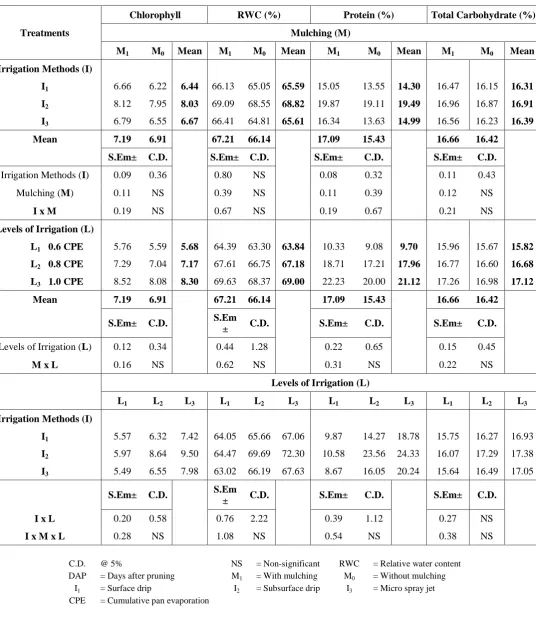
Leaf quality: Mulberry leaf quality was significantly influenced by different methods, levels of irrigation and mulching during rabi in EDZ of Karnataka (Table 1). Subsurface drip irrigation at 0.8 CPE recorded higher chlorophyll, relative water, protein and total carbohydrate content (8.64, 69.69%, 23.56% and 17.29%) compared to surface drip at 1.0 CPE (7.42, 67.06%, 18.78% and 16.93%) and micro spray jet at 1.0 CPE (7.98, 67.63%, 20.24% and 17.05%). This might be due to subsurface drip irrigation reducing the evaporation losses and spoon feeding of water and nutrients to plants compared to surface drip and micro spray jet irrigation methods. Chlorophyll content is very important for quantifying the photosynthetic efficiency. These results are in promised with those of El-Fawakhry (2004)stated that the drip irrigation is important in increasing the availability and absorption of nitrogen and other minerals in the plant, thereby increasing the chlorophyll content in the leaves. Subsurface drip irrigation was more efficient than surface drip irrigation for enhancing quantitative growth parameters and nutrient concentrations in plants and fertility in the soil was reported by Khalid (2012).Khattabet al., (2011)also observed that the augmentation in irrigation rate was concurrent with an increase in chlorophyll, could be attributed to increased nutrient uptake especially N and Mg as a consequence of improved soil moisture. Higher levels of irrigation at 0.9 CPE showed higher leaf moisture and nitrogen content in mulberry(Bongale and Siddalingaswamy, 2003).
Further, these results are in accordance with findings of Long Dominic and Thomos Spears (2003) reported that subsurface drip may also help in increasing quality parameters due to improved irrigation, nutrients and energy use efficiencies. Subsurfacedrip irrigation is potentially more efficient in arid and semi-arid regions of India because it provides water directly to the root zone and minimizing evaporation losses.Higher moisture content of mulberry leaves is one of the important factors and has a direct effect on growth and development of silkworms. Moisture content in mulberry leaves favourably affects their ingestion, digestion and also the conversion of nutrients in silkworm. Water content in mulberry leaves is considered as one of the criteria in estimating the leaf quality (Paul et al., 1992).
Quality parameters of mulberry leaf like chlorophyll, relative water, protein and total carbohydrate content (7.19, 67.21%, 17.09% and 16.66%)weresignificantly influenced by mulching and recorded higher than without mulching.This might be due to fact that mulches conserve the soil moisture, increases the water use efficiency, microbial population and the nutrient uptake of the plants and thereby improved the quality status of mulberry. These results are confirmed byRamakrishna et al., (2006) that the beneficial aspects of mulching includes conservation of moisture, controls weeds and moderate soil temperature for better root growth and higher quality. Mulching also increase the availability of more moisture and reduced soil temperature which increases the activity of the soil microbes might also helped in increasing quality parameters. These results are in confirmation with the findings of Das et al. (1990) in mulberry, Gangawaret al. (2000) in mulberry and Kumara et al. (2014) in stevia.
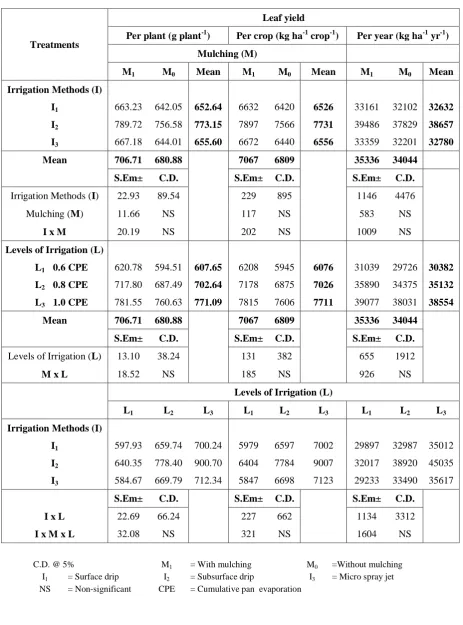
surface drip at 1.0 CPE (35012 kg ha-1 yr-1) and micro spray jet at 1.0 CPE (35617kg ha-1 yr-1). Subsurface drip irrigation had recorded higher growth and yield parameters resulted in higher leaf yield than surface drip and micro spay jet irrigation methodsmight be due to the availability of more moisture at root zone throughout the crop growth period. These results are in accordance with Ayarset al. (1999) have recorded 22 per cent higher yields in row crops with subsurface drip irrigation than surface flood irrigation. It was also observed that subsurface drip irrigation creates more suitable environment in the root zone area of the plants for better growth and production (Al-Omranet al., 2004). Subsurface drip system is used to provide water to plant roots while maintaining relatively dry soil surface, which ensures that applied water will be available to the plant root system. This is practically important in sandy and sandy loamy soils (ASAE Std., 1999). According to Evettet al. (1995), evaporation losses of 8.1 cm water from surface drip irrigation could be saved when drip laterals were placed 15-30 cm below the soil surface.
Similarly, Paleseet al. (2009) and Hussein (2008) also noticed that increased yield of mulberry leaf might be due to increase in photosynthetic rate as a result of more absorption of available nutrients, which cause increase in growth and photosynthesis efficiency. Subsurface drip irrigation is a very precise irrigation method, both in the delivery of water and nutrients to desired locations and the timing and frequency of applications for optimal plant growth was reported by Camp (1998). Subsurface drip irrigation provides incremental application of nitrogen and water to the plants. With good management, this has been reported to reduce NO3 leaching and contamination of groundwater
in lettuce production (Thompson and Doerge, 1996). Potato yield was increased by 27 per cent with subsurface drip irrigation over sprinkler irrigation, while reducing irrigation requirement by 29 per cent (De Tar et al., 1996).
Significantly higher leaf yield of 35336 kg ha-1 yr-1 was recorded in mulching treatment than without mulching.Similar results were also reported by Ramakrishna et al., (2006) that the beneficial aspects of mulching includes conservation of moisture, controls weeds and moderate soil temperature for better root growth and higher crop yield. Mulching also increase the availability of more moisture and reduced soil temperature which increases the activity of the soil microbes might also helped in increasing yield and quality parameters. However, the chlorophyll, relative water content and leaf yield were found non-significant due to the interaction effect between methods and levels of irrigation and mulching.
IV. Conclusion
Subsurface drip irrigation recorded higher quality and quantity of mulberry leaf than surface drip and micro spray jet irrigation due to spoon feeding of nutrients and water to plants besides saving 20% of water. Hence, subsurface drip irrigation may be appropriate and efficient method to achieve good quality and quantity of leaf in EDZ of Karnataka under water scarce situations.
Bibliography
[1] Al-Omran, A.M., Falatah, A.M., Sheta, A.S. and Al-Harbi, A.R., 2004, The use of clay deposits in drip irrigation system for water conservation. Internal. Conference, Water Resources and Arid Environment.
[2] Anonymous, 2006, Annual Administrative Report. Department of Sericulture, Government of Karnataka, Bangalore, pp. 90.
[3] ASAE Std., 1999, Soil and water terminology. S 526.1. ASAE standards. American Soc. Agric. Eng., St. Joseph, MI.
[4] Ayars, J.E., Phene, C.J., Hutmacher, R.B., Davis, K.R., Schoneman, R.A., Vail, S.S. and Mead, R.M., 1999, Subsurface drip irrigation of row crops: A review of 15 years of research at the Water Management Research Laboratory. Agri. Water Management, 42(1): 1-27.
[6] Bongale, U.D. and Siddalingaswamy, N., 2003. Irrigation for mulberry. Karnataka State Sericulture Research and Development Institute. Thalaghattapura, Bangalore, pp. 56-59.
[7] Camp, C.R., 1998, Subsurface drip irrigation: A review. Trans. of the ASAE,41(5): 1353-1367.
[8] Dandin, S. B., Jayantjayaswal and Giridhar, K., 2003. Handbook of Sericulture Technologies. CSB, Bangalore, p. 259.
[9] Das, D.K.M., Choudhury, D.C., Ghosh, A., Mallikarjuna, B., Suryanarayana, N. and Sengupta, K., 1990, Effect of green manuring, dry weed and black polythene mulching on soil moisture conservation, growth and yield of mulberry and their economics under rainfed condition. Indian J. Seri., 20: 263-272.
[10]De Tar, W.R., Browne, G.T., Phene, C.J. and Sanden, B.L., 1996, Real-time irrigation scheduling of potatoes with sprinkler and subsurface drip systems. In Proc. Internal. Conf. on Evapotranspiration and Irrigation Scheduling, Nov 3-6, San Antonio, Texas, USA, pp. 812-824.
[11]El-Fawakhry, F. M., 2004. Effect of different schedules of drip irrigation and complete liquid fertilizer rates on growth of cycas plants (Cycas revolute). Agric. Mans Univ., 29: 7273–7285.
[12]Evett, S.R., Howell, T.A. and Schneider, A.D., 1995, Energy and water balances for surface and subsurface drip irrigation: a comparison point and area sources. Irrig. Sci., 22: 171-176.
[13]Gangawar, S.K., Sinha, P.S., Singh, B.D., Ramnagina, Jayaswal, J. and Griyaghey, U.P, 2000, Maximization of leaf yield of mulberry (Morus alba L.) and economic returns per unit area of land from sericulture through mulching. Sericologia, 40: 491-497.
[14]Hussein, A. H. A., 2008. Response of Manzanillo Olive (Oleaeuropaea L.) Cultivar to Irrigation Regime and Potassium Fertigation under Tabouk Conditions, Saudi Arabia. J. Agron.,7:285-296.
[15]Jenson, M.C., Middleton, J.E. and Pruit, W.O., 1961. Scheduling of irrigation from pan evaporation. Circular 386, Washington Agricultural Experiment Station.
[16]Khalid M. Elhindi, 2012. Evaluation of composted green waste fertigation through surface and subsurface drip irrigation systems on pot marigold plants (Calendula officinalisL.) grown on sandy soil, Australian J. Crop Sci.,6(8):1249-1259.
[17]Khattab, M. M., Shaban, A. E., El-Shrief, A.H. and Mohamed, A.S.E., 2011. Growth and productivity of pomegranate trees under different irrigation levels: Leaf pigments, proline and mineral Content. J. Hort. Sci. & Ornamental Plants, 3(3): 265-269.
[18]Kumar, C.S., Sekharappa, B.M. and Sarangi, S.K., 1996, Influence of temperature and leaf quality on rearing performance of silkworm (Bombyx mori L.). Indian J. Seri., 36(2): 116-120.
[19]Kumara, R., Sood, S., Sharma, S., Kasana, R.C., Pathania, V.L., Singh, B. and Singh, R.D., 2014, Effect of plant spacing and organic mulch on growth, yield and quality of natural sweetener plant Stevia and soil fertility in western Himalayas. Internal. J. Plant Prod.,8(3): 311-333.
[20]Long Dominic, F.D. and Thomos Spears, 2003, Water scarcity and modern irrigation. In: Valmount-water management groups 7002 North 288 Street P.O. Box 358, Vally, NE 68064-0358, USA, p.16.
[21]Miyashita, V., 1986, A report on mulberry cultivation and training methods suitable to bivoltine rearing in Karnataka, Central Silk Board, Bangalore, India.
[22]Palese, A. M., Pasquale, V., Celano, G., Figliuolo, G., Masi, S. and Xiloyannis, C., 2009. Irrigation of olive groves in Southern Italy with treated municipal wastewater: Effects on microbiological quality of soil and fruits. Eco. and Envt.,129: 43-51.
[23]Paul, D.C., Subba Rao, G. and Deb, D.C., 1992, Impact of dietary moisture on nutritional indices and growth of Bombyx mori and concomitant larval duration. J. Insect Physiol., 38(3): 229-235.
[24]Ramakrishna A., Tam H. M., Wani S. P. and Long T. D., 2006. Effect of mulch on soil temperature, moisture, weed infestation and yield of groundnut in northern Vietnam. Field Crop Res.,95: 115-125.
[25]Thompson, T.L. and Doerge, T.A., 1996, Nitrogen and water interactions in subsurface trickle-irrigated leaf lettuce: Plant response. Soil Sci. Soc. Am. J., 60: 163-168.
[26]Yokoyama, T., 1963. Sericulture. Annual Review of Entomology, 8: 287-306.
Table 1: Quality of mulberry leaf as influenced by different methods, levels of irrigation and mulching
Treatments
Chlorophyll RWC (%) Protein (%) Total Carbohydrate (%)
Mulching (M)
M1 M0 Mean M1 M0 Mean M1 M0 Mean M1 M0 Mean
Irrigation Methods (I)
I1 6.66 6.22 6.44 66.13 65.05 65.59 15.05 13.55 14.30 16.47 16.15 16.31
I2 8.12 7.95 8.03 69.09 68.55 68.82 19.87 19.11 19.49 16.96 16.87 16.91
I3 6.79 6.55 6.67 66.41 64.81 65.61 16.34 13.63 14.99 16.56 16.23 16.39
Mean 7.19 6.91 67.21 66.14 17.09 15.43 16.66 16.42
S.Em± C.D. S.Em± C.D. S.Em± C.D. S.Em± C.D.
Irrigation Methods (I) 0.09 0.36 0.80 NS 0.08 0.32 0.11 0.43
Mulching (M) 0.11 NS 0.39 NS 0.11 0.39 0.12 NS
I x M 0.19 NS 0.67 NS 0.19 0.67 0.21 NS
Levels of Irrigation (L)
L1 0.6 CPE 5.76 5.59 5.68 64.39 63.30 63.84 10.33 9.08 9.70 15.96 15.67 15.82
L2 0.8 CPE 7.29 7.04 7.17 67.61 66.75 67.18 18.71 17.21 17.96 16.77 16.60 16.68
L3 1.0 CPE 8.52 8.08 8.30 69.63 68.37 69.00 22.23 20.00 21.12 17.26 16.98 17.12
Mean 7.19 6.91 67.21 66.14 17.09 15.43 16.66 16.42
S.Em± C.D. S.Em
± C.D. S.Em± C.D. S.Em± C.D.
Levels of Irrigation (L) 0.12 0.34 0.44 1.28 0.22 0.65 0.15 0.45
M x L 0.16 NS 0.62 NS 0.31 NS 0.22 NS
Levels of Irrigation (L)
L1 L2 L3 L1 L2 L3 L1 L2 L3 L1 L2 L3
Irrigation Methods (I)
I1 5.57 6.32 7.42 64.05 65.66 67.06 9.87 14.27 18.78 15.75 16.27 16.93
I2 5.97 8.64 9.50 64.47 69.69 72.30 10.58 23.56 24.33 16.07 17.29 17.38
I3 5.49 6.55 7.98 63.02 66.19 67.63 8.67 16.05 20.24 15.64 16.49 17.05
S.Em± C.D. S.Em
± C.D. S.Em± C.D. S.Em± C.D.
I x L 0.20 0.58 0.76 2.22 0.39 1.12 0.27 NS
I x M x L 0.28 NS 1.08 NS 0.54 NS 0.38 NS
C.D. @ 5% NS = Non-significant RWC = Relative water content
DAP = Days after pruning M1 = With mulching M0 = Without mulching
I1 = Surface drip I2 = Subsurface drip I3 = Micro spray jet
Table 2:Quantity of mulberry leaf as influenced by different methods, levels of irrigation and mulching
Treatments
Leaf yield
Per plant (g plant-1) Per crop (kg ha-1 crop-1) Per year (kg ha-1 yr-1)
Mulching (M)
M1 M0 Mean M1 M0 Mean M1 M0 Mean
Irrigation Methods (I)
I1 663.23 642.05 652.64 6632 6420 6526 33161 32102 32632
I2 789.72 756.58 773.15 7897 7566 7731 39486 37829 38657
I3 667.18 644.01 655.60 6672 6440 6556 33359 32201 32780
Mean 706.71 680.88 7067 6809 35336 34044
S.Em± C.D. S.Em± C.D. S.Em± C.D.
Irrigation Methods (I) 22.93 89.54 229 895 1146 4476
Mulching (M) 11.66 NS 117 NS 583 NS
I x M 20.19 NS 202 NS 1009 NS
Levels of Irrigation (L)
L1 0.6 CPE 620.78 594.51 607.65 6208 5945 6076 31039 29726 30382
L2 0.8 CPE 717.80 687.49 702.64 7178 6875 7026 35890 34375 35132
L3 1.0 CPE 781.55 760.63 771.09 7815 7606 7711 39077 38031 38554
Mean 706.71 680.88 7067 6809 35336 34044
S.Em± C.D. S.Em± C.D. S.Em± C.D.
Levels of Irrigation (L) 13.10 38.24 131 382 655 1912
M x L 18.52 NS 185 NS 926 NS
Levels of Irrigation (L)
L1 L2 L3 L1 L2 L3 L1 L2 L3
Irrigation Methods (I)
I1 597.93 659.74 700.24 5979 6597 7002 29897 32987 35012
I2 640.35 778.40 900.70 6404 7784 9007 32017 38920 45035
I3 584.67 669.79 712.34 5847 6698 7123 29233 33490 35617
S.Em± C.D. S.Em± C.D. S.Em± C.D.
I x L 22.69 66.24 227 662 1134 3312
I x M x L 32.08 NS 321 NS 1604 NS
C.D. @ 5% M1 = With mulching M0 =Without mulching
I1 = Surface drip I2 = Subsurface drip I3 = Micro spray jet