Narottam et al. World Journal of Pharmaceutical and Life Sciences
A NEW METHOD DEVELOPMENT AND VALIDATION FOR THE DETERMINATION
OF TENATOPRAZOLE IN TABLET DOSAGE FORM BY HPLC
Narottam Pal1*, Tayyaba Mahtab2, Sayeeda Tabasum2, Sumaiyya Saleem3 and A. Srinivasa Rao4
1Associate Professor, Department of pharmaceutical Analysis, Bhaskar Pharmacy College, Yenkapally (V), Moinabad
(M), R.R. District, Hyderabad-500075.
2Assistant Professor, Department of pharmaceutical analysis, Bhaskar Pharmacy College, Yenkapally (V), Moinabad
(M), R.R. District, Hyderabad-500075.
3Assistant Professor, Department of pharmacology, Bhaskar Pharmacy College, Yenkapally (V), Moinabad (M), R.R.
District, Hyderabad-500075.
4
Principal and Professor, Bhaskar Pharmacy College, Yenkapally (V), Moinabad (M), R.R. District, Hyderabad-500075.
Article Received on 06/06/2019 Article Revised on 27/06/2019 Article Accepted on 17/07/2019
INTRODUCTION
Tenatoprazole (TPZ)[1-4] is a novel proton pump inhibitor. It is potent drug which is having plasma half-life seven-fold longer than other conventional drugs in the same stream. There is a close relationship between the degree of gastric acid inhibition and duration of action of an acid suppressor. Efficacy of this compound was measured by monitoring intra-gastric pH in pharmaco-dynamic studies throughout 24 hours. The drug was invented by a giant company named Mitsubishi Tanabe Pharma. In India the major player for this compound is Cadila Pharmaceuticals Ltd. Tenatoprazole is believed to be a better choise in the treatment of gastro-esophageal reflux disease as compared to omeprazole, pantoprazole etc. Chemically the compound is known as 5-methoxy-2-[(4-methoxy-3,5- dimethylpyridin-2-yl)methylsulfinyl]-1H-imidazo[4,5-b]pyridine. Figure 1 represents the chemical structure of Tenatoprazole.
Figure 1: Chemical structure of Tenatoprazole.
Literature survey5-9 helps us to get motivated and go for the present research work. There are certain assay methods available for this compound. M. Sugumaran, Ravikrindhi Nageswara Rao, Dr Jothieswari developed UV- spectrophotometric determination of tenatoprazole from its bulk and tablets. Same authors also developed RP-HPLC method for the determination of Tenatoprazole in pharmaceutical formulations. Kumaraswamy Gandla, J.M. Rajendrakumar, J.V.L.N. Sheshagirirao, M. Arunadevi developed
World Journal of Pharmaceutical and Life Sciences
WJPLS
www.wjpls.org
SJIF Impact Factor: 5.088*Corresponding Author: Narottam Pal
Associate Professor, Department of pharmaceutical Analysis, Bhaskar Pharmacy College, Yenkapally (V), Moinabad (M), R.R. District, Hyderabad-500075.
ABSTRACT
A simple, accurate, rapid and precise isocratic reverse phase high performance liquid chromatographic method has been developed and validated for the determination of Tenatoprazole in tablet dosage form. The chromatographic separation was carried out with inertsil column (C18150x4.6, 5µm) , a mixture of triethylamine buffer acetonitrile in the ratio of 30:70 as mobile phase, at a flow rate of 1.0 ml/minute maintaining the temperature at 30ºc. UV detection was performed at 311 nm. The retention time was 4.980 minutes for Tenatoprazole. The method was validated according to ICH guidelines and the acceptance criteria of results for accuracy, precision, linearity, robustness, limit of detection, limit of quantification and ruggedness were met in all cases. The % RSD values for Tenatoprazole in precision study was found to be 0.70%. The linearity of the calibration curve for each analyte in the desired concentration range was good (r2>0.999). The high recovery and value of low relative standard deviation confirm the suitability of the method for routine evaluation of Tenatoprazole in pharmaceutical dosage forms.
Spectrophotometric determination of Tenatoprazole in bulk drug and pharmaceutical dosage form. LIU. Pei, SUN. Bo, LU. Xiu-mei, LI. Fa-mei developed RP-HPLC determination of tenatoprazole and its related substances in capsules. Sunil R. Dhaneshwar, Vaijanath N. Jagtap developed Stability Indicating RP-HPLC-PDA Method for Tenatoprazole and Its Application for Formulation Analysis and Dissolution Study. But the greatness of this drug and extensive use of this compound makes a scope to work further so that a more simple method will be available for the regular estimation purpose.
MATERIALS AND METHODS
Instruments: HPLC make Shimadzu (LC 20 AT VP).
Column as INERTSIL column, C18(150x4.6 ID) 5µm. Balance analytical- ER-180A, Sartorius Microbalance-M500P, Thermo scientific pH Meter, Sar torius Sonicator, Empower V 1.2.2.1 Software.
Chemicals: Water, Methanol, Potassium Dihydrogen
ortho Phosphate, Triethylamine and Acetonitrile.
Preparation of mobile phase: A mixture of 50 volumes
of bufferTriethylamine and 50 volumes of organic solvent Acetonitrile were prepared. The mobile phase was subjected for sonication for about 10min to remove gases.
Preparation of buffer: 5ml of Triethylamine was
dissolved in 1000ml of water.
Preparation of working stock solution (1000µg/ml): 10
mg of TPZ was weighed and finely powdered and transferred into 10 ml volumetric flask, diluted up to the mark with 7 ml mobile phase, sonicated for 30 minutes and made up the final volume with mobile phase.
Preparation of working standard solution: From the
above stock solution, 1 ml was pipeted out in to a 10ml volumetric flask and then made up to the final volume with mobile phase to get the concentration of 100 μg/ml TPZ and considered it as a standard 100 %. This solution was filtered through 0.45 μm membrane filter.
Label Claim: 40 mg of Tenatoprazole.
Method development
To develop a new method.[10-12] for estimation work several trials were conducted so that we can achieve most suitable chromatographic condition and the best results. The initial attempt was to use as much low part of organic solvents for the purpose of elution. But increased part of aqueous solvents in our mobile phase resulted in extending of retention time for all the compounds. But reasonable retention time, value of tailing factors, number of theoretical plates and all were found to be within the validation limit while using optimized chromatographic condition.
Methodvalidation
The method was evaluated.[13,14] as per protocol designed by ICH.[15] The evaluation parameters took into consideration were system suitability parameters, precision accuracy, intermediate precision, linearity, limit of quantification, limit of detection, robustness studies etc.
System suitability parameters: For one analytical
method validation system suitability parameters to be determined by preparing standard solutions of the compounds of specific concentration and the solutions to be injected six times and the parameters like peak tailing, theoretical plate count, retention time etc to be determined.
Specificity: Checking of interference if any in the optimized method. We should not find any interfering peak in blank in this method so that the method can be considered as specific.
Accuracy: The accuracy for a developed HPLC method
is to be examined by calculating the extant of recoveries of all the compounds by a procedure called standard addition. Correct amount of drug solutions (standard) of that particular project (each drug 50%, 100%, and 150%) to be added and injected to pre-quantified solution of sample. The quantity of each substance recovered to be determined.
Precision: The experimental repeatability as well as intermediate precision to be examined by repeatedly applying six injections containing the compounds with specific concentration at two subsequent days. Number of theoretical plates, retention time, peaks resolution, peak symmetry etc must be the subject of observation.
Linearity: A series of gradually increased concentration
for the entire range of compounds to be designed to conduct linearity test. To build up calibration curve, concentration and area should be considered at X and Y axis respectively.
LOD and LOQ: Calculation for Limit of detection as well as Limit of quantification to be been done by using standard Equations. LOD = 3.3×σ/S, LOQ = 10×σ/S. Here σ denotes for standard deviation of intercepts of regression lines, S denotes for slope.
Robustness: Evaluation for robustness to be conducted by making alteration in different chromatographic parameters. These parameters included flow rate, temperature, mobile phase composition etc.
Assay of marketed formulation: Assay of marketed
RESULTS AND DISCUSSION
Method development: A unique methodof assay was
innovated by using columns of different length and make. Mobile phases containing various compositions with different proportions were tried by taking standard
as well as sample in individual. Column or oven temperature, flow rate, different buffers (salt and acid combination) with slightly varying pH value and solvents were applied. Whichever the different mobile phases were prepared, subjected for filtration through membrane filters prior of their use. The mobile phase containing a mixture of triethylamine buffer acetonitrile in the ratio of 30:70 in the ratio of 30:70 was considered as the best to obtain peaks of TPZ at 4.980 minutes.
Figure 2: Optimized chromatogram of Tenatoprazole.
Validation Results
Results of system suitability: The optimized
chromatographic procedure as developed resulted in the elution of TPZ at 2.576 minutes. Figure 2 is the representative chromatogram of standard solution of
TPZ. System suitability results were evaluated by taking six replicates of standard solution at 10μg/ml for the compound as mentioned respectively. Table 1 narrates about the results of system suitability parameters.
Table 1: Results of system suitability parameters.
Compound Rt(Minutes) Area USPplate count Tailing factor
Tenatoprazole 4.980 3274.539 4217 1.45
Results of accuracy studies: Accuracy of the method was well established from the results of percentage recovery. It was calculated from the amount of compounds recovered by comparing the peak average
areas observed for standard and sample solutions. The percentage was found in the range of 98.58 – 101.22 % for TPZ as given in table 2.
Table 2: Results of Accuracy studies.
% Lavel Amount spiked Amount recovered % Recovery Mean recovery
50%
5 4.938 98.76
99.24% 5 4.929 98.58
5 4.935 98.70
100%
10 10.022 100.22 10 10.100 101.00 10 9.878 98.78
150%
Results of precision studies: The repeatability (intra-day trials) and intermediate precision (inter-(intra-day trials) studies for TPZ revealed slight variations in the
repetitive trial values (% RSD < 1.5) as narrated in table 3 indicating actual precision of the method.
Table 3: Results of precision studies.
S. No. Peak area of TPZ standard (intraday) Peak area of TPZ standard (interday)
1 3049.295 3055.558
2 3081.558 3069.669
3 3124.065 3148.812
4 3083.678 3147.600
5 3117.163 3066.090
6 3125.153 3050.225
Mean 3096.818 3089.659
SD 30.40 45.88
%RSD 0.98 1.48
N = 6.
Linearity and regression analysis: Concentration range
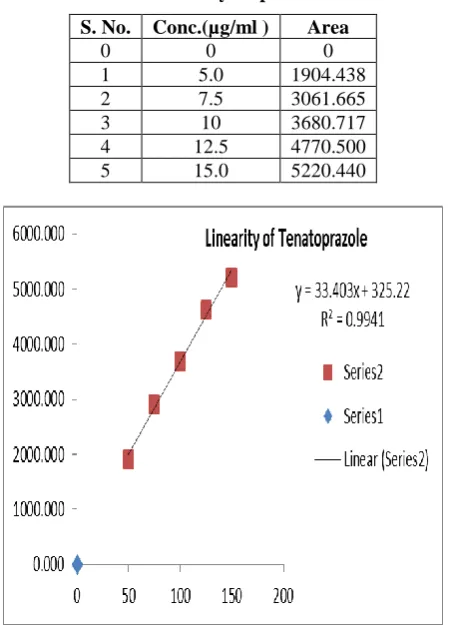
of 5 μg/ml -15 μg/ml for TPZ was designed for linearity test. Table 4 and 5, figure 3 explains about appropriateness of the developed method. Sensitivity of the new method was good enough. With very low concentration the response in graph was sufficient to read and calculate all the results of regression analysis. Results of linearity test revealed that the RSD of Y intercept value was0.28, value of correlation coefficient and SD of slope value 0.21, LOD 0.021µg/ml and LOQ 0.063µg/ml for TPZ was respectively.
Table 4: Results of linearity response.
S. No. Conc.(µg/ml ) Area
0 0 0
1 5.0 1904.438 2 7.5 3061.665 3 10 3680.717 4 12.5 4770.500 5 15.0 5220.440
Figure 3: Linearity plot of Tenatoprazole.
Table 5: Sensitivity and regression analysis.
Parameters Tenatoprazole
Linearity (μgm/ml) 5 μg/ml- 15 μg/ml Correlation Coefficient.(r) 0.994 Regression slope 33.40 SD of Slope 0.21 Regression Intercept (mean) 325.2 %RSD of Intercept 0.28 LOD 0.021µg/ml LOQ 0.063µg/ml
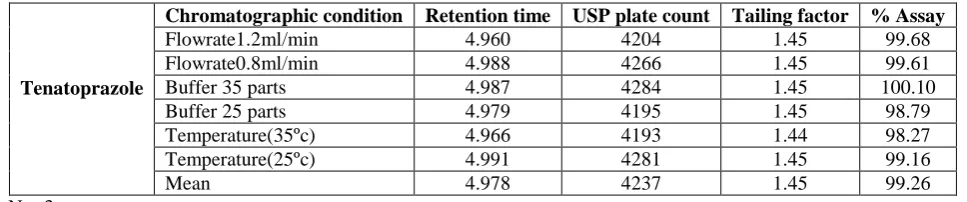
Table 6: Results of robustness studies.
Tenatoprazole
Chromatographic condition Retention time USP plate count Tailing factor % Assay
Flowrate1.2ml/min 4.960 4204 1.45 99.68 Flowrate0.8ml/min 4.988 4266 1.45 99.61 Buffer 35 parts 4.987 4284 1.45 100.10 Buffer 25 parts 4.979 4195 1.45 98.79 Temperature(35ºc) 4.966 4193 1.44 98.27 Temperature(25ºc) 4.991 4281 1.45 99.16
Mean 4.978 4237 1.45 99.26
N = 3
Assay of marketed formulation: The formulation
(Tablet- Tenata20mg) was procured from Medical store locally. Ten tablets had been chosen, weighed and collected in a clean and dry mortar. Tablets were triturated into powder form and then collected an equivalent quantity of 10mg of TPZ in a dry volumetric flask (100 ml). Entire quantity of powder was treated with diluent and then subjected for sonication. The volume was made with diluent. 1 ml of the solution was pipetted out into a volumetric flask (10 ml) and the volume was made with diluent. 10 μl of resultant solution was injected to the Chromatographic system and analytical result was studied as compared to that of standard preparation. Peak area response was taken into consideration. Mean assay value for six sample trial was found to be 99.21%.
CONCLUSION
The present HPLC method for the determination of Tenatoprazole was found to be one of the least time consuming, simple, highly accurate technique as all the validation results of all parameters were with very low value of %RSD. At the same time it also proved that the innovated technique is a precise and robust method. Therefore the above narrated novel analytical technique is a prefered and suitable one for evaluation of bulk and tablet formulation of the drug in laboratory on regular basis.
ACKNOWLEDGEMENTS
We are very much thankful to Dr. A. Srinivasa Rao, Professor and Principal Bhaskar Pharmacy College, Hyderabad for his guidance, kind help and constant encouragement at every step during the progress of this research work. We also express our gratitude to Dr. V.V. Rao, CEO, and Mr. J.V. Krishna Rao, secretary, J.B. Group of Educational Institution for providing a healthy working environment which is an essence in research field.
REFERENCES
1. https://onlinelibrary.wiley.com/doi/pdf/10.1111/j.13 65-2036.2004.01893.x.
2. Lozano, R.; Peralta Concha, M.G.; Montealegre, A.; Leon, d. E. L.; Villalba, Ortiz, J.; Esteban Lee, H.O.; Cromeyer, M.; Garcia Rivas, J.A.; Brossa, A.;
Lluberes, G.; Izquierdo Sandi, E.; Quros Burgos, H.; Ther Clin Risk Manag, 2007; 3: 149-155.
3. The Indian Pharmacopoeia, 2014 Volume-II, Government of India, Delhi, 1689.
4. https://en.m.wikipedia.org.tenatoprazole.
5. M. Sugumaran, M. Poornima, M. Yogesh Kumar and Sree Ramarajasekhar, RP-HPLC method for the determination of Tenatoprazole in pharmaceutical formulations. Der Pharmacia Sinica, 2011; 2(5): 12-16.
6. Kumaraswamy Gandla, J.M. Rajendrakumar, J.V.L.N. Sheshagirirao and M. Arunadevi, Spectrophotometric determination of Tenatoprazole in bulk drug and pharmaceutical dosage form. Research Journal of Pharmacy and Technology, 2011; 4(1): 574-77.
7. M. Sugumaran, Ravikrindhi Nageswara Rao, Dr Jothieswari. UV- spectrophotometric determination of tenatoprazole from its bulk and tablets. Int J Pharm Bio Sci, 2010; 1(1): 68-72.
8. LIU, Pei; SUN, Bo; LU, Xiu-mei; LI, Fa-mei; RP-HPLC determination of tenatoprazole and its related substances in capsules.Chinese Journal of Pharmaceutical Analysis, 2006; 26(10): 1454-56. 9. Sunil R. Dhaneshwar, Vaijanath N. Jagtap.
Development and Validation of Stability Indicating RP-HPLC-PDA Method for Tenatoprazole and Its Application for Formulation Analysis and Dissolution Study. American Journal of Analytical Chemistry, 2011; 2(1): 126-34.
10. Basic Education in Analytical Chemistry. Analytical Science, 2001; 17(1).
11. Willard HH, Merritt LL, Dean JJA, Frank AS. Instrumental method of analysis 1986: CBS Publishers and Distributors, New Delhi, 7th Edition. 12. Michael E, Schartz IS, Krull. Analytical method
development and Validation, 2004; 25-46.
13. Berry RI, Nash AR. Pharmaceutical Process Validation; Analytical method validation, Marcel Dekker Inc. New work, 1993; 57: 411-28.