An Inclusive Design Method for Addressing Human Variability and
Work Performance Issues
Amjad Hussain
1, Keith Case
1,, Russell Marshall
2, Steve J. Summerskill
21Mechanical and Manufacturing Engineering, Loughborough University, Leics, LE11 3TU, UK. 2Design School, Loughborough University, Leics, LE11 3TU, UK.
Received 06 April 2013; received in revised form 28 April 2013; accepted 30 May 2013
Abstract
Humans play vital roles in manufacturing systems, but work performance is strongly influenced by factors such as experience, age, level of skill, physical and cognitive abilities and attitude towards work. Current manufacturing system design processes need to consider these human variability issues and their impact on work performance. An ‘inclusive design’ approach is proposed to consider the increasing diversity of the global workforce in terms of age, gender, cultural background, skill and experience. The decline in physical capabilities of older workers creates a mismatch between job demands and working capabilities which can be seen in manufacturing assembly that typically requires high physical demands for repetitive and accurate motions. The inclusive design approach leads to a reduction of this mismatch that results in a more productive, safe and healthy working environment giving benefits to the organization and individuals in terms of workforce satisfaction, reduced turnover, higher productivity and improved product quality.
Keywords: inclusive design, human variability, work performance, older workers
1.
Introduction
Organizations are continually trying to improve their products, methods, work practices and procedures, but in spite of highly automated manufacturing systems, the importance of humans as a key resource cannot be ignored. In manufacturing organizations and elsewhere the workforce is becoming more diverse in terms of age, skill, gender and cultural background [1]. All these factors potentially have an impact on manufacturing system performance inconsistencies. Ignoring these human variability issues during the manufacturing system design process eventually leads to the setting of unrealistic and overestimated production capacities for manufacturing systems and results in real challenges for the organization. The literature reveals that there is sufficient evidence about the existence of these variability issues caused by diversity in skill, age, experience etc. For example, It was found that there is a relationship between work related musculoskeletal disorders and gender. Female workers have more chances of musculoskeletal disorders and are more likely to leave work because of these disorders [2-3].
Like gender, age also plays a significant role and considered a contributing factor to work related musculoskeletal disorders. Landau et al. [4] conducted a study over 256 workstations of a manufacturing industry and found that head-neck-shoulder symptoms occur more frequently in older workers.
Similarly, differences in working techniques play an important role in work productivity and exposing workers to risk factors. Evidence shows that women perform their work in different ways as compared with men and they like to perform their work with hands at above shoulder level and this technique is usually not considered safe as it causes shoulder and neck disorders [5].
However, very little is known about how to address these and other related issues. There is a need to understand possible factors that might cause variations in human performance and how designers can accommodate human variability issues so that more reliable, safe and consistent manufacturing systems might be assured.
2.
Workforce Diversity
Diversity refers to differences between individuals because of their age, gender, functional capability, cultural background, experience and education [6]. There are multiple dimensions of diversity mentioned in the literature and some dimensions, such as age, race, gender, disability and national origin are encountered very frequently. It is important to note that workforce diversity provides a number of potential benefits or more obvious challenges. Effective diversity management provides an opportunity to achieve high work performance by utilizing more diverse ideas in decision-making. On the other hand, an inadequate response to workforce diversity, may lead to an environment of conflict, a sense of insecurity, dissatisfaction and lower work commitment [7-8]. Consequently, it is very important to understand the relationships between different dimensions of workforce diversity and their impact on individual and organizational work performance.
Increases in creativity, innovation and competitiveness caused by variations in skill, experience and background, are considered as the sustained competitive advantage of having a diverse workforce [8-10]. Moreover, diversity potentially increases performance, as it brings a greater variety of perspectives, different kinds of skills and experiences along with a broad range of task relevant knowledge [11-12]. It’s equally important to identify the conditions when diversity may increase group performance. Pettigrew [13]concluded that positive outcomes of diversity are mainly facilitated by four conditions; intergroup cooperation, common goals, equal group status and support of authorities. Homan et al [14] further concluded that the highest performing teams are open to experience, whereas the lowest performing teams are lower on openness. On the other hand, it is also evident that heterogeneity in teams can affect work performance adversely, as dissimilar individuals have less trust, less frequent communication, lower level of group commitment and a lack of perception of organizational inclusiveness. Keeping in view the complexity of the issue, it has been highlighted that there is a need to consider all dimensions of diversity simultaneously as they are very interlinked [7, 15-16].
3.
Human Variability and Work Organization
organization process so as to be able to recommend such working procedures, methods or strategies that might minimize the effects of human variability.
4.
Ageing and Work Performance
It is evident in the literature that the world is experiencing a significant increase in the proportion of the older population. United Nations statistics [18] (Fig. 1) show that there were about 759 millions of people aged 60 or above in 2010 and it is further projected that this figure will increase to 2 billion by 2050. Moreover, this trend is more prominent in the developing world. Like other parts of the world, the UK population is also ageing [19]. There has been an increase of 1.7 million people aged 65 and over in last 25 years. On the other hand, the percentage of the population aged less than 16 years has decreased from 21 percent to 19 percent from 1984 to 2009. Fig. 2 shows the continuing trend that by 2030 will result in the percentage of people aged more than 65 years being approximately 23 percent, whereas the percentage of the population under 16 years will further decrease to 18 percent. There are other noticeable trends in the UK population which are expected to continue in future years. These are that the fastest percentage increase in the population will be in those who are more than 85 years old and a decrease in the ratio of women to men in the over-65 age group. In comparison with other European countries, the UK has a higher birth rate, which makes it less alarming. In 2008 Japan was the most aged country in the world and 22% of the population was aged 65 and over.
Fig. 1 World population aged 60 and over: 1980, 2010, and 2050 [18]
Fig. 2 Proportion of global population aged 65 and over [18]
0 500 1000 1500 2000 2500
1980 2010 2050
Year
M
il
li
on
The above demographics clearly identify the need for effective utilization of this valuable human capital. The current global economic crisis also indicates a need to accommodate and retain older and experienced workers for a longer time, so that this resource might be utilized for national and global economic growth. However, retention of older workers whilst it has potential benefits also introduces challenges for employment organizations. The experience, knowledge and skills of older workers are considered prominent positive factors influencing employers to consider older workers as assets of the organization. However, declines in physical and physiological capabilities of older workers present many challenges. For example, functional capability mainly depends on muscular strength of the body and this starts to decline after the age of 30. Muscular strength of a 60 year old person is approximately 70% of that of a person 30 years old [20]. Flexibility also decreases with age and is closely linked with balance disorders which can lead to a decline in work performance in sitting, standing, moving and leaning positions. Moreover, investigations show that age adversely affects joint mobility and this decline directly influences work performance as most manual activities need fast, accurate and repetitive movements of different parts of the body [21-23]. Similarly, it has been found that more reaction time variability exists in older people as compared with younger ones, and this directly influences work performance. However, decline in reaction time is more prominent in older women as compared with older men. Aerobic capacity is affected by age and comprehensive physiological investigations are recommended before assigning any task to an older person. However, physically active older workers are better able to manage physically demanding tasks, as compared with the less active. These facts significantly increase design complexity when designers wish to design workplaces, products and processes that are equally viable for an older population [24-28].
The above discussion reveals the need for understanding the effects of ageing and the potential impact on work performance. A realistic understanding of both positives and negatives about older workers can provide an opportunity for designers to address the design needs of this part of the workforce. Otherwise, unrealistic and over ambitious production targets will create a mismatch between job demands and the working capabilities of older workers. Such situations are likely to ultimately result in unsatisfied, over-stressed, frustrated and less loyal workforce which in turn is likely to result in a decrease in the work performance of individuals and the overall organisation.
5.
Inclusive Design Method
"Design is the process of converting an idea or market need into the detailed information from which a product or system can be made" [29]. The British Standards Institute [30] defines inclusive design as "The design of mainstream products and/or services that are accessible to, and usable by, as many people as reasonably possible ... without the need for special adaptation or specialised design”. Later on, the inclusive design term has also been related to providing quality of life and independent living for the ageing population [31].
The terms inclusive design, universal design, design for all, barrier-free design and accessible design have been promoted in different parts of the world. For example, universal design was firstly introduced in the United States by Ronald L. Mace in 1985 and was referred to as a design approach that could be utilized by a wide range of users. The term is also used frequently in Japan. Inclusive design and design for all are popular terms in the United Kingdom and most parts of northern and central Europe [32].
Disabilities Act in the USA [36] have played a vital role in promoting the level of awareness and importance of inclusive design. Therefore, it can be said that the promotion of inclusive design comes with financial as well as legislative incentives.
An ‘Inclusive design’ method aims to address the design needs of a broader range of population where an effort is made to understand existing differences among humans because of their age, gender, size, anthropometry, and working capabilities. However, 100 percent design inclusion is not possible as human variability presents challenges which may hinder designers, engineers and ergonomists in their quest to accommodate all varying design needs into a single design solution. Nevertheless, the inclusive design methodology significantly contributes in the promotion of such design scenarios that are equally viable for a broad range of population.
6.
The ‘HADRIAN’ Inclusive Design Approach
Computer-aided simulation tools, such as digital human modelling (DHM), are considered extremely useful in proactive ergonomics-based design investigations [37]. Furthermore, it has been argued that integration of digital human models with other computer-aided engineering methods significantly reduces overall cost, including design, engineering and ergonomic evaluation costs [38]. The tools facilitate designers by providing the option of constructing and evaluating a virtual prototype design before actual production. Different design options can be developed, and alternatives can be compared before physical mock-ups are built or production trials conducted. The availability of different design options and their visualization at an early design stage enhance cooperation and understanding between designers, engineers, ergonomists and workers, and promote a participatory ergonomic approach [38-41]. Digital Human Modelling (DHM) systems [42] have been available and providing design solutions for a couple of decades and RAMSIS, JACK, SAFEWORK and SAMMIE are typical examples of those commonly in use. RAMSIS was specifically designed for the important area of vehicle design and has been extensively used by automobile manufacturers such as Mercedes-Benz, Ford, BMW, Honda and many more. Many vehicle-specific functions are available for vision, belt analysis, comfort, etc. and the system is available within CATIA, a prominent 3D CAD design system used extensively in the automobile industry. JACK is perhaps more general purpose but has also been extensively used in the automobile industry and is available as part of Siemens NX (another major 3D CAD design system). JACK is noted for its realistic body shape representations and animation based on robotic kinematics. SAFEWORK, also integrated with CATIA, was originally aimed at manufacturing workplace design but is also used in product design for example by Boeing. SAMMIE is independent of any CAD system and was originally created for workplace design but has been widely used in product design.
These DHM systems all create human models based on a statistical model of the population being studied. At the simplest level a model can be created that represents a particular percentile of the underlying population (the 95th percentile stature is a stature that only 5% of the population exceed). Defining a 95th percentile model normally means that the model is 95th percentile in all body dimensions – a situation that is not found in real humans because of the poor correlation between body measures [42]. More sophisticated statistical methods are used (for example by RAMSIS) to determine a typography that is suitable for the evaluation at hand. A typography is a small number of models that to some degree represent the full population.
The DHM systems are typically driven by the user specifying reach points with the system using reverse kinematics to predict a posture. Sometimes these reach points are strung together as a sequence that could be thought of as a simple task description but inclusion of task-dependent variables still remains as a major challenge.
initiatives to look at age and disability issues in the home and integrated transport systems respectively. The opportunity was taken to study solutions to the two problems of poor correlation between body dimensions leading to unrealistic anthropometric representations and the need for more effective driving mechanisms using tasks. Both of these aspects are more acute when dealing with older people and those with disabilities. SAMMIE provides the evaluative ‘engine’ for HADRIAN while HADRIAN itself provides virtual user trial capabilities.
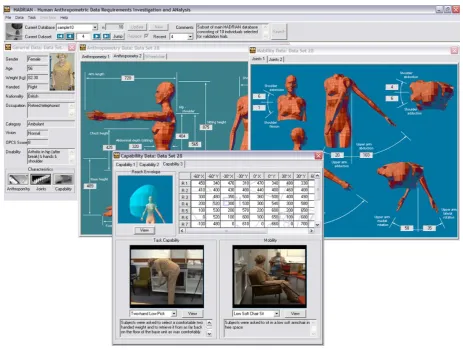
HADRIAN, whilst based on the SAMMIE digital human modelling system, does not use statistical representations of humans but rather data on 100 subjects was collected and maintained as individual data within a database containing different age groups, anthropometry, gender and levels of disability [43-45]. The database contains physical and behavioural data of individuals and is presented graphically so that designers can access and understand all the available information (Fig. 3).
Fig. 3 HADRIAN presentation of individual’s capabilities data
A noticeable characteristic effect of disability is that sufferers adopt coping strategies which allow them to carry out a task that would be impossible using a more normal or expected strategy. Fig. 4 shows the experimental collection of this behavioural information (in this case the strategy of kneeling to place heavy items in the oven of a kitchen mock-up). These behavioural strategies are extremely varied, greatly influence the ability to complete tasks and are used within HADRIAN to provide a degree of intelligence to the evaluation software.
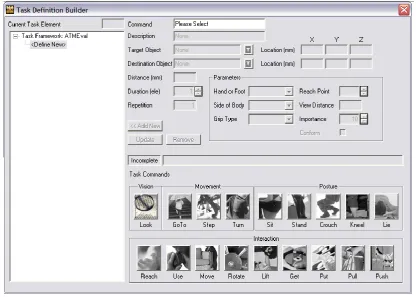
A further key feature of HADRIAN is the ability to define tasks as sets of basic elements. Fig. 5 shows the building of a task definition by the definition of a variety of task elements. The process of defining a task element has two main aspects; one is the definition of interaction points such as a point to be reached to and the other is the setting of optional parameters like which side of the body will be used, what type of grip is required to perform the task etc.? If these optional parameters are not selected the system will run under the default conditions and take advantage of any behavioural knowledge.
Fig. 5 The HADRIAN task definition builder
The combination of individual data on anthropometry, behavioural characteristics and the task definition enables an automated evaluation process which provides information on the percentage of the population that has been excluded. HADRIAN achieves this by the implementation of virtual user trials as an analogy to real-world user trials where a group of subjects is observed using products. HADRIAN automatically builds SAMMIE digital human models for each of the individuals in the database and executes the defined task taking into account the behavioural strategies of the individual. Importantly, HADRIAN also provides an opportunity to explore why an individual is unable to perform a task successfully, it being possible to display unsuccessful task elements for each individual (an out of reach condition for example). In this way, HADRIAN not only displays information about who is excluded but also how to modify and re-design so that it can be used for a broad range of population.
postural strategies adopted in relation to age and skill levels with the end objective of being able to make recommendations to modify the workplace and work task to be better suited to older workers.
Three teams, each of 4 multi-skilled workers, were selected at a furniture manufacturing company where all assembly activities were accomplished manually. Each team consisted of 4 workers possessing almost the same level of skill and the three teams were identified as specialized workers; multi-skilled workers and semi-skilled workers. Their skill levels were categorized by experts at the organization. Specialized workers were those who were excellent at their specialized jobs and used to performing their job activities at the same workstation. They prefer to perform similar kinds of activities during assembly activities of a variety of sofa models. Conversely, multi-skilled workers belong to that group of workers who are considered flexible in their job rotation; however, they are considered equally productive against similar job activities at different workstations. Semi-skilled workers are rated as significantly less skilled when compared to specialized and multi-skilled workers. All these workers were video recorded at least five times for a single activity consisting of a variety of manual assembly task elements. For the purpose of understanding basic differences in working strategies, all workers have been recorded against the same model of sofa. Task completion time was not considered and their task performing strategies were evaluated on the basis of established ergonomic evaluation criterion. For this study, OWAS [46] and REBA [47] methods were used for risk assessment. Recorded videos were analysed and 764 snap shorts were taken for analysis purposes and 706 were finally selected for risk assessment analysis. This study provides the basis for the future population of HADRIAN with assembly work task elements in the same way that it currently contains elements originating from studies in the home and transport. This is subject to future development work on HADRIAN after which it is intended to apply the method in ongoing research in manual assembly in the aerospace industry. Further details about the development and implementation of HADRIAN are available from [48-54].
Fig. 6 Behavioural strategies in furniture manufacture
The objective of these studies was not to design a tool for kitchen, transport or assembly related activities only; it was to try to capture generic working scenarios by observation and determine (where possible) the generic nature of the behavioural strategies so that they could be applied through the HADRIAN system into some other scenario. The fundamental principal behind the task analysis system was to define mismatches between job demands and human capabilities by utilizing individual’s anthropometric data along with working capabilities to address the concern of multivariate accommodation.
national standards. Eight tasks (such as reach to the card slot) were investigated for both heights using 10 subjects from the original HADRIAN survey (a total of 160 tasks). The first study involved a professional user of digital human modelling systems with 10 year’s experience of applying the DHM methodology to disability-related design problems. The SAMMIE DHM system was used but with the HADRIAN anthropometric and joint constraint data relating to the 10 subjects of the HADRIAN survey. The second study involved the 10 real subjects using the laboratory rig. Video recordings were made for subsequent postural analysis. The third study involved automatic evaluation of the ATM using HADRIAN with the data from the 10 real subjects. Details of the outcome can be found in Summerskill et al [52], but generally good agreement was found between the methods giving us some confidence in the performance of HADRIAN. The most interesting results concerned behavioural issues such as wheelchair users adopting an oblique rather than face-on or side-on approach to the ATM. The professional DHM user was better able than HADRIAN to predict the behaviour actually adopted by the real subjects and knowledge gained from the study was used to refine and fine tune the behavioural aspects of HADRIAN.
Fig. 7 Validation of the HADRIAN concept – a wheelchair user using a ticket machine
7.
Manufacturing Industry Perspective
variables including muscular strength, motor skills, vision and hearing capabilities can also affect the working strategies adopted by the workers and become extremely important when directly linked with factors like age, gender and disability.
Hence, it becomes very important to understand difference in strategies adopted by workers so that an optimal strategy in terms of physical load, repetitiveness, postural comfort and work safety might be selected. In this way, the HADRIAN inclusive design methodology might be used to evaluate different working strategies so as to select one that might be equally useful for a broad range of workers in spite of all existing differences. Designers might get some useful recommendations that can promote less harmful and more productive working strategies equally acceptable for a broad range of workers. This can also lead to better and more realistic standardization processes for manufacturing assembly activities. Currently, the focus has been shifted onto recording and analysing differences in working strategies adopted by different workers for manufacturing assembly activities. By following the same procedure, these recorded task performing behaviours will be integrated with the current system, so that the recommendations for a diverse workforce especially older and disabled people might be made.
8.
Conclusion
Demographic changes show that the global workforce is becoming more diverse in terms of age, gender, background, skill and experience. Whilst workforce diversity provides some positive opportunities in terms of variety of skill, a large pool of novel ideas and improved critical thinking, it also results in challenges such as the management of a variety of skills, variations in functional capabilities and difference in attitudes and working behaviours. All these issues potentially increase overall human variability issues that directly influence work performance at the individual and organizational level. The HADRIAN methodology has been proposed for the promotion of such design practices that can minimize human variability issues and their effects on work performance. Future research will be concerned with manufacturing assembly activities where an assembly-based task element can be included within the HADRIAN design system.
Acknowledgements
This article is a revised and expanded version of a paper entitled “Addressing human variability and work performance through an inclusive design method” presented at the 27th International Conference on Manufacturing Research (ICMR), Aston, Birmingham, UK, 11-13 September, 2012.
References
[1] M. Toosi, “A new look at long-term labor force projections to 2050,” Monthly Labor Review, pp. 19-39, November 2006.
[2] L. Punnett and R. Herbert, “Work-related musculoskeletal disorders: Is there a gender differential, and if so, what does it mean?” in: M. Goldman and M. Hatch (Eds.), Women and Health. San Diego: Academic Press, 2000.
[3] D. E. Treaster and D. Burr, “Gender differences in prevalence of upper extremity musculoskeletal disorders,” Ergonomics, vol. 47, pp. 495-526, 2004.
[4] K. Landau, H. Rademacher, H. Meschke, G. Winter, K. Schaub, M. Grasmueck, I. Moelbert, M. Sommer and J. Schulze, “Musculoskeletal disorders in assembly jobs in the automotive industry with special reference to age management aspects,” International Journal of Industrial Ergonomics, vol. 38, pp. 561-576, 2008.
[5] R. Dahlberg, L. Karlqvist, C. Bildt, and K. Nykvist, “Do work technique and musculoskeletal symptoms differ between men and women performing the same type of work tasks?” Applied Ergonomics, vol. 35, pp. 521–529, 2004.
[6] K. Y. Williams and C. A. O’Reilly, “Demography and diversity in organizations: A review of 40 years of research,” Research in Organizational Behavior, vol. 20, pp. 77-140, 1998.
[8] O. C. Richard, “Racial diversity, business strategy and firm performance: A resource based view,” Academy of Management Journal, vol. 43, pp. 164-177, 2000.
[9] J. T. Childs Jr., “Managing workforce diversity at IBM: A global HR topic that has arrived,” Human Resource Management, vol. 44, pp. 73-77, 2005.
[10] N. Bassett-Jones, “The Paradox of diversity management, creativity and innovation,” Diversity Management, Creativity and Innovation, vol. 14, pp. 169-175, 2005.
[11] M.-É . Roberge and R. Van Dick, “Recognizing the benefits of diversity: When and how does diversity increase group performance?” Human Resource Management Review, vol. 20, pp. 295-308, 2010.
[12] C. K. De Dreu and M. A. West, “Minority dissent and team innovation: the importance of participation in decision making,” Journal of Applied Psychology, vol. 86, pp. 1191-201, 2001.
[13] T. F. Pettigrew, “Intergroup contact theory,” Annual Review of Psychology, vol. 49, pp. 65-85, 1998. [14] A. C. Homan, J. R. Hollenbeck, S. E. Humphrey, D. V. Knippenberg, D. R. Ilgen and G. Van Kleef, “Facing
differences with an open mind: Openness to experience, salience of intragroup differences, and performance of diverse work groups,” Academy of Management Journal, vol. 51, pp. 1204-1222, 2008.
[15] P. Chatopadhayay, “Beyond direct and symmetrical effects: The influence of demographic dissimilarity on organizational citizenship behaviour,” Academy of Management Review, vol. 42, pp. 273-287, 1999.
[16] M. E. Mor Barak, D. A. Cherin, and S. Berkman, “Organizational and personal dimensions in diversity climate: Ethnic and gender differences in employee perceptions,” Applied Behavioral Science, vol. 34, pp. 82-104, 1998.
[17] P. Carayon, and M. J. Smith, “Work organization and ergonomics,” Applied Ergonomics, vol. 31, pp. 649-62, 2000. [18] U.N.O., “Ageing,” http://social.un.org/index/Ageing.aspx, December 13, 2012.
[19] O.N.S. U.K., http://www.statistics.gov.uk/cci/nugget.asp?ID=949, December 13, 2012.
[20] S. G. Wanger, A. Pfeifer, T. L. Cranfield and R. L. Craik, “The effects of ageing on muscle strength and function: A review of the literature,” Physiotherapy Theory and Practice, vol. 10, pp. 9-16, 1994.
[21] M. J. Chung, and M. J. Wang, “The effect of age and gender on joint range of motion of worker population in Taiwan,” International Journal of Industrial Ergonomics, vol. 39, pp. 596-600, 2009.
[22] D. L. Sturnieks, R. St George and S. R. Lord, “Balance disorders in the elderly,” Neurophysiologie Clinique /Clinical Neurophysiology, vol. 38, pp. 467-78, 2008.
[23] M. Chiacchiero, B. Dresely, U. Silva, R. Delosreyes and B. Vorik, “The Relationship between range of movement, flexibility, and balance in the elderly,” Topics in Geriatric Rehabilitation, vol. 26, pp. 147-154, 2010.
[24] D. F. Hultsch, S. W. S. MacDonald and R. A. Dixon, “Variability in reaction time performance of younger and older adults,” Journals of Gerontology. Series B, Psychological Sciences and Social Sciences, vol. 57, pp. 101-115, 2002. [25] G. Der and I. J. Deary “Age and sex differences in reaction time in adulthood: results from the United Kingdom Health
and Lifestyle Survey,” Psychology and Aging, vol. 21, pp. 62-73, 2006.
[26] W. D. McArdle, F. I. Katch and V. L. Katch, Exercise physiology: energy, nutrition, and human performance, 5th ed. Baltimore, MD: Lippincott Williams and Wilkins, 2001.
[27] J. Ilmarinen and J., Rutenfranz, “Occupationally induced stress, strain and peak loads as related to age,” Scandinavian Journal of Work, Environment & Health, vol. 6, pp. 274-82, 1980.
[28] P. O. Astrand, K. Rodahl, H. A. Dahl and S. B. Stromme, Textbook of work physiology, physiological bases for exercise, 4th ed. Champaign, IL: Human Kinetics, 2003.
[29] Royal Academy of Engineering, “Educating engineers in design,” http://wwww.raeng.org.uk, December 13, 2012. [30] British Standard7000-6:Design management systems. Guide to managing inclusivedesign. British Standards Institute,
London, UK, 2005.
[31] S. Waller, and P. J. Clarkson, “Tools for inclusive design,” The Universal Access Handbook. Taylor and Francis, Boca Raton, FL, 2009.
[32] E. Ostroff, “Universal design: an evolving paradigm,” Universal Design Handbook. McGraw-Hill, pp. 1.3-1.6, 2011. [33] R. Coleman “Designing inclusive experiences,” Universal Design Handbook. McGraw-Hill, pp. 21.1-21.8, 2011. [34] P. J. Clarkson, R. Coleman, S. Keates and L. Cherie, Inclusive Design: design for the whole population, 1st ed.
Springer, 2003.
[35] Disability Discrimination Act, London, HMSO, 1995.
[36] Americans with Disabilities Act – ADA – 42 U.S. Code Chapter 126, 1990.
[38] D. B. Chaffin, “Human motion simulation for vehicle and workplace design,” Human Factors and Ergonomics in Manufacturing, vol. 17, pp. 475-484, 2007.
[39] A. Sundin, M. Christmansson and M. Larsson “A different perspective in participatory ergonomics in product
development improves assembly work in the automotive industry,” International Journal of Industrial Ergonomics, vol. 33, pp. 1-14, 2004.
[40] A. Sundin and R. Ö rtengren “Digital human modeling for CAE applications,” in: G. Salvendy, (ed.), Handbook of Human Factors and Ergonomics, John Willy and Sons, Hoboken, NJ, pp. 1053-1078, 2006.
[41] D. B. Chaffin, “Improving digital human modelling for proactive ergonomics in design,” Ergonomics, vol. 48, pp. 478– 91, 2005.
[42] J. M. Porter, K. Case, R. Marshall, D. E. Gyi and R. E. Sims, “Beyond Jack and Jill: designing for individuals using HADRIAN,” International Journal of Industrial Ergonomics, vol. 33, pp. 249-264, 2004.
[43] R. Marshall, K. Case, J. M. Porter, SW. J. Summerskill, D. E. Gyi, P. Davis and R. E. Sims, “HADRIAN: a virtual approach to design for all,” Journal of Engineering Design, vol. 21, pp. 253-273, 2010.
[44] R. Marshall, K. Case, S. J. Summerskill, R. E. Sims, D. E. Gyi and P. Davis, “Virtual task simulation for inclusive design,” in: V. G. Duffy, (ed.), Digital Human Modeling, HCII 2009. Springer-Verlag Berlin Heidelberg, pp. 700-709, 2009.
[45] R. Marshall, K. Case, J. M. Porter, R. E. Sims and D. E. Gyi, “Using HADRIAN for eliciting virtual user feedback in ‘design for all’,” Proceedings of the Institution of Mechanical Engineers, Part B: Journal of Engineering Manufacture, vol. 218, pp. 1203-1210, 2004.
[46] O. Karhu, P. Kansi, P., and I. Kuorinka, “Correcting working postures in industry: A practical method for analysis,” Applied Ergonomics, vol. 8, pp. 199-201, 1977.
[47] S. Hignett and L. McAtamney, “Rapid entire body assessment (REBA),” Applied Ergonomics, vol. 31, pp. 201-205, 2000.
[48] R. Marshall, K. Case, R. E. Oliver, D. E. Gyi and J. M. Porter, “A task based ‘design for all’ support tool,” Robotics and Computer-Integrated Manufacturing, vol. 18, pp. 297-303, 2002.
[49] D. E. Gyi, R.E. Sims, J. M. Porter, R. Marshall and K. Case, “Representing older and disabled people in virtual user trials: data collection methods,” Applied Ergonomics, vol. 35, pp. 443-51, 2004.
[50] R. E. Sims, “Design for all: methods and data to support designers,” Ph.D. dissertation, Dept. Design Technology, Loughborough Univ., Loughborough, UK, 2003.
[51] S. J. Summerskill, R. Marshall, K. Case, D. E. Gyi, R. E. Sims, P. Davis, P. N. Day, C. Rohan and S. Birnie, “Validation of the HADRIAN system using an ATM evaluation case study,” Digital Human Modeling, HCII 2009. Springer-Verlag Berlin Heidelberg, pp. 727–736, 2009.
[52] S. J. Summerskill, R. Marshall, K. Case, D. E. Gyi, R. E. Sims, P. Davis, P. N. Day, C. Rohan and S. Birnie, “Validation of the HADRIAN system using an ATM evaluation case study,” International Journal of Human Factors Modelling and Simulation, vol. 1, pp. 420-432, 2010.
[53] K. Case, R. Marshall, D. Hogberg, S. J. Summerskill, D. E. Gyi and R. E. Sims, “HADRIAN: Fitting trials by digital human modelling,” in: V. G. Duffy, (ed.), Digital Human Modeling, HCII 2009. Springer-Verlag Berlin Heidelberg, pp. 673–680, 2009.
![Fig. 1 World population aged 60 and over: 1980, 2010, and 2050 [18]](https://thumb-us.123doks.com/thumbv2/123dok_us/9829225.1969038/3.595.173.434.553.722/fig-world-population-aged.webp)