Projecting the Mental Model of Social Networking Site Usage
Chun-Hui Wu
1,*, Yih-Her Yan
2,
Kuen-Ming Shu
31
Department of Information Management, National Formosa University, Yunlin, Taiwan, ROC.
2
Department of Electrical Engineering, National Formosa University, Yunlin, Taiwan, ROC.
3
Department of Mechanical and Computer-Aided Engineering, National Formosa University, Yunlin, Taiwan, ROC.
Received 02 June 2017; received in revised form 27 July 2017; accepted 11 August 2017
Abstract
The growth of online social networking sites (SNS) has created a new world of connection and communication for
online users. SNS usage has become an important part of people’s daily lives. This study aims to obtain new insights
towards SNS usage behaviour. Based on participants’ mental models, it is hoped to make more clear exposition about
their perceptions and experiences as well as to explore what factors affect their behaviour for using social networking
sites. A blend of qualitative methodologies was adopted for data collectio n and analysis, including the Zaltman
metaphor elicitation technique (ZMET) method, the laddering technique, and the means-end chain theory. The results
of this study show that the most important values of using SNS include its convenience, maintaining relationship,
gaining relaxation, as well as reaching coherence. Additionally, participants pointed out they cared about their online
privacy issues very much and had found some potential dangers; however, they continued to use these sites because
of the great benefits and enjoyment.
Keywords: social networking sites, projective technique, Zaltman metaphor elicitation technique, mental model, means-end chain theory
1.
Introduction
With the advancement and attractiveness of Web 2.0 technology, online social networking sites (SNSs) such as Facebook,
Google+, Instagram, Twitter, and LINE, have emerged as rapidly growing mechanisms that allow users to communicate with each
other for sharing information, posting videos, pictures, comments, and messages at any time a nd from any places around the
world. SNSs usage has become increasingly more influential on most Internet users’ daily lives and radically have changed how
they spend their time online. As SNSs continue to evolve at a breakneck speed, so does the usage gro wth on the respective
platforms. According to the 2016 Nielsen Company’s report [1], the global average time spent per person on social networking
sites is now nearly five and half hours per month. In addition, researchers from the Pew Research Center’s In ternet found that
nearly 80 percent of online adults used social networking sites, and almost 88% of teens and young adults were a member of at
least one social network [2-3].
Social networking sites support individuals to present themselves, articulate t heir social networks, and establish or maintain
connections with others - not only in forming but also maintaining relationships. In recent years, these sites have been the
fastest-expanding websites [4]. The growth of online social networks has created a new world of connection and communication
for online users. However, it is not only changing how online users interact with one another, but also changing how business es
touch with their consumers. The popularity of social networking is increasing very rap idly, and, therefore, businesses are turning
to these platforms in order to promote their products and to reach potential consumers. This is new opportunities for busines ses
to communicate with consumers for gaining much more transparency and ultimately to build profitable relationships with their
consumers. It is predicted that US advertisers will reach $2.6 billion to place advertises on social networking sites by the end of
2012, up more than $1.2 billion from 2008 [5]. This progress illustrates the increasing influence of social networking sites in
modern business environment.
These phenomena have attracted much attention of practitioners and researchers to question what factors may influence
the usage behavior on SNSs [6-7]. Yet despite this interest, there seems to be very limited understanding of users’ mind map.
Essentially, a clear understanding of users’ thoughts and feelings could help businesses better allocate funds appropriately to
effective factors and redesign or eliminate non -effective factors. By being aware of how mental models impact users’
understanding of SNSs can help businesses better apply marketing strategies that are consistent with users’ expectations and
behaviour in social media [8]. This study, therefore, sets out to explore the following research questions: what are the mental
models of online users toward the value of social networking sites? This study aimed to obtain new insights towards social
networking sites usage behavior. Based on participants’ mental models, it is hoped to make more clear exposition about their
perceptions and experiences as well as to explore what factors may has an impact on their behavior for using social networkin g
sites. An interpretative approach by means of the Zaltman Metaphor Elicitation Techniqu e (ZMET), a projective technique, was
conducted to a University context.
2.
The projective technique
The projective technique is a blend of three qualitative methodologies including the ZMET method, the laddering technique,
and the means-end chain theory.
2.1. The Zaltman Metaphor Elicitation Technique
For understanding users’ actual thoughts toward social networking sites, the projective technique, ZMET, was selected.
The rationale for using ZMET to collect and analyze data is that the ZMET process of th inking about and searching for images
is able to bring hidden, unconscious thoughts to the surface [9]. The ZMET method provides opportunity for researchers to lo ok
at the phenomena in more varied and deeper ways than is possible through other traditional qualitative methods.
Most qualitative research techniques, such as case study and focus groups, depend on verbal communication as a
data-collection method. However, for more than 80% of people communication being nonverbal and non -linear [10], verbal-based
interactions with subjects may result in an incomplete communication. Additionally, people decision -making and behavior are
guided by largely hidden experiences because probably 95% of all cognition is unconscious [11]. Thus, the way in which
thoughts occur may be very different from the way in which they are communicated. Cognitive scientists claims that people think
in images, not words; however lots of today’s qualitative research techniques rely on verbal-centric communication (i.e., literal,
verbal language) as a data collection method [10, 12]. As subjects are better able to transmit their thoughts and feels in nonverbal
terms, combining nonverbal images with verbal communication is able to generate a more meaningful message than totally
relying on verbal communication. In this regard, ZMET was designed to be a more precise research tool which can make up the
ZMET is a hybrid methodology, which integrates the visual projection technique, in -depth personal interview, and a range
of qualitative data-coding method, such as categorization, abstraction of categories, and comparison of instances within data to
elicit the metaphors, constructs, and mental models that drive consumers’ thinking and beha vior. For improving qualitative
research, ZMET uses multidisciplinary ideas such as cognitive neuroscience, neurobiology, art critique, literary criticism, v isual
anthropology, visual sociology, the philosophy of mind, art therapy, and psycholinguistics to combine knowledge from the
social sciences, biological sciences, and the humanities. Metaphors, photo analysis, and narrating are key concepts used in
ZMET, and each adds value to this research process. This technique achieves high validity since issues a nd structures emerge
from the data collected by the respondents themselves. Therefore, ZMET has been employed in numerous academic studies. In
addition, it has gained considerable interest and been used in over 20 countries around the world by the world's leading
companies, such as AT&T, Coca-Cola, Motorola, American Express, to explore consumer and organizational issues [9].
2.2. The Means-End Chain Theory and the Laddering Technique
The means-end theory sustains that the way participants relate to topics can be represented by a hierarchical model of three
interconnected levels: attributes, consequences, and values [13-14].
The ZMET approach can offer a deeper and richer understanding of the important personal constructs elicited through
laddering proces s [15]. The analysis of the means -end data comprised of three stages. At the first stage, the coding of
sequences of attributes, consequences and values (the ladders) takes place in the results of ZMET process. The second stage
involves the development of meaningful categories by grouping together phrases with identical meanings. The identification of
categories is by A-C-V phrases and key words that participants used during the ZMET interviews and from concepts derived
from the literature review. The s tudy will follow an iterative process of recoding data, splitting, combining categories and
generating new or dropping existing categories, followed by an aggregation of codes for individual means –end chains across
participants. Finally, two hierarchical value maps (HVM) of teachers and students will be generated. The map consists of nodes,
which stand for the most important attributes/consequences/values (conceptual meanings) and lines, which represent the
linkages between the concepts. The map graphically sums up the information collected during the ZMET interviews .
3.
Research Methodology
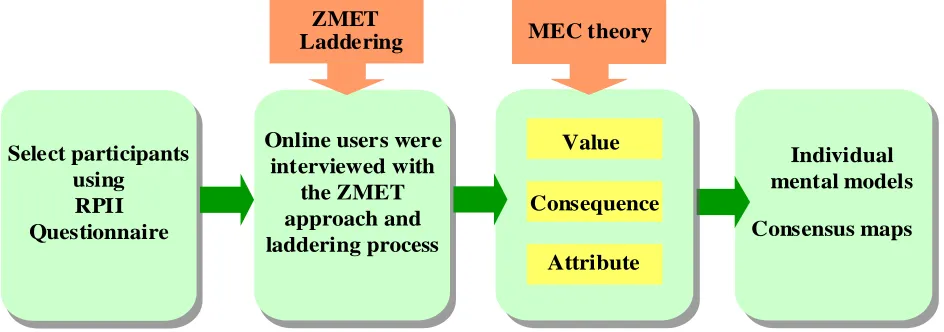
To address the research question, a qualitative research framework is presented in Fig. 1. In order to capture the mental of
online users who were using social networking sites, a blend of qualitative methodologies including the ZMET method,
means-end approach, and laddering process were used for data collection and analysis .
Online users were
interviewed with
the ZMET
approach and
laddering process
Individual
mental models
Consensus maps
ZMET
Laddering
ZMET
Laddering
Value
Consequence
Attribute
Value
Consequence
Attribute
MEC theory
MEC theory
Select participants
using
RPII
Questionnaire
This study had the ZMET approach as theory basis, combining means-end approach and laddering process to analyze the
high involvement people thoughts and feelings for SNSs usage. According to this method, we could realize the correlation about
SNSs attributes, usage consequences, and ultimate values. Qualitative-based procedures were selected for this study for three
reasons. First, this study seeks to deeply better understand what is actually happening within social networking sites. Secon d,
it is hoped to obtain more in-depth information that may be difficult to convey quantitatively. Third, ZMET method provides
opportunity for researchers to look at the phenomena in more varied and deeper ways than is possible through other traditiona l
qualitative method.
3.1. Selecting Participants
In this study, the revised personal involvement inventory (RPII) questionnaire was utilized to help find a representative
sample of Facebook users, who meet the requirements for the research objective and have a high relevance. The RPII is illustrated
in Table 1. After qualifying for participation using RPII, a total of 12 Facebook users are recruited to participate in our study. For
understanding users’ actual thoughts toward social networking sites, the projective technique, ZMET, was selected. The
rationale for using ZMET to collect and analyze data is that the ZMET process of thinking about and searching for images is able
to bring hidden, unconscious thoughts to the surface [9]. The ZMET method provides opportunity for researchers to look at th e
phenomena in more varied and deeper ways than is possible through other traditional qualitative methods. Twelfth qualitative
interviews based around the ZMET approach were used for this study including 12 users who have highly participated in social
networking sites were conducted.
Table 1 RPII- revised personal involvement inventory
1 Unimportant : : : : : : Important 2 Boring : : : : : : Interesting 3 Irrelevant : : : : : : Relevant 4 Unexciting : : : : : : Exciting
5 Means nothing : : : : : : Means a lot to me 6 Unappealing : : : : : : Appealing 7 Mundane : : : : : : Fascinating 8 Worthless : : : : : : Valuable 9 Uninvolving : : : : : : Involving 10 Need : : : : : : Not needed
Participants will be instructed to gather eight to ten pictures that represent their t houghts and feelings about social
networking sites. These pictures could come from any source, including photographs, magazines, books, newspapers, or
catalogues, and the instructions will be given seven to ten days prior to the interview. Participants were contacted one or two
days before their interview to confirm their understanding of the task and the whole processes, and each interview took
approximately two hours in a quiet room and were recorded .
Storytelling
1
Missed issues and images
2
Sorting task
3
Construct elicitation
4
Opposite images
5
Consensus maps
10
The vignette
9
The summary image
8
Sensory images
7
Most representative picture
6
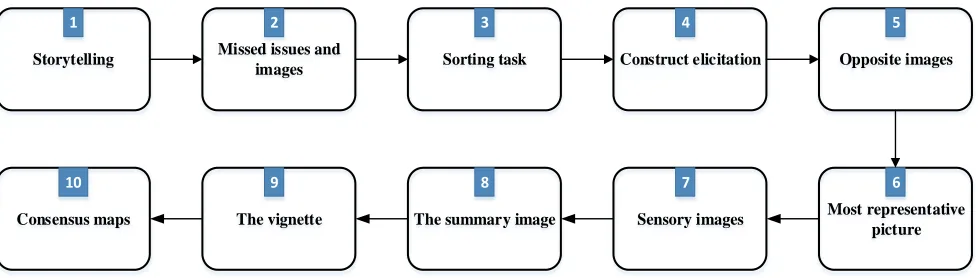
During the two-hour ZMET interview, ten steps in the ZMET method are summarized as follow and shown as Fig. 2.
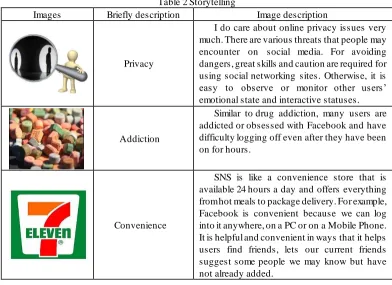
(1) Storytelling: Provides participants with an opportunity to tell th eir stories(as shown in Table 2) because human memory and communication is story-based.
(2) Missed issues and images: Participants describe any issues for which they are unable to find a picture to obtain and explain their relevance.
(3) Sorting task: Participants are asked to sort their pictures into meaningful pile s.
(4) Construct elicitation: The laddering technique is used to elicit basic constructs and their relationships. Participants’ pictures serve as stimuli.
(5) Opposite images: Respondent describes pictures that represent the opposite of the task.
(6) Most representative picture: Participants indicate the picture that is most representative.
(7) Sensory images: Descriptions are elicited of what does and does not describe the taste, touch, smell, sound, color, and emotion of the concept being explored.
(8) The summary image: Respondent, with scissors used to cut photos, creates a summary image.
(9) The vignette: Participant is asked to create a story or short imaginary video that communicates important issues related to the topic under consideration.
(10) Consensus maps: All the res pondents’ mental maps were merged to a consensus map.
Table 2 Storytelling
Images Briefly description Image description
Privacy
I do care about online privacy issues very much. There are various threats that people may encounter on social media. For avoiding dangers, great skills and caution are required for using social networking sites. Otherwise, it is easy to observe or monitor other users’ emotional state and interactive statuses.
Addiction
Similar to drug addiction, many users are addicted or obsessed with Facebook and have difficulty logging off even after they have been on for hours.
Convenience
SNS is like a convenience store that is available 24 hours a day and offers everything from hot meals to package delivery. For example, Facebook is convenient because we can log into it anywhere, on a PC or on a Mobile Phone. It is helpful and convenient in ways that it helps users find friends, lets our current friends suggest some people we may know but have not already added.
3.2. Data Analysis
Participants’ feelings, thoughts, and behaviors were analyzed based on means-end chain theory. All interviews were
recorded and later transcribed to enable empirical content analysis for achieving means-end chains. Each means-end chain links
the relationships between attributes, consequences, and values (A -C-V), it can also analyze the emotion product attributes
Attributes (Means)
Consequence (Means)(end)
Values (end)
Fig. 3 M eans-end chain connects relations between Attributes/Consequence/Values
A means-end chain links attributes of the social network sites, consequences of these attributes to participants, and the
personal values that the consequences reinforce. Next, each participant’s transcripts were read to discover the relationships
between attributes, consequences, and values. A participant’s sequence of attributes, consequences, and values (A -C-V) is
called a means-end chain and represents a perceptual orientation of decision criteria. Finally, a serious of A-C-V chains were
merged together to derive individual mental models and the aggregate consensus maps of all participants.
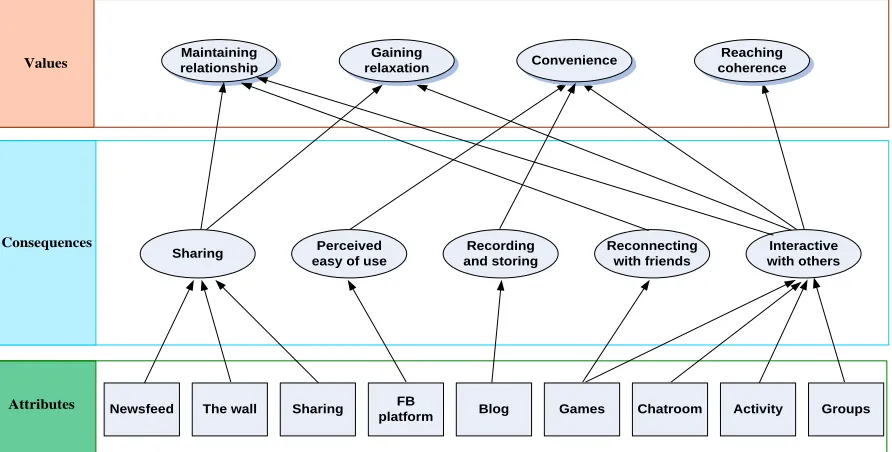
A consensus map represents the main concepts identified by all participants and the linkages between the concepts as
reflected in their interviews. The consensus map (see Fig. 4) in this study resulted from the linkages between system attributes,
usage consequences, and personal values. This consensus map presented over 80% of all constructs mentioned by each one
participant.
Sharing Consequences
Values
Attributes Newsfeed
Maintaining relationship
Perceived easy of use
Recording and storing
Reconnecting with friends
Interactive with others Gaining
relaxation Convenience
Reaching coherence
The wall FB
platform Blog Games Chatroom Activity Groups
Sharing
Fig. 4 The mental model towards social networking sites
4.
Findings and Conclusions
The ZMET method provides a good way for understanding consumers’ cognition and projecting consumers’ behaviour.
Therefor, research data were collected with the ZMET method to understand users ’ insights toward using social networking
sites more thoroughly and more deeply. The analytical results show that the majority of respondents in this study indicated the
most important value of social networking sites includes its convenience, maintaining relationship, gaining relaxation, as well as reaching coherence. This study’s findings were consistent with p revious research of of social networking sites [17-19].
Additionally, respondents pointed out they cared about their online privacy issues very much and had found some potential
dangers. However, they still continued to use social networking sites. The main reason is the perceived benefit and enjoyment
providing by social networking sites are greater than perceived potential dangers for most respondents. The benefits of social
networking service usage include formal educational outcomes, informal education and learning, creativity, individual identit y
and self-expression, strengthening social relationships, belonging and collective identity, building and strengthening
References
[1] Sean Casey, “The 2016 Nielsen social media report,” http://www.nielsen.com/us/en/insights/reports/2017/2016-nielsen-so cial-media-report.html, 2017.
[2] Pew Research Center, “79% of online adults (68% of all Americans) use Facebook,” http://www.pewinternet.org/2016/11/1
1/social-media-update-2016/pi_2016-11-11_social-media-update_0-02/.
[3] S. Jones and S. Fox, “Generations online in 2009,” http://www.pewinternet.org/’/media//Files/Reports/2009/PIP_Generatio
ns_2009.pdf, 2009.
[4] K. C. Laudon and J. P. Laudon, Management information systems: managing the digital firm, New Jersey: Prentice-Hall, 2012. [5] A. Lenhart, K. Purcell, A. Smith, and K. Zickuhr, “Social media and young adults,” Washington, DC: Pew Internet and
American Life Project, http://pewinternet.org/Reports/2010/Social-Media-and-Young-Adults.aspx, 2010.
[6] The 2010 Nielsen Company report, “Global audience spends two hours more a month on social networks than last yea r,”
http://blog.nielsen.com/nielsenwire/global/global-audience-spends-two-hours-more-a-month-on-social-networks-than-la st-year/>, 2010.
[7] J. Hahn, “Social networking ad spending to reach $2.6 billion,” http://www.emarketer.com/Article.aspx?id=1006278/.
[8] P. Rydén, T. Ringberg, and R. Wilke, “An investigation of the mental models of social media in the minds of managers,” the 43rd EMAC Annual Conf. 2014, 2014, pp. 1-9.
[9] G. Zaltman and R. Coulter, “Seeing the voice of the customer: Metaphor based advertising research ,” Journal of the Marketing Research Society, vol. 35, no. 4, pp. 35-51, 1995.
[10]G. Catchings-Castello, “The ZMET alternative,” Marketing Research, vol. 12, no. 2, p. 6, 2000.
[11]G. Zaltman, “Eliciting mental models through imagery 22,” The Languages of the Brain, vol. 6, pp. 363, 2002.
[12]A. G. Woodside, “Advancing means end chains by incorporating Heider’s balance theory and Fournier's consumer-brand relationship typology,” Psychology & Marketing, vol. 21, no. 4, pp. 279-294, March 2004.
[13]M. Vriens and F. T. Hofstede, “Linking attributes, benefits, and consumer values,” Marketing Research, vol. 12, no. 3, pp. 4-10, 2000.
[14]R. B. Woodruff and S. Gardial, Know your customer: New approaches to understanding customer value and satisfaction. Wiley, 1996.
[15]G. L. Christensen and J. C. Olson, “Mapping consumers’ mental models with ZMET,” Psychology and Marketing, vol. 19, no.
6, pp. 477-502, May 2002.
[16]T. J. Reynolds and J. Gutman, “Laddering theory, method, analysis, and interpretation ,” Journal of advertising research, vol.
28, no. 1, pp. 11-31, March 1988.
[17]D. Boyd and N. Ellison, “Social network sites: Definition, history, and scholarship,” Journal of Computer-Mediated Communication, vol. 13, no. 4, pp. 210-230, 2007.
[18]R. Junco, “The relationship between frequency of Facebook use, participation in Facebook activities, and student engagement,” Computers & Education, vol. 58, no. 1, pp. 162-171, January 2012.