International Journal of Emerging Technology and Advanced Engineering
Website: www.ijetae.com (ISSN 2250-2459,ISO 9001:2008 Certified Journal, Volume 3, Issue 2, February 2013)
125
Distributed query execution system for Transactional Database
using Lookup Table
Seema Patil
1, Prof. H. M. Jadhav
21
PG student, 2Assistant Professor, Information Technology Dept, Sinhgad COE, Pune. Abstract- As data volumes are incrementing rigorously, it is
essential to store such large amount of data distributed across many machines. In OLTP databases, the most common strategy for scaling database workload is to horizontally partition the database using hash or range partitioning. It works well in many simple applications such as an email application. Transactions that access few tuples do not run optimally using traditional partitioning schemes. For example, social networking, workloads involving many-to-many relationships is hard to partition. Fine-grained partitioning strategy can fix the scale out problem where related individual tuples are co-located together in the same partition. Maintaining a fine-grained partitioning requires storing the location of each tuple. This metadata is called a lookup table. This paper describes a design of a distributed query execution system that handles fine grained partitioning using lookup table. It also describes Look up tables can improve the performance of difficult to partition database workloads. This implementation provides better throughput on these workloads than simple range or hash partitioning and provides better scale-out performance.
Keywords--Fine grained partitioning, Look-up table, OLTP
I. INTRODUCTION
Partitioning is often used for OLTP systems to reduce contention in order to support a very large user population. A popular and favourable application of partitioning is in a distributed database management system. Each partition may be spread over multiple nodes, and users at the node can perform local transactions on the partition. This increases performance for sites that have regular transactions involving certain views of data, whilst maintaining availability and security.
The primary way in which databases are scaled to run on
multiple physical machines is through horizontal
partitioning. By placing partitions on different nodes, it is often possible to achieve nearly linear speedup, especially for analytical queries where each node can scan its partitions in parallel. Besides improving scalability, partitioning can also improve availability, by ensuring that when one partition fails the remaining partitions are able to
answer some of the transactions, and increase
manageability of the database by enabling rolling upgrades and configuration changes to be made on one partition at a time.
In order to be effective for web and OLTP workloads, a partitioning strategy should minimize the number of nodes involved in answering a query or transaction, thus limiting distribution overhead and enabling efficient scale-out. The most common strategy is to horizontally partition the database using hash or range partitioning. This is used by commercially available distributed databases and it works well in many simple applications. For example, in an email application, where each user only accesses his or her data, hash partitioning by userid effectively places each user’s data in separate partitions, requiring very few distributed queries or transactions.
In social networking workloads like Facebook, there is no obvious partitioning that will result in most queries operating on a single partition. For example, consider placing one user’s posts in a single partition (partitioning by author). A common operation is listing a user’s friends’ recent posts, which now needs to query multiple partitions. Alternatively, replicating a user’s posts on his or her friends’ partitions allows this ―recent posts‖ query to go to a single partition, but requires updates to be sent to multiple partitions. This simple example shows how workloads involving many-to-many relationships are hard to partition.
Instead of partitioning data randomly e.g using hash partitioning or via fixed partitioning of ranges, what is needed is to use a fine-grained partitioning strategy that places tuples that accessed together in the same partition. It can fix scale out problem introduced by simplistic partitioning schemes.
Another problem with traditional partitioning is that while queries on the partitioning attribute go to a single partition, queries on other attributes must be broadcast to all partitions. For example, for Wikipedia, two of the most common query is to select an article either by a numeric id or by title. No matter which attribute is chosen for partitioning, the queries on the other attribute need to be sent to all partitions. The solution is a partition index that specifies which partitions contain tuples matching a given attribute value (e.g., article id), without partitioning the data by those attributes.
International Journal of Emerging Technology and Advanced Engineering
Website: www.ijetae.com (ISSN 2250-2459,ISO 9001:2008 Certified Journal, Volume 3, Issue 2, February 2013)
126
This allows the administrator to partition tuples in an arbitrary (fine-grained) way. Furthermore, lookup tables can be used as partition indexes, since they specify where to find a tuple with a given key value, even if the table is not partitioned according to that key. A key property is that with modern systems, lookup tables are small enough that they can be cached in memory on database query routers, even for very large databases. Thus, they add minimal overhead when routing queries in a distributed database.A lookup table is created for one column of the table, mapping the value of the column to the tuple location on the back ends. This column is normally unique id for the tuple. The distributed query execution uses the lookup table to find tuple locations for a query so that it can route the query to the correct back-ends. Making lookup table works involves a number of challenges. First, lookup tables must be stored compactly in RAM, to avoid adding additional disk accesses when processing queries. A second challenge is efficiently maintaining lookup tables in the presence of updates; this paper is about how lookup tables can improve the performance of many different workloads.
The paper is organized as follows: section II provides the related work, III section discusses the overview of the system, section IV presents lookup table query processing and Section V provides storage alternatives. Section VI concludes the paper.
II. RELATED WORK
Distributed databases in modern commercial systems rely on data partitioning feature for scalability. Theses system typically support hash or range partitioning of the data. Although a number of automatic partitioning schemes have been investigated, the mostly widely used approaches are round-robin (send each successive tuple to a different partition), range (divide up tuples according to a set of predicates), or hash partitioning (assign tuples to partitions by hashing them).
Unfortunately, for workloads consisting of small transactions that touch a few records, none of these approaches is ideal. If more than one tuple is accessed, then round robin and hash partitioning typically require access to multiple sites. Executing distributed transactions reduces performance compared to running transactions locally. Range partitioning may be able to do a better job, but this requires carefully selecting ranges which may be difficult to do by hand. Look up tables can be used with all these systems, in conjunction with their support for partitioning.
Another use of lookup tables is as a type of secondary index for tables that are accesses via more than one attribute.
In previous research on partitioning in distributed databases many alternatives to this strategy have been proposed. For example, Bubba proposed Extended Range Declustering, where a secondary index on the non-partitioned attributes is created and distributed across the database nodes [5]. This permits more efficient queries on the secondary attributes, but they require two network round trips to two different partitions: one to query the secondary index, then one to fetch the actual data.
Another alternative are multi-attribute indexes, which require accessing a fraction of the partitions instead of all of them. MAGIC declustering is strategy, where the table is partitioned in a N-dimensional fashion using N indexed attributes [7]. This ensures that all queries on the indexed attributes go to a subset of the nodes, but each subset will still need to be larger than one. While this is an improvement, it still requires more work as the system grows, which hampers scalability.
Previous work has argued that hard to partition applications containing many-to-many relationships, such as social networks, can be partitioned effectively by allowing tuples to be placed in partitions based on their relationships. Schism uses graph partitioning algorithms to derive the partitioning [2], while SPAR uses an online heuristic to rebalance partitions [4]. The Schism work does not discuss how to use the fine-grained partitioning it produces as the focus in that paper is on using classification techniques to transform fine grained partitioning into range partitions. SPAR uses a distributed hash table to lookup up the tuple location, which introduces a network round-trip. Both these partitioning heuristics could use lookup tables to distribute queries.
An alternative approach is to force the user to use a schema and queries that are easily partitionable via a single attribute. The H-Store system is designed with the assumption that most OLTP applications are easily partitionable in this fashion [6]. Google Megastore [3] forces applications to execute only single partition transactions, providing mechanisms to specify how tables are partitioned together. This design removes the need for lookup tables, but also constrains how developers can use the database.
International Journal of Emerging Technology and Advanced Engineering
Website: www.ijetae.com (ISSN 2250-2459,ISO 9001:2008 Certified Journal, Volume 3, Issue 2, February 2013)
127
III. SYSTEM OVERVIEWThe basic architecture of the system is summarized in figure 1. In this architecture, database front-end that uses lookup tables to execute queries in a shared-nothing distributed database is built. In this design, query routers send queries to backend databases, which host the partitions. Lookup tables are stored in memory, and consulted to determine which backends should run each query. This architecture allows achieving linear scale-out on several difficult to partition datasets.
Fig.1. Architecture of the Lookup Table Partitioning System
Applications interact with the database as if it is a traditional single system, using JDBC driver. The system consists of two layers: backend databases, which store the data, and query routers that contain the lookup table and partitioning metadata. Each backend runs an unmodified DBMS e.g. MySQL plus an agent that manages updates to the lookup tables.
Routers receive an application query and execute it by distributing queries to the appropriate backends. A typical presumed abort two-phase commit protocol with the read-only participant optimization is used to manage distributed transactions across backends, using the XA transactions supported by most SQL databases. This design allows the throughput to be scaled by adding more machines. Adding backends requires the data to be partitioned appropriately, but adding routers can be done on demand; they do not maintain any durable state, except for distributed transaction commit logs. Routers process queries from multiple clients in parallel, and can also dispatch sub-queries to backends in parallel.
Thus, a single router can service many clients and backends, but more can be added to service additional requests.
The routers are given the network address for each backend, the schema, and the partitioning metadata when they are started. The partitioning metadata describes how data is divided across the backends, which can either be traditional hash or range partitioning, or lookup tables. To simplify initial description, basic approach assumes that the lookup table does not change, and that each router has a copy of it when it starts.
IV. LOOK UP TABLE LOGIC
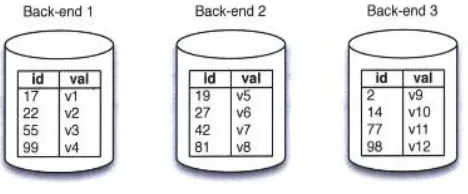
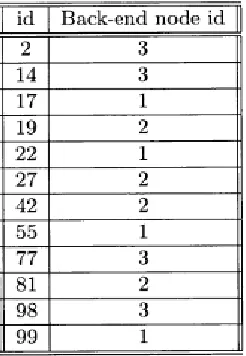
[image:3.612.76.276.262.438.2]A lookup table holds information about the partitions on which a set of tuples are stored. In the table , each tuple is identified by the value of some key attributes, and partitions are represented by an integer partition id. Figure 2 shows a simplistic database. Each back-end holds one partition of the table. The partitions have an id column, which is a primary key, along with a value. Table 4.1 shows the look-up table that is generated when id is used as the look-up table key. The mapping goes from tuple id to partition number. There can be multiple underlying implementations of look-up tables, although one important feature is that look-up of the partition given a key should be quick and require constant time.
Fig. 2. Example of distributed database with data
Though lookup tables are a simple idea, making them work well involves a number of challenges. First, lookup tables must be stored compactly in RAM, to avoid adding additional disk accesses when processing queries. A second challenge is efficiently maintaining lookup tables in the presence of updates; a simple set of techniques that guarantee that query routers and backend nodes remain consistent, even in the presence of failures.
Lookup tables can improve the performance of many different workloads. Several existing partitioning Schemes like Schism or little engine as well as manual partitioning can be implemented with lookup tables. They result in excellent performance, providing better throughput on specific workloads than either range or hash partitioning and providing better scale-out performance.
[image:3.612.331.565.413.510.2]International Journal of Emerging Technology and Advanced Engineering
Website: www.ijetae.com (ISSN 2250-2459,ISO 9001:2008 Certified Journal, Volume 3, Issue 2, February 2013)
[image:4.612.109.232.140.318.2]128
Table 1 Example look-up table generated from the database in figure 2
To describe the basic operation of lookup tables, consider the social networking example from the introduction. This example contains two tables: users and followers, each identified by an integer primary key. The followers relation contains two foreign keys to the users table: source and destination. This creates a many-to-many relationship, from each user to the users that they follow. The users table contains a status field. Users want to get the status for all users they are following. This is done with the following two SQL queries, the first of which fetches the list of user ids that are followed and the second of which fetches the status.
R=SELECT destination FROM followers WHERE source=x
SELECT * FROM users WHERE id IN (R)
For traditional hash partitioning, we can partition the users table by id, and partition the followers table by source. For lookup tables, we can partition users such that related users (e.g., that share many friends) are stored on the same node, and use the same lookup table to partition followers by source. In that case, various partitioning schemes can be used to figure out how to initially place users.
A. Basic lookup table operation
When a router receives a query from the application, it must determine which backends store the data that is referenced. For queries referencing a column that uses a lookup table (e.g., SELECT destination FROM followers WHERE source = 42), the router consults its local copy of the lookup table and determines where to send the query.
In the case of simple equality predicates, the query can simply be passed through to a single backend. If multiple backends are referenced (e.g., via an IN clause) then the query is rewritten and a separate query is sent to each backend. The results must then be merged in an appropriate way (e.g., via unions, sorts, or aggregates) before being returned to the client. More complex queries may require multiple rounds of sub-queries.
For example, the first query is sent to a single partition based on the lookup table value for user id = x. The second query is then sent to a list of partitions, based on the user ids returned by the first query. For each user id, the destination partition is found in the table. This gives us the freedom to place users on any partition. In this case, ideally one can determine an intelligent partitioning that co-locates a user with the users they are following. As the data is divided across more machines, the number of partitions that is accessed by this second query should stay small.
For hash partitioning, the second query accesses several partitions, since the users are uniformly distributed across partitions. When one attempt to scale this system by adding more machines, the query accesses more partitions. This limits the scalability of this system
In order to use lookup tables to route queries, they must be stored in RAM at each router, in order to avoid imposing any performance penalty. Conceptually, a lookup table is a map between a value and a list of partitions where matching values are stored. The common case is mapping a unique primary integer key to a partition.
B.Defining lookup table
A database administrator can use some basic SQL commands to define and populate lookup tables. These commands define the metadata used by the query router to perform query execution. To illustrate these commands, take an example users and followers tables. First, to specify that the users table should be partitioned into part1 and part2,
CREATE TABLE users ( id int, ..., PRIMARY KEY (id), PARTITION BY lookup(id) ON (part1, part2) DEFAULT NEW ON hash(id));
International Journal of Emerging Technology and Advanced Engineering
Website: www.ijetae.com (ISSN 2250-2459,ISO 9001:2008 Certified Journal, Volume 3, Issue 2, February 2013)
129
ALTER TABLE users SET PARTITION=part2
WHERE id=27;
It also allow tuples to be replicated, such that a given id maps to more than one partition, by specifying a list of partitions in the SET PARTITION = clause.
Here, the WHERE clause can contain an arbitrary expression specifying a subset of tuples. Additionally, it provide a way to load a lookup table from an input file that specifies a mapping from the partitioning key to the logical partition on which it should be stored (this makes it easy to use third party partitioning tools to generate mappings and load them into the database.)
To specify that the followers table should be partitioned in the same way as the users table, a location dependency can be created between the two tables, as
ALTER TABLE followers PARTITION BY
lookup(source) SAME AS users;
This specifies that each followers tuple f should be placed on the same partition as the users tuple u where u.id = f.source. This is important for joins between the followers and users table, since it guarantees that all matching tuples will reside in the same partition—this enables more effective join strategies. Also, this enables reuse, meaning that we only need to keep one copy of the lookup table for both attributes.
Finally, it is possible to define partition indexes (where a lookup table is defined on table that is already partitioned in some other way) using the CREATE SECONDARY LOOKUP command, as follows:
CREATE SECONDARY LOOKUP l_a ON
users(name);
This specifies that a lookup table l_a should be maintained. This allows the router(s) to figure out which logical partition (and thus physical node) a given user resides on when presented with a query that specifies that user’s name. Secondary lookups may be non-unique (e.g., two user’s may be named ’Joe’ and be on different physical backends.)
C. Query planning
In order to plan queries across distributed database, each router maintains a copy of the partitioning metadata defined by the above commands. This metadata describes how each table is partitioned or replicated, which may include dependencies between tables. This metadata does not include the lookup table itself, which is stored across all partitions. In this work, assume that the database schema and partitioning strategy do not change.
However, the lookup table itself may change, for example by inserting or deleting tuples, or moving tuples from one partition to another.
The router parses each query to extract the tables and attributes that are being accessed. This list is compared with the partitioning strategy. The goal is to push the execution of queries to the backend nodes, involving as few of them as possible. As a default, the system will fetch all data required by the query i.e., for each table, run a select query to fetch the data from each backend node, and then execute the query locally at the router.
Lookup tables are usually unique, meaning that each key maps to a single partition. This happens when the lookup table is on a unique key, as there is only one tuple for a given key, and thus only one partition. However, it also happens for non-unique keys if the table is partitioned on the lookup table key. This means there can be multiple tuples matching a given value, but they are all stored in the same partition. This is in contrast to non-unique lookup tables, where for a given value there may be multiple tuples located on multiple partitions.
For unique lookup tables, the existence of a tuple on a backend indicates that the query was routed correctly because there cannot be any other partition that contains matching tuples. If no tuples are found, we may have an incorrect lookup table entry, and so fall back to a broadcast query. There are three cases to consider: the router’s lookup table is up to date, the table is stale, or there is no
entry.
Non-unique lookup tables are uncommon, but arise for two reasons. First, a lookup table on a non-unique attribute that is not used to partition the table will map a single value to multiple partitions. Second, an application may choose to replicate certain tuples across multiple partitions to make reads more efficient, while making updates more expensive. The previous protocol relies on the fact that if at least one tuple is found, that backend server must contain all tuples for the given key, and thus the correct answer was returned. However, with non-unique lookup tables, tuples can be found even if some partitions are incorrectly omitted. It is always correct to query all partitions, but that is also very expensive.
V.
STORING LOOKUP TABLEInternational Journal of Emerging Technology and Advanced Engineering
Website: www.ijetae.com (ISSN 2250-2459,ISO 9001:2008 Certified Journal, Volume 3, Issue 2, February 2013)
130
A. Lookup Table ReuseWhenever location dependencies over fields that are partitioned by lookup tables, it means that two (or more) tables are partitioned using an identical partitioning strategy. Therefore, a simple way to reduce the memory footprint of lookup tables is to reuse the same lookup table in the router for both tables. This reduces main memory consumption and speeds up the recovery process, at the cost of a slightly more complex handling of metadata.
B. Compressed Tables
Lookup tables can be compressed in order to trade CPU time to reduce space. Huffman encoding is used which takes advantage of the skew in the frequency of symbols (partition identifiers). For lookup tables, this skew comes from two sources: (i) partition size skew, (e.g. due to load balancing some partitions contain fewer tuples than others), and (ii) range affinity (e.g., because tuples inserted together tend to be in the same partition). This last form of skew can be leveraged by ―bucketing‖ the table and performing separate Huffman encoding for each bucket.
C. Hybrid Partitioning
[image:6.612.340.566.552.687.2]Another way of reducing the memory footprint of a lookup table is to combine the fine-grained partitioning of a lookup table with the space-efficient representation of range or hash partitioning. In effect, this treats the lookup table as an exception list for a simpler strategy. The idea is to place ―important‖ tuples in specific partitions, while treating the remaining tuples with a default policy.
The net effect is that this hybrid partitioning correctly places all tuples in the desired partitions with a significant memory savings which produces almost a 4% reduction in memory required to store the lookup table. One advantage of this application of decision trees is that the runtime of the decision tree training process on large amounts of data is unimportant for this application. We can arbitrarily subdivide the data and build independent classifiers for each subset. This adds a minor space overhead, but avoids concerns about the decision tree classifier scalability.
VI. MODELING THE BENEFIT OF FINE GRAINED
PARTITIONING
The main benefit of fine grained partitioning is to reduce the number of distributed operations. Therefore overall system throughput is measured. Throughput is used as a measure of system performance because as databases scale with more data and users, the number of requests increases. For this reason, the database system needs to scale to handle a large rate of incoming queries.
To measure throughput, load is increased by adding clients until the throughput stops increasing. In order to get full load on the back-end databases, up to 500 clients are used to drive the router. The clients run on the same machine as the router.
Wikipedia example:
In this section, a subset of Wikipedia is used. The goal is to evaluate scaling on a real world dataset. The dataset consist of three tables: page, revision and text. The data set has 100,000 entries in the page table, approximately 1.5 million entries in the revision and text table. The database used totals about 36 GB of data.
The following schemes for partition the data are used:
Range partition page on page_title such that accesses
over title are approximately uniform across back-ends.
Hash partition revision on rev_page and page on
page_id
Lookup table on page.page_id so that the router knows
where a page is located based on page_id.
This scheme ensures that the router knows where the data is on the back-ends and that all transactions will happen on one node. For the lookup table experiment, the lookup tables are generated from the data and loaded at start up time. Then multiple clients drive the router with the predetermined workload.
A. Growing the database – constant partition size
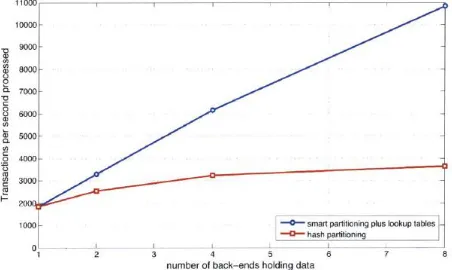
Hash partitioning is compared to smart partitioning with lookup table routing as the number of partitions grows to accommodate more data. This experiment tests the effect of throughput of transactions as the number of back-ends increases. In this particular experiment, the number of tuples in each back-end remains same. Figure 3 shows the results of this test which compres the effects of adding partitions.
International Journal of Emerging Technology and Advanced Engineering
Website: www.ijetae.com (ISSN 2250-2459,ISO 9001:2008 Certified Journal, Volume 3, Issue 2, February 2013)
131
From figure, eight partitions with smart partitioning provides throughput 6.6 times faster than a single back-ends. For hashing, eight partitions only yield 2.2. Times faster performance verses a single partition. Whereas lookup table implementation performs 3.0 Times faster than hash partitioning. It is also important to note that the smart lookup table implementation is continuing to scale at a near-linear rate, while hash partitioning scheme has started to taper off.B. Adding back-ends –constant database size
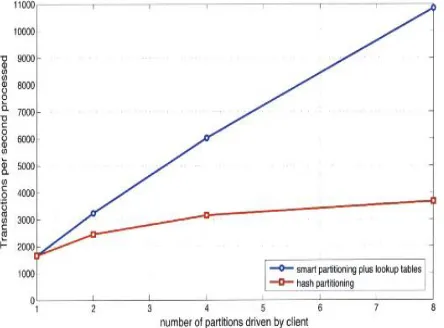
In this experience, the total database size is kept constant while the number of partitions is varied. Figure 4 shows the performance of the system measured using throughput verses the number of back-ends used. Eight bach-ends throughput is 5.9 times faster than a single database
performance for the smart partitioning whereas
performance for eight back-ends is only 2.0 times faster for hash partitioning. In the case of eight back-ends, the lookup table implementation performs 3.0 times faster as compared to hash partitioning scheme.
Fig. 4. Effect of changing the number of back-ends
VII. CONCLUSION
Scaling distributed transaction processing databases
linearly is a significant real world problem. Lookup tables presents a way to provide fine-grained partitioning for transactional database applications.
It is feasible and possible solution to the partitioning problem with growing database sizes. Using lookup tables, application developers can implement any partitioning scheme they desire, and can also create partition indexes that make it possible to efficiently route queries to just the partitions they need to access. Lookup tables can be used to partition difficult-to-partition applications. On these applications, lookup tables with an appropriate partitioning scheme can achieve better performance than either hash or range partitioning, and shows greater potential for further scale-out.
REFERENCES
[1 ] Aubrey L. Tatarowicz, Carlo Curino, Evan P. C. Jones, Sam Madden, ―Lookup Tables: Fine-Grained Partitioning for Distributed Databases,‖ In Data Engineering (ICDE), 2012 IEEE 28th International Conference, pp 102 -113, Apr 2012.
[2 ] C. Curino, Y. Zhang, E. P. C. Jones, and S. Madden, ―Schism: a workload-driven approach to database replication and partitioning,‖ In VLDB, Singapore, pp 48-57, Sep 2010.
[3 ] J. Baker, C. Bond, J. Corbett, J. Furman, A. Khorlin, J. Larson, J.-M. Leon, Y.Li, A. Lloyd, and V. Yushprakh, ―Megastore: Providing scalable, highly available storage for interactive services,‖ In CIDR, Monterey, CA, USA, pp 223-234, Jan 2011.
[4 ] J. M. Pujol, V. Erramilli, G. Siganos, X. Yang, N. Laoutaris, P. Chhabra, and P. Rodriguez, ―The little engine(s) that could: scaling online social networks,‖ In SIGCOMM, New Delhi, India, pp 375-386, Sep 2010.
[5 ] H. Boral, W. Alexander, L. Clay, G. Copeland, S. Danforth, M. Franklin, B. Hart, M. Smith, and P. Valduriez, ―Prototyping Bubba, a highly parallel database system,‖ IEEE Trans. on Knowledge and Data Eng., vol. 2, no. 1, pp. 4–24, 1990.
[6 ] M. Stonebraker, S. Madden, D. J. Abadi, S. Harizopoulos, N. Hachem, and P. Helland, ―The end of an architectural era: (it’s time for a complete rewrite),‖ in VLDB, Vienna, Austria, Sep. 2007. [7 ] S. Ghandeharizadeh and D. DeWitt, ―MAGIC: a multiattribute
declustering mechanism for multiprocessor database machines,‖ IEEE Trans. Parallel Distrib. Syst, vol. 5, no. 5, pp. 509 –524, May 1994.
[8 ] G. Graefe, ―Query evaluation techniques for large databases,‖ ACM Comput. Surv., vol. 25, pp. 73–169, Jun. 1993.
[9 ] N. Kallen, ―Big data in real-time at Twitter,‖ in QCon, San Francisco, USA, Nov. 2010, http://qconsf.com/dl/qcon-sanfran-2010/slides/NickKallen_DataArchitectureAtTweeter Scale.pdf. [10 ]C. Mohan, B. Lindsay, and R. Obermarck, ―Transaction
[image:7.612.57.279.387.551.2]