P R O T O C O L
Open Access
Evidence-based guidelines for
physiotherapy management of patients
with multiple myeloma: study protocol
Deepa Jeevanantham
1,2,3, Venkadesan Rajendran
1,2,3*, Line Tremblay
2,3, Céline Larivière
2,3and Andrew Knight
1,2Abstract
Background:Patients with multiple myeloma (MM) are often treated with chemotherapy, radiation, and, if indicated, autologous stem cell transplant. In addition to side effects of the treatment, patients with MM often have bone pain, pathological fractures, spinal cord compressions, fatigue, and muscle weakness, which negatively impact functional performance and quality of life. Currently, there are no related guidelines for safe and effective physiotherapy (PT) management. Accordingly, the aim of the present study is to develop guidelines for effective physiotherapy management of patients with MM by systematically reviewing and evaluating the available evidence followed by a consensus process to specifically describe the research questions as detailed below.
Methods/design:Physiotherapy management guidelines for patients with multiple myeloma will be developed based on the results of a systematic search of the following databases: US National Library of Medicine Database (PubMed), Medical Literature Analysis and Retrieval System Online (MEDLINE), Excerpta Medica Database (EMBASE), Cumulative Index to Nursing and Allied Health Literature (CINAHL), Elton B. Stephens Co. (EBSCO), Web of Science, Database of Abstracts of Reviews of Effects (DARE), Cochrane Database of Systematic Review, and Physiotherapy Evidence Database (PEDro). All articles will be screened for inclusion and exclusion criteria. Relevant potential articles will be identified and systematically reviewed for final phase of inclusion. Two independent reviewers will systematically review and analyze the quality of identified articles using standardized assessment tools. Scientific conclusions will be drawn and recommendations will be made based on a critical appraisal process. The guideline
development will also be based on the team’s judgment about the overall quality of the studies and a
consensus process.
Discussion: Draft guidelines will be developed in the form of action statements based on the strength of evidence and grades of recommendations. The draft guidelines will be reviewed internally by two independent reviewers using AGREE II and externally by a methodological expert from Evidence-Based Care–Cancer Care Ontario and will be sent to the Canadian Physiotherapy Association (CPA) for feedback from physiotherapists.
Systematic review registration:PROSPEROCRD42017064056
Keywords:Multiple myeloma, Physiotherapy, Guidelines
* Correspondence:[email protected]
1Medicine, Oncology and Palliative Care, Health Sciences North, Sudbury,
Ontario, Canada
2Northern Ontario School of Medicine, Sudbury, Ontario, Canada
Full list of author information is available at the end of the article
Background
Multiple myeloma (MM) is a malignancy of plasma cells that normally reside in bone marrow, producing immuno-globulins (antibodies). In MM, the uncontrolled growth of these cells result in increased osteoclastic activity with the destruction of bone matrix leading to hypercalcemia and an increased risk of fracture [1]. According to the 2017 Canadian Cancer Statistics report, MM accounts for 1.6% of all new cases of cancer in men and 1.2% of all new cases of cancer in women [2]. The incidence rate of MM is three times higher in more developed countries compared to lesser-developed countries [3]. MM is typically diag-nosed at the median age of 69 years, and the median sur-vival rate is 3 to 4 years [4]. Patients with MM may present with hypercalcemia, renal insufficiency, anemia, and bone disease [5]. The bone tissue destruction in MM results in bone pain, pathological fractures, and less fre-quently spinal cord compression.
Patients with MM are generally treated with chemo-therapy, radiation and potentially autologous stem cell transplant, and/or radiation. High-dose chemotherapy is a systemic therapy that uses high doses of cytotoxic drugs to destroy myeloma cells. In addition to destroying mye-loma cells, the cytotoxic drugs also destroy hematopoietic stem cells leading to neutropenia and thrombocytopenia [6]. This puts patients at the risk of developing infections and hemorrhage. Typically, patients receiving high-dose chemotherapy always undergo stem cell infusion to re-store marrow function [6]. In addition, patients receiving high-dose chemotherapy may experience numerous side effects including, but not limited to, nausea, vomiting, diarrhea, stomach pain, heart burn, mouth sores, hair loss, and skin rash [6]. These patients tend to be in bed for pro-longed periods of time.
Radiation therapy is often prescribed for management of bone pain and osteolytic lesions, preventing paralysis in patients with spinal cord compression. Radiation ther-apies induce apoptosis and reduce the tumor size [7]. This results in an analgesic effect and may prevent par-alysis by decompressing the nerves [8]. In addition, radi-ation therapy also induces re-calcificradi-ation and reduces the risk of fractures [8]. Patients with cancer including multiple myeloma, often experience fatigue due to both cancer and cancer related treatments. Cancer-related fa-tigue is defined as “a distressing, persistent, subjective sense of physical, emotional, and/or cognitive tiredness or exhaustion related to cancer or cancer treatment that is not proportional to recent activity and interferes with usual functioning” ([9], Pg.1). It is estimated that 30 to 91% of patients receiving chemotherapy and 25 to 83% of patients receiving radiation therapy experience cancer-related fatigue [2, 10]. Cancer-related fatigue is not relieved by rest or sleep, and it significantly affects functional performance and quality of life [11].
Patients considered as candidates for high-dose chemo-therapy and autologous transplantation are admitted to hospital for a 2- to 3-week period. During the in-patient stay, number of factors may significantly affect the physi-cal performance and functional status of hospitalized pa-tients with MM including, prolonged periods of bed rest with muscle inactivity, older age, effects of cancer treat-ments including fatigue. Careful attention to pain manage-ment, safe mobilization by providing exercises that are safe and preventing functional decline (deconditioning), improving strength and physical performance are signifi-cant in improving quality of life and also help in pre-venting complications.
Physiotherapy (PT) is a part of cancer rehabilitation and is often recommended for patients with MM; how-ever, there are no specific guidelines for safe and effective PT management. Evidence-based guidelines also known as clinical guidelines are systematically developed state-ments that guide health care practitioners and patients in making decisions on the selection of appropriate health care services/treatments [12–14]. Guidelines are typic-ally developed using systematic reviews by identifying evidence supporting clinical questions, critically ap-praising and grading the quality of the evidence based on methodological rigors, and providing recommenda-tions. Evidence-based guidelines assist with incorporat-ing best evidence into practice [13–15]. However, it is important to remember that treatment plans and deci-sions should be made based on individual clinical cir-cumstances [14].
The aim of the present study is to develop guidelines for effective physiotherapy management of patients with MM by systematically reviewing and evaluating the available evidence followed by an expert review process to specifically describe the research questions as detailed below.
Methods
The following steps recommended by the American Physical Therapy Association (APTA) [16] will be followed for drafting recommendations and determining levels of evidence: (1) determine research questions, (2) conduct a systematic literature search, (3) critically appraise evidence and extract data, and (4) draft recommendations and determine levels of evidence. Recommendations for re-search questions with inadequate or lack of evidence will be developed based on a consensus process. A similar method (i.e., consensus-based recommendation) has been used by other groups to develop guidelines in the absence of high-quality evidence [17].
The recommendations will be sent to the CPA to obtain feedback from physiotherapists. The guidelines will also be reviewed by a methodological expert from Evidence-Based Care - Cancer Care Ontario.
Development of research questions
Defining the research questions is a critical step that provides the framework for defining eligibility criteria and facilitating good clinical research [14,15]. This study will address the following answerable research questions developed based on the PICO (population, intervention, control, and outcomes) format [18]. Table 1 shows the key research questions in PICO format. Accordingly, the specific objectives of the present study is to develop evidence-based guidelines for the following: (1) safe mobilization of patients with MM in an acute care set-ting, (2) effective pain management in patients with MM, (3) physiotherapy (PT) management in patients with MM receiving chemotherapy, (4) PT management in patients with MM receiving radiation, (5) PT manage-ment in patients with MM receiving a stem cell trans-plantation, and (6) management of fatigue and muscle weakness in patients with MM.
Study registration and design
This study is registered in the International Prospective Register of Ongoing Systematic Reviews (PROSPERO) published by Centre for Reviews and Dissemination, University of York, in order to reduce duplication of
effort and publication bias [19, 20]. This study will adhere to the Preferred Reporting Items for Systematic Reviews and Meta-analyses Protocol (PRISMA–P 2015) checklist. The PRISMA–P 2015 checklist is comprised of 17 items, categorized into administrative information, introduction, and methods [21, 22]. The completed PRISMA-P checklist is included as an additional file (see Additional file1).
Types of studies
The studies that are of interest for this current investiga-tion are those that focus on physical therapy interveninvestiga-tion in patients with MM who had been actively receiving cancer treatment and in follow-up care. However, a pre-liminary literature search suggested that few randomized controlled trials addressing this topic were available. Therefore, the guideline development team has decided to include systematic reviews, meta-analyses, interventional and observational studies, and case series, which collect-ively might be informative and helpful in developing the guidelines. In addition, a gray literature search will be con-ducted to ensure that any potential informative articles are not missed. Only articles published in the English lan-guage from the earliest to Aug 2017 will be included.
Types of participants
Articles with human participants diagnosed with MM of any age, regardless of gender, tumor stage, and type of cancer treatment will be included.
Types of interventions/exposure and comparison
Articles examining the effects of exposure or the effects of physical therapy interventions including physical activity, exercise, and other modalities will be included. Articles with comparison groups with standard interventions or no intervention will be included.
Types of outcome measures
Articles reporting on the following primary outcomes of interest will be included: (1) pain, (2) safety, (3) labora-tory values, (4) length of stay, (5) range of motion, (6) muscle strength, (7) balance, (8) gait, (9) endurance, (10) fatigue, (11) physical performance, (12) functional per-formance, and (13) aerobic capacity. The secondary out-comes of interest are (1) quality of life and (2) anxiety/ depression.
Search strategy
A detailed literature search will be conducted on the US National Library of Medicine Database (PubMed), Medical Literature Analysis and Retrieval System Online (MEDLINE), Excerpta Medica Database (EMBASE), Cumulative Index to Nursing and Allied Health Lite-rature (CINAHL), EBSCO, Web of science, Database
Table 1PICO (population, intervention, control, and outcomes) Review question What are the available evidence for the following: - Safely mobilizing patients with multiple myeloma
in an acute care setting
- Effective pain management in patients with multiple myeloma
- Physiotherapy (PT) management in patients with multiple myeloma receiving chemotherapy - PT management in patients with multiple
myeloma receiving radiation
- PT management in patients with multiple myeloma receiving a stem cell transplantation - Management of fatigue and muscle weakness in
patients with multiple myeloma
Population Multiple myeloma or myeloma or plasma cell myeloma
Intervention Physiotherapy or physical therapy, ambulation, mobilization, mobility, functional mobility training, exercise, strength training, endurance training, cardio-pulmonary exercise, aerobics exercise, anaerobic exercise, high-intensity exercise, low-intensity exercise, home-based exercise, multi-modal exercise, flexibility exercise, physical activity, pain management, and fatigue management
Comparator Stated interventions compared with placebo or no interventions
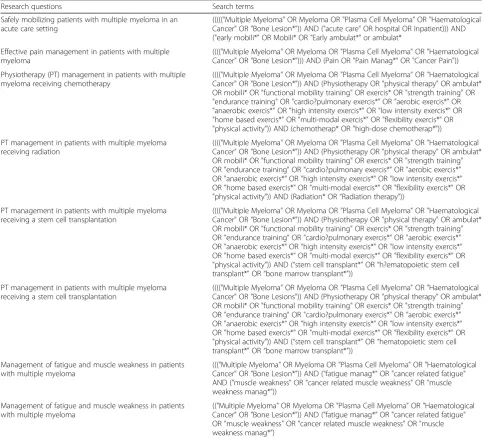
of Abstracts of Reviews of Effects (DARE), Cochrane Database of Systematic Review, and Physiotherapy Evi-dence Database (PEDro). All relevant literature from the abovementioned databases will be retrieved for each research question. Table 2 shows the search terms including the Boolean operators that will be used for each research question in the PubMed data-base. A literature search will be conducted by a single reviewer using relevant subject headings, and key-words and modifications will be done based on the da-tabases searched. All the articles will be retrieved and exported to EndNote software. As a first step, a single reviewer will de-duplicate in EndNote. The research assistant of the study will maintain a search log re-cording, search strategies, and search terms including
Boolean operators that will be used for each database and for each research question, number of articles re-trieved from each database, number of duplicates, and number of articles that will be archived at each phase of review.
Screening and selection of studies
Steps recommended by Pai et al. [23] will be followed in screening and selecting the studies. Each article in the EndNote software will be screened by two independent reviewers. In particular, the titles and abstracts of each article will be screened and include articles that meet the above described inclusion criteria and exclude all ar-ticles that are deemed irrelevant. The reviewers will meet and resolve any disagreements. Articles will be
Table 2Search terms used for each research questions (PubMed)
Research questions Search terms
Safely mobilizing patients with multiple myeloma in an acute care setting
((((("Multiple Myeloma" OR Myeloma OR "Plasma Cell Myeloma" OR "Haematological Cancer" OR "Bone Lesion*")) AND ("acute care" OR hospital OR Inpatient))) AND ("early mobili*" OR Mobili* OR "Early ambulat*" or ambulat*
Effective pain management in patients with multiple myeloma
(((("Multiple Myeloma" OR Myeloma OR "Plasma Cell Myeloma" OR "Haematological Cancer" OR "Bone Lesion*"))) AND (Pain OR "Pain Manag*" OR "Cancer Pain"))
Physiotherapy (PT) management in patients with multiple myeloma receiving chemotherapy
(((("Multiple Myeloma" OR Myeloma OR "Plasma Cell Myeloma" OR "Haematological Cancer" OR "Bone Lesion*")) AND (Physiotherapy OR "physical therapy" OR ambulat* OR mobili* OR "functional mobility training" OR exercis* OR "strength training" OR "endurance training" OR "cardio?pulmonary exercis*" OR "aerobic exercis*" OR "anaerobic exercis*" OR "high intensity exercis*" OR "low intensity exercis*" OR "home based exercis*" OR "multi-modal exercis*" OR "flexibility exercis*" OR "physical activity")) AND (chemotherap* OR "high-dose chemotherap*"))
PT management in patients with multiple myeloma receiving radiation
(((("Multiple Myeloma" OR Myeloma OR "Plasma Cell Myeloma" OR "Haematological Cancer" OR "Bone Lesion*")) AND (Physiotherapy OR "physical therapy" OR ambulat* OR mobili* OR "functional mobility training" OR exercis* OR "strength training" OR "endurance training" OR "cardio?pulmonary exercis*" OR "aerobic exercis*" OR "anaerobic exercis*" OR "high intensity exercis*" OR "low intensity exercis*" OR "home based exercis*" OR "multi-modal exercis*" OR "flexibility exercis*" OR "physical activity")) AND (Radiation* OR“Radiation therapy”))
PT management in patients with multiple myeloma receiving a stem cell transplantation
(((("Multiple Myeloma" OR Myeloma OR "Plasma Cell Myeloma" OR "Haematological Cancer" OR "Bone Lesion*")) AND (Physiotherapy OR "physical therapy" OR ambulat* OR mobili* OR "functional mobility training" OR exercis* OR "strength training" OR "endurance training" OR "cardio?pulmonary exercis*" OR "aerobic exercis*" OR "anaerobic exercis*" OR "high intensity exercis*" OR "low intensity exercis*" OR "home based exercis*" OR "multi-modal exercis*" OR "flexibility exercis*" OR "physical activity")) AND (“stem cell transplant*”OR“h?ematopoietic stem cell transplant*”OR“bone marrow transplant*”))
PT management in patients with multiple myeloma receiving a stem cell transplantation
(((("Multiple Myeloma" OR Myeloma OR "Plasma Cell Myeloma" OR "Haematological Cancer" OR "Bone Lesions")) AND (Physiotherapy OR "physical therapy" OR ambulat* OR mobili* OR "functional mobility training" OR exercis* OR "strength training" OR "endurance training" OR "cardio?pulmonary exercis*" OR "aerobic exercis*" OR "anaerobic exercis*" OR "high intensity exercis*" OR "low intensity exercis*" OR "home based exercis*" OR "multi-modal exercis*" OR "flexibility exercis*" OR "physical activity")) AND (“stem cell transplant*”OR“hematopoietic stem cell transplant*”OR“bone marrow transplant*”))
Management of fatigue and muscle weakness in patients with multiple myeloma
((("Multiple Myeloma" OR Myeloma OR "Plasma Cell Myeloma" OR "Haematological Cancer" OR "Bone Lesion*")) AND ("fatigue manag*" OR "cancer related fatigue" AND ("muscle weakness" OR "cancer related muscle weakness" OR "muscle weakness manag*"))
Management of fatigue and muscle weakness in patients with multiple myeloma
included if both the reviewers are in agreement. In case of disagreement, a third reviewer will be involved in the decision-making. All articles identified in the phase I screening process by mutual consent will be included in the phase II screening. In the phase II screening, full texts of all the identified articles in phase I screening will be thoroughly read and screened for the inclusion cri-teria by two independent reviewers. Articles considered eligible after full-text view by mutual consent will be in-cluded in the final analysis. The research assistant will continue to keep track of the number of articles and the rationale of excluding the articles at each of the screening phases. The research assistant will develop a flow diagram to report the number of articles included and excluded and the selection process as per the PRISMA guidelines.
Data extraction and management
Two independent reviewers will extract the data from all the articles that are included in the final selection phase using a standardized data extraction form. The standard-ized data extraction form will be customstandard-ized from the data extraction and assessment template proposed by “The Cochrane Public Health Group” [24]. Data extracted by mutual consent will be included for the final review. A third reviewer will assist in the decision-making upon dis-agreement between the two primary reviewers. The data extraction form will be pilot tested with two articles and will be revised based on suggestions by the team mem-bers. The following data will be extracted from each article: (1) general study details: Title, authors, source, country of study, publication type, and year of publica-tion; (2) study eligibility: type of study, participants characteristics including, number of participants, age, gender, diagnosis, type of cancer treatment, stage of cancer, inclusion/exclusion criteria, setting, methods including design/allocation, blinding, sampling, loss to follow-up, recruitment rates, retention rates, and ad-herence rates, intervention characteristics including type of exercise/physical activity, types of outcome measures including self-reported outcomes, objective outcomes; (3) study details: aim of study, aim of inter-vention, details of intervention including, setting, strat-egies used, frequency, intensity, duration, program length, provider, co-interventions, subgroups, details of outcomes, and results of the study. The data extraction will be documented in a Microsoft Excel spreadsheet.
Critical appraisal process
Each article will be critically appraised using standard-ized critical appraisal tools including the PEDro scale, the Methodological Index for Non-Randomized Studies (MINORS), the Critical Appraisal Skills Programme (CASP) checklists [25], the Measurement Tool to Assess Systematic Reviews (AMSTAR) [26–28], and the Appraisal
of Guidelines for Research and Evaluation II (AGREE II) tool [29] to ascertain adequate quality and appropri-ateness of the evidence to be used in guideline develop-ment. The above-described tools are recommended by the APTA [16] and have been used in guideline devel-opment by other groups [17, 30,31]. Critical appraisals will be performed by two independent reviewers. The two reviewers will undergo training and will practice the critical appraisal tools before doing the actual criti-cal appraisals. The scores between the two reviewers will be compared, and discrepancies will be resolved. A third reviewer will be involved upon disagreement.
Scientific conclusions will be drawn and recommenda-tions will be made based on the critical appraisals, the guideline development team’s (team with expertise on on-cology, physiotherapy, exercise specialists, clinical psych-ology, teaching, and research) judgment about the overall quality of the studies and consensus from the expert group.
Levels of evidence
The levels of evidence for each article will be determined based on the recommendations of Kaplan and colleagues [32] and critical appraisal scores. Evidence obtained from high-quality studies (≥50% critical appraisal scores) will be assigned “level I” and evidence obtained from lesser quality studies (< 50% critical appraisal scores) will be assigned“level II.” Studies with unacceptable quality will be excluded from consideration in the guideline. Table3 shows the description of the levels of evidence that will be used for determining levels of evidence of the articles.
Grades of action statements
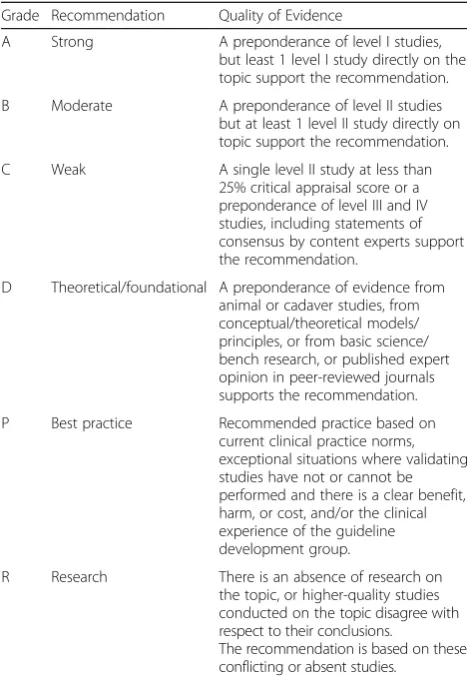
The Grading of Recommendations, Assessment, Develop-ment and Evaluation (GRADE) will be used to determine the strength of evidence [33]. See Table4for the criteria for the grades of recommendations for action statements. The guideline development team will use their judgment and
Table 3Levels of evidence Level Criteria
I Evidence obtained from high-quality diagnostic studies, prognostic or prospective studies, cohort studies or randomized controlled trials, meta analyses or systematic reviews (critical appraisal score>50% of criteria).
II Evidence obtained from lesser-quality diagnostic studies, prognostic or prospective studies, cohort studies or randomized controlled trials, meta
analyses or systematic reviews (eg, weaker diagnostic criteria and reference standards, improper randomization, no blinding, <80% follow-up) (critical appraisal score<50% of criteria). III Case-controlled studies or retrospective studies
IV Case studies and case series
V Expert opinion
weigh the quality of the collective evidence and potential benefit against potential harm for assigning grades to the action statements as recommended by the APTA [16].
Linking levels of evidence and grades of action statements
The following terms will be used in describing levels of obligation as recommended by the APTA ([16], pg. 32). The term must will be used if the evidence supports a strong recommendation (grade A) and harm might occur if the action is not followed. The termshouldwill be used if the evidence supports a strong (grade A) or moderate (grade B) recommendation. The termsmay or
couldwill be used if the evidence is weak (grade C).
Creating action statements
Recommendations will be made in the form of action statements. Brief, precise, quality-driven action-oriented statements will be created using a BRIDGE-Wiz software
as recommended by the APTA. The action statements will be described in terms of Who, When (under what specific conditions), Must, Should, or May (the level of obligation),Do what(precise action), andto Whom. Ac-tion statements will be supplemented by acAc-tion state-ment profiles listing aggregate decisions made by the guideline development team and consensus process. The action statement profiles will include the following head-ings: aggregate evidence quality, level of confidence in evidence, benefits, risks, harm, costs, benefit-harm as-sessment, value judgments, intentional vagueness, role of patient preferences, exceptions, policy level, and dif-ferences of opinion [16,34].
Consensus process
Five physiotherapists across Canada experienced with the care of patients with MM will independently review the contents of the guidelines and provide feedback. Ag-gregate level of evidence will be assigned after the group reaches consensus on the evidence supporting each key action statement. The guidelines will be revised till 80% consensus is achieved on each of the statements and profiles. Action statements that do not reach 80% con-sensus after three rounds of concon-sensus process will be removed from the guideline document.
Internal review
Three independent reviewers will evaluate the guideline using AGREE II. It is a reliable and valid instrument used to assess the quality of clinical practice guidelines. AGREE II consists of 23 items clustered under 6 do-mains (scope and purpose, stakeholder involvement, rigor of development, clarity of presentation, applicability, and editorial independence) developed to assess the qual-ity of the guidelines. Each item in the questionnaire is evaluated on a 7-point scale where score 1 refers to strong disagreement and score 7 refers to strong agreement.
External review
The guideline will undergo two external reviews. The guideline will be sent to CPA for feedback from physio-therapists. The guideline will also be reviewed by a methodological expert from Evidence-Based Care - Cancer Care Ontario. The draft guideline will be posted on the Health Sciences North (HSN) website for public comment.
Strengths and limitation of this study
This study will employ validated methodologies such as PICO guidelines, systematic reviews, and consensus process. This study will also use standardized quality as-sessment tools for specific research designs. The litera-ture search and data extraction processes will be done by independent reviewers thereby enhancing the validity of the study. Additionally, the review panel will consist
Table 4Definition of Grades of Recommendation for action statements
Grade Recommendation Quality of Evidence
A Strong A preponderance of level I studies,
but least 1 level I study directly on the topic support the recommendation.
B Moderate A preponderance of level II studies but at least 1 level II study directly on topic support the recommendation.
C Weak A single level II study at less than
25% critical appraisal score or a preponderance of level III and IV studies, including statements of consensus by content experts support the recommendation.
D Theoretical/foundational A preponderance of evidence from animal or cadaver studies, from conceptual/theoretical models/ principles, or from basic science/ bench research, or published expert opinion in peer-reviewed journals supports the recommendation.
P Best practice Recommended practice based on current clinical practice norms, exceptional situations where validating studies have not or cannot be performed and there is a clear benefit, harm, or cost, and/or the clinical experience of the guideline development group.
R Research There is an absence of research on the topic, or higher-quality studies conducted on the topic disagree with respect to their conclusions.
The recommendation is based on these conflicting or absent studies.
Reprinted from Kaplan SL, Coulter C, Fetters L. Developing evidence-based physical therapy clinical practice guidelines. Pediatr Phys Ther. 2013;25:257–
of experts in patients with MM. Moreover, the formu-lated guidelines will also be evaluated using the AGREE II instrument, which adds to the validity of this study.
The following study limitations are noted. We ac-knowledge that this study might have significant result publication bias, meaning that this study might review articles showing significant results (effects) on earlier de-scribed research question, which tells nothing about pos-sible ineffective interventions, as non-significant results are less likely to be published; however, this is beyond the control of any researcher. This study may be sub-jected to selection bias by not including relevant articles published in languages other than English. Reporting bias will be minimized by having two independent re-views and by having a third independent reviewer inter-vene when there are disagreements at each stage of data identification, data extraction, and critical appraisal.
Clinical and research implications
The outcomes of the study are expected to benefit prac-titioners because it will provide clear evidence-based guidelines regarding best practices to administer physio-therapy treatment to patients with MM. The recommen-dations made from this study will be based on rigorous and validated methods that will assist in minimizing potential harms and improve the quality of care. The patients will benefit from receiving the best possible treatment that is tailored to their unique set of health concerns. Rather than using a“one-size fits all”approach to PT treatment, the study will focus specifically on pa-tients that have MM and will seek to determine what specific PT treatment options are best suited for this population. The benefits could be measured qualitatively by requesting input from practitioners regarding the guidelines (clarity and ease of implementation). The ben-efits to the patients could be assessed in a follow-up study comparing standard PT care compared to the MM-tailored PT intervention program. The findings of this study will also provide a comprehensive platform for future research directions by identifying gaps in the literature.
Additional file
Additional file 1:PRISMA-P checklist. (DOCX 26 kb)
Abbreviations
AMSTAR:A Measurement Tool for the Assessment of Multiple Systematic Reviews; APTA: American Physical Therapy Association; CPA: Canadian Physiotherapy Association; GRADE: Grading of Recommendations
Assessment, Development and Evaluation; MINORS: Methodological Index for Non-Randomized Studies; MM: Multiple myeloma; PEDro: Physiotherapy Evidence Database; PICO: Population, intervention, control, and outcomes; PRISMA-P: Preferred Reporting Items for Systematic Reviews and Meta-Analysis Protocols; PROSPERO: International Prospective Register of Ongoing Systematic Reviews; PT: Physiotherapy/physical therapy
Funding
This study was reviewed and funded by the Northern Ontario Academic Medicine Association (Project C-17-11). The funding bodies played no role in developing the protocol.
Authors’contributions
DJ and VR conceived the idea for the study. All authors were involved in the study design. DJ and VR drafted the manuscript. LT, CL, and AK contributed to critical revision of the manuscript. All authors read and approved the final manuscript.
Authors’information
Deepa Jeevanantham(DJ) is a registered physiotherapist at Health Sciences North and clinical assistant professor at Northern Ontario School of Medicine. She is also an adjunct professor in the School of Human Kinetics at Laurentian University, Sudbury, Ontario.
Venkadesan Rajendran (VR)is a registered physiotherapist at Health Sciences North and clinical lecturer at Northern Ontario School of Medicine, Sudbury, Ontario. He is also an adjunct professor in the School of Human Kinetics at Laurentian University, Sudbury, Ontario.
Line Tremblay (LT)is a registered clinical psychologist, a full professor at Laurentian University, and a full professor in Clinical Sciences Division at Northern Ontario School of Medicine. She is currently the Associate Dean of the Faculty of Health. She is the co-founder of the Human Movement and Percep-tion Virtual Reality Laboratory where she is currently conducting applied health research.
Céline Larivière (CL)is a Registered Kinesiologist (RKin), is the Acting Dean of the Faculty of Health and a Full Professor in the School of Human Kinetics at Laurentian University and is also an Associate Professor in the Medical Sciences Division of the Northern Ontario School of Medicine.
Andrew Knight (AK)is the Clinical Lead for Palliative Care at Health Sciences North. He is the Education Co-chair of the Palliative Care Education Program for Family Physicians in North East Ontario and is an Assistant Professor of Family Medicine at the Northern Ontario School of Medicine.
Ethics approval and consent to participate
Not applicable
Consent for publication
Not applicable
Competing interests
The authors declare that they have no competing interests.
Publisher’s Note
Springer Nature remains neutral with regard to jurisdictional claims in published maps and institutional affiliations.
Author details
1Medicine, Oncology and Palliative Care, Health Sciences North, Sudbury,
Ontario, Canada.2Northern Ontario School of Medicine, Sudbury, Ontario, Canada.3Faculty of Health, School of Human Kinetics, Laurentian University, Sudbury, Ontario, Canada.
Received: 3 January 2018 Accepted: 20 July 2018
References
1. Coleman EA, Coon S, Hall-Barrow J, Richards K, Gaylor D, Stewart B. Feasibility of exercise during treatment for multiple myeloma. Cancer Nurs Int J Cancer Care. 2003;26(5):410–9.
2. Canadian Statistics for Multiple Myeloma.https://www.myelomacanada.ca/en/ about-multiple-myeloma/what-is-myeloma/statistics. Accessed 3 Aug 2017. 3. Torre LA, Bray F, Siegel RL, Ferlay J, Lortet-Tieulent J, Jemal A. Global cancer
statistics, 2012. CA Cancer J Clin. 2015;65:87–108.
4. About blood cancers. Leukemia and Lymphoma Society of Canada.
http://www.llscanada.org/sites/default/files/National/CANADA/Pdf/ Blood%20Cancer%20Facts%202014.pdf. Accessed 16 Nov 2016.
6. Rodriguez AL, Tariman JD, Enecio T, Estrella SM. The role of high-dose chemotherapy supported by hematopoietic stem cell transplantation in patients with multiple myeloma: implications for nursing. Clin J Oncol Nurs. 2007;11(4):579–89.
7. Filippovich IV, Sorokina NI, Robillard N, Lisbona A, Chatal JF. Radiation-induced apoptosis in human tumor cell lines: adaptive response and split-dose effect. Int J Cancer. 1998;77(1):76–81.
8. Matuschek C, Ochtrop TA, Bölke E, Ganswindt U, Fenk R, Gripp S, Kröpil P, Gerber PA, Kammers K, Hamilton J, Orth K, Budach W. Effects of
radiotherapy in the treatment of multiple myeloma: a retrospective analysis of a single institution. Radiat Oncol. 2015;10:71.
9. NCCN Clinical Practice Guidelines in Oncology. Cancer-related fatigue. Version 1.2014.http://williams.medicine.wisc.edu/fatigue.pdf. Accessed 3 Aug 2017. 10. Curt GA, Breitbart W, Cella D, et al. Impact of cancer-related fatigue on the
lives of patients: new findings from the fatigue coalition. Oncologist. 2000; 5(5):353–60.
11. Yeo TP, Cannaday S. Cancer-related fatigue: impact on patient quality of life and management approaches. Nursing: Research and Reviews. 2015;5:65–76. 12. Field MJ, Lohr KN, Committee to Advise the Public Health Service on
Clinical Practice Guidelines IoM. Clinical practice guidelines: directions for a new program. Washington, D.C: National Academy Press; 1990.
13. Woolf S, Schünemann H, Eccles M, Grimshaw J, Shekelle P. Developing clinical practice guidelines: types of evidence and outcomes; values and economics, synthesis, grading, and presentation and deriving recommendations. Implement Sci. 2012;7:61.
14. Lim W, Arnold DM, Bachanova V, Haspel RL, Rosovsky RP, Shustov AR, Crowther MA. Evidence-based guidelines––an introduction. Hematology Am Soc Hematol Educ Program. 2008:26–30.https://www.ncbi.nlm.nih.gov/ pubmed/19074050.
15. Ohtake PJ, Smith J, Lee SJC. Clinical practice guidelines: implementation in acute care physical therapist practice. Journal of Acute Care Physical Therapy. 2014;5:59–69.https://scholar.google.ca/scholar?hl=en&as_sdt= 0%2C5&q=Clinical+practice+guidelines%3A+implementation+in+acute +care+physical+therapist+practice.&btnG=.
16. APTA. Clinical practice guideline process manual. Alexandria, VA: American Physical Therapy Association; 2018.
17. Hopman K, Krahe L, Lukersmith S, McColl AR, Vine K. Clinical practice guidelines for the management of rotator cuff syndrome in the workplace: The University of New South Wales; 2013.
18. Sadaf A, Patricia E. Formulating a researchable question: a critical step for facilitating good clinical research. Indian J Sex Transm Dis. 2010;31(1):47–50. 19. Booth A, Clarke M, Ghersi D, Moher D, Petticrew M, Stewart L. An international
registry of systematic-review protocols. Lancet. 2011;377(9760):108–9. 20. Booth A, Clarke M, Dooley G, Ghersi D, Moher D, Petticrew M, Stewart L.
The nuts and bolts of PROSPERO: an international prospective register of systematic reviews. Syst Rev. 2012;1:2.
21. Moher D, Shamseer L, Clarke M, Ghersi D, Liberati A, Petticrew M, Shekelle P, Stewart LA, PRISMA-P Group. Preferred reporting items for systematic review and meta-analysis protocols (PRISMA-P) 2015 statement. BMC Systematic Reviews. 2015;4:1.
22. Shamseer L, Moher D, Clarke M, Ghersi D, Liberati A, Petticrew M, Shekelle P, Stewart LA. Preferred reporting items for systematic review and meta-analysis protocols (PRISMA-P) 2015: elaboration and explanation. BMJ. 2015;2:1–25. 23. Pai M, McCulloch M, Gorman JD, Pai N, Enanoria W, Kennedy G, Tharyan P,
Colford JM Jr. Systematic reviews and meta-analyses: an illustrated, step-by-step guide. Natl Med J India. 2004;17(2):86–95.
24. The Cochrane Public Health Group. Data extraction and assessment template.http://ph.cochrane.org/sites/ph.cochrane.org/files/public/uploads/ Guide%20for%20PH%20protocol_Nov%202011_final%20for%20website.pdf. Accessed 25 Jan 2017.
25. Zeng X, Zhang Y, Kwong JS, Zhang C, Li S, Sun F, Niu Y, Du L. The methodological quality assessment tools for preclinical and clinical studies, systematic review and meta-analysis, and clinical practice guideline: a systematic review. J Evid Based Med. 2015;8(1):2–10.
26. Shea BJ, Grimshaw JM, Wells GA, Boers M, Andersson N, Hamel C, Porter AC, Tugwell P, Moher D, Bouter LM. Development of AMSTAR: a measurement tool to assess the methodological quality of systematic reviews. BMC Med Res Methodol. 2007;7:10.
27. Shea BJ, Hamel C, Wells GA, Bouter LM, Kristjansson E, Grimshaw J, Henry DA, Boers M. AMSTAR is a reliable and valid measurement tool to assess the
methodological quality of systematic reviews. J Clin Epidemiol. 2009;62(10): 1013–20.
28. Shea BJ, Bouter LM, Peterson J, Boers M, Andersson N, Ortiz Z, Ramsay T, Bai A, Shukla VK, Grimshaw JM. External validation of a measurement tool to assess systematic reviews (AMSTAR). PLoS One. 2007;2(12):e1350.
29. Brouwers M, Kho ME, Browman GP, Burgers JS, Cluzeau F, Feder G, Fervers B, Graham ID, Grimshaw J, Hanna S, Littlejohns P, Makarski J, Zitzelsberger L. AGREE II: advancing guideline development, reporting and evaluation in healthcare. Can Med Assoc J. 2010;182(18):E839–42.
30. Hall CD, Herdman SJ, Whitney SL, Cass SP, Clendaniel RA, Fife TD, Furman JM, Getchius TS, Goebel JA, Shepard NT, Woodhouse SN. Vestibular Rehabilitation for Peripheral Vestibular Hypofunction: An Evidence-Based Clinical Practice Guideline: From the American Physical Therapy Association Neurology Section. J Neurol Phys Ther. 2016;40(2):124-55.
31. Langer D, Hendriks E, Burtin C, Probst V, van der Schans C, Paterson W, Verhoef-de Wijk M, Straver R, Klaassen M, Troosters T, Decramer M, Ninane V, Delguste P, Muris J, Gosselink R. A clinical practice guideline for physiotherapists treating patients with chronic obstructive pulmonary disease based on a systematic review of available evidence. Clin Rehabil. 2009 May;23(5):445–62. 32. Kaplan SL, Coulter C, Fetters L. Developing evidence-based physical therapy
clinical practice guidelines. Pediatr Phys Ther. 2013;25(3):257–70.https:// www.ncbi.nlm.nih.gov/pubmed/23743574.
33. Guyatt GH, Oxman AD, Vist GE, Kunz R, Falck-Ytter Y, Alonso-Coello P, Schünemann HJ. GRADE: an emerging consensus on rating quality of evidence and strength of recommendations. BMJ. 2008;336(7650):924–6. 34. Richard M. Rosenfeld, Richard N. Shiffman, Peter Robertson. Clinical Practice