Diamond Sampling Structure based BRINT Descriptor
for Texture Classification
Bala Sandeep Vallabhaneni
1, S. Srinivas Kumar
2 .1M.Tech Scholar,
2Professor,
Department of Electronics and Communication Engineering,
UCEK(A), JNTUK, (India)
ABSTRACT
The problem of texture classification is discussed in this paper. Local Binary Patterns (LBP) and most of LBP
variants still suffer from high noise sensitivity, high dimensionality and computational complexity. An approach
in which points are sampled in a diamond like structure is proposed and fixing the number of neighbor samples
to 8. This decreases the feature dimension significantly. The points are sampled in different neighborhoods and
encoded over a number of scales. The sampling points are averaged along radial direction for robustness of
noise. In addition, a new descriptor based on Binary Rotation Invariant and Noise Tolerant (BRINT) descriptor
is created to extract features. Unlike BRINT, uniform rotation invariant patterns in place of rotation invariant
patterns is used for each of the three descriptors. These three descriptors are added jointly to get proposed
descriptor. The experimental results on two benchmark texture datasets (OUTEX_TC_12_000 and
KTH-TIPS2b) prove that the proposed approach performs better than other state-of-the-art LBP variants both under
noise free and noisy conditions. The proposed approach is tested under different noise environments of
Gaussian, salt and pepper and speckle to demonstrate its robustness of noise.
Keywords: Diamond Sampling Structure, Local Binary Pattern (LBP), Low Complexity, SVM,
Texture Classification
I INTRODUCTION
Texture is a basic feature of visual aspect in all naturally occurring surfaces. It is used in the area of image processing to extract visual information from textures. The texture information is useful in several pattern recognition and computer vision problems like object classification and face identification. Texture classification is one of the difficulties faced in texture analysis. The various applications of texture classification include analysis of medical image, document identification and remote sensing. The various problems faced by texture classification method are as follows: low texture variation between different texture classes, changes in illuminations, view point and scale. The above problems were not dealt consummately by prevailing techniques and need improvement. The above issue is addressed in this paper comprehensively.
texture disregard for scale, rotation and lighting conditions. The different approaches of texture classification can be parted in two ways: Local Binary features and Bag of Words (BoW) paradigm. The BoW paradigm symbolize the image or texture as a histogram over discrete vocabulary of local features. Binary features gained popularity owing to its low complexity, effective and efficient performance. The original Local Binary Patterns (LBP) that is proposed by Ojala et al.[2] received wide spread recognition and popularity owing to the advantages as mentioned above. These advantages made LBP one of the best alternative for numerous uses relating to texture classification. Even though it has significant advantage over other methods, it is mainly intolerant to noise and fails to capture information from a large area.
The original LBP considers only the sign knowledge of difference between local pixels, then it encodes the difference sign into either 0 or 1. These codes are converted into a decimal number to depict arrangement. Pietkainen et al. [6] proposed a variation of LBP for rotation invariance to hold patterns which are rotationally unique there by reducing the feature dimension to 36. In addition, Ojala et al. [2] through their experiments found out that uniformity is the fundamental characteristic of textures and proposed uniform rotation invariant patterns of LBP. These patterns are calculated by taking bitwise transitions from 0 to 1 or 1 to 0 and considers only those patterns which has at most two bitwise transitions. Local Ternary Patterns (LTP) is proposed [3] as an extension of LBP to threshold pixels into three values and these three values are used to achieve lower and upper binary patterns. These two binary patterns are concatenated to get the descriptor that is better than LBP. Dominant LBP was proposed by Liao et al. [11] where only dominant patterns are considered. Guo et al. [4] proposed completed LBP (CLBP) considering both the magnitude and sign information pertaining to neighbor differences with the center pixel. Liu et al. [1] proposed BRINT descriptor for improved noise robustness and low feature by averaging pixels along an arc of circular neighborhood. BRINT restricts the number of neighbor pixels to 8 to improve noise robustness.
The above mentioned LBP variants have drawbacks of high computational complexity, less discriminative capability and noise sensitivity. To overcome these shortcomings, diamond sampling structure proposed by Zhibin et al. [10] which samples the pixels along diamond like locus is used thus reducing computational complexity. In this structure, the number of neighbors are fixed to 8. Moreover, all the neighbor pixels are averaged in the direction of 8 neighbor pixels ahead of binarization to improve insensitivity of noise. Two benchmark datasets are used in the experimental surveys to show the improved performance of proposed approach over the other LBP variants. It is having low complexity, noise robustness while ensuring efficiency.
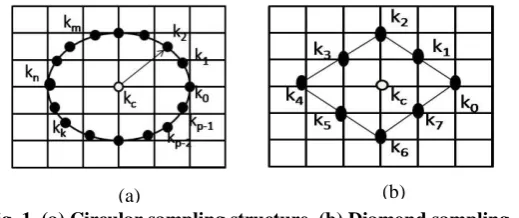
Fig. 1. (a) Circular sampling structure. (b) Diamond sampling structure.
II THE
PROPOSED
APPROACH
2.1
A Diamond Sampling Approach
Generally, in LBP sampling structure pixels are sampled in a circular neighborhood as shown in Fig. 1 (a). The sign of difference between center pixel kc and J neighbor pixels (p=0,1,…J-1) situated on a circle of radius r is encoded to calculate LBP.
0 , 0 0 , 1 ) ( , 70 ( )2
, a a a s i i c k p k s J r
LBP (1)
In this structure, if any of the neighbor pixels does not fall in the center of pixels then it will be approximated using bilinear interpolation. These interpolation generates inaccurate pixel values and undependable pixel data. Moreover, dimensionality of features increases gradually with the increasing neighbor samples which increases computation time.
In order to subdue these defects, diamond sampling structure is used in which distance between central pixel and its neighbors utilize Manhattan distance to supersede circular symmetric neighborhood structure. In diamond sampling structure, all of the neighbor pixels sit at integer pixel positions.
The diamond sampling structure used in this paper is shown in Fig. 1 (b). The number of neighbor pixels is restricted to 8 to diminish feature dimension. A resolution of 9 with additional 8 samples at each resolution is utilized as used in the multi resolution analysis of circular sampling structure. All the neighbors in each resolution is averaged along 8 radial directions.
2.2
Averaging along radial direciton
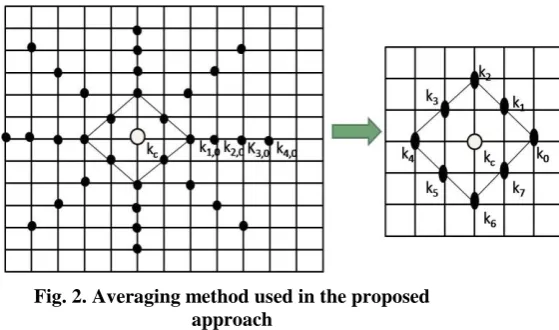
Averaging method in the direction of neighbor pixels is used to decrease the noise sensitivity which several LBP-like descriptors fails to achieve. Averaging method is used along the direction of 8 neighbor pixels for multi resolution analysis. Unlike original LBP, the neighbor pixel is replaced with the average of pixels along a radial direction, as shown in Fig. 2.
)
1
,...,
1
,
0
(
,
1
1 ,
J
p
k
m
k
m r p rp (2)
Where kr,p is the pixel value of the rth sample pixel direction of the given neighbor pixel kp. Here ‗m‘ depicts the resolution number or total count of pixels used in averaging and J represents the total number of neighbor
pixels. Here J=8 is used as number of pixels. We used multi-scale approach in this paper and 9 different scales to arrive at the desired descriptor. In Fig. 2, an illustration of averaging along radial direction is shown where four pixels are used to do average along all 8 radial directions.
2.3
DM_BRINT descriptor
BRINT descriptor approach is used to extract features as it has 3 descriptors to capture complementary information about texture. BRINT descriptor consists of 3 descriptors: BRINT_S, BRINT_M and BRINT_C. These three descriptors devised by taking motivation from CLBP. All the three descriptors of BRINT are used to effectively classify texture. Motivated by BRINT we create three new descriptors which are analogous to BRINT.
2.3.1 DM_BRINT_S Descriptor
Unlike BRINT_S diamond sampling structure is used to sample neighbor pixels around a central pixel kc and consider only 8 pixels at the locations shown in Fig.2. The neighbors are Kp=[K0,K1,…,K7]T. Now compute LBP with respect to the center pixel:
7
0 ( )2
_ _ i i c k p k s S BNT
DM (3)
Since 8 neighbors are used, a total of 256 patterns are possible and therefore feature length is 256. We use uniform rotation invariant patterns of DM_BNT_S to generate DM_BRINT_S thereby decreasing feature length and to extract relevant information. This step decreases the length of feature vector to 10.
2.3.2 DM_BRINT_M Descriptor
Similar to the above procedure, diamond sampling structure is used and then the magnitude of differences between central pixel kc and 8 neighbor pixels is calculated:
7 ,..., 1 , 0 | , |
kp kc p p
d (4)
Then compute a binary pattern DM_BNT_M based on dp as follows:
7
0 ( )2
_ _ i i r n p d s M BNT DM (5)
where nr isthe average of magnitude of differences (dp). Similar to previous descriptor, uniform rotation invariant version of DM_BNT_M is used to get DM_BRINT_M.
2.3.3 DM_BRINT_C Descriptor
Similar to BRINT_C, compute a binary pattern by comparing central pixel with global mean of the image without boundary pixels.
) ( _
_BRINT Cs kc
DM (6)
Where γ is the global mean of the image without boundary pixels.
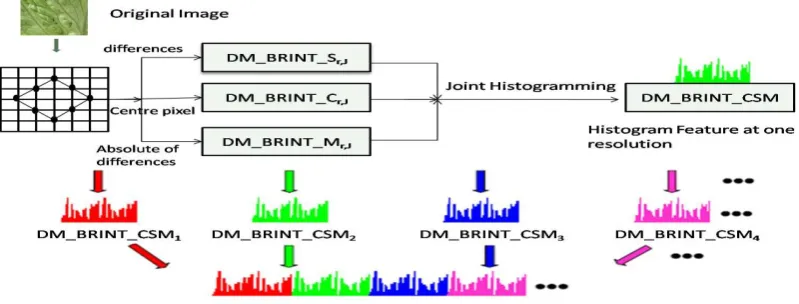
Now the joint histogram of DM_BRINT_S, DM_BRINT_M and DM_BRINT_C is the proposed descriptor. Now, name the descriptor as DM_BRINT_CSM or DM_BRINT. Thus far descriptor for single resolution only is created. For multi resolution analysis, different scales are needed to use.
2.4 Multi Resolution Approach
Thus far created descriptor for single resolution is devised. The number of pixels being averaged is changed to get descriptors for different resolutions. For instance, 2 pixels along radial direction of all neighbor pixels is averaged to get feature vectors for second resolution. Now Descriptors for 9 different resolutions are created and concatenated histograms of all resolutions to get the proposed texture descriptor DM_BRINT_CSM. The feature dimension of the proposed descriptor is 10×10×2=200 for each resolution. Fig. 3 visualizes the full model of the proposed approach .
III EXPERIMENTAL
RESULTS
The classification performance of the proposed approach is evaluated on two benchmark datasets which are available in public domain: OUTEX_TC_12_000 [5] and KTH-TIPS2b [8]. Extensive experiments are conducted on these two databases using either Nearest Neighbor Classifier (NNC) or non linear Support Vector Machine(SVM) classifier. In addition, γ2 distance metric is used for NNC classifier. Exponential chi-square kernel is used for non linear SVM classifier as it has shown better performance in [9].
3.1 Experimental Setup
OUTEX_TC_12_000 is pictured under different lighting conditions and rotation changes and it is better suited for rotation invariance analysis. It consists of 24 classes of images with 200 samples per class imaged under nine rotation angles (00, 50, 100, 150, 300, 450, 600, 750 and 900). 20 samples from each class is used for training and remaining samples for testing. Each sample is of size 128×128. The KTH-TIPS2b is imaged under different rotation changes, illumination conditions and scales. It consists of 432 images in each of the 11 different classes. 216 samples from each class is used for training and remaining samples for testing. KTH-TIP2b consists of texture samples which has 3 rotation angles, 4 different lightings and 9 different scales.
3.2 Methods in Comparison
The classification performance of the proposed approach is compared with below mentioned state-of-the-art methods:
CLBP_CSM: The 3 scale CLBP_CSM is implemented.
BRINT: The recommended BRINT_CS_CM is implemented with sampling scheme of (1,8), (2,16), (3,24),…, (9,24).
Mean LBP: Mean LBP which compares the central pixels with the average of neighbor pixels is implemented. 8 neighbor pixels are used to implement mean LBP.
To maintain uniformity, each texture sample is normalized to zero mean and unit standard deviation. Non linear SVM classification is done using LibSVM library. In the experiments opting for C=212 and γ=2-5 produced best results.
3.3 Results
Table I compares the classification accuracy of the proposed descriptor with the state-of-the-art LBP variants on OUTEX_TC_12_000 database. In each table, the best result is highlighted in bold letters. This result indicates that the approach has shown better rotation invariance than other implemented methods.
TABLE I.
Classification accuracies of the proposed approach in comparison to state-of-the-art resultson OUTEX_TC_12_000 dataset using SVM classifier
TABLE II.
Classification accuracies of the proposed approach in comparison to state-of-the-artresults on KTH-TIPS2b dataset using NNC classifier
Features Classification Accuracies(%)
BRINT_CS_CM 98.13
CLBP_CS_CM_riu2 96.12
LTP 91.36
Mean LBP 86.78
Proposed method 99.62
Features Classification Accuracies(%)
BRINT_CS_CM 66.12
CLBP_CS_CM_riu2 65.44
LTP 62.12
Mean LBP 61.32
Table II compares the classification accuracies of the proposed approach with the implemented LBP variants. It shows that the proposed method is tolerant to rotation changes, scales and different lighting conditions.
TABLE III.
Classification accuracies of the proposed approach in comparison to state-of-the-artresults on KTH-TIPS2b dataset under the influence of gaussian noise at different levels of SNR using
SVM classifier
TABLE IV.
Classification accuracies of the proposed approach in comparison to state-of-the-artresults on KTH-TIPS2b dataset under the influence of salt and pepper noise with zero mean and
different variances using SVM classifier
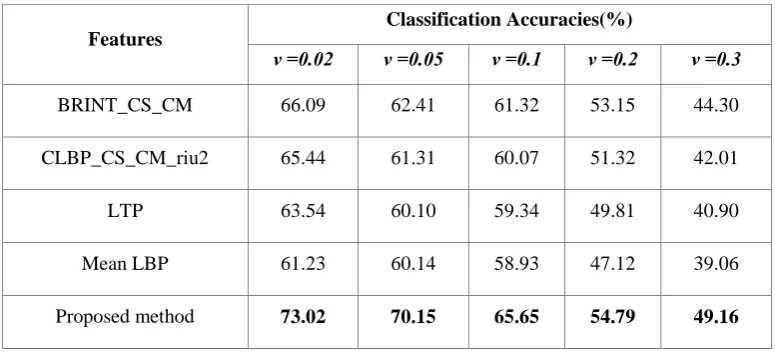
As intended the noise robustness has been tested for the approach using three types of noises: Gaussian noise, salt and pepper noise and speckle noise. In Table III, the performance of DM_BRINT is compared on KTH-TIPS2b dataset affected with additive Gaussian noise at different levels of Signal to Noise Ratio. Table III shows that proposed method performs better in presence of Gaussian noise at different levels of Signal to Noise Ratio (SNR). In Table IV, the noise robustness analysis is performed using KTH-TIPS2b database corrupted
Features Classification Accuracies(%)
SNR=100 SNR=30 SNR=15 SNR=10 SNR=5
BRINT_CS_CM 66.11 58.32 49.65 44.90 32.17
CLBP_CS_CM_riu2 64.98 56.03 46.32 41.23 30.91
LTP 61.90 53.12 45.14 39.84 29.31
Mean LBP 61.01 50.86 43.21 36.15 29.51
Proposed method 73.13 59.36 50.85 43.07 35.12
Features
Classification Accuracies(%)
ρ=0.05 ρ=0.1 ρ=0.2 ρ=0.3 ρ=0.4
BRINT_CS_CM 65.87 60.30 56.10 53.91 46.87
CLBP_CS_CM_riu2 63.24 55.10 49.39 44.12 40.54
LTP 61.98 57.34 52.30 46.01 42.34
Mean LBP 60.96 53.10 50.06 45.06 41.76
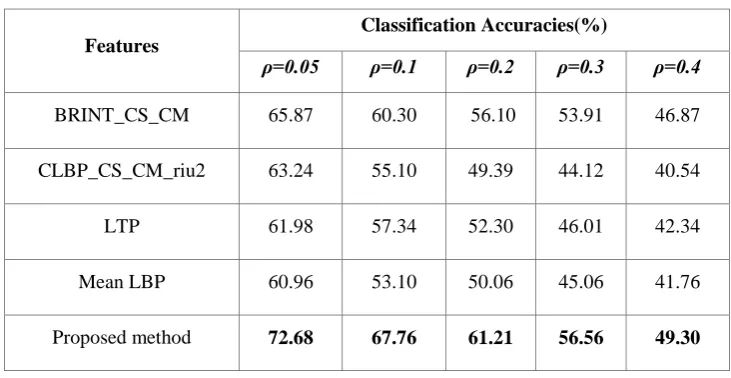
TABLE V.
Classification accuracies of the proposed approach in comparison to state-of-the-art resultson KTH-TIPS2b dataset under the influence of salt and pepper noise with zero mean and different
variances using SVM classifier
with salt and pepper noise under separate noise density ratios(ρ). Table IV proves that the proposed approach is more noise robust to salt and pepper noise than other LBP variants. Table V checks the performance against speckle noise for different LBP variants in place. Speckle noise of zero mean and different levels of variance is added. The proposed approach has shown significant improvement in the performance.
IV
CONCLUSION
In this paper, we aimed to achieve the balance between low computation complexity, low feature dimensionality and noise robustness. These were accomplished by using effective diamond sampling structure to simplify the computations and noise robustness is achieved through averaging along radial direction. A new descriptor motivated by BRINT descriptor is created to achieve better classification accuracy and low feature dimensionality. We conducted experimental tests on two benchmark texture databases. Results showed that the proposed approach performs superior to other state-of-the-art LBP like methods both in noisy and noise free conditions. It denotes that the proposed approach is simple, robust to noise while having low feature dimension.
Acknowledgment
The first author gratefully acknowledges the contributions of Mr. K. Durga Ganga Rao for his suggestions and support to complete this work.
REFERENCES
[1] L. Liu, Y. Long, P. Fieguth, S. Lao, G. Zhao, ―BRINT: binary rotation invariant and noise tolerant texture
classification.‖ IEEE Trans. Image Process., vol. 23, no.7, pp. 3071-3084, Jul. 2014.
[2] T. Ojala, M. Pietikäinen, and T. Mäenpää, ―Multiresolution gray-scale and rotation invariant texture
classification with local binary patterns,‖ , vol. 24, no. 7, pp. 971– 987, Jul. 2002.
Features
Classification Accuracies(%)
ν =0.02 ν =0.05 ν =0.1 ν =0.2 ν =0.3
BRINT_CS_CM 66.09 62.41 61.32 53.15 44.30
CLBP_CS_CM_riu2 65.44 61.31 60.07 51.32 42.01
LTP 63.54 60.10 59.34 49.81 40.90
Mean LBP 61.23 60.14 58.93 47.12 39.06
[3] M. Raja and V. Sadavisam, ―Optimized local ternary patterns: A new texture model with set of optimal patterns for texture analysis,‖ , vol. 9, no. 1, pp. 1–14, 2013.
[4] Z. Guo, L. Zhang, and D. Zhang, ―A completed modeling of local binary pattern operator for texture
classification,‖ , vol. 9, no. 16, pp. 1657–1663, Jun. 2010.
[5] T. Ojala, T. Mäenpää, M. Pietikänen, J. Viertola, J. Kyllönen, and S. Huovinen, ―Outex—New framework
for empirical evaluation of texture analysis algorithms,‖ in Proc. 16th Int. Conf. Pattern Recognit., vol. 1. 2002, pp. 701–706.
[6] M. Pietikäinen, T. Ojala, and Z. Xu, ―Rotation-invariant texture classification using feature distributions,‖
vol. 33, no. 1, pp. 43–52, Jan. 2000.
[7] C.-C. Chang and C.-J. Lin. (2001). [Online]. Available:
http://www.csie.ntu.edu.tw/ cjlin/libsvm
[8] P. Mallikarjuna, M. Fritz, A. T. Targhi, E. Hayman, B. Caputo, and J.-O. Eklundh. (2006). [Online]. available: http://www.nada.kth.se/cvap/databases/kth-tips/
[9] Learning With Kernels: Support Vector Machines, Regularization,
Optimization and Beyond
[10] Zhibin Pan, Xiuquan Wu, Zhengyi Li, and Zhili Zhou, ―Local Adaptive Binary Patterns Using Diamond
Sampling Structure for Texture Classification
[11] S. Liao, Max W. K. Law, and Albert C. S. Chung, ―Dominant local binary patterns for texture classification,‖ , vol. 18, no. 5, pp. 1107–1118, May 2009.
[12] Rakesh Mehta and Karen Egiazarian, ―Texture classification using dense micro-block difference,‖ IEEE