R E S E A R C H
Open Access
Some convergence results using
K
iteration process in
CAT
(0)
spaces
Kifayat Ullah
1*, Kashif Iqbal
1and Muhammad Arshad
2*Correspondence: [email protected] 1Department of Mathematics, University of Science and Technology, Bannu, Pakistan Full list of author information is available at the end of the article
Abstract
In this paper, some strong and
-convergence results are proved for Suzuki generalized nonexpansive mappings in the setting ofCAT(0) spaces using theK iteration process. We also give an example to show the efficiency of theKiteration process. Our results are the extension, improvement and generalization of many well-known results in the literature of fixed point theory inCAT(0) spaces.
MSC: Primary 47H09; secondary 47H10
Keywords: Suzuki generalized nonexpansive mapping;CAT(0) space;Kiteration process;
-convergence; Strong convergence
1 Introduction
The well-known Banach contraction theorem uses the Picard iteration process for approx-imation of fixed point. Numerical computation of fixed points for suitable classes of con-tractive mappings, on appropriate geometric framework, is an active research area nowa-days [1–3]. Many iterative processes have been developed to approximate fixed points of different type of mappings. Some of the well-known iterative processes are those of Mann [4], Ishikawa [5], Agarwal [6], Noor [7], Abbas [8], SP [9], S∗[10], CR [11], Normal-S [12], Picard Mann [13], Picard-S [14], Thakur New [15] and so on. These processes have a wide rang of applications to general variational inequalities or equilibrium problems as well as to split feasibility problems [16–19]. Recently, Hussain et al. [20] introduced a new three-step iteration process known as theK iteration process and proved that it is converging fast as compared to all above-mentioned iteration processes. They use a uniformly convex Banach space as a ground space and prove strong and weak convergence theorems. On the other hand, we know that every Banach space is aCAT(0) space.
Motivated by the above, in this paper, first we develop an example of Suzuki generalized nonexpansive mappings which is not nonexpansive. We compare the speed of conver-gence of theKiteration process with the leading two steps S-iteration process and leading three steps Picard-S-iteration process. Finally, we prove some strong and-convergence theorems for Suzuki generalized nonexpansive mappings in the setting ofCAT(0) spaces.
2 Preliminaries
For details as regardsCAT(0) spaces please see [21]. Some results are recalled here for CAT(0) spaceX.
Lemma 2.1([7]) For x,y∈X and letξ∈[0, 1],there exists a unique point s∈[x,y]where [x,y]is the line segment joining x and y,such that
d(x,s) =ξd(x,y) and d(y,s) = (1 –ξ)d(x,y). (1) The notation ((1 –ξ)x⊕ξy) is used for the unique pointssatisfying (1).
Lemma 2.2([13, Lemma 2.4]) For x,y,z∈X andξ∈[0, 1],we have
dz,ξx⊕(1 –ξ)y≤ξd(z,x) + (1 –ξ)d(z,y). (2) LetCbe a nonempty closed convex subset of aCAT(0) spaceX, and let{xn}be a bounded
sequence inX. Forx∈X, we set
rx,{xn}
=lim sup
n→∞
d(xn,x).
The asymptotic radius of{xn}relative toCis given by
rC,{xn}
=infrx,{xn}
:x∈C,
and the asymptotic center of{xn}relative toCis the set
AC,{xn}
=x∈C:rx,{xn}
=rC,{xn}
.
Just like in uniformly convex Banach spaces, it is well known thatA(C,{xn}) consists of
exactly one point in a completeCAT(0) space.
Definition 2.3 InCAT(0) spaceX, a sequence{xn}is said to be-convergent tos∈Xif
sis the unique asymptotic center of{ux}for every subsequence{ux}of{xn}. In this case
we write-limnxn=sand callsthe-limof{xn}.
A pointpis called a fixed point of a mappingT ifT(p) =p, andF(T) represents the set of all fixed points of the mappingT. LetCbe a nonempty subset of aCAT(0) spaceX.
A mappingT:C→Cis called a contraction if there existsξ∈(0, 1) such that d(Tx,Ty)≤ξd(x,y)
for allx,y∈C.
A mappingT:C→Cis called nonexpansive if
d(Tx,Ty)≤d(x,y)
for allx,y∈C.
In 2008, Suzuki [22] introduced a new condition on a mapping, called condition (C), which is weaker than nonexpansiveness. A mappingT:C→Cis said to satisfy condition (C) if for allx,y∈C, we have
1
The mapping satisfying condition (C) is called a Suzuki generalized nonexpansive map-ping. The following is an example of a Suzuki generalized nonexpansive mapping which is not nonexpansive.
Example2.4 Define a mappingT: [0, 1]→[0, 1] by
Tx=
1 –x ifx∈[0,101),
x+1
2 ifx∈[ 1 10, 1].
We need to prove thatT is a Suzuki generalized nonexpansive mapping but not nonex-pansive.
Ifx=111,y=101 we see that
d(Tx,Ty) =|Tx–Ty|
=1 – 1 11– 11 20 = 79 220 > 1 110
=d(x,y).
HenceTis not a nonexpansive mapping.
To verify thatTis a Suzuki generalized nonexpansive mapping, consider the following cases:
Case I: Letx∈[0,101), then21d(x,Tx) =1–2x
2 ∈( 2 5,
1 2]. For
1
2d(x,Tx)≤d(x,y) we must have 1–2x
2 ≤y–x, i.e., 1
2≤y, hencey∈[ 1
2, 1]. We have
d(Tx,Ty) =y+ 1
2 – (1 –x)
=y+ 2x– 1 2
< 1
10
and
d(x;y) =|x–y|> 1 10– 1 2 =2 5.
Hence 12d(x,Tx)≤d(x,y)⇒d(Tx,Ty)≤d(x,y).
Case II: Letx∈[101, 1], then 12d(x,Tx) =12|x+12 –x|=1–4x∈[0,409]. For12d(x,Tx)≤d(x,y) we must have1–4x≤ |y–x|, which gives two possibilities:
(a). Letx<y, then 1–4x≤y–x⇒y≥1+34x⇒y∈[1340, 1]⊂[101, 1]. So
d(Tx,Ty) =x+ 1
2 –
y+ 1 2
=1
2d(x,y)≤d(x,y).
Hence 12d(x,Tx)≤d(x,y)⇒d(Tx,Ty)≤d(x,y). (b). Letx>y, then 1–x
4 ≤x–y⇒y≤x– 1–x
4 = 5x–1
4 ⇒y∈[– 1
Nowx∈[15, 1] andy∈[101, 1] is already included in (a). So letx∈[15, 1] andy∈[0,101), then
d(Tx,Ty) =x+ 1
2 – (1 –y)
=x+ 2y– 1 2
.
For convenience, first we consider x∈[15,78] and y∈[0,101), then d(Tx,Ty)≤ 803 and d(x,y) >101. Henced(Tx,Ty)≤d(x,y).
Next consider x∈[78, 1] and y∈[0,101), then d(Tx,Ty)≤ 101 andd(x,y) > 7280. Hence d(Tx,Ty)≤d(x,y). So 12d(x,Tx)≤d(x,y)⇒d(Tx,Ty)≤d(x,y).
HenceTis a Suzuki generalized nonexpansive mapping.
We now list some basic results.
Proposition 2.5 Let C be a nonempty subset of a CAT(0)space X and T:C→C be any mapping.Then:
(i) [22, Proposition 1]IfT is nonexpansive thenTis a Suzuki generalized nonexpansive mapping.
(ii) [22, Proposition 2]IfT is a Suzuki generalized nonexpansive mapping and has a fixed point,thenTis a quasi-nonexpansive mapping.
(iii) [22, Lemma 7]IfTis a Suzuki generalized nonexpansive mapping,then
d(x,Ty)≤3d(Tx,x) +d(x,y)
for allx,y∈C.
Lemma 2.6 ([22, Theorem 5]) Let C be a weakly compact convex subset of a CAT(0) space X.Let T be a mapping on C.Assume that T is a Suzuki generalized nonexpansive mapping.Then T has a fixed point.
Lemma 2.7([23, Lemma 2.9]) Suppose that X is a complete CAT(0)space and x∈X.{tn}
is a sequence in[b,c]for some b,c∈(0, 1)and{xn},{yn}are sequences in X such that,for
some r≥0,we have
lim
n→∞supd(xn,x)≤r, nlim→∞supd(yn,x)≤r and
lim
n→∞supd
tnxn⊕(1 –tn)yn,x
=r;
then
lim
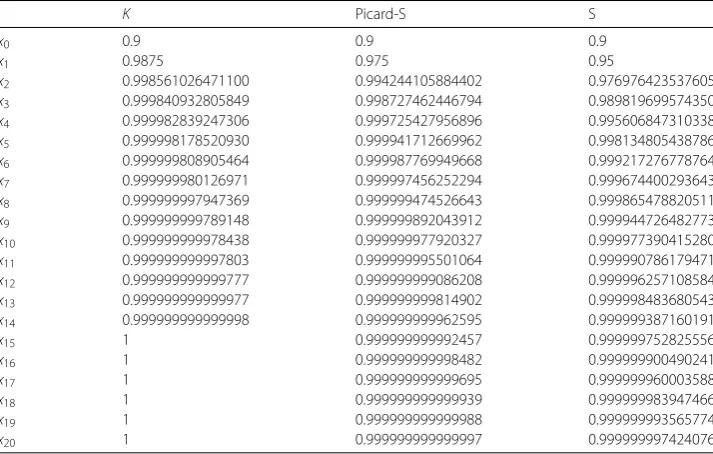
Table 1 Sequences generated byK, Picard-S- and S-iteration processes
K Picard-S S
x0 0.9 0.9 0.9
x1 0.9875 0.975 0.95
x2 0.998561026471100 0.994244105884402 0.976976423537605
x3 0.999840932805849 0.998727462446794 0.989819699574350
x4 0.999982839247306 0.999725427956896 0.995606847310338
x5 0.999998178520930 0.999941712669962 0.998134805438786
x6 0.999999808905464 0.999987769949668 0.999217276778764
x7 0.999999980126971 0.999997456252294 0.999674400293643
x8 0.999999997947369 0.999999474526643 0.999865478820511
x9 0.999999999789148 0.999999892043912 0.999944726482773
x10 0.999999999978438 0.999999977920327 0.999977390415280
x11 0.999999999997803 0.999999995501064 0.999990786179471
x12 0.999999999999777 0.999999999086208 0.999996257108584
x13 0.999999999999977 0.999999999814902 0.999998483680543
x14 0.999999999999998 0.999999999962595 0.999999387160191
x15 1 0.999999999992457 0.999999752825556
x16 1 0.999999999998482 0.999999900490241
x17 1 0.999999999999695 0.999999960003588
x18 1 0.999999999999939 0.999999983947466
x19 1 0.999999999999988 0.999999993565774
x20 1 0.999999999999997 0.999999997424076
Letn≥0 and{ξn}and{ζn}be real sequences in [0, 1]. Hussain et al. [20] introduced a
new iteration process namely theKiteration process, thus:
⎧ ⎪ ⎪ ⎪ ⎨ ⎪ ⎪ ⎪ ⎩
x0∈C,
zn= (1 –ζn)xn+ζnTxn,
yn=T((1 –ξn)Txn+ξnTzn),
xn+1=Tyn.
(4)
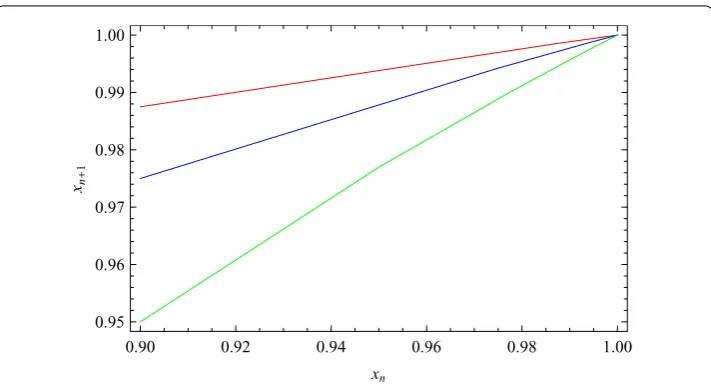
They also proved that theKiteration process is faster than the Picard-S- and S-iteration processes with the help of a numerical example. In order to show the efficiency of theK it-eration process we use Example 2.4 withx0= 0.9 and get Table 1. A graphic representation is given in Fig. 1. We can easily see the efficiency of theKiteration process.
3 Convergence results for Suzuki generalized nonexpansive mappings
In this section, we prove some strong and-convergence theorems of a sequence gener-ated by aKiteration process for Suzuki generalized nonexpansive mappings in the setting ofCAT(0) space. TheKiteration process in the language ofCAT(0) space is given by
x0∈C,
zn= (1 –ζn)xn⊕ζnTxn,
yn=T
(1 –ξn)Txn⊕ξnTzn
,
xn+1=Tyn.
(5)
Theorem 3.1 Let C be a nonempty closed convex subset of a complete CAT(0)space X and T :C→C be a Suzuki generalized nonexpansive mapping with F(T)=∅.For arbitrarily chosen x0∈C,let the sequence{xn}be generated by(5)thenlimn→∞d(xn,p)exists for any
Figure 1Convergence of iterative sequences generated byK(red line), Picard-S (blue line) andS(green line) iteration process to the fixed point 1 of the mappingTdefined in Example 2.4
Proof Letp∈F(T) andz∈C. SinceTis a Suzuki generalized nonexpansive mapping,
1
2d(p,Tp) = 0≤d(p,z) implies that d(Tp,Tz)≤d(p,z).
So by Proposition 2.5(ii), we have
d(zn,p) =d
(1 –ζn)xn⊕ζnTxn
,p
≤(1 –ζn)d(xn,p) +ζnd(Txn,p)
≤(1 –ζn)d(xn,p) +ζnd(xn,p)
=d(xn,p). (6)
Using (6) we get
d(yn,p) =d
T(1 –ξn)Txn⊕ξnTzn
,p
≤d(1 –ξn)Txn⊕ξnTzn
,p
≤(1 –ξn)d(Txn,p) +ξnd(Tzn,p)
≤(1 –ξn)d(xn,p) +ξnd(zn,p)
≤(1 –ξn)d(xn,p) +ξnd(xn,p)
=d(xn,p). (7)
Similarly by using (7) we have
d(xn+1,p) =d(Tyn,p)
≤d(yn,p)
This implies that {d(xn,p)} is bounded and non-increasing for all p∈F(T). Hence
limn→∞d(xn,p) exists, as required.
Theorem 3.2 Let C,X,T and{xn}be as in Theorem3.1,where{ξn}and{ζn}are sequences
of real numbers in[a,b]for some a,b with0 <a≤b< 1.Then F(T)=∅if and only if{xn}
is bounded andlimn→∞d(Txn,xn) = 0.
Proof SupposeF(T)=∅and letp∈F(T). Then, by Theorem 3.1,limn→∞d(xn,p) exists
and{xn}is bounded. Put
lim
n→∞d(xn,p) =r. (9)
From (6) and (9), we have
lim sup
n→∞ d(zn,p)≤lim supn→∞ d(xn,p) =r. (10)
By Proposition 2.5(ii) we have
lim sup
n→∞ d(yn,p)≤lim supn→∞ d(xn,p) =r. (11)
On the other hand by using (6), we have
d(xn+1,p) =d(Tyn,p)
≤d(yn,p)
=dT(1 –ξn)Txn⊕ξnTzn
,p
≤d(1 –ξn)Txn⊕ξnTzn,p
≤(1 –ξn)d(Txn,p) +ξnd(Tzn,p)
≤(1 –ξn)d(xn,p) +ξnd(zn,p)
=d(xn,p) –ξnd(xn,p) +ξnd(zn,p).
This implies that
d(xn+1,p) –d(xn,p)
ξn ≤
d(zn,p) –d(xn,p).
So
d(xn+1,p) –d(xn,p)≤
d(xn+1,p) –d(xn,p)
ξn ≤
d(zn,p) –d(xn,p)
implies that
d(xn+1,p)≤d(zn,p).
Therefore
r≤lim inf
From (10) and (12) we get
r= lim
n→∞d(zn,p)
= lim
n→∞d
(1 –ζn)xn⊕ζnTxn
,p. (13)
From (9), (11), (13) and Lemma 2.7, we havelimn→∞d(Txn,xn) = 0.
Conversely, suppose that{xn}is bounded andlimn→∞d(Txn,xn) = 0. Letp∈A(C,{xn}).
By Proposition 2.5(iii), we have
rTp,{xn}
=lim sup
n→∞
d(xn,Tp)
≤lim sup
n→∞
3d(Txn,xn) +d(xn,p)
≤lim sup
n→∞
d(xn,p)
=rp,{xn}
.
This implies thatTp∈A(C,{xn}). SinceXis uniformly convex,A(C,{xn}) is a singleton
and hence we haveTp=p. HenceF(T)=∅.
The proof of the following-convergence theorem is similar to the proof of [24, Theo-rem 3.3].
Theorem 3.3 Let C, X,T and {xn}be as in Theorem3.2with F(T)=∅.Then{xn}
-converges to a fixed point of T.
Next we prove the strong convergence theorem.
Theorem 3.4 Let C,X,T and{xn}be as in Theorem3.2such that C is compact subset
of X.Then{xn}converges strongly to a fixed point of T.
Proof By Lemma 2.6, we haveF(T)=∅and so by Theorem 3.1 we havelimn→∞d(Txn,xn) =
0. SinceCis compact, there exists a subsequence{xnk}of{xn}such that{xnk}converges strongly topfor somep∈C. By Proposition 2.5(iii), we have
d(xnk,Tp)≤3d(Txnk,xnk) +d(xnk,p) for alln≥1.
Lettingk→ ∞, we getTp=p, i.e.,p∈F(T). By Theorem 3.1,limn→∞d(xn,p) exists for
everyp∈F(T) and so thexnconverge strongly top.
A strong convergence theorem using conditionIintroduced by Senter and Dotson [25] is as follows.
Theorem 3.5 Let C,X,T and{xn}be as in Theorem3.2with F(T)=∅.If T satisfies
Proof By Theorem 3.1, we see that limn→∞d(xn,p) exists for all p ∈ F(T) and so
limn→∞d(xn,F(T)) exists. Assume thatlimn→∞d(xn,p) =rfor somer≥0. Ifr= 0 then
the result follows. Supposer> 0, from the hypothesis and condition (I),
fdxn,F(T)
≤d(Txn,xn). (14)
SinceF(T)=∅, by Theorem 3.2, we havelimn→∞d(Txn,xn) = 0. So (14) implies that
lim
n→∞f
dxn,F(T)
= 0. (15)
Sincef is a nondecreasing function, from (15) we havelimn→∞d(xn,F(T)) = 0. Thus, we
have a subsequence{xnk}of{xn}and a sequence{yk} ⊂F(T) such that
d(xnk,yk) < 1
2k for allk∈N.
So using (9), we get
d(xnk+1,yk)≤d(xnk,yk) < 1 2k.
Hence
d(yk+1,yk)≤d(yk+1,xk+1) +d(xk+1,yk)
≤ 1
2k+1 + 1 2k
< 1
2k–1 →0 ask→ ∞.
This shows that {yk}is a Cauchy sequence inF(T) and so it converges to a pointp.
SinceF(T) is closed,p∈F(T) and then{xnk}converges strongly top. Sincelimn→∞d(xn,p)
exists, we havexn→p∈F(T).
4 Conclusions
The extension of the linear version of fixed point results to nonlinear domains has its own significance. To achieve the objective of replacing a linear domain with a nonlinear one, Takahashi [26] introduced the notion of a convex metric space and studied fixed point results of nonexpansive mappings in this framework. This initiated the study of different convexity structures on a metric space. Here we extend a linear version of convergence results to the fixed point of a mapping satisfying conditionCfor the newly introducedK iteration process [20] to nonlinearCAT(0) spaces.
Acknowledgements
The authors are thankful to the reviewers for their valuable comments and suggestions.
Funding
We have no funding for this project of research.
Competing interests
Authors’ contributions
All authors contributed equally. All authors read and approved the final manuscript.
Author details
1Department of Mathematics, University of Science and Technology, Bannu, Pakistan.2Department of Mathematics, International Islamic University, Islamabad, Pakistan.
Publisher’s Note
Springer Nature remains neutral with regard to jurisdictional claims in published maps and institutional affiliations.
Received: 11 January 2018 Accepted: 20 March 2018 References
1. Saluja, G.S., Postolache, M.: Three-step iterations for total asymptotically nonexpansive mappings inCAT(0) spaces. Filomat31(5), 1317–1330 (2017)
2. Saluja, G.S., Postolache, M., Kurdi, A.: Convergence of three-step iterations for nearly asymptotically nonexpansive mappings inCAT(k) spaces. J. Inequal. Appl.2015, Article ID 156 (2015)
3. Abbas, M., Khan, S.H., Postolache, M.: Existence and approximation results for SKC mappings inCAT(0) spaces. J. Inequal. Appl.2014, Article ID 212 (2014)
4. Mann, W.R.: Mean value methods in iteration. Proc. Am. Math. Soc.4, 506–510 (1953) 5. Ishikawa, S.: Fixed points by a new iteration method. Proc. Am. Math. Soc.44, 147–150 (1974)
6. Agarwal, R.P., O’Regan, D., Sahu, D.R.: Iterative construction of fixed points of nearly asymptotically nonexpansive mappings. J. Nonlinear Convex Anal.8, 61–79 (2007)
7. Dhompongsa, S., Panyanak, B.: On-convergence theorem inCAT(0) spaces. Comput. Math. Appl.56, 2572–2579 (2008)
8. Abbas, M., Nazir, T.: A new faster iteration process applied to constrained minimization and feasibility problems. Mat. Vesn.66, 223–234 (2014)
9. Phuengrattana, W., Suantai, S.: On the rate of convergence of Mann, Ishikawa, Noor and SP-iterations for continuous functions on an arbitrary interval. J. Comput. Appl. Math.235, 3006–3014 (2011)
10. Karahan, I., Ozdemir, M.: A general iterative method for approximation of fixed points and their applications. Adv. Fixed Point Theory3(3), 510–526 (2013)
11. Chugh, R., Kumar, V., Kumar, S.: Strong convergence of a new three step iterative scheme in Banach spaces. Am. J. Comput. Math.2, 345–357 (2012)
12. Sahu, D.R., Petrusel, A.: Strong convergence of iterative methods by strictly pseudocontractive mappings in Banach spaces. Nonlinear Anal., Theory Methods Appl.74, 6012–6023 (2011)
13. Khan, S.H.: A Picard–Mann hybrid iterative process. Fixed Point Theory Appl.2013, Article ID 69 (2013) 14. Gursoy, F., Karakaya, V.: A Picard-S hybrid type iteration method for solving a differential equation with retarded
argument (2014). arXiv:1403.2546v2
15. Thakur, B.S., Thakur, D., Postolache, M.: A new iterative scheme for numerical reckoning fixed points of Suzuki’s generalized nonexpansive mappings. Appl. Math. Comput.275, 147–155 (2016)
16. Thakur, B.S., Thakur, D., Postolache, M.: New iteration scheme for numerical reckoning fixed points of nonexpansive mappings. J. Inequal. Appl.2014, Article ID 328 (2014)
17. Yao, Y., Postolache, M., Liou, Y.C., Yao, Z.: Construction algorithms for a class of monotone variational inequalities. Optim. Lett.10(7), 1519–1528 (2016)
18. Yao, Y., Liou, Y.C., Postolache, M.: Self-adaptive algorithms for the split problem of the demicontractive operators. Optimization (2018). https://doi.org/10.1080/02331934.2017.1390747
19. Yao, Y., Leng, L., Postolache, M., Zheng, X.: Mann-type iteration method for solving the split common fixed point problem. J. Nonlinear Convex Anal.18(5), 875–882 (2017)
20. Hussain, N., Ullah, K., Arshad, M.: Fixed point approximation for Suzuki generalized nonexpansive mappings via new iteration process (2018). arXiv:1802.09888v1
21. Bridson, M., Heaflinger, A.: Metric Space of Non-positive Curvature. Springer, Berlin (1999)
22. Suzuki, T.: Fixed point theorems and convergence theorems for some generalized nonexpansive mappings. J. Math. Anal. Appl.340, 1088–1095 (2008)
23. Lawaong, W., Panyanak, B.: Approximating fixed points of nonexpansive nonself mappings inCAT(0) spaces. Fixed Point Theory Appl.2010, Article ID 367274 (2010)
24. Basarir, M., Sahin, A.: On the strong and-convergence of S-iteration process for generalized nonexpansive mappings onCAT(0) space. Thai J. Math.12, 549–559 (2014)
25. Senter, H.F., Dotson, W.G.: Approximating fixed points of nonexpansive mappings. Proc. Am. Math. Soc.44, 375–380 (1974)