R E S E A R C H
Open Access
New solid phase extractor based on ionic liquid
functionalized silica gel surface for selective
separation and determination of lanthanum
Hadi M Marwani
1,2*and Amjad E Alsafrani
1Abstract
Background:Direct determination of metal ions, in particular at ultra-trace concentration, cannot be easily achieved in complex systems by analytical techniques because of the lack of sensitivity and selectivity of these methods. Therefore, an efficient separation step is often required prior to the determination of metal ions for sensitive, accurate, and interference-free determination of metal ions. In accordance, a new solid phase extractor based on silica gel functionalized with ionic liquid (SG-N-PhenacylPyrNTf2) was developed for a selective separation of La(III) prior to its determination by inductively coupled plasma-optical emission spectrometry.
Methods:Immobilization of the ionic liquid on activated silica gel surface was confirmed by both Fourier transform infrared spectroscopy and scanning electron microscope. The concentration of ionic liquid on the surface of activated silica gel was determined based on thermal desorption method. The uptake behavior of the new SG-N-PhenacylPyrNTf2 adsorbent toward metal ions was studied under static conditions by batch mode. The supernatant concentrations of metal ions were directly determined after filtration by inductively coupled plasma-optical emission spectrometry. Results:Fourier transform infrared spectroscopy and scanning electron microscopy results strongly confirmed the formation of SG-N-PhenacylPyrNTf2phase. Adsorption isotherm study revealed the preference of
SG-N-PhenacylPyrNTf2over activated silica gel for a selective separation of La(III) prior to its determination by inductively coupled plasma-optical emission spectrometry. Adsorption isotherm data were well fit the Langmuir adsorption model with a maximum adsorption capacity of 165.39 mg g−1for La(III), which was consistent with that (167.08 mg g−1) experimentally obtained from adsorption isotherm study. Kinetic study demonstrated that the adsorption of La(III) on the SG-N-PhenacylPyrNTf2phase followed the pseudo second-order kinetic model.
Conclusions:Ultimately, the developed method can be applied and effectively utilized for the determination of La(III) in natural water samples with acceptable and reliable results.
Keywords:N-PhenacylPyrNTf2; Silica gel surface; La(III); Adsorption; ICP-OES; Batch mode
Background
Rare earth metals (REMs) have been used in different fields, such as chemical engineering, metallurgy, nuclear energy, optical, magnetic, luminescence, and laser materials, high-temperature superconductors, secondary batteries, and catalysis (Maestro and Huguenin 1995; Gaikwad and Damodaran 1993). Lanthanum is one of the REMs and has received special interest due to its technological importance
and increasing demands for advanced new materials. Present day applications of lanthanum, as a pure element or in association with other compounds, are in super alloys, catalysts, special ceramics, and organic synthesis (Palmieri et al. 2002). However, most of the environmental problems are usually caused by human activities and natural re-sources. In recent years, this phenomenon is remarkably extended with the population density and growth of technology. There are several contaminants in nature, such as contamination with heavy metals, radionuclides, and lanthanides (Maanan 2008; Awwad et al. 2010). All of these are toxic and harmful to the public health, even at low * Correspondence:[email protected]
1Department of Chemistry, Faculty of Science, King Abdulaziz University, P.O.
Box 80203, Jeddah 21589, Saudi Arabia
2Center of Excellence for Advanced Materials Research (CEAMR), King
Abdulaziz University, P.O. Box 80203, Jeddah 21589, Saudi Arabia
© Marwani and Alsafrani; licensee Springer. This is an Open Access article distributed under the terms of the Creative Commons Attribution License (http://creativecommons.org/licenses/by/2.0), which permits unrestricted use, distribution, and reproduction in any medium, provided the original work is properly cited.
concentration level (Cui et al. 2007). Thus, the most con-venient way to overcome these problems is to apply select-ive extraction techniques, particularly when they exist at ultra-trace concentration level in complex matrix (Zang et al. 2010).
Various extraction techniques were implemented for the quantitative determination of trace metal ions, including liquid-liquid extraction (Khajeh 2011; Farajzadeh et al. 2009), coprecipitation (Komjarova and Blust 2006; Soylak and Erdogan 2006; Saracoglu et al. 2006), ion exchange (Tao and Fang 1998), cloud point extraction (Manzoori et al. 2007; Safavi et al. 2004), and solid-phase extraction (Zhang et al. 2012; Marahel et al. 2011; Duran et al. 2007). Recently, solid-phase extraction (SPE) has been widely used as a separation tool for the speciation of metal ions in environmental samples and has received much attention because of its advantages, such as ab-sence of emulsion, high enrichment factor, disposal cost due to low consumption of reagent, and more import-antly environment-friendly (Aydin and Soylak 2007; Simpson 2000). Nevertheless, the main limitation of SPE is the lack of selectivity (Jal et al. 2004), which leads to high interference of the other existing species with the target metal ion. The choice of a proper adsorbent plays an important role in SPE because it can control the analytical parameters, such as selectivity, affinity, and capacity (Cai et al. 2003; Dean 1998). Hence, differ-ent surface modification methods have been applied to classical SPE adsorbents (such as silica (Shin and Choi 2009) and polymer (Qiao et al. 2012)) in order to increase the selectivity.
Room-temperature ionic liquids (RTILs) have several unique chemical and physical properties which make it useful for wide applications in organic chemistry, inor-ganic chemistry, electrochemistry, and analytical che-mistry (Zhao 2006; Vidal et al. 2012). RTILs have good thermal stability, negligible vapor pressure, tunable vis-cosity and miscibility with water, high conductivity, and high heat capacity (Handy 2005; Koel 2009). In addition, extraction and separation techniques applying solid ad-sorbents modified with ionic liquids (ILs) have become very active fields in analytical chemistry (Anderson et al. 2006). ILs can be immobilized on the surface of solid supports for additional applications as solid phase ex-tractors of metal ions from their matrices or aqueous so-lutions (Mahmoud and Al-Bishri 2011). They have been immobilized on multiwalled carbon nanotubes (Wang et al. 2008), nanosilica (Mahmoud 2011; Mahmoud and Al-Bishri 2011), and silica gel (Ayata et al. 2011; Liang and Peng 2010). Silica gel (SG) adsorbents, as an ex-ample of inorganic solid phases, afford several advan-tages over organic solid phases, such as high porosity and hydrophilicity and ease of surface modification (Ngeontae et al. 2009; Quang et al. 2012). However,
research studies were little in the abovementioned field of the applications of supported ionic liquid phases.
In accordance, a solid phase extractant (SG-N-Phen-acylPyrNTf2) was developed based on a hybrid combi-nation of the hydrophobic character of newly synthesized ionic liquid with SG properties, without the need for parti-tion treatment by chelating compounds. Both Fourier transform infrared (FT-IR) spectroscopy and scanning electron microscope (SEM) confirmed the formation of the resulted SG-N-PhenacylPyrNTf2 adsorbent. The se-lectivity of SG-N-PhenacylPyrNTf2toward different metal ions, including Co(II), Fe(II), Fe(III), La(III), and Ni(II) was investigated. The uptake behavior of the new SG-N-PhenacylPyrNTf2adsorbent toward La(III) was eva-luated under batch conditions. Adsorption isotherm data were well fit with the Langmuir adsorption model, strongly supporting that the adsorption process was mainly monolayer on a homogeneous adsorbent sur-face. Kinetic study also demonstrated that the adsorp-tion of La(III) on the SG-N-PhenacylPyrNTf2 phase obeyed the pseudo second-order kinetic model. The proposed method was ultimately applied to real water samples with satisfactory results.
Experimental details
Chemicals and reagents
All reagents used were of high purity and of analytical re-agent grade, and doubly distilled deionized water was used throughout experiments. N-phenacylpyridinium bromide (N-PhenacylPyrBr), bis(trifluoromethane)sulfonimide lith-ium (LiNTf2), ethyl alcohol (Et-OH), and diethyl ether were purchased from Sigma-Aldrich (Milwaukee, WI, USA). SG (SiO2, particle size 10 to 20 nm) with purity of 99.5% was also obtained from Sigma-Aldrich. Lanthanum nitrate [La (NO3)3] and stock standard solutions of 1,000 mg L−1of Co(II), Fe(II), Fe(III), and Ni(II) were purchased from Sigma-Aldrich.
Preparation of the new solid phase extractor
Preparation of N-PhenacylPyrNTf2ionic liquid
N-PhenacylPyrNTf2ionic liquid was prepared according to previously reported standard method by Marwani (Marwani 2013; 2010). Specifically, an amount of 2 g N-PhenacylPyrBr was separately weighed and dissolved in 18.2 MΩ·cm distilled deionized water. The N-PhenacylPyrBr solution was then mixed with an equimolar amount of LiNTf2. The resultant reaction mixture was stirred for 2 h at room temperature, and the reaction resulted in two phases. The lower layer was separated and dried under vacuum overnight.
Activation of SG
hydrochloric acid solution for 8 h in order to remove metal oxide and nitrogenous impurity and to enhance the content of silanol groups on the SG surface. The ac-tivated SG powder was filtered, repeatedly washed with 18.2 MΩ·cm distilled deionized water until acid-free and oven dried at 120°C for 5 h to remove surface-adsorbed water.
Synthesis of SG-N-PhenacylPyrNTf2
The preparation of SG-N-PhenacylPyrNTf2 was based
on the immobilization of ionic liquid
(N-PhenacylPyrNTf2) on the surface of activated SG by a hybridization process of the hydrophobic character of ionic liquid with SG properties. An amount of 5 g ac-tivated SG was suspended in 100 mL ethyl alcohol, and 1 g N-PhenacylPyrNTf2 was weighed, completely dissolved by warming in 50 mL ethyl alcohol and added to the activated SG suspension. The reaction mixture was stirred at 60°C for 12 h. The newly modified SG-N-PhenacylPyrNTf2 phase was filtered and washed with 50 mL ethyl alcohol on three por-tions followed by doubly distilled deionized water and diethyl ether. The SG-N-PhenacylPyrNTf2 adsorbent was then allowed to dry in an oven at 80°C for 5 h and kept in a desiccator for further use. The syn-thetic route of SG-N-PhenacylPyrNTf2 is shown in Scheme 1.
Batch procedure
In this study, the effect of solution pH, adsorption capacity determination, effect of contact time, and effect of coexisting ions were investigated under static condi-tions by batch mode. For the effect of pH on the selec-tivity of SG-N-PhenacylPyrNTf2 toward selected metal ions, standard solutions of 2 mg L−1 of each metal ion were prepared and adjusted to pH values ranging from 1.0 to 9.0, except for Fe(II) and Fe(III), with a series of buffer solutions, 0.2 mol L−1 HCl/KCl for pH 1.0 and 2.0, 0.1 mol L−1CH3COOH/CH3COONa for pH 3.0 to 6.0, and 0.1 mol L−1 Na2HPO4/HCl for pH 7.0 to 9.0. Both Fe(II) and Fe(III) were prepared at the same concentration as above but were only studied with buffer solutions at pH values ranging from 1.0 to 4.0 in order to avoid any precipitation with buffer solutions at pH 5.0 to 9.0. Each standard solution was individually mixed with 20 mg of dry SG-N-PhenacylPyrNTf2 phase. All mixtures were shaken vigorously at room temperature for 1 h to facilitate adsorption of the metal ions onto the SG-N-PhenacylPyrNTf2. The supernatant concentration of metal ions was determined directly by inductively coupled plasma-optical emission spectrometry (ICP-OES) after filtration. For the study of La(III) adsorption capacity, standard solutions of 0, 5, 10, 20, 30, 40, 60, 80, 100, 125, 150, 200, and 500 mg L−1 were prepared as above, adjusted to the optimum pH value of 6.0 with the buffered aqueous solution (0.1 mol L−1 CH3COOH/
+ Heat
Et-OH
SG
SG-N-PhenacylPyrNTf2
N S
S
F3C O
O
F3C
O O
N-PhenacylPyrNTf2 N
O
N S
S
F3C O
O
F3C
O O N
O OH
OH OH OH
OH
OH
OH OH OH
OH
CH3COONa) and individually mixed with 20 mg SG-N -PhenacylPyrNTf2. The mixtures were mechanically shaken for 1 h at room temperature. In addition, the effect of shaking time on the La(III) uptake capacity was studied under the same batch conditions but at different equilibrium periods (2.5, 5, 10, 20, 30, 40, 50, and 60 min).
Methods
FT-IR spectra were recorded before and after modification of the SG phase on Perkin Elmer spectrum 100 series FT-IR spectrometer (Beaconsfield, Bucks, UK) in the range 4,000 to 600 cm−1. A Jenway model 3505 laboratory pH meter (CamLab, Cambridgeshire, UK) was employed for the pH measurements and was calibrated with standard buffer solutions. Surface morphologies of SG before and after modification were investigated by SEM on a field emission scanning electron microscope (QUANT FEG 450, Amsterdam, Netherlands). The microscope was oper-ated at an accelerating voltage of 15 kV. Thermolyne 47900 furnace was used to determine the millimoles per gram sur-face coverage value of SG-N-PhenacylPyrNTf2 surface by thermal desorption analysis. ICP-OES measurements were acquired with the use of a Perkin Elmer ICP-OES model Optima 4100 DV, Shelton, CT, USA. The ICP-OES instru-ment was optimized daily before measureinstru-ment and oper-ated as recommended by the manufacturers. The ICP-OES spectrometer was used with the following parameters: FR power, 1,300 kW; frequency, 27.12 MHz; demountable quartz torch, Ar/Ar/Ar; plasma gas (Ar) flow, 15.0 L min−1; auxiliary gas (Ar) flow, 0.2 L min−1; nebulizer gas (Ar) flow, 0.8 L min−1; nebulizer pressure, 2.4 bar; glass spray cham-ber according to Scott (Ryton), sample pump flow rate, 1.5 mL min−1; integration time, 3 s; replicates, 3; and wavelength range of monochromator 165 to 460 nm. The wavelengths selected for the determination of Fe(II and III), Ni(II), Co(II), and La(III) were 238.204, 231.604, 228.616, and 348.902 nm, respectively.
Results and discussion
Determination of the surface coverage value of the SG-N-PhenacylPyrNTf2phase
An amount of 100 mg SG-N-PhenacylPyrNTf2 adsor-bent was weighed in a dry porcelain crucible. The weighed amount was then gradually heated into a furnace from 50°C to 700°C, and the ignited phase was kept at this temperature for 1 h. The remaining SG-N-PhenacylPyrNTf2phase was left to cool inside the fur-nace and then transferred to a desiccator. The weight loss of hydrophobic ionic liquid was determined by the difference in sample masses before and after the process of thermal desorption. Based on thermal desorption method, the concentration of N-PhenacylPyrNTf2 was
determined to be 0.38 mmol g−1 on the surface of activated SG.
FT-IR and SEM characterization of SG-N-PhenacylPyrNTf2
In order to emphasize the immobilization of the N-PhenacylPyrNTf2 on activated SG surface, activated SG and SG-N-PhenacylPyrNTf2 were evaluated by FT-IR spectroscopy. FT-IR spectrum of newly modified adsor-bent shows spectral changes that are related to both N-PhenacylPyrNTf2 and activated SG phases, confirming the formation of the new physically modified SG-N-PhenacylPyrNTf2phase. The band observed at 1,347 cm−1, as displayed in Figure 1, was assigned to stretching vibrations of (NSO2) bonds. Other characteristic bands of the SG-N-PhenacylPyrNTf2adsorbent appeared at the position of about 1,644 cm−1for (C=C) and 1,713 cm−1 for (C=O). Two absorption peaks also appeared at 2,900 and 3,013 cm−1 which could be attributed to (−C–H) and (=C–H), respectively.
The formation of SG-N-PhenacylPyrNTf2 phase was not only confirmed by FT-IR measurements but was also supported by taking SEM images of the activated silica gel and SG-N-PhenacylPyrNTf2, as shown in Figure 2. Figure 2 displays a pronounced and charac-terized change of the surface morphology of activated SG as a result of the N-PhenacylPyrNTf2 immobilization on the surface of activated SG. It can be clearly observed that the activated SG particles were collected in aggregate forms and completely covered with N-PhenacylPyrNTf2. In addition, it is interesting to note that the particles of SG-N-PhenacylPyrNTf2 (Figure 2B) are individually distributed in uniform and homogeneous shapes as compared to that of the activated SG (Figure 2A).
Effect of pH and selectivity study
The acidity of solution plays an important role in the ex-traction of metal ions from different matrices. Therefore, the solution pH is the first parameter to be optimized. In order to evaluate the effect of pH on the adsorption of SG-N-PhenacylPyrNTf2toward Co(II), Fe(II), Fe(III), La(III), and Ni(II), pH values of the sample solution were studied in the range of 1.0 to 9.0 for all metal ions, except with Fe(II) and Fe(III) whose pH values were in-vestigated in the range 1.0 to 4.0 in order to avoid any precipitation with buffer solutions at a pH value higher than 4.0. Selected metal ions of 2 mg L−1 were indivi-dually mixed with 20 mg SG-N-PhenacylPyrNTf2phase. All mixtures were mechanically shaken at room tem-perature for 1 h. Figure 3 depicts the effect of solution pH on the % extraction of selected metal ions. In gen-eral, it can be observed that there is an increase in % extraction of all metal ions with an increase in the pH. However, it is of interest to note that the highest % ex-traction is reached for La(III) among all metal ions included in this study. In addition, the selectivity of
SG-N-PhenacylPyrNTf2 phase toward La(III) was found to be the most among all metal ions at pH value of 6.0.
The distribution coefficient was calculated for each metal ion at its optimum pH value for further confirm-ation of the selectivity of SG-N-PhenacylPyrNTf2phase toward La(III), as illustrated in Table 1. The distribution coefficient (Kd) corresponding to the character of a metal ion adsorbed by an adsorbent (mL g−1) can be obtained from the following equation (Han et al. 2005):
Kd¼ðCiC−CeÞ
e
V
m ð1Þ
where Ci and Ce correspond to initial and final concen-trations (mg L−1), respectively,Vdonates the volume of solution (mL), andmrefers to the mass of adsorbent (g). Results presented in Table 1 clearly indicated that La(III) had the greatest Kd value up to 2.50 × 10⁶ mL g−1 on the SG-N-PhenacylPyrNTf2 adsorbent among all other metal ions even at their optimum pH values. These re-sults strongly supported the finding that the selectivity of SG-N-PhenacylPyrNTf2was the most toward La(III).
The low % extraction of La(III) in the acidic medium could be ascribed to the presence of H+ ion competing with the La(III) ion for the adsorption sites of SG-N-PhenacylPyrNTf2 phase. At high pH values, the nega-tive charge produced on the surface of activated SG and incorporated donor atoms (N, O, and S) presented in the N-PhenacylPyrNTf2, as a result of the N-PhenacylPyrNTf2
Figure 2SEM images of (A) activated silica gel and (B) SG-N-PhenacylPyrNTf2phases.
Figure 3Effect of solution pH on the % extraction of selected metal ions.
Table 1 Selectivity study of 20 mg SG-N-PhenacylPyrNTf2 toward different metal ions
Metal ion Concentration (mg L−1) q
e(mg g–1) Kd(mL g−1)
Co(II) 2.00 0.54 340.33
Fe(II) 2.00 0.17 93.36
Fe(III) 2.00 1.65 2410.32
La(III) 2.00 2.50 2.50 × 10⁶
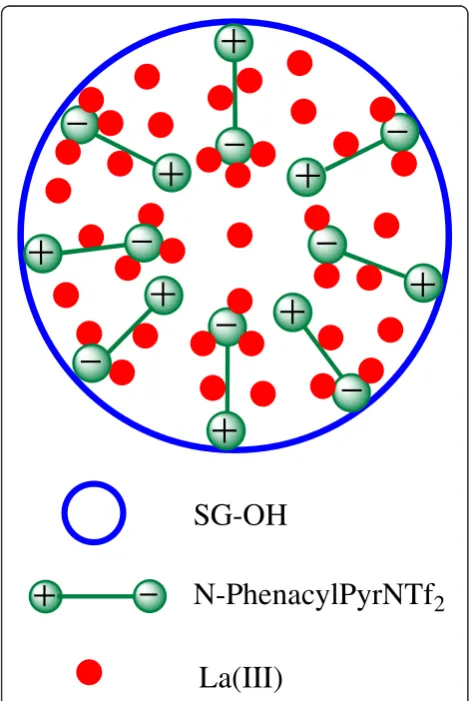
immobilization on the activated SG, strongly attained the selective adsorption of SG-N-PhenacylPyrNTf2toward La (III). Thus, the highest selectivity of the SG-N-Phena-cylPyrNTf2phase toward La(III) may be attributed to elec-trostatic attraction or complex formation mechanism between SG-N-PhenacylPyrNTf2and La(III), as shown in Figure 4. Based on the above results, La(III) was selected among other metal ions for the study of other parameters controlling its maximum uptake on SG-N-Phenacyl-PyrNTf2under batch conditions and at the optimum pH value of 6.0.
Determination of La(III) adsorption capacity
To determine the loading capacity of SG-N-Phena-cylPyrNTf2, 25 mL aliquots of a series of La(III) concen-trations (0 to 500 mg L−1) were adjusted to pH 6.0, and the proposed separation procedure previously described above was applied. The amount of La(III) adsorbed at each concentration level was determined by ICP-OES. The adsorption profile of La(III) on 20 mg SG-N-PhenacylPyrNTf2was obtained by plotting the La(III)
concentration (mg L−1) versus milligrams of La(III) adsorbed per gram SG-N-PhenacylPyrNTf2 (Figure 5). From adsorption isotherm study, the adsorption capacity of SG-N-PhenacylPyrNTf2for La(III) was experimentally found to be 167.08 mg g−1. The adsorption capacity of La(III) on the activated SG was also determined to be 85.06 mg g−1under the same batch conditions as well as that of La(III) with SG-N-PhenacylPyrNTf2 phase (Figure 5). These results indicated that the adsorption capacity for La(III) was increased by 96.43% with the newly modified SG-N-PhenacylPyrNTf2 phase. The adsorption capacity of La(III) reported in the present study was also compared with those reported with SPE materials, as summarized in Table 2. As could be ob-served in Table 2, the adsorption capacity for La(III) obtained by SG-N-PhenacylPyrNTf2is comparable with those previously reported with other studies.
Adsorption isotherm models
In order to evaluate the adsorption of La(III) on SG-N-PhenacylPyrNTf2adsorbent, the adsorption isotherm model was evaluated using Langmuir and Freundlich isotherm models. The Freundlich isotherm model as-sumes that the adsorption occurs on heterogeneous sur-faces. The Freundlich model is given by the following equation (Freundlich 1906):
logqe¼logKfþ1=n logCe ð2Þ
whereKfandnare the Freundlich constants and can be calculated from the intercept and slope, respectively, of the linear plot of logqeversus logCe.
The Langmuir isotherm model assumes that the adsorp-tion occurs at specific homogeneous adsorpadsorp-tion sites within the adsorbent and intermolecular forces that rapidly decrease with the distance from the adsorption surface
SG-OH
N-PhenacylPyrNTf
2
La(III)
Figure 4Interaction mechanism between SG-N-PhenacylPyrNTf2
(Unlü and Ersoz 2006). The Langmuir model is described by the following equation (Langmuir 1916):
Ce=qe¼ ðCe=QoÞ þ1=Qob ð3Þ
whereCecorresponds to the equilibrium concentration of the metal ion in the supernatant (mg mL−1) andqe repre-sents the amount of metal ion per gram of the adsorbent (mg g−1). The symbols Qo and b refer to Langmuir constants for SG-N-PhenacylPyrNTf2 and are related to the maximum La(III) adsorption capacity (mg g−1) and af-finity parameter (L mg−1), respectively. Langmuir constants can be obtained from a linear plot ofCe/qeagainstCewith a slope and intercept equal to 1/Qoand 1/Qob, respectively. In addition, the essential characteristics of the Langmuir adsorption isotherm can be represented in terms of a di-mensionless constant separation factor or equilibrium par-ameter,RL, which is defined asRL= 1/(1 +bCo), wherebis the Langmuir constant, indicating the nature of adsorption and the shape of the isotherm, andCois the initial concen-tration of the analyte of interest. TheRLvalue indicates the
type of the isotherm, andRLvalues lying between 0 and 1
indicates that the conditions were favorable for the adsorption process (McKay et al. 1982).
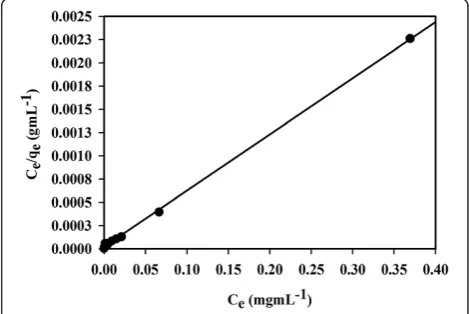
After evaluating both Freundlich and Langmuir iso-therm models, it was found that adsorption isoiso-therm data were well fit with the Langmuir model based on the least square fit. A close examination of Figure 6 reveals that a linear plot with correlation coefficient (R2) value
of 0.99 is obtained when plotting Ce/qe againstCe. This result confirmed the validity of Langmuir adsorption iso-therm model for the adsorption process of La(III) on SG-N-PhenacylPyrNTf2. In consequence, adsorption
isotherm data indicated that the adsorption process was mainly monolayer on a homogeneous adsorbent surface.
The corresponding fitting parameters of Qo and b of Langmuir isotherm model were also calculated and found to be 165.39 mg g−1and 0.27 L mg−1, respectively. The RL value of La(III) adsorption on
SG-N-Phena-cylPyrNTf2was also determined to be 0.02, supporting a highly favorable adsorption process based on the Langmuir adsorption isotherm model. It is also of in-terest to notice that the La(III) adsorption capacity (165.39 mg g−1) calculated from Langmuir equation was strongly consistent with that (167.08 mg g−1) experimen-tally obtained from the adsorption isotherm study.
Effect of contact time
The influence of shaking time is an important factor for evaluating the affinity of SG-N-PhenacylPyrNTf2 to La (III). The recommended static technique was carried out with a contact time varied from 2.5 to 60.0 min. Results of the effect of shaking time on the adsorption of La(III) on SG-N-PhenacylPyrNTf2 phase provided that the SG-N-PhenacylPyrNTf2 had rapid adsorption kinetics for La(III). As illustrated in Figure 7, over 152 mg g−1La (III) was absorbed by the SG-N-PhenacylPyrNTf2phase after only 10 min of the equilibrium period. The loading capacity of La(III) was also raised up to more than 159 mg g−1after 30 min until the maximum adsorption of SG-N-PhenacylPyrNTf2 for La(III) was reached to 167.08 mg g−1after 60 min.
Kinetic models
In order to analyze the uptake kinetic mechanism of La(III) adsorption on SG-N-PhenacylPyrNTf2, several kinetic models were evaluated to find kinetic adsorption parameters correctly representing the nature of adsorption process. Conventionally, the kinetics of metal ion
Table 2 Comparison of SG-N-PhenacylPyrNTf2adsorption
capacity for La(III) reported in the present study with other SPE materials
SPE material Adsorption capacity
(mg g−1) Reference
SG-N-PhenacylPyrNTf2 167.08 Present study
H,PEG400, PWa 220.80 (Zhang et al.2009)
H,PEG400, PMo 214.40 (Zhang et al.2009)
TA-MWCNTsb 5.35 (Tong et al.2011)
MRHc 175.40 (Awwad et al.
2010)
Turbinaria conoides biomass
154.70 (Vijayaraghavan
et al.2010)
Powderized leaves of Platanus orientalis
28.65 (Sert et al.2008)
MLTBCd 120.00 (Chen2010)
XAD-4-OVSCe 2.30 (Jain et al.2001)
a
Polyethyleneglycol (PEG)-phosphomolybdic (PMo)/phosphotungstic (PW) heteropolyacids;b
multiwalled carbon nanotube modified with tannic acid;
c
modified rice Husk activated carbon;d
modified low-temperature bamboo charcoal;e
amberlite XAD-4-o-vanillinsemicarbazone.
adsorption is described following the expressions origin-ally given by Lagergren, known as the pseudo first-order adsorption, which are special cases for the general Lang-muir rate equation (Wu et al. 2001). The pseudo first-order equation can be given by the following equation:
logðqe–qtÞ ¼logqe–ðk1=2:303Þt ð4Þ
where qe (mg g−1) and qt (mg g−1) are the amount of adsorption at equilibrium and at timet(min), respectively, and k1 denotes the adsorption rate constant of pseudo first-order adsorption (min−1). The adsorption rate constant k1and adsorption capacityqecan be calculated from the slope and intercepts of the plot of log(qe – qt) againstt.
In addition, the kinetics of La(III) adsorption on SG-N-PhenacylPyrNTf2 was fit by the pseudo second-order kinetic model, which can be expressed as follows (Rao et al. 2009):
t=qt¼1=υoþð1=qeÞt ð5Þ
where υo = k2 q2e is the initial adsorption rate (mg g–
1
min–1) and k2 (g mg–1 min–1) corresponds to the rate constant of the pseudo second-order adsorption; qe (mg g–1) is the amount of metal ion adsorbed at equili-brium, andqt(mg g–1) refers to the amount of metal ion on the adsorbent surface at any time t (min). Kinetic parameters of qeand υocan be obtained from the slope and intercept, respectively, of the linear plots of t/qt versust.
Adsorption kinetics data were well fit by the pseudo second-order model (Figure 8). The correlation coefficient (R2) factor was found to be 0.99, indicating that the pseudo
second-order adsorption is more reliable and accurate. Kinetic parameters of qe and υo were found to be 168.18 mg g–1and 167.40 mg g–1min–1, respectively, andk2was
determined to be 0.01 g mg–1min–1of La(III) adsorption
on the SG-N-PhenacylPyrNTf2phase. The La(III) adsorp-tion capacity on SG-N-PhenacylPyrNTf2obtained from the pseudo second-order kinetic model (168.18 mg g−1) was also closely related to those obtained from adsorption iso-therm experiments (167.08 mg g−1) and from the Langmuir isotherm model (165.39 mg g−1), supporting the highest ap-plicability of the pseudo second-order nature of the La(III) adsorption by SG-N-PhenacylPyrNTf2 and the validity of Langmuir adsorption isotherm model.
Performance of method in analytical applications
Effect of interfering ions
The effect of coexisting ions on the % extraction of La (III) was studied under optimized conditions in order to evaluate the applicability of proposed method for analyt-ical applications in analyzing real samples. Model stand-ard solutions containing fixed amount of 1 mg L−1 La (III) with either individual or mixed matrix ions were treated according to the recommended procedure. The tolerance limit of coexisting ions is defined as the largest amount making the recovery of analyte less than 90%. Results shown in Table 3 displayed that the extraction of La(III) was not affected by the medium composition containing either individual or mixed ions. This may be due to the low adsorption capacity or rate for interfering ions toward the SG-N-PhenacylPyrNTf2phase. Thus, it can be clearly concluded that the newly modified SG-N -PhenacylPyrNTf2phase has high selectivity toward La(III) when compared to other interfering ions, and the proposed method can be implemented for the determination of La (III) in real samples.
Application of the proposed method
In order to evaluate the applicability of the proposed procedure for the determination of targeted metal ion, the method was applied for the determination of La(III)
Figure 8Pseudo second-order adsorption kinetic model of La (III) uptake on 20 mg SG-N-PhenacylPyrNTf2.
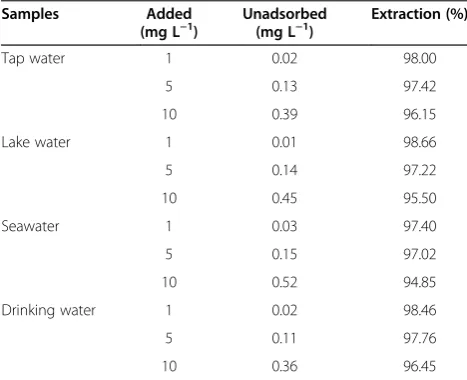
in real water samples. For the analysis of water samples, four different water samples, including drinking, lake, sea, and tap water, were collected from Jeddah in Saudi Arabia. Water samples were analyzed using the stand-ard addition method under the same batch conditions as above. Results displayed in Table 4 demonstrated that the % extraction of La(III) was in the range of 94.85% to 98.66%. Thus, the proposed method pro-moted the proportionality of SG-N-PhenacylPyrNTf2 for the determination of La(III) in real water samples.
Conclusions
In this study, the immobilization of N-PhenacylPyrNTf2 on activated SG, as a new solid phase extractor (SG-N-PhenacylPyrNTf2), was successfully accomplished via electrostatic interaction. The SG-N-PhenacylPyrNTf2 phase attained a perfect selectivity for the extraction
and determination of La(III) in aqueous solution even in the presence of plentiful interfering ions. Results also demonstrated that adsorption isotherm data for La(III) adsorption on the SG-N-PhenacylPyrNTf2 phase were well fit with the Langmuir classical adsorption isotherm model, providing that the formation of a monolayer over a homogeneous adsorbent surface. Moreover, kin-etic isotherm data displayed that the adsorption of La (III) on the SG-N-PhenacylPyrNTf2 phase obeyed a pseudo second-order kinetic reaction. Ultimately, the developed method can be applied and effectively utilized for the determination of La(III) in natural water samples with acceptable and reliable results.
Competing interests
The authors declare that they have no competing interests.
Authors' contributions
HMM designed the study and guided the research. AEA prepared sample solutions, carried out measurements, and drafted the manuscript. HMM modified the manuscript. Both authors read and approved the final manuscript.
Acknowledgements
The authors gratefully acknowledge the Department of Chemistry and Center of Excellence for Advanced Materials Research (CEAMR) at King Abdulaziz University for providing research facilities.
Received: 20 April 2013 Accepted: 2 September 2013 Published:
References
Anderson JL, Armstrong DW, Wei G (2006) Ionic liquids in analytical chemistry. Anal Chem 78:2893–2902
Awwad NS, Gad HM, Ahmad MI, Aly HF (2010) Sorption of lanthanum and erbium from aqueous solution by activated carbon prepared from rice husk. Colloids Surf B 81:593–599
Ayata S, Bozkurt SS, Ocakoglu K (2011) Separation and preconcentration of Pb(II) using ionic liquid-modified silica and its determination by flame atomic absorption spectrometry. Talanta 84:212–215
Aydin FA, Soylak M (2007) A novel multi-element coprecipitation technique for separation and enrichment of metal ions in environmental samples. Talanta 73:134–141
Cai Y, Jiang G, Liu J, Zhou Q (2003) Multiwalled carbon nanotubes as a solid-phase extraction adsorbent for the determination of bisphenol A, 4-n-nonylphenol, and 4-tert-octylphenol. Anal Chem 75:2517–2521 Chen Q (2010) Study on the adsorption of lanthanum (III) from aqueous solution
by bamboo charcoal. J Rare Earths 28:125–131
Cui Y, Chang X, Zhu X, Luo H, Hu Z, Zou X, He Q (2007) Chemically modified silica gel with p-dimethylaminobenzaldehyde for selective solid-phase extraction and preconcentration of Cr(III), Cu(II), Ni(II), Pb(II) and Zn(II) by ICP-OES. Microchem J 87:20–26
Dean JR (1998) Extraction methods for environmental analysis. Wiley, New York Duran C, Gundogdu A, Bulut VN, Soylak M, Elci L, Sentürk HB, Tüfekci M (2007)
Solid-phase extraction of Mn(II), Co(II), Ni(II), Cu(II), Cd(II) and Pb(II) ions from environmental samples by flame atomic absorption spectrometry (FAAS). J Hazard Mater 146:347–355
Farajzadeh MA, Bahram M, Zorita S, Mehr BG (2009) Optimization and application of homogeneous liquid-liquid extraction in preconcentration of copper (II) in a ternary solvent system. J Hazard Mater 161:1535–1543
Freundlich H (1906) Über die adsorption in lösungen (adsorption in solution). Z Phys Chem 57:384–470
Gaikwad AG, Damodaran AD (1993) Solvent extraction studies of holmium with acidic extractants. Sep Sci Technol 28:1019–1030
Han DM, Fang GZ, Yan XP (2005) Preparation and evaluation of a molecularly imprinted sol–gel material for on-line solid-phase extraction coupled with Table 4 Determination of La(III) at different
concentrations in real water samples using 20 mg
SG-N-PhenacylPyrNTf2
Samples Added
(mg L−1) Unadsorbed(mg L−1) Extraction (%)
Tap water 1 0.02 98.00
5 0.13 97.42
10 0.39 96.15
Lake water 1 0.01 98.66
5 0.14 97.22
10 0.45 95.50
Seawater 1 0.03 97.40
5 0.15 97.02
10 0.52 94.85
Drinking water 1 0.02 98.46
5 0.11 97.76
10 0.36 96.45
Table 3 Effect of matrix interferences on the extraction of 1 mg L−1La(III) on 20 mg SG-N-PhenacylPyrNTf2(N= 3) Coexisting ions Concentration (mg L−1) % Extraction of La(III)
Na+, K+, NH 4
+ 7,000 97.13
Ca2+, Mg2+ 7,000 98.07
Cd2+ 600 97.43
Co2+ 600 96.04
Fe2+ 600 95.57
Ni2+ 600 98.30
Pb2+ 600 96.36
Al3+ 300 98.25
Cr3+ 300 97.86
Cl−, F−, NO3− 4,000 98.39
CO32−, SO42− 3,000 97.77
high performance liquid chromatography for the determination of trace pentachlorophenol in water samples. J Chromatogr A 1100:131–136 Handy ST (2005) Room temperature ionic liquids: different classes and physical
properties. Curr Org Chem 9:959–988
Jain VK, Handa A, Sait SS, Shrivastav P, Agrawal YK (2001) Pre-concentration, separation and trace determination of lanthanum(III), cerium(III), thorium(IV) and uranium(VI) on polymer supported o-vanillinsemicarbazone. Anal Chim Acta 429:237–246
Jal PK, Patel S, Mishra BK (2004) Chemical modification of silica surface by immobilization of functional groups for extractive concentration of metal ions. Talanta 62:1005–1028
Khajeh M (2011) Response surface modelling of lead pre-concentration from food samples by miniaturised homogenous liquid-liquid solvent extraction: Box-behnken design. Food Chem 129:1832–1838
Koel M (2009) Ionic liquids in chemical analysis. CRC Press, Boca Raton Komjarova I, Blust R (2006) Comparison of liquid-liquid extraction, solid-phase
extraction and co-precipitation preconcentration methods for the determination of cadmium, copper, nickel, lead and zinc in seawater. Anal Chim Acta 576:221–228
Langmuir I (1916) The constitution and fundamental properties of solids and liquids. J Am Chem Soc 38:2221–2295
Liang P, Peng L (2010) Ionic liquid-modified silica as sorbent for preconcentration of cadmium prior to its determination by flame atomic absorption spectrometry in water samples. Talanta 81:673–677
Maanan M (2008) Heavy metal concentrations in marine molluscs from the Moroccan coastal region. Environ Pollut 153:176–183
Maestro P, Huguenin D (1995) Industrial applications of rare earths: which way for the end of the century. J Alloys Compd 225:520–528
Mahmoud ME (2011) Surface loaded 1-methyl-3-ethylimidazolium bis (trifluoromethylsulfonyl)imide [EMIM+Tf2N-] hydrophobic ionic liquid on nano-silica sorbents for removal of lead from water samples. Desalination 266:119–127
Mahmoud ME, Al-Bishri HM (2011) Supported hydrophobic ionic liquid on nano-silica for adsorption of lead. Chem Eng J 166:157–167 Manzoori JL, Abdolmohammad-Zadeh H, Amjadi M (2007) Ultra-trace
determination of silver in water samples by electrothermal atomic absorption spectrometry after preconcentration with a ligand-less cloud point extraction methodology. J Hazard Mater 144:458–463
Marahel F, Ghaedi M, Montazerozohori M, Nejati Biyareh M, Nasiri Kokhdan S, Soylak M (2011) Solid-phase extraction and determination of trace amount of some metal ions on duolite XAD 761 modified with a new Schiff base as chelating agent in some food samples. Food Chem Toxicol 49:208–214 Marwani HM (2010) Spectroscopic evaluation of chiral and achiral fluorescent
ionic liquids. Cent Eur J Chem 8:946–952
Marwani HM (2013) Exploring spectroscopic and physicochemical properties of new fluorescent ionic liquids. J Fluoresc 23:251–257
McKay G, Blair HS, Gardner JR (1982) Adsorption of dyes on chitin. I. Equilibrium studies. J Appl Polym Sci 27:3043–3057
Ngeontae W, Aeungmaitrepirom W, Tuntulani T, Imyim A (2009) Highly selective preconcentration of Cu(II) from seawater and water samples using amidoamidoxime silica. Talanta 78:1004–1010
Palmieri MC, Volesky B, Garcia O Jr (2002) Biosorption of lanthanum using sargassum fluitans in batch system. Hydrometallurgy 67:31–36 Qiao R, Zhang R, Zhu W, Gong P (2012) Lab simulation of profile modification
and enhanced oil recovery with a quaternary ammonium cationic polymer. J Ind Eng Chem 18:111–115
Quang DV, Kim JK, Sarawade PB, Tuan DH, Kim HT (2012) Preparation of amino-functionalized silica for copper removal from an aqueous solution. J Ind Eng Chem 18:83–87
Rao MM, Kumar Reddy DHK, Venkateswarlu P, Seshaiah K (2009) Removal of mercury from aqueous solutions using activated carbon prepared from agricultural by-product/waste. J Environ Manage 90:634–643 Safavi A, Abdollahi H, Hormozi Nezhad MR, Kamali R (2004) Cloud point
extraction, preconcentration and simultaneous spectrophotometric determination of nickel and cobalt in water samples. Spectrochim Acta Part A 60:2897–2901
Saracoglu S, Soylak M, Kacar Peker DS, Elci L, dos Santos WNL, Lemos VA, Ferreira SLC (2006) A pre-concentration procedure using coprecipitation for determination of lead and iron in several samples using flame atomic absorption spectrometry. Anal Chim Acta 575:133–137
Sert S, Kütahyali C, Inan S, Talip Z, Cetinkaya B, Eral M (2008) Biosorption of lanthanum and cerium from aqueous solutions by platanus orientalis leaf powder. Hydrometallurgy 90:13–18
Shin EM, Choi HS (2009) Column preconcentration and determination of cobalt (II) using silica gel loaded with 1-nitroso-2-naphthol. Bulletin of the Korean Chemical Society 30:1516–1520
Simpson NJK (2000) Solid phase extraction: principles, strategies and applications. Marcel Dekker, New York
Soylak M, Erdogan ND (2006) Copper(II)-rubeanic acid coprecipitation system for separation-preconcentration of trace metal ions in environmental samples for their flame atomic absorption spectrometric determinations. J Hazard Mater 137:1035–1041
Tao GH, Fang Z (1998) Dual stage preconcentration system for flame atomic absorption spectrometry using flow injection on-line ion-exchange followed by solvent extraction. J Anal Chem 360:156–160
Tong S, Zhao S, Zhou W, Li R, Jia Q (2011) Modification of multi-walled carbon nanotubes with tannic acid for the adsorption of La, Tb and Lu ions. Microchim Acta 174:257–264
Unlü N, Ersoz M (2006) Adsorption characteristics of heavy metal ions onto a low cost biopolymeric sorbent from aqueous solutions. J Hazard Mater 136:272–280
Vidal L, Riekkola M-L, Canals A (2012) Ionic liquid-modified materials for solid-phase extraction and separation: a review. Anal Chim Acta 715:19–41 Vijayaraghavan K, Sathishkumar M, Balasubramanian R (2010) Biosorption of
lanthanum, cerium, europium, and ytterbium by a brown marine alga, turbinaria conoides. Ind Eng Chem Res 49:4405–4411
Wang Z, Zhang Q, Kuehner D, Xu X, Ivaska A, Niua L (2008) The synthesis of ionic-liquid-functionalized multiwalled carbon nanotubes decorated with highly dispersed Au nanoparticles and their use in oxygen reduction by electrocatalysis. Carbon 46:1687–1692
Wu F-C, Tseng R-L, Juang R-S (2001) Kinetic modeling of liquid-phase adsorption of reactive dyes and metal ions on chitosan. Water Res 35:613–618 Zang Z, Li Z, Zhang L, Li R, Hu Z, Chang X, Cui Y (2010) Chemically modified
attapulgite with asparagine for selective solid-phase extraction and preconcentration of Fe(III) from environmental samples. Anal Chim Acta 663:213–217
Zhang L, Ding S-D, Yang T, Zheng G-C (2009) Adsorption behavior of rare earth elements using polyethyleneglycol (phosphomolybdate and tungstate) heteropolyacid sorbents in nitric solution. Hydrometallurgy 99:109–114 Zhang N, Peng H, Hu B (2012) Light-induced pH change and its application to
solid phase extraction of trace heavy metals by high-magnetization Fe3O4@SiO2@TiO2nanoparticles followed by inductively coupled plasma mass spectrometry detection. Talanta 94:278–283
Zhao H (2006) Innovative applications of ionic liquids as "green" engineering liquids. Chem Eng Commun 193:1660–1677
Cite this article as:Marwani and Alsafrani:New solid phase extractor based on ionic liquid functionalized silica gel surface for selective separation and determination of lanthanum.Journal of Analytical Science and Technology
Submit your manuscript to a
journal and benefi t from:
7Convenient online submission
7Rigorous peer review
7Immediate publication on acceptance
7Open access: articles freely available online
7High visibility within the fi eld
7Retaining the copyright to your article
Submit your next manuscript at 7 springeropen.com 10.1186/2093-3371-4-13