R E S E A R C H
Open Access
Production and optimization of
α
-amylase
from thermo-halophilic bacteria isolated
from different local marine environments
Eman A. Elmansy
1*, Mohsen S. Asker
1, Ebtsam M. El-Kady
1, Saadia M. Hassanein
2and Fawkia M. El-Beih
2Abstract
Background:Amylases are among the most important enzymes which are of great significance for biotechnology and have almost completely replaced chemical hydrolysis of starch in the starch processing industry. The present study was concerned with the production and optimization of extracellularα-amylase fromBacillussp. NRC22017. Results:The effect of various fermentation conditions onα-amylase production through shake-flask culture was investigated. Bacterial strain producesα-amylase was isolated from water in Wadi El-Natron. Based on microbiological, biochemical tests, and 16S rRNA gene sequences, the isolate was identified asBacillussp. NRC22017 and was later used for further studies. Maximum yield ofα-amylase is 15.15 ± 0.47 U/ml fromBacillussp. NRC22017; this strain is characterized with high temperature and high salinity in cultivated culture, and achieved maximum yield ofα-amylase at pH 6.0 with inoculum size of 500μl at 45 °C and aerobically incubation period of 72 h. The optimum volume of the fermentation medium was found to be 20 ml in 100 ml Erlenmeyer flask; the best starch and meat extract plus peptone concentration that provided the highest enzyme production fromBacillus sp. NRC22017 were found to be 2% and 1.05% (w/v) respectively.
Conclusion: Enzyme production was higher after optimizing the production conditions as compared to the basal medium.
Keywords: α-Amylase, Starch hydrolysis, Thermo-halophilic bacteria
Background
Alpha amylase (EC: 3.2.1.1), randomly attack α-1, 4-glycosidic bond of starch, maltodextrins, maltose, and glucose units were formed as a result of α-amylase ac-tion (Maity et al. 2015). Alpha amylase has gained a great attention due to its broad spectrum of applications and economic merits (Bansode2010). Currently, amylase production has reached up to 65% of enzyme market in the world and is continuously increasing (Abdullah et al. 2014). It has a wide range of applications in starch lique-faction, paper, desizing of textile fabrics, preparing starch coatings of paints, removing wallpaper, brewing industry, sugar induction by the production of sugar syrups, and pharmaceuticals. Alpha amylase can be produced by mi-cro- and macroorganisms(Simair et al.2017). When the
origins are in comparison, amylases from animal and plant origins have low resistance under acidic, basic, and high temperature conditions. On the other hand, bacter-ial and fungal amylases have good stability under such conditions and have more economic production opera-tions. So, microbial enzymes have been applied in a large number of applications.
Recently, starch saccharification, the main use of ase, has totally displaced chemical utilization with amyl-ase enzyme hydrolysis. Saccharification is executed at raised temperature and thermophilic microorganisms could be most hopeful candidates for amylase produc-tion because these strains will produce thermostable amylase. This is why, still, search for new microbial strains is continued to achieve industrial requirements of enzymes.
In addition, amylase is supplemented in local deter-gents due to high alkaline pH stability needed for indus-tries (Asad et al.2011). Moreover, thermophilic amylase
* Correspondence:[email protected]
1Microbial Biotechnology Department, National Research Centre, El-Tahreer
Street, Dokki, Cairo, Egypt
Full list of author information is available at the end of the article
is required for other applications in the production of sweeteners from starch and saccharification of starch for biochemical production (Castro et al.1999).
Bacillus genus is famous for alpha-amylase production and severalBacillusstrains such asB.stearothermophilus,
B.subtilis,B.cereus,B.licheniformis, andB.
amyloliquefa-ciens are isolated and screened for amylase production (Sivaramakrishnan et al. 2006). SomeBacillusstrains are involved in raw starch degradations (Demirkan et al.2005; Goyal et al.2005; Puspasari et al.2013).
Still, many are being searched to obtain the maximum output with unique industrial properties. Enzyme pro-duction could be improved through the optimization of various physical and nutritional growth parameters; the important factors that determine the bioprocess are in-cubation period, temperature, pH, aeration, inoculum size, carbon, and nitrogen sources. Therefore, in this study, the effects of physical and nutritional parameters were investigated for the optimum production of extra-cellular enzymeα-amylase fromBacillussp. NRC22017.
Results
Isolation, screening, and identification of amylolytic bacteria
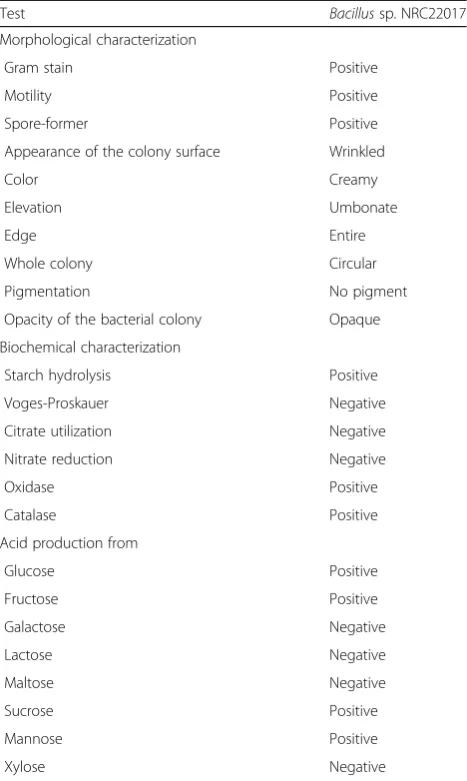
In the present investigation, a pure strain ofBacillussp. NRC22017 was isolated from Wadi El-Natron and we found bacteria isolated from such places may have better potential to produce enzyme under adverse conditions. The isolate was inspected for the qualitative production of α-amylase on a starch agar plate supplemented with 2% soluble starch using iodine solution (Fig. 1). Finally, NRC22017 strain was selected as the best amylase pro-ducer. The promising isolate (NRC22017) was identified based on its microscopic, morphological, and biochem-ical characterization and it was proven to beBacillussp. (Table1).
Fig. 1Bacterial isolate negative for starch hydrolysis test (a). Zone of clearance around NRC22017 (b) due to starch hydrolysis
Table 1Cultural and biochemical characteristic of the promising bacterial isolate
Test Bacillussp. NRC22017
Morphological characterization
Gram stain Positive Motility Positive Spore-former Positive Appearance of the colony surface Wrinkled Color Creamy Elevation Umbonate
Edge Entire
Whole colony Circular Pigmentation No pigment Opacity of the bacterial colony Opaque Biochemical characterization
Starch hydrolysis Positive Voges-Proskauer Negative Citrate utilization Negative Nitrate reduction Negative Oxidase Positive Catalase Positive Acid production from
A molecular technique was used to prove and further confirm the identification of the isolate to the species level. The partial 16S rDNA sequence was determined and was compared to the GenBank databases. The iso-late was identified as Bacillus sp. NRC22017. The se-quence was submitted to GenBank in NCBI (https:// www.ncbi.nlm.nih.gov/nuccore/KY614074) with the ac-cession number KY614074. The phylogenetic tree based on different species of Bacillus was constructed using neighbor joining method (Fig.2).
Optimization ofα-amylase production conditions
Though different Bacillus species have similar growth patterns and enzyme profiles, but their optimized condi-tions vary, depending upon the strain. Optimization of the process parameters is needed for the improved pro-duction of the enzyme to make the process cost effect-ive. Selected strainBacillussp. NRC22017 was subjected to various culture conditions to investigate the optimum culture conditions forα-amylase production.
Effect of five different fermentation media on alpha amylase production
Studies on bacterial growth andα-amylase production from
Bacillussp. NRC22017 in shake-flask cultures were carried out using five different media at pH 7.0 and incubated for 72 h at 50 °C. Results in Fig. 3illustrated that among the culture media, the medium 5 exhibited a significant impact on the microorganism development (2.15 ± 0.067) and en-zyme production (11.02 ± 0.17 U/ml), while the lowest growth rate (0.089 ± 0.001) andα-amylase synthesis (3.20 ± 0.12 U/ml) were obtained when medium 3 was used.
Effect of physical parameters on alpha amylase production
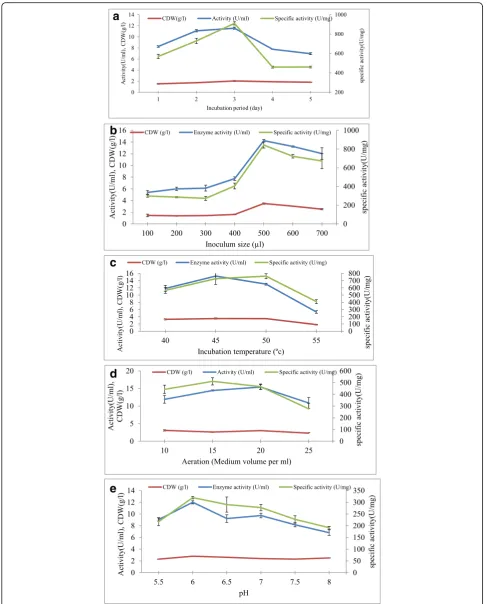
Incubation period The results obtained from the incu-bation time study in submerged culture cleared that bac-terial growth and α-amylase productivity was gradually
raised with the increment in the incubation period. Incu-bation for 3 days was the best for both α-amylase prod-uctivity (11.56 ± 0.20 U/ml) and bacterial growth (2.04 ± 0.09 g/l). The activity ofα-amylase was declined by fur-ther increasing the incubation period. At 5 days of incu-bation, it was extremely reduced and the minimum amount ofα-amylase was obtained after 5 days of incu-bation (6.96 ± 0.17 U/ml) (Fig.4a).
Inoculum size Data in Fig.4b show the effect of inocu-lum size (200 to 700μlv/v) on cell growth and extracellu-lar amylase secretion. The highest amylase yield was achieved when 500μl (14.24 ± 0.2 U/ml) of 24-h-old seeds culture was inoculated into the fermentation medium.
Incubation temperature Data in Fig.4c show the effect of fermentation temperature (40–55 °C) on the synthesis of amylase byBacillus sp. NRC22017 grown in fermen-tation medium containing 20 g/l starch and 14 g/l pep-tone plus yeast extract at pH 7.0 and incubated for 72 h. Enzyme concentration increased with incubation temperature and maximum amylase yield was noted at
Fig. 2Phylogenetic tree based on the 16S rRNA sequences of isolate and its closestBacillussp.
a
b
c
d
e
45 °C (15.27 ± 0.88 U/ml) and a further increase of temperature reduced amylase synthesis. The production of the enzyme was greatly inhibited at 55 °C (5.32 ± 0.36).
Aeration In our study, the highest productivity of α-amylase was recorded at 20 ml broth medium in 100 ml conical flask (15.42 ± 0.68 U/ml), and the lowest produc-tion level was reported at 25 ml broth medium in a con-ical flask of 100 ml capacity (10.89 ± 1.57 U/ml) (Fig.4d).
pH In our study, the maximum bacterial growth and synthesis of α-amylase were found at pH 6.0 (12.00 ± 0.28 U/ml) (Fig.4e).
Effect of nutritional factors onα-amylase production
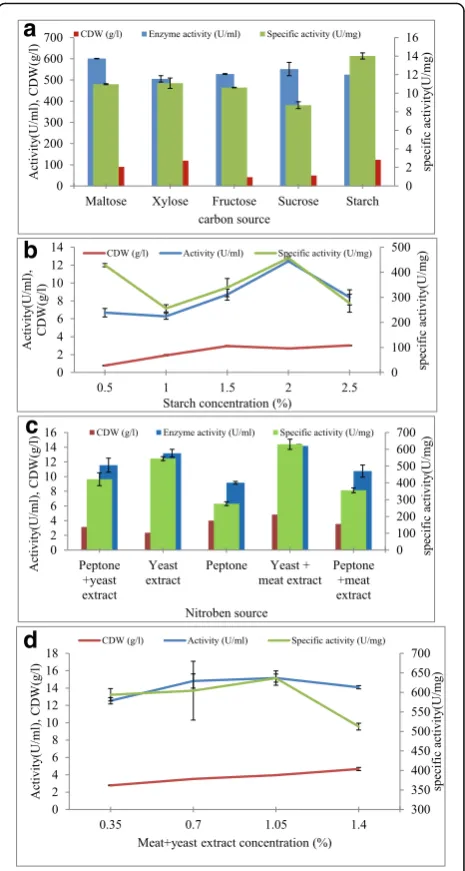
Various carbon sources Different carbon sources (starch, sucrose, fructose, xylose, and maltose) at a con-centration of 2.0% (w/v) were individually tested in the basal medium at optimal temperature, incubation period, and pH to observe the effect on enzyme synthesis by
Ba-cillussp. NRC22017. Out of these carbon sources, maltose was found to be the best for amylase production (13.74 ± 0.02 U/ml) within 72 h (Fig. 5a). Even though the max-imum activity of α-amylase enzyme was observed in the existence of maltose as a carbon source, starch is used for supplementation in the production process, because it works as an inexpensive source as compared with maltose. From the present findings, it was evident that the en-hancement of α-amylase needs substrates with α-1,4 glycosidic bonds, including starch and maltose.
The influence of starch concentration as a carbon source on α-amylase production from Bacillus sp. NRC22017 was clarified in Fig. 5b. The amount of α-amylase increase until it reaches the highest level at a starch concentration of 2% (w/v) (12.42 ± 0.06 U/ml), then it starts to decrease.
Various nitrogen sources The various organic nitrogen sources impact on bacterial growth and α-amylase pro-duction from Bacillussp. NRC22017 was shown in Fig. 5c. Supplementation of yeast extract plus meat extract to the fermentation medium gave the highest bacterial growth and enzyme productivity (14.17 ± 0.20 U/ml).
Figure 5d demonstrated that Bacillus sp. NRC22017 gave the highest α-amylase productivity at 1.05% meat plus yeast extract (15.15 ± 0.47 U/ml).Also, from the ob-tained data, it was obvious that bacterial growth increase with increasing nitrogen source concentration and the highest cell dry weight was obtained at the highest nitro-gen source concentration (1.4%) (4.67 ± 0.18 g/l), but α-amylase synthesis decreased with increasing nitrogen source concentration above the optimum concentration.
Discussion
The initial screening ofBacillussp. NRC22017 strain re-vealed zones of hydrolysis on starch agar plates. This clear zone indicated that NRC22017 α-amylase can hydrolyze starch.
In the present study, we observed 72 h as the optimum growth period for the presently reported
Bacil-lus strain and longer incubation period supported less number of colonies and lower enzyme activity. A pro-longed incubation period extremely reduced α-amylase possibly due to the exhaustion of nutrients, death of mi-croorganisms, gathering of byproducts in the medium
a
b
c
d
such as toxins, inhibitors, proteolysis of α-amylase by proteases enzymes, and also the cells may attained the decline phase and showed diminished amylase synthesis (Teodoro and Martins2000; Aiyer2005). These findings were closely similar to the results of B. licheniformis ATCC 12759 (Nurullah 2011) and Bacillus isolates (Kanimozhi et al. 2014). While, Kaur and Vyas (2012), Deb et al. (2013), Singh et al. (2016), and Paul et al. (2017) found that an extended period of incubation be-yond 48 h did not increase the enzyme production from
Bacillus sp. DLB, B. amyloliquefaciens P-001, Bacillus sp. strain B-10, andBacillussp. MB6, respectively. These results were in contradiction with our results in the present study.
Concerning inoculum size, this study proposed that
α-amylase output from Bacillus sp. strain depends on
the growth. Our results are almost in harmony with lit-erature for enzyme production from different strains concerning inoculum size. The size of inoculum plays a notable role in the fermentation rate. It is noteworthy that there is no precise bacterial inoculum volume suit-able for amylase production. It can vary from 0.5% forB.
amyloliquefaciens (Haq et al. 2010) to 2.95% (Zambare 2011) for Bacillussp. and 8% for B. cereus(Sivakumar et al. 2012).
Temperature is a highly sensitive parameter for α-amylase productivity and so it needs to be controlled and this is usually varied from organism to another (Sivakumar et al. 2011). Temperature can affect an en-zyme in two ways. One is a direct influence on the reac-tion rate constant, and the other is in thermal denaturation of the enzyme at elevated temperatures (Demirkan et al. 2017). Similarly, Vijayaraghavan et al. (2015) and Asad et al. (2011) obtained maximum amyl-ase secretion fromBacillus cereusIND4 andBacillussp. WA21 at 45 °C on starch agar medium, whereas Hasan et al. (2017) reported maximum amylase production was at moderate temperature (37 °C) for both
Chryseobacter-iumandBacillusisolates.
During fermentation, the aeration rate indirectly indi-cates the dissolved oxygen level in the fermentation broth. Yegneswaran and Gray (1991) reported that a high concentration of oxygen had an influencing effect on microbial growth and enzyme production. The bio-synthesis ofα-amylase was diminished with the increase in the broth volume; this behavior might probably be-cause of a reduction in air supply as a result of the drooping in the agitation rate of medium that happened with a high volume of fermentation medium (Narang and Satyanarayana2001). Riaz et al. (2003) and Dash et al. (2015) conveyed that the maximum yield of
α-amylase from B. subtilis GCBUCM-25 and B. subtilis
BI19 was gained at 25 and 50 ml of enzyme production medium in 250 ml Erlenmeyer flask respectively.
Different enzymes have different optimum pH values. This is the pH value at which the bonds within them are affected by H+and OH−ions in a way that the shape of the active site is the most complementary to the shape of the substrate. At the ideal pH, the rate of reaction is optimum. Any alteration in pH above or below the optimum will quickly cause a decline in the reaction rate, since more of the enzyme molecules will have ac-tive sites whose shapes are not (or at least are less) com-plementary to the shape of their substrate (Demirkan et al. 2017). Similar result has been recorded for Bacillus sp. and Brevibacillus borstelensis R1 (Singh et al. 2012, Suribabu et al.2014). The production optimization stud-ies showed that maximum enzyme production by
Peni-cillium notatum IBGE 03 was obtained at pH 5.5 (Ahmed et al.2015). In neutral conditions (pH 6.5–7.5),
the α-amylase production was reported in Bacillus sp.
(Asgher et al.2007), andBacillussp. NRC12017 (Elkady et al. 2017). In alkaline conditions (pH 7.5–11.0), the
α-amylase production was reported in Bacillus sp.
(Saxena et al. 2007). It was stated that at high pH, the metabolic action of bacterium may be suppressed and thus it inhibits the enzyme production (Ellaiah et al.2002).
Regarding the effect of different carbon sources on alpha amylase production byBacillussp. NRC22017, results ob-tained were in agreement with results of NandLal et al. (2017) in Bacillus licheniformis JAR-26; Thippeswamy et al. (2006) inBacillus species (B3) where highest amylase
production (0.464 U/ml) was induced by maltose. Suri-babu et al. (2014) also found maltose better than other carbon sources examined for α-amylase production with
Brevibacillus borostelensisR1 under submerged fermenta-tion. Whereas Elkady et al. (2017) and Gangadharan et al. (2006) reported thatBacillussp. NRC12017 and Bacillus
amyloliquefaciensgave the highest enzyme yield with sol-uble starch, followed by maltose. Bacillus sp. NRC22017 could grow and produceα-amylase in the presence or ab-sence of starch from the fermentation medium. Sucrose, fructose, and starch have almost similar effect on
α-amylase synthesis fromBacillussp. NRC22017 (12.61 ±
0.72, 12.07 ± 0.05, and 12.01 ± 0.17 U/ml), respectively. There was a decrease in enzyme production at exces-sive starch concentration and this might be imputed to the rapid consumption of starch leading to the release of toxic metabolic wastes which suppress the growth of bacteria and α-amylase production. Also, high starch concentrations caused the broth culture to be more vis-cous, thus interfering with O2 transfer resulting in
re-striction of dissolved O2 required for the microbial
growth. Similarly,Mishra and Behera (2008) found that raising the starch concentration increased both growth
and α-amylase production by Bacillus strain from
Tiwari et al. (2014) informed that 4% soluble starch concentration was the best for amylase production by
B. tequilensis RG-01 and above this concentration en-zyme production was slightly decreased tested.
Nitrogen source is another essential nutrient that is re-quired by the microorganisms in comparatively larger amounts. Nitrogen source type and relative concentra-tion in the growth medium are important for both mi-crobial growth and amylase production (NandLal et al. 2016). The nitrogen is metabolized to produce primarily amino acids, nucleic acids, protein, enzymes, and other cellular components that play a vital role in metabolism. The decrease inα-amylase production at excess nitrogen levels could be due to the pH depression or the stimula-tion of protease enzyme, which repress the amylolytic activity (Tonkova 2006). Both lower and higher nitrogen sources levels in the production broth are equally detri-mental and cause inhibition of the enzyme (Sharma et al. 2012).
Conclusion
In this study, a combination of physical and chemical parameters was employed to maximize α-amylase syn-thesis. By optimizing the incubation conditions of
α-amylase production from Bacillussp. NRC22017 was
enhanced with 37.63% enzyme yield as compared to control. Enzyme activities in modified medium and control medium were 15.15 ± 0.47 U/ml and 11.02 ± 0.17 U/ml, respectively. The results obtained in this study illustrated that the optimization of culture condi-tions played a pivotal role in influencing output through the fermentation bioprocess. Screening of microorgan-isms with higherα-amylase activities could therefore fa-cilitate the discovery of novel amylases suitable for new industrial applications. Purification and characterization of the enzyme are in progress.
Materials and methods
Sample collection
Samples were collected from water and sediment of marine and salterns at different locations for isolation of bacteria. The samples were taken from Rashid, Sidi Bisher beach at Alexandria, Tiba rose village (El Sāhel Al-shamali), Hurghada, mangrove tree around the rhizo-sphere area (Marsa Alam), Safaga, El-Ain Elsokhna beach, and Wadi El-natron. Samples were collected in sterile bottles and brought to the lab, stored in the re-frigerator at 4 °C until it was used.
Isolation and purification ofα-amylase producing bacteria
Sample was suspended into 90 ml sterilized saline solu-tion (0.85%, NaCl) and diluted using the dilusolu-tion method (Hayakawa and Nonomura 1987). Then, 100 μl of di-luted sample (10−4–10−6) concentrations was placed on
the starch agar plate and spreads with a sterile L-shaped glass rod (Kanimozhi et al. 2014). The plate was incu-bated at 50 °C for 24 and 48 h, and single colonies of different sizes were selected. The colonies were sub-jected to purification to obtain single pure colonies.
Screening of isolated samples forα-amylase production
All isolates were curried using the starch plate (Moller et al.2004). Bacteria were inoculated on starch plates to test for α-amylase secretion, incubated at 50 °C for 3 days, and stains with an iodine solution (0.5%). Amylase-positive stains were determined by the presence of a clear zone of starch hydrolysis around the colony on the starch plates, while presence of blue color around the growth indicated negative result (Hollo and Szeiti 1968). The bacterial isolates which produced a clear zone of hydrolysis in starch agar were selected as α-amylase producers for subsequent investigation. Se-lected colonies were maintained on nutrient agar slants at 4 °C and sub-cultured monthly.
Identification of potent amylase producer
Biochemical, morphological, and physiological character-istics of the potential producer (isolate number 16) was determined by adopting standard methods (Bergey and Holt 1994). The identification was confirmed with phylogenetic analysis. Briefly, genomic DNA of bacteria was extracted and universal primer 5′-TCCGTAGGT
GAACTTTGCGG-3′and 5′-TCCTCCGCTTATTGATA
TGC-3′primers was used for the amplification of DNA (Gardes and Bruns 1993). A single discrete PCR ampli-con band was observed when resolved on agarose gel. The PCR amplicon was purified to remove contami-nants. Sequencing products were resolved on an Applied Bio-systems model 3730XL automated DNA sequencing system (Applied BioSystems, USA). Data were submitted to GenBank database. The DNA sequence was com-pared to the GenBank database in the national Center for Biotechnology Information (https://www.ncbi.nlm. nih.gov/genbank/) using the BLAST program (Tamura et al. 2011). The sequencing was performed by Lab Technology Company.
Growth conditions forα-amylase production
To choose a proper culture medium for growth of the isolated strain and α-amylase production, primarily five different fermentation media were examined: Medium 1 (g/l): Na2HPO46.0, KH2PO43.0, NaCl 0.5, MgSO40.24,
CaCl2 0.01, Peptone 3.0, Starch 10.0 (Burhan et al.
2003). Medium 2 (g/l): Starch 10.0, Yeast extract 2.0, Peptone 5.0, MgSO40.5, NaCl 0.5, CaCl20.15 (Swain et
al. 2006). Medium 3 (g/l): Starch 20.0, Peptone 0.5, MgSO4.7H2O 0.5, NaH2PO40.1, (NH4)2SO40.1, KCl 0.1
10.0, Starch 5.0, Beef extract 10.0 (Amoozegar et al. 2003). Medium 5 (g/l): Starch 20, Peptone 10, Yeast ex-tract 4, MgSO4 0.5, CaCl2 0.2 (Kanimozhi et al. 2014).
The pH of the media was adjusted to 7 with 0.1N HCl and 0.1N NaOH. The media were sterilized and Erlen-meyer flasks of 100 ml capacity containing 20 ml of cul-ture medium were inoculated with 1 ml of previously prepared inoculum and incubated at 50 °C in a rotary shaker at 140 rpm for 72 h. The samples were harvested after 72 h and the cells were separated by centrifugation (5000 rpm for 15 min at 4 °C) in centrifuge (SIGMA 3-18 KS). The cell dry weight (CDW) of culture broth was measured by harvesting the cells after centrifugation and drying them at 105 °C to a constant weight.
Enzyme assay
α-Amylase activity was determined by measuring the re-duction in blue color intensity resulting from enzyme hydrolysis of starch (Palanivelu2001). The reaction mix-ture consisted of 200 μl cell-free supernatant, 250 μl of soluble starch (1% w/v), and 500 μl phosphate buffer (0.2 M pH 7) incubated at 50 °C for 30 min. The reac-tion was stopped by adding 250 μl of 0.1 N HCl and color was developed by adding 250μl of iodine solution. The optical density (OD) of the blue color solution was determined at 660 nm using (JASCO V-630) spectro-photometer. One unit (U) of enzyme activity is defined as the amount of enzyme that hydrolyzes 0.5 mg of starch per minute under assay optimum conditions. Spe-cific activity was expressed as units of enzyme activity per mg of protein. All measurements were performed three times. The data were expressed as mean ± standard error of the mean.
Protein determination
Protein content was estimated by Bradford’s method (Bradford1976) using bovine serum albumin as standard.
Factors affectingα-amylase production fromBacillussp. NRC22017
Flask cultures were performed in 100 ml Erlenmeyer flasks containing 20 ml of the medium 5. Factors affect-ing cell growth and α-amylase production were investi-gated using one factor at a time method. The optimized parameters were incubation time (1, 2, 3, 4, and 5 days) at 50 °C under shaking conditions at 140 rpm, inoculum size (100, 200, 300, 400, 500, 600, and 700 μl), medium volume (10, 15, 20, and 25 ml), temperature (40, 45, 50, and 55 °C), and initial pH of the medium (5.5, 6.0, 6.5, 7.0, 7.5, and 8.0). Studies were also performed to evalu-ate the influence of different carbon sources (maltose, su-crose, xylose, fructose, and starch 2% w/v) and different concentrations of starch (0.5, 1.0, 1.5, 2.0, and 2.5%w/v). Also different nitrogen sources were used (peptone, yeast
extract, peptone plus yeast extract, yeast plus meat extract, and peptone plus meat extract 1.4%w/v) at different con-centrations (0.35, 0.70, 1.05, and 1.40% w/v) of meat ex-tract plus yeast exex-tract were tested to get the best one for α-amylase production. The enzyme activity and protein concentration were determined.
Acknowledgements
Not applicable.
Funding
This research was a part of MSc that was funded by national research center.
Availability of data and materials
All data generated or analyzed during this study are included in this published article [and its supplementary information files].
Authors’contributions
This research was extracted from MSc thesis. All authors read and approved the final manuscript.
Ethics approval and consent to participate
Not applicable (this study does not involve human participants, human data, or human tissue)
Consent for publication
Not applicable.
Competing interests
Purification and characterization of the enzyme are in progress.
Publisher’s Note
Springer Nature remains neutral with regard to jurisdictional claims in published maps and institutional affiliations.
Author details
1Microbial Biotechnology Department, National Research Centre, El-Tahreer
Street, Dokki, Cairo, Egypt.2Microbiology Department, Faculty of Science, Ain
Shams University, Cairo, Egypt.
Received: 31 July 2018 Accepted: 19 November 2018
References
Abdullah R, Shaheen N, Iqtedar M, Naz S, Iftikhar T (2014) Optimization of cultural conditions for the production of alpha amylase byAspergillus Niger(BTM-26) in solid state fermentation. Pak J Bot 46(3):1071–1078
Ahmed K, Munawar S, Khan MA (2015) Cultural conditions for maximum alpha-amylase production byPenicillium notatumIBGE 03 using shaken flask technique of submerged fermentation. Applied Biology 4(3):306–312 Aiyer PV (2005) Amylases and their applications. Afr J Biotechnol 4(13):1525–1529 Amoozegar MA, Malekzadeh F, Malik KA (2003) Production of amylase by newly
isolated moderate halophileHalobacillussp. strain MA-2. J of Microbiological Methods 52:353–359
Asad W, Asif M, Rasool SA (2011) Extracellular enzyme production by indigenous thermophilic bacteria: partial purification and characterization ofα-amylase byBacillussp. WA21. Pak J Bot 43(2):1045–1052
Asgher M, Asad MJ, Rahman SU, Legge RL (2007) A thermostableα-amylase from a moderately thermophilicBacillus subtilisstrain for starch processing. J of Food Engineering 79:950–955
Bansode SD (2010) Screening of nutritional components forα-amylase production in submerged fermentation by bacteria isolated from soil using plackettburman design. Int J Pharm PharmSci 2:93–98
Bergey DH, Holt GJ (1994) Bergey's manual of determinative bacteriology 9thedition. The. Williams and Wilkins 428 East Preston street, Baltimore
Maryland 21202, U.S.A
Burhan A, Nisa U, Gokhan C, Omer C, Ashabil A, Osman G (2003) Enzymatic properties of a novel thermophilic, alkaline and chelator resistant amylase from an alkalophilicBacillussp. isolate ANT-6. Process Biochem 38:1397–1403 Castro GR, Baigorí MD, Siñeriz F (1999) Studies onα-amylase production by
Bacillus licheniformisMIR-61. Acta Biotechnol 19(3):263–272
Dash BK, Rahman MM, Sarker PK (2015) Molecular identification of a newly isolatedBacillus subtilisBI19 and optimization of production conditions for enhanced production of extracellular amylase. BioMed Research international. Article ID 859805:9
Deb P, Talukdar SA, Mohsina K, Sarker PK, Sayem SA (2013) Production and partial characterization of extracellular amylase enzyme fromBacillus amyloliquefacien. Springer plus (2)1:154.https://doi.org/10.1186/2193-1801-2-154.
Demirkan ES, Mikami B, Adachi M, Higasa T, Utsumi S (2005)α-Amylase fromB. amyloliquefaciens: purification, characterization, raw starch degradation and expression inE. coli. Process Biochem 40(8):2629–2636
Demirkan, Sevgi, Başkurt (2017) Optimization of physical factors affecting the production of theα-amylase from a newly isolatedBacillussp. M10 strain. Karaelmas Fen veMühendislikDergisi 7(1):23–30
El-Kady EM, Asker MS, Hassanein MS, Elmansy EA, El-Beih FM (2017) Optimization, production, and partial purification of thermostableα-amylase produced by marine bacteriumBacillussp. NRC12017. International Journal of Pharmaceutical and Clinical Research 9(8):558–570
Ellaiah P, Adinarayana K, Bhavani Y, Padmaja P, Srinivasulu B (2002) Optimization of process parameters for glucoamylase production under solid state fermentation by a newly isolated Aspergillus species. Process Biochem 38: 615–620
Gangadharan D, Sivaramakrishnan S, Namboothiri KM, Pandey A (2006) Solid culturing ofBacillus amyloliquefaciensforα-amylase production. Food Technol Biotechnol 44(2):269–274
Gardes M, Bruns TD (1993) ITS primers with enhanced specificity for basidiomycetes-application to the identification of mycorrhizae and rusts. Mol Ecol 2:113–118
Goyal N, Gupta JK, Soni SK (2005) A novel raw starch digesting thermostableα -amylase fromBacillussp. I-3 and its use in the direct hydrolysis of raw potato starch. Enzym Microb Technol 37:723–734
Haq I, Ali S, Javed MM, Hameed U, Saleem A, Adnan F, Qadeer MA (2010) Production ofαamylase from a randomly induced mutant strain ofBacillus amyloliquefaciensand its application as a desizer in textile industry. Pakistan J. of. Botany 42(1):473–484
Hasan MM, Marzan LW, Hosna A, Hakim, Azad AK (2017) Optimization of some fermentation conditions for the production of extracellular amylases by using Chryseobacterium andBacillusisolates from organic kitchen wastes. Journal of Genetic Engineering and Biotechnology 15(1):59–68
Hayakawa M, Nonomura H (1987) Vitamin agar, a new medium for the selective isolation of soil actinomycetes. J of Fermentation Technology 65:501–509 Hollo J, Szeitli J (1968) The reaction of starch with iodine. In: Rodely JA (ed)
Starch and its derivatives, 4th edn. Chapman and Hall, pp 203–246 Kanimozhi M, Midhusha Johny, Gayathri N, Subashkumar R (2014) Optimization
and production ofα-amylase from halophilicBacillusspecies isolated from mangrove soil. J Appl Environ Microbiol 2(3):70–73
Kaur P, Vyas A (2012) Characterization and optimal production of alkalineα -amylase fromBacillussp. DLB 9. Afr J Microbiol Res 6(11):2674–2681 Maity S, Mallik S, Basuthakur R, Gupta S (2015) Optimization of solid state
fermentation conditions and characterization of thermostable alpha amylase fromBacillus subtilis(ATCC 6633). J bioprocess. Biotechnol 5:1–7
Mishra S, Behera N (2008) Amylase activity of a starch degrading bacteria isolated from soil receiving kitchen waste. African J of Biotechnology 7:3326–3331 Moller K, Sharif MZ, Olsson L (2004) Production of fungalα-amylase bySacccharomyces
kluveriin glucose-limited cuttivations. J Biotechnology 111:311–318 NandLal, Jyoti J, Sachan P (2016) Optimization of nitrogen source(s) for the
growth and amylase production fromBacillus licheniformisJAR-26 under submerged fermentation. Indian Journal of Biology. 3(2):127–132
NandLal, Jyoti J, Sachan P (2017) Optimization of carbon sources for the amylase production and growth of Bacillus licheniformis JAR-26 under submerged fermentation. Indian Journal of Biology 1(1):31–36
Narang S, Satyanarayana T (2001) Thermostableα-amylase production by an extreme thermophileBacillus thermooleovorans. Lett Appl Microbiol 32:31–35 Nurullah A (2011) High level production of extracellularα-amylase fromB.
licheniformisATCC 12759 in submerged fermentation. Rom Biotechnol Lett 16(6):6833–6840
Palanivelu P (2001) Analytical biochemistry and separation techniques. In: Kalamanin Printers. Madurai, India
Paul JS, Lall BM, Jadhav SK, Tiwari KL (2017) Parameter’s optimization and kinetics study ofα-amylase enzyme of Bacillus sp. MB6 isolated from vegetable waste. Process Biochem 52:123–129
Puspasari F, Radjasa OK, Noer AS et al (2013) Raw starch-degradingα-amylase from Bacillus aquimaris MKSC 6.2: isolation and expression of the gene, bioinformatics and biochemical characterization of the recombinant enzyme. J Appl Microbiol 114(1):108–120
Riaz N, Haq I, Qadeer M (2003) Characterization ofα-amylase byBacillus subtilis. International J. of Agriculture and. Biology 5(3):249–252
Saxena RK, Dutt K, Agarwal L, Nayyar P (2007) A highly thermostable and alkaline amylase from aBacillussp. PN5. Bioresour Technol 98(2):260–265
Sharma N, Vamil R, Ahmad S, Agarwal R (2012) Effect of different carbon and nitrogen sources onα-amylase production fromBacillus amyloliquefaciens. International J of Pharmaceutical Sciences and Research 3(4):1161–1163 Simair AA, Qureshi AS, Khushk I, Ali CH, Lashari S, Bhutto MA, Mangrio GS, Lu C
(2017) Production and Partial characterization ofα-amylase enzyme from Bacillussp. BCC 01–50 and potential applications. BioMed Research International 2017, Article ID 9173040:9
Singh NR, Bahuguna A, Chauhan P, Sharma VK, Kaur S, Singh SK, Khan A (2016) Production, purification and characterization of thermostableα-amylase from soil isolateBacillus sp. strain B-10. J. of bioscience and. Biotechnology 5(1):37–43 Singh P, Gupta P, Singh R, Sharma R (2012) Factors affecting alpha-amylase
production on submerged fermentation byBacillussp. Int J Pha Life Sci 3(12):2243–2246
Sivakumar T, Ramasubramanian V, Shankar T, Vijayabaskar P, Anandapandian K (2011) Screening of keratinolytic bacteria Bacillus cereus from the feather dumping soil of Sivakasi. J Basic Appl Bio 5:305–314
Sivakumar T, Shankar T, Vijayabaskar P, Muthukumar J, Nagendrakannan E (2012) Amylase production usingBacillus cereusisolated from a Vermi compost site. International J of Microbiology Research 3(2):117–123
Sivaramakrishnan S, Gangadharan D, Nampoothiri KM, Soccol CR, Pandey A (2006)α-Amylases from microbial sources—an overview on recent developments. Food Technol Biotechnol 44(2):173–184
Suribabu K, LalithaGovardhan T, Hemalatha KPJ (2014) Optimization of physical parameters of alpha amylase producingBrevibacillus borostelensisR1 in submerged fermentation. Int jr of Res Eng and Tech 1(03):517–525 Swain MR, Kar S, Padmaja G, Ray RC (2006) Partial characterization and
optimization of production of extracellularα-amylase fromBacillus subtilis isolated from culturable cow dung microflora. Polish J. of. Microbiology 55(4): 289–296
Tamura K, Peterson D, Peterson N, Stecher G, Nei M, Kumar S (2011) MEGA5: molecular evolutionary genetics analysis using maximum likelihood, evolutionary distance and maximum parsimony methods. Mol Biol Evol 28: 2731–2739
Teodoro CED, Martin MLL (2000) Culture conditions for the production of thermostable amylase byBacillussp. Braz J Microbiol 31(1517-8382):298–302. Thippeswamy S, Girigowda K, Mulimani VH (2006) Isolation and identification of
α-amylase producingBacillussp. from dhal industry waste. Indian J Biochem Biophys 43(5):295–298
Tiwari S, Shukla N, Mishra P, Gaur R (2014) Enhanced production and characterization of a solvent stable amylase from solvent tolerantbacillus tequilensisrg-01: thermostable and surfactant resistant. Sci World J 2014, Article ID 972763:11
Tonkova A (2006) Microbial starch converting enzymes of theα-amylase family. In: Microbial biotechnology in horticulture, R.C. ray and O.P. wards (Ed.), pp. (421–472), science publishers, Enfield, IS BN, vol 9781578084173. New Hampshire, USA
Vijayaraghavan P, Kalaiyarasi M, Vincent SGP (2015) Cow dung is an ideal fermentation medium for amylase production in solid-state fermentation by Bacillus cereus. Journal of Genetic Engineering and Biotechnology 13(2):111–117 Yegneswaran PK, Gray MR (1991) Effect of dissolved oxygen control on growth
and antibiotic production inStreptomyces clavuligerusfermentations. Biotechnol Prog 7(3):246–250