O R I G I N A L R E S E A R C H
Open Access
On modified soft rough sets on a
complete atomic Boolean lattice
Heba I. Mustafa
Correspondence:
Mathematics Department, Faculty of Science , Zagazig University, Zagazig, Egypt
Abstract
Uncertainty has been used in different areas in our life such as medical diagnosis, social studies, pharmacology and others. The soft set theory and rough set theory are treated as mathematical approaches to deal with uncertainty. In 2011, Feng et al. introduced the notion of soft rough sets. In 2013, we introduced the notion of soft rough sets on a complete atomic Boolean lattice as a generalization of soft rough sets. In this paper, we strengthen the concept of soft rough set on a complete atomic Boolean lattice by defining the concept of modified soft rough set (MRS-set) on a complete atomic Boolean lattice. In this model, some properties which were not satisfied in soft rough sets on a complete atomic Boolean lattice can be proved. Finally, we will use this concept to introduce the concept of modified soft rough topology and we apply this concept in diabetes mellitus.
Keywords: Complete atomic Boolean lattice, Soft rough approximation operators on a complete atomic Boolean lattice, MSR sets on a complete atomic Boolean lattice, Boolean lattice information system, Modified soft rough topology
2010 MSC: 06B23; 54A05; 30E99
Introduction
In recent years, scientists, engineers, and mathematicians have shown great interest in uncertainty as it found many fields like decision-making, engineering, environmental sci-ence, social sciences, and medical science. Probability theory, fuzzy set theory [1], rough set theory [2,3], and other mathematical tools have been used successfully to describe uncertainty. Each of these ideas has its inherent difficulties as pointed out in [4,5]. Con-sequently, Molodtsov proposed a novel concept for modeling vagueness and uncertainty called soft set theory.
Theory of soft sets has enough parameters, so that it is free from abovementioned diffi-culties. It deals with uncertainty and vagueness on the one hand while on the other it has enough parametrization tools. These qualities of soft set theory make it popular among researchers and experts working in diverse areas. Some applications of soft set theory can be seen in [6–8]. Research on soft set theory is growing rapidly [9–13]. In [14], we pre-sented soft sets on a complete atomic Boolean lattice as a generalization of soft sets and obtained the lattice structure of these soft sets.
Rough set theory, introduced by Pawlak [3] in the 1980s, is a powerful machine learn-ing tool that has applications in many areas [15,16]. Rough set theory was proposed as a formal tool for modeling and processing incomplete information in information system.
Pawlak rough set is mainly based on equivalence relation. But in practical, it is very dif-ficult to find an equivalence relation among the element of a set. So, some other general relations such as tolerance one and dominance ones are considered to define rough set models. Equivalence relations can be replaced by tolerance relations [17], similarity rela-tions [18], and binary relarela-tions [19]. The properties of the rough approximarela-tions in more general setting of complete atomic Boolean lattice were studied by Järvinen in [20]. All these proposals share the common feature that they deal with approximations of concepts in terms of granules.
The major criticism on rough set theory is that it lacks parametrization tools. In order to make parametrization tools available in rough sets, a major step is taken by Feng et al. in [21]. They introduce the concept of soft rough sets, where instead of equivalence classes parameterized subsets of a set serve the purpose of finding lower and upper approxima-tions of a subset. In [22], Xueling and Jianming apply rough soft sets to BL-algebras. In [23,24], the concept of bipolar soft rough set and bipolar soft rough relation are proposed In [25], Shabir introduced a new approach to soft rough sets called modified soft rough set (MSR-set) and studied some of their basic properties. In [14], we defined two pairs of soft rough approximation operators on a complete atomic Boolean lattice Band gave their properties. These operators suffer from unexpected properties such as soft upper approx-imation of non zero element might be equal zero and soft upper approxapprox-imation of any element might not greater than this element. To resolve this problem, we introduce the notion of modified soft rough set on a complete atomic Boolean lattice and its application in decision making was analyzed.
This paper is arranged as follows, in “Preliminaries” section, some basic concepts of soft sets and rough sets on a complete atomic Boolean lattice are discussed. Also, we dis-cuss the notion of soft rough set on a complete atomic Boolean lattice. The purpose of “Modified soft rough sets (MSR-sets) on a complete atomic Boolean lattice” section is to generalize soft rough set theory by introducing the notion of modified soft rough approx-imation operators on a complete atomic Boolean lattice B. Moreover, we study their properties and introduce a new rough set model, which is an improvement of Järvinen,s model [20]. We study the relations between soft rough approximations on B [14] and current approximations. Also, we introduce the deviation of some properties of the pre-vious soft model [14] and our new model supported by counter examples. In “Relation between MSR sets and rough sets on a complete atomic Boolean lattice” section, we intro-duce the notion of Boolean lattice information system. Also, the relationship between the Boolean lattice information system and soft set on a complete atomic Boolean lat-tice is discussed. Also, the concept of approximations of Boolean latlat-tice information system with respect to another Boolean lattice information system is studied and we introduce an applicable example to illustrate this notion. In the last section we intro-duce the concept of modified soft rough topology and we apply it and its base in diabetes mellitus(DM).
Preliminaries
We assume that the reader is familiar with the usual lattice-theoretical notation and conventions, which can be found in [26,27].
(i) If S⊆T, thenS⊆T. (ii) (S∪T)=(S)(T). (iii) ({Xi:i∈I})={Xi∈I}.
Lemma 2[26] LetB=(B,≤)be a Boolean lattice, then for all x, y∈B (i) 0=1and1=0,
(ii) x=x,
(iii) (x∨y)=x∧y, and(x∧y)=x∨y, (iv) x≤y iff x∧y=0.
Lemma 3[20] LetB=(B,≤)be a complete Boolean lattice. Then for all{xi:i∈I} ⊆B and y∈B
y∧( i∈I
xi)= i∈I
(y∧xi) and
y∨( i∈I
xi)= i∈I
(y∨xi)
Definition 1[20] LetB=(B,≤)be an ordered set and x, y∈B, we say that x is covered by y (or that y covers x), and write, x ≺ y if x < y and there is no element z in B with x<z<y.
Definition 2[20] LetB=(B,≤)be a lattice with a least element 0. Then a∈B is called an atom if0≺a. The set of atoms of B is denoted by A(B). The lattice B is called atomic if every element of B is the supremum of the atoms below it, that is x={a∈A(B):a≺x}.
Definition 3[14] LetB=(B,≤)be a complete atomic Boolean lattice and E be a set of parameters. Let A be a non empty subset of E. A soft set over B, with support A , denoted by fAon B is defined by the set of ordered pairs
fA= {(e,fA(e)):e∈A,fA(e)∈B}, or is a function fA:A→B s.t
fA(e)=0 ∀ e∈A⊆E and fA(e)=0if e∈A.
In other words, a soft set over B is a parameterized family of elements of B. For each e∈A, f(e)is considered as e-approximate element of fA
Definition 4[14] LetB=(B,≤)be a complete atomic Boolean lattice. Let A⊆E and let fAbe a soft set over B. The complement of fA, denoted by(fA)cis defined by(fA)c=(fc,A), where fc:A→B is a mapping given by fc(e)=f(e)for every e∈A.
Definition 5[14] LetB= (B,≤)be a complete atomic Boolean lattice and let fAbe a soft set over B.
(i) fAis called full, ife∈Af(e)=1;
(ii) fAis keeping infimum, if for any e1,e2∈A, there exists e3∈A such that f(e1)∧f(e2)=
(iii) fAis keeping supremum, if for any e1,e2 ∈ A, there exists e3 ∈ A such that f(e1)∨
f(e2)=f(e3);
(iv) fAis called partition of B if
(1) e∈Af(e)=1,
(2) For every e∈A, f(e)=0,
(3) For every e1,e2∈A either f(e1)=f(e2)or f(e1)∧f(e2)=0.
Definition 6 [14] LetB= (B,≤)be a complete atomic Boolean lattice and let fAbe a soft set over B. For any element x ∈ B, we define a pair of operators x∨,x∧ : B → B as follows:
x∨={b∈A(B):∃e∈A s.t b≤f(e)and f(e)≤x}, x∧={b∈A(B):∃e∈A s.t b≤f(e)and f(e)∧x=0}.
The elements x∨and x∧are called the soft lower and the soft upper approximations of x over B. Two elements x and y are called soft equivalent if they have the same soft upper and soft lower approximations over B. The resulting equivalence classes are called soft rough sets over B.
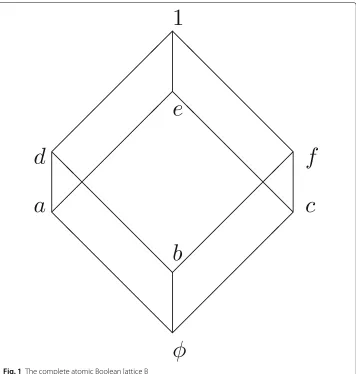
Example 1Let B= {0,a,b,c,d,e,f, 1}and let the order≤be defined as in Fig.1. The set of atoms of a complete atomic Boolean latticeB = (B,≤) is {a,b,c}. Let A =
{e1,e2,e3,}and fAbe a soft set over B defined as follows: f(e1)=a, f(e2)=b, and f(e3)=
d. So, fAis not full. Many odd situation occurs. For example,
If x=c=0, then x∨=x∧=0. Also if x=e, then x∧=a∨b=d≥e Moreover c≤x∨ or c≤x∧for any x∈B
In order to avoid these situations, we introduced in [14] the notion of full soft sets on B. Moreover the concept of soft postive, soft negative and soft boundary are meaningful in the case of full soft sets.
In the following, we show that negative element of anyx∈Bcannot be avoided.
Proposition 1Let fA be a soft set over B which is not full. Then there exists at least b∈A(B)such that b≤neg(x)=(x∧)for all x∈B.
ProofSincefAis not full, i.e.,
a∈Af(a) ≤ 1. So∃b∈A(B)s.t b ≤ f(a)∀a ∈ A. Let
x ∈ Bs.t b ≤ x. Ifb ≤ x∧, then ∃a∈A s.t b ≤ f(a) andf(a)∧x = 0 which is a contradiction. Henceb ≤ x∧. By a similar argument whenb ≤ xit can be shown that b≤x∧. Thereforeb≤1−x∧=(x∧).
Modified soft rough sets (MSR-sets) on a complete atomic Boolean lattice
Some properties of generalized soft rough model
Fig. 1The complete atomic Boolean lattice B
Definition 7LetB=(B,≤)be a complete atomic Boolean lattice and let fAbe a soft set over B. Letϕ:A(B)→℘ (A)be another map defined asϕ(b)= {a∈A:b≤f(a)}. Then the pair(A(B),ϕ)is called MSR-approximation space on B and for any element x ∈ B, lower MSR-approximation on B is defined as
x∨ϕ ={a∈A(B):a≤x,ϕ(a)=ϕ(b)∀b∈A(B)s.t b≤x}, and its upper MSR-approximation over B is defined as x∧ϕ ={a∈A(B):ϕ(a)=ϕ(b)for some b∈A(b)s.t b≤x}. If x∨ϕ =x∧ϕ, Then x is said to be MSR-element on B.
Remark 1Lower MSR-approximation of x over B can be defined as x∨ϕ ={a∈A(B): ϕ(a)=ϕ(b)∀b∈A(B)s.t b≤x}because if we letϕ(a)=ϕ(b)∀b∈A(B)s.t b≤x and a≤x, then by hypothesisϕ(a)=ϕ(a)which is impossible.
Lemma 4LetB= (B,≤)be a complete atomic Boolean lattice and let fAbe a soft set over B. Let(A(B),ϕ)be a MSR-approximation space on B. Then for all c∈A(B)and x∈B (i) c≤x∨ϕ ⇐⇒c≤x and ϕ(c)=ϕ(b)∀b∈A(B)s.t b≤x;
Proof(i) (⇒) Suppose that c ≤ x∨ϕ = {a∈A(B):a≤x,ϕ(a)= ϕ(b)∀b∈A(B)s.t b≤x}. So c ≤ x. If ϕ(c) = ϕ(b) ∀b ∈ A(B) s.t b ≤ x, then c ∧ x∨ϕ = c ∧ {a∈A(B):a≤x,ϕ(a)=ϕ(b) ∀b∈A(B)s.t b≤x}=
{a∧c:a∈A(B),c≤x,ϕ(a)=ϕ(b)∀b∈A(B)s.t b≤x}. Sinceϕ(c) = ϕ(b), then c=a, i.e.,c∧a=0. Hencec≤(x∨ϕ), a contradiction.
(⇐) Suppose that c ≤ x and ϕ(c) = ϕ(b)∀b ∈ A(B)s.t b ≤ x, then c ≤ {a∈A(B):a≤x,ϕ(a) = ϕ(b)∀b ≤ x} = x∨ϕ. Condition (ii) can be proved similarly.
Proposition 2LetB= (B,≤)be a complete atomic Boolean lattice and let fAbe a soft set over B. Let(A(B),ϕ) be a MSR-approximation space on B. Ifϕ(a) = ϕ(b)for some a,b∈A(B), then for any x∈B either a,b≤x∧ϕ or a,b≤x∧ϕ.
ProofIfa≤x∧ϕ, thenϕ(a)=ϕ(c)for somec∈A(B)s.tc≤x. Sinceϕ(a)=ϕ(b), then ϕ(b)=ϕ(c),c≤x. This implies thatb≤x∧ϕ.
Proposition 3LetB= (B,≤)be a complete atomic Boolean lattice and let fAbe a soft set over B. Let(A(B),ϕ)be a MSR-approximation space on B. Then for all x∈B
(i) x∨ϕ ≤x≤x∧ϕ (ii) 0∨ϕ =0=0∧ϕ (iii) 1∨ϕ =1=1∧ϕ
Proof(i) Assume thatb ∈ A(B), s.t b ≤ x∨ϕ, thenb ≤ x. For the other inclusion, let b∈A(B)s.tb≤x. Thenϕ(b)=ϕ(b)for someb≤x. Thusb≤x∧ϕ.
(ii) 0∨ϕ = {a∈A(B):a≤0 ,ϕ(a)=ϕ(b)∀b∈A(B)s.t b≤0} = 0. Also, 0∧ϕ =
{a∈A(B):ϕ(a)=ϕ(b) for some b ∈ A(B)s.t b ≤0} = 0. Claim (iii) can be proved similarly.
Proposition 4LetB= (B,≤)be a complete atomic Boolean lattice and let fAbe a soft set over B. Let(A(B),ϕ)be a MSR-approximation space on B. Then for all x,y∈B (i) The mappings∨ϕ :B−→B and∧ϕ :B−→B are order preserving.
(ii) The mappings∨ϕ :B−→B and∧ϕ :B−→B are mutually dual.
Proof(i) Assume thatx≤yanda≤x∨ϕ. Letb∈A(B)s.tb≤y. Sincex≤y, thenb≤x. Sincea≤x∨ϕ, thenϕ(a)=ϕ(b). Soa≤y∨ϕ and we getx∨ϕ ≤y∨ϕ. Now letb ≤x∧ϕ, that is ϕ(b)=ϕ(c)for somec∈A(B)s.tc≤x. Sincex≤y, thenϕ(b)=ϕ(c)for somec∈A(B) s.tc≤y. Thusb≤y∧ϕ. Consequently,x∧ϕ ≤y∧ϕ.
(ii) We must show thatx∧ϕ = ((x)∨ϕ) and((x)∧ϕ) = x∨ϕ. Leta ∈ A(B)s.ta≤ ((x)∨ϕ), thena≤(x)∨ϕ. So, eithera≤xorϕ(a)=ϕ(b)for someb∈A(B)s.tb≤(x) =x, that isa≤x∧ϕ. Conversely, Leta≤x∧ϕ, thenϕ(a) =ϕ(b)for someb∈ A(B)s.tb≤x. Thus a≤(x)∨ϕ, that isa≤((x)ϕ∨). Sox∧ϕ =((x)∨ϕ).
Conversely, leta ∈ A(B)s.ta ≤ x∨ϕ, thena ≤ xandϕ(a) = ϕ(b)for allb ∈ A(B)s.t b≤x. Thusa≤(x)∧ϕ, i.ea≤((x)∧ϕ). So((x)∧ϕ) =x∨ϕ.
For allS⊆B, we denoteSϕ∨= {x∨ϕ :x∈S}andS∧ϕ = {x∧ϕ :x∈S}.
Proposition 5LetB=(B,≤)be a complete atomic Boolean lattice and let fAbe a soft set over B. Let(A(B),ϕ)be a MSR-approximation space on B, then
i) For all S⊆B,∨S∧ϕ =(∨S)ϕ∧and∧Sϕ∧≥(∧S)∧ϕ. ii) For all S⊆B,∧S∨ϕ =(∧S)ϕ∨and∨Sϕ∨≤(∨S)∨ϕ.
(iii) (B∧ϕ,≤) is a complete lattice; 0 is the least element and 1 is the greatest element of (B∧
ϕ,≤).
(iv) (B∨ϕ,≤) is a complete lattice; 0 is the least element and 1 is the greatest element of(B∨ϕ,≤).
(v) The kernal∨ϕ = {(x,y) : xϕ∨ =y∨ϕ}of the map∨ϕ :B −→B is a congruence on the semi lattice(B,∧)such that the∨ϕ-class of any x has a least element.
(vi) The kernal∧ϕ = {(x,y) : x∧ϕ =y∧ϕ}of the map∧ϕ :B −→B is a congruence on the semi lattice(B,∨)such that the∧ϕ-class of any x has a greatest element.
Proof(i) LetS ⊆ B. The mapping∧ϕ:B −→ Bis order preserving, which implies that
∨Sϕ∧ ≤(∨S)ϕ∧and∧S∧ϕ ≥(∧S)ϕ∧. Letb ∈A(B)and assume thata ≤(∨S)∧ϕ. So,ϕ(a)= ϕ(b)for someb ∈ A(B)s.tb ≤ ∨S. So,ϕ(a) = ϕ(b)for someb ∈ A(B)andx ∈ Ss.t b≤x. So{a∈A(B):ϕ(a)=ϕ(b)forsome b∈A(B)s.t b≤ ∨S}
⊆ ∪x∈S{a∈A(B):ϕ(a)=ϕ(b)forsome b∈A(B)s.t b≤x}. Then
(∨S)∧ϕ ={a∈A(B):ϕ(a)=ϕ(b)for some b∈A(b)s.t b≤ ∨S}
≤(∪x∈S{a∈A(B):ϕ(a)=ϕ(b)for some b∈A(B)s.t b≤x})
=x∈S({a∈A(B):ϕ(a)=ϕ(b)for some b∈A(b)s.t b≤x}) (by Lemma1) ={x∧ϕ :x∈S} =Sϕ∧
(ii) LetS ⊆B. The mapping∨ϕ:B−→Bis order preserving, which implies that(∧S)∨ϕ ≤
∧Sϕ∨ and∨S∨ϕ ≤ (∨S)∨ϕ. Leta ∈ A(B) s.ta ≤ ∧S∨ϕ = ∧{xϕ∨:x∈S}. So, a ≤ xand ϕ(a) = ϕ(b) for all b ∈ A(B)s.t b ≤ xfor everyx ∈ S. Henceϕ(a) = ϕ(b) for all b∈A(B)s.tb≤ ∧S. In fact ifb≤ ∧S, then∃x∈Ss.tb≤x. So,ϕ(a)=ϕ(b). Therefore b≤(∧S)∨ϕ. Consequently,∧S∨ϕ ≤(∧S)∨ϕ. Assertions (iii) and (iv) follow easily from (i), (ii) and Proposition3(i). The proof of (v) and (vi) follow by (i) and (ii).
The inequalities in Proposition 5 may be proper. This can be seen in the following example.
Example 2Let B = {0,a,b,c,d,e,f, 1}and let the order≤be defined as in Fig.1. Let A= {e1,e2,e3,}and fAbe a soft set over B defined as follows:
f(e1) = 0, f(e2) = c, and f(e3) = d. Then the mapϕ of MSR-approximation space
(A(B),ϕ)on B will beϕ(a)= {e3},ϕ(b)= {e3}, andϕ(c)= {e2}.
If we take x =e and y =f . Then x∨y=1and(x∨y)∨ϕ = 1. Also, x∨ϕ =c, y∨ϕ =c and x∨ϕ ∨y∨ϕ =c. Thus(x∨y)∨ϕ>
=x
∨
ϕ ∨y∨ϕ.
Now x∧ϕ = a∨b∨c = 1, y∧ϕ = a∨b∨c = 1. So x∧ϕ ∧y∧ϕ = 1. On the other hand x∧y=e∧f =c and(x∧y)∧ϕ =0. Thus x∧ϕ ∧y∧ϕ>
=(x∧y)
∧
Proposition 6LetB= (B,≤)be a complete atomic Boolean lattice and let fn be a soft set over B. Let(A(B),ϕ)be a MSR-approximation space on B. Then,(B∨ϕ,≥)∼=(B∧ϕ,≤)
ProofWe show thatx∧ϕ−→(x)∨ϕ is the required dual order isomorphism. It is obvious thatx∧ϕ−→(x)∨ϕis onto(Bϕ∨,≥). We show thatx∧ϕ−→(x)∨ϕis order embedding. Suppose thatx∧ϕ ≤y∧ϕ . Then for alla∈A(B),a≤x∧ϕ impliesa≤yϕ∧. So, for alla∈A(B)such that ϕ(a)=ϕ(c)for somec∈A(B)s.tc≤ximpliesϕ(a)=ϕ(b)for someb∈A(B)s.tb≤y. Suppose that(y)∨ϕ≤(x)∨ϕ. So there existsa∈ A(B)such thata ≤ (y)∨ϕ anda ≤ (x)∨ϕ. Hencea≤yandϕ(a)=ϕ(b)for allb ∈A(B)s.tb≤(y) = y. Alsoa≤ (x)∨ϕ implies eithera≤xorϕ(a)=ϕ(c)for somec∈A(B)s.tc≤(x) =x, a contradiction. Hence (y)∨
ϕ ≤(x)∨ϕ. On the other hand, assume that(y)∨ϕ ≤(x)∨ϕ andx∧ϕ≤y∧ϕ. So there exists
a∈A(B)such thata≤x∧ϕ anda≤y∧ϕ. Soϕ(a)=ϕ(b)for someb ∈A(B)s.tb≤x. But ϕ(a)=ϕ(c)for allc∈A(B)s.tc≤y. Soa≤(y)∨ϕ anda≤(x)∨ϕ, a contradiction.
Proposition 7LetB= (B,≤)be a complete atomic Boolean lattice and let fAbe a soft set over B. Let(A(B),ϕ)be a MSR-approximation space on B. Then for all x∈B
i) (x∨ϕ)∨ϕ =x∨ϕ; ii) (x∧ϕ)∧ϕ =x∧ϕ. iii) (x∨ϕ)∧ϕ =x∨ϕ iv) (x∧ϕ)∨ϕ =x∧ϕ
Proofi)(x∨ϕ)∨ϕ ={a∈A(B):a≤xϕ∨,ϕ(a)=ϕ(b)∀b∈A(B)s.t b≤x∨ϕ}. By Propo-sition 3 x∨ϕ ≤ x which gives x ≤ (x∨ϕ). So if b ≤ x, then b ≤ (x∨ϕ). Therefore (x∨
ϕ)∨ϕ ={a∈A(B):a≤x∨ϕ ,ϕ(a)=ϕ(b)∀b∈A(B)s.t b≤x} =x∨ϕ.
ii)By Proposition3x∧ϕ ≤(x∧ϕ)∧ϕ. For the reverse inclusion, leta≤(x∧ϕ)∧ϕ, thenϕ(a)=ϕ(b) for someb∈A(B)s.tb≤x∧ϕ, that isϕ(b)=ϕ(c)for somec∈A(B)s.tc≤x. This implies thatϕ(a)= ϕ(c)for somec∈ A(B)s.tc≤x. Hencea≤x∧ϕ and therefore(xϕ∧)∧ϕ ≤x∧ϕ. Hence(x∧ϕ)∧ϕ =x∧ϕ.
iii)x∨ϕ ≤(x∨ϕ)∧ϕ by Proposition 3. For the converse assume thata≤(x∨ϕ)∧ϕ. Soϕ(a)=ϕ(b) for someb ∈ A(B) s.tb ≤ x∨ϕ. Henceϕ(b) = ϕ(c) for allc ∈ A(B)s.t c ≤ x. Since ϕ(a)=ϕ(b), thenϕ(a)=ϕ(c)for allc∈A(B)s.tc≤x. Sinceϕ(a)=ϕ(a), thena≤x, i.ea≤x. Soa≤xϕ∨. Hence(x∨ϕ)∧ϕ ≤x∨ϕ and we conclude that(x∨ϕ)∧ϕ =x∨ϕ.
iv)By Proposition 3 (x∧ϕ)∨ϕ ≤ x∧ϕ. Conversely, if a ≤ (x∧ϕ)∨ϕ, then either a ≤ x∧ϕ or ϕ(a) =ϕ(b)for someb∈A(B)s.tb ≤(x∧ϕ). Ifa≤x∧ϕ, then we get our required result. In later case,ϕ(a)=ϕ(b)for someb∈A(B)s.tb≤(x∧ϕ). Soϕ(b)=ϕ(z)for allz∈A(B) s.tz≤x. Thereforeϕ(a)=ϕ(z)for allz∈A(B)s.tz≤x. Also,a≤xbecause ifa≤x, thena≤x. Soϕ(a)=ϕ(a), a contradiction. Hencea≤(x)∨ϕ. That isa≤((x)∨ϕ) =x∧ϕ by Proposition4(ii).
Relations between soft rough approximations on B and current approximations
The following proposition shows a relation between soft lower approximation operators over a complete atomic Boolean lattice B and lower MSR-approximation over B.
ProofLetb∈A(B)s.tb≤x∨. Then∃a∈A s.t b≤f(a)≤x. Soa∈ ϕ(b)andb ≤x. Ifb≤x∨ϕ, thenϕ(b)=ϕ(c)forc∈A(B)s.tc≤x. Sincea∈ϕ(b)andϕ(b)=ϕ(c), then a∈ϕ(c)which implies thatc≤f(a)≤x. Hencec≤xwhich is a contradiction. Therefore x∨≤x∨ϕ.
The following example shows that the relation≤betweenx∨ϕ andx∨may be proper.
Example 3Let B = {0,a,b,c,d,e,f, 1}and let the order≤be defined as in Fig.1. Let A= {e1,e2,e3,}and fAbe a soft set over B defined as follows:
f(e1) = a, f(e2) = 0, and f(e3) = e. Then the mapϕ of MSR-approximation space
(A(B),ϕ)on B will beϕ(a)= {e1,e3},ϕ(b)=φ, andϕ(c)= {e3}.
Let x=d. Then x∨ϕ =a∨b=d and x∨=a. Thus x∨<=x∨ϕ.
In the following proposition we study a necessary and sufficient condition forx∨ϕ ≤x∨ to be hold for anyx∈B.
Proposition 9LetB=(B,≤)be a complete atomic Boolean lattice and let fAbe a soft set over B. Let(A(B),ϕ)be a MSR-approximation space on B. Then for any x∈B, x∨ϕ ≤x∨ iff for every b∈A(B)∃e∈A s.t f(e)={a∈A(B):ϕ(a)=ϕ(b)}.
Proof(⇒)Assume thatx∨ϕ ≤x∨for anyx∈ B. Letb ∈ A(B)andx = {a∈ A(B) : ϕ(a) = ϕ(b)}. Sox∨ϕ = {a ∈ A(B) : ϕ(a) = ϕ(c)for some c ∈A(B)c ≤x} ={a ∈ A(B):ϕ(a)=ϕ(b)} =x. Sinceb≤x=x∨ϕ andx∨ϕ ≤x∨, thenb≤x∨. Therefore∃e∈A s.tb ≤ f(e)andf(e) ≤ x. Also, for alla ∈ A(B)s.ta ≤ x, we haveϕ(a) = ϕ(b), thus e∈ ϕ(b)= ϕ(a). Soa ≤f(e)and thereforex ≤f(e). Consequently,f(e) =x ={a∈ A(B):ϕ(a)=ϕ(b)}.
(⇐)Letx ∈ Bandb ∈ A(B) s.tb ≤ x∨ϕ. So for everya ∈ A(B), ifϕ(a) = ϕ(b), then a≤x. Hence{a∈A(B):ϕ(a)=ϕ(b)} ≤x. By assumption,∃e∈As.tf(e)={a∈ A(B) :ϕ(a) =ϕ(b)}. Henceb ≤f(e)andf(e) ≤x. Thereforeb≤x∨and consequently, x∨ϕ ≤x∨.
Remark 2In general, there is no relation between x∧ϕ and x∧. If x=e in Example 1, then x∧=d and x∧ϕ =e≤d.
In Propositions10and11and Corollary2we show that there is a relation betweenx∧ϕ andx∧if some specific conditions hold.
Proposition 10LetB=(B,≤)be a complete atomic Boolean lattice and let fAbe a soft set over B. Let(A(B),ϕ)be a MSR-approximation space on B. Then fAis full iff x∧ϕ ≤x∧
for every x∈B.
Proof(⇒)Assume thatfAis full andx ∈B. Leta∈ A(B)s.ta≤x∧ϕ, then∃b ∈A(B) s.tb ≤ xandϕ(a) = ϕ(b). Sinceb ≤ 1 =
e∈Af(e), then∃e ∈ As.tb ≤ f(e). Hence
b≤f(e)∧xand thusf(e)∧x=0. By,b≤f(e), we havee∈ϕ(b)=ϕ(a)and therefore a≤f(e). Consequently,x∧ϕ ≤x∧.
(⇐)Suppose thatx∧ϕ ≤ x∧for everyx∈ B, we show that 1≤
thena≤a∧ϕ ≤a∧. Therefore∃e∈As.tf(e)∧a=0 and thusa≤f(e)becausea∈A(B). Consequently,fAis a full soft set over B.
Corollary 1LetB=(B,≤)be a complete atomic Boolean lattice and let fAbe a soft set over B. Let(A(B),ϕ)be a MSR-approximation space on B. Then fAis full iff x ≤ x∧ for every x∈B.
Proof(⇒)Assume thatfAis full andx ∈ B. Thenx ≤ x∧ϕ ≤ x∧ (by Propositions3
and 10).
(⇐)Assume thatx ≤x∧for everyx∈B. Letb∈ A(B), thenb ≤b∧ ≤{f(e):e∈A andf(e)∧b = 0} = {f(e):e∈A and b≤f(e)}. Therefore∃e ∈ As.tb ≤ f(e)and consequently,fAis full.
Proposition 11LetB = (B,≤) be a complete atomic Boolean lattice and let fAbe a soft set over B. Let(A(B),ϕ)be a MSR-approximation space on B. Then x∧≤x∧ϕ for every x∈B iff for every e1,e2∈A, f(e1)∧f(e2)=0whenever f(e1)=f(e2).
Proof(⇒)Assume thatx∧ ≤x∧ϕ for everyx ∈ B. Lete1,e2 ∈ A, iff(e1)∧f(e2) =0,
then∃b∈A(B)s.tb≤f(e1)∧f(e2). Sinceb≤f(e1), thenf(e1)≤{f(e):b≤f(e)} =
{f(e):b∧f(e)=0} = b∧ ≤ b∧ϕ = {a ∈ A(B) : ϕ(a) = ϕ(b)}. On the other hand we show that{a∈A(B):ϕ(a)=ϕ(b)} ≤f(e1). Letc∈A(B)s.tc≤{a∈A(B):ϕ(a)
=ϕ(b)}, thenϕ(c) = ϕ(b)and thuse1 ∈ ϕ(b) = ϕ(c). Thereforec≤ f(e1)and
conse-quently,f(e1) = {a ∈ A(B) : ϕ(a) = ϕ(b)}. Similarly, byb ≤ f(e2),f(e2) = {a ∈
A(B):ϕ(a)=ϕ(b)}and hencef(e1)=f(e2).
(⇐)Assume that for everye1,e2 ∈ A,f(e1)∧f(e2) = 0 wheneverf(e1) = f(e2). Let
x ∈ Banda ∈ A(B)s.ta ≤ x∧, then∃e1 ∈ As.ta ≤ f(e1)andf(e1)∧x = 0. So,∃
b∈A(B)s.tb≤f(e1)∧x. We show thatϕ(a)= {e2∈A:f(e2)=f(e1)}. Iff(e2)=f(e1),
thenf(e1)∧f(e2) = 0 by assumption. Thusa≤ f(e2)becausea ≤f(e1)and therefore
e2 ∈ϕ(a). Soϕ(a)⊆ {e2∈A: f(e2) =f(e1)}. On the other hand, iff(e2) =f(e1), then
a≤f(e2)and hencee2 ∈ϕ(a). Consequently,ϕ(a)= {e2∈A:f(e2)=f(e1)}. Similarly
we can show thatϕ(b)= {e2∈A:f(e2)=f(e1)}and thusϕ(a)=ϕ(b). Sinceb≤x, then
a≤x∧ϕ.
Corollary 2LetB=(B,≤)be a complete atomic Boolean lattice and let fAbe a soft set over B. Let(A(B),ϕ)be a MSR-approximation space on B. If f(e)=0for every e∈A, then fAis a partition soft set iff x∧=x∧ϕ for every x∈B.
ProofObvious.
Deviation of some properties of the previous soft rough approximations and the current approximations
LetB=(B,≤)be a complete atomic Boolean lattice and letfAbe a soft set over B. Then for allx∈B
(i) x≤x∧
(ii) 1∨ϕ =1=1∧
(iii) For allS⊆B,∧S∨=(∧S)∨.
(iv) (x∧)∧≤x∧.
(v) (x∨)∧≤x∨
(vi) In general(B∨,≥)∼=(B∧,≤)
The following counter example support our claims about the above deviations.
Example 4Let B = {0,a,b,c,d,e,f, 1}and let the order≤be defined as in Fig.1. Let A= {e1,e2,e3,}.
(1) Let fAbe a soft set over B defined as follows:
f(e1)=a, f(e2)=b, f(e3)=d and f(e4)=0. So fAis not full. Let x=f , then x∧=d≥f . So, x≤x∧. Also,1∨ϕ =d=1∧=1.
(2) Let fAbe a soft set over B defined as follows:f(e1)=a, f(e2)=f , f(e3)=e and f(e4)=
0. So fAis not keeping infumum. Let S= {f,e}, then∧S=f ∧e=c and(∧S)∨=c∨=0. Also, S∨ = {f,e}and hence∧S∨ =f ∧e =c≤ 0= (∧S)∨. Let x =a, then x∧ =e and (x∧)∧=e∧=1≤e=x∧. Also x∨=a and(x∨)∧=e≤a=x∨.
Let x = a and y = f ; then x∧ = e and y∧ = 1. Therefore x∧ ≤ y∧. On the other hand y∨=a≤f =x∨. Hence(B∨,≥)∼=(B∧,≤).
Remark 3(1)It is mentioned that in order to prove that x≤x∧and1∨=1=1∧in [14] we employed a strong condition on soft set fAover a complete atomic Boolean lattice to be full. However in proving x≤ x∧ϕ and1∨ϕ = 1 = 1∧ϕ in Proposition3no such condition is required.
(2) Also to prove that for all S⊆B,∧Sn= (∧S)∨in [14] we employed a strong condition on soft set fAover a complete atomic Boolean lattice to be keeping infimum. However in proving∧S∨ϕ =(∧S)∨ϕ in Proposition5no such condition is required.
(3) Finally to prove that(x∨)∧ = x∨,(x∧)∧ = x∧and(B∨,≥) ∼= (B∧,≤)we employed a strong condition on soft set fAover a complete atomic Boolean lattice to be a partition. However in proving(x∨ϕ)∧ϕ =xϕ∨,(x∧ϕ)∧ϕ =x∧ϕand(B∨ϕ,≥)=∼(B∧ϕ,≤)in Propositions6and 7no such condition is required.
(4) It is clear that MSR-element over a complete atomic Boolean lattice satisfies all the basic properties Järvinen,s approximations [20]. Thus, MSR-element over a complete atomic Boolean lattice provides a good combination of roughness and parametrization.
Relation between MSR sets and rough sets on a complete atomic Boolean lattice In the following, we introduce the notion of Boolean lattice information system and we show that every soft sets on a complete atomic Boolean lattice induces a Boolean lattice information system and vice versa.
information function from A(B)×A to V =
e∈AVewhere Ve = {g(b,e) :b ∈A(B),e∈
A}is the values of the attribute set e.
Definition 9A lattice information system (A(B),A,V,g) is called Boolean lattice information system if V = {0, 1}.
Definition 10LetB=(B,≤)be a complete atomic Boolean lattice and let S =fAbe a soft set over B. Then fAinduces a Boolean lattice information system Is=(A(B),A,V,gs), where gs:A(B)×A−→V = {0, 1}, For any b∈A(B)and e∈A,
gs(b,e)=
1 if b≤f(e), 0 if b≤f(e)
Definition 11LetB = (B,≤) be a complete atomic Boolean lattice and I = (A(B), A,V,g)be a Boolean lattice information system. Then SI = fAI is called a soft set over B induced by I, where fAI:A−→B and for e∈A, fI(e)= ∨{b∈A(B):g(b,e)=1}.
Proposition 12LetB = (B,≤)be a complete atomic Boolean lattice and S = fAbe a soft set over B. Let Is=(A(B),A,V,gs)be a Boolean lattice information system induced by S and SIs =fIs
A be a soft set over B induced by Is. Then f Is
A =fA. ProofBy Definition11, for anye∈A,fIs
A(e)= ∨{b∈A(B):gs(b,e)=1}. By Definition10, for anyb∈A(B)ande∈A,
gs(b,e)=
1 ifb≤f(e), 0 ifb≤f(e)
This implies thatgs(b,e)=1⇔b≤f(e). So, for anyb∈A(B)e∈A,f(e)=fIs(e).
Proposition 13Let B = (B,≤) be a complete atomic Boolean lattice and I = (A(B),A,V,g)be a Boolean lattice information system. Let SI = fAI be a soft set over B induced by I and IsI =(A(B),A,V,gsI)be a Boolean lattice information system induced by
SI. Then I=IsI.
ProofBy Definition10, for anyb∈A(B)ande∈A,
gsI(b,e)=
1 ifb≤fI(e), 0 ifb≤fI(e)
By Definition 11, for any e ∈ A, fI(e) = ∨{b ∈ A(B) : g(b,e) = 1}. Since I = (A(B),A,V,g)be a Boolean lattice information system, theng(b,e)=0 ifb≤fI(e). This implies that
g(b,e)=
1 ifb≤fI(e), 0 ifb≤fI(e)
So for any b ∈ A(B)ande ∈ A,gsI(b,e) = g(b,e). HencegsI = g and Consequently,
Definition 12LetB=(B,≤)be a complete atomic Boolean lattice and let S =fAbe a soft set over B. Let Is=(A(B),A,V,gs)be a Boolean lattice information system induced by S. Then Isinduces a mappingψs:A(B)−→B as follows; for every a,b∈A(B)
a≤ψs(b) ⇔ ∀e∈A gs(a,e)=gs(b,e)
In [14], we define a mapping induced by a soft setfA on a complete atomic Boolean lattice B as follows
Definition 13[14] LetB=(B,≤)be a complete atomic Boolean lattice and let fAbe a soft set over B. Define a mappingψf :A(B)→B by
a≤ψf(b)⇔ ∃e∈A, s.t a≤f(e)and b≤f(e)
for every a,b∈A(B). Thenψf is called the mapping induced by fAon B.
Definition 14[14] LetB=(B,≤)be a complete atomic Boolean lattice and let fAbe a soft set over B. Letψf :A(B)→B be the mapping induced by fAon B. We define a pair of soft approximation operators∇f,f :B→B as follows s
x∇f ={b∈A(B):ψf(b)≤x}, and
xf ={b∈A(B):ψf(b)∧x=0}.
The elementsx∇f andxf are called thesoft lowerand thesoft upperapproximations
of x with respect to the mappingψf induced byfArespectively. Two elements x and y are called equivalent if they have the same soft upper and lower approximations with respect to the mappingψf induced byfAon B. The resulting equivalence classes are called soft rough sets with respect to the mappingψf induced byfAon B.
Proposition 14LetB= (B,≤)be a complete atomic Boolean lattice and S = fAbe a partition soft set over B. Let Is = (A(B),A,V,gs)be a Boolean lattice information system induced by fA. Then
a≤ψs(b) ⇔a≤ψf(b)∀a,b∈A(B)
Proof(⇒)Leta,b ∈A(B)s.ta≤ψs(b). Then∀e∈A, gs(a,e)=gs(b,e). Sincea≤1 andfAbe a partition soft set, then∃e ∈ As.ta ≤ f(e). Sogs(b,e) = gs(a,e) = 1 and thereforeb≤f(e). Consequently,a≤ψf(b).
(⇐)Leta,b ∈ A(B) s.ta ≤ ψf(b). Then ∃e1 ∈ A s.ta ≤ f(e1) andb ≤ f(e1). So
gs(a,e1)=gs(b,e1). For everye2∈A− {e1}, iff(e1)=f(e2), thena≤f(e2)andb≤f(e2)
and thusgs(a,e2) = 1 = gs(b,e2). Iff(e1) =f(e2), thenf(e1)∧f(e2) = 0 becausefAis a partition. Sincea ≤ f(e1)andb ≤ f(e1), thena ≤ f(e2)andb ≤ f(e2)and therefore
gs(a,e2)=0=gs(b,e2). So,gs(a,e)=gs(b,e)∀e∈Aand consequentlya≤ψs(b). Proposition 15LetB=(B,≤)be a complete atomic Boolean lattice and let S=fAbe a soft set over B. Let(A(B),ϕ)be a MSR-approximation space on B and Is=(A(B),A,V,gs) be a Boolean lattice information system induced by S. Then
(ii) ∀x∈B, x∨ϕ =x∇s , where xs∇ ={b∈A(B):ψs(b)≤x}. (iii) ∀x∈B, x∧ϕ =xs , where xs={b∈A(B):ψs(b)∧x=0}
Proofi)(⇒)Leta,b∈A(B)s.ta≤ψs(b). Sogs(a,e)=gs(b,e)∀e∈A. Lete∈ϕ(a), so a≤f(e)and hencegs(a,e) =1. Thereforegs(b,e)=1 and thusb≤f(e). Consequently, e∈ϕ(b). Soϕ(a)⊆ϕ(b), similarly we can show thatϕ(b)⊆ϕ(a).
(⇐)Leta,b∈ A(B)s.tϕ(a) =ϕ(b). Lete∈ A, ifgs(a,e)= 1, thena≤ f(e)and hence e ∈ ϕ(a) = ϕ(b). Also,b ≤ f(e)and sogs(b,e) = 1. Ifgs(a,e) = 0, thena ≤ f(e)and hencee∈ϕ(a)= ϕ(b). Thereforeb≤ f(e)and thusgs(b,e) =0. Sogs(a,e)= gs(b,e)∀ e∈Aand consequently,a≤ψs(b).
ii) Letx∈Bandb∈A(B)s.tb≤x∨ϕ. We show thatψs(b)≤x. Leta∈A(B)s.ta≤ψs(b), thenϕ(a)= ϕ(b)by i). Butb ≤x∨ϕ implies thatϕ(b)=ϕ(c)∀c∈A(B)s.tc≤ x. Since ϕ(a)=ϕ(b), thena≤xand thereforeψs(b)≤x. This implies thatx∨ϕ ≤x∇s.
Conversely, Letb∈A(B)s.tb≤x∇s. Soψs(b)≤x. Leta∈A(B)s.ta≤x, thusa≤ψs(b). Thereforeϕ(a)=ϕ(b)by i) and sob≤x∨ϕ. Consequently,x∇s ≤x∨ϕ.
iii) Letx ∈ Bandb ∈ A(B)s.tb ≤ xϕ∧, then∃a∈ A(B)s.ta≤ xandϕ(a) = ϕ(b). So a≤ψs(b)by i) and thereforeψs(b)∧x=0. Consequently,b≤xs.
Conversely, letb∈ A(B)s.tb ≤xs , thenψs(b)∧x=0. Thus∃a∈A(B)s.ta≤xand a≤ψs(b). Thusϕ(a)=ϕ(b)by i) and thereforeb≤x∧ϕ.
In the following, we introduce the concept of Boolean lattice information system with respect to another Boolean lattice information system. We study upper and lower MSR-approximations of soft set on a complete atomic Boolean lattice with respect to another soft set.
Definition 15LetB=(B,≤)be a complete atomic Boolean lattice and let fA1be a soft set over B. Let(A(B),ϕ)be a MSR-approximation space on B whereϕ:A(B)−→P(A1)is
defined asϕ(b) = {a∈A: b≤ f(a)}. Let gA2 be another soft set over B. For any e∈ A2, lower and upper MSR approximations of gA2 over B are denoted by (gA2)∨ϕ and(gA2)∧ϕ defined as
g(e)∨ϕ ={a∈A(B):a≤g(e),ϕ(a)=ϕ(b)∀b∈A(B)s.t b≤g(e)} ∀e∈A2,
g(e)∧ϕ ={a∈A(B):ϕ(a)=ϕ(b)for some b∈A(b)s.t b≤g(e)} ∀e∈A2.
In order to understand this concept consider the following example:
Example 5Let B= {0,a,b,c,d,e,f, 1}representing 8 patients, where 0 denotes patient who drink mineral water only, a denotes patient who drink coffee, b denotes patient who drink cola, c denotes patient who drink tea, d denotes patient who drink caffeine liq-uids, e denotes patient who drink antioxidant liqliq-uids, f denotes patient who drink cold liquids and 1 denotes patient who drink all liquids. So, the order ≤can be defined as in Fig.1.
Let A1 = {e1,e2,e3,}, where e1denotes temperature, e2denotes headache and e3denotes
stomach problem and let fA1 be a soft set over B representing the diagnosis of doctor M, defined as follows:
Table 1Lattice information system of the soft setfA
e1 e2 e3
a 0 1 0
b 1 0 1
c 0 1 0
Then the map ϕ of MSR-approximation space (A(B),ϕ) will beϕ(a) = {e2}, ϕ(b) =
{e1,e3}, andϕ(c)= {e2}.
Let A2= {e1,e2,e3,e4}and gA2be another soft set over B representing the diagnosis of doc-tor N , where A2= {e1,e2,e3,e4}and e4represents cough, defined as follows:
g(e1)=d, g(e2)=b, g(e3)=c and g(e4)=e. So lower MSR-approximations of gA2over B are g(e1)∨ϕ =b, g(e2)∨ϕ =b, g(e3)∨ϕ =0and g(e4)∨ϕ =a. Also, upper MSR-approximations
of gA2over B are g(e1)∧ϕ =a∨b∨c=1, g(e2)ϕ∧=b, g(e3)∧ϕ =a∨c=e and g(e4)∧ϕ =e. So, for example the patient a will be diagnosed cough by doctor N.
Application
In this section, we introduce the concepts of modified soft rough topology based on the notion of modified soft lower and upper approximations
Proposition 16Let U be the universe,X ⊆ U B = ℘ (U)and FAbe a soft set over U. Then, the collectionτSRϕ(X)= {U,φ,Xϕ∨,Xϕ∧,yyϕ(X)= Xϕ∧−Xϕ∨}, forms a topology on U called the modified soft rough topology on U w.r.t X.
Proposition 17LetτSRϕ(X)be a modified soft rough topology on U w.r.t X. Then the collectionβSRϕ (X)= {U,X∨ϕ,Bndϕ(X)}forms a base forτSRϕ(X).
ProofObvious
Now, we will apply the concept of soft rough topology in Diabetes mellitus (DM), commonly referred to as diabetes, is a group of metabolic diseases in which there are high blood sugar levels over a prolonged period. Symptoms of high blood sugar include frequent urination, increased thirst and increased hunger. If left untreated, diabetes can cause many complications. Acute complications can include diabetic ketoacidosis, nonketotic hyperosmolar coma or death. Serious long-term complications include heart disease, stroke, chronic kidney failure, foot ulcers, and damage to the eyes.
Consider the following information table (Table2) giving data about 6 patients as a ran-dom representative. The rows of the table represent the attributes (the symptoms for Dia-betes) and the columns represent the objects (the patients). LetU= {p1,p2,p3,p4,p5,p6}
andA= {e1(Frequent Urination),e2(Increased Hunger),e3(Increased Thirst)}. LetFAbe a soft over U given by Table2and(U,ϕ)be a MSR-approximation space.
Let X = {p1,p4,p5} be the set of patients having diabetes. Then, we have
X∨ϕ = {p1,p4,p5},Xϕ∧= {p1,p4,p5}andBndϕ(X)=φ. ThereforeτSRϕ = {U,φ,{p1,p4,p5}} is a modified soft rough topology on U and its soft basisβSRϕ (X)= {U,ϕ,{p1,p4,p5}}.
If the attribute frequent urination is removed, we haveXϕ∨= {p4,p5},Xϕ∧= {p1,p3,p4,p5}
Table 2Tabular representation of the soft setFA
p1 p2 p3 p4 p5 p6
e1 1 0 0 1 1 0
e2 1 1 1 0 0 1
e3 0 1 0 1 1 1
Diabetes 1 0 0 1 1 0
modified soft rough topology on U and its soft basisβSRϕ (X)−e1= {U,{p4,p5},{p1,p3}} =
βSRϕ (X).
Again, if the attribute increased hunger is removed, we have Xϕ∨ = {p1,p4,p5},
X∧ϕ = {p1,p4,p5}andBndϕ(X)=φ. Therefore,τSRϕ(X)= {U,φ,{p1,p4,p5}}is a modified soft rough topology on U and its soft basisβSRϕ (X)−e2= {U,φ,{p1,p4,p5}} =βSRϕ (X). Finally, if the attribute Increased Thirst is removed, we have Xϕ∨ = {p1,p4,p5},
X∧ϕ = {p1,p4,p5}andBndϕ(X)=φ. ThereforeτSRϕ(X)= {U,φ,{p1,p4,p5}}is a modified
soft rough topology on U and its soft basisβSRϕ (X)−e3= {U,φ,{p1,p4,p5}} =βSRϕ (X).
Therefore,Core(SRϕ)(X)= {e1}, i.e., frequent urination is the key attribute that has close
connection to disease diabetes.
Algorithm:
Step 1: Given a finite universe U, a finite set A of attributes represent the data as an information table, rows of which are labeled by attributes (C),columns by objects and entries of the table are attribute values.
Step 2: Find the lower MSR approximation, upper MSR approximation and the soft MSR-boundary region ofX⊆U.
Step 3: Generate the soft rough topologyτSRϕ(X)on U and its soft basisβSRϕ (X).
Step 4: Remove an attribute x from conditions of attributes (C) and find the lower and upper MSR approximations and the MSR-boundary region of X onC−(x).
Step 5: Generate the soft rough topologyτSRϕ on U and its soft basisβSRϕ (X)−x.
Step 6: Repeat steps 4 and 5 for all attributes in C.
Step 7: Those attributes in C for whichβSRϕ (X)−x=βSRϕ (X)forms theCore(SRϕ)(X). Conclusion
Lattice is a very important structure in mathematics. In [14], we introduced the concept of soft sets on a complete atomic Boolean lattice B. We combine soft set and rough set by introducing the concept of soft rough set on B. Some shortcoming became the part of soft rough sets on B. In this paper, we introduced the concept of Modified soft rough sets(MSR) on a complete atomic Boolean lattice. Some important properties of MSR on B have been discussed. Similar results which require some strong conditions for their proof in soft rough sets on B can be proved in MSR sets without these conditions. Furthermore, we used the modified soft rough approximation operators to introduce the concept of modified soft rough topology and apply this concept in diabetes mellitus.
Acknowledgments Not applicable
Funding
Availability of data and materials It is not applicable in my paper.
Authors’ contributions
The author read and approved the final manuscript.
Competing interests
The author declares that there are no competing interests.
Publisher’s Note
Springer Nature remains neutral with regard to jurisdictional claims in published maps and institutional affiliations.
Received: 1 December 2018 Accepted: 12 February 2019
References
1. Zadeh, L. A.: Fuzzy sets. Inf. Control.8, 338–353 (1965)
2. Pawlak, Z.: Rough sets. Intern. J. Comput. Inf. Sci.11, 341–356 (1982)
3. Pawlak, Z.: Rough Sets: Theoretical aspects of reasoning about data. Kluwer Academic Publishers, Dordrecht (1991) 4. Molodtsov, D.: Soft set theory - first results. Comput. Math. Appl.37, 19–31 (1999)
5. Molodtsov, D.: The theory of soft set. URSS Publishers, Moscow (2004). in Russian
6. Bulendr, L., Palash, D.: Bell shaped fuzzy soft sets and their application in medical diagnosis. Fuzzy Inf. Eng.9(1), 67–91 (2017)
7. Khizar, H., Muhammad I.A., Bing, C., Xiao, Y.: A New Type-2 Soft Set: Type-2 Soft Graphs and Their Applications. Advacnes Fuzzy Syst. volune 2017 (Article ID 6162753, 17 pages)
8. Karaaslan, F.: Soft Classes and Soft Rough Classes with Applications in Decision Making. Math. Probl. Eng., 1–11 (2016).
https://doi.org/10.1155/2016/1584528
9. Yang, Y., Peng, X. D.: A revised TOPSIS method based on interval fuzzy soft set models with incomplete weight information. Fundamenta Informaticae.152, 297–321 (2017)
10. Peng, X. D., Yang, Y.: Algorithms for interval-valued fuzzy soft sets in stochastic multi-criteria decision making based on regret theory and prospect theory with combined weight. Appl. Soft Comput.54, 415–430 (2017)
11. Cagman, N., Karaaslan, F., Enginoglu, S.: Soft Lattices. J. N. Results Sci.1(1), 5–17 (2012)
12. Bera, S., Roy, S. K., Karaaslan, F.: Soft congruence relation over lattices. Hacet. J. Math. Stat.46(6), 1035–1042 (2017) 13. Karaaslan, F.: Fuzzy Soft Lattice Theory. ARPN J. Sci. Technol.3(3), 248–253 (2013)
14. Mustafa, H. I.: Soft rough approximation operators on a complete atomic Boolean lattice. Math. Probl. Eng. volume 616 2013( Article ID 486321, 11 pages)
15. Huang, Y., Li, T., Luo, C., Fujita, H., Horng, S.-J.: Matrix based dynamic updating rough fuzzy approximations for data mining. Knowl.-Based Syst.119, 273–283 (2017)
16. Hu, C., Liu, S., Huang, X.: Dynamic updating approximations in multigranulation rough sets while refining or coarsening attribute values. Knowl.-Based Syst.130, 62–73 (2017)
17. Skowron, A., Stepaniuk, J.: Tolerance approximation spaces. Fundamenta Informaticae.27, 245–253 (1996) 18. Slowinski, R., Vanderpooten, D.: Similarity relation as a basis for rough approximations(Wang, P., ed.), Vol. 4. Duke
University Press, Duke, NC (1997)
19. Liu, G., Zhu, W.: The algebraic structures of generalized rough set theory. Inf. Sci.178, 4105–4113 (2008) 20. Järvinen, J.: On the structure of rough approximations. Fundamenta Informaticae.50, 135–153 (2002) 21. Feng, F., Liu, X., Leoreanu-Fotea, V., Jun, Y. B.: Soft sets and soft rough sets. Inf. Sci.181, 1125–1137 (2011)
22. Xueling, M., Jianming, Z.: Application of rough soft sets to BL-algebras and corresponding decision making methods. J. Intell. Fuzzy Syst.34(1), 645–658 (2018)
23. Karaaslan, F.: Bipolar soft rough relations. Commun. Fac. Sci. Univ. Ank. Ser. A1: Math. Stat.65(1), 105–126 (2016) 24. Karaaslan, F., Gagman, N.: Bipolar soft rough sets and their applications in decision making. Africa Matematka.
29(5-6), 823–839 (2018)
25. Shabir, M., Irfan, M., Shaheen, T.: Another approach to soft rough sets. Knowl.-Based Syst.40, 72–80 (2013) 26. Davey, B. A.: Prestley, H.A. Cambridge University Press, Cambridge (1990)