Birmingham, West Midlands’ Young Persons’ Physical Activity Pathway Pilot
Birmingham, West Midlands
Young Persons’ Physical Activity Pathway
Pilot
Evaluation Report
University of Gloucestershire
August 2011
Acknowledgements
We are extremely grateful to the Steering Group members who worked with the evaluation team to develop an evaluation approach, the design and methods that facilitated the evaluation of the successful pilot of the Young Persons’ Physical Activity Pathway (YPPAP).
The professionalism and positive approach by those involved contributed greatly to the success of the pilot. Implementing pathways such as this is always challenging, yet it is clear that the intervention staff embraced it within a spirit of collaboration. This helped to address challenges, minimise disruption and aid collective learning. We are particularly grateful for the support and commitment shown by the project manager, Thalat Mahmood (TM) of Calthorpe School Sport Partnership (SSP), in maintaining the momentum of the pathway and in helping to avoid, and resolve, problems along the way.
Without the support of the schools involved, the piloting of the pathway would not have been possible. We are extremely grateful to all staff and schools from the Calthorpe School Sport Partnership (SSP) for their contribution and support, particularly in helping to coordinate the pathway and facilitating data collection.
We would especially like to thank Mark Roscoe, Commissioning and Development Manager for his knowledge and insight which helped to make the implementation of the pathway possible. As evaluators, we recognise the importance of working closely with commissioners and practitioners to ensure that research is as insightful as possible. We feel that this report demonstrates good practice for similar evaluations in the future and are grateful to the Heart of Birmingham Teaching Primary Care Trust and the members of the Steering Group.
To reference this report, please use the following citation:
Contents
Executive summary...4
1. Introduction and context...5
2. Evaluation aims and objectives...8
3. Evaluation design and methods...10
4. Data analysis methods and procedures...14
5. Evaluation findings...17
5.1Quantitative findings 17 5.2Qualitative findings 25 5.3Cost of project delivery 27 6. Discussion and Conclusion...28
7. Recommendations...31
References...33
Appendix A: Participant booklets...35
Appendix B: Descriptive data for PAQ-C items...52
Appendix B: Mean percentage change in physical activity scores by goal type...54
List of Tables Table 1: Data collected from participants...11
Table 2: Key potential explaining variables...19
Table 3: Nature of goals at BI1...21
Table 4: Example goals set by participants...21
Table 5: Physical activity at baseline versus follow-up...23
Table 6: Physical activity change in those who did versus did not set certain types of goal...24
Table 7: Project costs per child...27
List of Figures Figure 1: Schematic illustrating key components of the pathway...12
Figure 2: Participant progress through the pathway...17
Figure 3: Ethnic background of YPPAP participants...18
Figure 4: Composite Physical Activity Scores BI1...20
Figure 5: Number of goals set at BI1...20
Figure 6: Percentage of goals achieved in full or in part...22
Executive summary
The Birmingham, West Midlands’ Young Persons’ Physical Activity Pathway (YPPAP) is a pilot six week behavioural intervention (a physical activity pathway) aimed at increasing physical activity levels in school-aged children in school years 6 and 7 (ages 10-12 yrs). It builds on the experiences of the South Staffordshire (SS) Physical Activity Care Pathway (PACP), but was developed specifically to focus on school-age young people in an urban city setting.
For the purposes of the evaluation a mixed-methods approach including a quantitative and qualitative component was employed. Data analysis revealed that of the 239 eligible participants, 99 entered the pathway (31.2%). Ninety-three participants set physical goals at baseline and 3 were lost to follow up representing a pathway completion rate of 97% (n = 90). Overall, the results indicated that the increase in ‘spare time’ physical activity was statistically significant (t(95)=-2.88, p=.005), but the differences were not significant for overall physical activity (t(95)=-.096, p=.924), or mean frequency of physical activity (t(95)=-.414, p=.680). Analysis also revealed that the correlation between change in physical activity between baseline and follow up and the number of goals set by participants was not significant (r = 0.08, p =.436). This was potentially influenced by a number of confounding variables. Qualitative findings revealed that participants perceived that the pathway had helped to educate them about the relationship between physical activity and health and had provided a means of engaging with physical activity in a way that was fun and non-threatening. Delivery costs were also calculated taking into account management and delivery costs, including resources, training and support, the total cost per child of delivering the intervention was £143.
1.
Introduction and context
The Birmingham, West Midlands’ Young Persons’ Physical Activity Pathway (YPPAP) pilot was a six week behavioural intervention (a physical activity pathway) aimed at increasing physical activity levels in school-aged children in years 6 and 7 (10-12 yrs). The pilot was developed following the completion of the evaluation of the South Staffordshire (SS) Physical Activity Care Pathway (PACP). This pathway used Health Trainers (trained Lifestyle Advisers) to deliver an adult physical activity intervention in rural areas and those less urban than the present pilot. The focus on school age young people in an urban city setting clearly provides a very different context for the YPPAP in comparison with the SS PACP. Thus, the YPPAP is being evaluated in practice under particular ‘conditions’ that, to date, have not been the basis for a physical activity pathway.
Physical activity promotion has become a pervasive feature of UK health policy and is recommended as a principal means of securing the healthy growth and development of children (NICE, 2009). Physical activity1 provides a fundamental means of improving physical and mental health status (World Health Organisation, 2006) and plays a significant role in reducing risk factors for chronic diseases such as high blood pressure, overweight and obesity and high levels of low density lipoproteins (World Health Organisation, 2007). Current guidelines recommend that all children and young people should engage in moderate to vigorous intensity physical activity for at least 60 minutes and up to several hours every day (Department of Health, 2011). However, physical inactivity continues to present a major public health challenge in the developed world with considerable economic ramifications (Department of Health, 2004). Recent data indicates that, in Birmingham, approximately 23% of children in Year 6 are classified as obese (The Information Centre for Health and Social Care, 2010). This is higher than the average for England (18.7%) and the West Midlands region (22.4%). Problematically, evidence suggests that the increase in overweight and obesity in the UK shows little sign of abating with obesity levels set to rise so that, by 2025, approximately 14% of all young people (<20 years old) will be classified as obese (The Information Centre for Health and Social Care, 2009). As such, addressing concerns over increasing rates of obesity remains a central Government concern (HM Government, 2011).
1
In a systematic review of interventions to increase physical activity, NICE declared that brief interventions in primary care were an effective and cost effective means of increasing physical activity in the general population (NICE, 2006). Three additional approaches covered in the review included exercise referral schemes, pedometers and community based exercise programmes for walking and cycling. Consistent with this evidence, the ‘Let’s Get Moving’ PACP (Department of Health, 2009) supports behaviour change (physical activity in this context) by drawing on brief interventions, goal setting, written resources and follow-up support.
Research from outside the UK investigating the feasibility of running interventions in school settings as a means of increasing physical activity levels report mixed findings. Using elementary schools as a setting, Naylor et al. (2008) found that providing schools with the necessary training and resources to increase children’s physical activity increased the average number of steps taken by boys over a 16 month period. Whilst no overall effect was found for girls, this finding lends support to Rhodes et al. (2006) who suggest that childhood may be a critical stage for the development of physical activity behaviour and that normative and control-based interventions may be required to maximise uptake. As such, the importance of the support of parents, siblings, friends and schools on physical activity behaviour is recognised (Hohepa et al., 2007; Welk et al., 2003), but it is also important that interventions are tailored so that they reflect the settings in which they take place. For example, Joens-Matre et al. (2008) found that providing physical activity opportunities during children’s lunchtime might be an effective way of increasing physical activity levels of urban children, whilst scheduled after-school activities may be more important for children in rural areas. This underpins the importance of developing ‘culturally sensitive’ health promotion initiatives that build individual and organisational capacity to affect change in behaviour and the environment in which it takes place (Butterfoss and Kegler, 2002).
recommendations for prevention programmes in public health. It complements the Change4Life campaigns, the National Child Measurement Programme and other targeted interventions to address health inequalities, rising levels of obesity and general healthy living of young people.
2.
Evaluation aims and objectives
The evaluation team, in collaboration with the Calthorpe School Sports Partnership (SSP) based in Highgate, Birmingham, was commissioned by the Department of Health to undertake an evaluation of the pathway in schools within the SSP. From the outset, the over-arching aims of the evaluation were to:
1) evaluate the effectiveness of the pathway in terms of levels of engagement and increases in physical activity (PA) through implementing a data collection system to assess a young person’s progress through the pathway. This included an investigation of participant levels of engagement (i.e., attendance at screening, commencing intervention, level of completion) and changes in PA levels in relation to demographic data (i.e., gender, age, socioeconomic status, etc) and PA choice.
2) investigate the attitudes, opinions and experiences of the young people involved in the project (i.e. those following the pathway) with respect to the feasibility of using the school setting for increasing physical activity through such a pathway.
These over-arching aims translated into the following deliverables for the evaluation team:
D1. Investigate the feasibility, implementation and overall effectiveness of the pathway in changing physical activity levels in participants.
D2. Establish the flexibility of different modes of activity in the delivery element of the PACP and provide recommendations regarding the feasibility of different delivery mechanisms.
D3. Investigate the effectiveness of the pathway in moving individuals through the screening, intervention, delivery and completion elements of the pathway and the role that health trainers play. This includes looking at ‘drop-out’ from the pathway and either tracking activity levels or stages of behaviour change across the pathway.
D4. Quantify the cost per young participant of implementing the pathway.
A number of research questions corresponding to each deliverable were established. These were:
1. Are schools a feasible setting for such a physical activity care pathway? (including opportunities and barriers) (D1).
2. What evidence is there for physical activity behaviour change in young participants during the course of the pilot? Is the pathway effective at creating behaviour change in the short term? (D1)
3. Which physical activity services appear most popular at the service delivery stage and what are the implications of this for practice? (D2).
4. What can we learn by comparing the activity options chosen by young participants and outcomes regarding increases in levels of physical activity? (D2).
5. How does participation and adherence to physical activity and the care pathway vary with gender, class, ethnicity and disability status? (D3).
3.
Evaluation design and methods
The evaluation study design involved a mixed-methods approach, including the evaluation of process and outcomes (including costs) through quantitative and qualitative research techniques.
Ethics approval and data protection
Given the setting and target population for the pilot, the evaluation team were particularly aware of ethics considerations. Considerable time and effort was spent ensuring that the evaluation satisfied the University of Gloucestershire Ethics Committee. Ethical approval was granted by the University of Gloucestershire Ethics Committee in November 2010. Data protection was assured through the use of anonymised participant data, with electronic records held on password protected University computers and raw data stored in locked filing cabinets within a secure office.
Participant selection, recruitment and informed consent
The aim was to recruit 250 children who completed the pathway for the evaluation. This proposed sample size was estimated to meet the needs of the quantitative aspect and provides an adequate sample for the qualitative component. In consultation with the Steering Group, schools were identified and invited to take part, after which a single class in each was purposively sampled. The purpose and nature of the pathway was then explained and letters of consent were issued to the children and their parents. Those who returned the individual and parental consent were included in the pathway. For the qualitative element, group interviews were undertaken with a subsample of young participants who had completed the pathway. Selection depended on availability and was completed on the advice of the project manager (TM).
Research methods
socio-demographic data (e.g., age, gender, ethnicity, disability status, post code), and programme characteristics (e.g. PA choice, venue, goal setting).
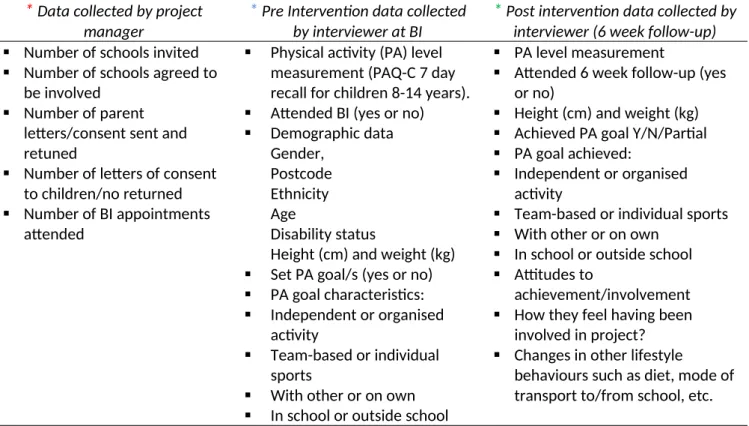
In consultation with the Steering Group a data collection protocol was developed to record participant data and track their progress through the pathway. The protocol was developed using the Physical Activity Questionnaire for Older Children (PAQ-C). The PAQ-C is a self-administered, 7-day recall questionnaire that measures general moderate to vigorous physical activity levels during the school year for school-aged children aged approximately 8 to 14 years old (Kowalski et al., 2004). The utility of the PAQ-C is that it measures general physical activity levels in comparison to the precise intensity, frequency and duration of young people’s activities, which is harder to measure, especially with self-report (Kowalski et al., 2004). Participant booklets were prepared using the protocol (see Appendix A). To ensure that the participants’ progress and data were recorded accurately, each participant was given a separate booklet that included all data highlighted in Table 1.
Table 1: Data collected from participants
*
Data collected by project manager* Pre Intervention data collected
by interviewer at BI*
Post intervention data collected by interviewer (6 week follow-up) Number of schools invited
Number of schools agreed to be involved
Number of parent letters/consent sent and retuned
Number of letters of consent to children/no returned
Number of BI appointments attended
Physical activity (PA) level measurement (PAQ-C 7 day recall for children 8-14 years).
Attended BI (yes or no)
Demographic data Gender,
Postcode Ethnicity Age
Disability status
Height (cm) and weight (kg)
Set PA goal/s (yes or no)
PA goal characteristics:
Independent or organised activity
Team-based or individual sports
With other or on own
In school or outside school
PA level measurement
Attended 6 week follow-up (yes or no)
Height (cm) and weight (kg)
Achieved PA goal Y/N/Partial
PA goal achieved:
Independent or organised activity
Team-based or individual sports
With other or on own
In school or outside school
Attitudes to
achievement/involvement
How they feel having been involved in project?
Changes in other lifestyle
behaviours such as diet, mode of transport to/from school, etc.
Note: see Figure 1 for associated data collection points signified by asterisks.
the staff in the participating schools and was not passed on to the evaluation team or other third parties.
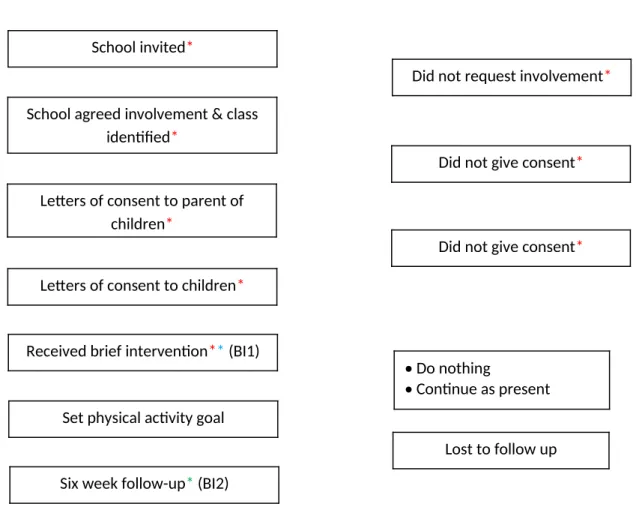
Figure 1 illustrates the key stages of the pathway. In consultation with the Steering Group, two principal data collection points were established at pre-intervention (BI1) and post-intervention (BI2), with additional data collection concerning the schools and participant demographics (see Table 1). Open questions concerning young participants’ perceptions of the pathway and physical activity were included in the booklets to add a qualitative dimension. Consistent with guidance in the PAQ-C2, it was explained to the young participants entering the pathway that the questions in the booklet were not part of a test and that it was designed to understand the actual activities that they had undertaken in the seven days prior to the behavioural interview.
Figure 1: Schematic illustrating key components of the pathway
To address Aim 2, data were collected via two group interviews (one year 6 group, n = 13, and one year 7, n = 11) to investigate the attitudes, opinions and experiences of the young people who had
2 Available at: http://toolkit.s24.net/documents/en/PAQ/PAQ_manual.pdf
School invited*
School agreed involvement & class identified*
Letters of consent to parent of children*
Letters of consent to children*
Received brief intervention** (BI1)
Set physical activity goal
Six week follow-up* (BI2)
Did not request involvement*
Lost to follow up Did not give consent*
Did not give consent*
Do nothing
engaged in and completed the pathway. The group interviews allowed the evaluation team to explore the following themes:
Participants’ experiences of the pathway
Motivations for sustaining physical activity
Exposure to new physical activity types
Advantages/positive aspects of taking part
Disadvantages/less positive aspects of taking part
Perceptions of physical activity and health
Future physical-activity-related goals
Each group was purposively sampled from two schools. The group interviews were undertaken using a semi-structured interview guide and recorded on a digital voice recorder. To comply with data protection requirements the recordings were transcribed verbatim and transferred to a password protected computer of the researcher undertaking the interview. The original sound file was deleted from the recorder and the subsequent transcripts (Word file) were stored on University-based password protected computers (in the locked office of Dr Colin Baker).
Quantitative data analysis
Upon completion of the pathway, the Project Manager (TM) collected all participant booklets from the intervention staff. A member of the evaluation team then collected these in person. All data in the booklets was then collated, cleaned and labelled using Excel before being imported into SPSS v.16 for analysis. Key stages of analysis included descriptive analysis to categorise the data for subsequent comparative analysis. The PAQ-C was referred to in order to calculate participants’ pre (BI1) and post intervention (BI2) physical activity scores as follows:
Item 1 (Spare time activity).
The mean of all activities (“no” activity being a 1, “7 times or more” being a 5) was taken to form a composite score for each participant.
Items 2 to 8 (PE, break time, lunch, right after school, evening, weekends, and ‘describes you best’).
Reported values on each of the questions (1 being the lowest activity response and 5 being highest) were recorded against each participant.
Item 9 (level of physical activity during last week: 1 being a “none”, 5 being a “very often”). The mean of all days of the week was taken to form a composite score.
Item 10 (sick or prevented from doing physical activity).
This is used to identify students who had unusual activity during the previous week, but was notused as part of the summary activity score.
Calculate the final PAQ-C activity summary score.
Once the values (1-5) for each of the 9 items (items 1 to 9) were obtained the mean of all 9 items was calculated. This represented the final PAQ-C activity summary score. A score of 1 indicated low physical activity, whereas a score of 5 indicated high physical activity. This provided the primary physical activity outcome used in analysis.
classifications were established using the UK 1990 BMI growth reference charts.3 Although there is no universally agreed BMI-based classification system for children, this tool gives age and gender-specific information. In addition, participant home postcodes were used to derive the relative level of deprivation based on the Index of Multiple Deprivation (IMD) (Communities and Local Government, 2007). Working at Lower Super Output Areas (LSOAs), the IMD Index establishes the relative level of deprivation experienced in an area across seven principal domains including:
Income Deprivation
Employment Deprivation
Health Deprivation and Disability
Education, Skills and Training
Barriers to Housing and Services
Crime
Living Environment
Qualitative data analysis
Interviews were transcribed verbatim and transcripts were downloaded into the qualitative software package NVivo 8 (QSR International Pty Ltd, 1999-2008) which was used to store and manage the data in preparation for analysis. The qualitative data analysis approach employed was inductive content analysis (Bawden and Maynard, 2001). In keeping with this approach, data were initially coded into broad themes. This was followed by the systematic process of re-viewing these broad themes, looking for connections between themes and their relevance to the research aims and objectives. Memos were attributed to each text unit specifically to indicate the meaning and researcher’s understanding of each unit and to allow for more stringent theme development and advanced analysis of participants’ perceptions. In the latter stages theme creation was achieved by reviewing the content and name of each theme and identifying subtle nuances and associations between themes.
This approach allowed the nominated researcher to unpack key themes within the data and explore them within the context in which participation took place. Although the sample is not purported to be representative, and individual responses are but one aspect of a range of evidence, these provided a rich contextual understanding of the factors experienced by young people. Consistent
with the evaluation brief, findings were synthesised where appropriate with the qualitative data recorded by the intervention staff in order to provider a richer set of findings.
This section presents findings from quantitative and qualitative analysis and the costs per child of delivering the intervention.
5.1 Quantitative findings
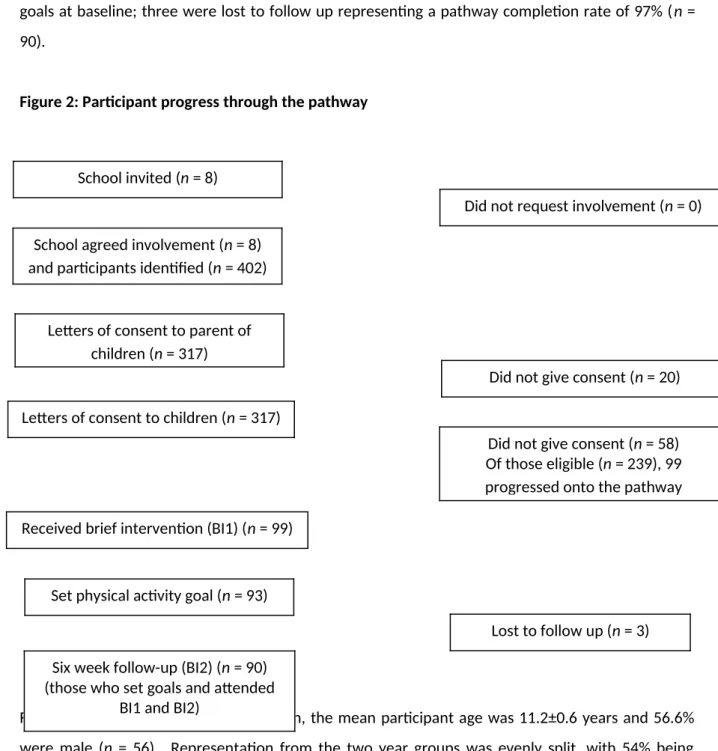
Participant progress through the pathway is shown in Figure 2. All eight schools invited to participate in the pathway indicated that they were happy to be involved. Having followed the protocol, contact was made with 78.9% (n = 317) of those that could be contacted (n = 402) (Figure 2), of which 99 participants entered the pathway (31.2%). Ninety-three participants set physical goals at baseline; three were lost to follow up representing a pathway completion rate of 97% (n = 90).
Figure 2: Participant progress through the pathway
7.
8.
9.
10.
For those receiving the brief intervention, the mean participant age was 11.2±0.6 years and 56.6% were male (n = 56). Representation from the two year groups was evenly split, with 54% being
School invited(n = 8)
School agreed involvement (n = 8) and participants identified (n = 402)
Letters of consent to parent of children (n = 317)
Letters of consent to children (n = 317)
Received brief intervention (BI1) (n = 99)
Set physical activity goal (n = 93)
Six week follow-up (BI2) (n = 90) (those who set goals and attended
BI1 and BI2)
Did not request involvement (n = 0)
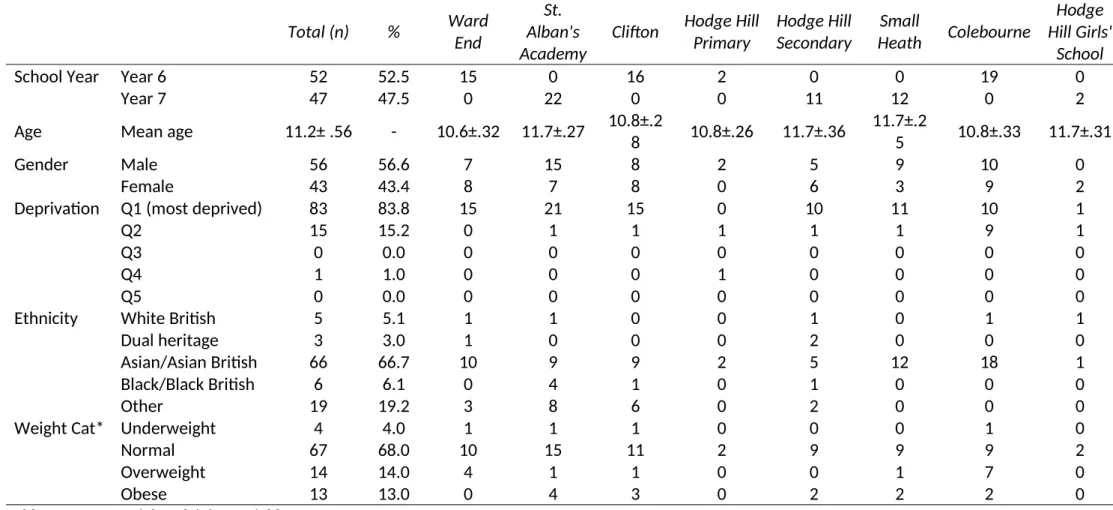
drawn from Year 6 (n = 53) and 46% (n = 48) from Year 7. Analysis of postcode data indicated that more than 80% (n = 83) resided in an area that fell within the most deprived 20% of national rankings. In contrast, no participants lived in areas within the least deprived quintile. The majority of participants were of Asian and Asian British ethnic backgrounds. A more complete description is presented in Figure 3 below. More than three-quarters (68%, n = 67) were classified with a normal weight according to the UK 1990 BMI growth reference charts.4 A full description of key potential explaining variables including school year, Index of Multiple Deprivation (IMD), Gender, Age, and Weight Category according to Body Mass Index (BMI), is provided in Table 2 overleaf.
Figure 3: Ethnic background of YPPAP participants
School
Total (n)
%
Ward
End
St.
Alban's
Academy
Clifton
Hodge Hill
Primary
Hodge Hill
Secondary
Small
Heath
Colebourne
Hodge
Hill Girls'
School
School Year
Year 6
52
52.5
15
0
16
2
0
0
19
0
Year 7
47
47.5
0
22
0
0
11
12
0
2
Age
Mean age
11.2± .56
-
10.6±.32
11.7±.27
10.8±.2
8
10.8±.26
11.7±.36
11.7±.2
5
10.8±.33
11.7±.31
Gender
Male
56
56.6
7
15
8
2
5
9
10
0
Female
43
43.4
8
7
8
0
6
3
9
2
Deprivation Q1 (most deprived)
83
83.8
15
21
15
0
10
11
10
1
Q2
15
15.2
0
1
1
1
1
1
9
1
Q3
0
0.0
0
0
0
0
0
0
0
0
Q4
1
1.0
0
0
0
1
0
0
0
0
Q5
0
0.0
0
0
0
0
0
0
0
0
Ethnicity
White British
5
5.1
1
1
0
0
1
0
1
1
Dual heritage
3
3.0
1
0
0
0
2
0
0
0
Asian/Asian British
66
66.7
10
9
9
2
5
12
18
1
Black/Black British
6
6.1
0
4
1
0
1
0
0
0
Other
19
19.2
3
8
6
0
2
0
0
0
Weight Cat* Underweight
4
4.0
1
1
1
0
0
0
1
0
Normal
67
68.0
10
15
11
2
9
9
9
2
Overweight
14
14.0
4
1
1
0
0
1
7
0
Obese
13
13.0
0
4
3
0
2
2
2
0
Table 2: Key potential explaining variables
Figure 4 provides an overview of the composite physical activity scores according to the PAQ-C at BI1. Approximately half of the participants scored 3 on a scale, where 1 indicates a low level of physical activity and 5 indicates a high level of physical activity. No participant scores exceeded 5 across the whole sample.
Figure 4: Composite Physical Activity Scores BI1
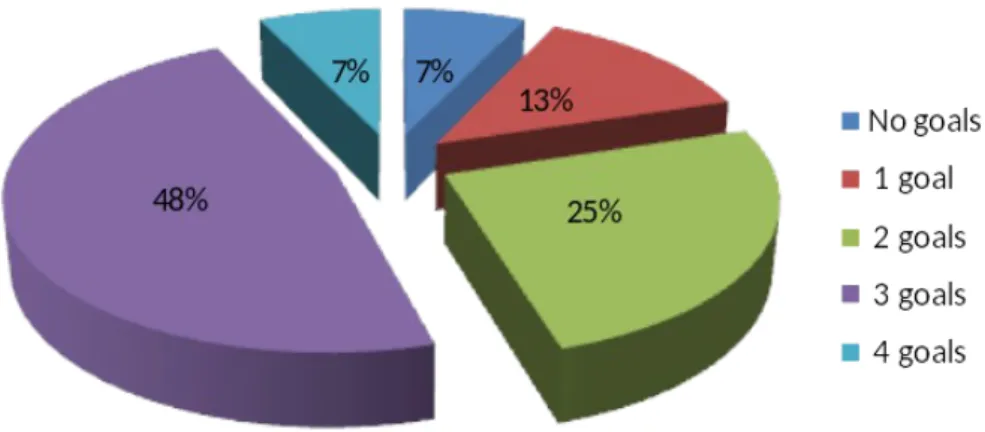
Figure 5 presents the data for the number of goals set by participants at BI1. 93 of the 99 participants who entered the pathway set goals, with nearly half of these setting 3 physical activity goals. In total, 232 physical activity goals were set during the pathway (mean = 2.5 goals per participant, excluding the 6 who did not set any goals).
Approximately half of participants (n = 47) set 3 physical activity goals. More than half of girls (51.2%, n = 22) set 3 physical activity goals in comparison to boys (44.6%, n = 25). Interestingly, all girls set at least 1 goal during the pathway, whereas 7 boys did not set any goals. For those participants who set at least one goal, the most popular choices were ‘organised’ and ‘in school’ activities. The least popular choice was ‘individual sport’ (Table 3).
Table 3: Nature of goals at BI1
*% of the 93 participants who set any goals. Participants were able to make multiple choices across the 8 responses.
Participants selected a variety of activities across each of the goal types (Table 4), including unstructured physical activity, sports club-based activities and those which required different levels of equipment and skill. These choices reflected the wide range of opportunities that were identified, and made available, by the intervention staff.
Table 4: Example goals set by participants
Physical activity-based goals Sports-based goals
Walk to school, walk to mosque Join after school athletics club
Go swimming with Dad Go to table-tennis once a week
12000 steps a day Join cricket club, Wednesdays after school
Join in break and lunch time activities Attend martial arts club in evenings
Join girls' youth club, Saturday mornings Go to Tri Golf on Thursdays
Skipping at break time - 10 minutes Join football club at school, Wednesdays
Play outside with family and friends Volleyball club before school
After school street dance club Morning table tennis, Wednesdays and Fridays Yes*
Goal type n %
Organised 75 81.5
In school 75 81.5
With others 71 77.2
Independent 67 72.8
Outside school 67 72.8
Team Sport 44 47.8
On own 43 46.7
At follow up, 70.7% (n = 70) of participants had achieved at least one goal in full and nearly 80% (n = 79) had fully or partly achieved at least one goal (see Figure 6).
Figure 6: Percentage of goals achieved in full or in part
Note: In total, 9 participants did not set goals or did not attend the follow up interview.
Table 5: Physical activity at baseline versus follow-up
Note: Sample size prevented meaningful analysis at school-level.
Baseline Follow-up
PA spare time
PA freq PA summary score
PA spare time
PA freq PA summary score
Total (all schools) Mean 1.64 3.06 3.03 1.75 3.21 3.06
SD 0.40 0.82 0.67 0.45 0.96 0.60
Ward End Mean 1.68 2.88 3.02 1.83 3.08 3.34
SD 0.44 0.80 0.77 0.37 1.00 0.70
St. Alban's Academy Mean 1.81 3.36 2.88 1.83 3.53 2.98
SD 0.50 0.81 0.70 0.66 1.16 0.64
Clifton Mean 1.61 3.02 3.29 1.88 3.37 3.16
SD 0.31 0.66 0.49 0.35 0.71 0.53
Hodge Hill Primary Mean 1.17 3.14 2.42 1.51 2.50 2.56
SD 0.12 1.41 0.38 0.11 0.10 0.00
Hodge Hill Secondary Mean 1.54 2.59 2.66 1.45 3.18 2.86
SD 0.30 0.70 0.38 0.20 0.97 0.30
Small Heath Mean 1.64 3.51 3.23 1.64 3.08 2.91
SD 0.31 0.65 0.71 0.32 0.90 0.65
Colebourne Mean 1.59 3.02 3.28 1.80 3.07 3.20
SD 0.40 0.88 0.65 0.44 0.88 0.58
Hodge Hill Girls' School Mean 1.37 1.64 2.02 1.43 2.29 2.36
Results indicated that the increase in ‘spare time’ physical activity was statistically significant (t(95) =-2.88, p=.005), but the differences were not significant for overall physical activity (t(95)=-.096, p=.924) (Mean = .0058, SD = 0.59), or mean frequency of physical activity (t(95)=-.414, p=.680). Descriptive data for the PAQ-C items relating to physical activity are available in Appendix B. Analysis also revealed that the correlation between change in physical activity and the number of goals set by participants was not significant (r = 0.08, p =.436) (Table 7).
Table 6: Physical activity change in those who did versus did not set certain types of goal
Goal type Group Statistics
N Mean SD T p
Any goals - independent No 25 -0.06 0.62 -0.98 0.329
Yes 67 0.07 0.57
Any goals - organised No 17 -0.13 0.41 -1.34 0.185
Yes 75 0.08 0.62
Any goals - team sport No 48 0.12 0.60 1.42 0.160
Yes 44 -0.05 0.57
Any goals - individual sport No 58 0.06 0.55 0.56 0.574
Yes 34 -0.01 0.65
Any goals - with others No 21 -0.13 0.55 -1.54 0.128
Yes 71 0.09 0.59
Any goals - own No 49 0.00 0.60 -0.64 0.527
Yes 43 0.08 0.58
Any goals - school No 17 -0.07 0.60 -0.83 0.408
Yes 75 0.06 0.59
Any goals - outside school No 25 -0.01 0.58 -0.45 0.655
No 67 0.05 0.59
Note: Independent samples t-tests showed that no changes were statistically significant
Figure 7: Mean change in summary physical activity score
-4 -2 0 2 4 6 8
independent organised team sport individual sport with others own school outside school
Mean % change in PA (summary score)
Did not set goal Did set goal
Note: The results should be interpreted with caution due the large standard deviations in comparison to the relatively small percentage changes in physical activity levels (see Appendix C).
5.2 Qualitative findings
The following qualitative findings represent the synthesis of key themes identified in the group interviews and data collected via the YPPAP pathway booklet.
experiences and knowledge concerning the relationship between dietary habits and their health; ‘...you could watch your weight, see what it is and keep checking it. You can see how you’re burning calories, what your using every day. I’d like to keep checking I’m eating healthy stuff and see how many calories I’m burning.’
The main constraintsto participation in physical activity were inclement weather, a lack of time and family commitments; ‘my dad was working and there was no one else to take me.’ Other general constraints identified by participants included a lack of personal motivation, not having any friends to go to physical activity sessions with, and problems with the running and administration of the sessions. At worst, the outcome of these factors was the inability to undertake physical activity. For example, some participants related that the sessions they had wanted to do had been oversubscribed, preventing them from taking part; ‘there were too many people at the club and I had to stand around too much, I didn’t like it’. Whilst it was recognised that certain constraints were insurmountable, at least in the short term, the main factors that moderated, or offset, these constraints included familial and peer support: ‘...it was more fun playing outside when friends and family were there.’
In respect of harnessing pathway potential and its attributes, learning, personal challenge, physical activity preference and a sense of funwereidentified as key drivers of participation. One particular factor articulated by participants was physical activity targets;
I ‘... you remember you had set targets, was that useful? AllYes.
I Why was that useful?
A Because like, if we did do a lot of exercise its good to have a target of when we’re going to do this and that...
I So were you thinking about your targets when you were doing exercise? AllYes.
I So you really wanted to sort of hit those targets, was that good? A Yes.
I Did you set your targets yourself? A Yes.
I And, how did that make you feel? A Good, happy!
participants to talk candidly about themselves, their concerns and personal preferences, without worrying about what their peers might think. As a consequence, the intervention staff was able to identify goals that were realistic and reflected the types of activities participants wanted to do or might like to try.
5.3 Cost of project delivery
In order to address D4, the project manager (TM) was consulted with regard to activities undertaken by the intervention staff. Overall, the overall management and administration of the project (basic hourly rate in addition to on-costs and associated travel) was just over £9,000 (Table 7). Taking into account other costs, including resources, training and support, the total cost per child of delivering the intervention was £143. In comparison with other regional findings on calculating intervention costs (see for example, University of Worcester, 2010) this would appear to be good value. However, bearing in mind that a full economic cost exercise was not possible, caution should be used when comparing with other seemingly like-for-like interventions.
Table 7: Project costs per child
FTE Children Actual Cost £
School Sports Partnership Coordinator (TM) – overall management and administration of the project.
1 day per week x 8 months
£9200 Travel costs for TM (incl. school visits & associated travel) (Included in £9200 above) YPPAP deliverers (School sports coordinators (SSCo) - 4
individuals working 1 day a week @ £150 per day x 4 months
99 x 2 appointments
each
£4300 Training & support costs - 1 x SSCo training workshop (1/2 day)
(incl. Brief Intervention trainer costs) £790
Resources for project (letters, informed consent, YPPAP booklets) (317 children received a letter to parent, letter to child, informed consent to parent, informed consent to child and a YPPAP booklet)
£35
TOTAL PROJECT COST £14125
6.
Discussion and Conclusion
This section contextualises the research findings and addresses the research questions corresponding to each deliverable identified in Section 2.
1. Are schools a feasible setting for such a physical activity care pathway (including opportunities and barriers)? (D1).
The results showed that more than 300 children were made aware of the pathway across the eight schools involved, of which 99 entered the pathway (31.2%). These children represented a range of backgrounds and personal characteristics, including those classified as overweight and obese (27%, n = 27). The high (97%) pathway completion rate, i.e., those introduced to the pathway at BI1 and who attended BI2, suggests that school-based settings are effective in sustaining participants throughout the pathway. Whilst it is not possible to determine the effect of the intervention staff directly, participants indicated that there were a range of opportunities made known to them. This highlights the importance of providing participants with up to date and relevant information so that individual preferences can be catered for. This lends support to the research of Naylor et al. (2008), who found that providing specific training and resources for schools might have a positive effect on children’s physical activity levels.
2. What evidence is there for physical activity behaviour change in young participants during the course of the pilot? Is the pathway effective at creating behaviour change in the short term? (D1).
than 3 out of 5. That obesity rates in the sample were was approximately 10% lower than that for Birmingham as a whole also lends support to the suggestion that the sample was relatively healthy by comparison. Usefully, the qualitative data suggested that the pathway led to an improvement in participant’s knowledge and awareness of health and wellbeing, the role of physical activity and the types of physical activity opportunities available to them in the community. Whilst some participants were not keen to repeat the pathway if invited again, this was not because the experience had been negative. They indicated a lack of interest in setting additional physical activity goals to complement existing participation, contentment with maintaining current habits without delimiting these to a specific set of goals.
3. Which physical activity services appear to be the most popular at the service delivery stage and what are the implications of this for current practice? (D2).
The activities chosen by the participants reflected a range of physical activity preferences including ‘organised’, ‘in school’, ‘with others’, ‘independent’, and ‘outside school’. These demonstrate that children were capable of formulating a wide range of physical activity goals. Although it is not possible to determine the level of satisfaction with the choices made available, it was apparent that by understanding and collating the precise number and type of opportunities within the local areas, participants could select a realistic set of goals that reflected local circumstances. Following Joens-Matre et al. (2008), who report that children’s physical activity may vary at a local level, the pathway provides an example of good practice in which participants’ preferences appeared to be well-aligned with local opportunities.
4. What can we learn by comparing the physical activity options chosen by young participants and outcomes regarding increases in levels of physical activity? (D2).
5. How does participation and adherence to physical activity and the care pathway itself vary with gender, class, ethnicity and disability status? (D3).
The pathway attracted a range of participants which demonstrated its potential in securing the interest and motivation of participants. Unfortunately, the sample size was not sufficient for direct comparisons between gender, class, ethnicity, disability status and adherence to the pathway or physical activity behaviour. Existing research using the PAQ-C reports differences between genders for physical activity levels after the completion of school-based interventions (Naylor et al., 2008). Running interventions that allow differences in physical activity participation and differences in adherence to pathways themselves may provide an important means of better understanding the effects of potential explaining variables on participation.
6. How much does the pathway cost to implement (in terms of money, people, time, etc) (D4).
7.
Recommendations
As a result of the discussion and conclusions above, which are in turn based on the synthesis of considerable empirical evidence, we make the following recommendations:
Recommendation 1: The school setting could be used as a suitable place to attract and recruit children from wide ranging demographic profiles within a community for a physical activity intervention. Schools involved in programmes such as Healthy Schools could provide suitable settings should interventions of this type be replicated.
Recommendation 2: Through aligning with other available data, such as the child weight management programme data, the school setting can provide an opportunity for targeting and monitoring children in need of intervention (e.g., physical activity interventions aimed at overweight and obese children, and those identified as inactive) within a class-level or whole-school approach via the use of a screening tool).
Recommendation 3: In terms of the content of brief interventions with children, the initial pathway session needs to concentrate on setting an achievable number of goals, perhaps 1 or 2, within the intervention period to ensure these are sufficiently considered genuine goals, rather than a child’s physical activity ‘wish list’.
Recommendation 4: The success of the pathway in terms of recruitment and ease of data management was achieved through integration into the network of school sports coordinators and partnership managers. Whilst these positions are currently changing in their nature and prevalence, future pathways should attempt to integrate into the existing systems to ensure the smooth and efficient running of recruitment and delivery, and to ensure opportunities available for physical activity after progression through the pathway. Current reforms in the management and commissioning of public health in the community, for example the emergence of Health and Well-being Boards, could benefit from ensuring that the integration between relevant bodies in education, and deliverers of physical activity, is maintained and supported.
that intervention periods are designed so that they run concurrent with school terms to reflect the changing nature of available physical activity opportunities and the level of support available to increase the likelihood for children to meet their goals.
References
BUTTERFOSS, F.D. & KEGLER, M.C. (2002). Towards a comprehensive understanding of community coalitions moving from practice to theory. In: DICLEMENTE, R.J., CROSBY, R.A., & KEGLER, M.C. (eds). Emerging theories in health promotion practice and research strategies for improving public health (pp. 159-193). San Francisco (CA): Jossey-Bass.
COMMUNITIES AND LOCAL GOVERNMENT (2007).The English Indices of Deprivation 2007. London: Department for Communities and Local Government.
DEPARTMENT OF HEALTH (2004). Choosing Health: Making Healthier Choices Easier. London: The Stationary Office.
DEPARTMENT OF HEALTH (2009). Let’s Get Moving - A new physical activity care pathway for the NHS: Commissioning guidance [online] Available at: http://www.dh.gov.uk/en/Publicationsandstatistics/Publications/PublicationsPolicyAndGuidance/ DH_105945 [accessed 11th December, 2010].
DEPARTMENT OF HEALTH (2009).Be Active, Be Healthy a plan for getting the nation moving [online] Available at: http://www.dh.gov.uk/prod_consum_dh/groups/dh_digitalassets/documents/ digitalasset/dh_094359.pdf [accessed 8th June, 2011].
DEPARTMENT OF HEALTH (2010). Healthy Lives, Healthy People Our Strategy for Public Health in
England [online] Available at:
http://www.dh.gov.uk/prod_consum_dh/groups/dh_digitalassets/documents/digitalasset/ dh_127424.pdf [accessed 8th June, 2011].
DEPARTMENT OF HEALTH (2011).Start Active, Stay Active. London: Stationary Office.
HM GOVERNMENT (2011). Healthy Lives, Healthy People Update and Way Forward. London: Stationary Office.
HOHEPA, M., SCRAGG, R., SCHOFIELD, G., KOLT, G.S. & SCHAAF, D. (2007). Social support for youth physical activity: Importance of siblings, parents, friends and school support across a segmented school day. International Journal of Behavioral Nutrition and Physical Activity, 4, 54 [online]. Available at: http://www.ncbi.nlm.nih.gov/pmc/articles/PMC2186357/ [accessed 3rd May, 2011].
JOENS-MATRE, R.R., WELK, G.J., CALABRO, M.A., RUSSELL, D.W NICKLAY, E. & HENSLEY, L.D. (2008). Rural–Urban Differences in Physical Activity, Physical Fitness, and Overweight Prevalence of Children. The Journal of Rural Health, 24(1), 49-54.
KOWALSKI, K.C., CROCKER, P.R.E. & DONEN, R.M. (2004). The Physical Activity Questionnaire for Older Children (PAQ-C) and Adolescents (PAQ-A) Manual. Saskatoon: University of Sasketchewan.
MARMOT REVIEW (2010). Fair Society, Healthy Lives: Strategic Review of Health Inequalities in England Post-2010.[online] Available at:
NATIONAL INSTITUTE FOR CLINICAL EXCELLENCE (2009). Promoting Physical Activity, Active Play and Sport for Pre-School and School-Aged Children and Young People in Family, Pre-School, School and Community Settings. London: National Institute for Clinical Excellence.
NATIONAL INSTITUTE FOR CLINICAL EXCELLENCE (2006). Four Commonly Used Methods to Increase Physical Activity: Brief Interventions in Primary Care, Exercise Referral Schemes, Pedometers and Community-Based Exercise Programmes for Walking and Cycling. London: National Institute for Clinical Excellence.
NAYLOR, P-J., MACDONALD, H.M., WARBURTON, D.E.R., REED, K.E. & MCKAY, H.A. (2008). An active school model to promote physical activity in elementary schools: Action schools! BC. British Journal of Sports Medicine, 42, 338-343.
RHODES, R.E., MACDONALD, H.M. & MCKAY, H.A. (2006). Predicting physical activity intention and behaviour among children in a longitudinal sample. Social Science and Medicine, 62(12), 3146-3156.
THE INFORMATION CENTRE FOR HEALTH AND SOCIAL CARE (2009). Statistics on obesity, physical activity and diet: England, February 2009 [online]. Available at: http://www.ic.nhs.uk/pubs/opad09 [accessed 2nd December, 2009].
THE INFORMATION CENTRE FOR HEALTH AND SOCIAL CARE (2010). National Child Measurement Programme: England, 2009/10 school year [online]. Available at: http://www.ic.nhs.uk/statistics-
and-data-collections/health-and-lifestyles/obesity/national-child-measurement-programme-england-2009-10-school-year.
UNIVERSITY OF WORCESTER (2010). Executive Summary. Univeristy of Worcester [online]. Available at: http://www.obesitywm.org.uk/resources/CWM_-_Worceste_Report_-_Executive_Summary.pdf [accessed 18th August, 2011].
WELK, G.J., WOOD, K. & MORSS, G. (2003). Parental Influences on physical activity in children: an exploration of potential mechanisms. Pediatric Exercise Science, 15, 19-33.
Appendix A: Participant booklets
Young People Physical Activity Pathway Project
Calthorpe Schools Sports Partnership.
PLEASE CHECK YOU HAVE THE FOLLOWING BEFORE YOU COMMENCE YOUR INTERVIEW
PLEASE TICK
Parental Consent
Child Consent
Child’s Unique ID Number
Child’s Height
Child’s Weight
Details of the child
Ethnicity of the child
Young People Physical Activity Pathway Project
Calthorpe Schools Sports Partnership.
ETHNICITY (please tick the appropriate box)
White English Scottish Welsh Irish Other
Dual Heritage White & Black Caribbean White & Black African White & Asian Other Asian or Asian British Indian Pakistani Bangladeshi Other
DETAILS OF THE CHILD
Gender : Male or Female ( please circle)
D.O.B: ___/____/___
Post Code:________________________
Height: ___________________ Weight ______________________ Name of School: ______________________
School Year: ______________________ Is the child registered disabled? : YES or NO Is the child registered as SEN? YES or NO Is the child registered as EAL? YES or NO
Child’s Unique ID Number:
Interviewer: ______________________ Consent from parent received: Yes or No Consent from child received: Yes or No
Please do not attach this form keep them filed securely should they be required. Date of planned Brief Intervention ( BI) One: ______________________
Venue for Brief Intervention: ______________________ Brief Intervention One attended: Yes or No
If NO, please give reason ( if any): ______________________
PART TWO: PHYISCAL ACTIVITY QUESTIONAIRE ( PAQ- C UK VERSION)
We are trying to find out about your level of physical activity from the last 7 days (in the last week). These includes sports or dance that make you sweat or make your legs feel tired, or games that make you breathe hard like tag, skipping, running, climbing and others.
Remember:
There are no right or wrong answers – this is not a test
Please answer all the questions as honestly and accurately as you can – this is very important
1. Physical activity in your spare time:
Have you done any of the following activities in the past 7 days (last week)? If yes, how many times? (Tick one per row only)
0 1-2 3-4 5-6 7 or more
Skipping ○ ○ ○ ○ ○
Rowing/ canoeing ○ ○ ○ ○ ○
Roller skating/ roller blading ○ ○ ○ ○ ○
Tag ○ ○ ○ ○ ○
Walking for exercise ○ ○ ○ ○ ○
Bicycling ○ ○ ○ ○ ○
Jogging or running ○ ○ ○ ○ ○
Group exercise ○ ○ ○ ○ ○
Swimming ○ ○ ○ ○ ○
Cricket ○ ○ ○ ○ ○
Dance ○ ○ ○ ○ ○
Football ○ ○ ○ ○ ○
Badminton ○ ○ ○ ○ ○
Rugby ○ ○ ○ ○ ○
Hockey ○ ○ ○ ○ ○
Volleyball ○ ○ ○ ○ ○
Basketball ○ ○ ○ ○ ○
Ice skating ○ ○ ○ ○ ○
Snow/ dry slope skiing ○ ○ ○ ○ ○
Ice hockey ○ ○ ○ ○ ○
Other (please specify) ○ ○ ○ ○ ○
Other (please specify) ○ ○ ○ ○ ○
2. In the last 7 days, during your physical education (PE) classes, how often were you very active (playing hard, running, jumping, throwing)? (Tick one only).
I don’t do PE ○
Hardly ever ○
Sometimes ○
Quite often ○
Always ○
3. In the last 7 days,what did you do most of the time at break? (Tick one only).
Sat down (talking, reading, doing schoolwork) ○
Stood around or walked around ○
Ran or played a little bit ○
Ran around and played quite a bit ○
Ran around and played hard most of the time ○
Sat down ( talking, reading, doing schoolwork) ○
Stood around or walked around ○
Ran or played a little bit ○
Ran around and played quite a bit ○
Ran around and played hard most of the time ○
5. In the last 7 days, on how many days right after school, did you do sports, dance or play games in which you were very active? (Tick one only)
None ○
1 time last week ○
2 or 3 times last week ○
4 times last week ○
5 times last week ○
6. In the last 7 days, on how many evenings did you do sports, dance or play games in which you were very active? ( Tick one only).
None ○
1 time last week ○
2 or 3 times last week ○
4 or 5 times last week ○
6 or 7 times last week ○
7. On the last weekend, how many times did you do sports, dance or play games in which you were very active? (Tick one only).
None ○
1 time ○
2 - 3 times ○
4 - 5 times ○
8. Which of the following describes you best for the last 7-days? Read all five statements before deciding on the one answer that describes you.
A. All or most of my free time was spent doing things that involve little physical effort ○
B. I sometimes (1-2 times last week) did physical things in my free time (e.g. played sports, went running, swimming, bike riding, did aerobics)
○
C. I often (3-4 times last week) did physical things in my free time ○
D. I quite often (5-6 times last week) did physical things in my free time ○ E. I very often (7 or more times last week) did physical things in my free time ○
9. Mark how often you did physical activity (like playing sports, games, doing dance, or any other physical activity) for each day last week (please tick one response for each day).
None Little bit Medium Often Very often
Monday ○ ○ ○ ○ ○
Tuesday ○ ○ ○ ○ ○
Wednesday ○ ○ ○ ○ ○
Thursday ○ ○ ○ ○ ○
Friday ○ ○ ○ ○ ○
Saturday ○ ○ ○ ○ ○
Sunday ○ ○ ○ ○ ○
10. Were you sick last week, or did anything prevent you from doing your normal physical activities? (Tick one).
Yes ○
No ○
……… ……… ………..
Part 3: Brief Intervention
1: Does the child want to make a physical activity goal? Yes or No
If NO please give reason why:
If yes, please detail each goal made and then tick the category(s) it resides in, like the example given in the first row.
Please detail each PA goal which should include activity:
Frequency Independent Organised Team sport
Individual sports
With others
On own
In school
Outside school
EXAMPLE:
To cycle to school
EXAMPLE:
2 x per week
1.
2.
3.
SECTION TWO: BRIEF INTERVENTION TWO
Brief Intervention 2
If YES - Date Arranged: ________________________
Time of Interview:________________________
Venue of Interview ___________________ If NO please ask then for their reason/
s_____________________________________________________________________
PART ONE: GENERAL INFORMATION
Child’s Unique Number:
Date of Planned Brief Intervention ( BI ) TWO: ________________________
Venue of BI ________________________
Brief Intervention TWO attended? YES or NO. If NO, please state reason given (if any): _______________________
PART TWO: PHYISCAL ACTIVITY QUESTIONAIRE (PAQ- C UK VERSION)
We are trying to find out about your level of physical activity from the last 7 days (in the last week). These include sports or dance that make you sweat
or make your legs feel tired, or games that make you breathe hard like tag, skipping, running, climbing and others.
Remember:
There are no right or wrong answers – this is not a test
Please answer all the questions as honestly and accurately as you can – this is very important
1. Physical activity in your spare time:
Have you done any of the following activities in the past 7 days (last week)? If yes, how many times? ( Tick one per row only.)
0 1-2 3-4 5-6 7 or
more
Skipping ○ ○ ○ ○ ○
Rowing/ canoeing ○ ○ ○ ○ ○
Roller skating/ roller blading ○ ○ ○ ○ ○
Tag ○ ○ ○ ○ ○
Walking for exercise ○ ○ ○ ○ ○
Bicycling ○ ○ ○ ○ ○
Jogging or running ○ ○ ○ ○ ○
Group exercise ○ ○ ○ ○ ○
Swimming ○ ○ ○ ○ ○
Dance ○ ○ ○ ○ ○
Football ○ ○ ○ ○ ○
Badminton ○ ○ ○ ○ ○
Skateboarding ○ ○ ○ ○ ○
Rugby ○ ○ ○ ○ ○
Hockey ○ ○ ○ ○ ○
Volleyball ○ ○ ○ ○ ○
Basketball ○ ○ ○ ○ ○
Ice skating ○ ○ ○ ○ ○
Snow/ dry slope skiing ○ ○ ○ ○ ○
Ice hockey ○ ○ ○ ○ ○
Other (please specify) ○ ○ ○ ○ ○
Other (please specify) ○ ○ ○ ○ ○
2. In the last 7 days, during your physical education (PE) classes, how often were you very active (playing hard, running, jumping, throwing)? (Tick one only).
I don’t do PE ○
Hardly ever ○
Sometimes ○
Quite often ○
Always ○
3. In the last 7 days,what did you do most of the time at break? (Tick one only)
Sat down ( talking, reading, doing schoolwork) ○
Stood around or walked around ○
Ran around and played quite a bit ○
Ran around and played hard most of the time ○
4. In the last 7 days, what did you normally do at lunch (besides eating lunch)? (Tick one only) Sat down ( talking, reading, doing schoolwork) ○
Stood around or walked around ○
Ran or played a little bit ○
Ran around and played quite a bit ○
Ran around and played hard most of the time ○
5. In the last 7 days, on how many days right after school, did you do sports, dance or play games in which you were very active? (Tick one only)
None ○
1 time last week ○
2 or 3 times last week ○
4 times last week ○
5 times last week
6. In the last 7 days, on how many evenings did you do sports, dance or play games in which you were very active? ( Tick one only).
None ○
1 time last week ○
2 or 3 times last week ○
4 or 5 times last week ○
6 or 7 times last week ○
7. On the last weekend, how many times did you do sports, dance or play games in which you were very active? (Tick one only).
None ○
2 - 3 times ○
4 - 5 times ○
6 or more times ○
8. Which of the following describes you best for the last 7-days? Read all five statements before deciding on the one answer that describes you.
A All or most of my free time was spent doing things that involve little physical effort ○
B I sometimes (1-2 times last week) did physical things in my free time (e.g. played sports, went running, swimming, bike riding, did aerobics) ○
C I often (3-4 times last week) did physical things in my free time ○
D I quite often (5-6 times last week) did physical things in my free time ○
E I very often (7 or more times last week) did physical things in my free time ○
9. Mark how often you did physical activity (like playing sports, games, doing dance, or any other physical activity) for each day last week (Please tick one for each day).
None Little bit Medium Often Very often
Monday ○ ○ ○ ○ ○
Tuesday ○ ○ ○ ○ ○
Wednesday ○ ○ ○ ○ ○
Thursday ○ ○ ○ ○ ○
Friday ○ ○ ○ ○ ○
Saturday ○ ○ ○ ○ ○
Sunday ○ ○ ○ ○ ○
10. Were you sick last week, or did anything prevent you from doing your normal physical activities? (Tick one).
Yes ○
If yes, what prevented you?
Part 3: BRIEF INTERVENTION
1. Refer back to the PA goals made in section 3 on page 5. In the table below remind the child of their goals and discuss each one and detail if they were met 1. In full / partially / or not at all. Please explain that it isn’t important if they didn’t and to tell the actual answer.
Please detail each goal made from the previous table and then tick the achievement category it resides in, either Achieved, Partially achieved or not achieved. The example given in the first row has a response in each to demonstrate the detail required, in your responses there will only be one achievement category completed.
Previous PA goal: Frequency Achieved Partially achieved Not at all
EXAMPLE:
To cycle to school
EXAMPLE
2x per week
EXAMPLE:
Cycle to school on wed and Fri with brother
EXAMPLE:
Cycle on Mondays only
EXAMPLE:
Unable to due to bike theft.
1.
2.
3.
2: What were the reasons that have helped you achieve or prevented you from achieving your goals?
3 What are the child’s opinions of the project? Please detail:
__________________________________________________________________________________________________________________________ __________________________________________________________________________________________________________________________ _________________________________________________________________________________________________________________
4. Have they made any changes to their lifestyle whilst taking part in the project i.e. changes to transport to and from school, diet, etc: If YES, what? Please