
R E S E A R C H
Open Access
An audio watermark-based speech bandwidth
extension method
Zhe Chen, Chengyong Zhao, Guosheng Geng and Fuliang Yin
*Abstract
A novel speech bandwidth extension method based on audio watermark is presented in this paper. The time-domain and frequency-domain envelope parameters are extracted from the high-frequency components of speech signal, and then these parameters are embedded in the corresponding narrowband speech bit stream by the modified least significant bit watermark method which uses perception property. At the decoder, the wideband speech is
reproduced with the reconstruction of high-frequency components based on the parameters extracted from bit stream of the narrowband speech. The proposed method can decrease poor auditory effect caused by large local distortion. The simulation results show that the synthesized wideband speech has low spectral distortion and its speech perception quality is greatly improved.
1 Introduction
The narrowband speech with 8 KHz sampling frequency is widely used in many communication systems [1]. This kind of speech sounds unnatural due to the missing of high-frequency components; therefore, it can not meet the demands for high-quality perception, such as tele-phone/video conference systems. With the increasing of communication network bandwidth, wideband speech transmission is strongly desired, but large-scale update of narrow communication infrastructures is difficult and expensive. For the existing communication network, such as public switched telephone network (PSTN) and global system for mobile communication (GSM), speech band-width extension (BWE) technique is an effective and realistic choice to obtain wideband speech quality.
Speech BWE methods are mainly divided into two classes. One is based on correlation between narrow-band speech components and widenarrow-band ones; the other is based on information hiding technique. Most of the former methods produce wideband speech by linear pre-diction (LP) model [2], i.e., excitation signal and linear prediction coefficients (stand for spectral envelope). Nagel et al. proposed high-frequency (HF) information genera-tion method based on signal sideband modulagenera-tion [3], i.e., low-frequency (LF) band signal is first modulated, then
*Correspondence: [email protected]
School of Information and Communication Engineering, Dalian University of Technology, Dalian 116023, China
extended into HF part, and, finally, filled the gap between LF and HF with noise and shaped the frequency-domain envelope. Fuchs and Lefebvre proposed a harmonic BWE method [4]. This method generated HF components by parallel phase vocoder and removed noise in the intersec-tion part of spectrums. Pulakka et al. proposed a speech BWE method using Gaussian mixture model based esti-mation of the high band Mel spectrum [5]. Pulakka and Alku proposed a BWE method of telephone speech using neural network and filter bank implementation for high-band Mel spectrum [6]. Pham et al. used back-forward filter to generate excitation signal [7], which makes per-ception quality of synthesized wideband speech improve greatly. Bauer and Fingscheidt used pre-trained neural network to generate HF speech components and synthe-sized wideband speech by spline interpolation method [8]. Naofumi proposed a hidden Markov model (HMM)-based BWE methods [9]. This method can enhance the speech quality without increasing the amount of transmis-sion data. These methods, based on correlation between narrowband speech components and wideband ones, have low enough computational complexity, but noises are eas-ily introduced into the frequency band between LF and HF [10].
The speech BWE methods based on information hid-ing technique usually embed HF components information into the bit stream of narrowband speech, and then, the wideband speech is recovered based on the HF infor-mation at the receiver. Chen and Leung proposed a
speech BWE method based on least significant bits (LSB) audio watermark [11], which can embed more HF speech components information but is susceptible to noise and channel interference. Geiser and Vary proposed a speech BWE method based on data hiding technique [12]. They embedded linear prediction coefficients of HF compo-nents into the encoded narrowband speech then recov-ered the data in the decoder and synthesized wideband speech. But when suffering from the channel interference, this method has poor synthesized wideband speech. Este-ban and Galand proposed a speech BWE method based on the GSM EFR codec [13], which embed the sideband information into the narrowband speech stream by water-mark. This method can synthesize wideband speech with less noise.
In this paper, a new BWE method based on the modified LSB watermark technique is proposed. This method first extracts the necessary HF components parameters, including time-domain envelopes, frequency-domain envelopes, and energy of the wideband speech; then these parameters are compressed and embedded into the narrowband speech bit stream with a modified watermark technique. In decoder, the reverse procedure is applied to extract the HF parameters; then these param-eters are used to synthesize HF components; finally, the wideband speeches are recovered from the LF and HF speech components.
2 Speech BWE method based on audio watermark
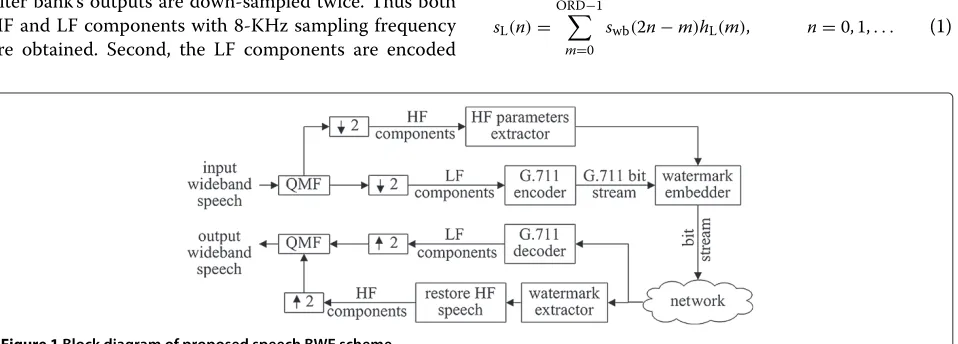
The block diagram of the proposed BWE method is shown in Figure 1, including quadrature mirror filter (QMF) based analysis filter bank, down-sampler, HF parame-ters extractor, G.711 encoder, watermark embedder at transmitting terminal, G.711 decoder, watermark extrac-tor, HF speech restorer, up-sampler, and QMF synthesis filter bank. At the receiving terminal, from Figure 1, first, input wideband speech with 16-KHz sampling fre-quency is put into two-channel QMF bank [14], and filter bank’s outputs are down-sampled twice. Thus both HF and LF components with 8-KHz sampling frequency are obtained. Second, the LF components are encoded
by the G.711 encoder. The HF parameters are estimated from the HF components by HF parameters extractor. Third, HF parameters are compressed and embedded into G.711 bit stream by modified watermark method, and the bit stream-embedded HF parameters are transmitted to the receiver through a narrowband communication net-work. At the receiving terminal, narrowband speech is decoded with G.711 decoder, while the HF parameters are extracted from the received bit stream, and then the HF speech is recovered with HF parameters. After recover-ing both LF and HF speech components, their samplrecover-ing frequency is doubled, and the wideband speech is finally synthesized through two-channel QMF filter-based syn-thesis bank. Every module in Figure 1 will be discussed in detail in the following subsections.
2.1 Down-sampling processing of speech signal
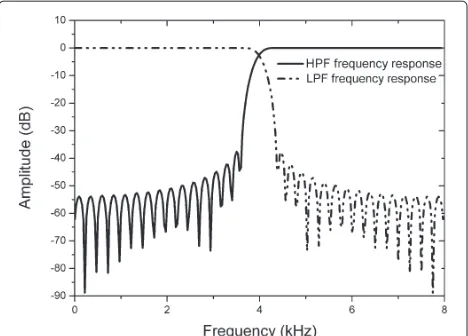
Here the analysis filter bank used in Recommendation G.729.1 is adopted [14]. There are two filters in the fil-ter bank, i.e., low-pass filfil-ter (LPF) and high-pass filfil-ter (HPF). Their unit impulse responses arehL(n)andhH(n) respectively. LPF’s technical specifications can be sum-marized as (a) sampling frequency, 16 KHz; (b) passband cutoff frequency, 3.7 KHz; (c) stopband cutoff frequency, 4.5 KHz; (d) maximum passband ripple, 0.015 dB; and (e) the minimum stopband attenuation, 39 dB. According to QMF filter bank theory, the unit impulse responses of HPF ishH(n) = hL(n)ejnπ = (−1)nhL(n). The frequency responses of LPF and HPF are dot-solid line and solid line in Figure 2, respectively.
The QMF analysis filter bank divides the wideband speech into two parts: 0 to 4 KHz LF components and 4 to 8 KHz HF components. To remove redundant infor-mation, the sampling frequency of both LF and HP com-ponents is reduced to 8 KHz by down-sampler. Thus, the LF componentssL(n)and HF componentssH(n) can be expressed as
sL(n)= ORD−1
m=0
swb(2n−m)hL(m), n=0, 1,. . . (1)
Figure 2Amplitude-frequency responses of LPF and HPF.
sH(n)= ORD−1
m=0
swb(2n−m)hH(m), n=0, 1,. . .,
(2)
where the filter order ORD is equal to 64, andswbis the input wideband speech signal.
2.2 High-frequency parameters extraction
The parameters of HF components include the time-domain and frequency-time-domain envelopes and their aver-ages. First, a HF speech frame, including 160 samples, is divided into 16 segments, i.e., each segment has 10 sam-ples. The time-domain envelope of theith segmentT(i) can be calculated as [14]
T(i)= 1 2log2[
9
n=0
s2H(n+10i)] , i=0, 1,. . ., 15.
(3)
The averageMTofT(i) can be obtained [14]
MT= 1 16
15
i=0
T(i). (4)
To removeMT from T(i) [15], the time-domain enve-lopeTM(i)is
TM(i)=T(i)−MT, i=0, 1,. . ., 15. (5)
By applying semi-Hamming window to a HF speech components and then attaching zero samples until the total samples number reaches 256 [14], we have
SwH(n)=w(n)SH(n), n=0, . . ., 159 SwH(n)=0, n=160, . . ., 255,
(6)
where semi-Hamming windoww(n)is
w(n)=
0.5−0.5 cos(2πn/96), n=0,. . ., 47
1, n=48,. . ., 159.
(7)
After fast Fourier transform (FFT), we have
SH(k)=FFT[swH(n)]
=
L−1
n=0
swH(n)e−j2Lπkn, k=0, 1,. . .,L−1, (8)
whereL=256.
The frequency band of HF speech is uniformly divided into 12 intervals. In order to reduce the range of param-eters and take the difference of the contribution of each point in the interval into account, the 12 frequency bands information are converted to weighted energy in sub-band, also named frequency envelope. The frequency envelopeF(k) for thekth interval is calculated as [14]
F(k)=1
2log2[ 10k+11
i=10k
wH(i−2k)|SH(i)|2] , k=0, 1,. . ., 11 (9)
where the weighting windowwHof sub-band frequency domain is defined as
wH(n)=
1, n=1, 2, . . ., 10
0.5, n=0, 11. (10)
The average frequency-domain envelopeMFis
MF= 1 12
11
k=0
F(k). (11)
SubtractingMFfromF(k), the frequency-domain enve-lopeFM(k)is obtained as [15]
FM(k)=F(k)−MF, k=0, 1,. . ., 11. (12)
2.3 Watermark embedding and extracting
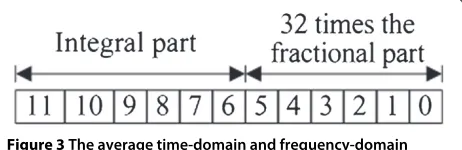
In each speech frame, the number of HF parameters is 30, including 16 time-domain envelope (TM(i), i = 0, 1,. . ., 15), 12 frequency-domain envelope (FM(k),k = 0, 1,. . ., 11), average time-domain envelopeMT, and aver-age frequency-domain envelope MF. Usually, these raw MTandMFare floating-point format, whereas embedded watermark is regarded as binary numbers, so the floating-point numbers need to be converted to binary ones. To reduce the deviation by bits error, conversion precision is set to 12 bits, where the former 6 bits represent the integer part, the latter 6 bits represent the fractional part multi-plied by 32. A typical representation of the watermark data is shown in Figure 3.
Figure 3The average time-domain and frequency-domain envelope in watermark data.
and frequency-domain envelopes [16]. In the VQ pro-cess, the time-domain and frequency-domain envelopes are divided into four sections and three sections, respec-tively, where each section is a four-dimensional vector and is quantized with 6 bits. Thus, the total number of digital information is 12+12+6∗4+6∗3=66 bits, and the quantization code book in reference [14] is available.
Usually, audio watermark is designed to be undetectable and perceivable but can be extracted with a hidden mes-sage by some algorithms. Using this feature of watermark, we assign the 66 bits digital information as watermark and embed it into LF bit stream; thus in the receiving termi-nal, HF information hidden can be obtained with water-mark extractor. In this paper, a modified LSB waterwater-mark method is proposed, which is based on communication protocol characteristics and human hearing perception.
According to the time-domain masking effect of human auditory, a large signal can make masking effect on the small signal [1]. So changes in the small signals can not be easily heard. With this auditory characteristics, we embed the watermark with LF and HF components parameters into the small signal position to make the watermark hidden better.
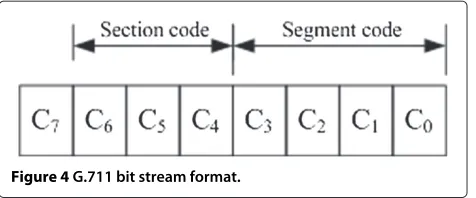
The detailed modified watermark method is as follows: C0 to C7 indicate the encoded bit stream from the lowest to the highest position, as shown in Figure 4. According to G.711 codec format, C7 is the symbol bit of the sampling points. We uses C6 to distinguish large-signal (C6 = 1) with small signal (C6 = 0), thus when C6 is equal to 0, the watermark is embedded. If embedded position is less than 66 bits, the other positions must be chosen to embed watermark.
When extracting watermark, we decide whether water-mark is embedded or not based on the characteristics of bit streams. If the C6 bit is 0, the watermark is extracted from the lowest position of bits; if the C6 bit is 1, there is no watermark in bit stream. If reaching the end of the frame but the extracted watermarks are less than 66 bits, then return to a starting point and extract watermark in the C6 = 1 position until the watermark bits extracted are up to 66 bits.
2.4 Recovery of HF components
The block diagram of HF components recovery is shown in Figure 5. Because the HF components and LF ones have correlation more or less [17], the LF components is used to construct the autoregressive (AR) model with transfer functionH(z) [18]
H(z)= G 1−
p i=1
aiz−i
, (13)
whereaiis linear prediction coefficient of the LF part,pis the order of AR model,Gis the gain.
In the decoder, white noise signal is generated as [18]
seed(n)=(word16)[31, 821·seed(n−1)+13, 849] (14)
where (word16) is the operation reserving lower 16 bits only, and the random seed, seed(n), atntime is a 16-bit integer and its initial value is 12,357. Let seed(n) through the AR model given in Equation 13, i.e.,
u(n)=Gseed(n)+
p
i=1
aiu(n−i). (15)
When obtainingu(n) from the AR model, the parame-ters of HF components are also extracted from watermark in LF bit stream, including 16 time-domain envelopes, 12 envelope frequency-domain envelopes, the average time-domain envelope, and the average frequency-time-domain envelope. Then, the HF parameters recovered from LF bitstream are used to shape both time-domain and frequency-domain envelopes of u(n) [15]. Since shaping method of the frequency-domain envelope is similar with the one in time-domain, shaping process of time-domain envelope is only given as follows.
From the extracted watermark, we can build the time-domain envelope TM(i) and the average time-domain envelopeMT. Then time-domain envelope of HF compo-nents are recovered as
T(i)=TM(i)+MT, i=0, 1,. . ., 15 (16)
The local gain factors of time-domain are computed as
gain_t(i)=2T(i)− ˜T(i), i=0, 1,. . ., 15, (17)
where T˜(i) are the envelope parameters of u(n) in time domain.
The gain factor between the two fragments can be obtained with linear interpolation
gain(n+10i)= ⎧ ⎨ ⎩ 1
9[ gain_t(i)−gain_t(i−1)](n−4)+gain_t(i), n=0, 1, 2, 3
gain_t(i), n=4, 5
1
9[ gain_t(i+1)−gain_t(i)](n−5)+gain_t(i), n=6, 7, 8, 9.
Figure 4G.711 bit stream format.
The time-domain envelope of noiseu(n) can be adjusted by local gain factor
ut(n+10i)=u(n+10i)gain(n+10i),
n=0, 1,. . ., 9 i=0, 1,. . ., 15. (19)
After above-mentioned time-domain and frequency-domain envelopes are shaped, the HF speech components are reconstructed.
2.5 Synthesis of wideband speech
The block diagram of wideband speech synthesis is shown in Figure 6. With G.711 decoder, the receiving bit stream is decoded to LF components with sampling frequency of 8 KHz. In order to remove the uncomfortable noise above 7 KHz, the reconstructed HF components are filtered with a low-pass filter, whose technical specifications can be summarized as (a) passband cutoff frequency, 3 KHz; (b) stopband cutoff frequency, 3.4 KHz; (c) maximum pass-band ripple, 0.8 dB; (d) minimum stoppass-band attenuation, 80 dB. The LF components and filtered HF components are up-sampled to 16 KHz by twice interpolation and then are synthesized to a wideband speech with QMF synthesis filter bank, which is the reciprocal of QMF analysis filter bank in Section 2.1.
3 Simulation and result discussion
In order to evaluate the performance of proposed BWE scheme, both objective and subjective experiments are carried out. Without loss of generality, according to the character of pitch and timbre, test speeches are divided into five types: male speech, female speech, boy speech, girl speech, and song. All test speeches are quantized with 16 bits and sampled at 16 KHz. These speeches will be used as the original wideband speeches for the following experiments.
Figure 6Block diagram of wideband speech synthesis.
3.1 Objective measurements
The objective measurements, including spectral distor-tion and spectrogram, are used to compare the perfor-mance between original wideband speech at transmitting terminal and expanded wideband speech at receiving terminal.
The spectral distortionDHCis defined as [19]
D2HC= 1 K
K
k=1 π
0.5π
20lg(Ak(ω) Ak(ω)
)−GC 2
dω, (20)
where Ak(ω) and A
k(ω) are the kth frame spectral envelopes for the original wideband speech and expanded wideband speech respectively,GCis the gain compensa-tion factor for removing the mean squared error between the two envelopes and is defined as
GC= 1 0.5π
π
0.5π 20lg(A
k(ω)
Ak(ω)
)dω. (21)
We select the five types of speech mentioned above with 52 s length and calculate their spectral distortion. Experience results of spectral distortion are shown in Table 1. Usually, the smaller the spectral distortion is, the more similar the synthesis of wideband speech and orig-inal speech is. From Table 1, an interesting result can be found that the spectral distortion of song is lower than the speech.
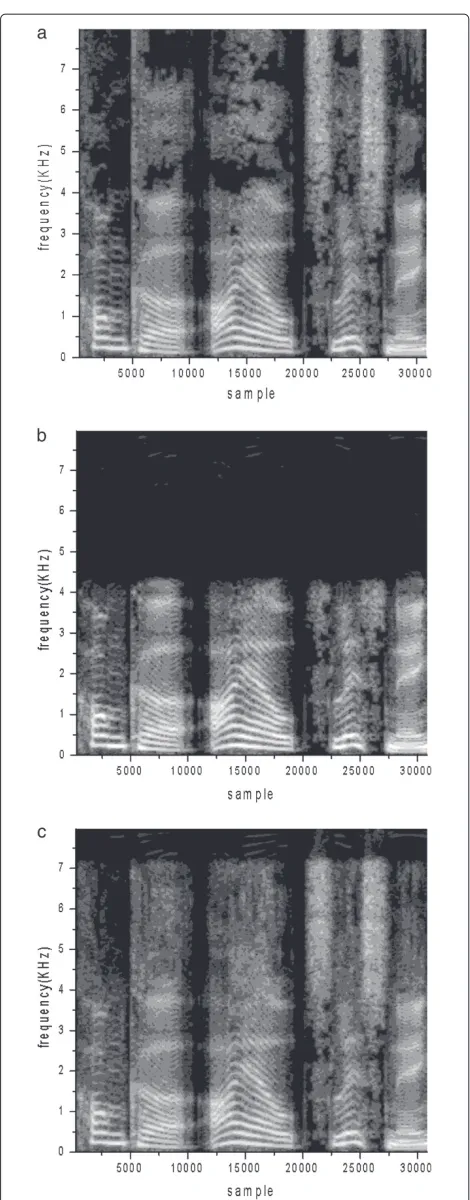
In order to visually compare the difference of spectro-grams of the original wideband speech, transmitted nar-rowband speech, and expanded wideband speech, adult male in Table 1 is chosen as an example and its spec-trograms are shown in Figure 7a,b,c. From Figure 7c, we note that after the speech bandwidth extension by the pro-posed method, the 4 to 8 KHz frequency components have significantly increased by comparing with the transmit-ted narrowband speech in Figure 7b. It can be noticeable that since the synthetic wideband speech is filtered by a
Table 1 Objective test results
Speech type Distortion measure (dB)
Adult male 5.64
Adult female 5.82
Boy 5.51
Girl 5.42
Song 4.94
low-pass filter with 3.4 KHz stopband cutoff frequency (equivalent to 6.8 KHz after twice up-sampling), com-pared to Figure 7a, its spectrogram is evident in the dark at 7 to 8 KHz in Figure 7c.
It is self-evident that the watermark embedded into narrowband bit stream will decrease narrowband speech quality. Here, we use signal-to-noise ratio (SNR) of speech to evaluate the modified watermark method, whose results are shown in Table 2. We can find from Table 2 that SNR results of narrowband speech by the proposed watermark method are higher than the conventional LSB method.
3.2 Subjective evaluation
Subjective evaluation is to determine the speech quality by a person’s hearing experience. Comparison mean opinion score (CMOS) method is used in this paper, and its scoring criteria is shown in Table 3.
There are four groups of wideband speech samples as subjective test set. The groups are labeled by female, male, boy, and girl, and each group has two different talk-ers. The length of each wideband (WB) speech sample is 8 s. Every person spoke five sentences, where one sen-tence is for pre-listening and other four sensen-tences are for testing. The above four groups of test samples are coded-decoded with eight kinds of bit rates by adaptive multi-rate (AMR) codec and nine kinds of bit rates by AMR-WB codec respectively. The higher the coding rate is, the better the speech quality is. The same test samples are also coded-decoded by the proposed BWE method. The speech sample process is shown in Figure 8.
Because human auditory and subjective perceptions are based on personal experiences, knowledge background, test environment, and mental state, each person’s sub-jective experience on the same speech will drift, but the difference is small. In order to make sure that the test situation can truly reflect the speech quality in the test, the 32 listeners (16 females and 16 males), whose ages are between 20 and 40, are invited for test experiments in the same test environment. None of the listeners had any hearing handicap, and they are native speakers of Chinese. The listeners have experience about commu-nications facilities; especially, they were not engaged in
Table 2 Signal-to-noise ratio of narrowband speech
Method SNR of narrowband speech
after G.711 decode (dB)
Without watermark 36.92
LSB 31.58
Proposed 34.71
communications or signal processing work and did not participate in any speech aspects of the subjective test in the recent 6 months.
Before formal listening tests, listeners was told of the main idea of the experiment. When the listeners under-stood the guidance, they will first listen to the initial situation and give their advices. Any technical problems, such as test principle or distortion degree, was forbidden before all experiments are over. In order to reduce the tiredness of the listeners, the test was divided into blocks. When test was ongoing, the listeners were not allowed to know the test results of other persons.
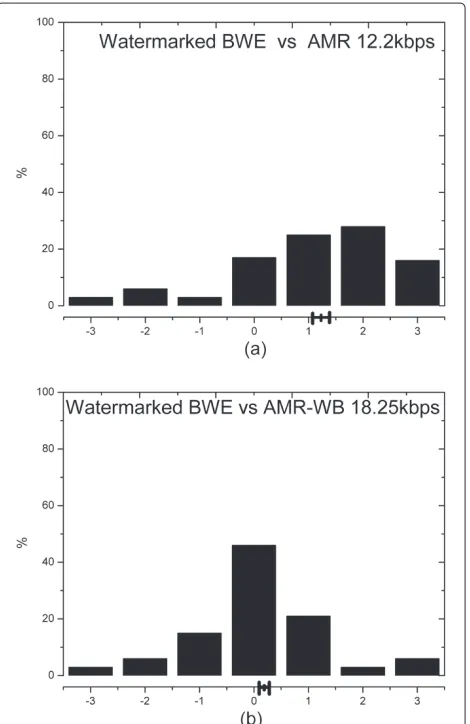
Figure 9 shows the distributions of subjective test among AMR 12.2 kbps, adaptive multi-rate-wideband (AMR-WB) 18.25 kbps and the proposed BWE method. In Figure 9, the average CMOS and its 95% confidence interval are also shown on the horizontal axis. Figure 9a shows the scores given in the comparison between the normal AMR codec at 12.2 kbps and the proposed BWE method. Figure 9b shows the scores given in the compar-ison between the AMR-WB codec at 18.25 kbps and the proposed BWE method. The black lines in abscissa in the Figure 9 represent the average scores in the test results. It can be seen from the Figure 9 that the average CMOS of the proposed method is slightly better than the AMR-WB codec at 18.25 kbps. However, compared with the results of AMR codec at 12.2 kbps, the performance of proposed method has greater improvement.
Most speech bandwidth extension methods are based on Gaussian mixture model or neural network model. In order to verify the effectiveness of proposed method, we made an experiment to compare the proposed method
Table 3 Signal to noise ratio of narrowband speech
Comparison Score
A is much better than B +3
A is better than B +2
A is slightly better than B +1
A is the same with B 0
A is slightly worse than B −1
A is worse than B −2
A is much worse than B −3
Figure 8Block diagram of speech sample process.
with references [5,6] by the CMOS. In the test, the 32 lis-teners (16 females and 16 males), whose ages are between 20 and 40, are invited for test experiments in the same test environment. None of the listeners had any hearing hand-icap, and they are native speakers of Chinese. After the experiment, the comparison result is shown in Table 4. We can see from the Table 4 that the average CMOS of the proposed method is slightly higher than that of reference [5], but compared with the reference [6], the proposed method has better performance.
Table 4 Comparison results of proposed method and ones by Pulakka et al. [5,6]
Method CMOS Confidence interval (%)
[5] 1.17 95
[6] 1.05 95
Proposed method 1.21 95
4 Conclusions
A speech bandwidth extension method based on the mod-ified audio watermark is proposed in this paper. The high-frequency speech information as watermark is embedded in the narrowband (i.e., low-frequency) speech bit stream. A modified LSB watermark method based on the charac-teristics of the communication protocol and the human hearing perception is proposed and used in the proposed BWE method. The objective and subjective evaluations show that the quality of speech synthesized by the pro-posed method is better than narrowband speech and is comparable to AMR-WB codec at 18.25 kbps.
Competing interests
The authors declare that they have no competing interests.
Acknowledgements
This work was supported by National Natural Science Foundation of China (nos. 61172107, 61172110, and 60772161), Dalian Municipal Science and Technology Fund Scheme (no. 2008J23JH025), Specialized Research Fund for the Doctoral Program of Higher Education of China (no. 200801410015), and the Fundamental Research Funds for the Central Universities of China (no. DUT13LAB06).
Received: 12 February 2013 Accepted: 13 May 2013 Published: 6 June 2013
References
1. G. 711 ITU-T Recommendation, Pulse code modulation (PCM) of voice frequencies. (ITU-T, 1972)
2. MD Plumpe, TF Quatieri, DA Reynolds, Modeling of the glottal flow derivative waveform with application to speaker identification. IEEE Trans. Speech Audio Process.7(5), 569–586 (1999)
3. F Nagel, S Disch, S Wilde, inIEEE International Conference on Acoustics Speech and Signal Processing (ICASSP). A continuous modulated single sideband bandwidth extension, pp. 357–360. Texas, 14–19 March 2010 4. G Fuchs, R Lefebvre, inIEEE International Conference on Acoustics, Speech
and Signal Processing (ICASSP). A new post-filtering for artificially replicated high-band in speech coders, pp. 713–716. Toulouse, 14–19 May, 2006 5. H Pulakka, U Remes, K Palomaki, inIEEE International Conference on
Acoustics, Speech and Signal Processing (ICASSP). Speech bandwidth extension using gaussian mixture model-based estimation of the highband Mel spectrum, pp. 5100–5103. Prague, 22–27 May 2011 6. H Pulakka, P Alku, Bandwidth extension of telephone speech using a
neural network and a filter bank implementation for highband Mel spectrum. IEEE Trans. Audio, Speech, Lang. Process.19(7), 2170–2183 (2011)
7. TV Pham, F Schaefer, G Kubin, in3th IEEE International Conference on Communications and Electronics (ICCE) Nha Trang. A novel
implementation of the spectral shaping approach for artificial bandwidth extension, pp. 262–267. 11–13 August 2010
8. P Bauer, T Fingscheidt, inIEEE International Conference on Acoustics, Speech and Signal Processing (ICASSP). An HMM-based artificial bandwidth extension evaluated by cross-language training and test, pp. 4589–4592. Las Vegas, 31 March–4 April 2008
9. Naofumi, A band extension technique for G.711 speech using steganography. IEICE Trans. Commun.E89-B(6), 1896–1898 (2006)
10. M Mohan, DB Karpur, M Narayan, inIEEE International Conference on Communications and Signal Processing (ICCSP). Artificial bandwidth extension of narrowband speech using Gaussian mixture model, pp. 410–412. Kerala, 10–12 February 2011
11. S Chen, H Leung, inIEEE International Symposium on Circuits and Systems (ISCAS). Artificial bandwidth extension of telephony speech by data hiding, pp. 3151–3154. Kobe, 23–26 May 2005
12. B Geiser, P Vary, inIEEE International Conference on Acoustics, Speech and Signal Processing (ICASSP). Backwards compatible wideband telephony in mobile networks: CELP watermarking and bandwidth extension, pp. 533–536. Honolulu, Hawaii, 15–20 April 2007
13. D Esteban, C Galand, inIEEE International Conference on Acoustics, Speech, and Signal Processing (ICASSP). Application of quadrature mirror filters to split band voice coding schemes, pp. 191–195. Hartford, May 1977 14. ITU-T Recommendation G.729.1: G.729-based embedded variable bit-rate
coder: an 8–32 kbit/s scalable wideband coder bit stream interoperable with G.729, (ITU-T, 2006)
15. T Nomura, M Iwadare, M Serizawa, inIEEE International Conference on Acoustics, Speech and Signal Processing (ICASSP). A bitrate and bandwidth scalable CELP coder, pp. 341–344. Seattle, 12–15 May 1998
16. F Mustiere, M Bouchard, M Bolic, inCanadian Conference on Electrical and Computer Engineering. Bandwidth extension for speech enhancement, pp. 1–4. Calgary, 2–5 May 2010
17. P Jax, P Vary, inIEEE International Conference on Acoustics, Speech, and Signal Processing (ICASSP). An upper bound on the quality of artificial bandwidth extension of narrowband speech signals, pp. 237–240. Orlando, 13–17 May 2002
18. HW Hsu, CM Liu, Decimation-whitening filter in spectral band replication. IEEE Trans. Audio, Speech, Lang Process.19(8), 2304–2313 (2011) 19. J Zhang, inIEEE International Conference on Acoustics, Speech, and Signal
Processing (ICASSP). Bandwidth extension for China AVS-M standard, pp. 4149–4152. Taipei, 19–24 April 2009
doi:10.1186/1687-4722-2013-10
Cite this article as:Chenet al.:An audio watermark-based speech
band-width extension method.EURASIP Journal on Audio, Speech, and Music
Pro-cessing20132013:10.
Submit your manuscript to a
journal and benefi t from:
7Convenient online submission
7 Rigorous peer review
7Immediate publication on acceptance
7 Open access: articles freely available online
7High visibility within the fi eld
7 Retaining the copyright to your article
![Table 4 Comparison results of proposed method and onesby Pulakka et al. [5,6]](https://thumb-us.123doks.com/thumbv2/123dok_us/9596505.1942082/8.595.55.292.110.168/table-comparison-results-proposed-method-onesby-pulakka-et.webp)
