The Thirty-Third AAAI Conference on Artificial Intelligence (AAAI-19)
Coverage Centrality Maximization in Undirected Networks
Gianlorenzo D’Angelo
Gran Sasso Science InstituteL’Aquila, Italy [email protected]
Martin Olsen
Department of Business Development and Technology
Aarhus University, Denmark [email protected]
Lorenzo Severini
ISI FoundationTurin, Italy [email protected]
Abstract
Centrality metrics are among the main tools in social network analysis. Being central for a user of a network leads to several benefits to the user: central users are highly influential and play key roles within the network. Therefore, the optimiza-tion problem of increasing the centrality of a network user re-cently received considerable attention. Given a network and a target userv, the centrality maximization problem consists in creatingknew links incident tovin such a way that the cen-trality ofvis maximized, according to some centrality metric. Most of the algorithms proposed in the literature are based on showing that a given centrality metric is monotone and sub-modular with respect to link addition. However, this property does not hold for several shortest-path based centrality met-rics if the links are undirected.
In this paper we study the centrality maximization problem in undirected networks for one of the most important shortest-path based centrality measures, the coverage centrality. We provide several hardness and approximation results. We first show that the problem cannot be approximated within a fac-tor greater than1−1/e, unlessP = N P, and, under the stronger gap-ETH hypothesis, the problem cannot be approx-imated within a factor better than1/no(1), wheren is the
number of users. We then propose two greedy approximation algorithms, and show that, by suitably combining them, we can guarantee an approximation factor ofΩ(1/√n). We ex-perimentally compare the solutions provided by our approxi-mation algorithm with optimal solutions computed by means of an exact IP formulation. We show that our algorithm pro-duces solutions that are very close to the optimum.
Introduction
Determining what are the most important nodes in a net-work is one of the main goals of netnet-work analysis (Newman 2010). Several so-called centrality metricshave been pro-posed in the literature to try to quantitatively measure the importance of a node according to network properties like: distances between nodes (e.g. closeness or harmonic central-ity), number of shortest paths passing through a node (e.g. betweenness or coverage centrality), or on spectral graph properties (e.g. PageRank or information centrality).
It has been experimentally observed that nodes with high centrality values play key roles within the network. For
ex-Copyright c⃝2019, Association for the Advancement of Artificial Intelligence (www.aaai.org). All rights reserved.
ample, closeness centrality is significantly correlated with the influence of users in a social network (Crescenzi et al. 2016; Macdonald et al. 2012), while shortest-path-based metrics are correlated with the number of passengers pass-ing trough an airport in transportation networks (Ishakian et al. 2012; Malighetti et al. 2009). The coverage centrality of a nodevis the number of distinct pairs of nodes for which a shortest path passes throughv. Nodes with high coverage centrality are pivotal to the communication between many other nodes of the network.
Generally speaking, centrality metrics are positively cor-related with many desirable properties of nodes, therefore, there has been a recent considerable interest on finding strategies to increase the centrality value of a given node in order to maximize the benefits for the node itself. In this paper we focus on the most used strategy which is that of modifying the network by adding a limited num-ber of new edges incident to the node itself. In detail we study the following optimization problem: given a graph G, a node v of G, and an integer k, find k edges to be added incident to v maximising the centrality value of v in the graphGaugmented with these edges. The problem is usually referred to as the centrality maximization prob-lemand it can be instantiated by using different centrality metrics such as: PageRank (Avrachenkov and Litvak 2006; Olsen and Viglas 2014), eccentricity (Demaine and Zadi-moghaddam 2010; Perumal, Basu, and Guan 2013), cover-age centrality (Ishakian et al. 2012; Medya et al. 2018), be-tweenness (Bergamini et al. 2018; D’Angelo, Severini, and Velaj 2016), information centrality (Shan, Yi, and Zhang 2018), closeness and harmonic centrality (Crescenzi et al. 2016). The centrality maximization problem is in general N P-hard but in all the mentioned cases the authors were able to devise algorithms ensuring a constant approximation factor. In Table 1 we list the bounds on the approximation ratio reported in these references.
Most of these approximation algorithms are based on a fundamental result on submodular optimization due to Nemhauser et al. (Nemhauser, Wolsey, and Fisher 1978). Given a monotone submodular set functionf 1 and an
in-tegerk the problem of finding a set S with|S| ≤ k that
1
A set functionfis is submodular if for any pair of setsA⊆B
Centrality Graph Approximation Hardness of metric type Algorithm approximation Harmonic Undir. 1−
1
e 1−
1 15e Dir. 1−1
e 1−
1 3e Betweenness Undir. OPEN 1−
1 2e Dir. 1−1
e 1−
1 2e Eccentricity undir. 2 + 1
OP T
3 2
PageRank Dir. (1−α2) (1−1
e
)
NO FPTAS Information Undir. 1−1
e OPEN
Constr. coverage Undir. 1−1
e OPEN
Coverage Undir. Ω(1/
√
n) 1−
1 e 1/no(1)
DAGs 1−1
e OPEN
Table 1: Summary of approximation bounds for the cen-trality maximization problem. The “Constr. coverage” row refers to the version of the coverage centrality maximization problem with the additional constraint that a pair of nodes can be covered by at most one edge. The results in this pa-per are marked in bold, the second hardness bound is under the Gap-ETH condition.
maximisesf(S)isN P-hard and hard to approximate within a factor greater than1−1/e, unlessP =N P(Feige 1998). However, the greedy algorithm that starts with the empty set and repeatedly adds an element that gives the maximal marginal gain of f guarantees the optimal approximation factor of1 −1/e (Nemhauser, Wolsey, and Fisher 1978). Many of the approximation algorithms for the centrality maximization problem are based on the fact that the value for nodev of the considered centrality metric is monotone and submodular with respect to the addition of edges inci-dent tov.
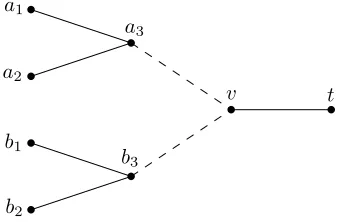
Unfortunately, not all the centrality metrics exhibit a sub-modular trend. Indeed, it has been shown that inundirected graphssome shortest-path based metrics are not submodular and, furthermore, the greedy algorithm exhibits an arbitrar-ily small approximation factor (D’Angelo, Severini, and Ve-laj 2016). For example, Figure 1 shows an undirected graph in which the increment in coverage centrality is not submod-ular with respect to edge addition. This is in contrast with the results for the same centrality metrics on directed graphs, where, e.g., betweenness and coverage centrality are mono-tone and submodular (Bergamini et al. 2018; Ishakian et al. 2012). Not being submodular makes things much harder and so far finding an approximation algorithm for the central-ity maximization problem on shortest-paths based metrics has been left as an open problem (Bergamini et al. 2018; D’Angelo, Severini, and Velaj 2016). To overcome this is-sue, Medya et al. (Medya et al. 2018) consider the coverage centrality maximization problem with the additional artifi-cial constraint that a pair of nodes can be covered by at most one edge. This constraint on the solution avoids the cases in Figure 1 and makes the objective function submodular. However, it does not consider solutions that cover pairs of nodes with pairs of edges, hence it looks for sub-optimal so-lutions to the general problem.
In this paper we give the first results on the general
cov-v t
a3 a1
a2
b1
b2
b3
Figure 1: Adding edge{a3, v} increases the coverage cen-trality of v by 3, since nodesai will have a shortest path
to t passing throughv. Similarly, adding edge {b3, v} in-creases the coverage centrality ofvby 3. However, adding both edges {a3, v} and{b3, v} will increase the coverage centrality of v by 15, since besides the shortest paths be-tween nodesaiandtand those between nodesbi andtwe
need to take into account the 9 shortest paths between nodes aiand nodesbithat pass throughv.
erage centrality maximization problem in undirected graphs. In the remainder of the paper we will refer to this problem as theMaximum Coverage Improvement(MCI) problem. Our results can be summarized as follows (see also Table 1).
• MCI cannot be approximated within a factor greater that
1−1/e, unlessP =N P.
• MCI is at least as hard to approximate as the well-known Densest-k-subgraph problem and hence cannot be ap-proximated within any constant, if the Unique Games with Small Set Expansion conjecture (Raghavendra and Steurer 2010) holds, and within1/no(1), where nis the number of nodes in the graph, if the Gap Exponential Time Hypothesis holds (Manurangsi 2017).
• We propose two greedy approximation algorithms for MCI that guarantee, respectively, approximation factors
of1−e−(1−kϵ−1)(t−1) and(1−ϵ)(1−1 e)
2 k
4n, wheret≥2is
a constant tuning parameter andϵis any positive constant.
• We show that combining the two proposed algorithms we can achieve an approximation factor ofΩ(1/√n).
• We implemented the proposed algorithms and experimen-tally compared the solutions provided by our approxima-tion algorithm with optimal soluapproxima-tions computed by means of an exact IP formulation. We experimentally show that our algorithm produces solutions that are very close to the optimum and that it is highly effective in increasing the coverage centrality of a target user.
Notation and problem statement
LetG= (V, E)be an undirected graph where|V|=nand |E|=m. For each nodev,Nvdenotes the set of neighbors
ofv, i.e.Nv = {u| {u, v} ∈E}. Given two nodessand
t, we denote bydst andPst the distance fromstotinG
2014) ofvis defined as the number of pairs(s, t)such that vis contained in a shortest path betweensandt, formally,
cv=|{(s, t)∈V ×V |v∈Pst, v̸=s, v̸=t}|.
In this paper, we consider graphs that are augmented by adding a setSof arcs not inE. Given a setS⊆(V×V)\E of arcs, we denote byG(S)the graph augmented by adding the arcs inStoG, i.e.G(S) = (V, E∪S). For a parameterx ofG, we denote byx(S)the same parameter in graphG(S), e.g. the distance fromstotinG(S)is denoted asdst(S).
The coverage centrality of a node might change if the graph is augmented with a set of arcs. In particular, adding arcs incident to some nodevcan increase the coverage cen-trality value ofv. We are interested in finding a setSof arcs incident to a particular nodevthat maximizescv(S). There-fore, we define theMaximum Coverage Improvement(MCI) problem as follows: Given an undirected graphG= (V, E), a nodev ∈ V, and an integerk ∈ N, find a setS of arcs
incident tov,S⊆ {{u, v} |u∈V \Nv}, such that|S| ≤k
andcv(S)is maximized.
Hardness of approximation
We first show that MCI cannot be approximated within a factor greater that1−1/e, unlessP =N P. Then, we show that, under stronger conditions, it cannot be approximated to within a factor greater thann−f(n), for anyf ∈o(1).
Constant bound
Our first hardness of approximation result is obtained by re-ducing theMaximum Set Coverage(MC) problem to MCI. The problem MC is defined as follows: Given a ground set U, a collectionF ={S1, S2, . . . , S|F|}of subsets ofU, and an integerk′ ∈ N, find a sub-collectionF′ ⊆ F such that
|F′| ≤ k′ ands(F′) = | ∪
Si∈F′ Si| is maximized. It is known that the MC problem cannot be approximated within a factor greater than1−1
e, unlessP =N P (Feige 1998).
Theorem 1. There is no polynomial time algorithm with ap-proximation factor greater than1−1
efor theMCIproblem on undirected graphs, unlessP=N P.
Proof. Assume that we have access to a polynomial time approximation algorithmAMCI for the MCI problem with
approximation factor1−1
e+ϵfor some positive numberϵ.
We consider an instanceIMCof the MC problem and build
the instanceIMCIof MCI shown in Fig. 2. The instance
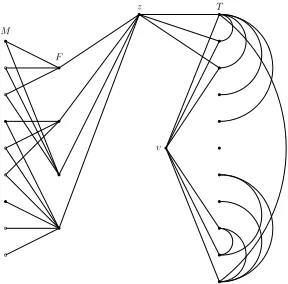
con-sists of5vertical layers of nodes. For each element ofU of the MC instance, we have a member (filled circle) andQ copies (unfilled circles) in theM-layer to the left. In theF -layer there is a node for each set in the collectionF in the MC instance. A node in theF-layer is connected to all the corresponding members and copies in theM-layer. In the third layer there is a single nodezconnecting all nodes in theF-layer to all nodes in theT-layer to the far right. In the fourth layer we have the nodevthat is connected to all nodes in theT-layer. All the nodes in theT-layer to the right form a clique. Note that not all the edges are shown in the figure. Letβ >0be a sufficiently small positive constant satisfying
1−1 e <
1 1 +β
( 1−1
e+ϵ
)
.
M F
z T
v
Figure 2: TheIMCIinstance used in Theorem 1.
To improve the readability, we will not distinguish between a set and its cardinality. E.g.,T can represent the set of all the T-nodes andT can also represent the number ofT-nodes. Our aim is to choose relatively smallQandT such that
(F+M + 1)2≤(β(Q+ 1)−k−F)T . (1)
We chooseQandTas follows (note thatM =U(Q+ 1)):
Q=
⌈1 +k+F
β −1
⌉
T = (F+M+ 1)2 .
Sinceβis a constant,TandM are polynomial in|IMC|.
Now letSMCIbe the solution computed byAMCIgiven the
IMCIinstance as input. LetSMCbe the solution for MC
cor-responding to all the sets for which there is an edge between theF-node andvinSMCI. Note thatSMCcan be computed
in polynomial time. LetA,A1andA2be defined as follows:
A={(s, t)∈V ×V |v∈Pst(SMCI)}
A1={(s, t)∈A|(s, t)∈(M ×T)∪(T×M)}
A2=A\A1 .
We now have the following identitycv(SMCI) =A1+A2.
The setA1consists of all the pairs of vertices with one ele-ment inM and one element inTthat are covered byvin the graph corresponding toSMCI. The contribution toA1of the edges inSMCIwith one element inFis2(Q+ 1)T·s(SMC)
and the contribution of edges inSMCIwith one element inM
is no more than2kT and there might be some overlap. This allows us to establish the following upper bound onA1:
A1≤2(Q+ 1)T ·s(SMC) + 2kT .
The remaining pairs that might be covered 1) have an ele-ment inFand an element inT, or 2) have no elements inT: A2≤2T F+ 2(F+M+ 1)2 .
According to (1), QandT have been chosen such that kT +T F + (F +M + 1)2 ≤ β(Q + 1)T, implying cv(SMCI)≤2(1+β)(Q+1)T·s(SMC). If we add edges tov
in the MCI instance corresponding to the optimal solution of the MC instance, we obtain a feasible solution for the MCI instance. For each covered element in the MC instance, we have2(Q+1)Tcovered pairs in the MCI instance, therefore
The algorithmAMCIhas approximation factor1−1e+ϵ:
cv(SMCI)
OP T(IMCI)
≥1−1 e +ϵ .
This allows us to set up the following inequality:
2(1 +β)(Q+ 1)T ·s(SMC) 2(Q+ 1)T·OP T(IMC)
≥1−1 e +ϵ .
We can now establish a lower bound for the approximation factor for the solution to our MC instance:
s(SMC)
OP T(IMC)
≥ 1
1 +β
( 1−1
e +ϵ
)
>1−1 e ,
a contradiction.
Conditional bound
To obtain our next hardness result, we reduce the
Densest-k-Subgraph(DKS) problem to MCI. DKS is defined as fol-lows: Given a graphGand an integerk, find a subgraph ofG induced onkvertices with the maximum number of edges.
Several conditional hardness of approximation results for DKS have been proved (see e.g. (Manurangsi 2017) and references therein). It has been shown that DKS is hard to approximate within any constant bound under the Unique Games with Small Set Expansion conjecture (Raghaven-dra and Steurer 2010). Recently, it has been shown that under the exponential time hypothesis (ETH) there is no polynomial-time algorithm that approximates DKS to within n−1/(loglogn)c
, for some constant c. Moreover, under the stronger Gap-ETH assumption, the factor can be improved ton−f(n)for any functionf ∈o(1)(Manurangsi 2017). The next theorem shows that there is an S-reduction (Crescenzi 1997) from DKS to MCI only adding a constant to the num-ber of nodes. Then, all the above mentioned inapproximabil-ity results extend to the MCI problem. The current state-of-the-art algorithm for DKS guarantees aΩ(n−14−ϵ)
approxi-mation (Bhaskara et al. 2010).
Theorem 2. There is an S-reduction fromDKStoMCI. The reduction transforms aDKSinstance withnvertices into an
MCIinstance withn+ 2vertices.
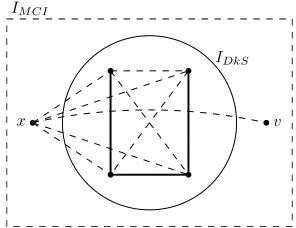
Proof. Consider a DKS instance given by the graph G′(V′, E′)and an integerk′. This instance is transformed into an MCI instance given by the graphG(V, E), a node v ∈ V and an integerkas follows. The set of nodesV is formed by adding a node xand the target node v for the MCI instance toV′:V = {x, v} ∪V′. The nodev is iso-lated andxis connected to all other nodes inV. In addition to the edges incident tox, the edges in the complement of the original graphG′are also added to the graph. Formally, E ={{u, w} | {u, w} ̸∈E′} ∪ {{x, u} |u∈ V′∪ {v}}. The value ofkis not changed:k =k′. See Fig. 3. We also need to explain how to transform a feasible solution of the MCI instance into a feasible solution of the DKS instance. Here we simply pick the nodes that are linking tov in the feasible solution for the MCI instance (excludingx).
We now prove that the reduction is an S-reduction. We claim that the following holds: The nodevis on the shortest
v x
IM CI
IDkS
Figure 3: The reduction from DKS. In the circle, we have the original DKS instance (solid edges) that is transformed into the MCI instance indicated by the rectangle (dashed edges).
path between s andt in the MCI instance after adding k edges if and only if 1) edges{v, s}and{v, t}are added, and 2) there is an edge betweensandtinG′. The if-direction is clear. To prove the only-if-direction, we assume thatvis on a shortest path between the nodessandtin the MCI instance. If 1) is false, then the length of the shortest path throughvis at least3. If 2) is false, we also arrive at a contradiction.
This implies that the number of edges induced by a fea-sible solution of the DKS instance is precisely the coverage centrality ofvin the corresponding MCI instance and vice versa. This shows that the reduction is an S-reduction.
Approximation algorithm
It is easy to see that, in the undirected case, the objective function is not submodular and that there are instances of MCI (similar to that in Figure 1) for which the greedy algo-rithm by Nemhauser et al. exhibits an arbitrarily small ap-proximation factor. The main problem with the greedy algo-rithm is that it does not take into account the shortest paths that pass through two of the added edges. In this section, we show how to overcome this limitation and we give an algo-rithm that guarantees aΩ(1/√n)-approximation.
The algorithm is based on a reduction to a generalization of the maximum coverage problem in which elements of a ground set are covered by pairs of “objects”, instead of a sin-gle set, and we look for a bounded set of objects that maxi-mizes the number of covered elements. We call this problem the Maximum Coverage with Pairs problem (MCP). For-mally, MCP is defined as: Given a ground setX, a setO of objects, and an integerk ∈ N, find a setO′ ⊆O, such that|O′| ≤ kandc(O′) = | ∪
i,j∈O′ C(i, j)|is maximum,
whereC(i, j)denotes the subset ofXcovered by pair{i, j}, for each unordered pair of objects{i, j}.
GivenO′ ⊆O, letC(O′) =∪i,j∈O′C(i, j)andc(O′) =
|C(O′)|. Wlog, we assume that each element inXis covered by at least a pair of objects inOand thatk≤ |O|.
The problem MCI can be reduced to MCP as follows: for each pair(s, t)of nodes inG, we add an element(s, t)to X; for eachu∈ V \N(v), we add an objectiu ={u, v}
to O (i.e. all the edges that can be added incident to v); for each pair of objects iu, iw ∈ O, we setC(iu, iw) =
feasible solution O′ to the above instance of MCP corre-sponds to a feasible solution S = O′ for MCI. Since for each pair of nodes(s, t)inV the shortest path between s andt inG(S)can only pass through at most two edges of S, thencv(S) =| ∪iu,iw∈O′C(iu, iw)|=c(O
′). Therefore, any approximation algorithm for MCP can be used to solve MCI with the same approximation factor. We observe that MCP is a generalization of the DKS problem, which corre-sponds to the case in which|C(i, j)| ≤1, fori, j ∈O, and each element ofXis covered by exactly one pair of objects (i.e. objects correspond to nodes and elements correspond to edges). Therefore, MCP is at least as hard to approximate as DKS.
Our algorithm exploits two procedures, called GREEDY1 and GREEDY2, that return two sets of objects, and selects one of these sets that gives the maximum coverage. In par-ticular, Procedure GREEDY1 returns a set that guarantees
an approximation factor of(1−e−(1−kϵ)(−1t−1) )
, where t ∈
[2, k]is a constant integer parameter of the procedure andϵ is any positive constant, while Procedure GREEDY2 guaran-tees an approximation factor of(1−ϵ)14(
1−1
e )2 k
|O|for any constantϵ > 0(see Theorems 4 and 5). The next theorem shows the overall approximation factor. When applied to the MCI problem, it guarantees aΩ(1/√n)-approximation. Theorem 3. LetO∗be an optimum solution for MCP, let
O1 andO2 be the solutions of ProceduresGREEDY1 and
GREEDY2, then
max{c(O1), c(O2)}
≥(1−ϵ)1 2
( 1−1
e
)3/2√
t−1
|O| c(O ∗),
for any constantt≥2andϵ∈(0,1).
Proof. The value of max{c(O1), c(O2)} is at least the geometric mean of c(O1) and c(O2). Moreover,
(
1−e−(1−kϵ)(−1t−1) )
≥ ( 1−1
e
)(1−ϵ)(t−1)
k−1 , for any ϵ ∈
(0,1)andk >12. Therefore,
max{c(O1), c(O2)} ≥√c(O1)·c(O2)
≥
√ (
1−1 e
)(1−ϵ)(t−1)
k−1 c(O
∗)
·
√
(1−ϵ)1 4
( 1−1
e
)2
k |O|c(O
∗)
≥(1−ϵ)1 2
( 1−1
e
)3/2√
t−1
|O| c(O ∗).
We now introduce procedures GREEDY1 and GREEDY2.
Procedure G
REEDY1
The pseudo-code of Procedure GREEDY1 is reported in Al-gorithm 1. For some fixed constant integer t ∈ [2, k], the
2
Indeed, 1−e−x ≥ (1−e−1)x, for anyx ∈ [0,1], and
(1−ϵ)(t−1)
k−1 ∈[0,1]for anyϵ∈(0,1),t≤k, andk >1.
Algorithm 1:Procedure GREEDY1 1 O′:=∅;
2 while|O′| ≤k−tdo
3 Z:= arg maxZ⊆O,|Z|≤t{C(O′∪Z)−C(O′)}; 4 O′:=O′∪Z;
5 Z:= arg maxZ⊆O,|Z|≤k−|O′|{C(O′∪Z)−C(O′)}; 6 O′:=O′∪Z;
procedure greedily selects a set of objects of sizetthat max-imizes the increment in the objective function. In particu-lar, it starts with an empty solution and iteratively adds to it a setZ of tobjects that maximizesc(O′ ∪Z)−c(O′), where O′ is the solution computed so far. The procedure stops when it has added at least k−t objects toS. Even-tually, if|O′| < k, it completes the solution by adding a further set of k− |O′| < tobjects (lines 5–6). Note that one or more objects of the selected set might already belong toO′(but not all of them). Hence, Algorithm 1 has at least
⌊k−t t
⌋
and at most kiterations. For each iterationi of Al-gorithm 1, letOibe the setO′at the end of iterationiand
let O∗ be an optimal solution. The next lemma is used to prove the approximation bound, the full proof can be found in (D’Angelo, Olsen, and Severini 2018).
Lemma 1. After each iterationiof Algorithm 1, the follow-ing holds
c(Oi)≥
(
1−
(
1− t(t−1) k(k−1)
)i)
c(O∗). (2)
Theorem 4. IfIis the number of iterations of Algorithm 1, then
c(OI)≥ (
1−e−(1−ϵ)kt−1−1 )
c(O∗) ,
for any constantϵ∈(0,1).
Proof. We observe that for any constantϵ >0, there exists a constant k0, such that for each k ≥ k0, I = ⌊k−t
t ⌋
≥
k
t−2≥(1−ϵ) k
t. Note that, whenkis a constant the problem
can be easily solvable in polynomial time by brute force and therefore we assume thatkis not a constant. PluggingIinto inequality (2), we obtain:
c(OI)≥ (
1−
(
1− t(t−1) k(k−1)
)⌊k−tt⌋) c(O∗).
≥
(
1−
(
1− t(t−1) k(k−1)
)(1−ϵ)kt) c(O∗).
By calculus, it can be shown that1−x≤e−x, which implies
that(1−kt((tk−1)−1))(1−ϵ) k t
≤e−(1−ϵ)kt−1−1, and finally:
(
1−
(
1−t(t−1) k(k−1)
)(1−ϵ)kt) c(O∗)
≥(1−e−(1−ϵ)kt−1−1 )
Algorithm 2:Procedure GREEDY2
1 Define an instance of MC made of ground setXand, for each objecto∈O, a set equal toN(o);
2 Run the greedy algorithm in (Nemhauser, Wolsey, and Fisher 1978) for MC to find a setHof size⌈k2⌉objects;
3 Define an instance of MC made of ground set
D(H) =N(H)\C(H)and, for each objecto∈O\H, a set equal to∪i∈HC(o, i)\C(H);
4 Run the greedy algorithm in (Nemhauser, Wolsey, and Fisher 1978) for MC to find a setIof size⌊k
2 ⌋
objects; 5 returnH∪I;
Procedure G
REEDY2
In order to describe Procedure GREEDY2, we need to in-troduce further notation. Given a setO′ of objects, we de-note byN(O′)the set of elements that the objects inO′can cover when associated with any other object in O, that is N(O′) = ∪o∈O′,i∈OC(o, i). The degreeof O′ is the
car-dinality ofN(O′)and it is denoted byd(O′). To simplify the notation, when O′ is a singleton, O′ = {o}, we use N(o)andd(o)to denoteN(O)andd(O), respectively. In-tuitively,N(O′)are the elements that are covered by at least an object inO′, whileC(O′)are the elements that are cov-ered by at least two objects inO′. In the following, we say that an element issinglecovered byO′ in the former case anddoublecovered byO′in the latter case. We observe that d(O′) ≥c(O′), for any set of objectsO′. Moreover, since the degree is defined as the size of the union of sets, then it is a monotone and submodular set function.
Procedure GREEDY2 is given in Algorithm 2. First, the procedure looks for a setH of⌈k2⌉objects with maximum degree. Since computing such a set is equivalent to solving an instance of MC, which is known to beN P-hard, we com-pute an approximation of it. In detail, the instance of MC is made of the same ground setX and, for each objecto∈O, a set equal toN(o). Any set of objectsO′ corresponds to a solution to this MC instance, where the number of single covered elements is equal tod(O′). Indeed, finding a set of
⌈k
2
⌉
objects that maximizes the degree in the MCP instance corresponds to finding a collection of sets that maximizes the single coverage ofX in this MC instance. Hence, we find a setHthat approximates the maximum single coverage ofX, and, in particular, we exploit a greedy algorithm that guar-antees an optimal approximation of1 −1/e (Nemhauser, Wolsey, and Fisher 1978). Then, the procedure selects a set of⌊k2⌋objects inO\Hthat maximizes the single coverage of the elements inN(H)not double covered byH. In other words, these objects,along withobjects inH, double cover the maximum fraction ofN(H). Again, computing such a set is equivalent to solving an instance of MC, and we find a(1−1/e)-approximation. In this case, the MC instance is made of the ground setD(H) =N(H)\C(H), and for each objecto∈O\H, a set equal to∪i∈HC(o, i)\C(H). The
ap-proximated solution found by the greedy algorithm for MC is denoted byI. Procedure GREEDY2 outputs the set of ob-jects H ∪I. In the next lemma we establish a connection between the number of single and double covered elements,
in particular, we show an upper bound to the optimal value c(O∗)of the MCP instance as a function ofd(H), whereH is the set of objects selected at line 2 of Algorithm 2. The full proof of the lemma can be found in (D’Angelo, Olsen, and Severini 2018).
Lemma 2. IfH is the set of objects selected at line 2 of Algorithm 2 andO∗is an optimal solution forMCP, then
d(H)≥ 1
2 (
1−1 e
)
c(O∗).
Theorem 5. IfH∪Iis the output of Algorithm 2 andO∗is an optimal solution forMCP, then
c(H∪I)≥(1−ϵ)1 4
( 1−1
e
)2 k
|O|c(O ∗),
for any constantϵ∈(0,1).
Proof. The objects in H double cover c(H) elements, hence, the number of elements that are single covered by H but not double covered byHisd(H)−c(H). The set of these elements isD(H) =N(H)\C(H). We now show that N(I)contains at least a fraction(
1−1
e ) ⌊k
2
⌋ 1
|O|of these el-ements and hence the objects inH∪Idouble cover at least
(d(H)−c(H))( 1−1
e ) ⌊k
2
⌋ 1
|O|of them.
Let us denote asI∗ a set of ⌊k2⌋ objects inO \H that maximizes the single coverage of elements inD(H), that is the size ofD(H)∩N(I∗)is maximum for sets of⌊k2⌋ objects. By contradiction, let us assume that the size of D(H)∩N(I∗)is smaller than(d(H)−c(H))⌊k
2
⌋ 1 |O|. Let us partition O \H into sets of ⌊k
2
⌋
objects plus a possible set of smaller size, if |O\H| is not divisible by
⌊k
2
⌋
. The number of the sets in the partition is
ℓ= ⌈
|O\H|
⌊k
2
⌋ ⌉
= ⌈
|O| −⌈k
2
⌉
⌊k
2
⌋ ⌉
≤ ⌊|O|k 2
⌋.
We denote the sets of this partition as Ii,i = 1,2, . . . , ℓ.
Since I∗ maximizes the single coverage of elements in D(H), then for eachIi, the size ofD(H)∩N(Ii)is smaller
than(d(H)−c(H))⌊k
2
⌋ 1
|O|. By submodularity we have
|D(H)∩N(O\H)| ≤
ℓ ∑
i=1
|D(H)∩N(Ii)|
<
ℓ ∑
i=1
(d(H)−c(H)) ⌊k
2 ⌋ 1
|O| ≤d(H)−c(H),
which is a contradiction because it implies that there are el-ements inD(H)that are not covered by any object inO\H and hence they cannot be double covered. This proves that the size ofD(H)∩N(I∗)is at least(d(H)−c(H))⌊k2⌋|O1|. Moreover, setIapproximates the optimal single coverage of D(H)by a factor1−1
eand hence the size ofD(H)∩N(I)
is at least(1−1
e )
(d(H)−c(H))⌊k
2
⌋ 1 |O|.
It follows that the overall number of elements double cov-ered byH∪Iis at least(d(H)−c(H))(
1−1
e ) ⌊k
2
Network n=|V| m=|E|
BA 50 96
CM 50 85
karate 34 78 windsurfers 43 336
jazz 198 2742 haggle 274 2899
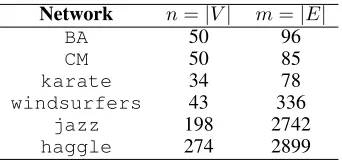
Table 2: Undirected networks used in the experiments.
(1
2 (
1−1 e
)
c(O∗)−c(H) ) (
1−1 e
) ⌊k
2 ⌋ 1
|O| +c(H).
For any constantϵ >0andkgreater than a constant,⌊k
2
⌋
≥
(1−ϵ)k2, then this number is at least
(1−ϵ) (1
2 (
1−1 e
)
c(O∗)−c(H) ) (
1−1 e
) k
2|O|
+c(H)
= (1−ϵ) k 4|O|
( 1−1
e
)2
c(O∗)
+c(H) (
1−(1−ϵ) (
1−1 e
) k
2|O|
)
≥(1−ϵ) k 4|O|
( 1−1
e
)2
c(O∗),
sincec(H)≥0andk≤2|O|.
Experimental study
In this section, we study the algorithms GREEDY1 and GREEDY2 from an experimental point of view. First, we compare the solutions of the greedy algorithms with opti-mal solutions computed by using an integer program for-mulation of MCP in order to assess the real performance in terms of solution quality (see (D’Angelo, Olsen, and Severini 2018) for the detailed implementation of the IP formulation). Then, we focus on the MCI problem and compare GREEDY1 and GREEDY2 with the natural algo-rithm that adds k random edges. We execute our experi-ments on two popular model networks, the Barabasi-Albert (BA) network (Barabasi and Albert 1999) and the Config-uration Model (CM) network (Bender and Canfield 1978; Molloy and Reed 1995), and on real-world networks ex-tracted from human activities3. The sizes of the networks
are reported in Table 2. All our experiments have been per-formed on a computer equipped with an Intel Xeon E5-2643 CPU clocked at 3.4GHz and 128GB of main memory, and our programs have been implemented inC++. The results of the comparison with the optimum are reported in Figure 4. For each network, we randomly choose 10 target nodes and, for each target nodev, we addknonexistent edges incident
3
http://konect.uni-koblenz.de/
BA CM
karate windsurfers
Figure 4: Average coverage centrality of target nodes as a function of the number k of inserted edges for GREEDY1 (witht= 2,3), GREEDY2, and optimal solutions.
jazz haggle
Figure 5: Average coverage centrality of target nodes as a function of the number k of inserted edges for GREEDY1 (t= 2,3), GREEDY2, and RANDOMonjazzandhaggle.
References
Avrachenkov, K., and Litvak, N. 2006. The effect of new links on google pagerank. Stoc. Models22(2):319–331. Barabasi, A.-L., and Albert, R. 1999. Emergence of scaling in random networks. Science286(5439):509–512.
Bender, E. A., and Canfield, E. R. 1978. The asymp-totic number of labeled graphs with given degree sequences.
Journal of Combinatorial Theory, Series A24(3):296–307.
Bergamini, E.; Crescenzi, P.; D’Angelo, G.; Meyerhenke, H.; Severini, L.; and Velaj, Y. 2018. Improving the between-ness centrality of a node by adding links. ACM Journal of Experimental Algorithmics23:1.5:1–1.5:32.
Bhaskara, A.; Charikar, M.; Chlamtac, E.; Feige, U.; and Vi-jayaraghavan, A. 2010. Detecting high log-densities: an
O(n1/4) approximation for densestk-subgraph. In Proceed-ings of the 42nd ACM Symposium on Theory of Comput-ing, STOC 2010, Cambridge, Massachusetts, USA, 5-8 June 2010, 201–210.
Crescenzi, P.; D’Angelo, G.; Severini, L.; and Velaj, Y. 2016. Greedily improving our own closeness centrality in a net-work. ACM Transactions on Knowledge Discovery from Data11(1):9:1–9:32.
Crescenzi, P. 1997. A short guide to approximation pre-serving reductions. InProceedings of the 12th Annual IEEE Conference on Computational Complexity, CCC ’97, 262– 273. IEEE Computer Society.
D’Angelo, G.; Olsen, M.; and Severini, L. 2018. Cover-age Centrality Maximization in Undirected Networks.CoRR
abs/1811.04331.
D’Angelo, G.; Severini, L.; and Velaj, Y. 2016. On the max-imum betweenness improvement problem. InProceedings of the 16th Italian Conference on Theoretical Computer Sci-ence (ICTCS15), volume 322 ofElectr. Notes Theor. Com-put. Sci., 153–168.
Demaine, E. D., and Zadimoghaddam, M. 2010. Minimizing the diameter of a network using shortcut edges. InProc. of the 12th Scandinavian Symp. and Work. on Algorithm The-ory (SWAT), volume 6139 ofLecture Notes in Computer Sci-ence, 420–431. Springer.
Feige, U. 1998. A threshold of ln n for approximating set cover.Journal of the ACM45(4).
Ishakian, V.; Erd¨os, D.; Terzi, E.; and Bestavros, A. 2012. A framework for the evaluation and management of network centrality. In Proc. of the 12th SIAM Int. Conf. on Data Mining (SDM), 427–438. SIAM.
Macdonald, B.; Shakarian, P.; Howard, N.; and Moores, G. 2012. Spreaders in the network SIR model: An empirical study. CoRRabs/1208.4269.
Malighetti, P.; Martini, G.; Paleari, S.; and Redondi, R. 2009. The impacts of airport centrality in the EU network and inter-airport competition on airport efficiency. Technical Report MPRA-7673.
Manurangsi, P. 2017. Almost-polynomial ratio eth-hardness of approximating densest k-subgraph. InProceedings of the
49th Annual ACM SIGACT Symposium on Theory of Com-puting, STOC 2017, 954–961. ACM.
Medya, S.; Silva, A.; Singh, A. K.; Basu, P.; and Swami, A. 2018. Group centrality maximization via network design. In
Proceedings of the 2018 SIAM International Conference on Data Mining, SDM 2018, 126–134. SIAM.
Molloy, M., and Reed, B. 1995. A critical point for random graphs with a given degree sequence. Random structures & algorithms6(2-3):161–180.
Nemhauser, G.; Wolsey, L.; and Fisher, M. 1978. An analysis of approximations for maximizing submodular set functions–I.Mathematical Programming14(1):265–294. Newman, M. 2010. Networks: An Introduction. Oxford University Press, Inc.
Olsen, M., and Viglas, A. 2014. On the approximability of the link building problem.Theor. Comput. Sci.518:96–116. Perumal, S.; Basu, P.; and Guan, Z. 2013. Minimizing ec-centricity in composite networks via constrained edge addi-tions. InMilitary Communications Conference, MILCOM 2013 IEEE, 1894–1899.
Raghavendra, P., and Steurer, D. 2010. Graph expansion and the unique games conjecture. InProceedings of the Forty-second ACM Symposium on Theory of Computing, STOC 2010, 755–764. ACM.
Shan, L.; Yi, Y.; and Zhang, Z. 2018. Improving infor-mation centrality of a node in complex networks by adding edges. InProceedings of the Twenty-Seventh International Joint Conference on Artificial Intelligence, IJCAI-18, 3535– 3541. International Joint Conferences on Artificial Intelli-gence Organization.
Yoshida, Y. 2014. Almost linear-time algorithms for adap-tive betweenness centrality using hypergraph sketches. In