FORMATION OF DIBENZO-
p
-DIOXINS AND DIBENZOFURANS IN OXIDATION
OF 2-CHLOROPHENOL OVER IRON OXIDE/SILICA SURFACE
Mosallanejad S1,Dlugogorski BZ1*, Kennedy EM1, Stockenhuber M1, Altarawneh M1,2
1 Priority Research Centre for Energy, ATC Building, Faculty of Engineering and Built Environment, The
University of Newcastle, Callaghan, New South Wales 2308, Australia; 2 Also at Chemical Engineering
Department, Al-Hussein Bin Talal University, Ma’an, Jordan
*Corresponding author: Phone: +61 2 4985-4433; Email: [email protected]
Introduction
Chlorophenols constitute one of the most important precursors for formation of polychlorodibenzo-p-dioxins and polychlorinated dibenzofurans (PCDD/F, polychlorodibenzo-p-dioxins), both under pyrolytic and oxidative conditions1, 2. PCDD/F emerge from condensation of chlorophenol, chlorophenoxy and chlorohydrophenoxy species, in catalytic (250 to 400 °C) and non-catalytic (550 - 700 °C) processes. The catalytic process involves reaction of chlorophenols with the terminal hydroxy groups on the active surfaces, followed by an electron transfer from the chemisorbed molecule of chlorophenolate to an active site3, subsequent reduction of the active site on the catalyst with concurrent formation of physisorbed chlorophenoxy and chlorohydroxyphenoxy radicals4, to conclude with either Langmuir-Hinshelwood (i.e., a reaction involving two adsorbed radicals) or Eley-Rideal (i.e., a reaction comprising an adsorbed radical and a gas-phase molecule) type formation of PCDF and PCDD, respectively. Oxides of redox-active metals such as copper, nickel, iron, and zinc effectively catalyse the formation of PCDD/F from chlorophenols5. In this contribution, for convenience, the term PCDD/F also includes monochlorinated and nonchlorinated dibenzo-p-dioxins and dibenzofurans.
Although iron represents the most abundant transition metal found in the fly ash produced in combustion systems6, the role of its oxides on the formation of PCDD/F remains unresolved. Some experimental studies have reported the destruction of PCDD/F on surfaces of iron oxides7, whereas the recent study by Nganai et al. described significant yields of PCDD/F from chlorophenols8, 9, including dibenzo-p-dioxin (DD),
1-monochlorodibenzo-p-dioxin (1-MCDD), dibenzofuran (DF) and 4,6-dichlorodibenzofuran (4,6-DCDF), in addition to large amounts of highly chlorinated benzenes. Nganai et al.’s detection of non-chlorinated DF (which was undetected in other studies), no detection of 4-MCDF, 2-MCDD and dichlorinated DD, and lower ratios of CDD/CDF comprise the most intriguing differences between their results and the measurements of the previous investigators, in particular Born et al.10 and Ryu11 who studied, respectively, the oxidation of 2-CP on fly ash and CuCl2 surfaces. Hence, different reaction pathways might operate on surfaces of Cu and Fe catalysts.
The present study was aimed at investigating the formation of volatile organic compounds (VOC, such as chlorophenols and chlorobenzenes) as well as PCDD/F from oxidation of 2-CP on silica-supported iron (III) oxide catalyst, under experimental conditions nearly similar to those of Nganai et al.9, to gain insight into the role of iron-rich fly ash on pollutant emissions from combustion systems. In particular, we intended to confirm Nganai et al.’s findings of significantly different effects of copper and iron surfaces on the formation of dibenzo-p-dioxins and dibenzofuran congeners from 2-CP. We used a more sensitive mass spectrometer than that featured in the work of Nganai et al., affording identification of additional reaction products. Our results indicate a similar distribution of PCDD/F products to those reported by Born et al.10 and Ryu11; in other words, we are unable to confirm the measurements of Nganai et al. The reason for the observed discrepancy remains unclear. We also carried out the density functional theory calculations involving a cluster of iron oxide to elucidate the energetics of the formation of the initial phenoxy radicals on Fe2O3 surfaces. Although these calculations are preliminary, they indicate profound similarities in the roles of copper and iron surfaces in formation of PCDD/F from 2-CP, supporting the experimental findings reported in this contribution.
Computational methods
Experimental methods
We prepared 5 % iron (III) oxide catalyst on silica support by the method of incipient wetness8, to serve as a model of the iron rich material, in subsequent experiments. After applying the solution of Fe(NO3)3 to silica
gel, we allowed the sample to dry at 110 °C and then calcined it in air at 450 °C for 5 h. The experiments involved catalyst particles of between 150 and 250 µm in size, further calcined in the reactor for 1 h immediately before the start of the reaction. In each experiment, we placed an amount of 50 mg of the catalyst with bulk density of 0.59 g/mL inside a 4 mm i.d. quartz tube, with the catalyst immobilised in the tube by quartz wool. The contact time between the gas and the catalyst was 0.04 s. We used a syringe pump for introducing the reactant to the system operated at a constant rate to keep its concentration at 75 ppm, in a dilute stream of oxygen in nitrogen (10 % O2). Experiments lasted for 1 h, with the product gases (PCDD/F and VOC) passing
through two XAD-2 resin cartridges (200 mg and 50 mg), positioned after the reactor’s tube. At the conclusion of each experiment, the resin was extracted with n-hexane for 2 h using a sonicator. We rinsed the reactor tube and the packed catalyst with dichloromethane and added the eluted solution from the reactor to the solution obtained from the extraction process. Finally, Agilent 7200 quadruple time-of-flight GC/MS, operating in splitless mode, served to identify VOC and PCDD/F products. The GC oven housed a HP-5MS column (30 m × 0.25 mm i.d. × 0.25 µm). The oven temperature for PCDD/F identification started at 80 °C (held for 1 min), then followed isothermal increase to 150 °C at 20 °C/min and then to 280 °C at 3 °C/min. Helium flowed at 1.2 mL/min and the sample size corresponded to 1 µL. The injector, the transfer line, and the source operated at 250 °C, 240 °C, and 230 °C, respectively. The electron impact source functioned at 70 eV ionisation energy.
Results and discussion
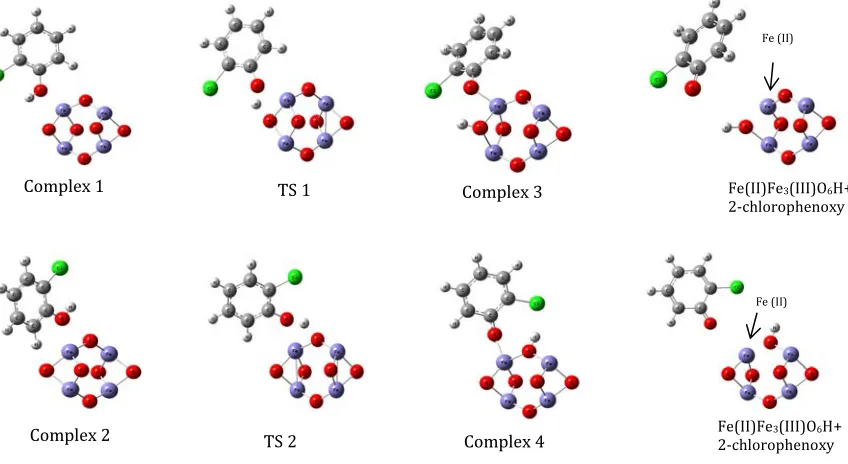
Formation of chlorophenoxy and chlorohydroxyphenoxy radicals from chlorophenol represents a crucial step in the production of PCDD/F via the precursor pathway. For the gas-phase reactions, this step may involve either the homogenous dissociation of the O-H bond requiring 362.7 kJ/mol, or bimolecular reactions between chlorophenols and radical pool necessitating modest reaction barriers, e.g., 12.5 kJ/mol for OH, and 54.8 kJ/mol for H13, 14. An example of our computations involving iron oxide clusters (Figures 1 and 2) highlights the exothermic nature of the catalytic dissociation of the O-H bonds. The size of the iron oxide cluster does not allow the initial termination of surface iron molecules by hydroxyl group, but, as illustrated in Figure 1, the initial reaction between 2-CP and iron entails the formation of surface-bound OH groups (which engender chemisorption of subsequent 2-CP molecules).
Figure 1. Optimised geometries of the complexes formed in reaction of 2-CP with Fe4O6 TS 1
TS 2 Complex 2
Complex 3 Complex 1
Complex 4
Fe (II)
Fe(II)Fe3(III)O6H+
2-chlorophenoxy
Fe (II)
Fe(II)Fe3(III)O6H+
The resulting chlorophenoxy radicals react on the catalyst’s surface via the Langmuir-Hinshelwood mechanism to produce PCDF. From the seminal work of Dellinger’s group, we know that chlorophenoxy radicals may also generate hydroxyphenoxy radicals that combine with a gas-phase chlorophenol molecules, leading to formation of PCDD via an Eley-Rideal mechanism15. Present calculations indicate that these steps remain essentially unchanged for iron surfaces. Figure 2 illustrates the potential energy surface (PES) for the formation of a 2-chlorophenoxy radical from 2-CP on an iron oxide cluster, and Table 1 presents the total and relative energies of complexes and their related transition states. The last step yields the formation of 2-chlorophenoxy radical and iron cluster that involves a reduced iron atom and an iron atom terminated by OH, with both products located 16.3 kJ/mol below the separated reactants. Clearly, in the process, iron (III) reduces to iron (II) by electron transfer from chlorophenolate to the iron, as it is also the case for copper catalyst. For comparison, Sun et al. reported the exothermicity of 97.9 kJ/mol for the formation of chlorophenoxy radical as a result of the interaction of the 2,4,5-TriCP molecule with a CuO cluster16.
Figure 2. The potential energy surface (PES) at 0 K for the reaction of 2-CP and Fe4O6
Table 1. The total energies (a.u.), zero-point energies (a. u.) and relative energies (kJ/mol) at 0 K
6-311G(d,p) ZPE 6-311+G(3df,2p) ΔE
Fe4(III)O6 -5506.08 0.02 -5506.28
Fe(II)Fe3(III)O6H -5506.75 0.04 -5506.94
2-chlorophenol -767.08 0.10 -767.21
2-chlorophenoxy -766.45 0.08 -766.55
Complex 1 -6273.18 0.12 -6273.51 -44.8
Complex 2 -6273.19 0.12 -6273.52 -69.0
Complex 3 -6273.22 0.12 -6273.54 -132.9
Complex 4 -6273.20 0.12 -6273.52 -77.1
TS 1 -6273.17 0.12 -6273.49 -1.2
TS 2 -6273.18 0.12 -6273.49 -9.7
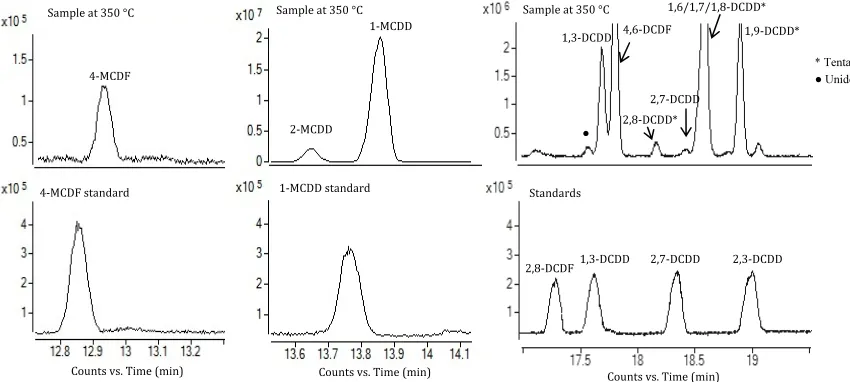
The experimental results indicate the primary DD/F products as 1-MCDD, followed by 4,6-DCDF and two isomers of DCDD, which we tentatively identified as 1,6-DCDD and 1,9-DCDD (Figure 3). The 4,6-DCDF forms by direct coupling of two surface-bound chlorophenoxy radicals (4,6-DCDF), whereas 1-MCDD is produced by one surface-bound chlorohydrophenoxy radical and one gas-phase molecule of chlorophenol, in processes established by Farquar et al. for copper surfaces4. Formation of dichlorinated DD requires coupling of two-surface bound chlorohydrophenoxy radicals, making it a less preferred route to that leading to 1-MCDD.
Figure 3. The identification of MCDD/F and DCDD congeners. Slight mismatch in residence time between samples and standards is due to different solvents used (hexane/DCM vs nonane).
Counts vs. Time (min) 4-MCDF standard
Sample at 350 °C
4-MCDF
Counts vs. Time (min) Sample at 350 °C
1-MCDD standard 1-MCDD
2-MCDD 2,3-DCDD
* Tentatively identified isomers ● Unidentified isomers of DCDF
Counts vs. Time (min) Standards
2,8-DCDF 1,3-DCDD 2,7-DCDD 2,3-DCDD 1,3-DCDD 4,6-DCDF
Sample at 350 °C
2,8-DCDD* 2,7-DCDD
1,9-DCDD* 1,6/1,7/1,8-DCDD*
Production of 4-MCDF requires dechlorination of 4,6-MCDF, resulting in minor emissions of 4-MCDF (Figure 3), as Fe2O3 is not a chlorination/dechlorination catalyst. In spite of the 99 % recovery of DF from
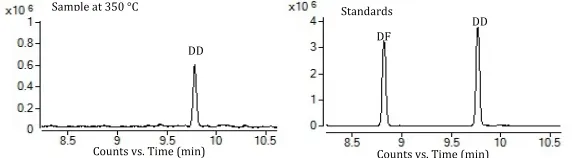
XAD-2, we have not detected DF (Figure 4), which would have to form by further dechlorination of 4-MCDF. This very characteristic result for catalytic oxidation of 2-CP has been also reported by Born et al.10 and Ryu11 for experiments involving fly ash and CuCl2 surfaces. Similarity of products formed on Cu and Fe catalysts is expected in light of the results from our DFT computations (Figures 1 and 2). From this perspective, a high yield of DF and no formation of 4-MCDF observed by Nganai et al. for Fe2O3 surface remain unexplained8,9.
Figure 4. Lack of detection of DF and identification of minor amounts of DD
Preference for chlorination of 1-MCDD in positions 3, 7 and 8 leads to the formation of minor amounts of 1,3-DCDD, 1,7-DCDD and 1,8-DCDD (Figure 3). Other DCDD (2,7 and 2,3-DCDD) products form only in trace amounts, as they require chlorination of 2-MCDD, a product which is much lower in concentration in comparison to 1-MCDD. By the same token, we observed production of trace amounts of only two TriCDD, as expected due to lack of chlorination/dechlorination functionality of Fe2O3. This observation is supported further
by detection of small amounts of 2,4-DCP, 2,6-DCP, 2,4,6-TriCP, 1,2-DCBz and 1,2,3-TriCBz in the present experiments. These species form by electrophilic halogenations of 2-CP and MCBz, in a process that could be facilitated by impurities in our Fe2O3 catalyst. The appearance of elevated amounts of polychlorinated phenols and benzenes, especially PCBz and HCBz, in the measurements of Nganai et al.8,9 is again inconsistent with the present results. Rather, one would expect enhanced emissions of these species in experiments involving fly ash and CuCl2 (or other Lewis acids such as FeCl3), as is evident in the data collected by Born et al.10 and Ryu11.
Acknowledgements
SM acknowledges the University of Newcastle for the postgraduate scholarship. We thank the Australian Research Council and the Australian National Computing Infrastructure for funding this study.
References
1. Altwicker ER, Milligan MS. (1993); Chemosphere 27(1–3): 301-7. 2. Addink R, Cnubben P, Olie K. (1995); Carbon 33(10): 1463-71.
3. Dellinger B, Lomnicki S, Khachatryan L, Maskos Z, Hall RW, Adounkpe J, McFerrin C, Truong H. (2007); Proc Combust Inst. 31(1): 521-8.
4. Farquar GR, Alderman SL, Poliakoff ED, Dellinger B. (2003); Environ. Sci. Technol. 37(5): 931-5. 5. Qian Y, Zheng M, Liu W, Ma X, Zhang B. (2005); Chemosphere 60(7): 951-8.
6. Cains PW, McCausland LJ, Fernandes AR, Dyke P. (1997); Environ. Sci. Technol. 31(3): 776-85. 7. Wang HC, Chang SH, Hung PC, Hwang JF, Chang MB. (2009); J. Hazard. Mater. 164(2–3): 1452-9. 8. Nganai S, Lomnicki S, Dellinger B. (2008); Environ. Sci. Technol. 43(2): 368-73.
9. Nganai S, Lomnicki S, Dellinger B. (2012); Chemosphere 88(3): 371-6. 10. Born JGP, Mulder P, Louw R. (1993); Environ. Sci. Technol. 27(9): 1849-63. 11. Ryu J-Y. (2008); Chemosphere 71(6): 1100-9.
12. Frisch MJ, Trucks GW, Schlegel HB. Gaussian 09, Revision A.1, Gaussian, Inc., Wallingford CT, 2009. 13. Altarawneh M, Dlugogorski BZ, Kennedy EM, Mackie JC. (2008); J. Phys. Chem A 112(16): 3680-92. 14. Altarawneh M, Dlugogorski BZ, Kennedy EM, Mackie JC. (2009); Prog. Energy Combust. Sci. 35(3):
245-74.
15. Lomnicki S, Dellinger B. (2003); J. Phys. Chem A 107(22): 4387-95.
Sample at 350 °C
DF DD
Standards
DD