Ames Laboratory Accepted Manuscripts
Ames Laboratory
11-26-2018
Reducing t1 noise through rapid scanning
Frederic A. Perras
Ames Laboratory
, [email protected]
Marek Pruski
Iowa State University and Ames Laboratory
, [email protected]
Follow this and additional works at:
https://lib.dr.iastate.edu/ameslab_manuscripts
Part of the
Materials Chemistry Commons
, and the
Radiochemistry Commons
This Article is brought to you for free and open access by the Ames Laboratory at Iowa State University Digital Repository. It has been accepted for inclusion in Ames Laboratory Accepted Manuscripts by an authorized administrator of Iowa State University Digital Repository. For more information, please [email protected].
Recommended Citation
Perras, Frederic A. and Pruski, Marek, "Reducing t1 noise through rapid scanning" (2018).Ames Laboratory Accepted Manuscripts. 302.
Abstract
The so-called t1 noise, which arises due to random instabilities in the spectrometer hardware, remains the
primary source of noise that limits the sensitivity of most 2D NMR experiments, particularly in the expanding
group of solid-state NMR methods that utilize dipolar-recoupling. In this communication we revisit the
relationship between the signal intensity and the t1 noise produced. It is shown that since the latter scales
linearly with the signal strength, the use of a conventional relaxation delay of 1.3T1 may prove far from
optimal. In cases where the fluctuations occur on a shorter timescale than the recycle delay, a considerably
faster repetition rate should be used to maximize the time sensitivity in a 2D experiment than what is used to
maximize the sensitivity in 1D. This is demonstrated with the acquisition of 1H{13C} Dipolar-mediated
Heteronuclear Multiple-Quantum Correlation (D-HMQC) type spectra in which the sensitivity could be
nearly doubled by choosing a very short relaxation delay corresponding to 0.2T1.
Keywords
2D NMR, t1 noise, Spin-lattice relaxation, D-HMQC, Solid-state NMR
Disciplines
Materials Chemistry | Radiochemistry
1
Reducing t
1Noise Through Rapid Scanning
Frédéric A. Perras
aand Marek Pruski
a,b*
aUS DOE, Ames Laboratory, Ames, IA 50011, USA
bDepartment of Chemistry, Iowa State University, Ames, IA 50011, USA
*Author to whom correspondence should be addressed. E-mail: [email protected]
Abstract
The so-called t1 noise, which arises due to random instabilities in the spectrometer hardware, remains the primary source of noise that limits the sensitivity of most 2D NMR experiments, particularly in the expanding group of solid-state NMR methods that utilize dipolar-recoupling. In this communication we revisit the relationship between the signal intensity and the t1 noise produced. It is shown that since the latter scales linearly with the signal strength, the use of a conventional relaxation delay of 1.3T1 may prove far from optimal. In cases where the fluctuations occur on a shorter timescale than the recycle delay, a considerably shorter relaxation delay should be used to maximize the time sensitivity in a 2D experiment than what is used to maximize the sensitivity in 1D. This is demonstrated with the acquisition of 1H{13C} Dipolar-mediated Heteronuclear Multiple-Quantum Correlation (D-HMQC) type spectra in which the sensitivity could be nearly doubled by choosing a very short relaxation delay corresponding to 0.2T1.
Keywords
2D NMR, t1 noise, Spin-lattice relaxation, D-HMQC, Solid-state NMR
One of the main factors limiting the application of advanced two-dimensional (2D) nuclear magnetic resonance (NMR) methods is the prevalence of t1 noise. This noise, generally, occurs due to various instrumental instabilities, which lead to random fluctuations of NMR intensities between the scans during the acquisition of the 2D dataset.[1] As a result, the Fourier-transformed 2D spectrum exhibits ridges of intense noise along the indirect dimension, wherever a peak appears in the directly-detected dimension. Common sources of t1 noise include temperature changes, magnetic field fluctuations, as well as instabilities of radiofrequency (rf) power and phase.[2] Despite the dramatically improved stability of modern NMR spectrometers, this artifact can significantly reduce the overall signal-to-noise ratio (SNR) of an otherwise sensitive experiment.
A number of solutions have been reported for reducing t1 noise, including various post processing methods[3,4,5] and spreading the t1 noise more thinly along F1 through oversampling.[6] The t1 noise from particularly strong resonances, such as those originating from solvents, can be further suppressed through presaturation.[7] Recently, Mo et al. have also demonstrated that t1 noise in lengthy 2D NOESY spectra could be significantly reduced if the experiment were cut into N shorter experiments, each consisting of 1/N scans.[8] This strategy succeeds in reducing the t1 noise resulting from slow changes in the magnetic field and temperature, which carry a smaller weight when the experiment is concluded quickly. The t1 noise may also be minimized by carefully managing the overall stability of the spectrometer performance and maintaining constant sample and ambient temperatures.[9]
In the case of magic-angle-spinning (MAS) solid-state NMR (SSNMR), by far the most important source of t1 noise is the instability in the rotor spinning.[10] The long-established methods relying on cross-polarization (CP) and spin-diffusion-based approaches are reasonably insensitive to the MAS frequency and the rotor phase.[9,10]
However, the rotation frequency can have a large impact on the signal amplitude when a recoupling experiment is used to acquire dipolar heteronuclear multiple-quantum correlation (D-HMQC)[11,12] or double-quantum single-quantum (DQ/SQ)[7] correlation experiments. The so-called non-“γ-encoded” sequences are particularly sensitive, as these require a precise control of the MAS rotor’s phase with respect to the timing of recoupling sequences. Changes in the MAS frequency (albeit not phase) can also alter the efficiency of these sequences as they depend on the ratio of the rf power and the rotation frequency being preserved.[13] As a result of these instabilities, t1 noise of this type is typically seen to increase as a function of the t1 evolution period. Lastly, secondary motional modes of the rotor, such as the in-out mode, affect the tuning of the probe and lead to changes in the rf power and phase from scan to scan. These sources of instabilities occur on a timescale that is shorter than the recycle delay and cannot, thus, be eliminated by the approach of Mo et al.[8] Recently, Nagashima et al. have attempted to address one of these sources of t1 noise, namely the sensitivity to the rotor phase, with their dipolar-heteronuclear universal-quantum correlation (D-HUQC) which makes use of γ-encoded dipolar recoupling.[14]
The abovementioned D-HMQC techniques have been recently gaining remarkable popularity as they are far more robust with respect to quadrupolar interactions and offset than CP-based approaches since only two 90° pulses are required on the indirect channel. For instance, D-HMQC experiments allow for the measurement of correlation spectra between spin-1/2 nuclei and quadrupolar nuclei,[15,16,17] between pairs of quadrupolar nuclei,[18] and to spin-1/2 nuclei with large chemical shift anisotropies.[19,20] The t1 noise is therefore, once again, an important limitation for the application of 2D SSNMR spectroscopy.
noise depends directly on the intensity of the NMR signal. This is an important distinction since most 2D SSNMR experiments are performed in such a way that maximizes the sensitivity in F2 and thus also increases the t1 noise along F1. For example, the intensity of the NMR signal in a single scan (S) following saturation is given by:
− − = 1 1 eq. 1 exp
T d S
S , (1)
where d1 is the recycling delay, T1 is the spin-lattice relaxation time and Seq. is the amplitude of signal at equilibrium, per scan. When accounting for the fact that additive noise scales only as the square root of the number of scans while the signal scales linearly, the time averaged SNR is given by:
1 eq.
1
add 1 1 exp d S T SNR N d − −
= , (2)
where Nadd corresponds to the noise level in a single scan, and is defined as a variance of the noise over all data points
2 add 1 1 n i i N N n =
=
∑
(3)with n denoting the number of data points and Ni the noise contribution to the ith data point. Independently of Seq. and Nadd, expression 2 has one maximum at d1/T1 of ca. 1.3.[21] In the absence of t1 noise, the best choice for d1 is thus 1.3T1, which is commonly used to maximize the sensitivity per unit of time.
In the presence of multiplicative noise equation 2 is no longer valid and its use can lead to important sensitivity losses. The noise level in F1 can be determined as follows:
2 2
F1 add mult
N = N + N , (4)
with Nmult expressed as:
1
mult add
1 1 exp d
N x N
T
−
= −
, (5)
where x is the ratio between the t1 and t2 noise levels at equilibrium (i.e.
with a recycle delay ˃ 5T1) and corresponds to the hypothetical multiplicative noise level from a single scan. This choice of this parameter was made as it renders the solution of the subsequent equations independent of Seq. and the exact noise levels. In direct analogy to equation 2, we can then express the signal-to-noise ratio in the F1 dimension of a 2D NMR experiment as:
1 eq. 1 2 2 1 add 1 1 1 exp
1 1 exp
d S
T SNR
d
N d x
T − − = − + −
. (6)
If we then take the derivative of equation 6 over d1 we can determine the function's maximum and determine the following relationship between x and the relaxation delay that maximizes sensitivity per unit of time:
1 1 1 1
1 1 1 1
2 1 1
exp exp 1 exp 2 1
exp 1
d d d d
T T T T
x d T − − + + = −
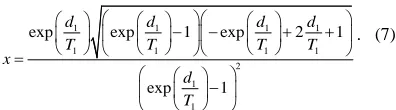
. (7)
This relationship, of course, reproduces the expected d1/T1 ratio of c.a. 1.3 when x is equal to 0 and also suggests the use of shorter relaxation delays when x > 0. Unfortunately, it is not possible to isolate d1 in order to have a convenient, and exact, closed-form solution to equation 7. If we assume that x is large (and thus d1/T1 is short) it is possible to considerably simplify equation 7 using a Taylor expansion with a first term equal to:
1
1
T x
d
= . (8)
This relationship nearly perfectly reproduces equation 7 when x ˃ 2 (see Figure 1). Accordingly, in cases where t1 noise is significant, the relaxation delay should be set to the following value in order to maximize the SNR in the F1 dimension:
add 1 1 1 mult eq.
N
T
d
T
x
N
=
=
. (9) [image:4.612.348.546.71.126.2] [image:4.612.331.546.455.644.2]The factor 〈Nadd〉/〈Nmult〉eq. includes the noise levels in F2 and F1 dimensions corresponding to a relaxation delay of 5T1, which can be easily measured. Note that our conclusion is counter to earlier suggestions that recycle delays of 5T1 should be applied to minimize t1 noise, which seems to be unnecessary if proper presaturation is performed.[1] In cases when x is relatively small the sensitivity gains available by shortening the relaxation delay are minor and thus a relaxation delay of 1.3T1 can be used. Equations 7 and 8,9 are plotted in Figure 1 where the relationship between the optimal relaxation delay and t1 noise level can be more clearly visualized.
3
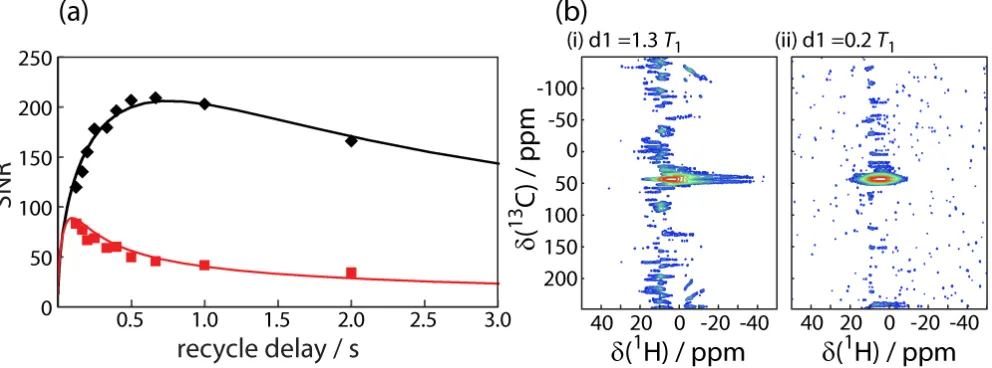
To demonstrate the improvements in SNR from rapid scanning, we have acquired 1H{13C} D-HUQC spectra of 13C,15 N-enriched glycine, using a 1.3-mm MAS probe with poor spinning stability (vide infra), a spinning frequency of ~40 kHz and relaxation delays varied between 0.125 s and 2 s. The T1 relaxation time was measured to be 0.6 s using a saturation recovery experiment. Presaturation was used in order to ensure that each scan initiated at the same steady-state. In all cases, the experiment time was maintained constant at 17 minutes. Unlike the seminal paper of Nagashima,[14] we chose to use an m = 2 heteronuclear dipolar recoupling sequence (R1852)[22] in order to decouple the 1H homonuclear dipolar coupling interactions during the heteronuclear recoupling. We have plotted the SNR that were obtained along F1 and F2 in Figure 2a and fit them using equations 2 and 5 with Seq/N = 250 and x = 6. As can be seen from the data in Figure 2, the relaxation delay which provides the highest
signal-to-noise ratio for this 2D experiment is of only 0.2 T1 rather than 1.3T1. In this case, the use of the more conventional relaxation delay of 1.3T1 would have led to a 50% reduction in SNR. This can be clearly seen in Figure 2b where we compare the 2D spectra acquired with relaxation delays of 1.3T1 and 0.2T1. Here, it is also worth mentioning that in experiments with severe t1 noise the optimal recycling delay may become shorter than the shortest allowable duty cycle. Of course, in those situations the shortest safe recycling delay should be used, which was the case in our example.
[image:5.612.58.554.263.447.2]In summary, we have demonstrated that that in case of 2D NMR measurements with strong t1 noise originating from fluctuations that are faster than the recycle delay, far shorter relaxation delays than the typically used d1 = 1.3T1 are required to maximize the sensitivity per unit of time. A simple expression is given in order to determine the appropriate value.
Figure 2. The signal-to-noise ratios measured along the F2 (black diamonds) and F1 (red squares) dimensions of 1H{13C} D-HUQC experiments lasting 17 minutes are plotted as a function of the recycling delay (a). The data are fit using equations 2 and 5 with values of Seq/N = 250, x = 4.5, and T1 = 0.6 s. Example 1H{13C} D-HUQC spectra are shown in (b) with recycling delays of 1.3T1 (i) and 0.2T1 (ii). The ‘floor’ is set to the same relative level in each case. As can be seen, although the use of a recycling delay lasting 1.3T1 yields the highest sensitivity in F2, a recycling delay of 0.2 T1 yields the highest overall sensitivity.
Experimental
All experiments were performed on a Bruker AVANCE III 400 MHz SSNMR spectrometer using a 1.3-mm MAS probe. This probe, which was designed for rapid sample changing at low-temperatures, suffers from additional instabilities caused by the VT and Venturi gas flows that increase the t1 noise. For the 1H{13C} D-HUQC experiments a 13C,15N-enriched glycine sample, purchased from ISOTEC, was used. The sample spinning frequency was set to 40 kHz and the rf magnetic fields for the 1H and 13C pulses were set to 100 kHz while those for the R1852 recoupling were of 180 kHz (4.5νR). The evolution in the indirect dimension was synchronized with the rotation frequency and a total of 128 t1 increments were acquired for each spectrum. A minimum of 4 scans were acquired with a recycling delay [1] J. Granwehr, Multiplicative or t1 noise in NMR spectroscopy, Appl.
Magn. Reson. 32 (2007) 113-156.
of 2 s and this number was increased to 64 when the recycling delay was decreased to 0.125 s. Purely absorptive phase 2D lineshapes were obtained using the States-TPPI method.
Acknowledgements
This research was supported by the U.S. Department of Energy (DOE), Office of Science, Basic Energy Sciences, Materials Science and Engineering Division. The Ames Laboratory is operated for the DOE by Iowa State University under Contract No. DE-AC02-07CH11358.
References
[3] N. Manoleras, R.S. Norton, Spectral processing methods for the removal of t1 noise and solvent artifacts from NMR spectra, J. Biomol. NMR. 2 (1992) 485-494.
[4] A. Gibbs, G.A. Morris, A.G. Swanson, D. Cowburn, Suppression of t1 noise in 2D NMR spectroscopy by reference deconvolution, J. Magn. Reson., Ser. A 101 (1993) 351-356.
[5] S. Poulding, A.J. Charlton, J. Donarski, J.C. Wilson, Removal of t1 noise from metabolomic 2D 1H-13C HSQC NMR spectra by correlated trace denoising, J. Magn. Reson. 189 (2007) 190-199. [6] J.-M. Nuzillard, R. Freeman, Oversampling in two-dimensional
NMR, J. Magn. Reson. Ser. A 110 (1994) 252-256.
[7] A.J. Robertson, M.K. Pandey, A. Marsh, Y. Nishiyama, S.P. Brown, The use of a selective saturation pulse to suppress t1 noise in two-dimensional 1H fast magic angle spinning solid-state NMR spectroscopy, J. Magn. Reson. 260 (2015) 89-97.
[8] H. Mo, J.S. Harwood, D. Yang, C.B. Post, A simple method for NMR t1 noise suppression, J. Magn. Reson. 276 (2017) 43-50. [9] J.W. Wiench, C.E. Bronnimann, V.S.-Y. Lin, M. Pruski, Chemical
shift correlation NMR spectroscopy with indirect detection in fast rotating solids: studies of organically functionalized mesoporous silicas, J. Am. Chem. Soc. 129 (2007) 12076-12077.
[10] M. Shen, S. Wegner, J. Trébosc, B. Hu, O. Lafon, J.P. Amoureux, Minimizing the t1-noise when using an indirect 1H high-resolution detection of unlabeled samples, Solid State Nucl. Magn. Reson. 87 (2017) 111-116.
[11] Z. Gan, 13C/14N heteronuclear multiple-quantum correlation with rotary resonance and REDOR dipolar recoupling, J. Magn. Reson. 184 (2007) 39-43.
[12] G. Tricot, J. Trébosc, F. Pourpoint, R. Gauvin, L. Delevoye, The D-HMQC MAS-NMR technique : An efficient tool for the editing of through-space correlation spectra between quadrupolar and spin-1/2 (31P, 29Si, 1H, 13C) nuclei, Annu. Rep. NMR Spectrosc. 81 (2014) 145-184.
[13] B. Hu, J. Trébosc, J.P. Amoureux, Comparison of several hetero-nuclear dipolar recoupling NMR methods to be used in MAS HMQC/HSQC, J. Magn. Reson. 192 (2008) 112-122.
[14] H. Nagashima, A.S.L. Thankamony, J. Trébosc, F. Pourpoint, O.
Lafon, J.P. Amoureux, γ-independent through-space hetero-nuclear correlation between spin-1/2 and quadrupolar nuclei in solids, Solid State Nucl. Magn. Reson. 84 (2017) 216-226. [15] O. Lafon, Q. Wang, B. Hu, F. Vasconcelos, J. Trébosc, S. Cristol,
F. Deng, J.-P. Amoureux, Indirect detection via spin-1/2 nuclei in solid state NMR spectroscopy: Application to the observation of proximities between protons and quadrupolar nuclei, J. Phys. Chem. A 113 (2009) 12864-12878.
[16] X. Lu, O. Lafon, J. Trébosc, G. Tricot, L. Delevoye, F. Méar, L. Montagne, Observation of proximities between spin-1/2 and quadrupolar nuclei: which heteronuclear dipolar recoupling method is preferable, J. Chem. Phys. 137 (2012) 144201.
[17] Q. Wang, Y. Li, J. Trébosc, O. Lafon, J. Xu, B. Hu, N. Feng, Q. Chen, J.-P. Amoureux, F. Deng, population transfer HMQC for half-integer quadrupolar nuclei, J. Chem. Phys. 142 (2015) 094201. [18] S. Xin, Q. Wang, J. Xu, N. Feng, W. Li, F. Deng, Solid State Nucl.
Magn. Reson. 84 (2017) 103-110.
[19] A.J. Rossini, M.P. Hanrahan, M. Thuo, Rapid acquisition of wideline MAS solid-state NMR spectra with fast MAS, proton detection, and dipolar HMQC pulse sequences, Phys. Chem. Chem. Phys. 18 (2016) 25284-25295.
[20] F.A. Perras, A. Venkatesh, M. P. Hanrahan, T. W. Goh, W. Huang, A.J. Rossini, M. Pruski, Indirect detection of infinite-speed MAS solid-state NMR spectra, J. Magn. Reson. 276 (2017) 95-102. [21] J.S. Waugh, Sensitivity in Fourier transform NMR spectroscopy of
slowly relaxing systems, J. Mol. Spec. 35 (1970) 298-305.