Ann. Geophysicae 14, 1134—1150 (1996) (EGS — Springer-Verlag 1996
Low-frequency waves in the Earth’s magnetosheath: present status
S. J. Schwartz, D. Burgess, J. J. Moses
Astronomy Unit, Queen Mary and Westfield College, Mile End Road, London E1 4NS, United Kingdom Received: 31 January 1996/Revised: 30 April 1996/Accepted: 29 May 1996
Abstract. The terrestrial magnetosheath contains a rich variety of low-frequency ([proton gyrofrequency) fluctu-ations. Kinetic and fluid-like processes at the bow shock, within the magnetosheath plasma, and at the mag-netopause all provide sources of wave energy. The domi-nance of kinetic features such as temperature anisotropies, coupled with the high-bconditions, complicates the wave dispersion and variety of instabilities to the point where mode identification is difficult. We review here the ob-served fluctuations and attempts to identify the dominant modes, along with the identification tools. Alfve´n/ion-cyclotron and mirror modes are generated by¹
M/¹E'1 temperature anisotropies and dominate when the plasma
b is low or high, respectively. Slow modes may also be present within a transition layer close to the subsolar magnetopause, although they are expected to suffer strong damping. All mode identifications are based on linearized theory in a homogeneous plasma and there are clear indications, in both the data and in numerical simulations, that nonlinearity and/or inhomogeneity modify even the most basic aspects of some modes. Additionally, the deter-mination of the wave vector remains an outstanding ob-servational issue which, perhaps, the Cluster mission will overcome.
1 Introduction
The interaction of the super-magnetosonic solar wind flow with the obstacle of the Earth’s magnetic field results in the formation of a magnetospheric cavity bounded by the magnetopause and a bow shock upstream thereof. The layer in between these two surfaces, known as the mag-netosheath, enables the incident solar wind flow, reduced to sub-magnetosonic speeds by the shock, to be diverted around the magnetosphere. The magnetosheath is a
re-Correspondence to: S. J. Schwartz
gion rich in wave modes which in turn carry information and redistribute energy and momentum from the bow shock to the magnetopause and vice versa. Since it is the magnetosheath which ultimately delivers solar wind material to the magnetosphere, the extent to which the magnetosheath modifies the solar plasma has important implications for the basic solar-terrestrial interaction.
Several aspects of the magnetosheath complicate our understanding. The dissipation provided by the bow shock results in high kinetic temperatures, so that the plasmabis large and the magnetic field is unable to order the plasma into a nearly laminar flow. It is a collisionless plasma, so that anisotropies, particle beams, unequal spe-cies temperatures, and other features are preserved unless collisionless processes, such as wave-particle scattering, are able to bring the plasma toward equilibrium. It is a non-uniform medium with substantial gradients over scales from thousands of kilometers or less (corresponding to foreshock-related turbulence) to several Earth radii (corresponding to the distance between the bow shock and magnetopause) or longer (corresponding to changes along the bow shock from perpendicular to quasi-parallel orientations of the interplanetary magnetic field with respect to the local bow shock normal). It is observed to be highly turbulent; that is,O(1) fluctuations in mag-netic field, density, and bulk flow velocity are usually present over a broad range of frequencies (see also Lacombe and Belmont, 1995; Hubert, 1994; Omidiet al., 1994; Onsager and Thomsen, 1991; Fazakerley and Southwood, 1994b).
rotational discontinuities which are also found in the magnetosheath. Additionally, transient processes at the bow shock (e.g., hot flow anomalies, see Schwartzet al., 1988; Thomsen et al., 1988a; Paschmann et al., 1988; Schwartz, 1995) and at the magnetopause (e.g., flux trans-fer events, Russell and Elphic, 1978; Farrugiaet al., 1988 and surface waves e.g., Sibecket al., 1989; Sibeck, 1992) give rise to transient fluctuations in the magnetosheath.
In the next section, we give an overview of the main postulated sources of magnetosheath waves and their basic observational characteristics. We then turn to a dis-cussion of mode identification via various linear theories and derived tools. We study in more detail the observa-tions and identification of the Alfve´n/ion-cyclotron, mir-ror modes, and slow/sound waves. Our discussion section includes recommendations and requirements to advance this subject further.
For further reference, we define below the various quantities and symbols used in this study. SI units are used throughout.
Symbol Formula Quantity
Bo Magnetic field
Ao Vector potential (Coulomb
gauge+·Ao"0)
¹ Temperature
P Pressure
P
B B2/2k0 Magnetic pressure
n Number density
o Mass density
»o Bulk velocity
b P/(B2/ 2k
0) Plasma beta
‘‘o’’ Average or background
values
‘‘E’’ [‘‘¡’’] Component along [perpendicular to]Bo
0
‘‘j’’ Species ‘‘j’’ only
v
A B
0/Jk0o0 Alfve´n speed
d Fluctuating component
u Wave angular frequency
ko Wave vector
ur[c] Reu[Imu] Real frequency [growth rate]
Xc qB/m Cyclotron frequency
up Jnq2/me
0 Plasma frequency
2 Magnetosheath waves:
sources and observational overview
There are several candidate sources for fluctuations ob-served in the magnetosheath. These range from processes upstream of or at the bow shock (including the ambient solar wind turbulence) to local processes within the mag-netosheath to the magnetopause itself. Local wave genera-tion/amplification occurs due to non-Maxwellian features of the particle distribution (later we discuss various fluid and kinetic descriptions of wave modes). Such kinetic features are often products or remnants of processes oc-curring more remotely, e.g., at the bow shock. It is also possible to detect systematic trends in both the waves and
particles through the magnetosheath due to wave propa-gation and generation mechanisms which dominate under different regimes (e.g., low b versus high b) and to the macroscopic magnetosheath draping and flow diversion about the magnetosphere. Such trends help confirm, by inference, the operation of particular local wave genera-tion mechanisms. Krauss-Varban (1994) reviews the gen-eral problem of mode transmission and coupling through the bow shock and inhomogeneous magnetosheath plasma. Other general studies and reviews are also helpful (Hubert, 1994; Lacombe and Belmont, 1995; Omidiet al., 1994; Onsager and Thomsen, 1991).
2.1 Reflected-gyrating ions at the quasi-perpendicular shock
Super-critical collisionless fast magnetosonic shock waves, such as large portions of the Earth’s bow shock, for which the angle between the upstream magnetic field and the shock normal is'45°, dissipate the incident bulk flow energy primarily via a coherent reflection process in which a fraction of the incident ion population is turned around at the main shock ‘‘ramp.’’ In this geometry, such reflected ions gyrate around the upstream field and return to the ramp because of their guiding centre motion. At this second encounter they pass into the downstream region where, in this idealized picture, they form a partially filled ring beam distribution, which gyrates around the initially transmitted core population (Paschmann et al., 1982; Sckopkeet al., 1983; Gosling and Robson, 1985).
There are two consequences of this behaviour. Firstly, the mutual gyration of the core and reflected components in the downstream region establishes a spatially coherent overshoot, undershoot and successive oscillations about the mean downstream field. This nonlinear structure, which stands in the downstream flow and is attached to the ramp, imposes a non-uniform background state which any subsequent instability must grow on and/or compete with. Secondly, the combined core/ring-beam distribution possesses an effective temperature anisotropy with ¹
M/¹E'1 which is unstable to Alfve´n/ion-cyclotron waves under low b conditions and to mirror modes at highb(Garyet al., 1993b; Lacombeet al., 1990; Lacombe
et al., 1992; McKean et al., 1995). As we move toward the magnetopause, the imposed structure, waves and instabilities evolve.
2.2 Quasi-parallel shock
Under quasi-parallel geometries, when the upstream field in within&45°of the shock normal, particles traverse the shock in both directions, with the guiding centre motion of any reflected ions now directed upstream. The result is an extended foreshock region with populations of ener-getic ‘‘diffuse’’ ions and large amplitude ULF turbulence (dB/B
0Z1). The turbulence interacts with, and accelerates,
flow. Such trains of short ‘‘pulsations’’ (Greenstadtet al., 1977; Thomsen et al., 1990b) or short large amplitude magnetic structures (SLAMS) (Schwartz, 1991) mask or replace a distinct shock transition, at least under some circumstances (Thomsen et al., 1988b; Schwartz and Burgess, 1991). Under such conditions, the mag-netosheath, like the quasi-parallel foreshock and shock, becomes a patchworked structure of dense warm regions (of plasma which has not suffered significant heating due to ion reflection from transient quasi-perpendicular fields) and less dense hot regions (heated via ion reflection and strong beam-plasma coupling) (Gosling et al., 1989; Thomsenet al., 1988b; Thomsen et al., 1990a; Schwartz and Burgess, 1991). This pattern persists well downstream of the quasi-parallel shock, suggesting that the variations seen here are merely the imposed spatial structure formed upstream/near the shock transition. Fuselieret al. (1994), however, report spectral features and an inverse temper-ature anisotropy/beta correlation in the quasi-parallel magnetosheath which is similar to that found under quasi-perpendicular geometries, suggesting similar local pro-cesses and wave generation in both cases.
2.3 The magnetopause itself
Ultimately it is the magnetopause which drives the bow shock, and which therefore must influence the mag-netosheath through which magnetopause signals are car-ried upstream. In simple MHD terms, one would expect three transitions, corresponding to the fast mode (e.g., the bow shock), intermediate mode/rotational discontinuity, and slow mode all standing sequentially at the points in the magnetosheath flow, which progressively decelerates from the super-fast magnetosonic solar wind flow down to sub-slow magnetosonic speeds near the sub-solar mag-netopause. Each such nonlinear front can amplify or mod-ify the waves passing through it. There is some evidence for a standing slow mode structure (Songet al., 1992a). The detection of slow mode waves, which should be heav-ily Landau damped in the highbmagnetosheath plasma, downstream of this transition is less conclusive at this stage. No one has reported to date any analogous fast mode waves propagating from the magnetopause to the fast mode bow shock, although the isotropic rather than guided nature of the fast mode does not lend itself to easily identifiable characteristics in the turbulent mag-netosheath.
Additionally, near the sub-solar portion of the mag-netopause the magnetic field lines drape around the nose of the obstacle. This results in perpendicular compression of the field, a depletion of the total plasma density, and a temperature anisotropy¹
M'¹E(Crookeret al., 1979; Anderson and Fuselier, 1993; Zwan and Wolf, 1976). Thus the temperature anisotropy in this ‘‘plasma depletion layer’’ can drive Alfve´n/ion-cyclotron or mirror instabili-ties. Finally, the magnetosheath flow interacts with the magnetopause via magnetic reconnection and via a gener-ally sheared flow (e.g., on the flanks of the magnetopause) resulting in sources of surface waves, Kelvin-Helmholtz instabilities, or other disturbances there.
2.4 Magnetosheath processes
In performing its role of slowing and diverting the incident solar wind flow about the magnetosphere, the mag-netosheath imposes systematic gradients in field and plasma parameters, as recent superposed epoch analyses reveal (Phan et al., 1994; Hill et al., 1995). The field line draping and consequent compression perpendicular to
Bo operates throughout the magnetosheath to drive or maintain a¹
M/¹E'1 anisotropy, although only near the sub-solar magnetopause is the effect dramatic enough to warrant the distinction of a separately named region (the depletion layer discussed earlier). As we have seen, these anisotropies drive local instabilities and/or enhance exist-ing fluctuations. Moreover, structures in the mag-netosheath, e.g., a rotational discontinuity, can amplify or modify the fluctuations passing through it (Omidi and Winske, 1995; see also Fig. 11 later).
2.5 Observational overview
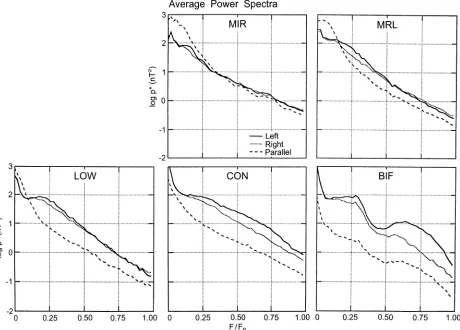
As a brief introduction to the observed fluctuations, Fig. 1 shows average power spectra for five categories of tur-bulence downstream of the quasi-perpendicular shock. Although categorized on the basis of magnetic spectral characteristics, these spectra also represent a transition from highb, low anisotropy (¹
M/¹E[1.5) (upper left plot) to low b, high anisotropy (¹
M/¹E&5) regimes (lower right). At highbthe fluctuations extend smoothly to low frequencies and are predominantly compressive; that is, the parallel field component contains most of the wave power. As we progress to lower b, higher anisotropy conditions, the transverse components become dominant, with the left-hand component systematically larger, and spectral features/peaks appear below frequencies corres-ponding to the proton and alpha particle gyrofrequencies. This progression withbmay be a simple consequence of linear plasma instability theory (Dentonet al., 1994b) (see Sects. 5 and 6). The final set of spectra (bottom right) show two peaks, which are probably indicative of the simulta-neous presence of alpha and proton Alfve´n/ion-cyclotron modes. Dentonet al. (1995) have gone on to consider the characteristic plasma variations for fluctuations near the sub-solar magnetopause. Systematic studies of wave/ plasma variations within the magnetosheath, however, have not been carried out, although isolated case studies have been performed (Lacombeet al., 1995; Leckbandet al., 1995; Songet al., 1992a, b).
3 Wave modes
Fig. 1. Classes of magnetic power spectra found within the mag-netosheath. Thetop leftMIR spectra show predominantly parallel (i.e., compressive) fluctuations peaking at low frequencies and identi-fied as mirror modes. There is a steady progression to thebottom right panelwhich is dominated by two higher frequency left-hand polarized peaks corresponding to alpha particle and proton
cyclo-tron modes. The progression also proceeds, though not by any selection criteria, from high-b, low ¹
M/¹E([1.5) to low-b, high ¹
M/¹
E(&5) conditions and thus suggests the operation of the mirror
and Alfve´n/ion-cyclotron instabilities under their respectively ap-propriate conditions. (Fig. 5 of Andersonet al., 1994)
sort in a homogeneous infinite medium. By contrast, the magnetosheath is a highly inhomogeneous medium with significant influences of its bounding regions and imposed structure on several scales. Finally, while the rather long length and time scales of the vast majority of the fluctu-ations suggest that fluid-like theories should be adequate to describe them, we know that there are kinetic effects which play important roles. Thus the most basic of ques-tions, e.g., ‘‘Do a particular set of fluctuations correspond to mirror modes or slow modes?’’ poses several potential pitfalls in reaching an answer. We thus begin here by describing the wave modes found via different theoretical frameworks.
3.1 Isotropic MHD waves
Linearized ideal isotropic MHD theory admits three well-known propagating wave solutions. All are linearly dis-persive, that is the phase velocity is independent of the wavelength. There is also a fourth zero-frequency mode, referred to as anentropymode, which is often ignored. The
entropy mode represents a spatially structured medium in static equilibrium.
The intermediate/Alfve´n wave is a non-compressive mode which is guided along the magnetic field; i.e., its group velocity is field-aligned. The velocity and magnetic field perturbations are parallel (or anti-parallel) to one another and are linearly polarized in the transverse direc-tion, i.e., alongko]Bo
0. The oscillations are supported by
the magnetic tension, leading to a phase velocity whose component alongBo
0is the Alfve´n speedvA.
The other two MHD modes are polarized in theko—Bo0
plane. The fast magnetosonic mode is compressive, with both magnetic and thermal pressure working in phase to provide the restoring force which supports the wave. This mode is nearly isotropic in the sense that the phase speed varies only weakly with direction, being largest at propa-gation perpendicular to Bo
0. By contrast, the slow mag
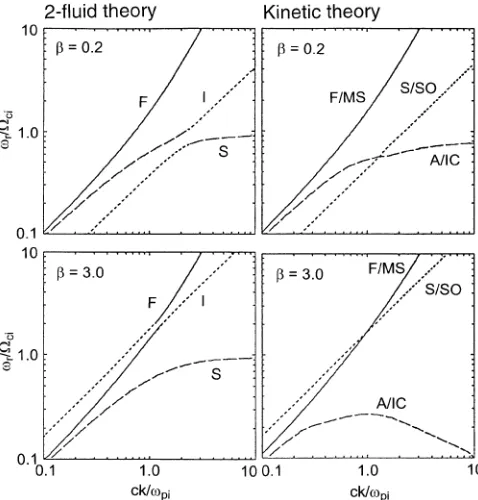
Fig. 2. Comparison of dispersion curves u(k) for obliquely propagating waves (hkBo"30°) as derived via two-fluid Hall MHD
(left panels) and kinetic theory (right panels). At lowb(top panels) the two fluid fast (F) mode corresponds to the kinetic fast magnetosonic (F/MS) mode. The two-fluid intermediate mode (I) behaves like the Alfve´n/ion-cyclotron (A/IC) at low frequencies and like the slow/sound (S/SO) above the ion cyclotron frequencyXci. The two-fluid slow mode (S) corresponds more closely to the slow/sound (S/SO) kinetic solution at low frequencies and to the Alfve´n/ion-cyclotron wave nearur&X
ci. At highb(lower panels) none of the modes in two-fluid theory correspond to a single kinetic mode, (from Krauss-Varbanet al., 1994, Fig. 1)
The three modes of ideal MHD are always ordered in phase speeds with the intermediate/Alfve´n wave lying between the fast and slow magnetosonic waves. Finally, it is worth bearing in mind that these ideal MHD modes are all purely oscillatory; there are no instabilities in lin-earized, homogeneous ideal MHD theory.
3.2 Anisotropic MHD waves
We have seen earlier that the magnetosheath plasma is not isotropic, and thus the application of isotropic MHD theory may be inadequate. Some improvement may be gained by including two equations of state, e.g., via CGL theory (Chewet al., 1956), to describe the plasma pressure parallel and perpendicular to the field. The result is a set of equations whose linearized forms yield three wave modes (Abraham-Shrauner, 1967) (more recently generalized to double polytropic equations of state (Hau and Sonnerup, 1993)) which are the counterparts of the three isotropic MHD modes. The Alfve´n wave remains transverse but becomes thefirehose instabilityforP
0E'P
0M#B2
0/k0. As
in isotropic MHD, the square of the wave frequencies are always real, so the firehose instability is non-oscillatory and grows with time. Thefast magnetosonicwave behaves very similarly to its isotropic MHD namesake. Finally, theslow magnetosonicmode becomes themirror instability
for anisotropies satisfying
P
0M
P
0E
'6
A
1# B20 2k0P0M
B
(1)
The lowest threshold corresponds to wave-vectors per-pendicular to the background magnetic field.
Interestingly, although it is possible to recover the isotropic MHD equations (with c"5/3) from the CGL set by lettingP
M"PE(Dentonet al., 1994a), this is equiva-lent to introducing a process which instantaneously redis-tributes energy between the perpendicular and parallel degrees of freedom. As a consequence, the dynamics of superficially equivalent phenomena are different. For example, at propagation parallel to Bo
0, the slow mode
phase speed is J5P
0/3o0 in isotropic MHD and
J3PoEo0 in CGL. Although in this case the CGL slow
mode does induce perturbations in PM, these have no dynamic role; that is, they do not enter the equation of motion.
3.3 Two-fluid/Hall MHD waves
Although the magnetosheath waves are generally domin-ated by low-frequency fluctuations, the power spectra (see Fig. 1) extend well above the proton cyclotron frequency. This is not surprising, as we have already seen that the sources of the waves are usually linked to distinct particle behaviour. Thus, the MHD assumption of frequencies well below the cyclotron frequency and wavelengths lon-ger than a Larmor radius may not be appropriate. The next improvement to the wave theory is thus to retain finite Larmor radius effects via a two-fluid approach,
treating the ions and electrons separately (Stringer, 1963). For waves dominated by the ions, a simplification can be achieved by ignoring the electron inertia, leading to the Hall MHD equations. See Krauss-Varbanet al. (1994) for a review of two-fluid/Hall wave solutions, which are sum-marized in the left two panels of Fig. 2. The Hall MHD modes are always ordered in phase speed and can be simply related to their MHD counterparts at low frequen-cies. At higher frequencies, the finite Larmor radius/Hall corrections result in nonlinear dispersion, with the fast mode becoming positively dispersive (ultimately to join the whistler branch) and the slow mode negatively disper-sive with a cutoff at the cyclotron frequency. The inter-mediate mode (Alfve´n mode at low frequencies) becomes acoustic at high frequencies, and its dispersion at moder-ate frequencies is thus opposite at low and highbin order to achieve a slope equal to the sound speed at high frequencies from its low-frequency beginnings.
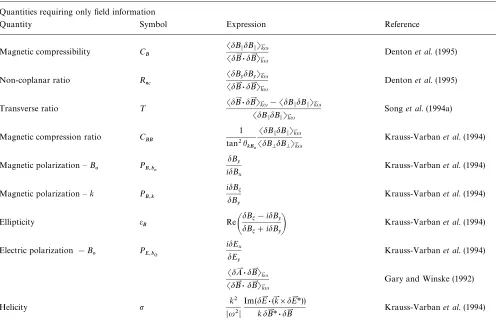
[image:5.573.304.543.400.650.2]Table 1.Transport ratios, polarizations, and other quantities for mode identification Quantities requiring only field information
Quantity Symbol Expression Reference
Magnetic compressibility C
B Sd
BEdBETkou
SdBo·dBoTkou Denton
et al. (1995)
Non-coplanar ratio R
nc
SdBydByTkou
SdBo·dBoTkou
Dentonet al. (1995)
Transverse ratio ¹ SdBo·dBoTkou
!SdBEdBETk ou
SdBEdBETkou
Songet al. (1994a) Magnetic compression ratio C
BB
1 tan2hkB
0
SdBEdBETkou
SdBMdBMTkou
Krauss-Varbanet al. (1994)
Magnetic polarization— B0 PB,b 0
dBy
idBx Krauss-Varbanet al. (1994)
Magnetic polarization— k P
B,k
idBm
dBy Krauss-Varbanet al. (1994)
Ellipticity eB Re
A
dBm!idB
y
dBm#idB
y
B
Krauss-Varbanet al. (1994)
Electric polarization!B
0 PE,bo
idEx
dEy Krauss-Varbanet al. (1994)
SdAo·dBoTkou SdBo·dBoTkou
Gary and Winske (1992)
Helicity p k2
Du2D
Im(dEo ·(ko]dEo*))
kdBo*·dBo Krauss-Varbanet al. (1994)
3.4 Kinetic/Vlasovwaves and instabilities
Kinetic theory readily takes into account multi-species plasmas, finite Larmor radii, temperature anisotropies, particle beams, and other phenomena which contribute to the plasma state of the magnetosheath. Although the linearized wave modes are more difficult to calculate (Stix 1992), widely available tools such as WHAMP (Ro¨nmark, 1982) considerably ease the burden. Even in the relatively simple case of an isotropic proton-electron plasma at low frequencies the kinetic results deviate significantly from fluid treatments, as can be seen by comparing the left and right-hand panels of Fig. 2. In the kinetic treatment par-ticles can exchange energy with the waves, giving rise to complex frequencies corresponding to wave growth or damping. Thus modes may cross in a diagram of Reu
versusk; the degeneracy is often removed in the complex plane. At highb, as typically found in the magnetosheath, the kinetic modes lose much of their resemblance to their fluid counterparts. The Alfve´n/ion-cyclotron mode now becomes the slowest mode and actually shows real fre-quencies which decrease as the wave number is increased to large values, although the mode is heavily damped at these wave numbers. The fast mode, whose dispersion progresses smoothly toward the whistler regime, is slower at low frequencies than the ‘slow/sound’ mode. Addition-ally, kinetic theory admits a fourth wave mode which can be identified as the mirror mode (see Fig. 8 and Belmontet al., 1992). It has zero rest frame frequency and is lightly
damped in a simple Maxwellian plasma, but can be unsta-ble in a (¹
M/¹E'1) plasma (see later) with a growth rate which confirms qualitatively but not quantitatively the CGL result in Eq. (1).
To make matters worse, the inclusion of multiple spe-cies, beams, anisotropies, etc., also introduces significant changes to the wave modes. At the most basic level, such kinetic deviations from thermal equilibrium can cause certain modes to become unstable and grow. Other grow-ing modes, e.g., certain ‘‘beam modes’’, owe their existence to non-equilibrium conditions (Gary, 1993).
The sensitivity of kinetic modes to the zeroth order distribution functions has generated a whole industry of calculating dispersion and mode properties on the one hand, and added substantial complexity in the process of mode identification on the other. Before turning to this problem of identification, we draw here an obvious con-clusion to the subject of linear wave theory: for most aspects of space plasmas, and certainly for the waves observed in the magnetosheath, fluid-based descriptions of any kind are inadequate, particularly under theb'1 conditions found there. And we have not yet considered complications due to inhomogeneity and nonlinearity!
3.5 Mode identification
Table 1.Continued
Quantities requiring plasma parameters
Quantity Symbol Expression Reference
Density-field ratio Cpj dnj
n0j B0
dBE Lacombe and Belmont (1995)Krauss-Varbanet al. (1994)
Parallel compressibility CEj,Re C
pj Sd
njdBETkou n
0jB0
B20
SdBEdBETkou Gary and Winske (1992)
Parallel phase ratio RE
njorCnBEj SdnjdBETkou JSdnjdnjTkouJSdBEdBETkou
Dentonet al. (1995) Lacombeet al. (1992)
Compressibility Cj SdnjdnjTkou n20j
B2 0
SdBo·dBoTkou
Krauss-Varbanet al. (1994)
Alfve´n ratio RAj Sd
»o
j·d»o
jTkou v2
A
B02
SdBo·dBoTkou Dentonet al. (1995)
Compressional ratio CPj SdPjdPjTkou P20j
B2 0
SdBo·dBoTkou
Songet al. (1994a)
Partition ratio Pj dPj
P 0j
PB 0
dPB Songet al. (1994a)
Doppler ratio Dj Sd
»o
j·d»o
jTkou »2
0
B02
SdBo·dBoTkou
Songet al. (1994a)
Cross helicity pcj 2
vAB0
Sd»o
j·dBoT
Sd»o
j·d»o
jTkou v2A
#SdBo·dBoTkou B20
Gary and Winske (1992)
1. Here the Alfve´n speedvAis calculated using only the proton mass density, i.e.,vA"B 0/Jk0o01
2. In this table, for any parametera, the symboldais the complex Fourier amplitude of the fluctuation, i.e.,a"a
0#daexpi(ko ·xo!ut).
3. The angle bracketSdadbTkourepresents the Fourier transform of the correlation functionCab(xo,xo@,t,t@). In terms of the Fourier amplitudes,
SdadbTkou"12(da*db#db*da). See Gary and Winske (1992) Eqs. (1—4). These relations assume stationary and homogeneity
4. We have introduced the nomenclature ‘‘density-field ratio’’ and reverted to the symbolC
pjused by Lacombeet al. (1992) to distinguish this quantity from the parallel compressibility, as in the past the same name and symbol have been used for both. Note thatC
pjis a complex quantity containing phase information (which is also accessible viaREnj)
5. We have corrected/been informed of (D. Krauss-Varban, private communication) several misprints in Krauss-Varbanet al. (1994). These include:
(a) The middle expressions in (A14) and (A15) should have 4no
01instead of the appearance of 4noj; that is, the normalization (and Alfve´n speed) is with respect to the proton mass density. In the final expressions in (A14) and (A15) the ratiosop/ojare to be interpreted as the ratios of the background mass densities. These final expressions are correct apart from a factor of sign (qj) which should multiply that in (A15)
(b) The middle expression in (A8) should be the imaginary part of the expression given. The final expression in terms ofamis correct (c) The specification ‘‘out of (in)’’ in the last paragraph on p5995 should be transposed to read ‘‘in (out of )’’
mode is. Given a background plasma state, a wave mode is a normal mode or eigenstate of the system. The eigen-value is usually taken to be the (complex) wave frequency
u, with the (real) wave vectorko prescribed. The associated eigenvector is the set of fluctuating fields (dEo,dBo) and plasma parameters (d»o,dP,do in the case of MHD or
df
j(vo) for kinetic waves). Mode identification is the pro-cess of comparing the observed eigenvalue/eigenvector with the possible theoretical ones and finding the one which matches.
The practical implementation of mode identification is strewn with pitfalls and complications, including: f There is usually a mixture, possibly phase-coherent, of
modes and/or frequencies, rather than an isolated mode.
f Frequencies are often Doppler shifted by an unknown, or poorly known, amount.
f Wave vectors are difficult to determine from the one-(or few-) point measurements available from spacecraft. f The mode eigenstate can depend sensitively on the wave vector, plasmab, and temperature anisotropy, as well as on the contributions of multi-species or non-Maxwellian kinetic features.
f Wave amplitudes are often large (of order unity), imply-ing nonlinear processes may be present and distort the eigenstate from its linear form, or give rise to intrinsi-cally nonlinear eigenstates.
f Similarly, inhomogeneities can distort the wave propa-gation or eigenstate in ways which have largely been unexplored.
f As we have seen, the theoretical wave properties depend on the framework in which the theory is performed. There is a trade-off between the simplicity/dubious ap-plicability of MHD or fluid treatments and the com-plexity associated with the infinite degrees of freedom of kinetic theory.
Fortunately, there are only a few modes in the fre-quency range of consideration here. Thus, it is only neces-sary to establish a few key pieces of information to distin-guish amongst these modes, as opposed to testing the complete eigenvector. Initially, only a few quantities were used in this process. These included the degree and han-dedness of the polarization of the magnetic field, the relative power in parallel versus transverse magnetic field fluctuations, in density fluctuations, etc. An ever-growing set of non-dimensional quantities, including ‘‘transport ratios’’ (Gary and Winske, 1992), polarizations, and other ratios has been devised. An extensive list is shown in Table 1. These ratios encapsulate distinctive aspects of the mode eigenvector, reducing the detail demanded from the observations, although many of the pitfalls itemized al-ready remain problematical. Of particular concern is the sensitivity of some kinetic instabilities to background parameters, and to the dilution/contamination arising from a mixture of modes and/or frequencies. In general, ratios used for mode identification should be independent of reference frame, to avoid problems associated with Doppler shift or normalization to a parameter which is not fixed from one episode to the next (this view is not universally shared, however, as evidenced in the Doppler ratio of Songet al., 1994b). Table 1 shows a preponder-ance of ratios based entirely on the magnetic field. This emphasis has more to do with history and the relative completeness/higher sampling frequency of the field data by comparison with the plasma data than with the intrin-sic capability of mode identification based on the mag-netic field alone. These remarks are particularly relevant to the high b conditions found in the magnetosheath, where the plasma dominates the field dynamics.
In Table 1 the subscript ‘‘j’’ refers to speciesp,e, . . . for protons, electrons, etc., withn,»o andPcorresponding to the species’ density, bulk velocity, and thermal pressure respectively. Subscripts ‘‘o’’ denote background quantit-ies. The coordinate system used is that of Krauss-Varban
et al., (1994) in whichBo
0"B
0zL and the wave-vectorko lies
in thexL—zL plane. The unit vectormo lies in this plane and is perpendicular to ko so that mª ,yL,kK form a right-handed system. The yL direction is sometimes referred to as the noncoplanar direction. Transport ratios are defined in terms of the ratio of (cross)-correlation functions of fluctu-ating quantities. Under the assumption that the state is turbulent, stationary and homogeneous, such correlation functions can be Fourier analyzed and related to the complex Fourier amplitudes of the fluctuations. The
oper-ator SdadbTkou denotes such a Fourier transform of the
cross-correlations between fluctuations in aandb(Gary and Winske, 1992).
There are two ways in which to apply the ratio proach to mode identification. The more traditional ap-proach, stylized to the extreme in Fig. 1 of Song et al. (1994b), builds a decision tree in which a single ratio is used to eliminate some possibilities and choose which branch to follow further. Quantities such as a measure of the compressibility of the mode, phase between density and field fluctuations, transverse/non-coplanar field com-ponent and handedness of polarization are often parti-cularly useful, although the last of these requires know-ledge of the wave vector and phase velocity relative to the flow velocity. Application of such a tree structure, either algorithmically or case by case, is quite natural. The obvious danger of the tree approach is that an incorrect choice at a single node can be fatal. Such fatal choices can be induced by measurement errors, noise, or contamina-tion of the eigenstate by the presence of more than one mode, nonlinearity, etc. Moreover, some information, which might be at odds with the final identification, may not be used if it only appears along some branches.
The alternative extreme applies a set of ratios, carefully chosen and weighted, together to measure the ‘‘distance’’ between an observed fluctuation and various theoretical ones in an N-dimensional ratio space, as exemplified re-cently by Dentonet al. (1995). This approach is also quite natural, with the benefit of never relying on any single ratio (and hence any single aspect of the observation) to eliminate possibilities. The problem lies in choosing a set of transport ratios from the list shown in Table 1 plus others yet to be invoked and in deciding how close is close enough to make a positive identification. The selected set should not bias the distance measure by repeated addition of essentially the same information. Worse still, the dis-tance measure can allow positive identification even when one of the ratios on its own would exclude it, such as accepting an observation as being a parallel propagating Alfve´n/ion-cyclotron mode when in fact it is right hand polarized. The method tries to cope with reality by estab-lishing that the observed fluctuations are at least closer to this mode than that one, and thus leaves the door open for further scrutiny.
In practice, both extremes should be applied with cau-tion, and both will cope adequately most of the time or fail simultaneously due to deficiencies in the data or appli-cability of the theory. Both these approaches rely on a comparison of the observations with expected values as derived from a particular theoretical framework. It should also be possible to classify the observations on their own, i.e., looking for clumps of observed events in some N-dimensional parameter space without an a priori attempt to pin down a particular theoretical mode. The average field spectra shown in Fig. 1 are an example of such an approach at a qualitative level and relying exclusively on field data.
Fig. 3. Contours of constant maximum growth rate cm in the b -anisotropy plane for the Alfve´n/ion (proton)-cyclotron (solid curves) and mirror (dashed) instabilities. The Alfve´n/ion-cyclotron instabil-ity is more weakly dependent onbpand requires a smaller¹
M/¹Eat
bp&1 for significant growth, (Fig. 2 of Garyet al., 1993b)
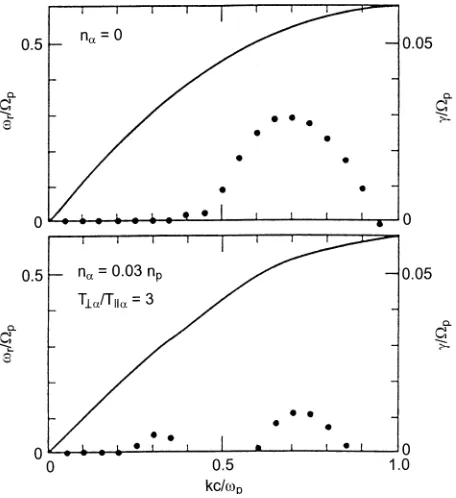
Fig. 4. Real frequencies (solid) and growth rates (dots) for the
paral-lel-propagating Alfve´n/ion-cyclotron instability in the case of no alpha particles (top) and a 3% alpha particle concentration (bottom). Proton parameters are bp"0.25 and ¹
Mp/¹E
p"2.5. The alpha
particles have¹E a"¹E
pand¹ Ma/¹E
a"3. The addition of
anisot-ropic alpha particles introduces a second region of instability at
ur[Xcawhich can be identified as an Alfve´n/ion (alpha)-cyclotron mode, (from Fig. 3 of Garyet al., 1993b)
fluid-like equations in an attempt to address the identi-fication of compressive, ULF fluctuations via observa-tions of fluid parameters. This also sheds light on the connection between MHD and kinetic solutions of the wave dispersion problem.
4 Fast magnetosonic/whistler waves
To date, no systematic study or search has reported low frequency fast modes in the magnetosheath. Even at large
bthe fast/magnetosonic mode of kinetic theory (as defined by Krauss-Varbanet al., 1994) is only lightly to moder-ately damped away from the cyclotron resonances and becomes the whistler mode at higher wave numbers. Fast magnetosonic waves can be driven unstable by fast ion beams, but these are not common in the magnetosheath. Whistler waves have been reported (Tsurutaniet al., 1982) occurring in regions of low magnetic field strength, where they are referred to as ‘‘lion roars’’. Lion roars are believed to be excited by an electron anisotropy driven instability (Smith and Tsurutani, 1976).
5 Alfve´n/ion-cyclotron waves
Alfve´n/ion-cyclotron waves are driven by an ion temper-ature anisotropy¹
M/¹E'1, as is commonly found in the magnetosheath. The instability is strongest for parallely propagating modes (h
kB0&0°) and is weakly dependent on
the ion b, as shown in Fig. 3. The mode is left-hand polarized at parallel propagation in the plasma rest frame, being cyclotron resonant with the protons. Maximum growth corresponds to wave numberskK0.5!1.0u
pp/c, whereu
pp is the proton plasma frequency, as shown in
Fig. 4. The bottom panel of Fig. 4 also shows that the addition of alpha particles reduces the growth rate (Gary
et al., 1993a; Gary et al., 1993b; Gary et al., 1994b) and introduces a second range of growth at lower frequencies and wave numbers which can be associated with the alpha particles. At high enough concentrations of cold alpha particles or proton anisotropies (¹
Mp/¹E
p'4) a gap in frequency appears at X
ca (Gary et al., 1993b). For low
concentrations ((1%) of alpha particles, an additional, marginally stable mode, sometimes termed the alpha cut-off mode, is found at very long wavelengths for frequencies just above the alpha particle cyclotron frequency (Lacombeet al., 1995).
An interesting example of a cyclotron mode is shown in Fig. 5. The polarization, field-aligned wave vector and expected growth based on¹
M/¹Eare all consistent with an Alfve´n/ion-cyclotron mode. The dual-spacecraft observa-tions and good determination of $ko via the minimum variance technique greatly assisted the analysis in this case. However, the Alfve´n/ion-cyclotron mode has an electron parallel compressibility,CE
e, significantly greater than one (see, for example, Fig. 11 of Krauss-Varbanet al., 1994), while that for the wave shown in Fig. 5 is only&1. Moreover, the phase of the electron density-field ratio,
[image:9.573.44.280.520.717.2]Fig. 5. Dual spacecraft magnetic wave-forms (top two panels), electron density (third panel) and field magnitude (bottom) showing a possible Alfve´n/ion-cyclotron wave. How-ever, the magnitude and phase of the electron density-field ratioCpedo not match that of the theory, leading the original authors to suggest that this is an example of a coherent, mixed-mode proton/alpha-cut-off cyclotron mode. (Fig. 3 of Lacombe
et al., 1995)
Fig. 6. Magnetic field (solid) and ion density (dashed) measurements
showing a nearly sinusoidal mirror mode. Note the strong anti-correlation between the field and density. (Fig. 1 of Leckbandet al., 1995).
kinds of difficulties faced in attempting to match observed fluctuations with particular wave modes/instabilities.
Recent attempts to illustrate the role of the Alfve´n/ion-cyclotron modes in the magnetosheath have stressed the mode’s ability to pitch-angle scatter particles, as revealed by one- and two-dimensional hybrid simulations (McKean et al., 1992b; Gary and Winske, 1993; Gary
et al., 1993c; McKeanet al., 1994). This scattering thereby results in a more-thermalized equilibrium state (Anderson
et al., 1994; Denton et al., 1994b; Gary and Lee, 1994; Garyet al., 1993a; Garyet al., 1994a; Garyet al., 1994b; Garyet al., 1994c). Moreover, this work established a sig-nificant correlation between the proton temperature an-isotropy and the protonbin the magnetosheath, and one which has the same slope as that required to keep the Alfve´n/ion-cyclotron mode near to marginal stability. This paradigm suggests that these waves are being driven within the magnetosheath and in turn react back on the particle distributions to reduce the mode growth rate from large values to that corresponding to further macroscopic pumping rates. Artificially driven simulations (Garyet al., 1994c; Dentonet al., 1993) have been used to support this paradigm, although they do not completely represent the pumping processes in the magnetosheath. The Alfve´n/ ion-cyclotron mode should be particularly effective at low
b. At higher b’s, the mirror mode should grow more readily (Gary, 1992; Garyet al., 1993b) (see Fig. 3), espe-cially as the inclusion of alpha particles suppresses the Alfve´n/ion-cyclotron mode in the regime of larger anisot-ropies.
6 Mirror modes
The mirror mode is unusual in that it has zero frequency in the plasma rest frame. The density and magnetic field fluctuations are in strict anti-phase (i.e.,RE
n"!1, which is also reflected in the phase of the density-field ratioC
pj). Figure 6 shows one example of a mirror mode. Other examples have been reported, including observations within the Earth’s magnetosheath (Tsurutaniet al., 1982;
Tsurutaniet al., 1984; Hubertet al., 1989; Lacombeet al., 1992; Fazakerley and Southwood, 1994a; Fazakerley
et al., 1995), the Jovian environment (Baloghet al., 1992; Phillipset al., 1993), the Saturnian environment (Violante
et al., 1995a, b), the Uranian environment (Russell et al., 1989), cometary environs (Russell et al., 1987; Mazelle
et al., 1991; Glassmeier et al., 1993), and interplanetary space (Tsurutani et al., 1992; Winterhalter et al., 1994). The mirror mode is unstable in kinetic theory for temper-ature anisotropies satisfying
¹
M
¹E
'1#1
bM (2)
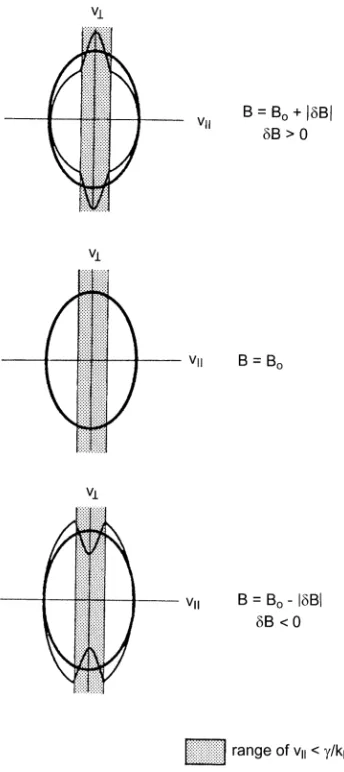
[image:10.573.304.548.315.492.2]Fig. 7. Contours of constant phase space density in the peak (top), node (centre) and trough of magnetic field strength of a mirror mode. Thesolid curvescorrespond to the initial state. The behaviour of the resonant particles nearvE"0 is due to the secular betatron
acceler-ation/deceleration and is opposite to the remaining circulating par-ticle behaviour. The circulating parpar-ticles respond adiabatically and the deformation of the contours in these regions is a simple conse-quence of Liouville’s Theorem for inhomogeneous quasi-stationary fields. (Fig. 2 of Southwood and Kivelson, 1993)
As this threshold is reached, the first unstable mode has a wave vectorko which is nearly perpendicular toBo
0. As the
anisotropy is increased, however, the most unstable mode shifts to more oblique ko’s, reaching hkB
0&60° for
¹
M/¹E*2 (Pantellini and Schwartz, 1995; Krauss-Var-banet al., 1994). Warm/hot electrons modify the instabil-ity threshold to some extent, and decrease the growth rate (Pantellini and Schwartz, 1995).
The physics of the mirror instability has received re-newed interest in recent years (Southwood and Kivelson, 1993) following a long period of neglect (Rose, 1965). The fluid perspective starts, paradoxically, from the adiabatic particle motion in a non-uniform magnetic field and Liouville’s Theorem. The second moment of the devi-ations of an initially anisotropic bi-Maxwellian distribu-tion yields the following reladistribu-tionship between the particle and the magnetic field pressures:
dP
M"b
M
A
1! ¹M
¹E
B
d(B2/2k0) (3)(Note that this is not consistent with CGL theory.) Thus, if ¹
M'¹E the variations in particle and magnetic field pressures transverse to the background field are in anti-phase. Moreover, at large bM the deviation in particle pressure is too large to be compensated by that of the magnetic field, and instability results.
Viewed from the kinetic perspective, the previous argu-ment applies to non-resonant particles, i.e., those which ‘‘circulate’’ freely through the mode crests and troughs. Resonant particles remain near a fixed phase point, i.e., they satisfykEvEKu
r. Sinceur"0, resonant particles in the case of the mirror instability are those with parallel speeds near zero. These particles see the growing wave field and are betatron accelerated (decelerated) in regions of field maximum (minimum), thus the change in their perpendicular energy is in-phase with the magnetic field, and they act to bring about near pressure equilibrium. A curious twist is then that the fewer the number of resonant particles, the less they are able to compensate and hence the faster the mode will grow (Southwood and Kivelson, 1993). Figure 7 shows the resulting distribution function expected in the mirror mode. Pantellini et al. (1994) have developed methods for extracting the distribu-tion funcdistribu-tions expected for modes based on kinetic theory, while Leckbandet al. (1995) have made tentative identifica-tion of the features predicted for the mirror modes (e.g., Fig. 8 of Pantellini and Schwartz, 1995) from satellite data. Figure 8 shows the real frequency and growth rates of the low-frequency modes based on kinetic theory. This figure reveals the competitive nature of the mirror mode at large anisotropy and the simultaneous existence of a heav-ily damped slow mode. Careful choice of transport ratios (see Fig.8b of Krauss-Varbanet al., 1994) should facilitate identification of these different modes, as attempted by Denton et al. (1995). Figure 9 shows that the electron compressibilityC
eof certain predominant classes of com-pressive magnetosheath waves indicate the presence of mirror modes, since they have compressibilities less than unity (the slow mode has compressibilities '1, Gary, 1992) and show density and magnetic field fluctuations in
anti-phase. (Note that the caption to Fig. 4 of Anderson
et al., 1994 refers toC
eas the parallel compressibility and that the definition ofC
egiven in their text is not that used in the cited work; see Table 1 and Gary, 1992.)
Fig. 8. Real frequencies (top) and growth rates (bottom) of the Al-fve´n/ion-cyclotron, slow/sound, and mirror modes as a function of ion temperature anisotropy from kinetic theory. The A/IC and
Mmodes show roughly comparable growth rates over a range of anisotropies, with the mirror instability stronger by a factor&2.
[image:12.573.44.216.92.340.2]Kinetic theory reveals the simultaneous presence of the slow mode, which is heavily damped. (Fig. 8a of Krauss-Varbanet al., 1994)
Fig. 9. Histogram of observed electron compressibilityCevalues for
compressive magnetosheath waves. Kinetic theory predicts that the mirror mode hasCe(1, while the slow mode hasC
e'1. Based on
this criterion alone, the histogram suggests that pure slow modes are not present in the observations, which are consistent with mirror modes. (Fig. 4 of Andersonet al., 1994)
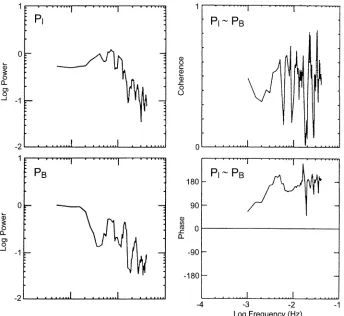
Fig. 10. Power spectra of the ion thermal pressure (top) and
mag-netic pressure (second panel) of fluctuations within the slow-mode transition near the sub-solar magnetopause. The coherence (third panel) and anti-phase (bottom) of the magnetic and thermal pressure fluctuations is consistent with either the slow mode or mirror mode. The rather low frequency of the feature at&0.008 Hz suggests that
[image:12.573.123.467.451.767.2]7 Slow/sound waves
Slow mode waves should be heavily damped under mag-netosheath conditions (e.g., Fig. 8). Moreover, the slow mode is heavily guided by the background magnetic field direction, so that the near perpendicular configuration created by magnetic field draping near the sub-solar re-gion of the magnetopause is unfavourable for its propaga-tion. However, along the stagnation line the bulk flow clearly drops below the slow mode speed. A standing slow mode front is expected and observed (Songet al., 1992a; Songet al., 1995; Southwood and Kivelson, 1992; Yan and Lee, 1994). Thus, the magnetopause is clearly capable of generating a slow mode disturbance of some kind, although a single standing front (shock?) does not by itself imply that small amplitude waves will also propagate.
Songet al. (1992b) do report low-frequency wavetrains with thermal and magnetic pressure variations in anti-phase and which apparently stand in the flow, i.e. they have a finite propagation speed, based on dual spacecraft timings. Their example is shown in Fig. 10. On the basis of linear theory, only the slow mode could possibly account for these observations (although the value of the flow velocity used is not given). Perhaps, therefore, the argu-ments about the slow mode being heavily damped do not reveal the whole story in the structured, inhomogeneous environment near the magnetopause. Alternatively, per-haps the inhomogeneous environment alters the proper-ties of, say, the non-propagating mirror mode or couples the two modes (see later).
One of the principal difficulties is the identification of theko-vector, as the conversion from spacecraft timings to propagation speeds depends critically on the direction of
ko. Sometimes (e.g., Song et al., 1992b), different methods give widely different answers. An alternative approach is to perform the process in reverse, using the spacecraft timings to constrain possible orientations of ko based on the phase speeds of likely wave modes (Gleaves and Southwood, 1990, 1991). This method provides a com-plementary approach, but relies heavily on the plasma parameters and theoretical framework for the wave modes. It is also possible to jump to the erroneous con-clusion (Gleaves and Southwood, 1991) that if the down-stream spacecraft sees the fluctuation first, the fluctuation cannot be a convected structure/mirror wave, as this con-clusion, while natural, depends again on the precise ori-entation ofko.
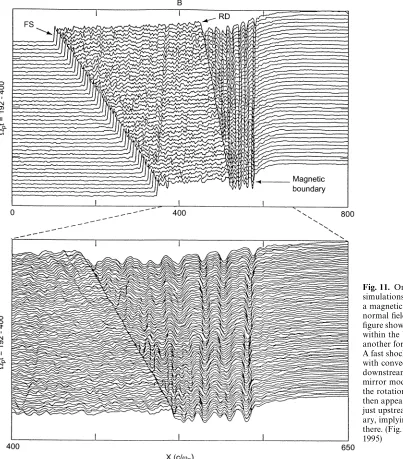
Computer simulations provide one means of overcom-ing the difficulties inherent in sovercom-ingle-point (or even few-point) satellite measurements by supplying complete spa-tial and temporal information within the computational domain. Omidi and Winske (1995) used a one-dimen-sional hybrid simulation to model the entire region from the solar wind to the magnetopause (or more correctly, a ‘‘magnetic boundary’’ since their simulation had a finite normal component ofBo and mass flux). The results are shown in Fig. 11. The fast shock (‘‘FS’’) is the left-most feature and propagates to the left. To its right are a set of mirror modes which convect and pass through a more slowly propagating rotational discontinuity (‘‘RD’’). The fluctuations to the right of the RD are still mirror modes,
which were amplified on their passage through the RD. Immediately to the left of the ‘‘magnetic boundary’’, how-ever, are a few cycles of fluctuations which appear to be phase standing relative to the ‘‘magnetic boundary’’. Since there is a net mass flux through the boundary, these phase standing waves must have a finite propagation speed in the plasma rest frame, and hence cannot be just mirror modes in the classical sense. Wave analysis (e.g., Fig. 10 of Omidi and Winske, 1995) confirms that the mode has a finite real frequency and a compressibility C
p&0.5 which is near but not identical to that for a mirror mode is the local conditions (&0.1). On the other hand, the mode frequency and compressibility are respectively one and two orders of magnitude below that of a pure slow mode of the same k. Omidi and Winske (1995) refer to these modes as ‘‘MIrror And slOW’’ or MIAOW waves, al-though as inferred above they are much ‘‘closer’’ to mirror waves than to the slow mode. Thus, the vicinity of the magnetic boundary would appear to modify the charac-teristics of the mirror mode to provide it with a finite phase velocity or, as Omidi and Winske (1995) phrase it, to allow some slippage of the plasma with respect to the field. These effects may be due to a variety of processes, including nonlinearity and mode-coupling in the in-homogeneous background state.
These simulations bear a remarkable resemblance to the observations of the slow-mode transition by Song
et al. (1992a). The question of whether there are any observations of modes matching more closely slow-mode wave trains remains an open one.
8 Discussion
We have seen that the magnetosheath is typically a high-b, anisotropic environment. Particle reflection at the bow shock and the ion foreshock provide upstream sources of turbulence and free energy to drive local instabilities. Field-line draping and compression at the magnetopause, along with the magnetopause itself, provide sources of free energy which are able to influence the local plasma and turbulence in the magnetosheath. The result is a turbulent magnetosheath with significant power over a wide range of the low-frequency spectrum. The high-b anisotropic conditions require a kinetic description; fluid theories of various kinds provide some insight into the possible wave mode properties, but cannot describe the plasma instabili-ties which arise and give misleading wave characteristics on some occasions.
Two wave modes seem to dominate the magnetosheath, and grow there due to the ion¹
Fig. 11. One dimensional hybrid simulations of a flow incident on a magnetic boundary with non-zero normal field (and mass flux). The figure shows the magnetic field profile within the box stacked above one another for various successive times. A fast shock (FS) propagates leftward with convecting mirror waves in the downstream region to its right. These mirror modes become amplified by the rotational discontinuity (RD) but then appear to stand against the flow just upstream of the magnetic bound-ary, implying a non-zero phase speed there. (Fig. 9 of Omidi and Winske, 1995)
These generalities mask a number of complications and difficulties associated with making a positive identifica-tion of a particular wave mode. Pure modes are rarely seen; instead a mixture of modes over a range of frequen-cies complicate the identification process. Such a mixture may be partially coherent, thereby mixing in an insepa-rable manner the mode characteristics. Mode properties and nomenclature rely on linear theory in a homogeneous plasma, often based on fluid/MHD theories of some kind. The real magnetosheath is a highly structured, in-homogeneous medium with strong kinetic aspects. Many of the parameters or ‘‘transport ratios’’ used as an aid to identification, and the wave dispersion/growth character-istics, can all be sensitive to plasma details (composition, anisotropy, wave-vector orientations, etc.) which are diffi-cult to measure with precision.
There are several areas where improvement is required and achievable. Perhaps the most important problem is
the determination of the wave vector ko. While this is possible under some circumstances, often traditional single-spacecraft techniques do not yield reliable esti-mates. Knowledge ofko would enable the Doppler shift due to the magnetosheath bulk flow to be removed, thus revealing the waves’ most basic quantity: the wave disper-sion. The application of more modern techniques (e.g., Dudok de Witet al., 1995) and the multipoint measure-ments of Cluster should greatly advance this area. Several multipoint analysis techniques have been developed re-cently (Glassmeieret al., 1995; Neubauer and Glassmeier, 1990; Pinion and Lefeuvre, 1991; Pinion, 1993; vom Stein
et al., 1993).
function. Features such as resonant particles again relate to fundamental wave/instability properties.
Finally, better theory/simulation dealing with the in-homogeneous, nonlinear, mixed-mode regimes common to the magnetosheath would be welcomed. Such theore-tical efforts not only provide spatial and temporal detail not possible in space, but also enable spacecraft tech-niques to be tested and refined.
Acknowledgements. This work grew out of a review presented at the XXI IUGG Assembly in Boulder, Colorado, July 1995. We are grateful for the encouragement of several attendees to write this review. Xochitl Blanco-Cano and Dietmar Krauss-Varban provided helpful comments. This work was supported by the Particle Physics and Astronomy Research Council of the UK via Grants GR/J36440 and GR/J88388.
Topical Editor K.-H. Glaßmeier thanks C. Mazelle and R. E. Denton for their help in evaluating this paper.
References
Abraham-Shrauner, B.,Propagation of hydromagnetic waves through
an anisotropic plasma,J.Plasma Phys.,1,361—378, 1967.
Anderson, B. J., and S. A. Fuselier,Magnetic pulsations from 0.1 to
4.0 Hz and associated plasma properties in the Earth’s subsolar magnetosheath and plasma depletion layer,J.Geophys.Res.,98,
1461—1479, 1993.
Anderson, B. J., S. A. Fuselier, S. P. Gary, and R. E. Denton,
Magnetic spectral signatures in the Earth’s magnetosheath and plasma depletion layer,J.Geophys.Res.,99,5877—5891, 1994.
Balogh, A., M. K. Dougherty, R. J. Forsyth, D. J. Southwood, E. J.
Smith, B. T. Tsurutani, N. Murphy, and M. E. Burton,Magnetic
field observations in the vicinity of Jupiter during the Ulysses flyby,Science,257,1515, 1992.
Belmont, G., and C. Mazelle, Polytropic indexes in collisionless
plasmas — theory and measurements, J. Geophys. Res., 97,
8327—8336, 1992.
Belmont, G., D. Hubert, C. Lacombe, and F. Pantellini,Mirror mode
and other compressive ULF modes, Proceedings of the 26th ES¸AB Symposium,Killarney, Ireland,16—19June 1992, ESA
SP-346, 263—267, 1992.
Chew, G. F., M. L. Goldberger, and F. E. Low, The Boltzmann
equation and the one-fluid hydromagnetic equations in the ab-sence of particle collisions,Proc.R.Soc.,A236,112, 1956.
Crooker, N. U., T. E. Eastman, and G. S. Stiles,Observations of
plasma depletion in the magnetosheath at the magnetopause,
J.Geophys.Res.,84, 869—874, 1979.
Denton, R. E., M. K. Hudson, S. A. Fuselier, and B. J. Anderson,
Electromagnetic ion-cyclotron waves in the plasma depletion layer,J.Geophys.Res.,98,13477—13490, 1993.
Denton, R. E., B. J. Anderson, S. P. Gary, and S. A. Fuselier,
Bounded anisotropy fluid model for ion temperatures,J.Geo
-phys.Res.,99,11225—11241, 1994a.
Denton, R. E., S. P. Gary, B. J. Anderson, S. A. Fuselier, and M. K.
Hudson,Low-frequency magnetic fluctuation spectra in the
mag-netosheath and plasma depletion layer, J. Geophys. Res., 99,
5893—5901, 1994b.
Denton, R. E., S. P. Gary, X. L. Li, B. J. Anderson, J. W. Labelle, and
M. Lessard,Low-frequency fluctuations in the magnetosheath
near the magnetopause,J.Geophys.Res.,100,5665—5679, 1995.
Dudok de Wit, T., V. V. Krasnosel’skikh, S. D. Bale, M. W. Dunlop,
H. Lu¨hr, S. J. Schwartz, and L. J. C. Woolliscroft,Determination
of dispersion relations in quasi-stationary plasma turbulence using dual satellite data, Geophys. Res. ¸ett., 22, 2653—2656,
1995.
Farrugia, C. J., R. P. Rijnbeek, M. A. Saunders, D. J. Southwood, D. J. Rodgers, M. F. Smith, C. P. Chaloner, D. S. Hall, P. J.
Christiansen, and L. J. C. Woolliscroft,A multi-instrument study
of flux-transfer event structure,J.Geophys.Res.,93,14465, 1988.
Fazakerley, A. N., and D. J. Southwood,Mirror instability in the
magnetosheath,Adv.Space Res.,14,65—68, 1994a.
Fazakerley, A. N., and D. J. Southwood,Theory and observation of
magnetosheath waves, inSolar¼ind Sources of Magnetospheric ºltra-¸ow Frequency¼aves, pp. 147—158, American
Geophysi-cal Union, 1994b.
Fazakerley, A. N., A. J. Coates, and M. W. Dunlop,AMPTE-UKS
observations of ion velocity distributions associated with mag-netosheath waves,Adv.Space Res.,15,349, 1995.
Fuselier, S. A., B. J. Anderson, S. P. Gary, and R. E. Denton,Inverse
correlations between the ion temperature anisotropy and plasma-beta in the Earth’s quasi-parallel magnetosheath,J.Geo
-phys.Res.,99,14931—14936, 1994.
Gary, S. P.,The mirror and ion-cyclotron anisotropy instabilities,
J.Geophys.Res.,97,8519—8529, 1992.
Gary, S. P.,¹heory of space plasma microinstabilities, Cambridge
University Press, New York, 1993.
Gary, S. P., and M. A. Lee,The ion-cyclotron anisotropy instability
and the inverse correlation between proton anisotropy and pro-ton-beta,J.Geophys.Res.,99,11297—11301, 1994.
Gary, S. P., and D. Winske, Correlation-function ratios and the
identification of space plasma instabilities,J.Geophys.Res.,97,
3103—3111, 1992.
Gary, S. P., and D. Winske,Simulations of ion-cyclotron anisotropy
instabilities in the terrestrial magnetosheath,J.Geophys.Res.,98,
9171—9179, 1993.
Gary, S. P., B. J. Anderson, R. E. Denton, S. A. Fuselier, M. E.
McKean, and D. Winske,Ion anisotropies in the magnetosheath,
Geophys.Res.¸ett.,20,1767—1770, 1993a.
Gary, S. P., S. A. Fuselier, and B. J. Anderson, Ion anisotropy
instabilities in the magnetosheath, J. Geophys. Res., 98,
1481—1488, 1993b.
Gary, S. P., M. E. McKean, and D. Winske,Ion-cyclotron
anisot-ropy instabilities in the magnetosheath—theory and simulations,
J.Geophys.Res.,98,3963—3971, 1993c.
Gary, S. P., B. J. Anderson, R. E. Denton, S. A. Fuselier, and M. E.
McKean,A limited closure relation for anisotropic plasmas from
the Earth’s magnetosheath,Phys.Plasmas,1,1676—1683, 1994a.
Gary, S. P., P. D. Convery, R. E. Denton, S. A. Fuselier, and B. J.
Anderson,Proton and helium cyclotron anisotropy instability
thresholds in the magnetosheath, J. Geophys. Res., 99,
5915—5921, 1994b.
Gary, S. P., M. E. McKean, D. Winske, B. J. Anderson, R. E. Denton,
and S. A. Fuselier, The proton cyclotron instability and the
anisotropy beta-inverse correlation, J. Geophys. Res., 99,
5903—5914, 1994c.
Glassmeier, K. H., U. Motschmann, C. Mazelle, F. M. Neubauer,
K. Sauer, S. A. Fuselier, and M. H. Acuna,Mirror modes and
fast magnetoacoustic waves near the magnetic pileup boundary of Comet-p Halley,J.Geophys.Res.,98,20955—20964, 1993.
Glassmeier, K. H., U. Motschmann, and R. v. Stein,Mode
recogni-tion of MHD wave fields at incomplete dispersion measure-ments,Ann.Geophysicae,13,76—83, 1995.
Gleaves, D. G., and D. J. Southwood,Phase delays in transverse
disturbances in the Earth’s magnetosheath,Geophys.Res.¸ett.,
17,2249—2252, 1990.
Gleaves, D. G., and D. J. Southwood,Magnetohydrodynamic
fluctu-ations in the Earth’s magnetosheath at 1500 LT-ISEE-1 and ISEE-2,J.Geophys.Res.,96,129—142, 1991.
Gosling, J. T., and A. E. Robson, Ion reflection, gyration, and
dissipation at supercritical shocks, inCollisionless Shocks in the Heliosphere:Reviews of Current Research, pp. 141—152, American Geophysical Union, 1985.
Gosling, J. T., M. F. Thomsen, S. J. Bame, and C. T. Russell,Ion
reflection and downstream thermalization at the quasi-parallel bow shock,J.Geophys.Res.,94,10,027—10,037, 1989.
Greenstadt, E. W., C. T. Russell, V. Formisano, P. C. Hedgecock,
F. L. Scarf, M. Neugebauer, and R. E. Holzer, Structure of
a quasi-parallel, quasi-laminar bow shock,J.Geophys.Res.,82,
651, 1977.
Hasegawa, A.,Drift mirror instability of the magnetosphere,Phys.