www.geosci-model-dev.net/8/431/2015/ doi:10.5194/gmd-8-431-2015
© Author(s) 2015. CC Attribution 3.0 License.
A test of an optimal stomatal conductance scheme within the
CABLE land surface model
M. G. De Kauwe1, J. Kala2, Y.-S. Lin1, A. J. Pitman2, B. E. Medlyn1, R. A. Duursma3, G. Abramowitz2, Y.-P. Wang4, and D. G. Miralles5,6
1Macquarie University, Sydney, Australia
2Australian Research Council Centre of Excellence for Climate Systems Science and Climate Change Research Centre, University of New South Wales, Sydney, NSW, 2052, Australia
3Hawkesbury Institute for the Environment, University of Western Sydney, Sydney, Australia 4CSIRO Ocean and Atmosphere Flagship, Private Bag #1, Aspendale, Victoria 3195, Australia 5Department of Earth Sciences, VU University, Amsterdam 1081 HV, the Netherlands
6Laboratory of Hydrology and Water Management, Ghent University, 9000 Ghent, Belgium Correspondence to: M. G. De Kauwe ([email protected])
Received: 29 September 2014 – Published in Geosci. Model Dev. Discuss.: 15 October 2014 Revised: 20 January 2015 – Accepted: 1 February 2015 – Published: 24 February 2015
Abstract. Stomatal conductance (gs) affects the fluxes of car-bon, energy and water between the vegetated land surface and the atmosphere. We test an implementation of an opti-mal stomatal conductance model within the Community At-mosphere Biosphere Land Exchange (CABLE) land surface model (LSM). In common with many LSMs, CABLE does not differentiate betweengs model parameters in relation to plant functional type (PFT), but instead only in relation to photosynthetic pathway. We constrained the key model pa-rameter “g1”, which represents plant water use strategy, by PFT, based on a global synthesis of stomatal behaviour. As proof of concept, we also demonstrate that theg1parameter can be estimated using two long-term average (1960–1990) bioclimatic variables: (i) temperature and (ii) an indirect es-timate of annual plant water availability. The new stomatal model, in conjunction with PFT parameterisations, resulted in a large reduction in annual fluxes of transpiration (∼30 % compared to the standard CABLE simulations) across ever-green needleleaf, tundra and C4 grass regions. Differences in other regions of the globe were typically small. Model per-formance against upscaled data products was not degraded, but did not noticeably reduce existing model–data biases. We identified assumptions relating to the coupling of the veg-etation to the atmosphere and the parameterisation of the minimum stomatal conductance as areas requiring further investigation in both CABLE and potentially other LSMs.
We conclude that optimisation theory can yield a simple and tractable approach to predicting stomatal conductance in LSMs.
1 Introduction
significant role in the global carbon, energy and water cycles, hence it modulates climate feedbacks and plays a critical role in global change (Henderson-Sellers et al., 1995; Pollard and Thompson, 1995; Cruz et al., 2010; Sellers et al., 1996; Ged-ney et al., 2006; Betts et al., 2007; Cao et al., 2010).
In both ecosystem and land surface models, it is com-mon to represent gs with empirical models (Jarvis, 1976; Ball et al., 1987; Leuning, 1995; see Damour et al., 2010 for a review). In a recent inter-comparison study, 10 of the 11 ecosystem models considered applied some form of the “Ball–Berry–Leuning” approach (De Kauwe et al., 2013a). The empirical nature of these models means that we cannot attach any theoretical significance to differences in model parameters across data sets or among species. As a conse-quence, models which use these schemes commonly either assume the model parameters only vary with photosynthetic pathway, or tune the parameters to match a specific experi-ment where necessary. Whilst more mechanistic gs models have been proposed (e.g. Buckley et al., 2003; Wang et al., 2012), they have not been widely applied due to their relative complexity and the need to obtain additional model param-eters, for which we have no (or limited) observational data across a variety of plant functional types (PFTs).
An alternative approach, originally proposed by Cowan and Farquhar (1977) and Cowan (1982), is to model stom-atal conductance using an optimisation framework (Hari et al., 1986; Lloyd, 1991; Arneth et al., 2002; Katul et al., 2009; Schymanski et al., 2009; Medlyn et al., 2011). This approach hypothesises that optimal stomatal behaviour occurs when the carbon gain (photosynthesis, A) is maximised, whilst minimising water loss (transpiration, E) over some period of time (t2–t1). Therefore, optimal stomatal behaviour is the result of maximising
t2
Z
t1
(A (t )−λE (t ))dt, (1)
whereλ(mol−1C mol−1H2O) is the marginal carbon cost of water use.
Medlyn et al. (2011) recently proposed a tractable model that analytically solves the optimisation problem. This model has great potential because it combines a simple functional form, similar to current empirical approaches, with a theoret-ical basis. Biologtheoret-ical meaning can be attached to the param-eters, which can then be hypothesised to vary with climate and plant water use strategy (Medlyn et al., 2011; Héroult et al., 2013; Lin et al., 2015). In addition, the behaviour of this model has been widely tested at the leaf scale and it has been shown to perform at least as well, if not better than, the more widespread empirical approaches currently used (Med-lyn et al., 2011; De Kauwe et al., 2013a; Duursma et al., 2013; Medlyn et al., 2013; Héroult et al., 2013). We also note that it is possible to implement a numerical solution of this optimisation problem into a LSM (Bonan et al., 2014).
Here, we present an implementation of the Medlyn et al. (2011) optimal stomatal conductance model within the Community Atmosphere Biosphere Land Exchange (CA-BLE) LSM (Wang et al., 2011). CABLE is the LSM used within the Australian Community Climate Earth System Simulator (ACCESS, see http://www.accessimulator.org.au; Kowalczyk et al., 2013), a fully coupled Earth system model used as part of the Coupled Model Intercomparison Project (CMIP-5), which in turn informed much of the climate pro-jection research underpinning the Fifth Assessment Report of the Intergovernmental Panel on Climate Change. CABLE currently implements an empirical representation ofgs fol-lowing Leuning et al. (1995). The existing CABLE param-eterisation of stomatal conductance, similar to other LSMs, including the Community Land Model version 4.5 (CLM4.5: Oleson et al., 2013) and the ORganizing Carbon and Hydrol-ogy in Dynamic EcosystEms model (ORCHIDEE: Krinner et al., 2005), only characterises differences in stomatal be-haviour relating to photosynthetic pathway, rather than PFT. The implementation assumes that all PFTs can be adequately described by three parameters, two of which vary with pho-tosynthetic pathway. Simulated latent heat (LE) by CABLE has been shown to be sensitive to these parameters (Lu et al., 2013), but the origin of this parameterisation has not been well documented in the literature. In contrast, here we seek to constrain the new Medlyn model implementation with data derived from a recent global synthesis of stomatal behaviour (Lin et al., 2015). We first test the implementation of the new gs scheme at a series of flux tower sites and then undertake a series of offline simulations to examine the model’s be-haviour at the global scale.
2 Methods
2.1 Model description
2.2 Stomatal model and parameterisation
In CABLE,gs(stomatal conductance, mol m−2s−1)is mod-elled following Leuning (1995):
gs=g0+
a1βA (Cs−0)
1+ D
D0
, (2)
where A is the net assimilation rate (µmol m−2s−1), Cs (µmol mol−1) andD (kPa) are the CO2 concentration and the vapour pressure deficit at the leaf surface, respectively, 0 (µmol mol−1) is the CO2 compensation point of photo-synthesis, andg0(mol m−2s−1),D0(kPa) anda1are fitted constants representing the residual stomatal conductance as net assimilation rate reaches zero, the sensitivity of stomatal conductance toDand the slope of the sensitivity of stomatal conductance to assimilation, respectively. In CABLE, the fit-ted parametersg0anda1vary with photosynthetic pathway (C3 vs. C4) but not PFT, andD0is fixed for each PFT. The g0 is scaled from the leaf to the canopy by accounting for LAI, following Wang and Leuning (1998). Theβrepresents an empirical soil moisture stress factor:
β= θ−θw
θfc−θw
;β[0,1], (3)
where θ is the mean volumetric soil moisture content (m3m−3)in the root zone,θw is the wilting point (m3m−3) andθfcis the field capacity (m3m−3).
In this study we replaced Eq. (2) with thegsmodel of Med-lyn et al. (2011) using the sameβfactor as above:
gs=g0+1.6
1+ √g1β
D
A
Cs
, (4)
whereg1(kPa0.5)is a fitted parameter representing the sensi-tivity of the conductance to the assimilation rate. In this for-mulation of thegsmodel, theg1parameter has a theoretical meaning and is proportional to
g1∝ r
0∗
λ , (5)
where λis defined by Eq. (1) and 0∗ (µmol mol−1)is the CO2compensation point in the absence of mitochondrial res-piration. As a result, g1 is inversely related to the marginal carbon cost of water,λ(Medlyn et al., 2011).
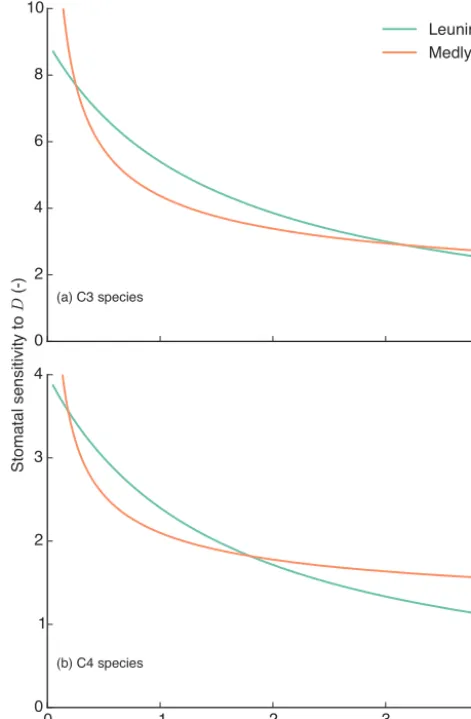
Figure 1 shows the stomatal sensitivity to D predicted by the two models in the absence of soil water stress. In this comparison, the Medlyn model has been calibrated us-ing least squares against gs values predicted by the Leun-ing model, where D varies between 0.05 and 3 kPa. The Leuning model was parameterised in the same way as the CABLE model, for C3 species:a1=9.0, D0=1.5 kPa and for C4 plants: a1=4.0, D0=1.5 kPa. The calibrated pa-rameters for the Medlyn model were g1=3.37 kPa0.5 and
Figure 1. Stomatal sensitivity to increased vapour pressure deficit
(D). The Leuning model has been parameterised in the same way
as the CABLE model, for C3 species:a1=9.0,D=1.5 kPa and
for C4 plants:a1=4.0,D0=1.5 kPa. The Medlyn model has been
fit to output generated by the Leuning model using least squares
forDranging from 0.05 to 3 kPa. The calibrated parameters for
the Medlyn model wereg1=3.37 andg1=1.09 for C3 and C4
species, respectively.
g1=1.10 kPa0.5 for C3 and C4 species, respectively. Over low to moderateDranges (<1.5 kPa), thegs calculated by the Medlyn model declines more steeply than the Leuning model. There is then a crossover between the two models, such that at highDthe Leuning model predictsgsto be more sensitive to increasingD than the Medlyn model. We use this calibration of the Medlyn model (MED-L) to the Leun-ing model (LEU) throughout this paper, in order to distin-guish structural difference between the models from differ-ences resulting from model parameterisation (MED-P) based on a global synthesis of stomatal behaviour (see below).
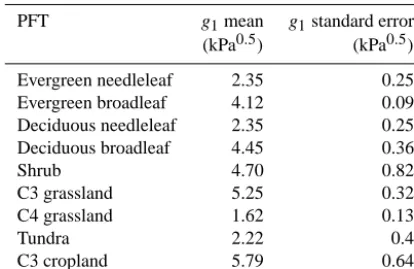
includ-Table 1. Fitted g1 values based on the CABLE PFTs using data
from Lin et al. (2015).
PFT g1mean g1standard error
(kPa0.5) (kPa0.5)
Evergreen needleleaf 2.35 0.25
Evergreen broadleaf 4.12 0.09
Deciduous needleleaf 2.35 0.25
Deciduous broadleaf 4.45 0.36
Shrub 4.70 0.82
C3 grassland 5.25 0.32
C4 grassland 1.62 0.13
Tundra 2.22 0.4
C3 cropland 5.79 0.64
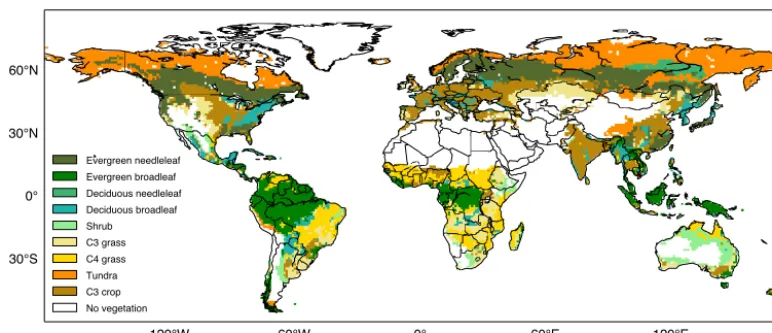
ing Arctic tundra, boreal, temperate forests and tropical rain-forest. We estimated parameter values forg1for each of the 10 PFTs in CABLE (Fig. 2) by fitting Eq. (4) to this data set, using the non-linear mixed-effects model approach presented by Lin et al. (2015). We used only data from ambient field conditions, excluding elevated [CO2], temperature, or other treatments. The model was fit to data for each PFT separately, using species as a random effect on theg1parameter (to ac-count for correlation of observations within species groups). For all mixed-effects models, we used the lme4 package in R version 3.1.0 (R Core Development Team, 2014). For this fitting, we set the parameter g0 equal to zero. The reasons for this choice, and the consequences, are discussed in detail below.
The data set compiled by Lin et al. (2015) did not have measurements from the deciduous needleleaf PFT. As Lin et al. (2015) hypothesised that the high marginal cost of water in evergreen conifers is a consequence of the lack of vessels for water transport in conifer xylem, we assumed that the marginal cost of water for deciduous needleleaf trees would be similar to that of evergreen needleleaf.
Lin et al. (2015) also demonstrated a significant rela-tionship (r2=0.43) betweeng1and two long-term average (1960–1990) bioclimatic variables: temperature and a mois-ture index representing an indirect estimate of plant water availability. First, they estimated g1 for each species sepa-rately using non-linear regression, and then they fit the fol-lowing equation to these individual estimates ofg1:
log(g1)=a+b×MI+c× ¯T+d×MI× ¯T , (6) wherea,b,c, andd are model coefficients,T¯ is the mean surface air temperature during the period of the year when the surface air temperature is above 0◦C, and MI is a mois-ture index calculated as the ratio of mean precipitation to the equilibrium evapotranspiration (as described in Gallego-Sala et al., 2010). Equation (6) was fit using a linear mixed-effects model, where PFT was used as random intercept, because we assumeg1observations were independent observations for a given PFT.
Table 2. Model coefficients used in mixed-effects model to predict
g1from two long-term average (1960–1990) bioclimatic variables:
temperature and a moisture index representing an indirect estimate of plant water availability.
PFT a b c d e
Evergreen needleleaf 1.32 0.03 0.02 0.01 −0.97
Evergreen broadleaf 1.32 0.03 0.02 0.01 −0.67
Deciduous needleleaf 1.32 0.03 0.02 0.01 −0.97
Deciduous broadleaf 1.32 0.03 0.02 0.01 −0.37
Shrub 1.32 0.03 0.02 0.01 −0.29
C3 grassland 1.32 0.03 0.02 0.01 −0.1
C4 grassland 1.32 0.03 0.02 0.01 −1.35
Tundra 1.32 0.03 0.02 0.01 −0.73
C3 cropland 1.32 0.03 0.02 0.01 0.0
We derived global MI andT¯values from Climate Research Unit (CRU) CL1.0 climatology data set (1961–1990), inter-polating the 0.5 degree data to 1.0 degree to match the res-olution of the global offline forcing used, using a nearest-neighbour approach. We masked land surface areas in the CRU data which did not correspond to one of CABLE 10 PFTs. In addition, we also masked pixels where MI andT¯
estimates were not available (40 out of a possible 54 000 pix-els). To directly evaluate the differences in g1 responses to the two climatic variables amongst PFTs, we modified Eq. (6):
log(g1)=a+b×MI+c× ¯T+d×MI× ¯T+e×PFT, (7) wherea,b,c,d andeare model coefficients (Table 2). We fitted Eq. (7) to the individual estimates ofg1by species (see above), but this time with a linear regression model (because PFT here is assumed to be a fixed effect). We then used the model coefficients to predictg1 values (MED-C) based on the PFT, MI andT¯ values for each pixel. In the MED-C sim-ulations therefore the predictedg1values vary within a PFT as a function of the bioclimatic indices. Standard errors of the prediction were calculated with standard methods for linear regression. Finally, we masked pixels where MI orT¯ values are outside the range (MI>3.26; T >¯ 29.7◦C) covered by thegs synthesis database (126 out of a possible 54 000 pix-els) to avoid extrapolation of the model.
2.3 Model simulations
30°S 0° 30°N 60°N
120°W 60°W 0° 60°E 120°E
Evergreen needleleaf Evergreen broadleaf Deciduous needleleaf Deciduous broadleaf Shrub C3 grass C4 grass Tundra C3 crop No vegetation
Figure 2. Map showing the plant functional types (PFTs) currently used in CABLE (Lawrence et al., 2012). CABLE also has C4 crop,
wetland and urban PFTs, however these are currently not operational.
broadleaf forest; (ii) evergreen broadleaf forest; (iii) ever-green needleleaf forest; (iv) C3 grassland; (v) C4 grassland; and (vi) cropland (Table 4). In both site and global simu-lations, each site/pixel contained only a single PFT type. Site data were obtained through the Protocol for the Anal-ysis of Land Surface models (PALS; http://pals.unsw.edu.au; Abramowitz, 2012) which has previously been pre-processed and quality controlled for use within the LSM community. This process ensured that all site-years had near complete observations of key meteorological drivers (as opposed to significant gap-filled periods). CABLE simulations at the six flux sites were not calibrated to match site characteristics; in-stead default PFT parameters were used for the appropriate PFT for each site.
Next, we performed global offline simulations using the second Global Soil Wetness Project (GSWP-2; Dirmeyer et al., 2006a) multi-model, 3-hourly, offline, meteorological forcing – precipitation (rain and snowfall), downward short-wave and longshort-wave radiation, surface air temperature, sur-face specific humidity, sursur-face wind speed and sursur-face air pressure – over the period 1986–1995 at a resolution of 1◦ by 1◦with a 30-year spin-up. Although CABLE has the abil-ity to simulate carbon pool dynamics, this feature was not activated for this study, given the relatively short simulation periods. For both the site-scale and global simulations, LAI was prescribed using CABLE’s gridded monthly LAI clima-tology derived from Moderate-resolution Imaging Spectrora-diometer (MODIS) LAI data. In all simulations, we used the standard soil moisture stress function,β, defined in Eq. (3).
The GSWP-2 driven simulation used the soil and vege-tation parameters similar to those employed when CABLE is coupled to the ACCESS coupled model, rather than those provided by the GSWP-2 experimental protocol. This was to ensure that any discrepancies between different CABLE sim-ulations could be attributed to the differences in the stomatal model only. When CABLE is coupled to ACCESS model,
differences in surface fluxes and temperature as simulated by CABLE with different stomatal models can also influ-ence the surface forcing fields provided by the atmospheric model, which further modify the simulation results by CA-BLE. Therefore, to ensure that the results here are compara-ble to future ACCESS coupled simulations, we use the same soil and vegetation parameters as used by CABLE within ACCESS, rather than those specified by the GSWP-2 pro-tocol.
2.4 Data sets for global evaluation 2.4.1 LandFlux-EVAL ET
The LandFlux-EVAL data set (Mueller et al., 2013) provides a comprehensive ensemble of global ET estimates at a 1◦by 1◦ resolution over the periods 1989–1995 and 1989–2005, derived from various satellites, LSMs driven with observa-tionally based forcing, and atmospheric re-analysis. We used the ensemble combined product (i.e. all sources of ET and associated standard deviations) over the period 1989–1995 (that overlaps with the GSWP-2 forcing period). The ratio-nale for comparing the simulated ET against the LandFlux-EVAL ET was to test that the uncertainties propagated to the ET estimates based on the parameterisation ofg1were within the uncertainty range of the ensemble of existing models and observational estimates.
2.4.2 GLEAM ET
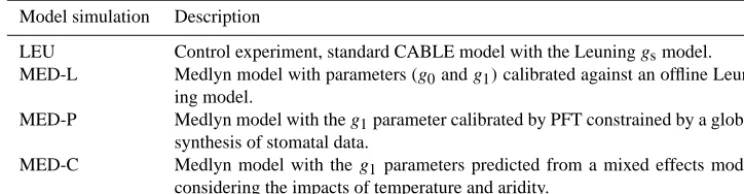
Table 3. A summary of model simulations.
Model simulation Description
LEU Control experiment, standard CABLE model with the Leuninggsmodel.
MED-L Medlyn model with parameters (g0andg1)calibrated against an offline
Leun-ing model.
MED-P Medlyn model with theg1parameter calibrated by PFT constrained by a global
synthesis of stomatal data.
MED-C Medlyn model with theg1parameters predicted from a mixed effects model
considering the impacts of temperature and aridity.
Table 4. Summary of flux tower sites.
Site FLUXNET vegetation type CABLE PFT Latitude Longitude Country Years
Bondville Cropland C3 Crop 40.00◦N −88.29◦W US 1997–2006 Cabauw Grassland C3 Grass 51.97◦N 4.93◦E Holland 2003–2006 Harvard Deciduous broadleaf Deciduous broadleaf 42.54◦N −72.17◦W US 1994–2001 Howard Springs Woody savannah C4 grass −12.49◦S 131.15◦E Australia 2002–2005 Hyytiälä Evergreen needleleaf Evergreen needleleaf 61.85◦N 23.29◦E Finland 2001–2004 Tumbarumba Evergreen broadleaf Evergreen broadleaf −35.66◦S 148.15◦E Australia 2002–2005
of the LandFlux-EVAL ensemble (Mueller et al., 2013). The GLEAM product assimilates multiple satellite observations (temperature, net radiation, precipitation, soil moisture, veg-etation water content) into a simple land model to provide estimates of vegetation, soil and total evapotranspiration. Al-though estimates of vegetation transpiration are available, we only use the total ET product, as the latter has been vigor-ously evaluated against flux-tower measurements (Miralles et al., 2011, 2014).
2.4.3 Upscaled FLUXNET data
To estimate the influence of the newgs parameterisation on gross primary productivity (GPP), we compared our simu-lations against the upscaled FLUXNET model tree ensem-ble (FLUXNET-MTE) data set of Jung et al. (2009). This data set is generated by using outputs from a dynamic global vegetation model (DGVM) forced with gridded observations as the surrogate truth to upscale site-scale quality-controlled observations. The product is more reliable where there is a high density of high-quality observations, mostly restricted to North America. Nonetheless, the DGVM used to gener-ate this product is one of the most extensively evalugener-ated bio-sphere models (Jung et al., 2009). The FLUXNET data set provides two versions of upscaled GPP, which differ slightly in the way they are derived. We use the mean of the two prod-ucts.
3 Results
3.1 Flux site results
Figure 3 shows a site-scale comparison during daylight hours (8 a.m.–7 p.m.) between observed and predicted GPP, LE and transpiration (E) at six FLUXNET sites. Table 5 shows a se-ries of summary statistics (RMSE, bias and index of agree-ment) between modelled and observed LE.
3.1.1 Impact of model structure
Figure 3 shows that the differences in simulated fluxes due to model structure, shown by comparing LEU with MED-L, are small across the six flux tower sites. Differences due to the structure of the model, shown by comparing LEU with MED-L in Fig. 3, are small across sites. These small differences indicate that the replacement of the Leuning model with the Medlyn model (calibrated to the Leuning model, MED-L) does not significantly alter CABLE simulations.
3.1.2 Impact of newg1parameterisation
Table 5. Summary statistics of modelled and observed LE at the six FLUXNET sites during daylight hours (9 a.m.–18 p.m.) and over the
peak growing season (for Northern Hemisphere sites, from June-July-August and for Southern Hemisphere sites, from December-January-February).
Site RMSE Bias Index of agreement
LEU MED-L MED-P LEU MED-L MED-P LEU MED-L MED-P
Bondville 109.91 102.74 109.78 −12.92 −9.50 −5.80 0.81 0.83 0.84
Cabauw 82.13 78.65 82.76 −13.54 −13.15 −12.75 0.78 0.80 0.79
Harvard 59.17 55.51 58.51 8.35 4.10 7.10 0.94 0.95 0.95
Howard Springs 105.92 105.72 138.57 −4.86 1.16 −61.25 0.83 0.84 0.62
Hyytiälä 58.90 54.62 47.33 21.00 16.26 −0.24 0.89 0.89 0.89
Tumbarumba 130.91 124.28 124.84 −15.06 −14.30 −13.22 0.76 0.78 0.78
represented by tree PFTs, Harvard and Tumbarumba, the dif-ferences between modelled fluxes are negligible. The impact of gs on LE fluxes is noticeably smaller than the impact on Ebecause modelled (and observed) LE also includes a flux component from the soil.
The PFT parameterisation (MED-P) does not have a no-ticeable impact on predicted fluxes of GPP, with the excep-tion of Howard Springs. GPP is insensitive to the stomatal parameterisation because of the non-linear relationship be-tweengsandA. When stomata are fully open,Ais limited by the rate of ribulose-1,5-bisphosphate (RuBP) regeneration, and is relatively insensitive to the changes in Ci caused by small reductions in stomatal conductance.
The differences between models at Howard Springs do not stem from the new g1 parameterisation (MED-P), but instead result from the large positive g0 parameter as-sumed for C4 grassland in CABLE. The asas-sumed g0 of 0.04 mol m−2leaf s−1is multiplied by LAI meaning that the minimum canopy stomatal conductance at this site can be as high as 0.1 mol m−2ground s−1. By contrast, in the MED-P model we assumedg0=0, meaning thatgsgoes to zero un-der low light and, importantly, high VPD conditions.
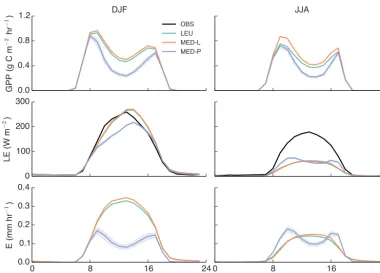
Figure 4 shows that at Howard Springs, high afternoon VPD caused stomatal closure, represented by reduced E, in the MED-P model but not the MED-L or LEU models (Fig. 4), due to the assumption of a high g0as Atends to-wards zero. Consequently, daily fluxes are significantly lower in the MED-P when compared to the LEU and MED-L mod-els.
3.1.3 Decoupling factor
The relative insensitivity of modelled fluxes to the new gs parameterisation (MED-P) results from CABLE’s assump-tions about the coupling of the vegetation to the surrounding atmosphere boundary layer. In CABLE, transpiration from the vegetation to the atmosphere is controlled by several re-sistances operating in series, both above (aerodynamic) and within the canopy (stomatal and leaf boundary layer), and a longwave radiative balance through radiative conductance on
net available energy (Leuning et al., 1995; Kowakczyk et al., 2006). These resistances in serial, result in a relatively weak coupling between the canopy surface and the atmosphere.
Figure 5 shows the average seasonal cycle ofgs and the decoupling coefficient (Jarvis and McNaughton, 1986; Mc-Naughton and Jarvis, 1991) simulated by CABLE at the six flux tower sites. The decoupling coefficient () represents how well coupled the vegetation is to the surrounding at-mosphere, with a value of 0 representing fully coupled be-haviour, where transpiration is controlled bygs, and a value of 1 representing completely decoupled behaviour, where transpiration is controlled by the available energy. The mod-erate to highat all sites, with the exception of Hyytiälä, explains the lack of sensitivity in theE, LE and GPP fluxes to changes ings. At Hyytiälä,is low, and becomes lower wheng1is reduced in the MED-P model, resulting in an ef-fect onEwhich is more apparent than at the other sites (see Fig. 3).
3.2 Global results 3.2.1 Global maps ofg1
To facilitate global comparisons, we have derived global maps of the g1 parameter. Figure 6a shows a clear latitu-dinal gradient, with lower values of g1, which represent a more conservative water use strategy, found in mid-latitudes (20–60◦N), whilst higher values ofg
0 5 10 15 20
Bondville
GPP (g C m−2 d−1) LE (W m−2)
0 1 2 3 4
5 E (mm d−1)
Cabauw
0 50 100 150 200 250
OBS LEU MED-L MED-P
0 5 10 15 20
Harvard
0 1 2 3 4 5
Howard Springs
0 50 100 150 200 250
0 5 10 15 20
Hyytiala
0 1 2 3 4 5
Jan Jun Dec
Tumbarumba
Jan Jun Dec
Month of year 0
50 100 150 200 250
Jan Jun Dec
Figure 3. A comparison of the modelled average seasonal cycle of gross primary productivity (GPP), latent heat flux (LE), transpiration (E) and the observed (OBS) LE flux at six FLUXNET sites during approx. daylight hours (8 a.m.–7 p.m.). Time series have been averaged across all years as described in Table 4 to produce seasonal cycles. Light blue shading indicates the uncertainty in predicted fluxes from the Medlyn model (MED-P), accounting for±2 standard errors in the siteg1parameter value.
3.2.2 Impact of model structure on simulated GPP andE
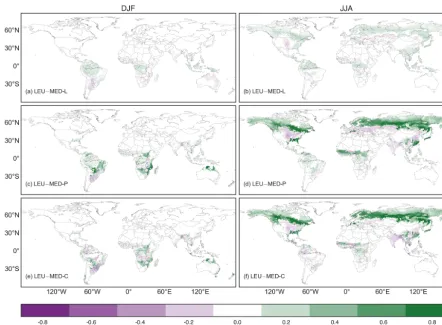
We next extend our comparison by examining the impact of different stomatal conductance models on the simulated seasonal and annual GPP and E, the fluxes most directly impacted by gs in the model. Figures 7 and 8 show mean seasonal (December-January-February: DJF, and June-July-August: JJA) difference maps of predicted GPP and E,
0.0
0.4
0.8
1.2
G
P
P
(g
C
m
−
2
h
r
−
1
)
DJF
OBS LEU MED-L MED-P
JJA
0
100
200
300
LE
(W
m
−
2
)
0
8
16
24
Hour of day
0.0
0.1
0.2
0.3
0.4
E
(m
m
h
r
−
1
)
0
8
16
24
Figure 4. Mean diurnal modelled gross primary productivity (GPP), latent heat flux (LE), transpiration (E) and the observed (OBS) LE flux at the Howard Springs FLUXNET sites during daylight hours (8 a.m.–7 p.m.). Time series have been averaged across all years as described in Table 2 to produce diurnal seasonal cycles. Light blue shading indicates the uncertainty in predicted fluxes from the Medlyn model (MED-P), accounting for±2 standard errors in the siteg1parameter value.
Table 6. Mean and 1 standard deviation difference in annual GPP between the LEU and MED-L model, the LEU and MED-P models and
the LEU-C models for each of CABLE’s PFTs. Where standard deviations are large relative to the mean it suggests large variability between the LEU and other models within a PFT.
PFT GPP: LEU−MED-L GPP: LEU−MED-P GPP: LEU−MED-C
(g C m−2yr−1) (g C m−2yr−1) (g C m−2yr−1)
Evergreen needleleaf −3.08±18.39 39.05±34.18 43.45±24.2
Evergreen broadleaf 36.1±51.93 76.12±61.99 73.70±65.08
Deciduous needleleaf −1.84±5.14 24.06±5.35 34.03±5.75
Deciduous broadleaf −31.48±57.77 −17.31±38.0 −46.3±69.01
Shrub −69.28±32.31 −45.46±17.61 −35.39±17.41
C3 grassland −47.73±46.83 −66.76±41.55 −62.79±50.02
C4 grassland −93.04±45.95 302.94±113.93 115.53±89.29
Tundra 0.3±12.63 16.61±14.16 13.36±11.02
C3 cropland −26.85±36.51 −64.93±36.58 −65.45±58.21
µ=93.0 gC m−2yr−1,µ change =5.6 %) and shrub PFTs (GPP µ=69.3 gC m−2yr−1,µchange =12 %), where the LEU model predicts higher fluxes (Fig. 7a, b). Figure 8a and b show that the largest differences (relative to the LEU) in E occur across the tropics, where fluxes in broadleaf forest PFTs are higher (Eµ=34.3 mm yr−1,µchange=5.5 %) in the MED-L model. These differences are consistent with the different sensitivities of the modelled stomatal conductance toD, as shown in Fig. 1. The LEU model would tend to
pre-dict highergsfluxes at low to moderateD(<2 kPa), whereas the calibrated MED-L model would predict highergs fluxes at moderate to highD(>2 kPa).
3.2.3 Impact of empirically fittedg1parameterisation on the simulated GPP andE
needle-0.00
0.15
0.30
0.45
Bondvilleg
s(mol m
−2s
−1)
LEU MED-L MED-P
Ω
(-)
0.00
0.15
0.30
0.45
Cabauw0.00
0.15
0.30
0.45
Harvard0.00
0.15
0.30
0.45
Howard Springs0.00
0.15
0.30
0.45
HyytialaJan
Jun
Dec
Month of year
0.00
0.15
0.30
0.45
TumbarumbaJan
Jun
Dec
Figure 5. Average seasonal cycles of the simulated decoupling coefficient (), total boundary layer conductance (gb)and stomatal
con-ductance (gs)at six FLUXNET sites during daylight hours (8 a.m.–7 p.m.). Time series have been averaged across all years as described
in Table 2 to produce seasonal cycles. Light blue shading indicates the uncertainty in predicted fluxes from the Medlyn model (MED-P), accounting for±2 standard errors in the siteg1parameter value.
leaf, C4 grass and Tundra PFTs. Fluxes were reduced across the boreal zone (Eµ=76.1 mm yr−1), over C4 grass areas (GPP µ=302.9 gC m−2 y−1, µ change =16.5 %; Eµ= 107.7 mm yr−1, µ change =27.1 %) and the tundra PFT (Eµ=24.1 mm yr−1,µchange =28.5 %). Fluxes are also predicted to decrease over deciduous needleleaf PFTs, but
Figure 6. Global maps showing how theg1model parameter varies across the globe. Panel (a) shows the fittedg1parameter values for each
PFT based on the data, panel (b) shows the predictedg1parameter values considering the influence of climate indices. In total, 126 out of
a possible 54 000 pixels have been masked from panel (b), representing pixels where the temperature range and moisture index extended outside the range of the database of Lin et al. (2015).
Figure 7. Mean seasonal (December-January-February: DJF and June-July-August: JJA) difference maps of gross primary productivity
(GPP) calculated across the 10 years of the Global Soil Wetness Project2 (GSWP-2) forcing (1986–1995) period. Panels (a) and (b) show the difference between the standard CABLE (LEU) model and the Medlyn model fit to the Leuning model (MED-L), panels (c) and (d) show the
difference between the LEU model and the Medlyn model with theg1PFT parameterisation (MED-P), and finally, panels (e) and (f) show
the difference between the LEU model and the Medlyn model with theg1parameter predicted as a function of climate indices (MED-C).
In total, 126 out of a possible 54 000 pixels have been masked from panels (e) and (f), representing pixels where the temperature range and moisture index extended outside the range of the synthesisgsdatabase. Data shown in panels (b), (c), (d), (e), (f) have been clipped, with the
Figure 8. Mean seasonal (December-January-February: DJF and June-July-August: JJA) difference maps of transpiration (E) calculated across the 10 years of the Global Soil Wetness Project2 (GSWP-2) forcing (1986–1995) period. Panels (a) and (b) show the difference between the standard CABLE (LEU) model and the Medlyn model fit to the Leuning model (MED-L), panels (c) and (d) show the difference
between the LEU model and the Medlyn model with theg1PFT parameterisation (MED-P), and finally, panels (e) and (f) show the difference
between the LEU model and the Medlyn model with theg1parameter predicted as a function of climate indices (MED-C). In total, 126 out
of a possible 54 000 pixels have been masked from panels (e) and (f), representing pixels where the temperature range and moisture index extended outside the range of the synthesisgsdatabase. Data shown in panels (c), (d), (e), (f) have been clipped, with the maximum ranges
extending to (−0.3 to 1.12), (−0.33 to 1.27), (−0.63 to 0.84) and (−0.64 to 1.31) and this affects 36, 251, 8 and 444 pixels, respectively.
=5.5 %; Eµ=30 mm yr−1, µ change =10.9 %) and C3 grasses (GPP µ=66.8 gC m−2yr−1, µ change =5.9 %; Eµ=17.4 mm yr−1,µchange=7.6 %).
3.2.4 Impact of predictedg1parameterisation on the simulated GPP andE
Figures 7e, f and 8e, f show the predicted fluxes wheng1is allowed to vary within a PFT according to climate indices. Generally, the changes are in line with the changes intro-duced by the MED-P parameterisation. The largest change is a 32 % reduction in E relative to the control simulation for evergreen needleleaf pixels. The notable difference com-pared to the MED-P simulation occurs over C4 grass pixels. The MED-C model predicts fluxes that are approximately half those predicted by the MED-P model for both GPP and E. This suggests a less conservative water use strategy than
is obtained through the PFT-specific parameterisation alone, i.e. MED-P.
3.3 Comparison with benchmarking products
0 5 10 15
G
P
P
(g
C
m
−
2 d
−
1)
(a)
DJF
LEU MED-P MED-C FLUXNET-MTE
(b)
JJA
-60◦S -30◦S 0◦ 30◦N 60◦N 90◦N
Latitude 0
1 2 3 4 5
E
T
(m
m
d
−
1)
(c) LandFlux-EVAL
-60◦S -30◦S 0◦ 30◦N 60◦N 90◦N
(d)
Figure 9. Latitudinal average (December-January-February: DJF and June-July-August: JJA) of mean annual (a, b) gross primary
produc-tivity (GPP) and (c, d) evapotranspiration (ET) predicted by the CABLE model compared to the upscaled FLUXNET and LandFlux-EVAL products. CABLE model simulations are shown are from the standard CABLE (LEU), the Medlyn model fit to the Leuning model (MED-L),
Medlyn model with theg1PFT parameterisation (MED-P) and the Medlyn model with theg1parameter predicted as a function of climate
indices (MED-C). The shading represents±1 standard deviation in the data product and±2 standard errors in the MED-P and MED-C
models. Data shown cover the 10 years of the Global Soil Wetness Project2 (GSWP-2) forcing (1986–1995) period. In total, 126 out of a possible 54 000 pixels have been masked from the zonal average of the MED-C model, which represents pixels where the temperature range and moisture index extended outside the range of the synthesisgsdatabase. Missing data areas in the both data products have been also been
excluded from any comparisons (for example over the Sahara Desert, see Zhang et al., 2013).
Table 7. Mean and 1 standard deviation difference in annualEbetween the LEU and MED-L model, the LEU and MED-P models and the LEU-C models for each of CABLE’s PFTs. Where standard deviations are large relative to the mean it suggests large variability between the LEU and other models within a PFT.
PFT E: LEU−MED-L E: LEU−MED-P E: LEU−MED-C
(mm yr−1) (mm yr−1) (mm yr−1)
Evergreen needleleaf 16.55±9.78 76.27±36.34 81.72±29.36
Evergreen broadleaf 34.34±14.34 27.31±14.7 22.66±48.16
Deciduous needleleaf 10.5±6.18 54.36±17.07 67.03±17.83
Deciduous broadleaf 11.15±13.61 0.56±8.45 −10.16±34.36
Shrub −11.14±5.2 −4.81±5.51 −1.68±6.21
C3 grassland 0.34±10.68 −17.37±8.63 −15.51±19.63
C4 grassland −11.99±5.67 107.77±41.88 47.34±32.21
Tundra 5.9±3.87 24.13±14.38 20.96±11.75
C3 cropland 0.8±12.37 −30.07±12.36 −28.56±30.11
MED-P/C models do not noticeably improve agreement with the GLEAM or FLUXNET-MTE products.
Figure 9 shows zonal means by latitude for DJF and JJA compared to the upscaled FLUXNET-MTE GPP and LandFlux-EVAL ET products. As described above, across all latitudes, the differences between the GPP from the data products and those fluxes predicted by the models (LEU, MED-P and MED-C) are generally large and the impact of
Table 8. Summary statistics for December-January-February (DJF) June-July-August (JJA), describing the root mean squared error (RMSE)
and bias between the FLUXNET-MTE GPP product and the CABLE model.
PFT LEU (JJA; DJF) MED-P (JJA; DJF) MED-C (JJA; DJF)
RMSE Bias RMSE Bias RMSE Bias
Evergreen needleleaf 3.23; 0.4 2.73; 0.11 2.98; 0.39 2.42; 0.1 2.92; 0.39 2.37; 0.1
Evergreen broadleaf 2.31; 2.29 1.87; 1.57 2.14; 2.16 1.66; 1.36 2.12; 2.09 1.68; 1.36
Deciduous needleleaf 4.41; 0.00 4.37; 0.00 4.17; 0.00 4.13; 0.00 4.07; 0.00 4.03; 0.00
Deciduous broadleaf 2.33; 1.81 1.75; 1.27 2.33; 1.88 1.78; 1.33 2.35; 1.97 1.82; 1.42
Shrub 0.98; 0.86 0.72; 0.51 1.10; 0.95 0.84; 0.61 1.08; 0.91 0.82; 0.57
C3 grassland 1.86; 1.44 1.37; 0.85 2.09; 1.57 1.67; 0.97 2.06; 1.59 1.61; 0.99
C4 grassland 3.15; 2.36 2.55; 1.73 2.43; 1.67 1.77; 0.94 2.94; 2.16 2.24; 1.43
Tundra 2.48; 0.29 1.79; 0.03 2.31; 0.27 1.62; 0.03 2.34; 0.27 1.66; 0.03
C3 cropland 1.96; 1.25 1.33; 0.83 2.18; 1.39 1.64; 0.94 2.13; 1.43 1.59; 0.96
the MED-P model also predicts lower GPP and ET fluxes across the tropics (20◦S–20◦N) which would be towards the low end of the uncertainty envelope from the LandFlux-Eval product, but still falls outside the uncertainty range of FLUXNET-MTE.
4 Discussion
4.1 Optimisation theory in LSMs
In this study we have implemented a simple stomatal conduc-tance model, which was derived using optimisation theory, into a LSM. By calibrating parameters to match the exist-ing parameterisation of the original empirical stomatal model (MED-L), we were able to show that the new model structure for stomatal conductance does not degrade overall model per-formance. This result is similar to that of Bonan et al. (2014), who implemented the optimal stomatal conductance scheme into the CLM LSM, following Williams et al. (1996). In their implementation they solve the optimisation problem numer-ically (Eq. 1), with the additional assumption that leaf wa-ter potential cannot fall below a minimum value, effectively replacing the empirical soil water scalar used here (Eq. 3). Our results and those of Bonan et al. (2014) demonstrate that model performance using the optimisation scheme was com-parable to the original empirical stomatal conductance (Ball et al., 1987) scheme.
Optimisation of key plant attributes is a viable alterna-tive to empirical or overly complex mechanistic model algo-rithms (Dewar et al., 2009). Optimisation is readily achieved via numerical methods, but these are typically computation-ally intensive, which is a concern for models used in long-term climate projections. Analytical approximations to opti-misation such as the stomatal conductance model used here (Medlyn et al., 2011) provide an operational alternative. In this instance, the analytical solution is preferable to the nu-merical optimisation because it correctly captures stomatal responses to rising atmospheric CO2concentration, whereas
the full numerical solution does not. In the full numerical solution, optimal stomatal behaviour differs depending on whether RuBP regeneration or Rubisco activity is limiting photosynthesis, and the predicted CO2response is incorrect when Rubisco activity is limiting, unless the stomatal slope g1 is assumed to vary with atmospheric CO2 (Katul et al., 2010; Medlyn et al., 2013). The analytical solution, in con-trast, assumes that stomatal behaviour is regulated as if pho-tosynthesis were always RuBP-regeneration-limited, which yields the correct CO2response.
The advantage of using an analytical model based on opti-misation theory rather than an empirical model is that it pro-vides a basis for model parameterisation. Our implementa-tion of the optimal model has one key parameter,g1, which is related to the marginal carbon cost of water. It is possible to use theoretical considerations to predict how this parameter should vary among PFTs and with mean annual climate (e.g. Prentice et al., 2014; Lin et al., 2015). The parameter can also be readily and accurately estimated from data, meaning that the predicted parameter values can be tested. For exam-ple, Héroult et al. (2013) predicted and demonstrated a nega-tive correlation between theg1parameter and wood density, and a positive correlation with the root-to-leaf hydraulic con-ductance. Lin et al. (2015) examined these relationships with their global stomatal data set and concluded that such a rela-tionship is consistent across angiosperm tree species but not gymnosperm species.
Asg1represents plant water use strategy, there is also po-tential to hypothesise how it may vary during drought. In-adequate simulation of soil moisture availability by LSMs is often identified as a key weakness in surface flux prediction (Gedney et al., 2000; Dirmeyer et al., 2006b; Lorenz et al., 2012; De Kauwe et al., 2013b). In LSMs, as soil moisture de-clines, gas exchange is typically reduced through an empir-ical scalar (Wang et al., 2011) accounting for change in soil water content, but not plant behaviour (isohydric vs. aniso-hydric) (Egea et al., 2011). Bonan et al. (2014) showed that during drought periods, the formulation of the soil moisture stress scalar was likely to be the cause of error ings calcu-lations, rather than the gs scheme itself. Zhou et al. (2013, 2014) demonstrated that the g1 parameter could be linked to a more theoretical approach to limit gas exchange during water-limited periods, by considering differences in species water use strategies.
4.2 Performance of the new model and parameterisation
We tested an implementation of a new stomatal conductance model within the CABLE LSM, at site and global scales to assess the impact on the simulated carbon, water and energy fluxes. We utilised a data set that synthesised stomatal be-haviour across the globe in order to constrain g1 for each PFT (MED-P). In addition, we demonstrated thatg1can be predicted from bioclimatic temperature and aridity data sets and tested the impact of model simulations using this param-eterisation (MED-C).
Introducing the Medlyn gs model with g1 parameterisa-tions (MED-P/C) to the CABLE LSM resulted in reducparameterisa-tions in Eof ∼30 % compared to the standard CABLE simula-tions across evergreen needleleaf, tundra and C4 grass re-gions (Figs. 7c–f and 8c–f). This large difference represents the conservative behaviour of these PFTs as reported by Lin et al. (2015), currently not captured by the standard CABLE parameters. In other regions of the globe, the differences be-tween fluxes predicted by the models was typically small (Figs. 7, 8 and Tables 6 and 7). Changes of ∼30 % in E across evergreen needleleaf, tundra and C4 grass PFTs has the potential to affect regional and conceivably global scale climate.
In comparison to the LandFlux-EVAL ET product, across mid to high latitudes, the ET predicted by the MED-P/C models is closer to the mean of the LandFlux-EVAL prod-ucts, though the LEU simulations were still within the un-certainty range of the ensemble (Fig. 9). Across the trop-ics, the MED-P model predicted a reduction in ET fluxes when compared with LandFlux-EVAL estimate and the LEU model, however simulations were still within the uncertainty envelope. Interestingly, over this region the MED-C scheme predicted fluxes closer to the LEU model than the MED-P. Lorenz et al. (2014) showed that CABLE, when coupled to ACCESS, predicted excessive ET across much of the
North-ern Hemisphere, leading to unrealistically small diurnal tem-perature ranges. The new stomatal parameterisation predicts reduced transpiration across northern latitudes (Figs. 8d and 9d). We note that this only results in a small improvement in the spatial agreement when compared with the GLEAM ET product (Table 9), suggesting that there are other causes not related togsfor the model–data bias.
Across all latitudes, the changes introduced by the new stomatal scheme did not degrade the agreement with the FLUXNET-MTE GPP data product (Table 8), although it was notable that CABLE over-predicted (outside the uncer-tainty range) GPP across the tropics. The MED-P model did predict lower GPP fluxes for this region and the direction of the change was supported by the data product, but the change in fluxes was small and still outside the uncertainty range of the FLUXNET-MTE product. Data from Lin et al. (2015) for three species in the Amazon suggests that a g1 value of 4.23 kPa0.5 would be appropriate, which is close to the PFT-derived evergreen broadleaf value used in MED-P sim-ulations (4.12 kPa0.5). This line of evidence, in combination with the GPP over-prediction, would tend to suggest that the mismatch between model and data stems from other biases (in model and/or forcing) unrelated togs. Zhang et al. (2013) previously identified a bias in predicted ET and runoff fluxes from CABLE over the Amazon region, but argued that this bias was unlikely to result from the meteorological forcing data.
Another avenue of potential bias may relate to the use of a prescribed (as is typical in LSMs) MODIS LAI climatol-ogy, which has been reported to be inaccurate over forested regions (Shabanov et al., 2005; De Kauwe et al., 2011; Sea et al., 2011; Serbin et al., 2013). The sensitivity to stomatal parameterisation may be larger when using prognostic LAI. In prognostic LAI simulations there may be feedbacks from changes ingsto LAI that could cause larger differences be-tween the Medlyn and the standard Leuning model, both in terms of the different timings of predicted flux maximums and associated feedbacks on carbon and water fluxes. We cannot resolve these wider issues of model bias here, but these issues warrant further investigation.
4.3 Implications for other models
We anticipate that the new stomatal model could also be readily incorporated into other LSMs. However, other LSMs may show more or less sensitivity to the introduction of a new stomatal model and parameters, depending on how they represent boundary layer conductance. Models with low boundary layer conductance will have low stomatal control of fluxes, and highly decoupled canopies, whereas models with relatively high boundary layer conductance will have strong stomatal control and highly coupled canopies.
de-Table 9. Summary statistics for December-January-February (DJF) June-July-August (JJA), describing the root mean squared error (RMSE)
and bias taking the GLEAM ET product as reference.
PFT LEU (JJA; DJF) MED-P (JJA; DJF) MED-C (JJA; DJF)
RMSE Bias RMSE Bias RMSE Bias
Evergreen needleleaf 2.37; 1.83 0.79; 0.24 2.28; 1.83 0.31; 0.23 2.27; 1.83 0.26; 0.23
Evergreen broadleaf 2.17; 2.32 −0.05;−0.25 2.18; 2.34 −0.12;−0.32 2.17; 2.32 −0.1;−0.31
Deciduous needleleaf 1.45; 0.69 1.15;−0.02 1.19; 0.69 0.75;−0.02 1.13; 0.69 0.65;−0.0
Deciduous broadleaf 2.69; 2.43 0.79; 0.58 2.69; 2.43 0.77; 0.58 2.69; 2.43 0.78; 0.61
Shrub 1.25; 1.34 0.29; 0.47 1.24; 1.34 0.29; 0.46 1.25; 1.34 0.29; 0.45
C3 grassland 1.66; 1.49 0.53; 0.34 1.67; 1.5 0.55; 0.36 1.67; 1.5 0.54; 0.37
C4 grassland 1.37; 1.38 0.33; 0.29 1.32; 1.35 0.2; 0.09 1.35; 1.35 0.29; 0.2
Tundra 2.35; 1.88 0.74; 0.37 2.31; 1.88 0.55; 0.36 2.31; 1.88 0.57; 0.36
C3 cropland 1.8; 1.38 0.9; 0.29 1.85; 1.39 0.98; 0.3 1.84; 1.39 0.97; 0.3
coupled model because it considers multiple conductances in series, including aerodynamic (above the canopy), bound-ary layer (within the canopy), and a radiative conductance, accounting for differences in longwave radiation balance be-tween isothermal and non-isothermal conditions (Wang and Leuning, 1998). In comparison, some other LSMs, for exam-ple the Joint UK Land Environment Simulator (JULES; Best et al., 2011; Cox et al., 1999) and O-CN (Zaehle and Friend, 2010), only consider a bulk aerodynamic conductance term, and thus would typically predict considerably more coupling. Therefore, such LSMs would predict a larger influence of changes in stomatal conductance than CABLE. This sensi-tivity was demonstrated by Booth et al. (2012), who used the Met Office Surface Exchange System (MOSES; from which JULES was developed) to highlight that the stomatal con-ductance parameter was a key driver of uncertainty in future estimates of the atmospheric concentration of CO2 from a coupled carbon cycle model (HadCM3C). They showed that by perturbing the stomatal slope parameter (i.e.g1in our no-tation), their model predicted a large uncertainty in the 1900 to 2100 atmospheric CO2change of between 380 to 850 ppm. The Ecosystem Demography model v2 (ED2; Medvigy et al., 2009) is another relatively coupled model, with high sensitiv-ity togs. Dietze et al. (2014) estimated that∼10 % of the un-certainty in net primary productivity (NPP) predicted by the ED2 model across North America Biomes was directly due to the stomatal slope parameter (i.e.g1). This uncertainty was found to be largest in the evergreen PFTs (∼21 %), whereas estimates of NPP from grassland PFTs were largely insen-sitive. It is clear that levels of coupling between the canopy and the atmosphere vary between LSMs and this presents a key area of model uncertainty.
Determining the appropriate level of decoupling is not a trivial task. Previous estimates of the decoupling coefficient ()based on flux data have either estimated the aerodynamic resistance from the wind speed and the friction velocityu∗ (e.g. Lee and Black, 1993; Hasler and Avissar, 2006), or from wind speed, stand height and roughness length (e.g. Stoy
et al., 2006); both approaches ignore within-canopy turbu-lence. Launiainen (2010) reported an average (1997–2008) July–August =0.32 (standard deviation =0.07) for the Hyytiälä site. By comparison, CABLE predicted a more cou-pled canopy, July–August (1996–2006)=0.21 (standard deviation=0.11) from the standard Leuning model. Other literature studies for coniferous forests suggest a lower
∼0.1–0.2 (Jarvis, 1985; Jarvis and McNaughton, 1986; Lee and Black, 1993; Meinzer, 1993). Ranges suggested for other PFTs are typically broad; between 0.5–0.9 for broadleaf trop-ical forest species (Meinzer, 1993; Meinzer et al., 1997; Wullschleger et al., 1998; Cienciala et al., 2000) and 0.4– 0.9 for crops (Meinzer, 1993). This broad range inmakes it difficult to conclude which LSM most correctly simu-lates coupling. However, as a major source of disagreement among models, we emphasise that coupling strength is an important issue to address.
4.4 Minimum stomatal conductance,g0
First, it will be important to query the way in whichg0is incorporated into the stomatal model. Adding ag0term as a model intercept, as is currently done, is not based on theory, and has the unintended consequence that it affects predicted stomatal conductance at all times, not only when photosyn-thesis approaches zero, resulting in high sensitivity to this model parameter. Alternative model structures incorporating g0can be derived depending on whatg0is assumed to repre-sent. If we assume, for example, thatg0represents a physical lower limit to stomatal conductance, below which it is not possible forgsto fall, the optimal behaviour would be forg0 to be a lower bound to stomatal conductance predicted by the standard model. Thus, an alternative model structure to con-sider would be the maximum ofg0and the optimalgs, rather than the sum of the two.
Appendix A
Figure S1
11
Figure A1. Global maps showing the uncertainty of theg1model parameter. Panel (a) shows−2 standard errors (SE) and (b)+2 SE for the
fittedg1for each of CABLE’s PFTs. Panel (c) shows−2 standard errors (SE) and (e)+2 SE for predictedg1parameter values considering
the influence of climate indices. In total, 126 out of a possible 54 000 pixels have been masked from panels (c) and (d), representing pixels where the temperature range and moisture index extended outside the range of the synthesis
Figure S2
gsdatabase.0 1 2 3 4 5
Minimum photosynthesis (µmol m 2s 1)
0 20 40 60 80 100 120
Minim
um
gs
(mmol
m
2s 1)
C3 species from Lin et al. 2015 C4 species from Lin et al. 2015 CABLE default C3 value CABLE default C4 value
Mean night-time C3 value from Zeppel et al. 2014 Mean night-time C4 value from Zeppel et al. 2014
Figure A2. Minimum measured stomatal conductance (gs)as a function of corresponding photosynthesis rate, for each data set in the Lin
et al. (2015) synthesisgsdatabase with minimum photosynthesis rate<5 mol m−2s−1. Data are separated into C3 (131 data sets) and C4
species (22 data sets). Also shown for comparison are the defaultg0values used in CABLE, as well as average night-timeg0values for C3
and C4 plants, calculated from Fig. 2 in a review by Zeppel et al. (2014).
Acknowledgements. This work was supported by the Australian
Research Council Centre of Excellence for Climate System Science through grant CE110001028, and by ARC Discovery Grant DP120104055. This study uses the LandFlux-EVAL merged benchmark synthesis products of ETH Zurich pro-duced under the aegis of the GEWEX and ILEAPS projects (http://www.iac.ethz.ch/url/research/LandFluxEVAL/). We thank CSIRO and the Bureau of Meteorology through the Centre for Australian Weather and Climate Research for their support in the use of the CABLE model. We thank the National Computational Infrastructure at the Australian National University, an initiative of the Australian Government, for access to supercomputer resources. The upscaled FLUXNET data set was provided by Martin Jung from the Max Planck Institute for Biogeochemistry. This work used eddy covariance data acquired by the FLUXNET community for the La Thuile FLUXNET release, supported by the following networks: AmeriFlux (US Department of Energy, Biological and Environmental Research, Terrestrial Carbon Program (DE-FG02-04ER63917 and DE-FG02-04ER63911)), AfriFlux, AsiaFlux, CarboAfrica, CarboEuropeIP, CarboItaly, CarboMont, ChinaFlux, FLUXNET-Canada (supported by CFCAS, NSERC, BIOCAP, Environment Canada, and NRCan), GreenGrass, KoFlux, LBA, NECC, OzFlux, TCOS-Siberia, USCCC. We acknowledge the financial support to the eddy covariance data harmonisation provided by CarboEuropeIP, FAO-GTOS-TCO, iLEAPS, Max Planck Institute for Biogeochemistry, National Science Foundation, University of Tuscia, Universiteì Laval and Environment Canada and US Department of Energy and the database development and technical support from Berkeley Water Center, Lawrence Berkeley National Laboratory, Microsoft Research eScience, Oak Ridge National Laboratory, University of California – Berkeley, University of Virginia. D. G. Miralles acknowledges financial support from Netherlands Organisation for Scientific Research (NWO) through grant 863.14.004. All data analysis and plots were generated using the Python language and the Matplotlib Basemap Toolkit (Hunter, 2007).
Edited by: G. Folberth
References
Abramowitz, G.: Towards a public, standardized, diagnostic bench-marking system for land surface models, Geosci. Model Dev., 5, 819–827, doi:10.5194/gmd-5-819-2012, 2012.
Abramowitz, G., Leuning, R., Clark, M., and Pitman, A.: Evaluating the Performance of Land Surface Models, J. Climate, 21, 5468– 5481, 2008.
Arneth, A., Lloyd, J., Šantr˘uˇcková, H., Bird, M., Grigoryev, S., Kalaschnikov, Y., Gleixner, G., and Schulze, E.-D.: Response of central Siberian Scots pine to soil water deficit and long-term trends in atmospheric CO2 concentration, Global Biogeochem. Cy., 16, 1005, doi:10.1029/2000GB001374, 2002.
Ball, M. C., Woodrow, I. E., and Berry, J. A.: Progress in Photosyn-thesis Research, edited by: Biggins, I., Martinus Nijhoff Publish-eres, Netherlands, 221–224, 1987.
Barnard, D. and Bauerle, W.: The implications of minimum stom-atal conductance on modeling water flux in forest canopies, J. Geophys. Res. Biogeosci., 118, 1322–1333, 2013.
Best, M. J., Pryor, M., Clark, D. B., Rooney, G. G., Essery, R .L. H., Ménard, C. B., Edwards, J. M., Hendry, M. A., Porson, A., Gedney, N., Mercado, L. M., Sitch, S., Blyth, E., Boucher, O., Cox, P. M., Grimmond, C. S. B., and Harding, R. J.: The Joint UK Land Environment Simulator (JULES), model description – Part 1: Energy and water fluxes, Geosci. Model Dev., 4, 677–699, doi:10.5194/gmd-4-677-2011, 2011.
Betts, R. A., Boucher, O., Collins, M., Cox, P. M., Falloon, P. D., Gedney, N., Hemming, D. L., Huntingford, C., Jones, C. D., Sex-ton, D. M., and Webb, M. J.: Projected increase in continental runoff due to plant responses to increasing carbon dioxide, Na-ture, 448, 1037–1041, 2007.
Booth, B. B., Jones, C. D., Collins, M., Totterdell, I. J., Cox, P. M., Sitch, S., Huntingford, C., Betts, R. A., Harris, G. R., and Lloyd, J.: High sensitivity of future global warming to land carbon cy-cle processes, Environ. Res. Lett., 7, 024002, doi:10.1088/1748-9326/7/2/024002, 2012.
Bonan, G. B., Williams, M., Fisher, R. A., and Oleson, K. W.: Modeling stomatal conductance in the earth system: linking leaf water-use efficiency and water transport along the soil-plant-atmosphere continuum, Geosci. Model Dev., 7, 2193–2222, doi:10.5194/gmd-7-2193-2014, 2014.
Buckley, T., Mott, K., and Farquhar, G.: A hydromechanical and biochemical model of stomatal conductance, Plant Cell Environ., 26, 1767–1785, 2003.
Cao, L., Bala, G., Caldeira, K., Nemani, R., and Ban-Weiss, G.: Importance of carbon dioxide physiological forcing to future cli-mate change, Proc. Natl. Acad. Sci. USA, 107, 9513–9518, 2010. Cox, P., Betts, R., Bunton, C., Essery, R., Rowntree, P., and Smith, J.: The impact of new land surface physics on the GCM simula-tion of climate and climate sensitivity, Clim. Dynam., 15, 183– 203, 1999.
Cienciala, E., Kuˇcera, J., and Malmer, A.: Tree sap flow and stand transpiration of two Acacia mangium plantations in Sabah, Bor-neo, J. Hydrol., 236, 109–120, 2000.
Cowan, I. and Farquhar, G.: Stomatal function in relation to leaf metabolism and environment, Symposia of the Society for Ex-perimental Biology, 31, 461–505, 1977.
Cowan, I. R.: Regulation of water use in relation to carbon gain in higher plants, in: Encyclopedia of Plant Physiology, New Series, Vol. 12B, edited by: Lange, O. L., Nobel, P. S., and Osmond, C. B., Springer-Verlag, Berlin, 589–613, 1982.
Cruz, F. T., Pitman, A. J., and Wang, Y.-P.: Can the stom-atal response to higher atmospheric carbon dioxide explain the unusual temperatures during the 2002 Murray-Darling Basin drought?, J. Geophys. Res.-Atmos., 1984–2012, D02101, doi:10.1029/2009JD012767, 2010.
Damour, G., Simonneau, T., Cochard, H., and Urban, L.: An overview of models of stomatal conductance at the leaf level, Plant Cell Environ., 33, 1419–1438, 2010.
De Kauwe, M. G., Taylor, C. M., Harris, P. P., Weedon, G. P., and Ellis, R. J.: Quantifying land surface temperature variability for two Sahelian mesoscale regions during the wet season, J. Hy-drometeor., 14, 1605–1619, 2013b.
Dewar, R., Franklin, O., Mäkelä, A., Mcmurtrie, R., and Valen-tine, H.: Optimal Function Explains Forest Responses to Global Change, BioScience, 59, 127–139, 2009.
Dietze, M. C., Serbin, S. P., Davidson, C., Desai, A. R., Feng, X., Kelly, R., Kooper, R., LeBauer, D., Mantooth, J., McHenry, K., and Wang, D.: A quantitative assessment of a terrestrial bio-sphere model’s data needs across North American biomes, J. Geophys. Res. Biogeosci., 119, 286–300, 2014.
Dirmeyer, P. A., Gao, X., Zhao, M., Guo, Z. H., Oki, T., and Hanasaki, N.: GSWP-2-multimodel analysis and implications for our perception of the land surface, B. Am. Meteorol. Soc., 87, 1381–1397, 2006a.
Dirmeyer, P. A., Koster, R. D., and Guo, Z.: Do global models prop-erly represent the feedback between land and atmosphere?, J. Hy-drometeor., 7, 1177–1198, 2006b.
Duursma, R. A., Payton, P., Bange, M. P., Broughton, K. J., Smith, R. A., Medlyn, B. E., and Tissue, D. T.: Near-optimal response of instantaneous transpiration efficiency to vapour pressure deficit, temperature and [CO2] in cotton (Gossypium hirsutum L.), Agr. Forest Meteorol., 168, 168–176, 2013.
Egea, G., Verhoef, A., and Vidale, P. L.: Towards an improved and more flexible representation of water stress in coupled photosynthesis–stomatal conductance models, Agr. Forest Me-teorol., 151, 1370–1384, 2011.
Farquhar, G. D. and Sharkey, T. D.: Stomatal conductance and pho-tosynthesis, Annu. Rev. Plant Physiol., 33, 317–345, 1982. Gallego-Sala, A., Clark, J., House, J., Orr, H., Prentice, I.C., Smith,
P., Farewell, T., and Chapman, S.: Bioclimatic envelope model of climate change impacts on blanket peatland distribution in Great Britain, Clim. Res., 45, 151–162, 2010.
Gedney, N., Cox, P., Douville, H., Polcher, J., and Valdes, P.: Char-acterizing GCM land surface schemes to understand their re-sponses to climate change, J. Climate, 13, 3066–3079, 2000. Gedney, N., Cox, P., Betts, R., Boucher, O., Huntingford, C., and
Stott, P.: Detection of a direct carbon dioxide effect in continental river runoff records, Nature, 439, 835–838, 2006.
Hari, P., Mäkelä, A., Korpilahti, E., and Holmberg, M.: Optimal control of gas exchange, Tree Physiol., 2, 169–175, 1986. Hasler, N. and Avissar, R.: What controls evapotranspiration in the
Amazon Basin?, J. Hydrometeor., 8, 380–395, 2006.
Henderson-Sellers, A., McGuffie, K., and Gross, C.: Sensitivity of global climate model simulations to increased stomatal
resis-tance and CO2increases, J. Climate, 8, 1738–1756, 1995.
Héroult, A., Lin, Y.-S., Bourne, A., Medlyn, B. E., and Ellsworth, D. S.: Optimal stomatal conductance in relation to photosynthesis in climatically contrasting Eucalyptus species under drought, Plant Cell Amp. Environ., 36, 262–274, 2013.
Hunter, J. D.: Matplotlib: A 2D graphics environment, Comput. Sci. Amp Eng., 9, 90–95, 2007.
Jarvis, P.: The interpretation of the variations in leaf water potential and stomatal conductance found in canopies in the field, Philos. Trans. R. Soc. Lond. B. Biol. Sci., 273, 593–610, 1976. Jarvis, P. and McNaughton, K.: Stomatal control of transpiration:
Scaling up from leaf to region, Adv. Ecol. Res., 15, 1–49, 1986.
Jarvis, P. G.: Attributes of Trees as Crop Plants, in: Attributes of Trees as Crop Plants, edited by: Cannell, M. G. R. and Jackson, J. E., Institute of Terrestrial Ecology, 460–480, 1985.
Jasechko, S., Sharp, Z. D., Gibson, J. J., Birks, S. J., Yi, Y., and Fawcett, P. J.: Terrestrial water fluxes dominated by transpiration, Nature, 496, 347–350, 2013.
Jung, M., Reichstein, M., and Bondeau, A.: Towards global em-pirical upscaling of FLUXNET eddy covariance observations: validation of a model tree ensemble approach using a biosphere model, Biogeosciences, 6, 2001–2013, doi:10.5194/bg-6-2001-2009, 2009.
Kala, J., Decker, M., Exbrayat, J.-F., Pitman, A. J., Carouge, C., Evans, J. P., Abramowitz, G., and Mocko, D.: Influence of Leaf Area Index Prescriptions on Simulations of Heat, Moisture, and Carbon Fluxes, J. Hydrometeorol., 15, 489–503, 2014.
Katul, G. G., Palmroth, S., and Oren, R.: Leaf stomatal responses to vapour pressure deficit under current and CO2-enriched atmo-sphere explained by the economics of gas exchange, Plant Cell Environ., 32, 968–979, 2009.
Kowalczyk, E. A., Wang, Y. P., Wang, P., Law, R. H., and Davies, H. L.: The CSIRO Atmosphere Biosphere Land Exchange (CA-BLE) model for use in climate models and as an offline model (No. CSIRO Marine and Atmospheric Research paper 013), CSIRO, 2006.
Kowalczyk, E. A., Stevens, L., Law, R. M., Dix, M. D., Wang, Y.-P., Harman, I. N., Haynes, K., Srbinovsky, J., Pak, B., and Ziehn, T.: The land surface model component of ACCESS: description and impact on the simulated surface climatology, Austr. Meteorol. Oceanogr. J., 63, 65–82, 2013.
Krinner, G., Viovy, N., de Noblet-Ducoudré, N., Ogée, J., Polcher, J., Friedlingstein, P., Ciais, P., Sitch, S., and Prentice, I. C.: A dynamic global vegetation model for studies of the cou-pled atmosphere-biosphere system, Global Biogeochem. Cy., 19, GB1015, doi:10.1029/2003GB002199, 2005.
Launiainen, S.: Seasonal and inter-annual variability of energy ex-change above a boreal Scots pine forest, Biogeosciences, 7, 3921–3940, doi:10.5194/bg-7-3921-2010, 2010.
Lawrence, P. J., Feddema, J. J., Bonan, G. B., Meehl, G. A., O’Neill, B. C., Oleson, K. W., Levis, S., Lawrence, D. M., Kluzek, E., Lindsay, K., and Thornton, P. E.: Simulating the Biogeo-chemical and Biogeophysical Impacts of Transient Land Cover Change and Wood Harvest in the Community Climate System Model (CCSM4) from 1850 to 2100, J. Climate, 25, 3071–3095, doi:10.1175/JCLI-D-11-00256.1, 2012.
Lee, X. and Black, T. A.: Atmospheric turbulence within and above a Douglas fir stand. Part II: eddy fluxes of sensible heat and water vapour, Bound. Lay.-Meteorol., 64, 369–389, 1993.
Leuning, R.: A critical appraisal of a combined stomatal-photosynthesis model for C3 plants, Plant Cell Environ., 18, 339–355, 1995.