ENGINEERING AND GINNING
Influence of Grid Bar Shape on Field Cleaner Performance –
Laboratory Screening Test
John D. Wanjura*, Gregory A. Holt, Mathew G. Pelletier, and Jeffery A. Carroll
J.D. Wanjura*, G.A. Holt, and M.G. Pelletier, USDA - ARS Cotton Production and Processing Research Unit, 1604 East FM 1294, Lubbock, TX 79403; J.A. Carroll, USDA - ARS Livestock Issues Research Unit, 1604 East FM 1294, Lubbock, TX 79403
*Corresponding author: [email protected]
ABSTRACT
Extractor-type cleaners are used on cotton stripper harvesters and in seed cotton cleaning systems in the ginning process to remove large foreign material such as burs and sticks. Early research indicated that the shape of the grid bars used in extractors may influence the performance of these machines but studies were not conducted to specifically address this issue. The objective of this work was to evaluate the influence of grid bar cross sectional geometry on extractor per-formance with regard to foreign matter removal, seed cotton loss, and fiber quality preservation. A laboratory-screening test was used to
evalu-ate nine experimental grid bar geometries along with a conventional round grid bar geometry in twenty-eight machine configurations. Total for-eign matter removal and seed cotton loss were influenced by machine configuration. Machine configurations that removed the most total for-eign matter also had the highest seed cotton loss. Machine configuration had no effect on HVI fiber quality parameters and a minimal effect on AFIS fiber quality. The results indicate that foreign matter removal and seed cotton loss increase as the open space between grid bars increases. Find-ings suggest that total foreign matter removal and seed cotton loss can be improved for field cleaners using grid bars with a flat approach and angled relief installed around the bottom saw cylinder.
B
rush-roll stripper harvested cotton contains more foreign material than spindle picker harvested cotton due to the indiscriminate harvesting action of cotton stripper row units.Thus, extractor-type seed cotton cleaners are used on stripper harvesters to reduce the foreign material content of harvested seed cotton. Large foreign material such as burs and sticks are removed by centrifugal force in extractor type cleaners as seed cotton is pulled across a series of grid bars by a rotating saw cylinder. This cleaning mechanism, referred to as the “sling-off” principal, is used by extractors in the gin, as well as those used onboard stripper harvesters (i.e. field cleaners). Many factors influence the performance of extractors including machine design, cotton moisture level, processing rate, adjustments, speed and condition of the machine, the amount and nature of trash in the cotton, distribution of cotton across the machine, and the cotton cultivar (Baker et al., 1994). Field cleaners used on stripper harvesters have been shown to improve lint turnout, leaf and color grades of ginned lint, and help reduce the influence of immature fibers and neps on spun yarn (Brashears, 1991; Bennett et al., 1995; Baker and Brashears, 2000; Kulkarni et al., 2005).
Much of the research leading to the development of the field cleaners used today focused on identify -ing machine design and operat-ing parameters, which helped to maximize foreign matter removal and mini-mize seed cotton loss. Previous field cleaner research by Barker et al. (1969) and Smith and Dumas (1982) showed that faster cleaning saw speeds improved foreign matter removal. However, both studies also observed unintentional ginning of the seed cotton when operating the cleaners at high speed.
improved foreign matter removal but increased seed cotton loss and vice versa. The trade-off between foreign matter removal and seed cotton loss affected through grid bar configuration has been observed by several researchers (Kirk et al.,1970; Kirk et al., 1973; and Wilkes et al., 1982).
Wilkes et al. (1982) reported an improvement in foreign matter removal by field cleaners used on Allis Chalmers cotton strippers when replacing the angle iron grid bars located toward the bottom of the reclaiming saw with round grid bars. They found that acceptable levels of seed cotton loss could be achieved by spacing the round grid bars wider apart at the top of the saw and narrower toward the bot-tom of the saw. However, Brashears (1986) showed seed cotton loss could be reduced while maintaining foreign matter removal by reversing the spacing recommendations made by Wilkes et al. (1982).
Kirk et al. (1970) developed performance rela-tionships for an extractor-type seed cotton cleaner based on five factors: grid bar diameter, grid bar spacing, saw to grid bar clearance, saw speed, and feeding rate. They found that the two most influential factors in predicting foreign matter removal and seed cotton loss were the distance between grid bars and grid bar diameter. This finding suggests that grid bar cross sectional geometry likely has a significant in -fluence on the performance of field cleaners and other extractor-type seed cotton cleaners. Whitelock and Anthony (2003) found that replacing conventional round cross section grid bars in cylinder-type seed cotton cleaners with square cross section grid bars improved cleaning efficiency but increased seed cot -ton loss. Unlike extractor cleaners, cylinder cleaners use spiked cylinders to impart a scrubbing action on seed cotton as it passes over closely spaced grid rods or screens to remove small foreign matter such as leaf and soil particles.
Previous research points out the influence of several design and operational parameters on extractor performance and the trade-off between maximizing foreign matter removal and minimizing seed cotton loss. However, to our knowledge, no study has specifically investigated the influence of grid bar cross sectional geometry on field cleaner or extractor performance. This work was conducted to investigate the influence of grid bar cross sectional geometry on field cleaner performance with regard to foreign matter removal, seed cotton loss, and fiber quality preservation.
MATERIALS AND METHODS
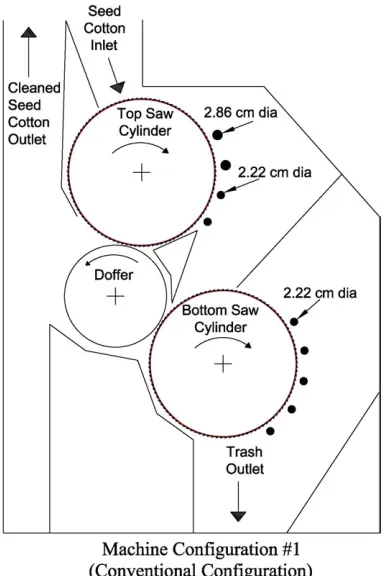
Commercial field cleaners on modern stripper harvesters utilize round grid bars with varying diameter. Typically, the top two grid bars around the primary (upper) saw cylinder are larger in diameter than the remaining grid bars located around the primary and reclaiming (lower) saw cylinders (Figure 1). For this project, nine experimental grid bar cross sectional ge-ometries were evaluated against a conventional round grid bar configuration in a field cleaner from a John Deere model 7445 cotton stripper (Moline, IL) in the ginning laboratory at the USDA - ARS Cotton Produc-tion and Processing Research Unit, Lubbock, TX. The field cleaner (removed from the harvester) was installed in the ginning laboratory with a pneumatic seed cotton feeding system for testing. The conventional configura -tion shown in Figure 1 consisted of the following:
●Top Saw (saw diameter = 33.66 cm)
○Four grid bars spaced 8.9 cm (3.5 in) apart (center to center distance)
○Top two bars - 2.86 cm (1.125 in) diameter and 1.59 cm (0.625 in) saw to grid bar clearance
○Bottom two bars - 2.22 cm (0.875 in) diameter and 1.27 cm (0.5 in) saw to grid bar clearance ●Bottom Saw (saw diameter = 33.66 cm)
○Five grid bars each with 2.22 cm (0.875 in) diameter and 1.27 cm (0.5 in) saw to grid bar clearance
○Upper two bars spaced 8.9 cm (3.5 in) apart (center to center distance)
○Lower three bars spaced 6.35 cm (2.5 in) apart (center to center distance).
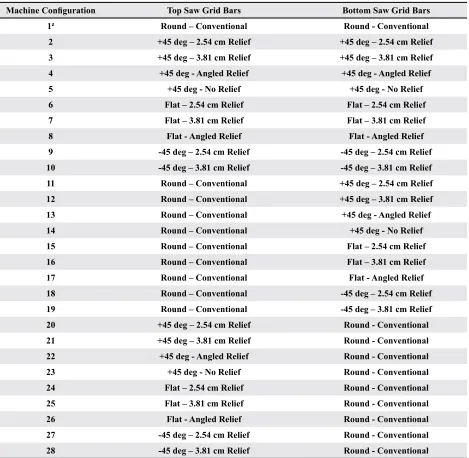
A screening test was conducted on the conven-tional and experimental grid bars installed in the field cleaner under twenty-eight machine configurations. The twenty-eight machine configurations (Table 1) were the treatments tested in a completely randomized experimental design with three replications (runs) per treatment. During each run, approximately 22.7 kg (50 lb) of non-field cleaned (23.5% lint turnout) stripper harvested seed cotton (FiberMax 9063 B2RF, Bayer Crop Science, Research Triangle Park, NC) was fed through the machine at 114 kg/min-m (77 lb/min-ft) of machine width. Processing rate for cotton stripper mounted field cleaners varies with machine ground speed and crop yield and condition. The processing rate used in this test is equivalent to that of a 1.52 m (5ft) wide field cleaner operating on an 8-row (1.02 m row spacing) stripper harvesting cotton yielding 4.94 bales/ha (2 bales/acre) at 2.74 km/h (1.7 mi/h). Internal guards installed in the field cleaner reduced the effective length of the machine to 38.1 cm (15 in) and the primary and reclaiming saw cylinders were
Figure 1. Schematic diagram of field cleaner configured with conventional round grid bars (machine
configuration #1).
Figure 2. Schematic diagram of field cleaner configured with experimental grid bars as defined for machine configuration #11.
Figure 3. Schematic diagram of experimental grid bar and saw cylinder showing approach, cleaning point, and relief sections of grid bar.
AgriLife Research and Extension Center in Lub-bock, TX. The machinery sequence used to gin the samples was: 1) seed cotton intake/suction, 2) two-saw stick machine, 3) extractor feeder, 4) ten-two-saw gin stand, and 5) lint cleaner. Lint samples collected after ginning were sent to Cotton Incorporated (Cary, NC) for High Volume Instrument (HVI) and Advanced Fiber Information System (AFIS) fiber analysis. Samples were collected to determine seed cotton moisture content immediately before ginning (1 sample), and seed and lint weights were recorded after ginning.
operated at 630 and 550 rpm, respectively. Seed cotton samples were collected before and after (3 samples per location per run) the material was processed through the machine for fractionation analysis (Shep-herd, 1972). Seed cotton samples were collected after the field cleaner for dry-basis gravimetric moisture content analysis (2 samples per run) and the material removed from the seed cotton by the field cleaner was weighed and sampled (3 samples per run) for hand fractionation analysis.
The seed cotton cleaned during each run was ginned on a laboratory ginning system at the Texas
Table 1. Machine configurations tested in the field cleaner during the grid bar geometry screening tests.
Machine Configuration Top Saw Grid Bars Bottom Saw Grid Bars
1z Round – Conventional Round - Conventional
2 +45 deg – 2.54 cm Relief +45 deg – 2.54 cm Relief
3 +45 deg – 3.81 cm Relief +45 deg – 3.81 cm Relief
4 +45 deg - Angled Relief +45 deg - Angled Relief
5 +45 deg - No Relief +45 deg - No Relief
6 Flat – 2.54 cm Relief Flat – 2.54 cm Relief
7 Flat – 3.81 cm Relief Flat – 3.81 cm Relief
8 Flat - Angled Relief Flat - Angled Relief
9 -45 deg – 2.54 cm Relief -45 deg – 2.54 cm Relief
10 -45 deg – 3.81 cm Relief -45 deg – 3.81 cm Relief
11 Round – Conventional +45 deg – 2.54 cm Relief
12 Round – Conventional +45 deg – 3.81 cm Relief
13 Round – Conventional +45 deg - Angled Relief
14 Round – Conventional +45 deg - No Relief
15 Round – Conventional Flat – 2.54 cm Relief
16 Round – Conventional Flat – 3.81 cm Relief
17 Round – Conventional Flat - Angled Relief
18 Round – Conventional -45 deg – 2.54 cm Relief
19 Round – Conventional -45 deg – 3.81 cm Relief
20 +45 deg – 2.54 cm Relief Round - Conventional
21 +45 deg – 3.81 cm Relief Round - Conventional
22 +45 deg - Angled Relief Round - Conventional
23 +45 deg - No Relief Round - Conventional
24 Flat – 2.54 cm Relief Round - Conventional
25 Flat – 3.81 cm Relief Round - Conventional
26 Flat - Angled Relief Round - Conventional
27 -45 deg – 2.54 cm Relief Round - Conventional
28 -45 deg – 3.81 cm Relief Round - Conventional
Cleaning performance, seed cotton loss, and fiber quality data collected during the laboratory screening test were analyzed using the General Lin-ear Model procedure in SAS (SAS 9.1, SAS Institute Inc., Cary, NC). Significant differences among ma -chine configurations were detected using Fischer’s Least Significant Difference (LSD) test with a 0.1 level of significance. Analyses of grid bar approach, relief, and location were conducted using the General Linear Model procedure in SAS. Location refers to the installation location of the experimental grid bars: both saws = machine configurations 2 – 10 (Table 1), bottom saw = machine configurations 11 - 19, and top saw = machine configurations 20 – 28. Fischer’s LSD test (a = 0.1) was used to determine which ap-proach, relief, and locations produced different total trash reduction and seed cotton loss levels.
RESULTS AND DISCUSSION
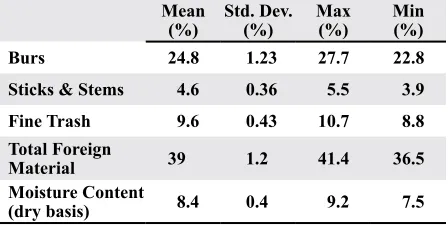
Machine Configuration Analysis. Fraction-ation analysis on the seed cotton samples collected before the field cleaner indicated no significant dif -ferences among machine configurations for any for -eign matter fraction. Similarly, seed cotton moisture content was not different by machine configuration. Mean, standard deviation, and range values for the fractionation and moisture content analyses are presented in Table 2.
Table 2. Fractionation and moisture content analysis results for the seed cotton samples collected before the field cleaner.
Mean
(%) Std. Dev. (%) Max (%) Min (%)
Burs 24.8 1.23 27.7 22.8
Sticks & Stems 4.6 0.36 5.5 3.9
Fine Trash 9.6 0.43 10.7 8.8
Total Foreign
Material 39 1.2 41.4 36.5
Moisture Content
(dry basis) 8.4 0.4 9.2 7.5
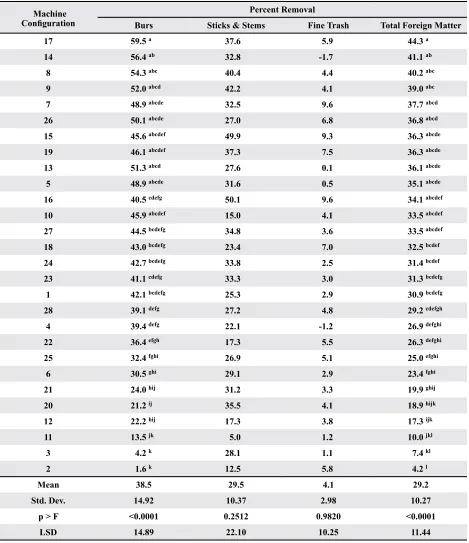
The performance of the field cleaner with regard to foreign matter removal varied by foreign matter fraction and by machine configuration (Table 3). As expected for an extractor type cleaner, the larger foreign matter components (e.g. burs and sticks and stems) were removed with greater efficiency than the fine trash component. Machine configurations exhibiting a high bur removal also produce high total foreign matter removal. Differences among machine
configurations were observed for the percent burs and total foreign matter removed. Machine configu -ration 17 exhibited the best cleaning performance removing 44.3% of the initial total foreign matter. Total foreign matter removal was significantly higher (13.4%) for machine configuration 17 compared to the conventional configuration. Negative fine trash removal was observed for machine configurations 4 and 14 and was a consequence of higher fine trash content in seed cotton fractionation samples col-lected after the cleaner than those colcol-lected before the cleaner. Possible reasons for this observation are 1) additional fine trash was generated in the field cleaner by the breaking up of larger foreign matter components, and 2) variability in fine trash content of the seed cotton used during the test.
Differences in seed cotton loss by machine configuration were observed (Table 4). Seed cotton loss ranged from a minimum of 0.02% for machine configuration 2 to a maximum of 2.01% for machine configuration 5. The LSD for seed cotton loss was 0.65% and the group of machine configurations with lowest seed cotton loss included 22 of the 28 configu -rations tested (Table 4). Machine configu-rations that exhibited lower seed cotton loss tended to remove less total foreign material and vice versa. Machine configurations 2, 3, 11, and 12 removed the least total foreign matter and were in the lowest five configura -tions for seed cotton loss. Machine configura-tions 17, 14, and 8 removed the most total foreign material while they were among the six configurations which lost the most seed cotton.
Data collected during ginning indicated an aver-age lint turnout of 31.5% and seed turnout of 50.5% (lint to seed ratio = 0.626). The average moisture content of the seed cotton samples collected during ginning was 8.1% and ranged from 7.1 to 9.4%.
SFC(n) was different between machine configura -tions 9 and 26 only (26.53 and 21.63%, respectively). Machine configurations 9 and 26 were similar in total foreign matter removal and seed cotton loss (Tables 3
and 4), thus natural fiber quality variability within the seed cotton used in the screening test was suspected to be the cause for the observed differences in AFIS L(n) and SFC(n).
Table 3. Percent removal for component and total foreign matter for 28 machine configurations tested. Machine configurations are listed in order of decreasing total foreign matter removal.
Machine Configuration
Percent Removal
Burs Sticks & Stems Fine Trash Total Foreign Matter
17 59.5a 37.6 5.9 44.3a
14 56.4ab 32.8 -1.7 41.1ab
8 54.3abc 40.4 4.4 40.2abc
9 52.0abcd 42.2 4.1 39.0abc
7 48.9abcde 32.5 9.6 37.7abcd
26 50.1abcde 27.0 6.8 36.8abcd
15 45.6abcdef 49.9 9.3 36.3abcde
19 46.1abcdef 37.3 7.5 36.3abcde
13 51.3abcd 27.6 0.1 36.1abcde
5 48.9abcde 31.6 0.5 35.1abcde
16 40.5cdefg 50.1 9.6 34.1abcdef
10 45.9abcdef 15.0 4.1 33.5abcdef
27 44.5bcdefg 34.8 3.6 33.5abcdef
18 43.0bcdefg 23.4 7.0 32.5bcdef
24 42.7bcdefg 33.8 2.5 31.4bcdef
23 41.1cdefg 33.3 3.0 31.3bcdefg
1 42.1bcdefg 25.3 2.9 30.9bcdefg
28 39.1defg 27.2 4.8 29.2cdefgh
4 39.4defg 22.1 -1.2 26.9defghi
22 36.4efgh 17.3 5.5 26.3defghi
25 32.4fghi 26.9 5.1 25.0efghi
6 30.5ghi 29.1 2.9 23.4fghi
21 24.0hij 31.2 3.3 19.9ghij
20 21.2ij 35.5 4.1 18.9hijk
12 22.2hij 17.3 3.8 17.3ijk
11 13.5jk 5.0 1.2 10.0jkl
3 4.2k 28.1 1.1 7.4kl
2 1.6k 12.5 5.8 4.2l
Mean 38.5 29.5 4.1 29.2
Std. Dev. 14.92 10.37 2.98 10.27
p > F <0.0001 0.2512 0.9820 <0.0001
LSD 14.89 22.10 10.25 11.44
Table 4. Average seed cotton loss (%) for 28 machine configurations tested. Machine configurations are listed in order of increasing seed cotton loss.
Machine Configuration Seed Cotton Loss (%)
2 0.02a
11 0.02a
3 0.03a
7 0.05a
12 0.08a
16 0.08a
20 0.12ab
25 0.13ab
23 0.13ab
13 0.20abc
22 0.20abc
28 0.22abc
4 0.25abc
21 0.29abc
27 0.31abc
15 0.35abc
1 0.36abc
24 0.40abc
6 0.44abcd 9 0.44abcd
26 0.53abcde
19 0.58abcde
17 0.76bcde
18 0.78cde
14 1.07def
8 1.13ef
10 1.43fg
5 2.01g
Mean 0.44
Std. Dev. 0.47
p > F 0.0002
LSD 0.65
* Means within a column followed by the same letter are not significantly different according to Fischer’s Least Significant Difference (LSD) Test (α = 0.1).
Table 5. Average HVI fiber properties measured from the fiber ginned from the seed cotton samples cleaned by the field cleaner during the screening tests. P > F values listed are for ANOVA tests for differences by machine configuration.
Mean Std. Dev. p > F
MIC 4.1 0.1 0.0550
UHM [mm] 31.5 0.5 0.1090
UI [%] 83 0.7 0.6410
STR [g/tex] 31.3 0.6 0.1600
ELO [%] 6 0.3 0.6460
Rd 79.8 2.0 0.6790
+b 8.6 0.7 0.6880
AREA [%] 0.5 0.2 0.3000
SFC [%] 8.3 0.3 0.1140
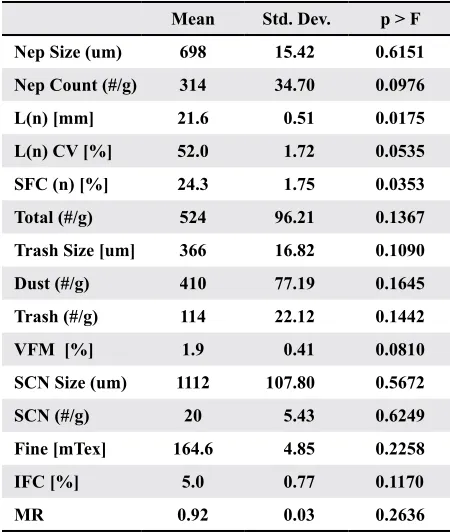
Table 6. Selected AFIS fiber analysis results for the fiber ginned from the cleaned seed cotton samples produced by the field cleaner during the screening tests. P > F values listed are for ANOVA tests for differences by machine configuration.
Mean Std. Dev. p > F
Nep Size (um) 698 15.42 0.6151
Nep Count (#/g) 314 34.70 0.0976
L(n) [mm] 21.6 0.51 0.0175
L(n) CV [%] 52.0 1.72 0.0535
SFC (n) [%] 24.3 1.75 0.0353
Total (#/g) 524 96.21 0.1367
Trash Size [um] 366 16.82 0.1090
Dust (#/g) 410 77.19 0.1645
Trash (#/g) 114 22.12 0.1442
VFM [%] 1.9 0.41 0.0810
SCN Size (um) 1112 107.80 0.5672
SCN (#/g) 20 5.43 0.6249
Fine [mTex] 164.6 4.85 0.2258
IFC [%] 5.0 0.77 0.1170
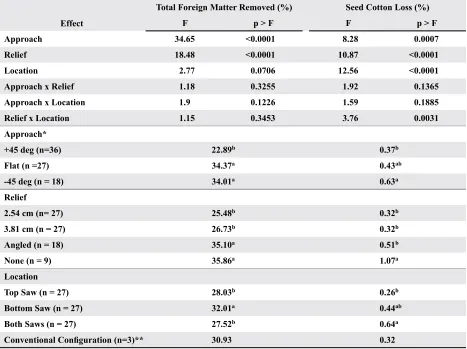
Table 7. Analysis of grid bar approach, relief, and installation location (top saw, bottom saw, or both saws) effects on total foreign matter removed and seed cotton loss (%).
Total Foreign Matter Removed (%) Seed Cotton Loss (%)
Effect F p > F F p > F
Approach 34.65 <0.0001 8.28 0.0007
Relief 18.48 <0.0001 10.87 <0.0001
Location 2.77 0.0706 12.56 <0.0001
Approach x Relief 1.18 0.3255 1.92 0.1365
Approach x Location 1.9 0.1226 1.59 0.1885
Relief x Location 1.15 0.3453 3.76 0.0031
Approach*
+45 deg (n=36) 22.89b 0.37b
Flat (n =27) 34.37a 0.43ab
-45 deg (n = 18) 34.01a 0.63a
Relief
2.54 cm (n= 27) 25.48b 0.32b
3.81 cm (n = 27) 26.73b 0.32b
Angled (n = 18) 35.10a 0.51b
None (n = 9) 35.86a 1.07a
Location
Top Saw (n = 27) 28.03b 0.26b
Bottom Saw (n = 27) 32.01a 0.44ab
Both Saws (n = 27) 27.52b 0.64a
Conventional Configuration (n=3)** 30.93 0.32
* Means within a column by approach, relief, or location with the same letter are not significantly different according to Fischer’s LSD test (α = 0.1)
** Conventional grid bar data were not included in analysis by approach, relief, or location due to the reduced number of observations.
The screening test was conducted to quan-tify the performance of the field cleaner using the experimental grid bar configurations with regard to foreign matter removal, seed cotton loss, and fiber quality preservation. The conventional configuration (machine configuration 1, Table 1) was included in the screening test to provide information on the relative improvement in field cleaner performance when using the experimental machine configurations. Machine configuration 7 exhibited the best balance between maximum total foreign matter removal and minimum seed cotton loss (Tables 3 and 4). Total foreign matter removal and seed cotton loss were improved for machine configuration 7 compared to the conventional con -figuration. Machine configuration 17 exhibited the
highest total foreign matter removal compared to all other machine configurations. HVI and AFIS fiber quality parameters were not different between machine configurations 7 and 17 and the other configurations tested.
The +45 degree approach removed less total foreign matter than the flat or -45 degree approaches. Seed cotton loss was lower for the +45 degree ap-proach compared to the -45 degree apap-proach. Seed cotton loss for the flat approach was not different than the other two approaches tested. Total foreign matter removal was higher for the grid bars with angled and no relief compared to those with 2.54 and 3.81 cm straight relief types. Grid bars with no relief had significantly higher seed cotton loss than grid bars with an angled relief or straight relief types of either length. These findings were expected as previous research showed that grid bars more widely spaced remove more foreign material than those more nar-rowly spaced (Baker and Laird, 1986). Although the distance between cleaning points on the experimental grid bars were kept the same as the conventional grid bar spacing, the effective open space between experi-mental grid bars was increased for approach types: flat or -45 degree and relief types: angled or none.
More total foreign matter was removed when the experimental grid bars were installed around the bottom saw than when installed around the top saw only or around both saws. Seed cotton loss was higher when the experimental grid bars were installed around both saws than when they were installed around the top saw only. Seed cotton loss was not different when the experimental grid bars were installed around the bottom saw than any other location. The relationship between grid bar relief type and seed cotton loss var-ied by location (Figure 5) and produced a significant relief x location interaction (Table 7). Seed cotton loss increased more for grid bars with angled and no relief installed around both saws compared to the top saw and bottom saw only locations.
CONCLUSIONS
Foreign matter removal, seed cotton loss, and fiber quality were measured for twenty-eight field cleaner machine configurations in a laboratory-screening test. Differences by machine configu -ration were observed for bur and total foreign matter removal and seed cotton loss. Machine configurations that removed the most total foreign matter also had higher seed cotton loss. Machine configuration had no effect on HVI fiber quality parameters and a minimal effect on AFIS fiber quality. Only machine configurations 9 and 26 produced significantly different values for AFIS L(n) and SFC(n) but this difference was likely caused by natural fiber quality variability.
Foreign matter removal and seed cotton loss increased as the open space between experimental grid bars increased. The grid bar geometry analysis indicated that grid bars with a flat approach and angled relief installed around the bottom saw (ma-chine configuration 17) can improve total foreign matter removal and seed cotton loss. The results of the machine configuration analysis indicated that machine configuration 7 exhibited the best balance in terms of maximum total foreign matter removal and minimum seed cotton loss. Future work should focus on confirmation of these find -ings for cotton stripper harvester-mounted field cleaners operating under field conditions and extractor-type cleaners used in cotton gin seed cotton cleaning systems.
ACKNOWLEDGEMENT
The authors would like to acknowledge the financial support of Cotton Incorporated in this study. The support of Dr. Jane Dever with Texas AgriLife Research is gratefully acknowledged for allowing access to the laboratory ginning system used in this study.
DISCLAIMER
Mention of trade names or commercial prod-ucts in this manuscript is solely for the purpose of providing specific information and does not imply recommendation or endorsement by the U.S. Depart-ment of Agriculture. USDA is an equal opportunity provider and employer.
Figure 5. Plot of seed cotton loss (%) as influenced by grid bar relief type for three installation locations averaged over all grid bar approach types.
0.00 0.50 1.00 1.50 2.00 2.50
2.54 cm 3.81 cm Angled None
Se
ed
cot
ton
loss (
%
)
Relief type
REFERENCES
Baker, R.V., and J.W. Laird. 1986. Effects of feed position and grid spacing on stick machine performance. Trans. ASAE. 29(6): 1536-1539.
Baker, R.V., and A.D. Brashears. 2000. Combined effects of field cleaning and lint cleaning on stripper harvested cot -ton. p. 1616-1621. In Proc. Beltwide Cotton Conf., San Antonio, TX. 4-8 Jan. 2000. Natl. Cotton Counc. Am.,
Memphis, TN.
Baker, R.V., W.S. Anthony, and R.M. Sutton. 1994. Seed cot-ton cleaning and extracting. p. 69-90. In W.S. Anthony and W.D. Mayfield (eds.) Cotton Ginners Handbook. Agricultural Handbook No. 503. U.S. Dept. of Agric. Washington D.C.
Barker, G.L, C.S. Shaw, and K.E. Luckett. 1969. A seed cotton cleaning attachment for mechanical pickers. Southeast Region Meeting, Mobile, AL. 3-5 Feb. 1969. Soc. Agric. Eng., St. Joseph, MI.
Bennett, B.K, S.K. Misra, A.D. Brashears, and T.L. Dowty. 1995. Effect of bur extractor on trash in seed cotton and fiber quality for different harvest dates. p. 649-652. In
Proc. Beltwide Cotton Conf., San Antonio, TX. 4-7 Jan. 1995. Natl. Cotton Counc. Am., Memphis, TN.
Brashears, A.D. 1986. Reversing of grates to reduce extrac-tion loss. 1986 Annual Report. USDA ARS Project – 6208-20550-008. U.S. Dept. Agric. Agric. Res. Ser-vice - Cotton Production and Processing Research Unit, Lubbock, TX.
Brashears, A.D. 1991. Field cleaner efficiency as affected by variety. ASAE paper no. 911078. ASAE International Summer Meeting, Albuquerque, NM. 23-26 June 1991. Am. Soc. Agric. Eng., St. Joseph, MI.
Kirk, I.W., T.E. Corley, and F.A. Kummer. 1970. Performance relations for a saw grid seed cotton cleaner. Trans. ASAE.
13(2): 171-176.
Kirk, I.W., E.B. Hudspeth, Jr., and A.D. Brashears. 1973. Optimizing saw-grid cleaner design for cotton stripper harvesters. Trans. ASAE. 16(3): 446-449.
Kulkarni R., E. Segarra, M. Kelley, R.K. Boman, and A.D. Brashears. 2005. The economics of crop termination and use of field cleaners. p. 304-309. In Proc. Beltwide Cot-ton Conf., New Orleans, LA. 4-7 Jan. 2005. Natl. CotCot-ton Counc. Am., Memphis, TN.
Shepherd, J.V. 1972. Standard procedures for foreign matter and moisture analytical tests used in cotton ginning research. Agricultural Handbook No. 422. U.S. Dept. of Agric., Washington D.C.
Smith, L.A. ,and W.T. Dumas. 1982. A cleaner for cotton strippers. Trans. ASAE. 25(2): 291-296.
Whitelock, D.P., and W.S. Anthony. 2003. Evaluation of cylin-der cleaner grid bar configuration and cylincylin-der speed for cleaning of seed cotton, lint, and lint cleaner waste. Appl. Eng. Agric. 19(1): 31-37.