Available online at http://scik.org
Commun. Math. Biol. Neurosci. 2016, 2016:17 ISSN: 2052-2541
OPTIMAL CONTROL OF A COMPUTER VIRUS MODEL WITH NETWORK ATTACKS
HONGYUE PEI1, YONGZHEN PEI1,2,∗, XIYIN LIANG1, MEIXIA ZHU1
1School of Computer Science and Software Engineering, Tianjin Polytechnic University, Tianjin, 300387,China 2Department of Basic Science, Military Transportation University, Tianjin, 300161, China
Copyright c2016 H. Pei, Y. Pei and M. Zhu. This is an open access article distributed under the Creative Commons Attribution License, which permits unrestricted use, distribution, and reproduction in any medium, provided the original work is properly cited.
Abstract. This paper addresses the issue of how to promote the spread of computer virus, which is regarded
as an intelligence weapon, by means of the optimal control method. First, a state-delay computer virus spread
model is established. Second, an objective functional for optimizing the control cost and effect is described. Third,
an algorithm for computing the gradient of the optimal control problem is developed. Finally, several numerical
examples is shown.
Keywords:state delay; computer virus; optimal control; network attacks.
2010 AMS Subject Classification:49N90.
1. Introduction
Computer virus is a malicious mobile code that are intended to spread among computers and perform detrimental operations including virus, worm, logic bomb and so on[1]. From their first appearance in 1986, computer virus has become a great threat to our work and daily life. Espe-cially, in recent years, this threat has become more and more serious because of the development
∗Corresponding author
Received April 12, 2016
of hardware and software technology and the popularity of computer networks. So computer viruses are an important risk to computational systems endangering either corporations of all sizes or personal computers used for domestic applications, then we can use computer viruses to cripple a computational system, which will be serious damaged. Computer virus is consid-ered as one of the most important weapon in the internet, and their emergence and spread may have great effect on the computer world[2]. For example, the U.S. military has been using the primary computer virus techniques against the Iraqi command heart when the outbreak of the Gulf War in the 1991. This is the first time in the world of battle with a computer virus and uncover the prelude of computer virus in actual combat. Different codes have different ways to spread in the internet. Virus mainly attack the file system and worm uses system vulnerability to search and attack the computer. And for trojan horses, they camouflage themselves and thus induce the users to download them[3].
Since Kephart and White [4,5] took the first step towards computer virus spread model, much effort has been done in the area of developing a mathematical model for the computer virus propagation[1,2,3,6-10]. But we noticed that the above-mentioned work ignores the fact that computer viruses can be regarded as not only a threat to our information system, but also a intelligence weapon to attack computer systems of the enemies. Some scientists asserted: in the future, the greatest threat of mankind is not a nuclear war any more, but computer virus which is more direct and more dangerous. So the computer virus attack has become a new and important topic in modern information warfare.
principle. Finally, numerical examples demonstrate that the spread of computer virus can be maximized effectively by use of an optimal control strategy, while the budget of the spread can be minimized.
2. Model formulation
Our work is based on the delayed computer virus model on internet.
dS
dt = (1−p)b−µS−βS(t−τ1)I(t−τ1) +νR(t−τ2), dI
dt =βS(t−τ1)I(t−τ1)−(µ+γ+α)I dR
dt =pb+γI−µR−νR(t−τ2).
(2.1)
It is assumed that each node is denoted as one computer and the state of it can be the healthy computers who are susceptible (S(t)) to infection, the already infected computers (I(t)) who can transmit the virus to the healthy ones or the recovered (R(t)) who cannot get the virus or transmit it[3,14,15]. Here bis the number of newly coming nodes, pis the immune rate of a newly coming node,β is the infection rate of an infected node,µ is the natural leaving rate of
a node,ν is the loss rate of immunity of a recovered node, γ is the recovery rate of an infected
node, α is the removing rate of an infected node due to the action of the virus,τ1is the latent period of an infected node, andτ2is the immune period of a recovered node [3].
Next, we will introduce network attacks into model (2.1). Let τ3be the latent period of an offensive node, η be the budget for attacking susceptible computers. Then the corresponding
model with the network attack of computer virus is employed as follows:
dS
dt = (1−p)b−µS−βS(t−τ1)I(t−τ1) +νR(t−τ2)−ηS(t−τ3), dI
dt =βS(t−τ1)I(t−τ1)−(µ+γ+α)I+ηS(t−τ3) dR
dt =pb+γI−µR−νR(t−τ2),
(2.2)
The initial conditions for model (2.2) are
whereτ=max{τ1,τ2,τ3},R3+={(S,I,R)∈R3,S≥0,I≥0,R≥0}. Therefore, all the standard
results on existence, uniqueness and continuous dependence on initial condition of solutions are evidently satisfied.
3. Optimal control problems with state-delay controls
To formulate an optimal problem on the network attack, we introduce some preliminary def-initions[16]. Letτ= (τ1,τ3)be a vector of delays andη be the budget for attacking susceptible
computers. We impose the following bound constraints on the delays and budget: ˜
τi≤τi≤τ¯i, i=1,3, (3.1)
and
˜
η ≤η≤η,¯ (3.2)
where ˜τi, ¯τi, ˜ηjand ¯ηj are given constants such that 0≤τ˜i<τ¯iand ˜ηj<η¯j.
Any vector τ = (τ1,τ3)T satisfying (3.1) is called an admissible state-delay vector. Let Γ denote the set of all such admissible state-delay vectors. The vectorη satisfying (3.2) is called
an admissible budget vector. LetZdenote the set of all such admissible parameter vectors. Any combined pair(τ,η)∈Γ×Z is called an admissible control pair for system (2.2). Let
X(t) =h S(t) I(t) R(t)
iT
.
For a given terminal timetf and given time pointsti,i=1,2, ...,psatisfying
0<t1≤t2. . .≤tn≤tp, <tf (3.3)
our aim is to find an admissible control pair(τ,η)∈Γ×Z that minimizes the following cost
function
J=min{Φ(S(ti|τ,η),I(ti|τ,η),R(ti|τ,η))
+
Z tp
0
L(X(t|τ,η),X(t−τ1|τ,η),X(t−τ2|τ,η),η)dt
,
(3.4)
where
Φ=−
p
∑
i=1
L=
Z tp
0
η2
2 dt
In (3.4), our objective aim is to find a control to maximize the accumulated number of infected nodes at the characteristic times and meaning while to minimize the total budget for network attack during the time period [0,tp]. In order to achieve those goals, we will focus on the following algorithms.
4. Gradient computation
For convenient calculation, define the right side of (2.2) fort∈[0,tp] as:
f(X(t|τ,η),X(t−τ1|τ,η),X(t−τ3|τ,η)) =
h
dS dt
dI dt
dR dt
iT
,
and initial conditions for t≤0 as
X(t) =
h
S(t) I(t) R(t)
iT
=φ(t,η).
Furthermore, in order to find an optimal solution, define
ψ(t|τ,η) =
∂φ(t,η)
∂t , ift<0,
f(X(t|τ,η),X(t−τ1|τ,η),X(t−τ3|τ,η)), ift∈[0,tf], and fori=1,3
∂f¯(t|τ,η)
∂X =
∂f(X(t|τ,η),X(t−τ1|τ,E),X(t−τ3|τ,η),η)
∂X ,
∂f¯(t|τ,η)
∂x˜i =
∂f(X(t |τ,η),X(t−τ1|τ,η),X(t−τ3|τ,η),η)
∂X(t−τi)
,
∂L¯(t|τ,η)
∂x˜i =
∂L(X(t |τ,η),X(t−τ1|τ,η),X(t−τ3|τ,η),η)
∂X(t−τi)
.
According to literature [16] and model (2.2), we deduce the auxiliary impulsive system cor-responding to this problem as follows:
˙
λ(t) =−
∂f¯(t|τ,η) ∂X(t)
T
λ(t)−
∑
l=1,3
(
∂f¯(t+τl|τ,η) ∂x˜l
T
λ(t+τl) +
∂L¯(t+τl|τ,η) ∂x˜l
T)
Then for the system(2.2), given the admissible control pair (τ,η)∈Γ×Z and the
corre-sponding solution of state system (2.2), there exist adjoint variablesλi(i=1, 2, 3) satisfying
˙
λ1(t) =µ λ1(t) +βIλ1(t+τ1)−βIλ2(t+τ1), ˙
λ2(t) = (µ+γ+α)λ2(t)−γ λ3(t) +βSλ1(t+τ1)−βSλ2(t−τ1) +η λ2(t+τ3), ˙
λ2(t) =µ λ3(t).
(4.1)
By jump conditions,
λ(tk−) =λ(tk+) +
∂Φ(X(t1|τ,η), . . . ,X(tp|τ,η),η)
∂X(tk)
T
,k=1,2, . . . ,p (4.2)
and
∂Φ(X(t1|τ,η), . . . ,X(tp|τ,η),η)
∂X(tk)
= ∂J
∂S ∂J ∂I ∂J ∂R
= 0 −1 0
, (4.3)
we get jump conditions at pointstk(k=1,2,3, ...,p):
λ1(tk−) =λ1(tk+)
λ2(tk−) =λ2(tk+)−1
λ3(tk−) =λ3(tk+),
with boundary conditions λi(tf) =0 (i=1,2,3). So, from the above derivation, we can get following conclusion.
Theorem 4.1 For the solution of system (2.2) corresponding to the admissible control pair
(τ,η)∈Γ×Z, the auxiliary impulsive system (4.1)-(4.3) is established.
Next, we devote to gradient with respect to state-delaysτ1andτ3:
∂J(τ,η) ∂ τi
=∂Φ
∂ τi +
Z tp
0
∂L¯ ∂ τi
−
∂L¯(t|τ,η)
∂x˜i +λ
T(t|τ,
η)∂
¯
f(t|τ,η)
∂x˜i
ψ(t−τi|τ,η)
dt,
herei=1,3. After simple computer, one gets
∂Φ
∂ τi = ∂I
∂ τi
=0, ∂L¯ ∂ τi
= ∂
η2
2
∂ τi
=0, ∂L¯(t|τ,ζ)
∂x˜i =
∂η
2
2
We also get
∂f¯(t|τ,η)
∂x˜i =
∂S˙(t)
∂S(t−τi)
∂S˙(t)
∂I(t−τi)
∂S˙(t)
∂R(t−τi)
∂I˙(t)
∂S(t−τi)
∂I˙(t)
∂I(t−τi)
∂I˙(t)
∂R(t−τi)
∂R˙(t)
∂S(t−τi)
∂R˙(t)
∂I(t−τi)
∂R˙(t)
∂R(t−τi)
,ψ(t−τi|τ,η) =
˙
S(t−τi)
˙
I(t−τi)
˙
R(t−τi)
, and
∂f¯(t|τ,q) ∂X(t−τ1)
=
−βI(t−τ1) −βI(t−τ1) 0
βI(t−τ1) βI(t−τ1) 0
0 0 0
,∂f¯(t|τ,q) ∂X(t−τ3)
=
0 0 0
0 η 0
0 0 0
.
In conclusion, we obtain gradient with respect to state-delaysτ1andτ3:
∂J(τ,η) ∂ τ1
=−
Z tp
0
h
λ1(t) λ2(t) λ3(t)
i
−βI(t−τ1) −βI(t−τ1) 0
βI(t−τ1) βI(t−τ1) 0
0 0 0
˙
S(t−τ1)
˙
I(t−τ1)
˙
R(t−τ1)
dt =
Z tp
τ1
[−λ1(t) +λ2(t)][βI(t−τ1)S˙(t−τ1) +βS(t−τ1)I˙(t−τ1)]dt,
(4.4)
∂J(τ,η) ∂ τ3
=−
Z tp
0
h
λ1(t) λ2(t) λ3(t)
i
0 0 0
0 η 0
0 0 0
˙
S(t−τ3)
˙
I(t−τ3)
˙
R(t−τ3)
dt =
Z tp
τ3
λ2(t)I˙(t−τ3)dt,
(4.5) where ˙S(t),I˙(t),R˙(t)are given by the right hand side of (2.2).
Theorem 4.2 For each admissible control pair(τ, η)∈Γ×Z, we obtain gradients (4.4) and
Analogously, forη according to ∂J(τ,η)
∂ η =
∂Φ(x(t1|τ,η), . . . ,x(tp|τ,η),τ,η)
∂ η +λ
T(0+|
τ,η)∂φ(0,η) ∂ η
+
Z tp
0
∂L¯(t|τ,η)
∂ η +λ
T(t|τ,
η)∂
¯
f(t|τ,η)
∂ η dt + m
∑
l=1
Z 0
−τl
∂L¯(t+τl|τ,η)
∂x˜l +λ
T(t+
τl|τ,η)∂
¯
f(t+τl|τ,η)
∂x˜l
∂φ(t,ζ)
∂ η dt,
(4.6) where
∂Φ(x(t1|τ,ζ), . . . ,x(tp|τ,ζ),τ,ζ)
∂ ζj
= ∂I
∂ η =0,
∂L¯(t|τ,ζ) ∂ ζj
=∂
η2
2
∂ η =1.
Combined withϕ(t,q)which is a constant in[−τ,0], together with cost functionJ which is a
explicit function ofη, it is obtain gradient with respect to the budgetη:
∂J(τ,η)
∂ η =
Z tp
0
{h λ1(t) λ2(t) λ3(t)
i
∂S˙(t)
∂ η
∂I˙(t)
∂ η
∂R˙(t)
∂ η
+1}dt
=
Z tp
0
{h λ1(t) λ2(t) λ3(t)
i 0
I(t−τ3)
0
+1}dt
=−
Z tp
0
{λ2(t)I(t−τ3) +1}dt
(4.7)
Theorem 4.3For each admissible control pair(τ, η)∈Γ×Z, we obtain gradients (4.7) with
respect to budgetη.
As in [3], we shall take the parameter values given in Table 1. Furthermore, we shall assume that S(0) = 8, I(0) = 1, and R(0) = 1[17].
TABLE 1. Values of the parameters.
Parameters p b β µ ν γ
Values 0.9 1 0.2 0.32 0.7 0.35
5.1. Optimal attacking problem with delay and without delay network attacks
The subject of attacking in computer systems is considered as a multidisciplinary area of research which includes economists, network technology and resource management. And what role does the time delay select play in optimal attack?
Simulation 1.
0 0.2 0.4 0.6 0.8 1 5
10 15 20 25 30 35 40 45
η
Total number of Infected computer
τ1=0,τ3=0
τ1=0.8,τ3=0.8
FIGURE 1. The total number of infected computer with respect to budget effort
η in interval (0, 1] for without and with delays attacking.
In this subsection, we assume that the terminal time istp=50 and the immune period of a recovered computerτ2 =0.2, and we will firstly probe into optimal attacking problem based on non-selective attack. That is, for fixedτ1=τ3=0, maximum attack is studied whenη is regarded as a control parameter. Then the optimal harvest strategy with selective catch along withτ1=1,τ3=1 are researched.
attacking is more appropriate. The growth of the number not really obvious with the budget grow.
5.2. Composite optimization problem (COP) based on the time delay attack
Problem (3.4) is a composite optimization problem related to the resources exploitation and computer virus attacking from the perspective of economics and computer science whenφ 6=0
andL6=0.
Simulation 2.
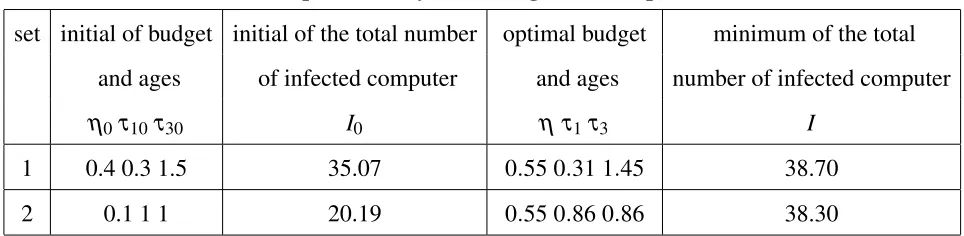
When the initial of budget and ages are chosen, optimal budget and ages are computed by algorithmic design. Furthermore the corresponding number of Infected computer is obtained in Table 2. The terminal time istp=50.
Table 2: Optimal delays and budget with respect to COP
set initial of budget initial of the total number optimal budget minimum of the total and ages of infected computer and ages number of infected computer
η0τ10 τ30 I0 η τ1τ3 I
1 0.4 0.3 1.5 35.07 0.55 0.31 1.45 38.70
2 0.1 1 1 20.19 0.55 0.86 0.86 38.30
5.3. Evolution of number of computers with or without man-made attack.
Simulation 3.
In this section, we shall assume that S(0)=8, I(0) = 1, and R(0) = 1. Letτ1=0.1,τ3=0.2 and
η =0.5. Figure. 2 plots the evolution of number of susceptible nodes both with and without
0 0.5 1 1.5 2 2.5 3 3.5 4 1
2 3 4 5 6 7 8
Time t
Susceptible population size
with man−made attack without man−made attack
FIGURE 2. Evolution of number of susceptible computers with or without man-made attack.
0 0.5 1 1.5 2 2.5 3 3.5 4 1
1.5 2 2.5 3 3.5 4 4.5
Time t
Infected population size
with man−made attack without man−made attack
FIGURE 3. Evolution of number of infected computers with or without
man-made attack.
0 0.5 1 1.5 2 2.5 3 3.5 4
1 1.2 1.4 1.6 1.8 2 2.2 2.4
Time t
Recovered population size
with man−made attack without man−made attack
FIGURE 4. Evolution of number of recovered computers with or without man-made attack.
his paper aims to promote the spread of computer virus and the cost savings effectively by means of the optimal control method. First, a controlled delayed computer virus spread model has been established. Second, an optimal control problem has been proposed by maximizing the number of infected nodes and minimizing the budget. Third, develop a numerical algorithm for computing the gradient of the optimal control problem by the lights of optimal state-delay control problem and Pontryagin-type minimum (maximum) principle. Finally, some numerical examples have been provided, which show that the spread of computer virus can be promoted effectively by taking optimal control measures.
Conflict of Interests
The authors declare that there is no conflict of interests.
Acknowledgements
This work is supported by the National Natural Science Foundation of China (11101305, 11471243).
REFERENCES
[1] P. Szor, The Art of Computer Virus Research and Defense, Addison-WesleyEducation Publishers Inc., 2005.
[2] L. Billings, W.M. Spears, I.B. Schwartz, A unified prediction of computer virus spread in connected networks,
Physics Letters A, 297 (2002), 261-266.
[3] X. Han, Q. Tan, Dynamical behavior of computer virus on Internet, Appl. Math. Comput. 217 (2010),
2520-2526.
[4] Kephart JO, White SR. Directed-graph epidemiological models of computer viruses. In: Proceedings of the
IEEE symposium on security and privacy; 1991. 343-59.
[5] Kephart JO, White SR. Measuring and modeling computer virus prevalence. In: Proceedings of the IEEE
symposium on security and privacy; 1993. 2-15.
[6] Mishra BK, Jha N. Fixed period of temporary immunity after run of anti-malicious software on computer
nodes. Appl Math Comput, 190 (2007): 1207-1212.
[7] Piqueira JRC, Araujo VO. A modified epidemiological model for computer viruses. Appl Math Comput, 213
(2009): 355-60.
[8] Piqueira JRC, de Vasconcelos AA, Gabriel CECJ, Araujo VO. Dynamic models for computer viruses.
Com-put Secur, 27 (2008): 355-359.
[9] Wierman JC, Marchette DJ. Modeling computer virus prevalence with a susceptible-infected-susceptible
[10] Yuan H, Chen G. Network virus-epidemic model with the point-to-group information propagation. Appl Math
Comput, 206 (2008): 357-67.
[11] J.G. Ren, X.F. Yang, Q.Y. Zhu, L.X. Yang, C.M. Zhang, A novel computer virus model and its dynamics,
Nonlinear Anal. Real World Appl. 13 (2012), 376-384.
[12] J.G. Ren, X.F. Yang, L.X. Yang, Y.H. Xu, F.Z. Yang, A delayed computer virus propagation model and its
dynamics, Chaos Solitons Fractals 45 (1) (2012), 74-79.
[13] C. C. Zou, D. Towsley, W. Gong, On the performance of internet worm scanning strategies. Perform. Eval.
63(2006), 700-723.
[14] Guirong Jiang, Qigui Yang, Bifurcation analysis in an SIR epidemic model with birth pulse and pulse
vacci-nation, Applied Mathematics and Computation 215 (2009) 1035-1046.
[15] Ruiqing Shi, Xiaowu Jiang, Lansun Chen, The effect of impulsive vaccination on an SIR epidemic model,
Applied Mathematics and Computation 212 (2009) 305-311.
[16] Q. Chai, R. Loxton , K. Teo, C. Yang, A class of optimal state-delay control problems. Nonlinear Anal-Real
14 (2013) 1536-1550.
[17] Q.Y. Zhu, X.F. Yang, L.X. Yang, C.M. Zhang, Optimal control of computer virus under a delayed model,