DOI: 10.22067/cke.v1i2.60500
Designing Optimized Scheduling QoS-Aware RPL for
Sensor-Based Smart Grid Communication Network
Mohammad Alishahi
, Mohammad Hossein Yaghmaee Moghaddam
and Hamid Reza Pourreza
Abstract: Various applications with different requirments are rapidly developed in the smart grid. The need to provide Quality of Service (QoS) for such a communication network is inevitable. However, recently a protocol called RPL (Routing Protocol for Low Power and Lossy Network) has been standardized and is known as the main solution for last mile communication network of smart grid. In this paper, by studying the existing methods and identifying the shortcomings, we propose a customized version of RPL which we call OMC-RPL (Optimized Multi Class-RPL). Two principal advantages of the proposed method are: a holistic objective function including distinctive metrics related to QoS; and supporting the data classification which is an important requirement in this context. The main contribution of this paper is to make different objective functions proportional to the number of classes by using weighting parameters. The best values of these coefficients are determined by an optimization algorithm. OMC-RPL is evaluated from different aspects. Simulation results show that the new idea significantly decreases the end-to-end delay and increases lifetime of the nodes that have limited source of energy. It seems that OMC-RPL could be a good substitution for the available methods.
Keyword: RPL, DODAG, QoS.
1. Introduction:
One of the basic issues in Smart Grid (SG) is a reliable and secure communication network that can support SG applications such as Advanced Metering Infrastructure (AMI), Demand Response (DR), Distribution Automation (DA) etc.. Within the communication network associated with the power grid, the SG Neighbor Area Network (NAN) and Home Area Network (HAN), as shown in
Fig. 1, are faced with substantial communication challenges because of their size and traffic variation [1-3].
The IETF ROLL working group had a mission to propose a routing protocol for LLN (Low Power and Lossy Networks) which leads to RPL (Routing Protocol for LLN) standard in 2012 [4, 5]. LLNs are made up of a large number of embedded devices with limited power, memory,
Manuscript received November 23, 2016; accepted January 4, 2017.
Mohammad Alishahi, Department of Computer Engineering, Fariman Branch, Islamic Azad University, Fariman, Iran, Mohammad Hossein Yaghmaee Moghaddam, Department of Computer Engineering, Ferdowsi University of Mashhad, Mashhad, Iran.
Hamid Reza Pourreza, Department of Computer Engineering, Ferdowsi University of Mashhad, Mashhad, Iran.
The corresponding author's e-mail is: [email protected]
and resources that connect to each other using various communications protocols, such as IEEE 802.15.4, Wi-Fi, and power-line communication (PLC) [6]. RPL is the main candidate for acting as the standard routing protocol for IP smart object networks in NAN. This popularity is because of two reasons, one is its flexibility to adapt to different topologies, and the other is its capability of QoS support [7]. Distinctive types of applications in the smart grid, especially in NAN and HAN are experiencing the same situation as LLN. This last mile network is made of highly limited devices interconnected by fairly unstable low-quality links that cause different QoS requirements, which is not the same as the traditional IP networks [8]. Eke the QoS is an essential component of the overall architecture in the smart grid [9]. Some data such as alert or control signals have real-time requirements. Ergo the networking infrastructure somehow should guarantee the quality of service, for example, decreasing the end-to-end delay. Due to the necessity of QoS in SG and usability of RPL, in this paper, we propose an optimized QoS-aware RPL, which is completely suited for SG communication network (SGCN). The remaining sections of this paper are organized as follows. In section 2, the RPL is explained. In section 3 the related work on QoS in smart grid and especially those methods using RPL, are studied. Section 4 explains the proposed method. Finally, the last two sections are about simulation results and conclusion.
I. RPL
RPL is a distance-vector protocol that is based on the concept of a topological Directed Acyclic Graph (DAG). DAG uses a tree structure in which each node can have more than one parent. Specifically, RPL organizes these nodes into Destination Oriented DAGs (DODAG) whose roots are destination nodes – e.g., sinks, concentrators, or network gateways. Fig. 2 shows a sample DODAG with a similar structure to a tree that specifies the conventional route between the LLN nodes [7].
22 Alishahi et. al. Designing Optimized Scheduling QoS Aware RPL for Sensor Based Smart Grid…
Fig. 1. Smart Grid System Architecture [3]
Fig. 2. A Sample of DODAG
The RPL protocol’s process helps to create a self-configuring, self-healing, loop detecting system that will be suitable for NAN and HAN networks in the smart grid.
The specification of RPL does not force any routing metric and leaves it open to implementations. The proposed objective functions by the IETF presented in [10] and [11] have put forth some recommendations on how to implement OF without specifying usable routing metrics.
In RFC 6552 [10] the principle of the OF is described, which is called Objective Function Zero (OF0). As explained earlier, the two main duties of an objective function are choosing a proper rank and the preferred parents. RFC 6552 describes the principles and rules of defining an objective function based on the required metrics and constraints. For instance, there is a rule that says, a node with the lowest rank should be chosen as a preferred parent, but note that this document does not consider any routing metric specified in [12]. The proposed objective function in this paper is also based on these foundations.
One typical OF based on the metric of link quality is Expected Transmission Count (ETX) [11]. The main idea of this objective function is the probable amount of transmission to send a packet successfully. This OF is
usually used in wireless environments. ETX has been widely used in recent research papers [13, 14].
2. Related Works
In this section, we investigate about the related works in two parts. The first part is about the concepts and the methods that try to ensure the QoS in smart grid, but the second part is only about the techniques that use RPL algorithm to achieve this goal.
A. QoS in Smart Grid
B. Methods Using RPL to Guarantee QoS in Smart Grid
Although RPL has been released recently, several research studies have been presented to investigate about the subjects that are left open by the working group. In [19], two MAC-based routing metrics are used. The first one checks the ETX and the packet losses due to the MAC contention. The second metric selects the routes that have the acceptable traffic load by considering the power consumption, and the application required reliability. The proposed method is implemented by the author in a real testbed composed of seven Telos motes. The performance parameters in this paper are end-to-end reliability and the power consumption.
In [20] the impact of objective functions on the network topology is analyzed. LQL (Link Quality Level) is another objective function, which is based on the link condition. The author uses two objective functions (OF0 and LQL) for comparison. In [21] a combination of two routing metrics among hop counts, ETX, remaining energy, and RSSI is used. In fact, the first metric is responsible for choosing a parent with the lower rank. If the first values are equal, then the node with the lower rank of the second composition metric is selected as the preferred parent.
Another study [8] suggests a cross-layer QoS mechanism that merges a priority queue with multiple instances of RPL. The focus of this paper is on the MAC level QoS separation. Moreover, both RPL instances are based on the same objective function and root, but generate distinct DODAGs due to partitioning of the actual physical network (i.e., nodes are classified as regular or alarm, regular nodes are responsible for physical environment monitoring and generate data packets at a low rate; however, alarm nodes randomly generate small-size alert packets). This paper intends to extend the idea of QoS through multiple RPL instances by supporting priority traffic in MAC layer and exploring the effect of traffic differentiation at the network layer.
In [3] the QoS is guaranteed through traffic prioritization in MAC layer in a way that the random backoff mechanism is altered based on the traffic classes, and this is how they control the channel accessibility. The author compares the single instance RPL, multi-instance RPL and multi-instance RPL with prioritized channel backoff to see the effect of traffic differentiation at the network layer.
The author in [9] proposes a network-MAC cross-layer protocol based on incorporation of RPL and SCSP (Sleep Collect and Send Protocol) in wireless sensor networks. In fact, SCSP is a power-saving mechanism and media access control protocol. The RPL-SCSP guarantees fast transmission for critical data while reducing the energy consumption. In RPL-SCSP the preferred parent is slected based on the queue load; moreover, the nodes with the empty queue will be switching to an inactive state in order to extend the network lifetime.
Another study [22] believes that in order to optimize the path to the DODAG’s root, the existing objective functions rely either on a single metric or on the combination of the two metrics. Thus a novel objective function based on the fuzzy parameters has been designed. Four different metrics, including end-to-end delay, hop counts, link quality and
remaining energy are used to propose holistic objective function by using fuzzy logic. The proposed fuzzy system is a four-input controller with three membership functions for each input that leads to 81 rules. Eventually, by using centroid defuzzification method, control action based on several membership values is produced.
3. THE PROPOSED OMC-RPL (Optimized Multi-Class-RPL) PROTOCOL
As studied in related work section, the existing protocols that offer the QoS by using RPL are usually faced with two major shortcomings:
1) Most of the approaches do not provide a comprehensive and holistic objective function. For example, an OF may improve the end-to-end delay by finding the most proper path towards the sink, but as all packets try to use the same path, it is possible to have a bad effect on energy consumption.
2) The data classification, which is one of the most important requirements in assuring the QoS is not supported by available methods. The main reason is that if we categorize the data, then each class type has its own specification, and it should be treated in a distinctive way. This means that we need different objective functions for each class of data, which is a notable challenge. Although some studies use two classes of data or two different OFs, but it is for multiple instances RPL. In fact, some networks may run multiple instances of RPL concurrently, but logically these instances are independent.
In this paper, we propose a customized RPL with holistic objective function. The proposed protocol is named OMC-RPL (Optimized Multi-Class OMC-RPL) which can support data classification.
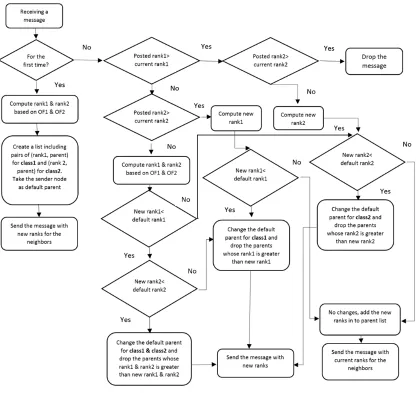
Although DODAG construction in RPL is clear, but as OMC-RPL should support data classification, we need a new procedure. OMC-RPL is able to support several types of traffics. In order to better understand the DODAG construction process we provide a flowchart in Fig. 3, that shows the steps in creating DODAG regarding just two classes of data with two ranks for each node.
In the first step, the root broadcasts a message (including default values for rank1 and rank2 and the two objective
functions) to the nodes in its vicinity . When a node receives a message from the root for the first time, the algorithm calculates two ranks for the node based on two different OFs sent by the root and creates a list which includes pairs of (rank1, parent) and (rank2, parent);
24 Alishahi et. al. Designing Optimized Scheduling QoS Aware RPL for Sensor Based Smart Grid…
Fig. 3. OMC-RPL Algorithm for Constructing DODAG with Two Classes
Various steps taken by the algorithm in order to select the preferred parents are as follow:
The receiving node checks the posted rank for each class, and if it is not greater than the current rank, then it is reasonable to find new parents otherwise it drops the message.
The receiving node computes the new ranks based on the fresh information to see if it is really from a better suited parent; if so it updates the pairs of (ranki and parent) in its
list and removes the parents with greater rank. To clarify the concern of overhead, we should be careful that there are not separate routing tables, we just keep different ranks and preferred parents for each node.
When the DODAG is constructed, the upward route is clear because the only routing process for the intermediate nodes is to send their packets based on their class to the preferred parents, which is chosen during the DODAG’s construction procedure.
We provide an example to better describe the proposed algorithm. Fig. 4 shows a sample network of twenty nodes and two roots in HAN and NAN. Each node may be related to different applications such as DR (Demand Response), AMI (Advanced Metering Infrastructure), Smart Streetlight, Smart Home Devices, EVSE (Electric Vehicle Supply Equipment), etc. with various QoS requirements. The root could be a concentrator in a station. After performing the two classes OMC-RPL algorithm, a DODAG as shown in Fig. 5 is created. It is obvious that this exemplary DODAG is formed based on a specific OF. If we change the objective function, we willprobably face another DODAG. As mentioned earlier, according to two classes of data, each node has two preferred parents (the parents could be different from each other), and also each node could have none or several reserved parents.
Algorithm 1 is the generalized OMC-RPL algorithm for classes of data. Note that the messages in OMC-RPL are standard IPv6 message. These messages are modified easily by adding some fields for extra ranks.
Now, the challenge is designing objective functions for each class of data. According to [22] a good route should be real-time (low end-to-end delay), reliable (high delivery ratio) and energy efficient. Therefore, our goal is to propose comprehensive objective function that satisfies these properties. Instead of having objective functions, we suggest weighting parameters that make the difference for each class of data based on its requirements. Three main components of our proposed objective function are: the quality of the node, the quality of the link (henceforth, we name them NR (Node Rank), LR (Link Rank) respectively) and the energy efficiency, that we evaluate by Remaining Energy (RE) in each node in percent. It is obvious that the RE is meaningful for the nodes that are supplied by battery and have the energy concern; for the other nodes, we consider the RE equal to one.
The proposed objective function is given by Equation 1:
R i R p α NR β LR
RE 1
(1)
Table 1 shows all the parameters and their definitions, which are used in the equations. According to the proposed objective function, the rank of each node for each class of data is the sum of its parent’s rank in the same class, plus the ratio of link and node quality (the NR/LR coefficients are changed equivalently to the class type) to RE, plus one hop count. The weighting parameters are used to control the effectiveness of NR and LR based on the class type. Distinctive types of traffics and five classes of data related to LLN are presented in [23]. Each data class faces with different QoS requirements. This issue is satisfied by changing the weighting coefficients. In fact, the data classification scale is the amount of allowed delay times for various types of applications. Packets with very low allowance of a delay, belong to critical, real-time and high-priority classes. Assume a spectrum of applications from real-time to non-real-time, that can be divided into several classes; the first class is the most critical, and that last one is the most unimportant.
When there are real-time packets, the values of weighting parameters should be selected in a way that the objective function offers the best path (appropriate nodes and links) towards the root. The qualities of node and link are determined by the proposed equations 2-6. Equations 2, 4 and 5 compute the node quality by multiply the ratio of service rate to arrival rate and the ratio of queue length to buffer length. Equation 3 is used to keep the history of node quality. This parameter is calculated, using the current and old values of NR. Equation 6 is the ETX, that we use it for the link quality.
(2)
. 1 . . (3)
(4)
(5)
, ⁄ (6)
26 Alishahi et. al. Designing Optimized Scheduling QoS Aware RPL for Sensor Based Smart Grid…
Fig. 5. An exemplary DODAG after Using OMC-RPL Based on Two Classes of Data
Table 1: Definition of parameters used in objective function.
Parameters Definition
rank of node for ′ class
the rank of preferred parent for ′ class
Weighting coefficient for ′ class between (0-1) Weighting coefficient for ′ class between (0-1) The amount of this parameter shows the node quality
The amount of this parameter shows the link quality between two nodes Remaining Energy in percent
Coefficient between (0-1) Arrival rate
Service rate Queue length Buffer length
data packets transmitted from node i to node j Number of successful network layer transmission
In order to find the best values for the weighting coefficients, we use the PSO (Particle Swarm Optimization) algorithm. PSO is a population-based algorithm that was introduced by Kennedy and Eberhart in 1995. It is based on the social behavior of a swarm of birds and fishes in search of for food [24]. This algorithm is an appropriate solution for a large-scale non-convex optimization problem. Searching rules in this algorithm are easy and yet meaningful, the computation time is low and there is no need for much memory space; these are the reasons why it has been used by many applications to solve several problems. The procedure of PSO algorithm in finding optimal values follows the animal behavior through using the best personal/global experience of particles. PSO consists of a swarm of particles, where each particle represents a potential solution [25]. Although recently, several modifications have been made to the original PSO, but the main idea of PSO asserts that position of the particle toward the optimized answer is influenced by a velocity vector. Let denote the position of particle in the search space at time step (denotes discrete time steps). According to equation 7, the new position of the particle is obtained by adding a velocity to the current position. The velocity is calculated based on equation 8 which is the outcome vector of previous velocity, local best and global best values [26].
1 1 (7)
1 1
1
(8)
In equation 8, and
respectively show the best personal and the best neighborhood experience of particles in time slot ,
are acceleration coefficient and are random numbers between 0 and 1. After a certain number of repetitions, the algorithm will find the optimized answers in the search space.
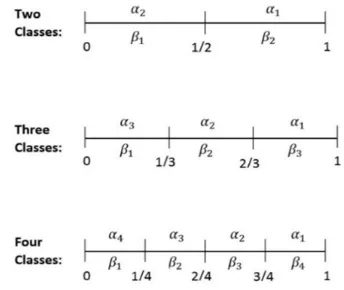
Despite the non-real-time classes, the critical and sensitive classes of data need a fast path; with regard to this issue, the NR coefficient is considered greater than the LR and for the less important classes, it happens vice versa. This classification idea causes the spread of traffic through the network. This leads to congestion prevention and an increase in the network lifetime . Eventually, the PSO procedure of finding the optimized values for weighting parameters is as follows: the required initial values are determined; the random weighting coefficient values are selected for the particles; the PSO objective function which we consider as the average end-to-end delay is implemented; then the best personal and global experiences are identified; the algorithm is repeated based on equation 7 to find the optimized values. According to the aforementioned, and in order to have distinctive weighting coefficients for each class of data, The ranges for the coefficients, equivalent to the number of classes is specified in Fig. 6. For example, in a case that there are two classes of data, the optimized NR coefficient for the first class should be found between 0.5 and 1, and the optimized LR coefficient should be found between 0 and 0.5. In the next section using the simulation, the performance of the proposed method is evaluated.
28 Alishahi et. al. Designing Optimized Scheduling QoS Aware RPL for Sensor Based Smart Grid…
4. PERFORMANCE EVALUATION:
In order to evaluate the OMC-RPL, we create a sample network with several nodes and sinks. This network generates different traffic types related to the various applications and classes. Furthermore, to support distinctive applications, some of the nodes have energy concern and work with a battery. Table 2 shows the general information of simulation environment.
Table 2. The General Information of Simulation Environment
Simulator Riverbed 18.0
Simulation area 250×250m Number of nodes 88 Number of sinks 3 Number of nodes work with battery 7 Initial node energy for
battery base nodes 50 joule Test duration for each
scenario 1 Hour
Traffic patterns
Is defined based on the classes and specifications in [23]
Before evaluating the proposed method, we need to find the optimized values for weighting coefficients. In the current study, we consider three different cases, including two, three and four classes of data; with that in mind, the described PSO is implemented inside the simulation software, and we need to run the algorithm for each class. If we have two classes, then we should run the algorithm two times. The achieved values of parameters at different cases is shown in table 3. For example, in the case of two classes of data and by using the achieved values, the objective functions for the first and second class are given in equations 9 and 10, respectively. Now the OMC-RPL is able to support different classes and has several OFs corresponding to the number of classes.
R i R p 0.87 NR 0.33 LR
RE 1 (9)
R i R p 0.39 NRRE0.76 LR 1 (10)
Table 3. The Values of Weighting Coefficients Two Classes 0.87 0.33 0.39 0.76 Three Classes 0.90 0.13 0.54 0.43 0.16 0.88 Four Classes 0.81 0.18 0.66 0.42 0.37 0.70 0.22 0.91
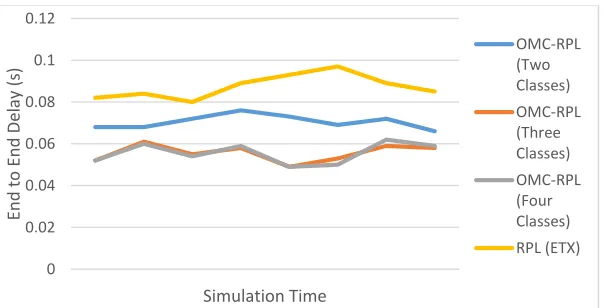
In the following, we evaluate the performance of OMC-RPL in distinctive scenarios. In all scenarios, four different cases, including OMC-RPL with two, three and four classes of data (which henceforth we call case A, case B and case C, respectively) and ordinary RPL that is based on ETX, are used for comparison. In the first scenario, we compare the end-to-end delay of these cases during the simulation time; the results of which can be seen in
Fig. 7. It shows that the classification idea outperforms the RPL with single OF. Although in cases B and C, the results are almost the same, but both of them act better than case A. It seems that the diversity of applications are in a way that there is no difference between three and four classes of data.
In the second scenario, we again investigate the end-to-end delay, but this time some nodes are congested randomly. This scenario is illustrated in Fig. 8. The peaks in regular RPL show the congestions, and the results demonstrate that in all cases OMC-RPL acts better. In OMC-RPL the process of DODAG construction is continuously repeated and upon any changes in nodes and links, ranks are modified and a new DODAG is created, while in ordinary RPL, any changes in nodes are not effective and lead to the increase of the drop rate in case of congestions. That is why at these moments the end-to-end delay increases slightly in OMC-RPL and rises sharply in ordinary RPL.
Fig. 7. End to End Delay During the Simulation Time (All Nodes Work Normally)
0 0.02 0.04 0.06 0.08 0.1 0.12 End to End Del ay (s )
Simulation Time
Fig. 8. End to End Delay During the Simulation Time (Some Nodes Are Congested)
Fig.9 is about the third scenario which depicts the end-to-end delay in a situation that some nodes fail. When failure happens in ordinary RPL (ETX), the end-to-end delay increase significantly while this growth is negligible in each OMC-RPL case. We know that when a receiving node fails, the algorithm easily uses the reserved parents. The variation of end-to-end delay in cases B and C are more than the previous scenarios, then we can conclude that in the case of node failure, more classes of data could act better.
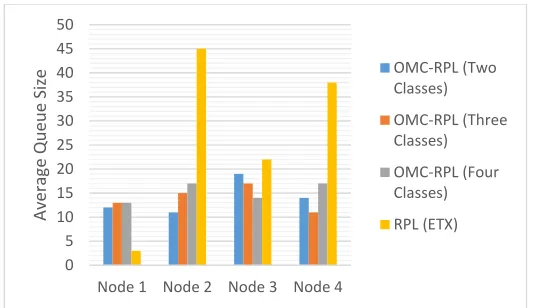
The average node’s queue size is a QoS metric. For the fourth scenario, we choose four sample nodes.
Fig. 10 shows the average queue size in the selected nodes during the simulation. Looking at the chart, it is obvious that when using RPL (ETX) a node like node 2 is too busy but conversely, node 1 is rarely selected as the preferred parent and is idle. The average queue size in each case of OMC-RPL does not exceed more than half the
capacity, in fact, OMC-RPL by using a holistic OF and various parameters balance the traffic load in all the nodes.
The goal of the fifth scenario is the assessment of energy consumption in the nodes that work with battery. In this scenario, we choose three of the seven available nodes that have the energy concern; two of these nodes are common with the previous scenario (node 1 and 2). Fig. 11 shows the remaining energy of nodes in percentages. The leftover energy in node 1 is around 90 percent, which means that this node is not used very often, unlike node 2 that lost its energy completely. The achieved results from both the last scenarios prove that the ordinary RPL is not able to find the appropriate paths due to the lack of proper objective function; therefore, some nodes are used immensely while others remain unused . The results for any case of OMC-RPL show that the remaining energies in nodes are acceptable and OMC-RPL can help to increase the network lifetime. Among different instances of the proposed method, case C outperforms in terms of energy consumption.
Fig. 9. End to End Delay During the Simulation Time (Some Nodes Are Failed)
0 0.02 0.04 0.06 0.08 0.1 0.12 0.14
End
to
End
Delay
(s
)
Simulation Time
OMC‐RPL (Two Classes) OMC‐RPL (Three Classes) OMC‐RPL (Four Classes) RPL (ETX)
0 0.02 0.04 0.06 0.08 0.1 0.12 0.14
End
to
End
Delay
(s
)
Simulation Time
30 Alishahi et. al. Designing Optimized Scheduling QoS Aware RPL for Sensor Based Smart Grid…
Fig. 10: Average Queue Size for Four Sample Nodes
Fig. 11: Remaining Energy in Percent for Three Sample Nodes that Work with Battery
5. Conclusion
As mentioned earlier, recently RPL protocol has become one of the main solutions in the smart grid. Lots of researches have been done on this issue. In this paper by studying the shortcomings and challenges of RPL, we present a modified version of RPL with the approach of QoS. Since data classification is the main requirement of providing QoS, the proposed method with comprehensive objective function regarding the QoS metrics is able to support multi-classes of data; in this regard the PSO optimization algorithm is used to find the best values of coefficients used in OF. OMC-RPL with the different number of classes and various scenarios was simulated; the results in comparison with ordinary RPL are significant. Using OMC-RPL with any number of classes leads to decrease end-to-end delay, balance the traffic load in the network and increase the lifetime of battery supplied nodes. Although the results for three and four classes of data are very close, but in some scenarios, we still experience better outcomes for four classes of data. Thereupon using the idea of multi-class RPL can play an important role in the smart grid and can be used as an alternative solution. As future work, we can propose new OF with different metrics and approaches for specific cases; we can investigate about the stability of the network and also the optimized number of classes can be studied.
References
[1] Gungor, V.C., et al., A survey on smart grid potential applications and communication requirements. Industrial Informatics, IEEE Transactions on, 2013. 9(1): p. 28-42.
[2] Ho, Q.-D., Y. Gao, and T. Le-Ngoc, Challenges and research opportunities in wireless communication networks for the smart grid. Wireless Communications, IEEE, 2013. 20(3): p. 89-95.
[3] Rajalingham, G., et al. Quality of service differentiation for smart grid neighbor area networks through multiple RPL instances. in Proceedings of the 10th ACM symposium on QoS and security for wireless and mobile networks. 2014. ACM.
[4] Thai, P., Dissertation/Thesis Approval Form. 2011. [5] Winter, T., RPL: IPv6 routing protocol for low-power
and lossy networks. 2012.
[6] Vasseur, J., Terminology in low power and lossy networks. Work in Progress, 2011.
[7] Gaddour, O. and A. Koubâa, RPL in a nutshell: A survey. Computer Networks, 2012. 56(14): p. 3163-3178.
[8] Long, N.T., et al. QoS-aware cross-layer mechanism for multiple instances RPL. in Advanced Technologies for Communications (ATC), 2013 International Conference on. 2013. IEEE.
[9] Abdessalem, R.B. and N. Tabbane. RPL-SCSP: A Network-MAC Cross-Layer Design for Wireless Sensor Networks. in Proceedings of Ninth
0 5 10 15 20 25 30 35 40 45 50
Node 1 Node 2 Node 3 Node 4
Aver ag e Qu eu e Size
OMC‐RPL (Two Classes) OMC‐RPL (Three Classes) OMC‐RPL (Four Classes) RPL (ETX)
0 20 40 60 80 100
Node 1 Node 2 Node 3
Re m aini n g En er gy in Percent
International Conference on Wireless Communication and Sensor Networks. 2014. Springer.
[10] Thubert, P., Objective function zero for the routing protocol for low-power and lossy networks (RPL). 2012.
[11] Gnawali, O. and P. Levis, The ETX Objective Function for RPL. 2010.
[12] Vasseur, J.-P., et al., Routing metrics used for path calculation in low-power and lossy networks. 2012. [13] Gaddour, O., et al. Simulation and performance
evaluation of DAG construction with RPL. in Communications and Networking (ComNet), 2012 Third International Conference on. 2012. IEEE. [14] Wang, D., et al. RPL based routing for advanced
metering infrastructure in smart grid. in Communications Workshops (ICC), 2010 IEEE International Conference on. 2010. IEEE.
[15] Jeon, Y.-H., QoS requirements for the smart grid communications system. International Journal of Computer Science and Network Security, 2011. 11(3): p. 86-94.
[16] Deshpande, J.G., E. Kim, and M. Thottan, Differentiated services QoS in smart grid communication networks. Bell Labs Technical Journal, 2011. 16(3): p. 61-81.
[17] Sun, W., et al. Quality of service networking for smart grid distribution monitoring. in Smart Grid Communications (SmartGridComm), 2010 First IEEE International Conference on. 2010. IEEE.
[18] Gharavi, H. and C. Xu, Traffic scheduling technique for smart grid advanced metering applications. Communications, IEEE Transactions on, 2012. 60(6): p. 1646-1658.
[19] Di Marco, P., et al. MAC-aware routing metrics for low power and lossy networks. in INFOCOM, 2013 Proceedings IEEE. 2013. IEEE.
[20] Brachman, A., Rpl objective function impact on llns topology and performance, in Internet of Things, Smart Spaces, and Next Generation Networking. 2013, Springer. p. 340-351.
[21] Karkazis, P., et al. Design of primary and composite routing metrics for rpl-compliant wireless sensor networks. in Telecommunications and Multimedia (TEMU), 2012 International Conference on. 2012. IEEE.
[22] Gaddour, O., et al. OF-FL: QoS-aware fuzzy logic objective function for the RPL routing protocol. in Modeling and Optimization in Mobile, Ad Hoc, and Wireless Networks (WiOpt), 2014 12th International Symposium on. 2014. IEEE.
[23] Shah, S. and P. Thubert, Differentiated Service Class Recommendations for LLN Traffic. 2012.
[24] Kennedy, J. and R. Eberhart. Particle swarm optimization. in Neural Networks, 1995. Proceedings., IEEE International Conference on. 1995.
[25] Rini, D.P., S.M. Shamsuddin, and S.S. Yuhaniz, Particle swarm optimization: technique, system and challenges. International Journal of Computer Applications, 2011. 14(1): p. 19-26.
[26] Engelbrecht, A.P., Fundamentals of computational swarm intelligence. 2006: John Wiley & Sons.
32 Alishahi et. al. Designing Optimized Scheduling QoS Aware RPL for Sensor Based Smart Grid…
![Fig. 1. Smart Grid System Architecture [3]](https://thumb-us.123doks.com/thumbv2/123dok_us/8944675.1854043/2.612.122.508.79.303/fig-smart-grid-system-architecture.webp)