5425
XEW 2.0 : ESTABLISHMENT OF A NEW COMPETITIVE
INTELLIGENCE SYSTEM FOR BIG DATA ANALYTICS
1AMINE EL HADDADI, 2ANASS EL HADDADI, 3ABDELHADI FENNAN, 4BERNARD
DOUSSET
1,3LIST, Department of Computer Science, FST, Tangier, Morocco
2Department of Mathematics and Computer Science, ENSA, Al-Hoceima, Morocco
4Toulouse Institute of Computer Science Research, UT3, Toulouse, France
E-mail: 1[email protected], 2[email protected], 3[email protected],
ABSTRACT
Competitive Intelligence is a strategic management of information, which aims to provide collaborative decision-making. In other words, competitive intelligence is a mapping of the surrounding business environment. Nowadays, every organization needs a competitive intelligence system in order to enhance its position in the market, or simply to survive, as well as to be able to track every single change and to provide the right response to it in a real time scale. We propose in this paper a new Competitive Intelligence System for Big Data Analytics (CIS-BG: XEW 2.0).
Keywords: Competitive Intelligence System; Big Data Analytics, Big Data Visualisation; XEW 2.0
1. INTRODUCTION
Six decades have marked the phenomenal development of the information technologies since their birth in the fifties with the “Electronic Data Processing” (EDP) developed in 1954 [1]. Later, in the mid-sixties, came the Management Information Systems (MIS) which were meant to provide information to the decision-makers instead of automatically processing data as in EDP which was more focused on automating the administrative procedures such as payroll, etc…
By the late sixties early seventies, the information system’s industry was still in its early days and many of its concepts were not very well defined yet. It was very common to assimilate an information system to an automated data processing system, with the idea that the IS should be able to deliver the right information to the right person in the right time (The R3 rule)[2]. A few years later, the most important paradigms regarding the Operational Information Systems (OIS) were stated in the book The Information System for organization by Pascal Vidal and Vincent Petit [3]. During the eighties, the IS field has gained some maturity with the establishment of the first IS specialized research centers, MIS related university research departments, as well as adopting academic
programs which were dedicated to the information systems. Moreover, the economic crisis of the eighties has altered the companies’ habits, giving birth to the Strategic Information Systems (SIS), which could be defined as the art of coordinating the company’s business strategy, structure and information system [4].
Nowadays, we are talking more about Competitive Intelligence Systems (CIS). Thanks to its competitive intelligence process, a CIS is able to provide more services than classical information systems; yet, it includes them as a step for information research, data management, sharing, interpretability, as well as security.
So, what is a CIS? Is it simply a new buzzword? Or is it a combination of several strategic and collaborative systems? Or maybe is it the art of managing information systems? First, we will spot the light on the Competitive Intelligence concept in the second section. Then we will present the CIS as well as the different models adopted in their conception. And finally, the fourth section’s subject will be the introduction of our own CIS called XEW 2.0.
2. COMPETITIVE INTELLIGENCE
5426 regarding the business environment in order to manage its strategic challenges [5]. Collecting and processing information remain a must whatever the strategy wasis. The application of the competitive intelligence process, namely setting up a strong measure for the strategic management of information, four strategic implications can be identified:
• Vision, which is often the collective result
carried by the manager’s leadership;
• Innovation, which is the outcome of a specific
problem;
• Creation, an opening towards possibilities that
were unknown so far;
• And Anticipation, which combines problem’s,
outcome of environmental data and
intentionality.
In order to answer to tackle this problem, we propose a competitive intelligence system which offers more than the classic information systems, and yet, it includes them as a step for information
research, data management, diffusion,
interpretability, as well as security.
The concept of competitive intelligence induces a collective culture of information along with offensive actions and the constant worry about protecting the organization’s information capital. As a concept in itself, it is a blend of different notions as shown in the following semantic network.
We define competitive intelligence as:
Competitive Intelligence is at the same time a process, a product and a service:
• As a process, competitive intelligence is the
workflow of the strategic management of information.
• As a product, competitive intelligence is a
strategic and organizational information system.
• As a service, competitive intelligence is a
mapping of the business environment.
Figure 1: Evolution of CI concept
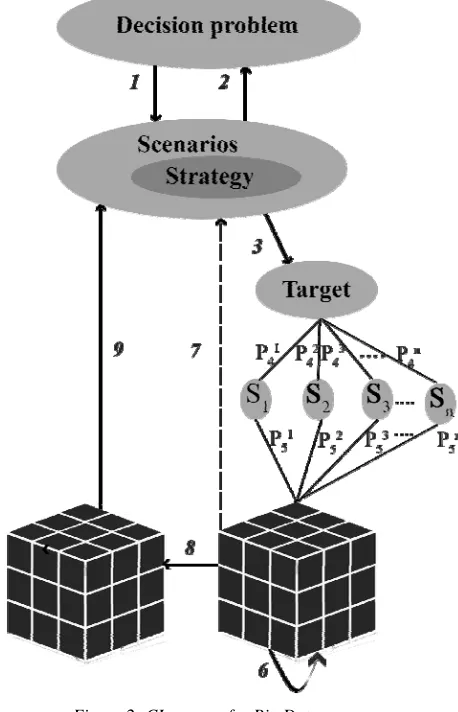
[image:2.612.320.549.222.578.2]So, according to this definition, the competitive intelligence process is coordination between data management processes and IS based strategic foresight. The following figure (1. Develop, 2.Choose, 3. Identify & Prioritize, 4. Identify & Select, 5. Collect & Evaluate, 6. Organize & Remember, 7. Validate & Stream and 8. Analyze & Interpret. Presents the four essential steps of the competitive intelligence cycle:
Figure 2: CI process for Big Data
• Understanding the need;
• Searching and collecting the information;
• Treating the information;
• Diffusing the information.
Adopting these steps within a competitive intelligence process has caused several alters in the terminology describing them adapting it to the different situations:
• Understanding the need has got several names
5427 General Orientation [7], Identification of the decision problem and its translation into an informational need [8].
• As for Searching and collecting information,
we find: Tracking [9], Finding [10], Acquiring [11], Gathering and Research [12].
• Exploitation becomes processing then analysis
[13].
• Diffusion seems to be the only step which
keeps unanimity, although it may sometimes be inserted in the middle of the process.
In the Competitive Intelligence literature, all the authors [14, 15, 16, 17, and 18] agree on the importance of the “Understanding the need” step. This first step aims to define the decision problem by putting together a set of plausible scenarios and to propose a business strategy accordingly. It allows
translating the strategic orientation into
development axes. These axes are translated into priority targets by identifying the informational questions on which we should be informed. These targets can be strong signals, new interests, new products, competitiveness, new actors or new processes.
When the informational need is determined, the next step is the strategic foresight which helps analyzing and monitoring the informational environment as well as the targets identified by the selected strategy.
It’s about seeking the most appropriate information according to the targets set in the previous step, would it be inside or outside the organization. The first step is about identifying the information sources which are more likely to contain this information. The useful information is extracted and evaluated from there. There are two types of information which are necessary to put a strategy together: useful information which can be directly used from its source, and the developed information which results from analyzing and processing useful information. The processing and analysis step is carried by Big Data Mining tools which help revealing the hidden, mostly statistic information out of the useful information.
The last step of the cycle consists on returning the most relevant results to the potential users who will define and establish strategic actions based on the result’s reliability. This step can generate a redefinition or a readjustment of the target, and then the cycle becomes iterative.
Protecting information is a process that is established parallel to the competitive intelligence
process and applies to all of its steps. All these steps may be carried using information systems.
So our approach consists in defining a competitive intelligence system based on our competitive intelligence process which aims to:
• Support the approach’s, various steps while
offering all of the options such as competitiveness, need of analysis and strategic foresight.
• Extract and process structured, half-structured,
as well as unstructured data from every kind of sources: scientific papers, patents, RSS feed, mails, social networks, blogs, forums, etc…
• Respond to the CI analysis needs by offering
synthetized knowledge about the business information environment regarding a given area.
• Return the results in the form of a smart
web/mobile portal providing a next generation visualization (reporting) which would ease the collaborative decision making.
In order to respond to these analysis needs, we propose, in this paper, a new prototype of the competitive intelligence system which pairs both the needs of the CI process steps and the Big Data Mining technics. But before that, we need to understand the evolution of the alliance between the information systems and the business strategy. That would be the subject of our next section.
3. INFORMATION SYSTEM’S AND
STRATEGY
3.1 The rise of the Strategic Information
Systems
For many companies, information systems are considered as strategic assets. An observation of the companies’ architecture evolution reveals the roles of information systems. This evolution allowed the IS to move from its traditional role of support to a more innovative strategic tool [19]. By the early nineties, two very close models present a synthesis of all the previous approaches. The first was introduced by an MIT team led by M. Scott Morton [20] after a request from big companies (American Express, Kodak, General Motors, etc…). Their goal was to describe the impact of information technologies on organizations, and how this impact could alter the companies’ organizations, and at a larger scale, the competitive landscape.
5428 new representation of the company. This representation showed that the IS can influence the business operational state. Thus, it insists on the technology as a primary factor for the rise of the IS concept in a strategic framework [2]. M. Scott Morton’s presentation is taken over by H. Tardieu [21] who proposes a model focused on the strategic triangle concept. This presents the SIS as equilibrium between strategy and information systems.
H. Tardieu and B. Guthman [22] have distinguished two kinds of strategic information systems:
• The S-IS or, Strategic-Information System uses
the information system to bring a competitive advantage to the company. So the S-IS is a strategy support tool.
• The SI-S or, Strategic Information-System
provides all information and/or necessary models to better the strategic decision making process. The information system is the basis of the decision-making.
It doesn’t matter what models were mobilized, or if we talk about an internal or external diagnosis, the problematic remains the same: strategic decision-making and strategic management, since it is naturally more difficult than the others, needs to gather and organize a large variety of information concerning the business and its environment as a whole (competitiveness, legal environment, etc…).
So the SI-S has a double dimension:
• An internal dimension: the company’s ability
to collect, process and organize different operational data in order to put together the most precise representation of its own performance;
• An external dimension: collect useful
information which could impact the company’s strategy in the short, medium or long terms from its business environment.
3.2 The SI-S’s internal dimension
The strategic analysis is a collective decision taken from the highest level of the organization’s hierarchy; it has to be transversal and concerns the whole organization. For this reason, the information system which will collect the necessary internal information to be used in the strategic decision-making should respond to several characteristics such as:
• The ability to “vertically” aggregate
information, since the strategic decision-making is taken in the organization’s highest hierarchy level. The internal SI-S should be able to provide an aggregate representation of all information concerning a particular function since its basic operational information.
• The ability to “horizontally” aggregate
information. The internal SI-S should be able
to gather information from normally
partitioned functions and having independent information systems.
For all these reasons, the information system designers have considered, as soon as it was technologically possible, to set up systems that were able to save all the information in unique programs in order to provide coherent and quickly available data to the managers. That was how the ERPs (Enterprise Resource Planning) were born [23]. The ERPs are “global” information systems which are able to collect, organize and make all the information from the whole organization available to the user.
3.3 The SI-S’s external dimension: Monitoring
and Competitive Intelligence
The business strategy always had a double dimension: it has an “integrative” dimension (focusing on the inside and key skills development), and an “adaptive” dimension (focusing on the outside and seeking strategic opportunities). As such, the internal information oriented SIS only covers a part of the issue. Strategy makes needs also to possess external information, normally less available than inside information.
Once more, technology allowed us to develop information systems dedicated to this purpose using the conjunction of two related phenomena:
• The technological ability to create systems able
to search, select, and sort massive data. These systems should ensure a considerable storage performance and a very fast processing ability (so they can keep getting updated information).
• The information availability. Fifteen years ago,
it was difficult to find the information sought, even with the same technological abilities that we have today. The press could certainly provide information but it was the Internet explosion that has exponentially raised the amount of available information, and thus, the need for tools to process it.
5429 systems by adding to them a new function, a new range to express the information system related needs. At the same time, they ensure their own legitimacy, since, without information systems, would it be possible to consider geographically distributed strategic or competitive intelligence procedures?
The external SI-S doesn’t with work the same logic as an ERP. It has to deal with less coherent, so less reliable information, to propose links between data gathered from different sources, as well as to assess the information’s relative value or at least present it to the decision maker in a decodable form.
The external SI-Ss are in an emerging phase nowadays but they are still much less used than the
internal information collection tools. The
complexity of their development as well as the reliability of the processed information certainly slows their expansion down.
3.4 The rise of the Competitive Intelligence
System
Every strategic presentation in the information systems nowadays relies on an informational dimension which uses different kinds of systems:
• The SI-Ss which are oriented to the
information research in order to enhance the strategic decision making.
• The S-ISs which are made to give the
organization a competitive advantage, in other words, to practice the competitive monitoring.
The alliance between S-IS and SI-S gave birth to the competitive intelligence system, which can be defined as: “An external strategic information system that collects information from the business environment. This information can have a short, mid or long term impact on the company’s strategy as well as on its internal governance”. So how can we model such a system? What can be the most appropriate architecture in order to develop this kind of information system? The next section will allow us to answer these two questions.
4. THE METHODS USED TO DESIGN
COMPETITIVE INTELLIGENCE SYSTEMS
After twenty years of research in competitive intelligence, many difficulties still lay in the design of competitive intelligence systems, especially when we find, in many works [24, 25, 26, and 27] a
certain confusion between competitive intelligence systems and business intelligence systems. However, most of the field-related sources are the findings of experts or state representatives that are not aware of the theoretical dimension of the competitive intelligence concept. These researches show that these competitive intelligence analysis models focus on four key dimensions which are:
• The business environment dimension which
gathers all the elements that may influence the company’s strategic evolution either directly or indirectly. It mainly concerns the partners, the competitors, the markets, the customers, etc…
• The human dimension, which includes all the
internal or external actors concerned with the competitive intelligence demarche. It is about collaboration networks, interaction networks, as well as communication networks linking these actors.
• The strategic dimension, which corresponds to
the different analysis models that allow putting together the company’s strategies from the objectives identification to the decision-making and actions definition.
• The technological dimension, which assembles
all of the methods, tools and techniques to be used in order to respond to the informational needs in a competitive intelligence demarche, by the means of searching, collecting,
processing and diffusing information
procedures.
The awareness of one or more of these dimensions allows designing several analysis models of the competitive intelligence. We have selected two academic models based on these dimensions: the MEDESIIE model and the SITE model.
4.1 The MEDSSIIE analysis model
The competitive intelligence model proposed by Maryse Salles [29] with the MEDESIIE project was completely dedicated to the competitive intelligence oriented requirements engineering. The MEDESIIE method was developed in order to analyze the SME / SMI’s needs related to competitive intelligence.
5430 MEDESIIE proposes models than can describe the company, its strategy, its environment, its competitive intelligence related needs and its products/services as in the next figure:
• A company’s model is described according to
its different functions (productive, market-related, financial, and innovative (information system wise)). Every function of these is itself composed of management sub-functions.
• A strategy model is represented by a set of
structural strategic choices and development axes (search for independence, growth of the activity, increased profits, etc…).
• An environmental model was, at first,
described as the company’s function and its relations with its environment. Later, it was described as the external business environment organized by eight great axes (markets size, demand, technology, competitiveness, financial system, supply conditions, and geopolitics).
• A need’s model is a framework of the need’s
collecting, formalization, analysis and
validation. The expressed need is a set of need units. The need units’ model is described according to three dimensions: the decision control level for which the unit is expressed (its value: operational, tactical, or strategic), the decision process step related to the unit, and its information content (identifying its value and its function).
• A products and services model, every
environment related decision making tool which consists of a prototyping tool made according to the satisfaction of the gathered needs in order to define their costs, reach, and eventually, effects.
MEDESIIE’s positioning makes it closer to the approaches of the target oriented requirements engineering. It is about constructing (or more
precisely co-constructing) the company’s
competitive intelligence needs according to its strategy [29].
4.2 The SITE models
The SITE model sums all of the CI models proposed by the SITE research team of the LORIA lab of Nancy, France. The team’s objective was to study the strategic information systems’ modeling and development in a competitive intelligence framework.
The team works have in common the importance of the user in the information systems. They propose models that allow defining different actors,
their interactions as well as their positions in the competitive intelligence process.
We will retain three models of them, which are: EquAte (Explore Query Analyze Annotate), MEPD (Modèle pour l’explication d’un problème décisionnel), and WISP (Model for Information Retrieval query Annotations Based on Expression Levels).
The EquAte model [31] represents an information research situation which includes the following:
• Exploring the information environment
• Querying the information base
• Analyzing the information base
• Annotation based on various preferences
The MEPD model [32] is about defining different sides of a decision problem. It is based on:
• Modeling the decider, through his identity,
personality, cognitive style, as well as his experience
• Modeling the environment, the immediate one
(customers, suppliers, competitors), as well as the global one (social, economic, political, etc…)
• Modeling the organization, through its
environment, signal, as well as the assumptions that the decision maker may deduce from detecting the collected signals.
The WISP model [33] is associated to the MEPD model on which it is integrated taking some of its parameters. The WISP is a tridimensional multisided model which includes the concept of the “point of view”:
• The analytic dimension includes the
demand-issue-context comprehension, the definition of the information indicators and all of the analysis and knowledge creation operations which can be made by the studying the saved elements
• The methodological dimension includes, in a
first level, the ability to translate the decision problem into an information problem, and in a second level, the research strategies by which the information is identified and the knowledge is learned.
• The operational dimension corresponds to
selecting action plans and to set up the WISP model related resolution methodology’s different steps.
5431 Based on our competitive intelligence process presented in the second section and referring to the best practices of the “user/role” aspect in a CIS proposed in the EquAte, MEDP, WISP models and the requirement engineering model presented in MEDESIIE, we propose our own model for the analysis and design of a competitive intelligence system, XEW.
• XEW is a capitalization of knowledge and a
sustainable amelioration of the Xplor model which we have proposed and developed in 2011. XEW’s core is based on three models:
• XEW Data Analytics (XEWDA) is a
multidimensional exploratory analysis model based on the extraction of knowledge out of Big Data as well as on the diachronic and incremental evolution of knowledge.
• XEW Service Quality (XEWSQ) is an
indicator model which aims to define a set of calculating indicators according to the analysis
needs using the multidimensional
representation of the documents for a qualitative evaluation of the system’s various interactions.
• XEW Security (XEWSE) is a security model
[image:7.612.100.299.367.577.2]based on the user/role model in order to secure the information and the processes led by our competitive intelligence system.
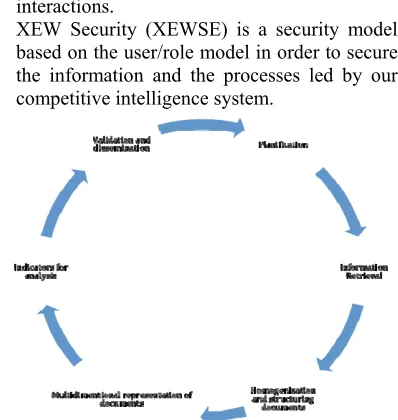
Figure 3: Lifecycle of XEW Model
The first step in this model is to analyze the needs, which means translating the decision problem into an information problem. This step is based on the information problem expressed by the decision makers. The objective is to describe the analysis process’s steering approach. This activity is defined according the concept of the 5W-1H (What, Why, Who, When, Where, How).
This allows us to describe the expressed information need and to orientate the analysis.
Every identified information source, would it be formal or informal, is able to contain useful information.
Once the needs analysis is validated, the second step consists in researching the necessary information for the analysis. This step allows, according to predefined criteria, to focus on data supposed to be both interpretable and having a high informative potential. Moreover, preparing the data consists in, first, selecting it according to our
objectives using the information research
techniques [34 and 35], and second, in launching the Big Data Mining process since we are dealing with massive data which is more and more unstructured, which brings the necessity to develop processing and exploitation tools that have to be more and more efficient. Once the analysis step is validated, we diffuse the knowledge using a last generation web/mobile graphic form by referring to the latest advances in the Data Visualization field.
Our research’s objective is to define a modular architecture of the competitive intelligence system XEW based on a Model Driven Architecture (MDA) for Big Data Analytics. This development approach will allow combining the techniques of Information Research, Extraction, Big Data Mining and Big Data Visualization in way that every technique can be seen as a module with precise and delimited functions. Easier to design and develop, stronger, and tested in diverse contexts, these components can be assembled in different ways creating various applications adapted to the final user’s needs.
5. THE COMPETITIVE INTELLIGENCE
SYSTEMS
A competitive intelligence system is a compromise between S-IS and SI-S. It is an information system that gives more services than the aforesaid information system and yet includes them as a step for:
• diffusion
• interpretability
• storage
• security
• collaborative decision making
So the competitive intelligence system induces a collective exploitation of the information along with offensive actions and the constant concern of protecting the company’s information capital.
5432 environment and its market. It produces information in order to help individuals in the execution, management and decision making related functions [36].
It has to:
• Ease decision making, by automating a certain
number of actions or by providing the necessary elements to the decision making.
• Coordinate information processing related
actions.
• Have a stable and sustainable storage of
information.
• Process the data; this is the most important
action of the information system since it creates useful information to the decision makers.
This design allows conceiving information systems capable of giving the organizations a better information management and a base of action coordination between the different actors. This transverse coordination is motivated by:
• The interconnection between the competitive
intelligence demarche’s objectives. They cannot be processed separately.
• The need to share information between the
different actors.
• Sharing the knowledge acquired during a
certain step.
• Organizing the company in a functional
transverse way.
This conception should evolve from a vertical architecture to a transverse architecture allowing an overall management of the information.
The transverse architecture is based on a modular evolutionary architecture based on the company’s projects, the global infrastructure will allow, according to [9] to:
• Reduce numerous vertical coordinations by
reducing the hierarchical levels.
• Have a better monitoring on the environment
of the decentralized units.
• Have a certain level of decompartmentalization
by adopting a transverse communication.
• Orient the relations according to the skills’
complementarity.
• Have a better adaptation to the market’s
dynamics.
This analysis confirms the rise of the competitive intelligence systems. The competitive intelligence
demarche thus fits in the overall scheme of the company’s strategic information system.
6. THE COMPETITIVE INTELLIGENCE
SYSTEMS XEW
After the great number of strategic analyses that we have already realized with the software Tétralogie and Xplor V1, we realized that the final users of analysis products need, along with the macroscopic view, some microscopic analyses on the already identified elements (competitiveness, markets, new products or processes, potential partners, etc…) or to discover others. In hindsight, many experts or decision makers need more details on the traditional elements of their environment, especially concerning their specific vocabulary, the actors and markets around them, as well as the alliances they plan.
So what we propose is to keep adopting the proposed Xplor model and to complete its macroscopic analyses by an advanced online model XEW that enhances the obtained information using statistical overlaps, incremental classifications or multidimensional analyses. Our goal is to favor the information’s extraction according to the general context and non-exclusively by decrypting the contents of separate documents. This makes it possible to retrieve, from a known element (actor, keyword), all or some of its related information (teams, collaboration, concepts, rises, associate keyword, etc…) using advanced filtering concepts.
The XEW prototype helps running strategic analyses on information corpuses coming from all various sources such as online bases (scientific publications, patents, portals, directories), CDs, visible and invisible web, newspapers, internal bases, RSS feed, social networks, etc… and gives the decision makers the possibility to run their own investigations without the assistance of a senior analyst or expert.
Its applications are very diverse:
• Identification of themes and actors of the field.
• Demonstrating the development and
cooperation strategies.
• Proposing scenarios for the technologic
evolution (innovation).
• Extracting weak signals.
• Consulting updated information in real time
thanks to the web services.
• Make up “field” information during salons,
customer visits, or meetings.
• Asking for urgent specific information to be
5433
7. BIG DATA ARCHITECTURE
[image:9.612.95.295.159.341.2]The CI model XEW 2.0 relies on a four level Big Data architecture:
Figure 4: XEW 2.0 architecture
7.1 XEW Sourcing Service (XEW-SS)
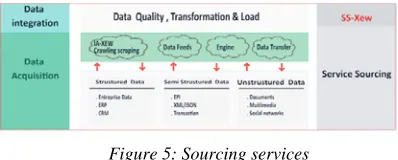
This service allows searching, collecting, and processing the data from different sources. This requires consideration of a multimodal fusion able to consider the heterogeneity, the imprecision and the uncertainty of multisource data. This fusion awareness ensures mastering the knowledge and the information and consequently, eases the decision making. XEW-SS processes the information heterogeneity from different sides:
• Semantic content: scientific, technical, etc…
• Structural: From highly structured (Patents), to
unstructured (emails).
• Language (multilingualism): Chinese, Arabic,
etc…
• Support format: Word, HTML, PDF, etc…
• Size: Definition of the information unit to be
analyzed (information granularity).
Figure 5: Sourcing services
This architectural level’s objective is to provide a complete description of the multisource data process. The techniques used in this level rely on
web services dedicated to every source of information.
7.2 XEW Data warehousing Service
(XEW-DWS)
[image:9.612.313.559.272.308.2]This service is a storage space which allows, on its first level, having a unified view of the target corpus, extraction and storage of data coming structured, half-structured unstructured source in a multidimensional form. The second level is about the datawarehouse creation processes: from the classical SQL to NoSQL (MongoDB, Neo4j, GraphDB, and Hbase).
Figure 6: Multidimensional Service
7.3 XEW Big Data Analytics Service
(XEW-BDAS)
[image:9.612.311.560.435.470.2]This service allows making multidimensional analyses by adapting data mining algorithm to Big Data. It is based on the parallelism of the algorithms developed in the Tétra-Xplor system, as well as other open source tools such as Weka or R.
Figure 7: Big Data Analytic Services
7.4 XEW Big Data Visualization Service
(XEW-BDVS)
This service aims to offer the user a comprehensible interpretation of the collected knowledge thanks to an interactive and collaborative platform easing the navigation through the relational environment of a known element (company, research center, researcher, inventor, keyword, etc…). It is then possible to use this element to retrieve all or a part of its related information (alliances, competitors, teams, rises, weak signals, etc…).
[image:9.612.90.289.597.677.2] [image:9.612.315.535.674.710.2]5434 XEW-DVS proposes innovative methods of Big Data Visualization such as incremental clustering, compared by time steps (diachronic) and temporal graphs.
Figure 9: Visaulizing incremtal clusturing in SBDV-XEW
Managing all these services allows us to represent the CIS as a set of organizational capabilities able to offer value to the user in form of services. This value is based, on the one hand, on a software quality approach, and on the other hand, on the quality control indicators scattered all over the process chain.
8. Case of analysis with XEW 2.
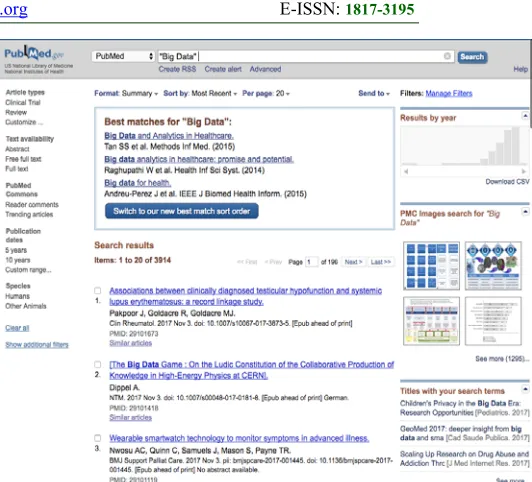
[image:10.612.96.297.185.310.2]I this section, we present the experiment carried out to validate the XEW 2.0 prototype. that we realized in the framework of the Offices of Study of Decisional Computing .this experiment, we take as an example the analysis on Big Data in health. To achieve this, we surveyed the PubMed database via the SS-XEW sourcing service and we collected 3914 scientific articles through the PubMed agent. The same search equation on PubMed directly gives us the same result while the SS-XEW.
Figure 10: Results of the "Big Data" search equation
in PubMed
As a result of the SBDA-XEW we are able to analyze, define and identify the most effective
countries, authors, their specialties and
developments in the field of Big Data. The interpretation of the results using SBDV- afford them the ability to highlight the different professional, international, semantic and other networks. The XEW 2.0 API helps it be easier for people to navigate the information environment of Big Data.
As a first result, the evolution of Big Data in medicine over the past decade shows us a spike in 2016 with a production of 959 scientific articles on the theme, as shown in Figure 11.
Figure 11: The evolution of Big Date between 2008
and 2017
[image:10.612.313.568.539.661.2]5435
Figure 12: The most cited keywords
[image:11.612.95.566.84.278.2]The United States, China, the United Kingdom, Australia, Canada, Germany, the Netherlands, Taiwan, Spain and France present the Top 10 countries working on Big Data issues in medicine (Big Data in Health), as shown in Figure 13.
Figure 13: Top 10 countries in the field of Big Data
in medicine
[image:11.612.313.566.320.445.2]Figure 14 shows the evolution of publications annually for the top 5 countries.
Figure 14: Evolution of Top 5 country publications
Geostrategic map representation easily illustrates global production in Big Data, as shown in Figure
4.19. Particularly, it confirms the dominant position of the United States.
Figure 15: Global production in Big Data
France has published 703 articles in this field, allowing it to be in 10th position.
Figure 16: The production of Farnce in Big Data
[image:11.612.93.308.376.531.2]Morocco has published 6 articles in this field.
Figure 17: Morocco's production in Big Data
We presented in this section, presents the experimental environment that we have set up to validate our proposals: the presentation of the XEW 2.0 prototype with the intelligent scraping agent by having an analysis on Big Data in the field of health.
[image:11.612.316.566.476.599.2] [image:11.612.90.305.562.681.2]5436 In this article we have presented the CIS XEW 2.0, which can be presented as a compromise between a “Strategic Information – System” and a “Strategic – Information System”. It is based on modular web services architecture allowing us to automate up to 80% of the competitive intelligence process. It takes into consideration the interaction with mobile users in order to ease the navigation through the harvested knowledge and to offer the best strategic monitoring conditions in order to
better the public or private organism’s
competitiveness. We have run a survey on the analyses run within competitive intelligence consultancies. The results have shown the benefits of using XEW in a competitive intelligence context and more precisely in scientific and technological monitoring since most of the experimentations were run on bibliographic bases, scientific articles and patents.
Moreover, the Model Driven Engineering aspect has allowed us to elaborate a Computation Independent Model (CIM), a distant data collection and processing web service which can adapt to all types of data sources. We wanted to transform the proposed web services into a Platform Independent Model (PIM) and then into a Platform Specific Model (PSM), making the CIS XEW generic and adaptive to every informational need.
Among the big challenge of our system is the maintenance of the agents of sourcing because we do not control the modifications of the sources of information and which became harder through the anti-agent scripts.
The CIS XEW comes to complete a set of competitive intelligence tools by offering the possibility to manage and to exploit the informational environment everywhere in an interactive and secure manner.
REFRENCES:
[1] S. Mittelstaedt, D. Spretke, D. Sacha, D.A.
Keim, B. Heydar and J. Kopp, “Visual
analytics for critical infrastructures”, Security
in Critical Infrastructures Today, Procedings
of International ETG-Congress, Pages
1-8,2013.
[2] P. Vidal andpo V. Petit, “Systèmes
d’information organisationnels”, 2ème édition,
Pearson Education, 2009.
[3] P. Vidal and V. Petit , “Systèmes
d’information organisationnels”, Broché, 2011.
[4] A. V. Thakor, “ Strategic information
disclosure when there is fundemental
disagreement”, Journal of Financial
Intermediation, 2013.
[5] H. Araujo, C. J. Costa and M. Aparicio,
“Competitive Intelligence (CI) model”, 12th
Iberian Conference on Information Systems
and Technologies, Pages 1-6, 2017.
[6] L. N Semerkova, A. P. Zaretskiy, Z. A.
Dienko, E. S. Grosheva and G. V. Vishnevskaya, “Application of information
technologies in competitive intelligence”, XX
IEEE International Conference on Soft
Computing and Measurements (SCM), Pages
804-807, 2017.
[7] L. Sun, “Knowledge representation and fusion
methode of human resource-related
competitive intelligence”, International
Conference on Progress in Informatics and
Computing (PIC), Pages 18-22, 2016.
[8] B. Yan-Li and H. He-feng, “Framework and
management of competitive intelligence system for tourist hotels in the era of big data”,
2nd IEEE International Conference on
Computer and Communications, Pages 60-64,
2016.
[9] M. Spruit and A. Cepoi, “CIRA : A
Competitive Intelligence reference
Architecture for dynamic solutions”, 7th
International Joint Conference on Knowledge Discovery, Knowledge Engineering and
Knowledge Management (IC3K), Pages
249-258, 2015.
[10] Y. Bao and H. Hua, “Research on evaluation
index system of tourist hotels’ competitive
intelligence ability”, 4th International
Conference on Computer Science and Network
Technology (ICCSNT), Pages 495-499, 2015.
[11] L. Sun, “Knowledge representation of
competitive intelligence based on decision
scenarios”, IEEE International Conference on
Progress in Informatics and Computing (PIC),
Pages 128-132, 2015.
[12] L. Sun, “Knowledge Element-Based
Competitive Intelligence Analytics Serving for
SWOT situation assessment”, 8th International
Symosium on Computational Intelligence and
Design (ISCID), Pages 576-579, 2015.
[13] P. Fenies, F. Gautier and N. Lebrument, “ An
approach for the valorization of competitive intelligence practices in SME supply chains ”,
5437
Engineering and Systems Management (IESM),
Pages 591-600, 2015.
[14] Ľ. Štefániková et G. Masárová, “ The Need of
Complex Competitive Intelligence”, Procedia - Social and Behavioral Sciences, Volume 110, Pages 669-677, 2014.
[15] N. Sewdass et A. Du Toit, “ Current state of
competitive intelligence in South Africa”,
International Journal of Information
Management, Volume 34, Issue 2, Pages 185-190 , 2014.
[16] M. Saba, D. B. DE Rémur et S. Gerbaix, “ ICT
implementation. Going beyond expectations? An essay of interpretation through competitive
intelligence”, International Strategic
Management Review, Volume 2, Issue 1, Pages 46-55, 2014.
[17] I. Ip, S. Fong, Y. Zhunag and R. Wong,
“Competitive intelligence study on Macau
Food and Baverage Industry”, 7th Conference
on Cloud Computing and Big Data, Pages
170-174, 2016.
[18] Z. Drissi, “Competitive intelligence and
decision”, 6th International Conference on
Information Systems and Economic
Intelligence (SIIE), Pages 71-78, 2015.
[19] F. Kitsios and M. Kamariotou, “Decision
support systems and business strategy : a
conceptual framework for strategic
informations systems planning”, 6th
International Conference on IT Convergence
and Security, Pages 1-5, 2016.
[20] M. S. Morton, “L'entreprise compétitive au
future : Technologies de l'information et transformation de l'organisation”, Collection ingénierie des systèmes d'information, Les Éditions d'Organisation, Paris, 349 pages, 1995.
[21] H. Tardieu, J. Mélèse,“un croisé des sciences
de l’organisation”, Revue internationale de systémique, vol. 11, n° 4, p. 401-414, 1997.
[22] H. Tardieu , B. Guthmann B., “Le Triangle
stratégique”, éditions d’Organisation, 1991.
[23] ] P. Ruivo, A. Mestre, M. Courchesne et E.
Elia, “ Defining the ERP and CRM Integrative Value”, Procedia Technology, Volume 16, Pages 430-439, 2014.
[24] Y. R. Pargaonker, “Leveraging patent
landdscape analysis and IP competitive
intelligence for competitive advantage”. World
Patent Information, Volume 45, Pages 10-20,
2016.
[25] L. Stefanikova and G. Masarova, “The Need
of complex Competitive Intelligence ”,
Procedia – Social and Behavioral Sciences,
Volume 110, Pages 665-677, 2014.
[26] S. Higgins, “Learning organizations and
Competitive Intelligence”, Managing
Academic Libraries, Pages 65-70, 2017.
[27] C. Hakansson and M. Nelke, “The value of
competitive intelligence”, Competitive
Intelligence for Information Professionals,
Pages 1-11, 2015.
[28] A. El Haddadi, A. El Haddadi et A. Fennan, “
XEW 2.0, le SIE pour l’analyse de Big Data”, JIE, 2014.
[29] M. Salles,“ Ingénierie de méthodes d'ingénierie
des exigences pour l'aide à la décision ”, HDR, 2013.
[30] P.S. Seligmann, G.M.Wijers et H.G.Sol,
“Analysing the structure of I.S. methodologies, an alternative approach”, Proceedings of the 1st Dutch Conference in Information Systems, Amersfoort, The Netherlands, 1989.
[31] A. David et O. Thiery, “Application of
“EQuA2te” Architecture”, Economic
Intelligence, 2002.
[32] N. Bouaka, “Développement d’un modèle pour
l’explication d’un problème décisionnel: un outil d’aide à la décision dans un contexte d’Intelligence Economique”, Thèse de doctorat de l’université Nancy 2, 2004.
[33] PH. Kislin “Modélisation du problème
informationnel du veilleur dans la démarche d’intelligence économique”. Thèse de doctorat de l’université Nancy 2, France, 2007.
[34] A. El Haddadi, A. Fennan, A. El Haddadi, Z.
Boulouard and L. Koutti, “Mining unstructured data for a competitive intelligence system
XEW ”,6th International Conference on
Information Systems and Economic
Intelligence (SIIE), Pages 146-149, 2015.
[35] A. Khan, J. P. Li and M. Y. Khann, “Vision
Based Information Retrieval”, 13th
International Computer Conference on Wavelet Active Media Technology and
Information Processing (ICCWAMTIP), Pages
265-268,2016.
[36] C. Hakansson and M. Nelke, “Competitive
Intelligence from start to end“, Competitive
Intelligence for Information Professionals,