Identifying and Ranking Development Drivers of Knowledge-based Technology-Driven Companies (Case study: Fars Province Science
and Technology Park)
Nour Mohammad Yaghoubi1 Mosayeb Pahlavani2 Farzad Parsaei3
Abstract
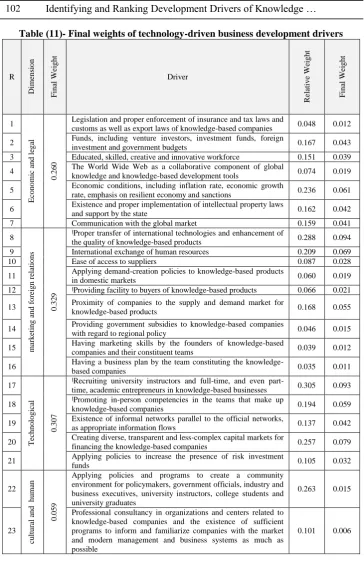
The purpose of this Study study is to identify and rank the development drivers of knowledge-based, technology-driven businesses. This work is conducted as a case study in Fars Province Science and Technology Park. It is a descriptive survey in terms of purpose since a part of its data is collected through questionnaires and is of surveying type because it describes the existing conditions. The population of the study includes all the knowledge-based, technology-driven companies located in the mentioned Science and Technology Park. At the stage of identifying the drivers, 201 employees were randomly assigned by stratified sampling. For the prioritization of these drivers, 30 of the senior managers of those companies were deliberately consulted and the collected data were analyzed using exploratory and confirmatory factor analysis as well as fuzzy hierarchy process analysis. The findings showed 37 drivers in five economic and legal, marketing and foreign relations, technological, cultural and human relationships and, ultimately, structural and informational dimensions. Drivers of communication with the world market, the world web as a factor for enhancing the world knowledge and a means for knowledge-driven development; ease of access to the technology and technical consulting; ease of access to the suppliers and providing public subsidies to knowledge-based companies while taking note of regional policy were considered as the most important drivers in the development of knowledge-based, technology-driven companies. Also, the dimensions of marketing and foreign relations, technological, economic and legal dimensions were identified as the most important dimensions respectively.
Keywords: Knowledge-based, technology-driven businesses, science and technology parks, explorative and confirmatory factor analysis, fuzzy hierarchical analysis process
1 Professor, Faculty of Management and Economics, University of Sistan and Baluchestan, Iran (Corresponding Author), Email: [email protected].
1. Introduction
Complex and rapid developments in recent decades and acceleration in the process of globalization have led to a situation, in which different communities increasingly try to prepare themselves for embracing development (Rao, 1979). During the recent 50 years, developing economies have undergone a type of change so that knowledge has been at the top of those developments (Rahman Seresht and Simar Asl, 2009). In the knowledge-driven economy, knowledge is the main capital of knowledge-based businesses and, generally, the main capital for the communities (Samadi et al., 2008). Such knowledge could have a technological origin or the other way round (Mahdavi et al, 2011) and a significant portion of the value added of economic activities is gained through activities based on knowledge (Ansari and Soltanzadeh, 2012).
some of the following features in common: high skill, higher education, labor, high level of research and development, high tendency to exporting, high proportion of intangible assets, products and services with a short life curve and high gross profit margin. In addition, it is likely that knowledge-based businesses use more of advanced technologies or innovative processes in their products, services or processes (Gorman and Mccarthy, 2006).
In knowledge-based businesses, one should attempt to explain and model knowledge production (research and development of new knowledge), enrich the knowledge (education, training and development of the manpower) and transfer knowledge (publication and promotion of knowledge and innovation). In such a business, knowledge is divided into different types based on the type of knowledge and those who learn them (Hamidizadeh, 2008). In fact, a knowledge-based business is based on publication, promotion and use of information, science, wisdom and knowledge as well as their creation (Alibino et al., 2014) and the purpose of establishing such a business is to assist in the enhancement of knowledge and wealth, development of knowledge-driven economy, extension of inventions and innovations and their application for commercializing and operationalizing the findings of research and development of inventions (Ghazinoori and Azadeganmehr, 2008).
Knowledge-based companies are the firms that employ university graduates and specialists who constitute their main body and the main factor of creating income in them is knowledge rather than natural resources, capital or unskilled labor. Today, knowledge-based companies have paved the way for the attraction and enhancement of entrepreneurship talents (Salajegheh and Kazemi, 2014). According to the bill on the protection of Iranian knowledge-based companies, one could divide them into 3 categories: 1) Technology units affiliated to Science and Technology Centers and Parks or incubators; 2) Businesses approved by High Council of Science, Research and Technology; 3) businesses belonging to universities or university knowledge-based companies (Safaei Ghadiklaei et al., 2013).
complex marketing measures. Thy operate in a more complex environment that requires the use of more sophisticated marketing efforts; however, due to their limited ability to market and identify customers' needs (Rezvani et al., 2011), most of the investments in these companies are wasted because their products and services rarely attract customers.
The importance of these companies is because, in addition to their advantages such as being small- and medium-sized, they are also becoming increasingly important because of the activity in the field of modern technology.
2. Literature Review
2.1. Knowledge-based, technology-driven businesses
One of the basic concepts concerning knowledge-based companies is the technology-driven companies that have been widely studied on theoretical foundations. Different concepts used in the literature lead to increased ambiguity and confusion. In other words, it is difficult to know what the authors mean while analyzing the results of different studies.
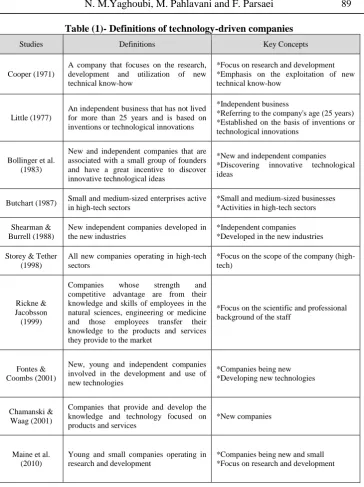
Also, in some cases, it is challenging to make a comparison between them since a multitude of statements has been used to refer to the concept of technology-driven companies (Storey & Tether, 1998). Therefore, it is necessary to provide a precise definition for technology-driven companies in the framework of this study and to state what features are associated with this particular group of companies. One of the first definitions found in the literature on technology-driven companies is Cooper's definition: "A company that focuses on research and development or its major emphasis is on exploiting new technical knowledge." On the theoretical foundations, the concept of technology-driven companies uses widespread definitions, as well as limited definitions. One of the widespread definitions of application is that all the new companies operating in high-tech sectors can be considered as technology-based companies (Butchart, 1987).
Table (1)- Definitions of technology-driven companies
Studies Definitions Key Concepts
Cooper (1971)
A company that focuses on the research, development and utilization of new technical know-how
*Focus on research and development *Emphasis on the exploitation of new technical know-how
Little (1977)
An independent business that has not lived for more than 25 years and is based on inventions or technological innovations
*Independent business
*Referring to the company's age (25 years) *Established on the basis of inventions or technological innovations
Bollinger et al. (1983)
New and independent companies that are associated with a small group of founders and have a great incentive to discover innovative technological ideas
*New and independent companies *Discovering innovative technological ideas
Butchart (1987) Small and medium-sized enterprises active in high-tech sectors
*Small and medium-sized businesses *Activities in high-tech sectors
Shearman & Burrell (1988)
New independent companies developed in the new industries
*Independent companies *Developed in the new industries
Storey & Tether (1998)
All new companies operating in high-tech sectors
*Focus on the scope of the company (high-tech)
Rickne & Jacobsson (1999)
Companies whose strength and competitive advantage are from their knowledge and skills of employees in the natural sciences, engineering or medicine and those employees transfer their knowledge to the products and services they provide to the market
*Focus on the scientific and professional background of the staff
Fontes & Coombs (2001)
New, young and independent companies involved in the development and use of new technologies
*Companies being new *Developing new technologies
Chamanski & Waag (2001)
Companies that provide and develop the knowledge and technology focused on products and services
*New companies
Maine et al. (2010)
Young and small companies operating in research and development
Technology-driven companies are often defined as small and medium enterprises or companies set up by a small group (Maine et al., 2010). Although there is little agreement on the definition of knowledge-based, technology-driven businesses, most banks and government agencies have agreed that knowledge-based, technology-driven businesses have some, but not all, of the following characteristics:
High skill
Workforce with higher education
High level of research and development
High tendency to exporting
High percentage of intangible assets and products
Services with short life expectancy and gross margins
In addition, knowledge-based businesses may use more of the advanced technology or innovative processes in their products, services or processes (Gorman & McCarthy, 2006). In general, in this study, the knowledge-based, technology- driven enterprise is meant to be small and medium-sized enterprises whose main focus is on high technology.
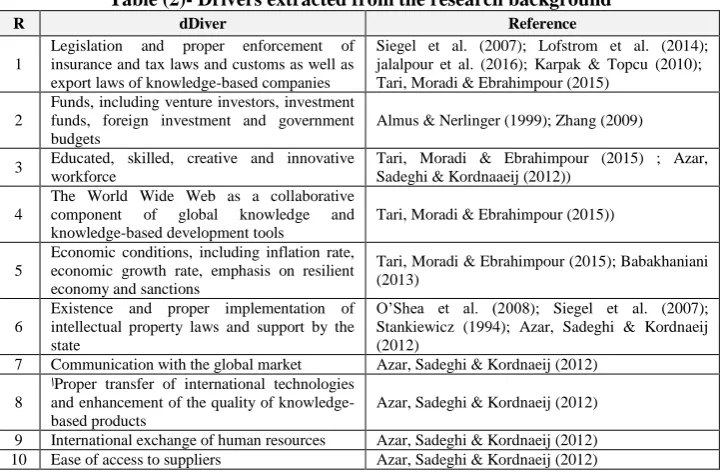
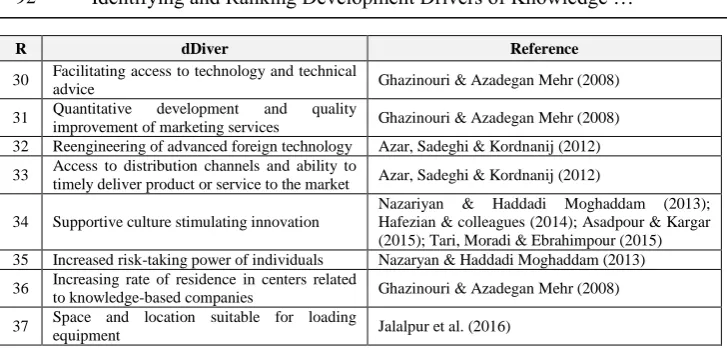
By reviewing the research background, a comprehensive set of development drivers of knowledge-based, technology-driven business was found, as described in Table 2.
Table (2)- Drivers extracted from the research background Reference dDiver
R
Siegel et al. (2007); Lofstrom et al. (2014); jalalpour et al. (2016); Karpak & Topcu (2010); Tari, Moradi & Ebrahimpour (2015)
Legislation and proper enforcement of insurance and tax laws and customs as well as export laws of knowledge-based companies 1
Almus & Nerlinger (1999); Zhang (2009) Funds, including venture investors, investment
funds, foreign investment and government budgets
2
Tari, Moradi & Ebrahimpour (2015) ; Azar, Sadeghi & Kordnaaeij (2012))
Educated, skilled, creative and innovative workforce
3
Tari, Moradi & Ebrahimpour (2015)) The World Wide Web as a collaborative
component of global knowledge and knowledge-based development tools
4
Tari, Moradi & Ebrahimpour (2015); Babakhaniani (2013)
Economic conditions, including inflation rate, economic growth rate, emphasis on resilient economy and sanctions
5
O’Shea et al. (2008); Siegel et al. (2007); Stankiewicz (1994); Azar, Sadeghi & Kordnaeij (2012)
Existence and proper implementation of intellectual property laws and support by the state
6
Azar, Sadeghi & Kordnaeij (2012) Communication with the global market
7
Azar, Sadeghi & Kordnaeij (2012) اProper transfer of international technologies
and enhancement of the quality of knowledge-based products
8
Azar, Sadeghi & Kordnaeij (2012) International exchange of human resources
9
Azar, Sadeghi & Kordnaeij (2012) Ease of access to suppliers
Reference dDiver
R
Zhang (2009); Waarts et al. (2002); Siegel et al. (2007)
Applying demand-creation policies to knowledge-based products in domestic markets 11
Siegel et al. (2007); Azar, Sadeghi & Kordnaeij (2012); Nazarian & Haddadi;Moghaddam (2013) اProviding facility to buyers of
knowledge-based products 12
Man & Chan (2002) Proximity of companies to the supply and
demand market for knowledge-based products 13
Storey (2003); Ali Ahmadi & Ghazinouri (2008); Amin Bidokhti & Zargar (2010)
Providing government subsidies to knowledge-based companies with regard to regional policy 14
Zahra et al. (2007); zhang et al. (2009);
Nazarian & Haddadi Moghaddam (2013); Azar, Sadeghi and Kordnaeij (2012)
Having marketing skills by the founders of knowledge-based companies and their constituent teams
15
Vohora et al. (2004) Having a business plan by the team
constituting the knowledge-based companies 16
Zhang (2009); Lockett et al. (2003) اRecruiting university instructors and full-time,
and even part-time ,academic entrepreneurs in knowledge-based businesses
17
Czarnitzki et al. (2014); Zahra et al. (2007) اPromoting in-person competencies in the
teams that make up knowledge-based companies
18
Donckels & Lambrecht (1995) Existence of informal networks parallel to the
official networks, as appropriate information flows
19
Stankiewicz (1994) Creating diverse, transparent and less-complex
capital markets for financing the knowledge-based companies
20
Moore & Garnsey (1993) Applying policies to increase the presence of
risk investment funds 21
Grimaldi et al. (2011) Applying policies and programs to create a
community environment for policymakers, government officials, industry and business executives, university instructors, college students and university graduates
22
Donckels & Lambrecht (1995); Storey (2003) Professional consultancy in organizations and
centers related to knowledge-based companies and the existence of sufficient programs to inform and familiarize companies with the market and modern management and business systems as much as possible
23
Czarnitzki et al. (2014); Zahra et al. (2007) Presence of specialized committees for
evaluating raw materials and products of the company
24
Tari, Moradi & Ebrahimpour (2015) Presence of a flexible and dynamic
organizational structure tailored to the development of the relevant technology 25
Zahra et al. (2007); zhang et al. (2009) Teaching soft and psychological skills (topics
such as stress, self-esteem, leadership and conflict management)
26
Azar, Sadeghi & Kordnanij (2012) The technology being immutable by other
companiesا 27
Donckels & Lambrecht (1995); Storey (2003) Pricing the products based on the value
expected by the customer 28
Rashidinejad & Sharifzadeh Kermani (2006) The interaction between knowledge-based,
Reference dDiver
R
Ghazinouri & Azadegan Mehr (2008) Facilitating access to technology and technical
advice 30
Ghazinouri & Azadegan Mehr (2008) Quantitative development and quality
improvement of marketing services 31
Azar, Sadeghi & Kordnanij (2012) Reengineering of advanced foreign technology
32
Azar, Sadeghi & Kordnanij (2012) Access to distribution channels and ability to
timely deliver product or service to the market 33
Nazariyan & Haddadi Moghaddam (2013); Hafezian & colleagues (2014); Asadpour & Kargar (2015); Tari, Moradi & Ebrahimpour (2015) Supportive culture stimulating innovation
34
Nazaryan & Haddadi Moghaddam (2013) Increased risk-taking power of individuals
35
Ghazinouri & Azadegan Mehr (2008) Increasing rate of residence in centers related
to knowledge-based companies 36
Jalalpur et al. (2016) Space and location suitable for loading
equipment 37
3. Research methodology
Table (3)- Fields of activity of knowledge-based technology-driven companies and the number of knowledge worker
Field Number of
companies
Number of people
(population) Percentage Sample
size Comprehensive Technology Development Center 7 80 8.18 38 Center for Oil, Gas and Petrochemical Development 15 218 4.51 103 Center for Agricultural and Natural Resource Development 1 21 5 10 Center for Information and Communication Technology Development 9 105 8.24 50
Total 32 424 100 201
In this research, to identify the effective drivers in the development of knowledge-based, technology-driven businesses from exploratory factor analysis and to reduce the probable number of these propellers and ensure the correct placement of drivers in the dimensions, the confirmatory factor analysis method was used. Finally, the fuzzy hierarchy process analysis method was employed for weighting the developmental drivers. Lisrel, SPSS and Excel were utilized to process the data.
4. Research findings
4.1. Exploratory factor analysis
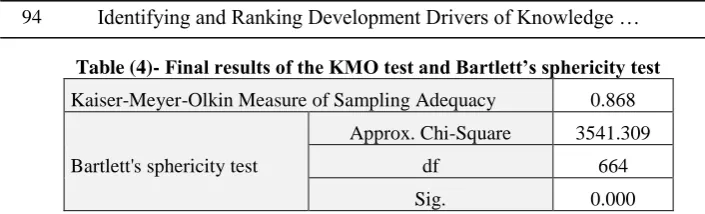
Table (4)- Final results of the KMO test and Bartlett’s sphericity test
Kaiser-Meyer-Olkin Measure of Sampling Adequacy 0.868
Bartlett's sphericity test
Approx. Chi-Square 3541.309
df 664
Sig. 0.000
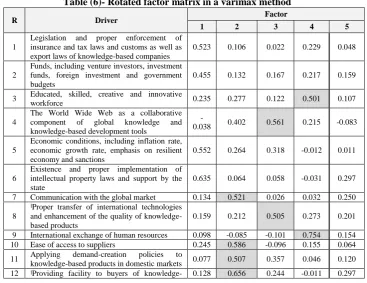
Factor analysis is in fact a theoretical test model. In this way, the analysis begins with a previous hypothesis. This model, which is empirical-basis and has strong theory, specifies which variables are correlated with which factors and which factors are associated with which other factors. Different methods of factor analysis first help extract a set of factors from a set of variables. The results of exploratory factor analysis through varimax rotation and principal components method are shown in Table 3. It can be seen that Factors 1 to 5, respectively, yielded variances of 271.23, 14.340, 13.309, 12.886 and 9.666, respectively. The total number of variances explained by five factors was also 447.73.
Table (5)- Results of varimax rotation and number of variances explained
C
o
m
p
o
n
en
t
Initial Eigenvalues
Extraction Sums of Squared
Loadings Rotation Sums of Squared Loadings
Total Variance % of Cumulative % Total Variance % of Cumulative % Total Variance % of Cumulative %
1 19.602 52.980 52.980 19.602 52.980 52.980 8.610 23.271 23.271
2 3.524 9.525 62.505 3.524 9.525 62.505 5.306 14.340 37.611
3 1.766 4.772 67.277 1.766 4.772 67.277 4.924 13.309 50.919
4 1.238 3.346 70.624 1.238 3.346 70.624 4.761 12.867 63.787
5 1.045 2.824 73.447 1.045 2.824 73.447 3.575 9.661 73.447
6 .878 2.374 75.821
7 .659 1.781 77.602
8 .623 1.683 79.285
9 .603 1.629 80.914
10 .534 1.442 82.356
11 .485 1.310 83.666
12 .466 1.258 84.924
13 .407 1.100 86.024
15 .370 1.000 88.052
16 .350 .946 88.998
17 .343 .926 89.924
18 .323 .873 90.797
19 .298 .806 91.603
20 .288 .779 92.381
21 .260 .703 93.085
22 .239 .646 93.731
23 .234 .631 94.363
24 .226 .612 94.975
25 .201 .543 95.518
26 .183 .496 96.013
27 .181 .490 96.503
28 .171 .461 96.964
29 .160 .433 97.398
30 .156 .422 97.819
31 .140 .377 98.196
32 .132 .357 98.554
33 .126 .342 98.895
34 .121 .327 99.222
35 .109 .293 99.515
36 .091 .247 99.762
37 .088 .238 100.000
Extraction Method: Principal Component Analysis.
Figure (1)- Scribble plot
Table 6 shows the high correlation of indicators with their related dimensions and their lower correlation with other dimensions (divergent validity).
Table (6)- Rotated factor matrix in a varimax method Factor Driver R 5 4 3 2 1 0.048 0.229 0.022 0.106 0.523 Legislation and proper enforcement of insurance and tax laws and customs as well as export laws of knowledge-based companies 1 0.159 0.217 0.167 0.132 0.455 Funds, including venture investors, investment funds, foreign investment and government budgets 2 0.107 0.501 0.122 0.277 0.235 Educated, skilled, creative and innovative workforce 3 -0.083 0.215 0.561 0.402 -0.038 The World Wide Web as a collaborative component of global knowledge and knowledge-based development tools
4 0.011 -0.012 0.318 0.264 0.552 Economic conditions, including inflation rate, economic growth rate, emphasis on resilient economy and sanctions
5 0.297 -0.031 0.058 0.064 0.635 Existence and proper implementation of intellectual property laws and support by the state 6 0.250 0.032 0.026 0.521 0.134 Communication with the global market
7 0.201 0.273 0.505 0.212 0.159 اProper transfer of international technologies and enhancement of the quality of knowledge-based products 8 0.154 0.754 -0.101 -0.085 0.098 International exchange of human resources
9 0.064 0.155 -0.096 0.586 0.245 Ease of access to suppliers
Factor Driver R 5 4 3 2 1 based products 0.102 0.326 0.079 0.435 0.339 Proximity of companies to the supply and demand market for knowledge-based products 13 0.158 0.033 0.042 -0.010 0.716 Providing government subsidies to knowledge-based companies with regard to regional policy 14 0.046 0.267 0.362 0.597 0.015 Having marketing skills by the founders of knowledge-based companies and their constituent teams 15 0.669 -0.007 0.120 0.303 0.316 Having a business plan by the team constituting the knowledge-based companies 16 0.315 0.494 0.019 -0.020 0.403 اRecruiting university instructors and full-time, and even part-time, academic entrepreneurs in knowledge-based businesses 17 -0.094 0.478 0.341 0.268 -0.080 اPromoting in-person competencies in the teams that make up knowledge-based companies 18 0.493 0.046 0.267 0.213 0.208 Existence of informal networks parallel to the official networks, as appropriate information flows 19 0.192 0.214 0.010 0.070 0.642 Creating diverse, transparent and less-complex capital markets for financing knowledge-based companies 20 0.028 0.016 -0.170 0.273 0.749 Applying policies to increase the presence of risk investment funds
21 -0.003 0.561 0.285 0.317 0.045 Applying policies and programs to create a community environment for policymakers, government officials, industry and business executives, university instructors, college students and university graduates
22 0.588 0.278 0.059 0.005 0.203 Professional consultancy in organizations and centers related to knowledge-based companies and the existence of sufficient programs to inform and familiarize companies with the market and modern management and business systems as much as possible
23 0.567 -0.075 0.015 -0.061 0.283 Presence of specialized committees for evaluating raw materials and products of the company 24 0.544 0.049 0.055 0.291 0.145 Presence of a flexible and dynamic organizational structure tailored to the development of the relevant technology 25 0.030 0.522 0.358 0.177 0.137 Teaching soft and psychological skills (topics such as stress, self-esteem, leadership and conflict management) 26 -0.057 -0.017 0.714 0.161 0.091 Technology being immutable by other companiesا 27 0.205 -0.060 0.237 0.617 0.221 Pricing the products based on the value expected by the customer
Factor Driver R 5 4 3 2 1 advice 0.063 0.127 0.213 0.665 -0.040 Quantitative development and quality improvement of marketing services
31 0.158 0.060 0.707 0.121 0.036 Reengineering of advanced foreign technology 32 0.213 0.226 -0.043 0.412 0.324 Access to distribution channels and ability to timely deliver product or service to the market 33 0.252 0.642 -0.063 0.154 0.098 Supportive culture stimulating innovation
34 -0.073 0.626 0.208 0.455 0.238 Increased risk-taking power of individuals
35 0.619 0.009 0.159 0.048 0.108 Increasing the rate of residence in centers related to knowledge-based companies 36 0.593 -0.293 0.003 0.149 0.251 Space and location suitable for loading equipment
37
Also, by referring to the text of the questionnaire and extractive indicators, dimensions were named as economic and legal drivers, marketing and foreign, technological, cultural and human relations and, finally, structural and informational drives.
To ensure the reliability of the model, Cronbach's alpha coefficient was used, which is shown in Table 7. Cronbach's alpha index of above 0.7 represents appropriate reliability which, according to the table, can be considered as acceptable for the model reliability.
Table (7)- Results of the measurement model analysis
Cronbach's alpha Number of questions
Dimension Cod
0.838 7
Economic and legal ECLW
0.828 9
Marketing and foreign relations MARK 0.775 5 Technological TECH 0.756 8
Cultural and human CAHU
0.874 8
Structural and informational STIN
4.2. Confirmatory factor analysis
In order to test the proposed model, we used the structured equations and Liserl 8.80 software. Confirmatory factor analysis is one of the oldest statistical methods, which is used to examine the relationship between the variables (dimensions) and the observed variables (indicators) and represents the measurement model. In this type of analysis, the main components of the research are measured and whether the main variable is properly measured by sub-factors (dimensions and indicators)?
Q1 Q2 Q5 Q6 Q14 Q20 Q21 Q7 Q10 Q11 Q12 Q13 Q15 Q28 Q31 Q33 Q4 Q8 Q27 Q30 Q32 Q3 Q9 Q17 Q18 Q22 Q26 Q34 Q35 Q16 Q19 Q23 Q24 Q25 Q29
Q36 Q37 0.61
0.45 0.32
0.52 0.30 0.39 0.63 0.30 0.26 0.47
0.27 0.45
0.61 0.36 0.55
0.27
0.38
0.42 0.39 0.28 0.44
0.48 0.59 0.52 0.45 0.79
0.36
0.29 0.53 0.79 0.55 0.39 0.67 0.42 0.77
0.71 0.65
KNBA TECH
MARK ECLW
CAHU
STIN
Chi-square=324.84, df=146, P-value= 0.0000, RMSEA=0.042
1.00
0.8 7
0.6 9
0.6 4
0.8 1 0.8 6
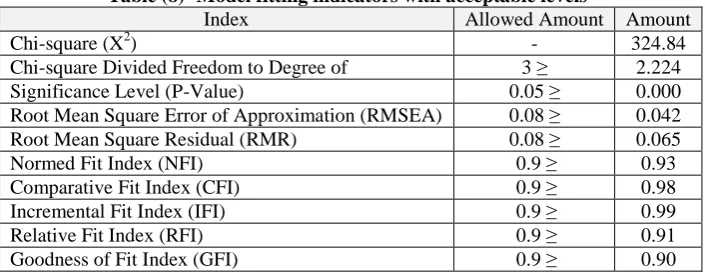
As shown in Fig. 1, the observed variables can well explain the latent variable. Because the factor load of all observed variables (indexes) was greater than 0.3, it had a good relationship with hidden variables. To determine the fitting of the model, the indicators that can be presented in soft parts of Liserl were used, which are presented in Table 6.
Accordingly, the modeling proponents of the model were suitable criteria because the pattern fit of the pattern in the confirmatory factor analysis confirmed the fitting of the model.
Table (8)- Model fitting indicators with acceptable levels
Amount Allowed Amount
Index
324.84
-Chi-square (X2)
2.224
≤ 3 Chi-square Divided Freedom to Degree of
0.000
≤ 0.05 Significance Level (P-Value)
0.042
≤ 0.08 Root Mean Square Error of Approximation (RMSEA)
0.065
≤ 0.08 Root Mean Square Residual (RMR)
0.93 0.9 ≤
Normed Fit Index (NFI)
0.98 0.9 ≤
Comparative Fit Index (CFI)
0.99 0.9 ≤
Incremental Fit Index (IFI)
0.91 0.9 ≤
Relative Fit Index (RFI)
0.90 0.9 ≤
Goodness of Fit Index (GFI)
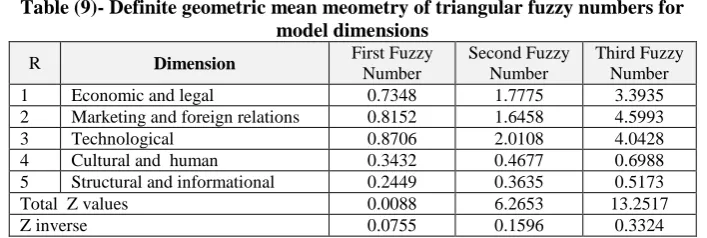
After identifying the drivers of business development of technology-driven businesses, the importance of each of the drivers was also identified by using the fuzzy hierarchy analysis method. To do so, a pairwise comparison questionnaire designed for this purpose was distributed among 30 experts (senior managers of the companies). Then, these data were analyzed by triangular fuzzy numbers. To this end, the expertise of the experts was integrated into a general matrix. Thus, in this matrix, the first fuzzy number of the least amount of response of the experts, the second fuzzy number, the geometric mean of the response of the experts and the third fuzzy number represented the highest response value of the experts.
Table (9)- Definite geometric mean meometry of triangular fuzzy numbers for model dimensions
R Dimension First Fuzzy
Number
Second Fuzzy Number
Third Fuzzy Number 1 Economic and legal 0.7348 1.7775 3.3935 2 Marketing and foreign relations 0.8152 1.6458 4.5993
3 Technological 0.8706 2.0108 4.0428
4 Cultural and human 0.3432 0.4677 0.6988 5 Structural and informational 0.2449 0.3635 0.5173
Total Z values 0.0088 6.2653 13.2517
Z inverse 0.0755 0.1596 0.3324
Below, the weight of the dimensions was calculated individually, the results of which are shown in Table 10. As can be found in this table, the dimensions of marketing and foreign relations (0.2090), technological (0.3073), and economic and legal (0.2605), respectively, had the highest importance among the dimensions of business development drivers of technology-driven businesses located in Fars Science and Technology Park. Then, the structural and informational (0.0441), cultural and human (0.591) had the least importance.
Table (10)- Final weight of model dimensions
R Dimension Fuzzy Number Defuzzy Final
Weight
1 2 3
1 Economic and legal 0.0555 0.2837 1.1279 0.4890 0.2605 2 Marketing and foreign relations 0.0615 0.2627 1.5286 0.6176 0.3290 3 Technological 0.0657 0.3209 1.3437 0.5768 0.3073 4 Cultural and human 0.0259 0.0746 0.2323 0.1109 0.0591 5 Structural and informational 0.0185 0.0580 0.1719 0.0828 0.0441
Table )11(- Final weights of technology-driven business development drivers F in al W ei g h t R el at iv e W ei g h t Driver F in al W ei g h t D ime n si o n R 0.012 0.048
Legislation and proper enforcement of insurance and tax laws and customs as well as export laws of knowledge-based companies
0 .2 6 0 Ec o n o mi c an d l eg al 1 0.043 0.167
Funds, including venture investors, investment funds, foreign investment and government budgets
2
0.039 0.151
Educated, skilled, creative and innovative workforce 3
0.019 0.074
The World Wide Web as a collaborative component of global knowledge and knowledge-based development tools
4
0.061 0.236
Economic conditions, including inflation rate, economic growth rate, emphasis on resilient economy and sanctions
5
0.042 0.162
Existence and proper implementation of intellectual property laws and support by the state
6
0.041 0.159
Communication with the global market 7
0.094 0.288
اProper transfer of international technologies and enhancement of the quality of knowledge-based products
0 .3 2 9 mark et in g a n d f o re ig n r el at io n s 8 0.069 0.209
International exchange of human resources 9
0.028 0.087
Ease of access to suppliers 10
0.019 0.060
Applying demand-creation policies to knowledge-based products in domestic markets
11
0.021 0.066
اProviding facility to buyers of knowledge-based products 12
0.055 0.168
Proximity of companies to the supply and demand market for knowledge-based products
13
0.015 0.046
Providing government subsidies to knowledge-based companies with regard to regional policy
14
0.012 0.039
Having marketing skills by the founders of knowledge-based companies and their constituent teams
15
0.011 0.035
Having a business plan by the team constituting the knowledge-based companies
16
0.093 0.305
اRecruiting university instructors and full-time, and even part-time, academic entrepreneurs in knowledge-based businesses
0 .3 0 7 Te ch n o lo g ic al 17 0.059 0.194
اPromoting in-person competencies in the teams that make up knowledge-based companies
18
0.042 0.137
Existence of informal networks parallel to the official networks, as appropriate information flows
19
0.079 0.257
Creating diverse, transparent and less-complex capital markets for financing the knowledge-based companies
20
0.032 0.105
Applying policies to increase the presence of risk investment funds
21
0.015 0.263
Applying policies and programs to create a community environment for policymakers, government officials, industry and business executives, university instructors, college students and university graduates 0 .0 5 9 cu lt u ra l an d h u ma n 22 0.006 0.101
Professional consultancy in organizations and centers related to knowledge-based companies and the existence of sufficient programs to inform and familiarize companies with the market and modern management and business systems as much as possible
F in al W ei g h t R el at iv e W ei g h t Driver F in al W ei g h t D ime n si o n R 0.007 0.123
Presence of specialized committees for evaluating raw materials and products of the company
24
0.008 0.143
Presence of a flexible and dynamic organizational structure tailored to the development of the relevant technology
25
0.006 0.104
Teaching soft and psychological skills (topics such as stress, self-esteem, leadership and conflict management)
26
0.005 0.091
Technology being immutable by other companiesا 27
0.005 0.098
Pricing the products based on the value expected by the customer 28
0.004 0073
Interaction between knowledge-based, technology-driven companies and interacting with other science and technology parks
29
0.014 0.315
Facilitating access to technology and technical advice
0 .0 4 4 S tr u ct u ra l an d i n fo rma ti o n al 30 0.005 0.119
Quantitative development and quality improvement of marketing services
31
0.004 0.107
Reengineering of advanced foreign technology 32
0.004 0.102
Access to distribution channels and ability to timely deliver product or service to the market
33
0.006 0.151
Supportive culture stimulating innovation 34
0.003 0.082
Increased risk-taking power of individuals 35
0.003 0.077
Increasing the rate of residence in centers related to knowledge-based companies
36
0.002 0.043
Space and location suitable for loading equipment and equipment 37
5. Conclusions and suggestions
the concerns faced by many businesses while trying to build their own products. In the meantime, lack of access to global markets and lack of proper domestic market for knowledge-based business products, along with absence of knowledge in science, commerce and marketing among these businesses, are among the challenges facing growth and development of business assets.
along with the proper appropriation of capital is the prerequisite for any knowledge-based company, which must be pursued scientifically and in principle.
Another finding of this research is the importance of the technological dimension in the development of knowledge-based, technology-driven businesses. In the meantime, the World Wide Web and the facilitation of access to new technology are more important. This fact has been proven in various studies (Table 2). Today, the Internet is considered as the most important global phenomenon since the Industrial Revolution. The role of the Internet in creating convergence and the proximity of human communication with different types encompass and provide broad possibilities for eliminating geographical distances and accelerating the communication function between different human beings regarding economic, cultural, social, ethical, religious and political levels. Together, all of these components will undoubtedly provide the appropriate background for expanding information interactions.
When we upgrade the exchange of information from the individual to organizational levels, we will have new windows, needs and structures. The Internet as a communication bridge across the globe provides the opportunity for all organizations to follow their communications and interactions in a common context. Hence, creating a fundamental change in the attitude of organization managements to the Internet and paying attention to the useable growing capacities of this important tool can have an extraordinary impact on the organization's exit from static structures and becoming a dynamic organization.
various policies have been considered to support commercialization. One of the most important of these policies is financial support and facilitation of the formation and development of small and medium-sized private companies and cooperatives engaged in the commercialization of knowledge-based, technology-driven business activities, especially the production of products based on advanced technologies and export of technical and engineering services. In the case of financial support of the knowledge-based business and taking the driving risk of these companies, in the short- or long-term planning, they can produce other valuable products such as technology for the industry plus their products, which, in addition to satisfying the needs and bottlenecks of the country, can be considered as an arm of entrepreneurship in the country. Besides, the wealth of manpower in the country itself is used and, in case of the prosperity of technology business of such companies, the general level of welfare of the community is also improved.
According to the findings and identification of the most important development drivers of knowledge-based, technology-driven businesses, the following suggestions are provided for the use of these drivers and, ultimately, development of the companies in question.
In view of the fact that the indicator of "Communication with the world market" was identified as the most significant indicator (0.0949), it is suggested, by creating platforms for financial support of knowledge-based, technology-driven businesses, these companies are assisted to enter the international arena and international exhibitions. Also, familiarizing the knowledge-based, technology-driven businesses with global standards and quality management systems to compete in global markets can be effective in that regard. Collaboration with other domestic and international institutions that are active in the field of developing knowledge-based, technology-driven businesses and taking models from successful countries in the field of knowledge-based, technology-driven businesses development can also be a solution to improve communication with the world market.
the most important infrastructures, help develop the knowledge-based, technology-driven businesses.
The indicator "Facilitation of the access to technology and technical advice" with the significance value of 0.0792 in this study was ranked third. In this way, the development of the university's communication with companies through the creation and expansion of knowledge-based businesses in the private sector and companies derived from universities and research centers can be a useful solution. At the moment, many businesses operate in science and technology development parks and centers that process different stages of their technology development. The creation and expansion of these companies under direct supervision of universities and research centers are the effective step in accessing technical advice. Contributing to the creation of non-governmental organizations supporting the knowledge-based businesses, such as development centers, contracting institutions, consulting institutes and the bank for the development of knowledge-based enterprises, can also be a way to facilitate access to technical know-how.
The indicator "Ease of access to suppliers" has the fourth priority with the significance value of 0.0689. Thus, creating a supplier management system can be used as a highly advanced database for the registration and maintenance of suppliers' information. Creating a business venture near suppliers or communicating to a large number of suppliers can help knowledge-based, technology-driven businesses to easily access suppliers and meet their needs at a lower cost. Also, facilitating the process of supplying services to these businesses through the elimination of ineffective administrative laws and regulations can be a way to improve this indicator.
References
1- Akbarzadeh N., Shafizadeh A (2012). On the Role of Government in Improving the Process of Establishing and Developing Knowledge-based Businesses, Quarterly Journal of Parks and Growth Centers, 9 (33), 46-53. 2- Ali Ahmadi A., Ghazi-Nouri S (2008). Prioritization of Policy Tools for Supporting Newly Founded Technology-driven businesses in the Country Using Fuzzy Multi-Criteria Decision Making Model, Science and Technology Policy, 1(3), 73-89.
3- Almus, M. & Nerlinger, E. A (1999). of new technology-based firms: Which factors matter?, Small Business Economics, 13(2), 141- 154. 4- Amin Bidokhti A., Zargar S. P (2011). Pathology of Small and Medium Enterprises (SMEs) and Expression of Practical Strategies to Protect them (Case Study: Semnan Province), Development Management Process, 24 (78), 125-156.
5- Ansari R., Soltanzadeh J (2012). Presentation of a Framework for Implementation of Technology Management in Technology-Driven Enterprises, Technology Development Quarterly, Eighth, 32, 22-31. 6- Asadpour M., Kargar M (2015). Investigating the Effect of Organizational Innovation and Management Innovation on the Success of Knowledge Based Companies: Knowledge Based Enterprises, based in Guilan Science and Technology Park, Technology Development, 11(43), 71-79.
7- Azar A., Sadeghi A., Kordnaeij A (2012). Prioritization of Effective Factors on Success of Small and Medium Business Enterprises, in the field of Superior Technologies - Fuzzy Network Analysis Process Approach, Technology Development, Volume 5, Number 2 (16), 165-184.
8- Bollinger, L., Hope, K., Utterback J (1983). A review of literature and hypotheses on new technology-based firms, Research Policy, 12, 1-4. 9- Butchart, R., A new UK definition of high technology industries. Econ. Rev. 400, 82–88, 1987.
10- Chamanski, A., Waag, S (2001). The organizational success of new, technology-based firms, working paper, Norwegian university of Science and Technology, Trondheim.
12- Czarnitzki, D., Rammer, C. & Toole, A. A (2014). University spin-offs and the performance premium”, Small Business Economics, 43(2), 309- 326.
13- Fontes, M., Coombs, R (2001). Contribution of new technology-based firms to the strengthening of technological capabilities in intermediate economies, Research Policy, 30, 79-97.
14- Ghazi Noori S., Azadegan Mehr (2008). Expertise and Participation, Needs of Growth Centers to Support Newly Founded Technology-Driven Companies, Third Technology Management Conference, Tehran, Technology Management Association of Iran.
15- Gorman, G., McCarthy, S (2006). Business development support and knowledge-based businesses. The Journal of Technology Transfer, 31, 1, 131-43.
16- Grimaldi, R., Kenney, M., Siegel, D. S. & Wright, M (2011). 30 years after Bayh–Dole: Reassessing academic entrepreneurship, Research Policy, 40(8), 1045- 1057.
17- Hafez Nia M (2014). An Introduction to the Research Methodology in the Humanities, Tehran, Organization for the Study and Compilation of the Humanities Books of Universities, Tehran: Sadegh, 16.
18- Hafezian M., Salehi M., Enayati T (2014). Effective Factors on the Infrastructure of Academic Incubators and Its Role in Establishing Productive Companies of the University, Journal of Entrepreneurship Development, 7, 4 (26).
19- Hamidizadeh, M (2008). Knowledge-based business acquisition approach, Management researches, 1, 163-190.
20- Jalalpour S., Talebi K., Tabibi J (2016). Improving the Performance of Iranian Knowledge-based Companies: Identifying Effective Factors in Implementing Policies and Programs, Entrepreneurship Development, 9(2), 199-27.
21- Karpak, B., Topcu, L (2010). Small medium manufacturing enterprises in Turkey: An analytic network process framework for prioritizing factors affecting success. International Journal of Production Economics, 125(1), 60-70.
23- Lockett, A., Wright, M. & Franklin, S (2003). Technology transfer and universities' spin-out strategies, Small Business Economics, 20(2), 185-200.
24- Lofstrom, M., Bates, T. & Parker, S. C (2014). Why are some people more likely to become small-businesses owners than others: Entrepreneurship entry and industry-specific barriers, Journal of Business Venturing, 29(2), 232- 251.
25- Mahdavi, H., Sheikh Zainaldin, M., & Khodabandeh, L (2011). Analysis of the Effectiveness of Science and Technology Parks by Using the Results of the Evaluation Process of Knowledge Based Companies, based on Science and Technology Parks, Quarterly Journal of Technology Development, Seventh Year, 27, 53 -60.
26- Mahmoudi Sefidgar R., Nasiri Y (2013). On the Establishment and Management of Knowledge Based Business Units, National Conference on Business Management with Focus on: Entrepreneurship Business and Knowledge based Economy, Ramsar, Payame Noor University, Mazandaran Province.
27- Maine, EM., Shapiro, DM., Vining, AR (2010). The role of clustering in the growth of new technology-based firms, Journal of Small Business Economics, 34(2), 127-146.
28- Man, T. W., Lau, T. & Chan, K. F. (2002). The competitiveness of small and medium enterprises: A conceptualization with focus on entrepreneurial competencies, Journal of Business Venturing, 17(2), 123- 142.
29- Momeni M., Qayyomi A (2007). Statistical Analysis Using SPSS, Tehran: Ketab Now Publishing.
30- Monavarian A., Asgari N (2004). Policy-making in Knowledge-based Economies, Fourth International Conference on Quality Management, Iran., 2004.
31- Moore, I. & Garnsey, E (1993). Funding for innovation in small firms: The role of government, Research Policy, 22(5), 507- 519.
33- O’Shea, R. P., Chugh, H. & Allen, T. J (2008). Determinants and consequences of university spinoff activity: A conceptual framework”, The Journal of Technology Transfer, 33(6), 653- 666.
34- Rahman-Seresht H., Simar Asl (2009). Approaches to Knowledge Management and Patterns of Knowledge Splits in the Age of Technology, Technology Development Quarterly, 5(20), 41-48.
35- Rao R. V (1979). Small industries and the developing economy in India. Concept Pub. Co.
36- Rashidi-Nejad, M., & Sharifizadeh Kermani, Z (2006). Evaluation of the ability of science and technology parks using hybrid innovational algorithm, technology development, 9 (41), 3-34.
37- Rickne, A., Jacobsson, S (1999). New technology-based firms in Sweden - A study of their impact on industrial renewal, Economic Innovation New Technology, 8, 197-223.
38- Safayi Qadikolai, A., Aghajani, H. A., Kochkabaghi, M (2013). Knowledge Based Business and Sustainable Production, National Conference on Entrepreneurial University (Knowledge-based industry), Babolsar, Mazandaran University.
39- Salajegheh S., & Kazemi S (2014). Solutions for Improving the Knowledge-based Business in the Country, Summit of Excellence Companies, Mother Companies and Brandists (Locomotives of Knowledge based Economy), Tehran, Khajeh Naseeriddin Toosi Advanced Technology Development Research Center.
40- Samadi, S., Kolahdozan, A, & Esfandiari, M (2008). Technology clusters and their functions in creating the flow of technology trade in the country, Quarterly Journal of Technology Development, 4 (14), 27-33. 41- Shearman, C., & Burrell, G (1988). New technology-based firms and the emergence of new industries: Some employment implications, New Technology Work Employment, 3(2), 87–99.
42- Siegel, D. S., Wright, M., & Lockett, A (2007). The rise of entrepreneurial activity at universities: organizational and societal implications, Industrial and Corporate Change, 16 (4), 489– 504.
44- Storey, D. J., Tether, B. S (1998). New technology-based firms in the European Union: An introduction, Research Policy, 26 (9), 933-946. 45- Tari.M., Moradi M., Ebrahimpour M (2015). Investigating the Factors Affecting the Growth and Success of Knowledge-based Companies, Quarterly Journal of Technology Development, 12, 45.
46- Vohora, A., Wright, M. & Lockett, A (2004). Critical junctures in the development of university high-tech spinout companies, Research policy, 33(1), 147- 175.
47- Waarts, E., Everdingen, Y. M. & Hillegersberg, J. (2002). The dynamics of factors affecting the adoption of innovations, Journal of Product Innovation Management, 19(6), 412- 423.
48- Zahra, S. A., Van de Velde, E. & Larraneta, B. (2007). Knowledge conversion capability and the performance of corporate and university spin-offs, Industrial and Corporate Change, 16(4), 569- 608.